Key Takeaways
What You’ll Learn
- Turning a startup idea into an app starts with validation, not coding first.
- A clear problem and target audience make the product stronger.
- MVP planning helps reduce risk and speeds up launch.
- Ready-made and clone solutions can shorten development time for startups.
- Long-term success depends on feedback, iteration, and smart scaling.
Stats That Matter
- The article highlights idea validation, feature planning, MVP building, and launch strategy as the main startup app steps.
- Validation starts with identifying the problem and understanding who faces it and how they solve it today.
- An MVP is the simplest version of the app that solves the core problem and gathers real user feedback.
- Ready-made apps and clone apps are presented as faster and lower-risk launch options for founders.
- After launch, analytics, user feedback, and gradual feature expansion guide future growth.
Real Insights
- Too many features delay launch and increase startup risk.
- Talking to potential users early helps refine the idea before development starts.
- Startups grow faster when they launch simple and improve through real market feedback.
- Choosing the wrong development approach too early can waste time and money.
- The strongest startup apps are built around one clear value proposition first.
Every successful startup starts with a simple idea. But turning that idea into a real mobile app can feel confusing—especially if you’re not a developer.
Many founders struggle with questions like:
- Where do I begin?
- Do I need a technical team?
- How much does it cost to build an app?
- Should I build the full product or start small?
Building a startup app is not only about coding. It also involves validating your idea, selecting the right features, creating an MVP, and planning a smart launch. With the right guidance and support from Miracuves, even non-technical founders can turn their startup ideas into a successful mobile app.
Why Startup App Ideas Fail
Before jumping into development, it’s important to understand why many startup apps fail.
According to multiple startup studies, over 40% of startups fail because there is no real market need.
Lack of Idea Validation
Many founders build an app first and test later. This approach is risky because you may spend thousands of dollars building something users don’t actually want.
Too Many Features at the Beginning
Trying to build the perfect app in the first version often delays launch and increases costs.
Successful startups usually launch with a simple MVP first.
Ignoring User Problems
Your app should solve a specific problem for a defined audience. If the problem isn’t clear, the product won’t attract users.
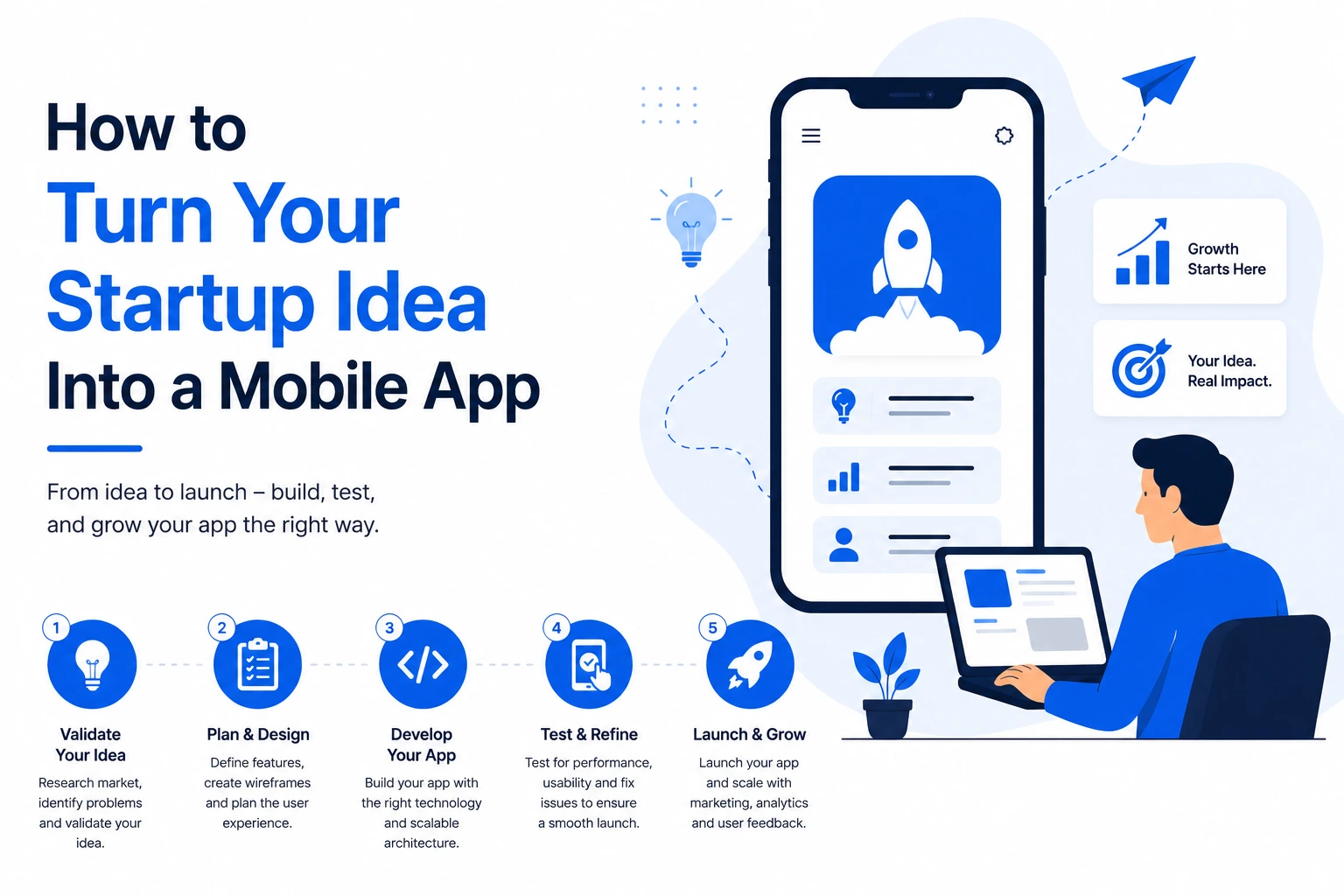
Steps to Turn Your Startup Idea Into a Mobile App
Now that you understand the common mistakes startups make, let’s look at the key steps that will help you turn your idea into a successful mobile app. In the following steps, you’ll learn how to validate your idea, plan the right features, build an MVP, and launch your app effectively.
Step 1: Validate Your Startup App Idea
The first step to turning your startup idea into a mobile app is validation.
Validation helps you confirm whether your idea solves a real problem.
Identify the Problem Your App Solves
Ask yourself:
- What problem does my app solve?
- Who experiences this problem?
- How are people solving it today?
The clearer the problem, the stronger your startup concept becomes.
Research Competitors
Look at existing apps that solve similar problems.
Study:
- Their features
- User reviews
- Pricing models
- Market positioning
Competitor analysis helps you identify gaps in the market where your app can stand out.
Talk to Potential Users
This is one of the most valuable steps.
Ask potential users questions like:
- Would you use this app?
- What feature would be most useful?
- What frustrates you about current solutions?
User feedback helps refine your idea before development begins.
Step 2: Define Your App’s Core Features
Once your idea is validated, the next step is deciding which features your app should include first.
The goal is to build a Minimum Viable Product (MVP).
What Is an MVP?
An MVP is the simplest version of your app that solves the main problem.
Instead of building everything at once, you launch with essential features and improve based on user feedback.
Feature Prioritization Example
| Core Features | Advanced Features |
|---|---|
| User registration | AI recommendations |
| Search functionality | Analytics dashboards |
| Payment integration | Third-party integrations |
| User profiles | Advanced automation |
Focus only on the features that are necessary for the first version.
This approach saves time, money, and development effort.
Step 3: Choose the Right Development Approach
There are several ways to build a startup mobile app. Your choice depends on budget, timeline, and business goals.
Custom App Development
This approach involves building the app from scratch.
Advantages include:
- Complete customization
- Unique product features
- Greater scalability
However, custom development can take more time and budget.
Startups looking for professional mobile app development services often partner with experienced companies like Miracuves to build scalable products.
Ready-Made Apps
Ready-made apps are pre-built software solutions that can be customized and launched quickly.
Benefits include:
- Faster time to market
- Lower development costs
- Proven business models
These solutions are ideal for startups that want to launch quickly.
You can explore ready-made mobile appsfor startups through platforms like Miracuves.
Clone Apps
Clone apps replicate successful business models such as Uber, Airbnb, or food delivery platforms.
Advantages include:
- Proven concept
- Faster launch
- Lower development risk
Clone app solutions allow founders to test business ideas without starting from zero.
Step 4: Build a Minimum Viable Product (MVP)
Once the development approach is chosen, the next step is building the MVP.
The MVP is crucial because it allows startups to enter the market quickly and gather real user feedback.
Benefits of an MVP
An MVP helps founders:
- Test the idea with real users
- Reduce development costs
- Validate product-market fit
- Improve features based on feedback
Many successful companies started with simple MVPs.
For example:
- Airbnb started by renting out an apartment
- Facebook started as a small university network
- Instagram began as a photo-sharing app with limited features
Your MVP should focus on one core value proposition
Step 5: Design an Intuitive User Experience
User experience plays a huge role in app success.
Even if the app idea is great, poor design can drive users away.
Key UX Design Principles
Focus on:
- Simple navigation
- Fast loading speed
- Clear user onboarding
- Minimal steps to complete actions
Good UX design improves user retention and engagement.
Importance of UI Design
A visually appealing interface builds trust with users.
Elements to focus on include:
- clean layout
- readable typography
- consistent color schemes
- easy-to-use buttons
Professional UI/UX design ensures your app feels polished and user-friendly.
Step 6: Develop and Test the Mobile App
After planning and design, development begins.
This stage involves converting wireframes and designs into a functional application.
App Development Phases
Typical development includes:
- frontend development
- backend development
- database integration
- API integrations
Working with experienced development teams ensures the product is built with scalability and performance in mind.
Importance of Testing
Testing is essential before launching the app.
Testing ensures the app works smoothly across different devices and operating systems.
Step 7: Launch Your Startup App
Launching the app is a major milestone, but it should be carefully planned.
App Store Deployment
Your app needs to be submitted to platforms such as:
- Apple App Store
- Google Play Store
Each platform has specific guidelines that must be followed.
Beta Testing
Before public launch, many startups release a beta version to a small group of users.
This helps identify bugs and collect feedback.
Marketing Your App
Successful launches involve marketing strategies such as:
- social media promotion
- influencer marketing
- referral programs
- content marketing
The goal is to attract early adopters who can help spread the word.
Step 8: Improve and Scale Your App
After launch, the real work begins.
Startups must continuously improve their apps based on user feedback.
Use Analytics to Understand Users
Analytics tools help track:
- user behavior
- retention rates
- feature usage
- conversion rates
These insights help prioritize future updates.
Add Features Gradually
Once the core product proves successful, startups can expand features.
Examples include:
- AI integrations
- automation tools
- new user features
Companies like Miracuves help startups scale with AI automation platforms, SaaS solutions, and custom development services.
Using ready-made apps or clone solutions can significantly reduce development costs and launch time.
Common Mistakes Startup Founders Make
Many founders repeat similar mistakes during app development.
Building Too Many Features
Adding unnecessary features delays launch and increases costs.
Start small and focus on solving one core problem.
Ignoring Market Feedback
User feedback is extremely valuable. Ignoring it can lead to building the wrong product.
Choosing the Wrong Development Approach
Some startups invest heavily in custom development before validating their idea.
Using ready-made apps or MVP development strategies can reduce risk.
Read more : – Top UI/UX Mistakes in Digital Banking & Fintech Apps
How Miracuves Helps Founders Turn Ideas Into Apps
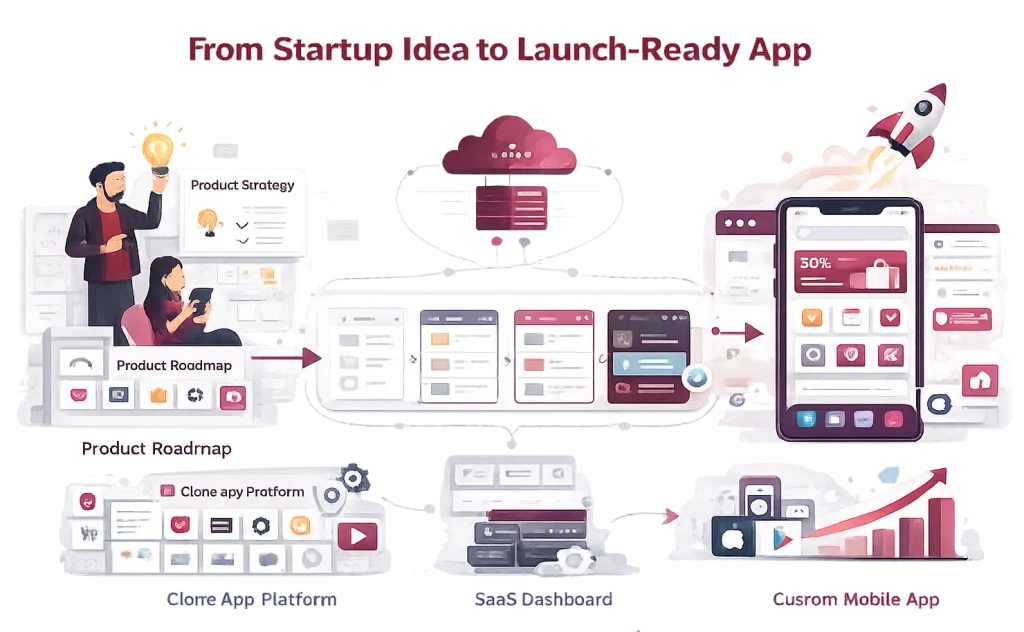
Turning a startup idea into a mobile app can be challenging without the right technical expertise.
Platforms like Miracuves help founders launch faster with solutions such as:
- ready-made apps
- clone app platforms
- SaaS solutions
- custom mobile app development
- AI automation tools
These solutions help startups reduce development time and bring products to market faster.
Whether you’re launching a marketplace, on-demand service, or SaaS product, the right development strategy can make all the difference.
Conclusion
Turning a startup idea into a mobile app is an exciting journey, but it requires the right strategy.
Instead of rushing into development, successful founders focus on:
- validating the idea
- building an MVP
- launching quickly
- improving based on user feedback
With the right approach and the right development partner, your startup idea can evolve into a powerful digital product.
If you’re ready to transform your concept into a real mobile app, solutions offered by Miracuves can help you launch faster and scale efficiently.
Faqs
How do I turn my startup idea into a mobile app?
Start by validating your idea, identifying the target audience, planning core features, creating an MVP, choosing the right tech stack, and working with an experienced app development company to build and launch the app.
Do I need coding skills to build a startup app?
No, coding skills are not required to build a startup app. Many founders work with app development companies or ready-made app platforms to turn their ideas into a real product without technical expertise.
How can startup apps make money?
Startup apps can generate revenue through subscriptions, commissions, advertisements, premium features, in-app purchases, service fees, and marketplace models.
Why choose Miracuves for startup app development?
Miracuves provides ready-made and custom mobile app solutions with scalable architecture, faster deployment, modern UI/UX, and cost-effective development for startups and growing businesses.
Related Articles
Miracuves is an independent software development company. We are not affiliated with, connected to, sponsored by, or endorsed by any company or product named in this article.
Terms such as “X Clone” are used descriptively. It is how the software industry refers to building a platform with functionality comparable to a known service, and how clients search for it.
The entire design and codebase of our products is built by our own team. Our products contain no code, design, graphics, or content originating from any third-party website or applications.
All third-party names and marks referenced in this article are the property of their respective owners, referenced solely to identify the services discussed.