
Key Takeaways
- Keep three layers apart Store raw source data, normalized economic events and accounting entries separately so reclassification and audit never require rewriting history.
- Ingestion sets the ceiling Missed transfers, unhandled reorgs and silent zero prices cannot be fixed later, so raw data needs hashes, fetch times and a finality rule.
- Classification needs a review queue Rules will never place every event, so unmatched items should go to a queue with reasons, owners and a full change history.
- Lot method is a policy FIFO, specific identification or average cost should be configurable, with each result recording which method produced it.
- US reporting is wallet-level now Lots must carry their wallet or account, and ledgers should reconcile to Form 1099-DA figures where a broker files them.
- DeFi needs explicit treatments Receipt tokens, liquidity positions, staking rewards and bridges each need a rule your accountants approve and the engine applies consistently.
- Reconcile, then lock Balance, activity and third-party reconciliation should be clear before a period closes, and later changes should land as adjustments.
- Build only when it pays A subscription tool suits simple back-office books; owning the ledger pays off when it is part of your product or your activity outgrows generic models.
Crypto accounting software development starts with one job that sounds simple: turn on-chain and exchange activity into books a finance team can close and an auditor can test. In practice it is one of the harder ledgers to build, because a single economic event can show up as five raw records across two chains, a bridge contract and an exchange export, each with its own timestamp, fee and price.
This guide is for founders and product owners who are planning to build crypto accounting software, either as a product to sell or as an internal system for a fund, exchange, payments company or treasury team. It walks through the real mechanics: how data comes in, how raw transfers become accounting events, how lots and cost basis are tracked, where DeFi and staking break naive designs, and how the ledger reconciles, syncs to an ERP and survives an audit.
Nothing here is tax advice. The point is to show what the software has to support so that your accountants and tax advisers can apply the rules they choose, and so that every number they rely on can be traced back to the chain.
Why a Multi-Chain Ledger Is Not Ordinary Bookkeeping
A traditional general ledger receives clean inputs: an invoice, a bank line, a payroll run. Each has a counterparty, a currency and an amount that someone already agreed. Blockchain data arrives in a very different shape. A wallet sees transfers, not transactions in the accounting sense, and nothing on the chain says whether a transfer was a sale, a loan, a fee, a reward or simply you moving funds between two of your own addresses.
Three properties make this hard. First, identity is pseudonymous, so the ledger has to learn which addresses belong to the business and which belong to counterparties. Second, value is denominated in thousands of assets, many of which have thin or missing price history. Third, the same asset can exist in several forms at once: a native coin, a wrapped version on another chain, a receipt token from a lending pool and a liquid staking token, all pointing at the same underlying exposure.
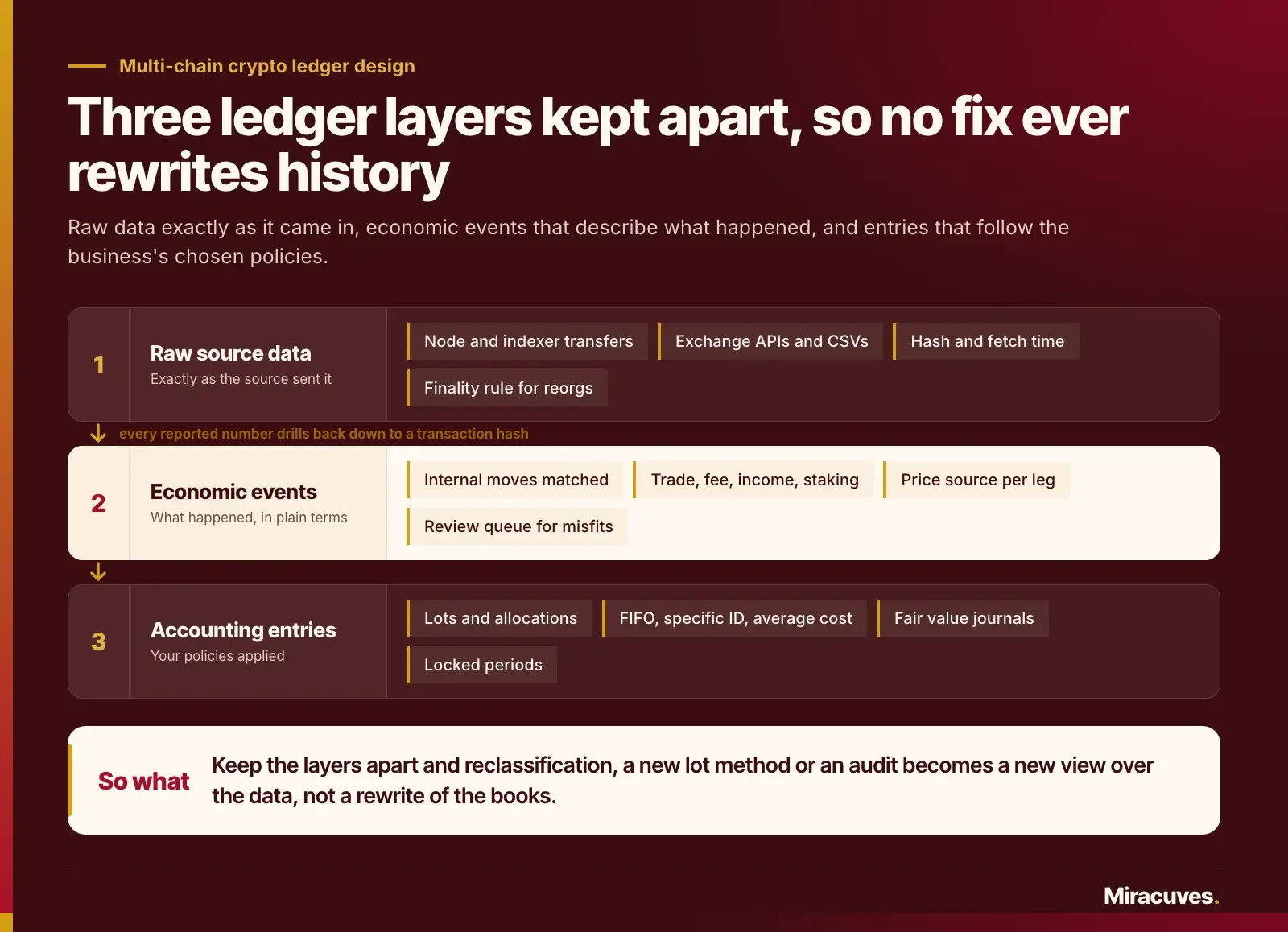
Good blockchain accounting software accepts this mess as the starting point. Its core design choice is to separate three layers that many first versions blend together: raw data exactly as it came from the source, normalized events that describe what happened economically, and accounting entries that follow the business’s chosen policies. Keep those layers apart and every later feature, from reclassification to audit, becomes far easier.
Ingestion: Wallets, Chains and Exchange Feeds
Ingestion decides the ceiling on data quality. If a transfer is missed here, no amount of clever classification later will find it. A production system usually pulls from four kinds of sources, each with its own failure modes.
On-chain sources
For account-based chains such as Ethereum and its rollups, you need native transfers, token transfer events, internal calls that move value and the gas paid on each transaction. For UTXO chains such as Bitcoin, you need the full input and output set, because change outputs return to your own addresses and must not be booked as income. Running your own nodes or archive access gives you control and repeatability; relying only on third-party indexers is faster to start but harder to defend when a number is challenged.
Every chain needs a finality rule. A block that is reorganized away must not leave a ghost entry in the books, so the ingestion layer should hold recent blocks in a pending state and only promote them once they pass the chain’s confirmation threshold.
Exchange and custodian feeds
Centralized venues expose trades, deposits, withdrawals, fees, funding payments and interest through APIs and CSV exports. They rarely agree on formats, they change them without notice, and many cap how far back the API can go. Store every raw file and response untouched, with a hash and a fetch time, so you can replay parsing when a venue changes a column or you find a bug.
Prices and reference data
Each event needs a fiat value at the moment it happened. That means a price source hierarchy (primary feed, fallback feed, manual override), a rule for which timestamp to use, and a record of which source priced each line. Long-tail tokens with no market need an explicit unpriced state rather than a silent zero, because a zero that should have been a large number is the kind of error that surfaces months later.
Finally, you need an address book: which wallets the business owns, which entity owns each one, and which known contracts (bridges, pools, staking contracts) the business interacts with. Ownership changes over time, so the address book needs effective dates, not a simple flag. If your business also runs its own wallets, for instance through custom crypto wallet development, the ledger can read new addresses straight from the wallet service instead of from a list someone keeps by hand.
Classification: Turning Raw Transfers Into Accounting Events
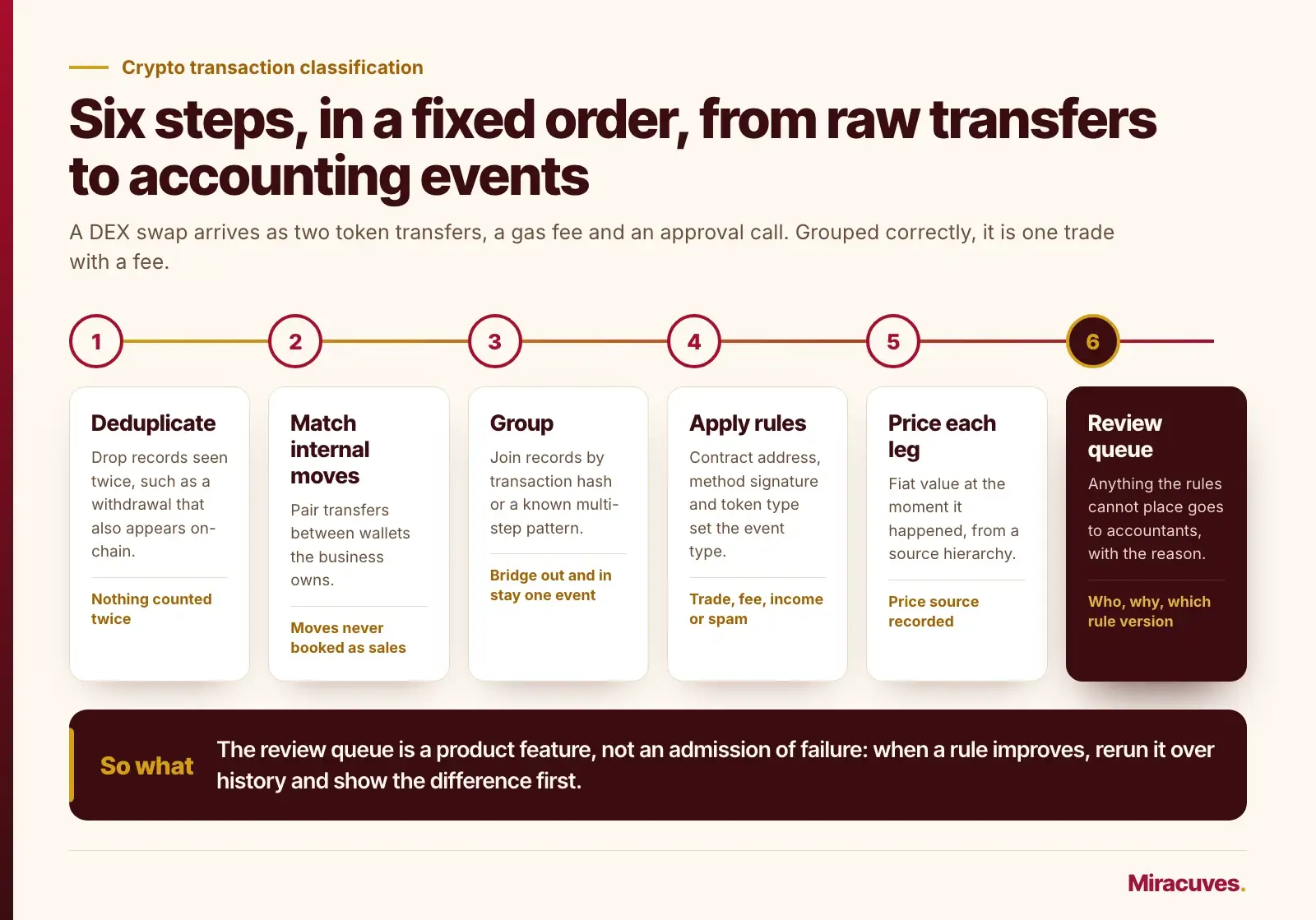
Classification is where crypto accounting software earns its keep. The engine looks at a group of raw records and decides what economic event they represent. A swap on a decentralized exchange might produce an outgoing token transfer, an incoming token transfer, a gas fee in the native coin and an approval call. Booked one by one, that looks like a disposal, an acquisition and an unrelated expense. Grouped correctly, it is one trade with a fee.
A reliable pipeline usually runs in a fixed order, so that each step can trust the one before it:
- Deduplicate records that arrive from more than one source, such as an exchange withdrawal that also appears on-chain.
- Match internal transfers between wallets the business owns, so that moving funds is never booked as a sale and a purchase.
- Group records that share a transaction hash or a known multi-step pattern (bridge out and bridge in, deposit and receipt token mint).
- Apply rules keyed on contract address, method signature and token type to assign an event type: trade, transfer, fee, income, lending, borrowing, liquidity, staking, airdrop or spam.
- Price each leg and record the price source.
- Send anything the rules cannot place to a review queue, with the reason it failed.
The review queue is a product feature, not an admission of failure. Accountants will always need to reclassify some events, and the system should record who changed what, why, and which rule version produced the original guess. When a rule is improved, the engine should be able to rerun it over history and show the difference before anyone accepts it.
Spam deserves its own handling. Wallets receive unsolicited tokens constantly, and some are designed to lure users into malicious contracts. The classifier should hide them from balances by default while keeping them in raw data, so that nothing is deleted and nobody is tempted to interact with them.
Lots, Cost Basis and the Tax Engine
Once events are classified, the tax engine tracks lots. A lot is a quantity of an asset acquired at a specific time, at a specific cost, in a specific wallet or account. Every disposal consumes one or more lots, and the gain or loss is the difference between proceeds and the cost of the lots consumed. This is the heart of any crypto tax software development effort, and it is where most of the tricky data modeling lives.
Supporting more than one method
The engine should treat the lot-relief method as a policy, not hard-coded logic. First in, first out is the common default. Specific identification lets the business choose which lots a disposal consumes, which only holds up if the choice is recorded at or before the time of the disposal and can be shown later. Some jurisdictions and some accounting frameworks call for average cost. Which method applies, and when, is a decision for the business and its advisers; the software’s job is to apply the chosen method consistently and record which one produced each result.
A practical design stores lots as immutable rows and records each disposal as a set of allocations against them. Changing a method then means producing a new allocation set, not rewriting history. That gives you side-by-side comparisons and a clean answer when someone asks why a number changed.
Wallet-level tracking and US broker reporting
In the US, the IRS moved digital asset basis toward a wallet-by-wallet or account-by-account approach from January 1, 2025, and Rev. Proc. 2024-28 gave a safe harbor for allocating unused basis across wallets as of that date. For the software, the lesson is structural: lots must carry the wallet or account they sit in, and a transfer between your own wallets must move the lot with its original cost and date rather than creating a new one.
Broker reporting raises the stakes. Under the final IRS regulations, custodial brokers report gross proceeds from digital asset sales on Form 1099-DA for transactions on or after January 1, 2025, and report basis for certain covered transactions on or after January 1, 2026. If you are building for a platform that acts as a broker, the ledger must produce per-customer, per-transaction records that tie to those forms. If you are building for businesses that receive the forms, the ledger must reconcile its own figures to what the broker reported, and flag the gaps. One rule did not survive: Congress overturned the separate DeFi broker rule for non-custodial platforms under the Congressional Review Act (H.J. Res. 25, signed April 10, 2025), so 1099-DA reporting sits with custodial brokers, and a DeFi-heavy ledger should not expect a form for on-chain swaps.
Outside the US, rules differ by country and change often. In the EU, Council Directive (EU) 2023/2226 (DAC8) requires crypto-asset service providers to collect and report user transaction data from 1 January 2026, in line with the OECD Crypto-Asset Reporting Framework, so an EU-facing ledger should keep per-user, per-transaction records that can be tied to those reports. A sound tax engine keeps jurisdiction logic in configurable rule sets with effective dates, so that a new rule is a new rule set rather than a code rewrite.
Holding periods, fees and missing history
Three details trip up most lot engines. Holding periods matter wherever short-term and long-term gains are treated differently, so every lot needs an acquisition timestamp that survives internal transfers and bridges untouched. Fees need a consistent home: a gas fee paid to acquire an asset can be added to that lot’s cost, a fee paid on a sale can reduce proceeds, and a fee paid to move funds between your own wallets is neither, so the engine should apply whichever treatment your policy sets and label it.
Missing history is the third problem. A wallet that received funds before your records begin has lots with unknown cost. The engine should mark them as such and route them to a review step, where someone can attach evidence or a documented estimate, rather than quietly assigning a zero cost that overstates every later gain.
DeFi, Staking and the Edge Cases That Break Naive Ledgers
Most first versions handle simple trades well and fail on everything else. DeFi activity is where the gap shows, because protocols wrap value in receipt tokens, rebase balances and batch many movements into one call. Each pattern needs an explicit treatment that your accountants sign off on, and the software needs to apply that treatment the same way every time.
Lending, borrowing and receipt tokens
Depositing into a lending pool often returns a receipt token whose balance or exchange rate grows over time. The ledger has to decide whether the deposit is a disposal or a transfer into a position, and how to recognize the yield: when it accrues, when it is claimed, or when the position is closed. Borrowing creates a liability that must be tracked in units of the borrowed asset, and a liquidation is a forced disposal of collateral that needs to be recognized as such, with the penalty separated from the principal.
Liquidity pools
Adding liquidity sends two assets into a pool and returns a position token. Removing it returns different quantities of the same two assets, because the pool rebalanced while you were in it. The engine needs a position model that remembers what went in, at what cost, and splits what came out between return of capital, gain or loss and earned fees, according to the policy the business chose.
Staking and rewards
Staking rewards arrive in different ways: as discrete transfers, as balance increases on a rebasing token, or as an increasing exchange rate on a liquid staking token. Each needs a recognition rule and a fair value at the moment of recognition, which in turn creates a new lot with that value as its cost. Unbonding periods, slashing and validator commissions are separate events, not adjustments to hide inside a single number.
Bridges, airdrops and failed transactions
A bridge transfer leaves one chain and arrives on another, sometimes as a wrapped asset, sometimes hours later. Matching both legs keeps the lot intact instead of booking a loss on one chain and a windfall on the other. Airdrops and forks create new assets that may have no price at first. Failed transactions still cost gas, so the fee must be booked even though nothing else moved. These cases are small individually, but together they decide whether the books balance.
Reconciliation, ERP Sync and the Month-End Close
Proving the ledger matches the chain
A ledger is only as credible as its reconciliation. The core check is simple to state: for every wallet and account, at a chosen cut-off, the balance computed from the ledger must equal the balance reported by the chain or the custodian. When it does not, the difference must be explained by named items, never by a plug.
In practice you reconcile at three levels. Balance reconciliation compares end-of-period holdings per asset per wallet. Activity reconciliation compares the movements during the period, which catches offsetting errors that leave balances looking fine. Third-party reconciliation compares your figures with custodian statements, exchange reports and broker forms. Each break goes to a queue with an owner, an age and a resolution note, and the period should not lock until the queue is clear or each open item is approved.
Rebasing tokens, dust balances and rounding across assets with very different decimal precision cause a steady stream of tiny breaks. Store quantities as exact integers in the smallest unit of each asset, with the decimal count alongside, and convert only for display. Floating-point arithmetic in a crypto ledger is a slow-moving bug.
Feeding the ERP and locking the period
Very few businesses want a second general ledger. They want a sub-ledger for digital assets that feeds summarized journal entries into the ERP they already close in. That design keeps transaction-level detail, lots and gains where they belong, and gives the controller the familiar trial balance.
The sync layer needs a chart-of-accounts mapping per entity, a choice between posting at transaction level or as daily or monthly summaries, and a way to post fair value or impairment adjustments under the reporting framework the business follows. Every journal posted to the ERP should carry an identifier that links back to the exact set of sub-ledger events behind it, so that an auditor can drill from a balance down to a transaction hash.
In practice the target is usually one of three systems. QuickBooks Online takes postings through the JournalEntry entity of its Accounting API, Xero through Manual Journals in its Accounting API, and Oracle NetSuite through journal entry records, where multi-subsidiary accounts need the subsidiary set on each entry and can post intercompany journals. Each expects the accounts you post to already exist in its chart of accounts, so the sync job should validate the mapping before it posts, queue failures for retry, and never post the same batch twice. Xero treats each organization separately, so a group with five entities needs five connections and five mappings.
US GAAP: fair value under ASU 2023-08
For US companies the book side changed recently. Under FASB Accounting Standards Update 2023-08, in-scope crypto assets are measured at fair value, with changes recognized in net income each reporting period. They are presented separately from other intangible assets on the balance sheet, and the remeasurement is shown separately in the income statement. The update is effective for fiscal years beginning after December 15, 2024, including interim periods, with early adoption permitted. Before it, most holders carried crypto as indefinite-lived intangibles and recorded only impairments, so many older ledgers had no mark-to-market logic at all.
That has direct consequences for the software:
- A period-end fair value snapshot per asset, per entity, with the price source and the time of the price recorded, since fair value follows ASC 820.
- A remeasurement journal posted separately from realized gains and losses, so the income statement can show the two apart.
- Book values and tax basis kept side by side. Tax lots still follow cost, so the two numbers now diverge every period and both have to be explainable.
- A scope flag on each asset that your accountants set. The standard covers fungible assets not issued by the company or its related parties, and assets that give a claim on underlying goods or assets can fall outside it, which may include some stablecoins and wrapped tokens.
- Data for the new disclosures, including significant holdings and an annual roll-forward of additions, dispositions, gains and losses.
Closing a period means freezing it. After the close, late-arriving data or a reclassification should not quietly change locked numbers; it should land in the next open period as an adjustment, with a reference to what it corrects. Multi-entity groups add intercompany transfers, which need the same matching logic as internal wallet moves, plus elimination entries at consolidation.
Audit Trail, Access Control and Data Protection
Auditors do not trust totals; they trust trails. The system should be able to show, for any number in a report, the raw records it came from, the rule version that classified them, the price source used, the lot method applied, and every human change along the way. An append-only event log, with corrections recorded as new events rather than edits, makes that possible without heroic effort.
Access control follows the same thinking. Separate the roles that configure rules, the roles that approve reclassifications and the roles that close periods, so no single user can change a policy and sign off its result. Read-only connections to exchanges and wallets are the default; a ledger should never hold keys that can move funds.
Data protection is easy to overlook because blockchain data is public. The sensitive part is the mapping: once your system links an address to a named customer or employee, that link is personal data, and in the EU the General Data Protection Regulation applies to it. Keep identity data in a separate store from transaction data, so that a deletion request can be honored for the identity mapping while records the business must retain for legal reasons stay intact. Encryption at rest, scoped API keys and logged administrative access belong in the first release, not a later hardening sprint. The same controls recur on any platform that holds customer wallets, as our look at wallet verification, KYC controls and audit trails on investment platforms shows.
Build or Buy: When Owning the Ledger Pays Off
Plenty of finance teams should not build crypto accounting software at all. A small company holding a handful of assets on one or two exchanges, closing books quarterly with an outside accountant, will rarely recover the cost of building its own ledger. Renting a subscription product is the sensible choice there.
The picture changes when the ledger is part of your product or when your activity outgrows what a generic tool models well. The table below sets out the signals finance and product leaders tend to weigh.
| Decision factor | Renting a subscription tool fits when | Building your own ledger fits when |
|---|---|---|
| Role of the ledger | It is a back-office tool for your own books | Your customers see its output, such as gain and loss statements inside your exchange or wallet app |
| Transaction volume | Thousands of events a month, mostly simple trades | Millions of events, or volume growing faster than per-transaction pricing can absorb |
| Chains and protocols | Major chains and common protocols the tool already supports | Newer chains, your own smart contracts or protocols a vendor will not prioritize |
| Accounting policies | Standard treatments your accountant accepts as-is | Specific policies for staking, lending or liquidity positions that must be applied exactly |
| Data residency and access | Sharing read-only data with a third party is acceptable | Customer identity data or regulators require that data stays in your infrastructure |
| Integration depth | A standard export to your ERP is enough | The ledger must feed your own risk, billing, reporting or customer-facing systems |
| Team and budget | No engineering team to own a ledger long term | You can fund ongoing maintenance as chains and rules change |
Be honest about the ongoing cost. Chains upgrade, protocols launch new contract versions, venues change their exports and tax rules move. A custom ledger is a product with its own roadmap, not a one-off project. If you cannot commit to maintaining the parsers and rule sets, a subscription tool that someone else maintains will serve you better.
One more signal is worth naming. If you run an exchange, wallet or payments product, your users will ask for statements they can hand to their own accountants. Embedding crypto accounting software logic inside your own product, rather than sending users to a third party, keeps their data in your infrastructure and their attention in your app. If you are launching a white-label crypto exchange with spot trading, KYC and an admin panel, plan this statement engine as a module from the first release, since custodial venues are the ones that must tie customer records to 1099-DA figures.
There is also a middle path. Some teams rent a tool for their own books while building a narrower custom engine for the part that touches customers, such as gain and loss statements inside an exchange app. Others start by building only ingestion and reconciliation, then add the tax engine once the data foundation has proven reliable.
Crypto Accounting Software Development: Architecture and Delivery Plan
If you decide to build, a few architecture choices save a great deal of pain later. A relational database such as PostgreSQL suits the ledger core, because lots, allocations and journals need transactions and constraints. Raw source data can live in cheaper object storage, keyed by source and fetch time. Chain-specific parsers should be separate services or modules with a shared normalized event schema, so that adding a chain does not touch the tax engine.
Treat classification rules and accounting policies as versioned data, not code buried in conditionals. Give finance users a rule editor with a preview mode that shows which historical events a change would affect. Build recompute as a first-class job that can rerun any period from raw data, because you will need it every time a rule improves.
Phase the delivery around risk rather than features. Start with ingestion for the chains and venues you actually use, plus balance reconciliation, so the team can see that data is complete. Add classification and the review queue next, then lots and gains, then ERP sync and period close. DeFi coverage comes protocol by protocol, ranked by how much value flows through each. Customer-facing reports, if you need them, come last, once the numbers underneath have survived a full close cycle.
Testing deserves a dedicated budget. Keep a library of real, anonymized transaction histories with expected results agreed by your accountants, and run every rule change against it. A single golden dataset that includes a bridge, a liquidation, a rebasing token and a failed transaction will catch more regressions than hundreds of synthetic unit tests.
Cost and Timeline for Crypto Accounting Software Development
Cost follows scope, and scope follows the chain and protocol list. The phases below are typical for a first release covering two or three chains, two or three exchanges or custodians, one ERP and one legal entity. Several run in parallel once ingestion is stable, so a first release usually takes about 20 to 30 weeks.
| Phase | Typical duration | What pushes it longer |
|---|---|---|
| Discovery, accounting policy workshop, chart-of-accounts mapping | 2 to 3 weeks | Several entities, open questions on staking or lending treatment |
| Ingestion and balance reconciliation for chosen chains and venues | 6 to 10 weeks | UTXO chains, venues with short API history, own node setup |
| Classification engine and review queue | 4 to 8 weeks | Heavy DEX activity, many spam tokens, intercompany transfers |
| Lot engine, cost basis methods and gains | 4 to 8 weeks | Several methods, wallet-level US tracking, missing history |
| ERP sync, fair value journals and period close | 3 to 6 weeks | NetSuite multi-subsidiary, transaction-level posting |
| DeFi protocol coverage | 1 to 3 weeks per protocol | Rebasing tokens, liquidity positions, bridges |
| Customer-facing statements (optional) | 4 to 8 weeks | 1099-DA tie-out for a custodial platform, many jurisdictions |
As an illustrative estimate, a team of four to five people (backend and data engineers, a QA engineer and a part-time analyst with accounting knowledge) for 20 to 30 weeks costs roughly $210,000 to $390,000 in salary alone, using the US median software developer wage of $135,980 a year in May 2025 from the Bureau of Labor Statistics, or about $2,615 per person per week. It leaves out benefits, overhead, node or indexer fees and price data subscriptions, and rates differ by region. Plan for ongoing maintenance too: every new chain, protocol version or venue export change is new parser work.
Building Your Crypto Ledger With Miracuves
For a finance team, a first release from Miracuves usually covers four pieces: connectors for the wallets, chains and venues you hold funds on, a classification engine with a review queue your accountants control, a lot ledger that applies the cost-basis method your advisers pick, and journal posting into your ERP with drill-down to transaction hashes. Our blockchain engineering team shapes each piece around how your business actually moves funds, instead of forcing your activity into a generic model.
Around the ledger sits a browser-based console where controllers edit rules, clear reconciliation breaks and lock periods, plus Android and iOS apps where approvers sign off reclassifications and period close away from their desks. Your company owns every line of source code at handover, which lets your own engineers add chains or protocols later. Pricing follows a per-project scope drawn from your chain list, event volumes and integrations.
Assurance is planned in from the first sprint. Our engineers build the ledger to SOC 2 controls and GDPR requirements, with role separation, append-only audit logs, encryption at rest and a separate identity store. When your company seeks a SOC 2 report, independent audit partners carry out that audit with you, and the resulting attestation report is issued to your company as its holder; neither Miracuves nor the ledger software receives it. Support for that audit is scoped per project, and how this works is explained in our compliance record.
A useful first step is to send us your chain list, sample venue exports, the DeFi protocols you touch and the reports your accountants or customers expect. We will mark which parts justify custom crypto accounting software, which ones a subscription tool could cover, and what belongs in release one.
Frequently Asked Questions
What does crypto accounting software actually do?
It pulls transactions from wallets, chains and exchanges, groups raw transfers into economic events such as trades, fees and rewards, and prices each one in fiat. It then tracks cost basis lots, calculates gains and losses, reconciles balances to the chain and custodians, and posts journal entries to the general ledger the finance team already closes in.
How do you build crypto accounting software?
Start with ingestion for the chains and venues you actually use, with raw data stored untouched and a finality rule for each chain. Add balance reconciliation, then classification with a review queue, then lots and gains, then ERP sync and period close. DeFi protocols come one by one, ranked by the value that flows through each, and customer reports come last.
How should crypto be accounted for under US GAAP?
Under FASB ASU 2023-08, in-scope crypto assets are measured at fair value with changes recognized in net income each period, and presented separately from other intangibles. It is effective for fiscal years beginning after December 15, 2024. The ledger therefore needs period-end fair value snapshots, separate remeasurement journals and tax lots kept alongside, because book and tax values now differ.
Which cost basis methods should the software support?
Most engines support first in, first out and specific identification, and many add average cost for jurisdictions or frameworks that call for it. The method itself is a decision for the business and its tax advisers; the software should apply it consistently, keep lots per wallet or account, and record which method produced each result.
Does Form 1099-DA affect how I design the ledger?
Yes, if you operate as a custodial broker or receive these forms. The IRS requires gross proceeds reporting for transactions from January 1, 2025 and basis reporting for certain covered transactions from January 1, 2026. The separate DeFi broker rule was overturned in April 2025, so the records that must tie to forms are those held at custodial brokers.
How should the system handle staking rewards and DeFi positions?
Each pattern needs an explicit treatment that your accountants approve, such as when staking rewards are recognized and how a liquidity position is split on exit. The engine then applies that rule the same way every time, records the fair value used at recognition, and creates a new lot with that value as its cost.
How much does crypto accounting software development cost and how long does it take?
It depends on chains, venues, DeFi protocols, entities and ERP depth. As an illustrative estimate, four to five people for 20 to 30 weeks comes to roughly $210,000 to $390,000 in US salary alone at the BLS median developer wage, before overhead and data fees. Each extra DeFi protocol usually adds one to three weeks, and maintenance continues after launch.
Can a custom crypto ledger sync with QuickBooks, Xero or NetSuite?
Yes. The usual design is a digital asset sub-ledger that posts summarized journals through the ERP API: JournalEntry in QuickBooks Online, Manual Journals in Xero, or journal entry records in NetSuite, with subsidiaries on multi-entity accounts. Each journal links back to the underlying transactions so auditors can drill down from a balance to a transaction hash.
Should I build my own crypto accounting platform or use an existing tool?
A subscription tool is usually the better choice for simple back-office books with mainstream assets. Building pays off when the ledger is part of your product, when volumes or protocols outgrow generic tools, when accounting policies must be applied exactly, or when customer data must stay in your own infrastructure.
What would Miracuves build first for a crypto ledger project?
Usually connectors for the wallets and venues you hold funds on, plus balance reconciliation, so your finance team can see the data is complete before any gain is calculated. The classification queue, lot ledger and ERP posting follow, and your company owns the full source code. Scope and quote are set per project from your chains, venues and policies.
Miracuves is an independent software development company. We are not affiliated with, connected to, sponsored by, or endorsed by any company or product named in this article.
Terms such as “X Clone” are used descriptively. It is how the software industry refers to building a platform with functionality comparable to a known service, and how clients search for it.
The entire design and codebase of our products is built by our own team. Our products contain no code, design, graphics, or content originating from any third-party website or applications.
All third-party names and marks referenced in this article are the property of their respective owners, referenced solely to identify the services discussed.