
Key Takeaways
- Investment Platform Security should protect investor identity, wallet balances, payments, transactions, admin permissions, KYC records, and audit history from the beginning.
- Wallet balances should change only after verified backend payment events, with clear ledger records, gateway references, refunds, blocked funds, and settlement history.
- KYC should operate as a lifecycle with document review, approval, rejection, resubmission, risk status, eligibility rules, and audit logs.
- Role-based access should restrict support, finance, compliance, and operations teams to only the data and actions required for their responsibilities.
- Audit trails should record who performed an action, what changed, when it changed, the previous value, and why the change was made.
Security Signals
- Multiple failed payments, repeated wallet funding and withdrawals, unusual account changes, refund spikes, and suspicious login patterns can require additional review.
- KYC status should control wallet funding, withdrawals, order placement, asset access, transaction limits, and advanced investment features.
- High-risk admin actions should require permission checks, reason capture, timestamps, and before-and-after audit records.
- Sensitive user information should be masked or restricted based on role rather than being visible to every internal user.
- Transaction, wallet, payment, refund, withdrawal, and order records should remain traceable so operations teams can investigate disputes and reconciliation issues.
Real Insights
- Security is cheaper and easier to manage when wallet controls, KYC workflows, permissions, and audit logging are designed into the platform instead of retrofitted later.
- The front end should display financial status, but the backend should remain the source of truth for payment verification, balance changes, transaction rules, and ledger records.
- Compliance-ready software can support KYC, monitoring, audit logs, permissions, and reporting, but final compliance still depends on jurisdiction, licences, partners, integrations, and legal review.
- Security also supports growth because stronger verification, wallet control, and transaction visibility can reduce disputes and make advanced asset access easier to manage.
- The strongest security flow is: verify identity → confirm payments server-side → control wallet balances → apply KYC-based eligibility → restrict admin permissions → monitor risk signals → log sensitive changes → maintain traceable records → review controls as transaction volume grows.
Security is not a feature that can be added after an investment app is built. It is part of the product foundation.
When users add funds, complete verification, place orders, track holdings, withdraw money, update profiles, or raise disputes, the platform must know who they are, what they are allowed to do, where their money moved, and which admin action changed the record.
For founders, this creates an important build question: how should a secure Multi-Asset Investment Platform manage wallet verification, KYC controls, transaction records, and audit trails without slowing down the user experience?
This guide explains the core security layers a modern wealth app should consider, including investor onboarding, wallet funding, payment verification, KYC review desks, role-based admin access, transaction monitoring, fraud signals, and audit logs.
The goal is not to replace legal or compliance review. The goal is to help founders understand what a safer, compliance-ready product foundation should include before they launch.
Why Security Is the Trust Layer of an Investment App
An investment app handles more than screens, charts, and product listings. It handles personal identity, bank details, payment flows, wallet balances, order records, investment preferences, tax-sensitive data, and support requests.
Readers who need broader product context can also review this guide to how modern investing apps work before evaluating wallet, KYC, portfolio, and security workflows.
That means every important action should be verifiable.
A user should not be able to trade before completing required verification. A wallet should not be credited before payment confirmation. An admin should not be able to change a user’s status without leaving a record. A support team should not see sensitive information that is not required for resolving the ticket.
Security matters because money movement and identity data create real operational risk. If the app cannot explain how a user was verified, how funds were credited, how an order was approved, or why an account was restricted, trust becomes fragile.
For founders evaluating a ready-made wealth app foundation, Miracuves provides a secure investing app launch path that can support user onboarding, wallet workflows, portfolio visibility, KYC review, admin control, and source-code ownership.
The Security Foundation: Identity, Money, Access, and Records
A secure investment app needs four connected security layers.
| Security Layer | What It Protects | What the App Should Support | Founder Risk If Missing |
|---|---|---|---|
| Identity verification | User legitimacy and eligibility. | KYC workflows, document review, risk flags, and verification status. | Unverified users may access restricted investment actions. |
| Wallet verification | Funds, balances, deposits, withdrawals, and refunds. | Payment confirmation, ledger records, blocked balance, and transaction history. | Incorrect credits or unclear withdrawals can create financial disputes. |
| Access control | Admin actions, sensitive data, and operational permissions. | Role-based dashboards, permission rules, admin authentication, and approval workflows. | Internal users may access or change records beyond their authority. |
| Audit trails | Operational accountability. | Before-and-after values, timestamps, actor identity, change reason, and review logs. | The business may be unable to prove what happened during disputes or reviews. |
Founders comparing different fintech product directions can explore Miracuves’ investment app solution options to understand how wealth, trading, and portfolio products can be structured.
The key point is that these layers should not be isolated. KYC status should affect wallet permissions. Wallet status should affect order eligibility. Admin changes should create audit records. Suspicious activity should be visible to the operator.
Wallet Verification: Why Balance Changes Must Be Controlled
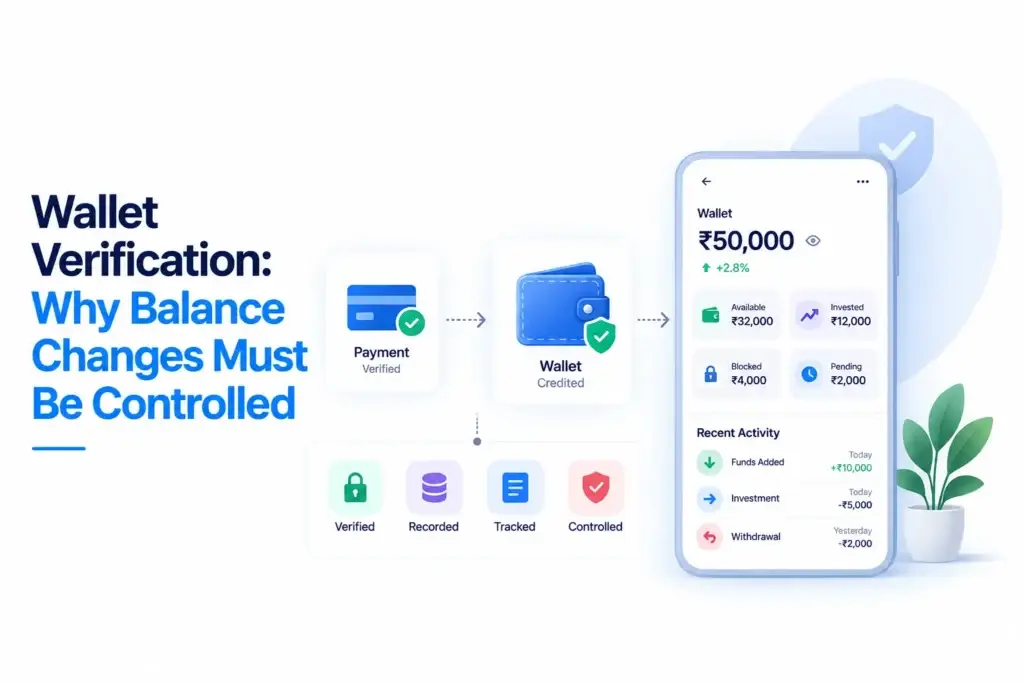
Wallet verification is one of the most important security layers in an investment app because money movement must be precise.
A wallet is not just a visible balance on the user dashboard. It should be backed by a ledger that records how money entered, where it moved, what is blocked, what is settled, what is refundable, and what is withdrawable.
For example, a user may add funds through a payment gateway. The payment may be initiated, pending, successful, failed, reversed, or disputed. The wallet should not be credited just because the front-end shows a payment attempt. It should be credited only after the backend receives and verifies the correct payment confirmation.
A secure wallet workflow should support:
- Payment initiation records
- Server-side payment verification
- Unique payment identifiers
- Idempotent retry handling
- Available balance
- Blocked balance
- Invested amount
- Pending withdrawals
- Failed transaction records
- Refund references
- Gateway response storage
- Wallet activity history
- Admin review notes
- Ledger reconciliation
This protects both the user and the operator. The user gets clarity. The operator gets traceability.
What Can Go Wrong Without Wallet Verification?
Wallet issues can damage trust quickly because users treat wallet balance as money, not as software data.
Without proper verification, an app may face:
- Duplicate wallet credits after gateway retries
- Balance updates from unverified callbacks
- Disputes without transaction evidence
- Withdrawals from unsettled funds
- Refund confusion
- Manual reconciliation errors
- Support teams unable to explain failed payments
- Operators unable to distinguish fraud from technical failure
The safest approach is to make wallet balance changes happen through controlled backend paths only. The front end can display status, but it should not be the source of financial truth.
KYC Controls: Verification Should Be a Lifecycle
KYC should not be treated as a single upload screen. In an investment app, KYC is a lifecycle that determines what the user can access.
A new user may be allowed to explore educational content or view public instruments. But actions such as adding funds, placing orders, withdrawing money, applying for certain products, or accessing specific asset categories may require approval.
A strong KYC workflow should support:
- Step-by-step onboarding
- Identity document upload
- Address verification where required
- Bank account verification
- Risk profile collection
- User type classification
- Resubmission after rejection
- Manual review queue
- Approval and rejection reasons
- User status history
- Document validity indicators
- Politically exposed person flags where required
- Risk category tagging
- Admin comments
- KYC audit logs
The platform should also support different verification paths depending on user type, geography, investment access, and business model.
Most importantly, the KYC decision should be stored clearly. If an operator approves, rejects, suspends, or requests resubmission, the system should record who made the decision, when it happened, what changed, and why.
KYC Status Should Control Investment Access
A secure investing experience should not expose every function to every user.
KYC status can control:
- Wallet funding
- Withdrawal access
- Order placement
- Asset category visibility
- Higher transaction limits
- International asset access
- Advanced trading features
- Subscription plan eligibility
- Account recovery steps
- Risk disclosure requirements
For example, a user with incomplete verification may be able to browse educational content but not place an investment order. A user with a rejected verification record may need to resubmit documents. A user flagged for review may need restricted access until the operations team completes manual checks.
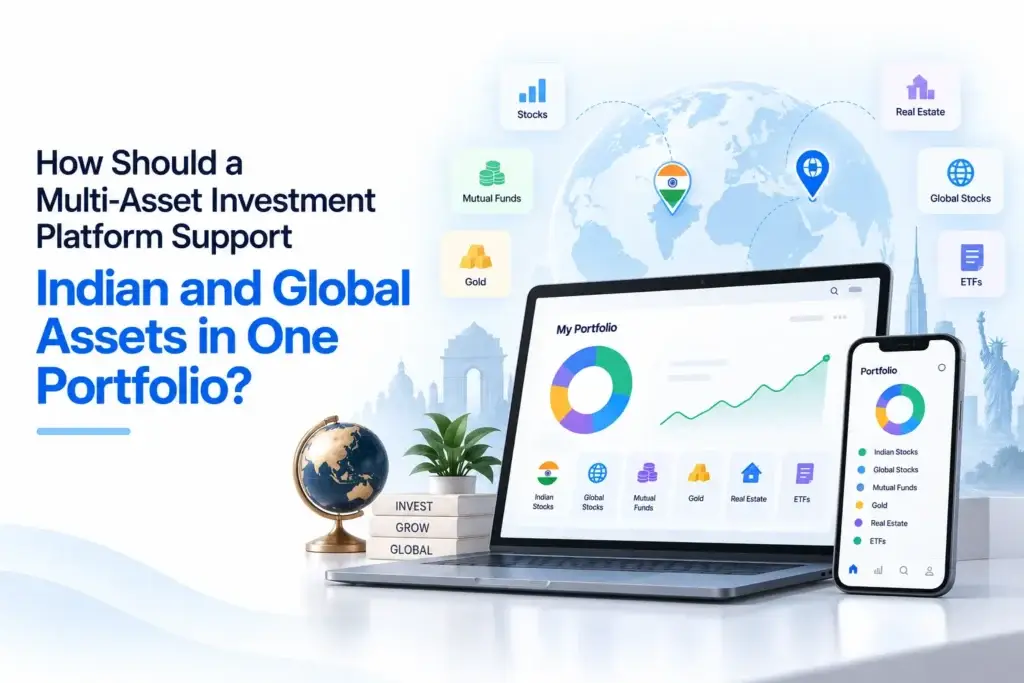
If your product roadmap includes domestic and overseas investment access, this guide to Indian and global asset access workflows can help you plan eligibility, portfolio visibility, wallet permissions, and KYC requirements more clearly.
This protects the platform from unauthorized activity and gives the admin team a clear way to manage user eligibility.
For a deeper look at product modules that support verification, wallet, and operator workflows, founders can review Miracuves’ investment app feature modules.
Audit Trails: The System Memory Every Fintech App Needs
An audit trail is the system’s memory.
It records important actions in a way that can be reviewed later. This includes user actions, admin decisions, financial events, status changes, permission updates, document reviews, wallet adjustments, refunds, withdrawals, and order overrides.
A good audit trail should answer five questions:
- Who performed the action?
- What changed?
- When did it change?
- What was the previous value?
- Why was the action taken?
For example, if a user’s KYC status changes from pending to approved, the audit record should show the admin identity, timestamp, previous status, new status, and review reason. If an order is overridden, the system should preserve the old state, new state, and reason. If a wallet refund is processed, the gateway reference and internal record should be connected.
This level of traceability is essential for support, internal review, compliance preparation, fraud investigation, and operational accountability.
Role-Based Access: Not Every Admin Should See Everything
Many founders focus on customer security but forget internal security.
In a fintech app, internal users can create risk if access is too broad. A support agent may need to view ticket history but not change KYC status. A finance user may need payout records but not document uploads. A compliance reviewer may need verification details but not marketing controls. A super admin may need full visibility, but even that role should be protected carefully.
Role-based access control should support:
- Separate admin login
- Permission-based dashboards
- Role-specific modules
- Action-level permissions
- Sensitive data masking
- Approval workflows for high-risk actions
- Activity logs
- Session controls
- Admin status controls
- Password and security policies
Access control reduces the risk of accidental changes, misuse, internal confusion, and unauthorized viewing of sensitive data.
A strong platform does not simply ask, “Can the admin log in?” It asks, “What exactly should this admin be allowed to see, change, approve, export, or override?”
Transaction Monitoring and Risk Signals
A secure investment app should monitor transactions for patterns that may require review.
This does not mean the platform must block every unusual action automatically. It means the platform should create visibility for operations teams when activity looks risky, inconsistent, or high-impact.
Transaction monitoring may include:
- Multiple failed payment attempts
- Repeated wallet funding and withdrawal cycles
- Sudden account detail changes before withdrawal
- High-value transactions
- Repeated order failures
- Frequent refund activity
- Suspicious login patterns
- Mismatched identity and bank details
- Multiple accounts using related data
- Unusual device or location signals
- Manual override frequency
These signals help teams identify abuse, technical issues, user confusion, or support needs earlier.
For founders, the key is not to overcomplicate the first version. Start with the risk signals that matter most to your operating model, then expand monitoring as transaction volume grows.
Security Layers by Workflow
Different app workflows need different security controls.
| Workflow | Security Control Needed | Why It Matters |
|---|---|---|
| User registration | Email or phone verification, device checks, and secure password policies. | Reduces fake accounts and improves account ownership confidence. |
| KYC submission | Document upload, review queue, risk fields, and approval history. | Ensures investment access is tied to verified identity status. |
| Wallet funding | Server-side payment verification, gateway references, and ledger entries. | Prevents false credits and supports reconciliation. |
| Order placement | KYC eligibility, balance checks, server-side fee calculation, and order status lifecycle. | Ensures users can only place valid orders with sufficient and approved access. |
| Withdrawal | Bank verification, available balance check, and withdrawal status tracking. | Protects user funds and reduces payout disputes. |
| Admin override | Permission check, reason capture, and before-and-after audit row. | Creates accountability for sensitive operational changes. |
| Support resolution | Ticket history, masked data, activity logs, and restricted actions. | Allows support teams to help users without exposing unnecessary sensitive data. |
The stronger the workflow, the lower the chance of operational guesswork.
Founder Decision Signals
Speed
Use a foundation where onboarding, KYC review, wallet verification, admin access, and audit logging already work together. This helps reduce avoidable build delays.
Cost
Security costs less when planned early. Retrofitting wallet controls, audit trails, permission rules, and verification workflows later can create rework across the entire product.
Scalability
Manual review may work for a small user base, but larger fintech operations need queues, filters, status histories, permission rules, and reporting dashboards.
Trust
Investors trust platforms that can explain identity status, money movement, failed transactions, refunds, order decisions, and admin actions clearly.
Compliance-Ready Does Not Mean Compliance Is Automatic
A fintech app can provide the workflows needed to support compliance, but the software itself does not remove the operator’s legal responsibilities.
Founders should be careful with claims such as “fully compliant everywhere” or “approved for all markets.” Those statements can create risk because investment products depend on jurisdiction, licences, partner institutions, broker arrangements, payment providers, user geography, data policies, and legal review.
A more accurate approach is to build a compliance-ready foundation that supports:
- KYC review workflows
- AML workflow support where required
- User verification status
- Document records
- Transaction monitoring
- Risk flags
- Audit logs
- Role-based access
- Secure payment gateway integration
- Data protection controls
- Report export support
- Admin approval history
Final compliance depends on the target market, operating structure, licences, integrations, and professional legal review.
This distinction matters. Strong software gives the business the right control fabric. It does not replace regulatory responsibility.
How Security Impacts Monetization and Growth
Security is often seen as a defensive layer, but it also affects growth.
A platform with clear verification, secure wallet handling, and reliable audit records can onboard users more confidently, support more asset categories, reduce operational disputes, and create the foundation for future revenue streams.
Founders planning commercial workflows can study this wealth app business model breakdown and this investment app revenue model guide to understand how verification, subscriptions, wallet flows, and user access can support monetization.
For example:
- Subscription plans need correct user eligibility and billing records.
- Advanced asset access may require stronger verification.
- Advisory workflows may require documented user risk profiles.
- International assets may require additional disclosures and eligibility checks.
- Business dashboards may require strict role permissions.
- Higher-value investors may expect better reporting and security visibility.
This is why security should be connected to the business model, not treated only as a technical checklist.
Founders planning monetization can explore this wealth app business model breakdown to understand how verification, wallets, subscription access, and platform controls can support commercial strategy.
Common Security Mistakes Founders Should Avoid
Crediting Wallets Before Proper Verification
A wallet should not update because the front end says a payment was attempted. Balance changes should depend on verified backend events and traceable payment references.
Treating KYC as a Static Form
KYC needs status history, review queues, rejection reasons, resubmission paths, risk fields, and audit records. A simple upload form is not enough for serious fintech operations.
Giving Every Admin Full Access
Support, finance, compliance, and operations teams need different permissions. Broad access increases internal risk and makes sensitive actions harder to govern.
Skipping Audit Logs Until Later
Audit trails are hardest to recreate after the fact. If the system did not record who changed what, the business may not be able to prove what happened during a dispute.
What Founders Should Check Before Development
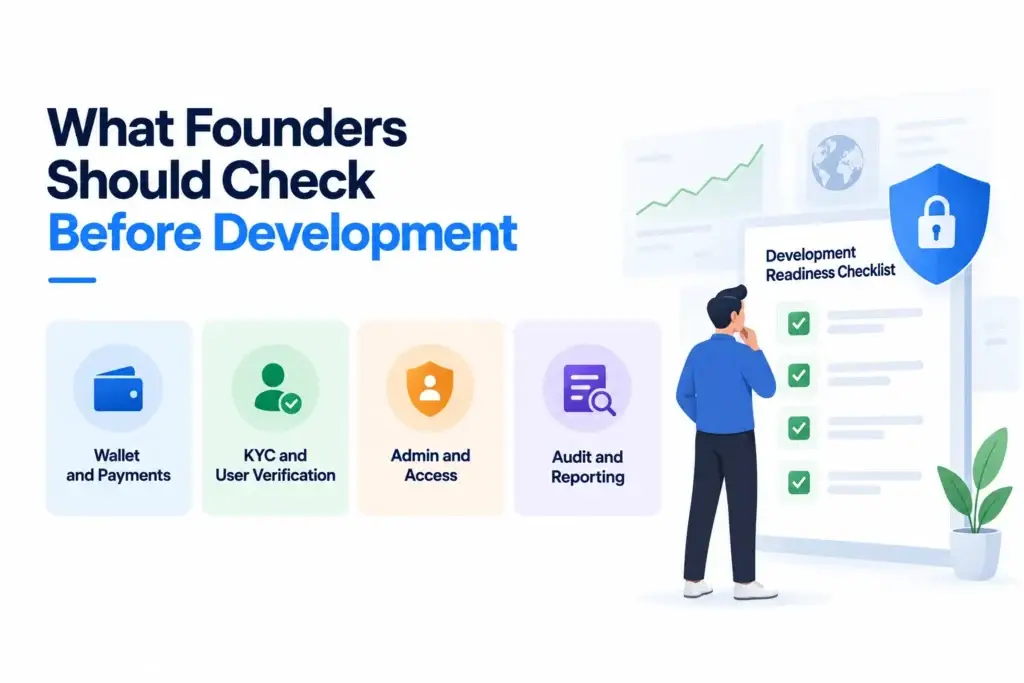
Before building or buying an investment app foundation, founders should ask practical security questions.
Wallet and Payment Questions
- Are wallet credits verified server-side?
- Does the system store payment gateway references?
- Can balances be split into available, blocked, pending, and withdrawable amounts?
- Are refunds and failed payments traceable?
- Can the finance team reconcile wallet activity?
KYC and User Verification Questions
- Does the app support a full verification lifecycle?
- Can users resubmit documents after rejection?
- Are approval and rejection reasons stored?
- Can risk categories and user types be tracked?
- Can KYC status control access to wallet and order actions?
Admin and Access Questions
- Are admin roles separated?
- Can permissions be controlled by role?
- Are sensitive fields masked where needed?
- Do high-risk admin actions require reason capture?
- Does admin authentication stay separate from customer login?
Audit and Reporting Questions
- Does every important status change create an audit record?
- Are before-and-after values stored?
- Can support and compliance teams review history?
- Are order overrides traceable?
- Can reports be exported when needed?
Before finalizing the build scope, teams should review the investment app development cost guide and compare the features and pricing considerations for investment apps.
These checks help founders compare platforms on operational readiness, not just interface design.
For teams estimating development scope, Miracuves’ investment app development cost guide can help explain how wallet logic, KYC workflows, audit trails, integrations, and customization affect the final build.
Why Source-Code Ownership Matters for Fintech Security
Security needs change as the product grows.
A founder may start with basic domestic investing workflows, then add new asset classes, new user roles, new risk rules, additional KYC steps, deeper reporting, or new payment integrations. If the business does not own the source code, these changes may depend heavily on vendor restrictions, licensing limits, or slow change requests.
If the product requires highly custom security policies, advanced integrations, or unique financial workflows, Miracuves also offers custom mobile app development services.
Source-code ownership gives the operator more long-term control over:
- Security policy changes
- New verification states
- Admin permission updates
- Wallet ledger improvements
- Integration upgrades
- Reporting requirements
- Compliance workflow changes
- Infrastructure decisions
- Internal review needs
- Custom risk controls
For fintech founders, ownership is not only a technical preference. It can affect operating flexibility, audit readiness, and long-term product control.
How Miracuves Helps Founders Launch Secure Investment Apps Faster
Miracuves helps founders build ready-made and white-label fintech app solutions with source-code ownership, branded design, admin dashboards, wallet workflows, KYC review flows, secure payment integrations, and operator controls.
For suitable ready-made solution scopes, Miracuves can support 6-day delivery. This helps founders move faster than building every security, onboarding, wallet, and admin module from zero. Final launch scope, integrations, compliance requirements, and customization should still be confirmed before deployment.
If your team is evaluating who should build the product, this guide on choosing an investment app development partner can help you compare technical readiness, fintech workflow depth, source-code ownership, and support expectations.
Final Thoughts
Investment app security is not only about protecting login screens. It is about protecting identity, funds, transactions, permissions, admin actions, and the records that explain every important change.
Wallet verification ensures money is credited only when payment events are verified. KYC controls ensure users access only what they are eligible to use. Role-based access ensures internal teams work within clear permission boundaries. Audit trails ensure the business can explain who changed what, when, and why.
For founders, the strongest decision is to build security into the foundation instead of treating it as a later patch. A secure wealth app needs onboarding, wallet logic, KYC review, transaction visibility, access control, and audit records from the beginning.
Miracuves helps founders move faster with ready-made, white-label fintech app foundations that support secure workflows, admin control, source-code ownership, and 6-day delivery for suitable ready-made scopes.
FAQs
Why is wallet verification important in an investment app?
Wallet verification is important because user balances must only change after confirmed payment, refund, withdrawal, or approved system events. Without verification, the app may face duplicate credits, failed payment disputes, unclear refunds, or reconciliation problems.
What is a KYC control workflow in a fintech app?
A KYC control workflow manages how users submit identity details, upload documents, receive approval or rejection, resubmit information, and gain access to investment actions. It should include status tracking, admin review, rejection reasons, risk fields, and audit records.
What should an audit trail record in an investment app?
An audit trail should record the actor, action, timestamp, previous value, new value, reason, and related transaction or user record. It should apply to KYC decisions, admin overrides, wallet changes, permission updates, order changes, refunds, and sensitive profile actions.
How does role-based access improve fintech security?
Role-based access ensures that each internal user can only view or change what their job requires. This reduces the risk of unauthorized actions, accidental changes, sensitive data exposure, and unclear accountability inside the admin console.
Can software guarantee fintech compliance?
No. Software can provide a compliance-ready foundation and support important workflows such as KYC review, transaction monitoring, audit logs, and access control. Final compliance depends on jurisdiction, licences, legal review, partner integrations, and the operating model.
What security features should founders prioritize before launch?
Before launch, founders should prioritize secure onboarding, KYC lifecycle management, server-side wallet verification, payment gateway records, ledger accuracy, role-based admin access, audit logs, encrypted data transfer, and transaction monitoring.
Why should wallet balance changes happen only on the backend?
Wallet balance changes should happen only through controlled backend paths because the backend can verify payment events, enforce transaction rules, prevent duplicate credits, store gateway references, and create reliable ledger records.
How can Miracuves help with secure fintech app development?
Miracuves helps founders build ready-made and white-label fintech app foundations with wallet workflows, KYC review, admin dashboards, secure payment integrations, audit records, source-code ownership, and 6-day delivery for suitable ready-made scopes.
Miracuves is an independent software development company. We are not affiliated with, connected to, sponsored by, or endorsed by any company or product named in this article.
Terms such as “X Clone” are used descriptively. It is how the software industry refers to building a platform with functionality comparable to a known service, and how clients search for it.
The entire design and codebase of our products is built by our own team. Our products contain no code, design, graphics, or content originating from any third-party website or applications.
All third-party names and marks referenced in this article are the property of their respective owners, referenced solely to identify the services discussed.