Key Takeaways
- build multi-currency payment gateway requires more than connecting payment processors. The platform must coordinate payment methods, currencies, providers, financial records, settlement, and compliance controls.
- A modular architecture makes international payment expansion easier. Separate payment APIs, orchestration, provider adapters, FX services, ledgers, reconciliation, and administrative controls reduce unnecessary coupling.
- Presentment, funding, and settlement currencies should be tracked separately. The currency charged to the customer may differ from the currency associated with the payment instrument and the currency received by the merchant.
- International cards and local payment methods require different workflows. Wallets, bank transfers, QR payments, and card transactions can have different authentication, confirmation, refund, and settlement behaviors.
- Currency conversion needs explicit rate, fee, precision, and quote rules. The system should distinguish informational rates from executable quotes and record the source amount, converted amount, fees, currency pair, and quote conditions.
- A double-entry ledger is essential when the platform records financial movements. Payments, fees, FX conversions, refunds, transfers, and settlement activity should create traceable financial records rather than relying only on payment status fields.
- Payment retries must account for uncertain transaction outcomes. A timeout does not necessarily mean a payment failed. Idempotency, provider status checks, and separate payment-attempt records help reduce duplicate charges.
- Settlement reconciliation connects software records with actual money movement. Gross payments, processing fees, FX differences, refunds, adjustments, and net settlements should be matched against provider and bank records.
- Security and compliance must be considered before handling real financial activity. Tokenization, access controls, transaction monitoring, identity verification, audit trails, and applicable licensing responsibilities depend on the operating model and jurisdictions.
- Start with a focused market and payment corridor before expanding. Define the initial countries, currencies, payment methods, financial partners, and operating responsibilities before adding additional rails and advanced routing.
A customer in Germany wants to pay an international business in euros. Another customer prefers a local bank transfer, while a third uses a mobile wallet in their domestic currency. The business, meanwhile, wants to receive settlements in US dollars and understand exactly how much it earned after processing fees and currency conversion.
Supporting these transactions through one payment experience is considerably more complex than connecting a checkout form to a card processor. Each payment method operates under different rules, authorization requirements, settlement schedules, supported currencies, and failure conditions.
For founders evaluating custom payment gateway development, understanding these technical differences is essential. A successful payment platform must coordinate payment providers, financial records, exchange-rate calculations, local transfer systems, and compliance controls without introducing inconsistent balances or duplicated transactions.
This guide explains how to build a custom multi-currency payment gateway from an architecture perspective. It covers international card payments, regional wallets, local payment rails, payment orchestration, FX processing, settlement reconciliation, fraud controls, and the engineering decisions required to support reliable international transactions.
The objective is not to recreate every banking or payment network independently. It is to understand which layers a business should build, which capabilities require regulated financial partners, and how to connect them into a reliable, extensible payment system.
What Does a Multi-Currency Payment Gateway Actually Do?
A multi-currency payment gateway provides a technical interface for accepting or initiating payments involving different currencies and payment methods. Depending on its operating model, it may coordinate card processors, regional wallet providers, bank transfer systems, currency conversion services, and settlement partners.
Its responsibility is not necessarily to hold funds, issue cards, or directly participate in clearing networks. Those functions may belong to licensed institutions and contracted payment partners.
The software gateway typically manages the transaction request, verifies that the selected payment method is supported, communicates with the appropriate provider, records the result, and exposes a consistent payment status to the business using it.
Payment Gateway, Payment Orchestrator, and Money Transfer Platform
These terms are often used together, but they describe different responsibilities.
| System | Primary responsibility | Typical example |
|---|---|---|
| Payment gateway | Securely initiates and manages payment requests | Customer checkout with card or wallet payment |
| Payment orchestrator | Selects providers and coordinates multiple payment integrations | Routing a transaction to an eligible processor |
| Payment processor or acquirer | Provides contracted transaction processing capabilities | Card authorization and acquiring services |
| Currency conversion service | Provides exchange rates, quotes, and conversion execution through supported partners | Converting a payment from EUR to USD |
| Wallet and account ledger | Records financial claims, liabilities, and movements | Tracking balances in different currencies |
| Remittance platform | Coordinates sending funds to beneficiaries, potentially across borders | International bank-account transfers |
One business may operate several of these layers through one application. However, a card checkout system does not automatically become a licensed remittance business merely because it supports currency conversion.
Founders should define the exact financial activities they intend to perform before choosing their architecture. The licensing, custody, safeguarding, settlement, and reporting responsibilities can change substantially between different models.
If you are still deciding which business model to run rather than how to engineer it, start with this overview of multi-currency payment platforms for fintech startups. This guide stays on the engineering of the gateway itself.
The Core Architecture of a Custom Multi-Currency Payment Gateway
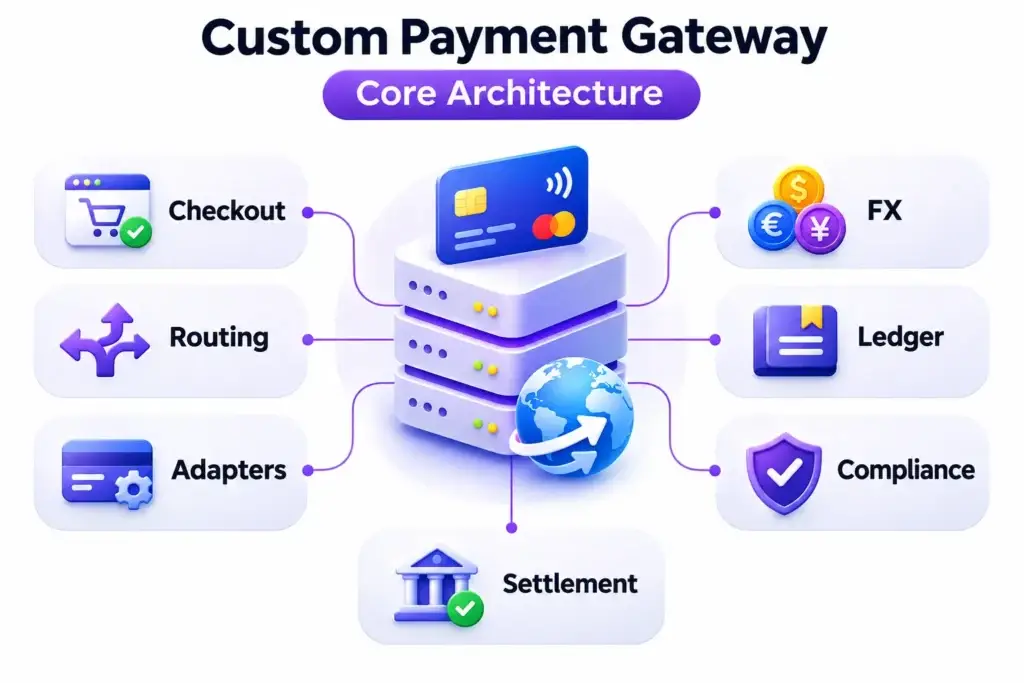
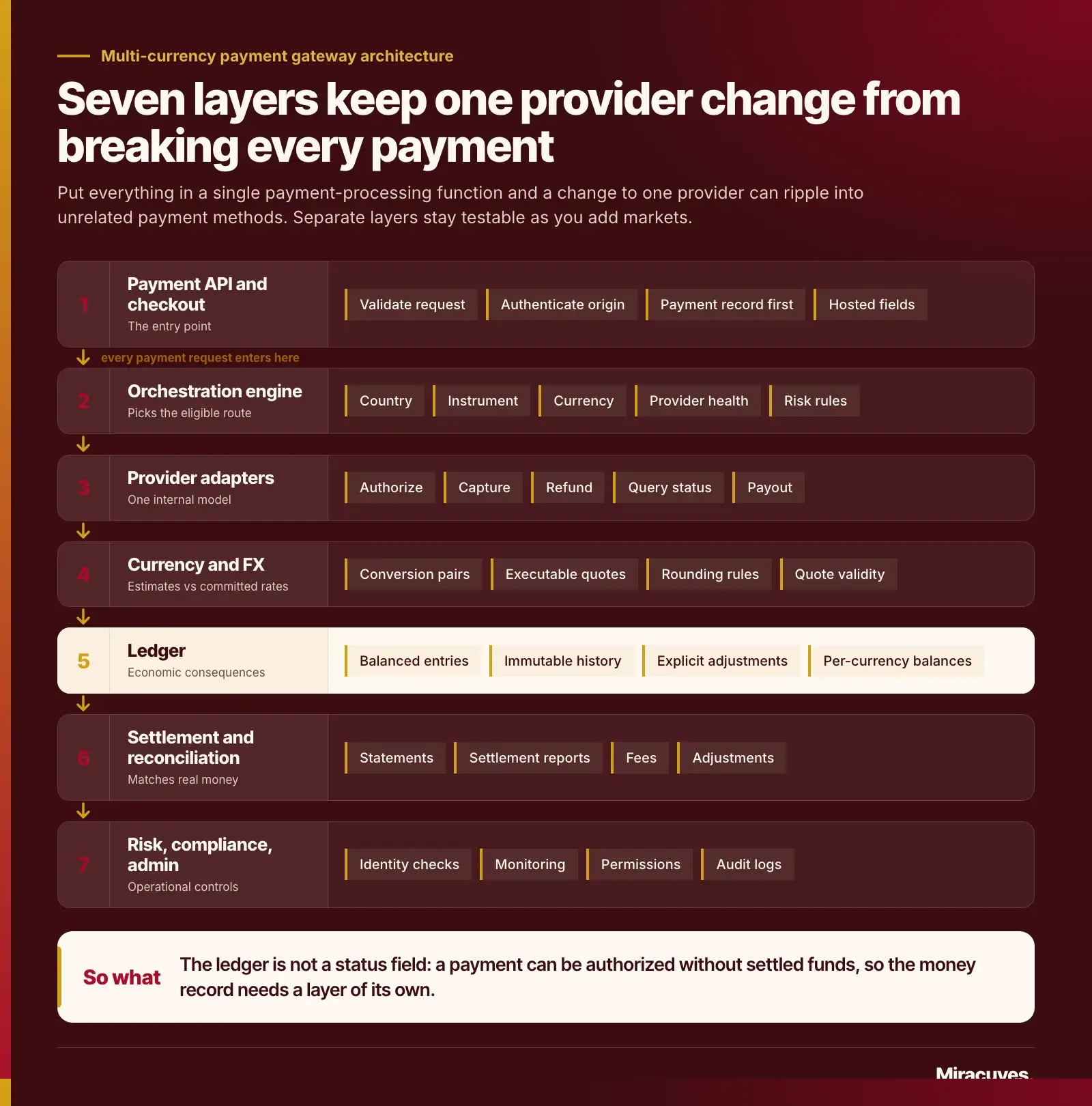
A reliable payment platform benefits from clear separation between customer-facing payment requests, routing decisions, external provider communication, financial records, and administrative operations.
When all these responsibilities are combined inside a single payment-processing function, changes to one provider can create unexpected effects across unrelated payment methods.
A modular architecture makes the system easier to maintain, test, and expand into additional markets.
1. Payment API and Checkout Layer
The entry point accepts a payment request containing the amount, currency, merchant identity, payment method, transaction reference, and other permitted information.
The application validates the request, authenticates its origin, checks basic eligibility, and creates a persistent payment record before contacting an external processor.
For card payments, using approved hosted fields or tokenized collection methods can reduce the extent to which sensitive payment details enter the platform’s own systems.
2. Payment Orchestration Engine
The orchestration engine determines which payment route is eligible for a specific transaction. It evaluates factors such as merchant country, payer location, payment instrument, transaction currency, provider availability, risk controls, and contractual restrictions.
It should not automatically choose the lowest advertised processing fee. A route may have a lower nominal fee but unfavorable conversion economics, lower reliability, slower settlement, or limited refund support.
3. Provider Adapter Layer
Each external processor or local payment system exposes its own API structure, authentication method, transaction states, and error codes.
Provider adapters translate these differences into the platform’s internal payment model. This allows the core orchestration engine to work with consistent commands such as authorize, capture, refund, query status, or initiate payout, where supported.
The adapter must also preserve provider-specific details that cannot be safely represented as generic states.
4. Currency and FX Service
The currency service handles currency metadata, eligible conversion pairs, exchange-rate quotations, rounding rules, fee calculations, and quote validity.
It should clearly distinguish estimated conversions from committed financial conversions. A displayed rate is not necessarily an executable rate until a qualified provider confirms the applicable terms.
5. Ledger and Financial Records
The financial ledger records the economic consequences of transactions. It should support balanced accounting entries, immutable financial history, corrections through explicit adjustments, and currency-specific balances.
The ledger is not simply a collection of payment status fields. A payment can be authorized without settled funds being available, and a completed transfer may involve several distinct financial entries.
6. Settlement and Reconciliation
This layer compares internal transaction records with statements, settlement reports, bank movements, processing fees, and adjustments received from financial partners.
Without reconciliation, an apparently successful payment flow can conceal missing payouts, incorrect fees, duplicate transfers, or accounting differences.
7. Risk, Compliance, and Administration
Risk controls, merchant permissions, identity verification, sanctions screening where applicable, transaction monitoring, and audit logs provide the operational layer required to manage financial activity responsibly.
The exact controls depend on the regulated activity, jurisdiction, partner agreements, customer types, and transaction risk.
Multi-Currency Payment Architecture: Transaction Flow
Customer or Merchant Payment Request
↓
Authentication, Validation, and Idempotency
↓
Payment Orchestration and Eligibility Rules
↓
Currency Quote and Risk Evaluation
↓
Card Processor / Regional Wallet / Local Bank Rail
↓
Authorization or Payment Confirmation
↓
Ledger Entries and Settlement Tracking
↓
Reconciliation, Reporting, and Exception Handling
This is a simplified logical architecture. Some payment methods use asynchronous confirmation, while others involve additional authentication, capture, clearing, or payout stages.
How International Card Payments Work Across Different Currencies
International cards provide broad payment acceptance, but supporting them introduces several independent financial decisions.
Consider a merchant pricing a subscription in euros while the customer uses a card funded in another currency. The merchant may authorize the charge in euros, but the cardholder’s issuer can perform its own conversion into the account currency.
The merchant may subsequently receive settlement in euros or another supported currency, depending on the acquiring arrangement.
Presentment Currency, Card Currency, and Settlement Currency
These three concepts should be represented separately in the database.
- Presentment currency: The currency in which the customer is charged.
- Card or funding currency: The currency associated with the customer’s payment instrument or account.
- Settlement currency: The currency in which the acquiring or payment partner settles funds to the merchant or relevant account.
They may be the same, but the architecture should never assume that they always match. Provider capabilities, geographic restrictions, and contractual arrangements determine which combinations are available.
Authorization Is Not Final Settlement
A card authorization indicates that the issuer has responded to an authorization request. The transaction may still require capture, clearing, settlement, and eventual merchant payout.
These stages can occur at different times. The customer interface should communicate the appropriate status without implying that funds are already settled merely because the initial authorization succeeded.
Additional Authentication and Risk Controls
Some transactions require additional customer authentication based on the region, payment instrument, issuer, and applicable regulations.
The payment application must handle redirects, challenges, interrupted sessions, and authentication outcomes without losing its authoritative transaction state.
Tokenization should also be considered when storing reusable payment credentials. A provider-issued token or network token can reduce the need to process raw card information directly, although token portability and reuse depend on the tokenization arrangement.
Strong Customer Authentication and 3-D Secure 2 in Europe
For cards issued and acquired in the European Economic Area, PSD2 requires strong customer authentication (SCA): two of knowledge, possession and inherence. Enforcement for online card payments began on December 31, 2020 in the EEA and on March 14, 2022 in the UK. In practice SCA runs through EMV 3-D Secure 2, which lets the issuer approve many low-risk payments without a challenge and send the rest to a one-time code or banking-app approval.
The detailed rules, including the exemptions, sit in Delegated Regulation (EU) 2018/389. A gateway that serves European cardholders needs to model these cases explicitly:
| Rule | Condition | What the gateway must do |
|---|---|---|
| Low-value remote payment (RTS Art. 16) | Up to EUR 30 per transaction, until the payer passes EUR 100 cumulative or five transactions since the last SCA | Request the exemption, but always handle a step-up challenge; the issuer keeps the counter |
| Transaction risk analysis (RTS Art. 18) | Remote card payments up to EUR 100, 250 or 500, depending on the provider’s reported fraud rate | Only available if your acquirer or PSP supports it; store which party applied the exemption |
| Recurring payments, same amount and payee (RTS Art. 14) | Series authenticated once at set-up | Keep the original authentication reference with the mandate |
| Trusted beneficiaries (RTS Art. 13) | Payer adds the merchant to an allowlist held by the issuer | Nothing to build beyond passing the request; the issuer decides |
| Merchant-initiated transactions | Charges the cardholder agreed to in advance, set up with SCA | Flag them correctly in the authorization request; they are treated as out of scope rather than exempt |
Build the 3-D Secure flow as its own state in the payment state machine (authentication requested, challenged, succeeded, failed, abandoned), and record the exemption requested, the exemption applied and the liability shift. When the card or the acquirer sits outside the EEA (“one-leg-out”), SCA applies on a best-effort basis, so the same code path must handle both outcomes. PSD3 and a new Payment Services Regulation, politically agreed in November 2025, will replace much of PSD2 after a transition period, so check the final text and application dates before your launch.
Integrating Regional Wallets and Alternative Payment Methods
Card acceptance alone may not satisfy customer preferences in every market. Some customers primarily use domestic digital wallets, account-to-account payments, QR-based payment services, or bank-authorized transfers.
A custom gateway should allow additional methods to be introduced without rewriting the entire checkout and reporting system.
Normalize the Payment Interface, Not Every Payment Behavior
Some wallets confirm payment immediately. Others send the customer to a separate application, require a QR scan, or complete through an asynchronous notification.
The gateway can expose a consistent payment request interface while preserving these method-specific differences.
For example, a payment response may contain a redirect URL, a QR payload, an authorization requirement, or a pending status rather than a simple success flag.
Payment Method Availability Is Market-Specific
Not every wallet supports every merchant country, transaction currency, or use case. The eligibility engine should filter payment methods according to actual provider availability and business configuration.
This prevents the checkout from displaying options that cannot process the current transaction.
Refunds May Follow Different Rules
A refund through a card network may behave differently from reversing a domestic bank transfer or returning funds to a regional wallet.
Some methods support partial refunds; others impose restrictions or require separate return transfers. These differences must be represented in the provider adapter rather than hidden behind unsupported assumptions.
Founder insight: Supporting more payment methods is not automatically beneficial. Prioritize the methods that customers actually use in the intended launch markets and that your financial partners can support reliably.
Connecting Local Payment Rails for Regional Collections and Payouts
Local payment rails allow money to move through domestic or regional financial infrastructure. Depending on the country, these systems may support bank account transfers, instant payments, clearing-based transactions, or other regulated payment arrangements.
Examples of rail categories include domestic bank transfers, instant-payment networks, regional credit transfers, and correspondent banking routes for cross-border settlement.
A gateway generally accesses these systems through approved financial partners or authorized connections. Software integration alone does not provide unrestricted access to domestic clearing networks.
Collections and Payouts Are Separate Capabilities
A provider may support receiving payments through a particular local method without supporting outgoing payouts through the same arrangement.
For each market, the integration design should record whether the partner supports collections, payouts, refunds, returns, account validation, and relevant reconciliation information.
Model Settlement Time and Finality
Some domestic payments can be confirmed quickly, while others operate through scheduled clearing windows. Even when a payment notification arrives immediately, the funds may not yet be irrevocably settled or available for payout.
The gateway should distinguish initiation, acceptance, processing, completion, return, and finality according to the relevant rail’s rules.
Build a Country and Currency Capability Matrix
Before integrating a new rail, document its supported countries, currencies, settlement windows, transaction limits, operating days, beneficiary requirements, return processes, and partner fees.
| Rail category | Typical use | Architecture consideration |
|---|---|---|
| International card processing | Consumer and business purchases | Authorization, authentication, capture, disputes |
| Regional digital wallets | Local consumer payments | Redirects, QR flows, asynchronous status |
| Domestic bank transfers | Account-based collections and payouts | Bank validation, reference matching, clearing |
| Instant-payment systems | Near-real-time domestic transfers where available | Eligibility, confirmation semantics, operating limits |
| Correspondent banking | Cross-border bank-account transfers | Intermediary fees, beneficiary details, tracking |
| Internal wallet transfers | Movements between accounts within an authorized platform | Ledger consistency, funding and safeguarding rules |
These categories are not interchangeable. Routing logic must choose a rail appropriate to the transaction’s legal, operational, geographic, and financial requirements.
Named Rails Your Capability Matrix Will Need
The categories above become concrete once you name the rails in your launch corridors. These are the ones buyers ask about most, with the facts that change the build:
| Rail | Region | Key 2025-2026 facts | Build note |
|---|---|---|---|
| SEPA Instant Credit Transfer | Euro area and SEPA | Under the Instant Payments Regulation, euro-area PSPs had to receive instant euro transfers from January 9, 2025 and send them, with Verification of Payee, from October 9, 2025 | Settles in seconds, around the clock; handle Verification of Payee name-match results before release |
| FedNow | United States | Federal Reserve instant rail; the network limit was raised to $10 million per transaction in November 2025 | Reached through a participating bank or service provider; ISO 20022 messages; banks may set lower limits |
| UPI | India | NPCI data show a record 25.47 billion UPI transactions in October 2026 | Accessed through a sponsor bank or an RBI-authorized payment aggregator; QR and app-intent flows |
| Pix | Brazil | Central Bank of Brazil instant payment scheme, live since November 2020 | Integrated through a Pix participant institution; dynamic QR codes and Pix keys |
| Swift cross-border (CBPR+) | Global | ISO 20022 became mandatory for cross-border payment instructions when the MT/MX coexistence period ended on November 22, 2025 | Expect structured remittance and address data; legacy MT formats are converted only as a paid contingency |
Most of these rails now speak ISO 20022 or map cleanly to it, so modeling payment messages around ISO 20022 fields (structured party names, addresses and remittance information) from the start avoids a second migration later.
For businesses serving regulated financial institutions or enterprise payment operations, the banking and insurance technology sector overview provides broader context for the operational environments in which these integrations may be used.
Building a Currency Conversion Engine Without Creating Financial Errors
Currency conversion introduces additional complexity because a quoted amount, converted amount, processing fee, and eventual settlement amount may be determined at different stages of the payment lifecycle.
A reliable FX service needs clear rules about where rates originate, when quotes expire, which party bears conversion costs, and how financial amounts are recorded.
Separate Rate Discovery From Executable Quotes
An informational market rate can help calculate an estimate. An executable quote, however, should come from a partner or treasury process capable of honoring the terms under the specified conditions.
The system should store the quoted currency pair, rate, fee components, expected recipient amount, validity period, and applicable conversion conditions.
A displayed rate should not silently change during checkout without appropriate user confirmation when the commercial terms require a fixed quote.
Use Currency-Specific Precision
Different currencies have different minor-unit conventions. Some commonly use two decimal places, while others use zero or more decimal places for standardized accounting or API representation.
Financial amounts should use fixed-precision decimal arithmetic or appropriately defined integer minor units, not binary floating-point calculations that can introduce rounding errors.
Always record the currency alongside the amount. An integer amount without its currency and unit convention is not a complete financial value.
Understand Where FX Margin Appears
The customer-facing exchange rate may differ from a reference market rate because the provider applies a margin, transaction fee, or other conversion charge.
A transparent checkout should identify the information needed for the customer to understand the payment’s currency and applicable conversion terms.
Illustrative FX Quote Calculation
Customer sends: 1,000 USD
Illustrative executable exchange rate: 1 USD = 0.90 EUR
Illustrative service fee: 5 USD, deducted before conversion
Amount converted: 995 USD
Illustrative recipient amount: 995 × 0.90 = 895.50 EUR
These are hypothetical figures, not live exchange rates, actual service prices, or a guaranteed payout quote. Real transactions can include additional provider fees, settlement costs, taxes, and jurisdiction-specific requirements.
The example demonstrates why the platform should maintain explicit records of fee treatment, source amount, conversion amount, destination amount, and quote conditions.
For a more focused discussion of market rates, quote APIs, freshness, and conversion workflows, explore the real-time foreign exchange API integration guide. This article concentrates on coordinating the FX layer with the broader payment gateway.
Why a Double-Entry Ledger Is Essential for Multi-Currency Payments
A payment gateway that only stores a payment ID and a success status may be sufficient for limited checkout reporting, but it is not a complete financial accounting system.
Platforms that maintain wallet balances, track customer funds, coordinate payouts, or record FX transactions need a carefully structured financial ledger.
Model Financial Events as Balanced Entries
A double-entry ledger records movements through corresponding debits and credits. Each posted journal entry must balance within the relevant currency accounting model.
For example, receiving customer funds may increase a settlement asset and create a corresponding liability to the customer. When funds are paid out, subsequent entries reduce the relevant balances according to the actual transaction lifecycle.
Cross-currency transactions require explicit conversion entries and appropriate balancing or clearing accounts rather than forcing different currency amounts to be arithmetically equal.
Separate Available, Reserved, and Pending Funds
A user interface may show a balance, but the platform may need to distinguish settled funds, pending incoming transactions, reserved payouts, and frozen amounts.
This prevents users or businesses from spending money that is not yet available under the applicable financial rules.
Never Rewrite Financial History to Fix an Error
Corrections should be represented by additional entries with references to the original transaction. This allows finance and compliance teams to reconstruct what happened.
The system should preserve transaction identifiers, timestamps, accounting periods, currencies, journal references, and the responsible system or authorized operator.
How to Design Payment Routing, Retries, and Provider Failover
One of the main benefits of payment orchestration is the ability to connect multiple providers without tying all transaction logic to a single integration.
However, routing and failover must be implemented carefully because a payment request can have an uncertain outcome even when the application receives no successful response.
Routing Based on Eligibility and Expected Economics
A routing decision can consider supported payment method, country, currency, merchant configuration, transaction limits, provider health, costs, and available settlement routes.
Over time, performance data may help operators adjust rules based on observed authorization outcomes, reliability, and settlement expenses.
Routing rules should remain explainable and auditable, especially when they affect financial risk or regulatory obligations.
Do Not Blindly Retry an Uncertain Payment
Suppose the gateway sends a payment request to a provider but the connection times out before receiving a response. The absence of a response does not prove that the provider rejected the transaction.
Immediately creating a new payment through another provider could cause duplicate charges if the original transaction succeeded.
A safe recovery process should use provider idempotency controls, transaction-status lookup, and an explicit state model before initiating any new attempt.
Track Logical Payments Separately From Attempts
One customer payment may produce multiple technical attempts. The system should maintain a parent payment record and separate attempt records containing the selected provider, request identifier, response, and final outcome.
This makes operational investigations possible without confusing the original customer intent with each individual processor interaction.
Webhook Processing and Payment State Synchronization
Financial transactions often progress asynchronously. A customer may leave the checkout page before the provider sends a final status update, and a bank transfer may require additional processing before reaching its completed state.
Webhooks allow external systems to deliver transaction updates, but they must be processed as untrusted, potentially duplicated, and sometimes delayed messages.
Authenticate Incoming Events
Where supported, verify webhook signatures or other provider authentication mechanisms. Reject unauthorized messages and avoid trusting a user-submitted payment status as evidence that funds were received.
Make Processing Idempotent
The same event may be delivered more than once. Store stable event identifiers and ensure that repeated processing cannot create duplicated ledger entries, refunds, or payout instructions.
Handle Events That Arrive Out of Order
An earlier status event can arrive after a more recent one. The payment state machine should enforce valid transitions and use authoritative provider queries when the sequence is unclear.
Keep Failed Messages Visible
Use durable queues, controlled retries, and an exception-handling process for messages that cannot be applied successfully. Operational dashboards should show the age and business impact of unresolved events.
Settlement Reconciliation: Matching Gateway Records With Actual Money
A transaction may appear successful in the checkout system while the actual merchant settlement is reduced by processing fees, refunds, disputes, currency conversion, or other adjustments.
Reconciliation connects the application-level payment history to the financial statements provided by processors and banks.
Track Gross and Net Amounts Separately
Do not assume the amount paid by the customer equals the amount deposited into the merchant’s account. The financial model should preserve the gross payment, fees, adjustments, FX differences, and net settlement.
Support Batch-Level Settlement Matching
Payment partners may settle multiple transactions together. A reconciliation service should map each batch to its underlying transactions and related financial adjustments.
Where available, settlement reports should be matched against bank statements rather than relying exclusively on the payment provider’s internal transaction status.
Create a Clear Exception Process
Unmatched bank credits, missing settlements, duplicate references, unexpected fees, and returned payouts require investigation.
The operations dashboard should allow authorized staff to identify discrepancies, attach evidence, and post controlled corrections without destroying the original financial record.
| Financial event | What the system should record | Common risk |
|---|---|---|
| Payment authorization | Authorized amount, currency, reference | Treating authorization as settled funds |
| Capture | Captured amount and timestamp | Incorrect or duplicated capture |
| Settlement | Settlement batch, currency, provider deductions | Unmatched financial movement |
| FX conversion | Rate, currency pair, fees, converted amount | Incorrect rounding or unexpected conversion |
| Refund | Original payment link, refund amount, status | Duplicate or excessive refund |
| Dispute or chargeback | Case reference, adjustment, outcome | Missing financial liability |
| Merchant payout | Beneficiary, currency, bank reference, status | Incorrect payout or reconciliation mismatch |
Security, Compliance, and Financial Partner Requirements
Multi-currency payment systems handle sensitive financial instructions and, depending on their design, cardholder data, identity information, wallet balances, and regulated payment flows.
Security should be incorporated into the original architecture rather than added after payment integrations are complete.
Reduce Card Data Exposure
Use appropriate tokenization, secure payment collection components, encryption, access restrictions, and secrets management. The applicable PCI DSS responsibilities depend on which cardholder data the business stores, processes, or transmits and the chosen integration model. Build against PCI DSS v4.0.1, the current version of the standard; its future-dated v4.0 requirements became mandatory on March 31, 2025.
Using a hosted payment component may reduce scope, but it does not automatically eliminate all security obligations. The architecture and organizational controls must be reviewed against the applicable requirements.
Which PCI DSS Self-Assessment Applies to Your Integration?
The integration model you choose decides how much of the PCI DSS standard you must validate. It is one of the biggest compliance cost levers in a gateway build:
| Integration model | Typical PCI DSS validation | What it means for the build |
|---|---|---|
| Hosted payment page or iframe fields from a PCI DSS compliant provider | SAQ A, if all account data functions are outsourced and the site meets the script-attack eligibility criterion added to SAQ A in 2025 | Card numbers never reach your servers, but you still protect every page that loads the payment form |
| Direct post or JavaScript that builds the payment form on your own page | SAQ A-EP | Your web servers can affect payment security, so payment-page script control (Requirement 6.4.3) and tamper detection (11.6.1) apply |
| Your API receives, stores or forwards card numbers (a true gateway) | SAQ D for Service Providers, or a Report on Compliance | Full PCI DSS scope; Visa classes service providers handling over 300,000 Visa transactions a year as Level 1, which requires an annual Report on Compliance by a Qualified Security Assessor (QSA) |
Many teams start with hosted fields from a PSP for checkout, which keeps the merchant-facing product near SAQ A, and only take on SAQ D scope when the business case for owning card data, such as vaulting for multiple acquirers, is proven. Your acquirer or a Qualified Security Assessor confirms the final validation level.
Apply Role-Based Financial Controls
Administrative privileges should be limited according to responsibility. A support agent who views a payment should not automatically have permission to modify settlement instructions or release frozen funds.
Sensitive operations can require additional approvals, authenticated actions, and immutable audit trails.
Define Identity and Transaction Monitoring Responsibilities
Depending on the operating model, the platform may require customer or business verification, sanctions screening, transaction monitoring, suspicious activity review, and applicable reporting workflows.
These responsibilities vary by jurisdiction, financial activity, contractual structure, and the role played by regulated partners.
Confirm Regulatory Authorization Before Handling Funds
Building a payment interface is not the same as receiving authorization to acquire payments, hold safeguarded customer funds, issue payment instruments, or conduct regulated international transfers.
Founders should involve appropriate legal and compliance specialists to determine licensing, safeguarding, customer protection, privacy, and operational requirements for each launch market.
A software platform can support compliance workflows, but actual legal compliance depends on the operating organization, partners, implementation, and jurisdiction.
For orientation, these are the authorizations founders most often run into. In the United States, a business that transmits money generally registers with FinCEN as a money services business and needs money transmitter licenses state by state. In the EU, holding or moving client funds generally requires authorization as a payment institution or e-money institution under PSD2. In India, collecting payments for merchants requires RBI authorization as a payment aggregator. Many startups avoid these obligations at launch by operating as a technology layer on top of a licensed partner that holds the funds.
What Does It Cost to Operate a Multi-Rail Payment Gateway?
The operating cost of a payment gateway is influenced by the number of financial partners, the markets served, transaction volumes, settlement requirements, fraud exposure, and the complexity of the reconciliation process.
Founders should separate initial software engineering from recurring payment economics. A platform with relatively modest hosting costs may still incur substantial processor, FX, compliance, and dispute-related expenses.
Primary Cost Drivers
- Processor and acquiring fees: Charges determined by the transaction method, market, provider, and contract.
- FX expenses: Conversion spreads, provider fees, and treasury-related costs.
- Payment-method integrations: Initial development, provider certification, and ongoing API maintenance.
- Settlement and payout charges: Fees for transferring merchant or beneficiary funds.
- Fraud and dispute costs: Verification services, chargebacks, manual review, and financial losses.
- Compliance operations: Verification, monitoring, reporting, and specialist oversight.
- Infrastructure and observability: Hosting, databases, monitoring, secrets management, and incident response.
An Illustrative Transaction Economics Model
Consider a hypothetical merchant payment worth $200. Suppose the applicable processor fee is 2.5%, the provider charges an additional $0.30, and other transaction-related operating expenses average $0.20.
Example: Payment Processing Economics
Gross transaction: $200.00
Hypothetical percentage fee: $5.00
Hypothetical fixed processing fee: $0.30
Other allocated transaction expense: $0.20
Illustrative net after listed expenses: $194.50
This is a hypothetical arithmetic example, not an industry rate or a provider quotation. It excludes possible currency conversion, taxes, refunds, disputes, settlement charges, and additional operating costs.
The objective is to model effective cost per successfully completed transaction, not only the advertised processor percentage. Payment failures, retries, settlement timing, and manual reconciliation can all change overall economics.
How Much Does It Cost to Build a Multi-Currency Payment Gateway?
Engineering cost follows the module list. The table below is an illustrative estimate for a first release covering one card provider, one local rail, two or three currencies, a double-entry ledger and reconciliation, built by a team of five to six people over roughly 14 to 18 weeks. The $20 and $40 hourly rates are planning assumptions for a blended offshore team, not quotes.
| Module | Hours (illustrative) | At $20/hr | At $40/hr |
|---|---|---|---|
| Payment API, checkout and hosted fields | 300-400 | $6,000-$8,000 | $12,000-$16,000 |
| Orchestration, payment state machine and idempotency | 350-450 | $7,000-$9,000 | $14,000-$18,000 |
| First provider adapter (cards with 3-D Secure 2, refunds, webhooks) | 250-350 | $5,000-$7,000 | $10,000-$14,000 |
| Second adapter (one local rail through a partner) | 200-300 | $4,000-$6,000 | $8,000-$12,000 |
| FX quote service and currency precision | 200-280 | $4,000-$5,600 | $8,000-$11,200 |
| Double-entry ledger | 350-450 | $7,000-$9,000 | $14,000-$18,000 |
| Settlement reconciliation and exception queue | 250-350 | $5,000-$7,000 | $10,000-$14,000 |
| Admin, roles, audit trail and reporting | 250-350 | $5,000-$7,000 | $10,000-$14,000 |
| Security, PCI scoping, QA and failure testing | 350-450 | $7,000-$9,000 | $14,000-$18,000 |
| Discovery, architecture, PM and DevOps | 250-330 | $5,000-$6,600 | $10,000-$13,200 |
| Total | 2,750-3,710 | $55,000-$74,200 | $110,000-$148,400 |
Priced at the US median wage for software developers, QA analysts and testers, $64.44 an hour according to the US Bureau of Labor Statistics (May 2025), the same hours come to roughly $177,000 to $239,000 in wages alone, before overhead or margin. As a rough planning assumption, a multi-provider orchestration layer with smart routing, failover and five or more rails can need two to three times these hours. Not included: PCI DSS assessment fees, licensing and legal work, partner onboarding, and the recurring processing costs described above.
How to Plan the Technical Build in Practical Stages
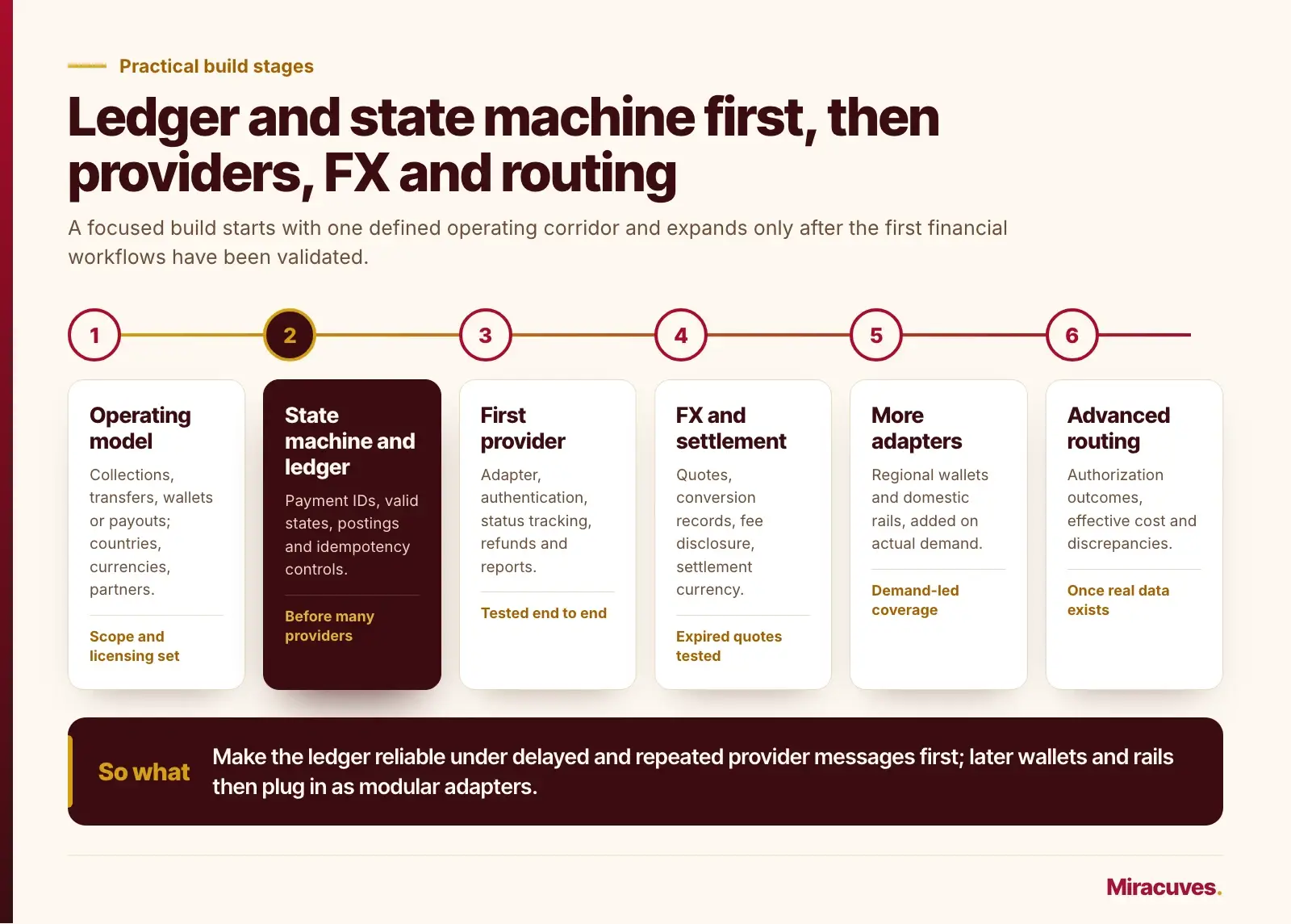
Attempting to support every country, currency, card network, wallet, and payout rail in the first release can create unnecessary complexity. A focused build begins with a clearly defined operating corridor and expands after the initial financial workflows have been validated.
Stage 1: Define the Operating Model and Partners
Identify whether the product will support merchant collections, international transfers, stored-value wallets, business payouts, or a combination of these services.
Specify launch countries, supported currencies, transaction types, financial partners, licensing responsibilities, and required customer verification workflows.
Stage 2: Build the Payment State Machine and Ledger
Establish authoritative payment identifiers, valid transaction states, currency handling, financial postings, and idempotency controls before introducing numerous external providers.
The ledger and transaction lifecycle must remain reliable even when a processor sends delayed or repeated messages.
Stage 3: Integrate the First Card or Local Payment Provider
Implement the provider adapter, authentication flows, transaction initiation, final status tracking, refunds where supported, and reconciliation reports.
Validate the end-to-end financial flow under real test conditions before assuming that the integration is production-ready.
Stage 4: Add FX and Multi-Currency Settlement Logic
Introduce currency metadata, quote management, conversion records, fee disclosure, and settlement-currency mapping according to the available financial partner arrangements.
Test currency precision, expired quotes, rounding boundaries, partial refunds, and reconciliation differences.
Stage 5: Expand Through Modular Provider Adapters
Add regional wallets and domestic rails based on actual customer demand. Define clear eligibility rules and avoid presenting methods that cannot be used for the selected transaction.
Stage 6: Introduce Advanced Routing and Operational Analytics
Once meaningful transaction data exists, measure authorization outcomes, routing performance, effective processing cost, settlement discrepancies, and unresolved exceptions.
Advanced optimization should be introduced in response to observed operational needs, not simply because it is technically possible.
For a broader explanation of accounts, transfers, verification, and financial application structure, see the cross-border financial platform architecture guide. This article focuses on the payment gateway and multi-rail orchestration layer rather than the entire customer-facing finance application.
Technical Testing Scenarios Every Multi-Currency Gateway Should Pass
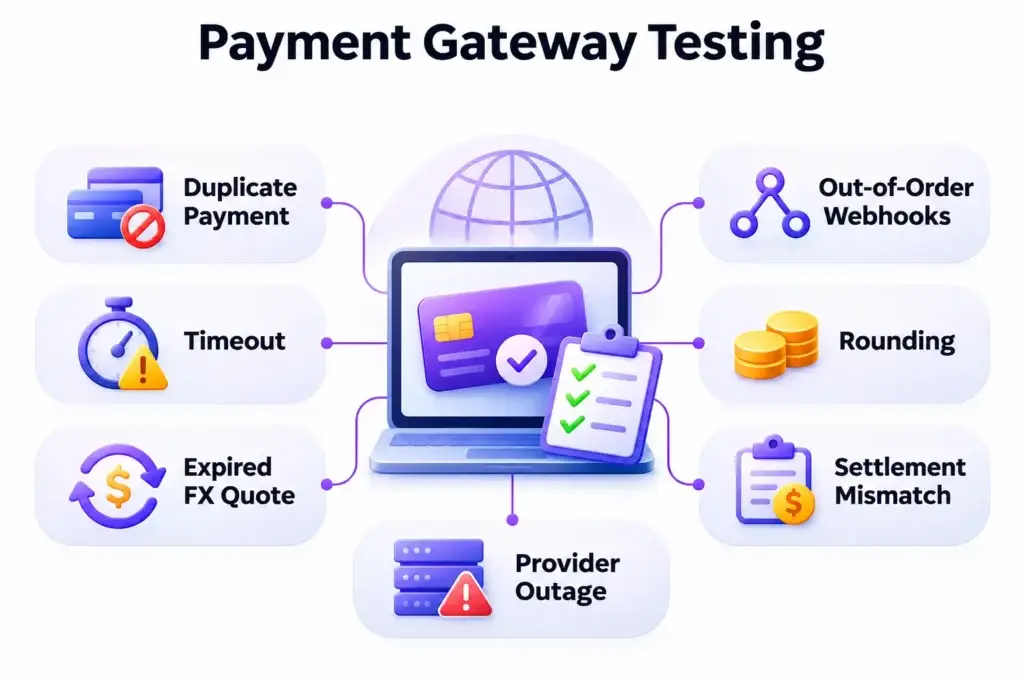
Payment testing should cover more than successfully charging a test card. The most expensive failures can occur when network conditions, financial states, or currency assumptions do not behave as expected.
Scenario 1: Duplicate Payment Submission
Submit the same logical payment request more than once using the same idempotency key. Confirm that the application cannot create unintended duplicate financial actions.
Scenario 2: Expired FX Quote
Attempt to confirm a payment after the applicable exchange-rate quote expires. The platform should follow the documented requoting or rejection process rather than silently applying unsupported pricing.
Scenario 3: Currency Precision and Rounding
Test different currency minor units, boundary amounts, partial fees, conversion rounding, and refunds. Verify that ledger entries remain balanced according to the chosen accounting model.
Scenario 4: Settlement Mismatch
Introduce unexpected processing fees or an unmatched settlement entry. Confirm that reconciliation flags the difference without altering original financial history.
Scenario 5: Abandoned 3-D Secure Challenge
Start a European card payment that triggers a challenge, then close the banking app without approving it. The payment should move to an abandoned or failed authentication state after the provider timeout, release any reserved funds in the ledger, and never be retried as a frictionless charge.
Scenario 6: Instant Rail Return After Payout Release
Credit an instant transfer, release the funds for payout, then receive a return or recall from the partner. Confirm the ledger records the reversal as new entries, the payout exposure is flagged, and the case lands in the exception queue.
Build From Scratch or Use a Reusable Financial Platform Foundation?
The decision to build every module independently depends on the project’s intended financial activity, available expertise, regulatory structure, and differentiation requirements.
Custom development may be appropriate when a business needs unusual payment routing, specialized treasury operations, or deep integrations that do not fit an existing platform.
A reusable foundation can be valuable when the required workflows are relatively familiar, such as customer accounts, multi-currency wallets, payment requests, transfers, operational dashboards, and transaction monitoring.
| Decision factor | Custom engineering | Reusable platform foundation |
|---|---|---|
| Initial architecture | Designed for specific requirements | Existing modules reviewed and adapted |
| Integration effort | All connections scoped individually | Existing connectors assessed; new integrations added as needed |
| Financial flexibility | Potentially extensive control over design | Depends on code ownership and architecture quality |
| Implementation duration | Depends on complexity and staffing | May be shorter for supported standard configurations |
| Compliance obligations | Require assessment and implementation | Still require assessment and implementation |
| Best use case | Specialized payment infrastructure | Common financial workflows with manageable customization |
Miracuves provides ready-made and white-label financial software that founders can evaluate as a starting point for relevant account, wallet, transfer, and administrative workflows. Its six-working-day delivery positioning applies to eligible standard ready-made configurations, not to building or certifying an entirely new international payment network.
For a feature-level comparison of ready-made gateway software, see this breakdown of Adyen-style payment platform features and pricing. Businesses assessing international money movement may also review the white-label remittance software approach and the available remittance platform solutions to compare possible product foundations without confusing software delivery with regulated payment access.
Founder Decision Signals: What Should You Prioritize First?
01. What Financial Activity Will the Business Perform?
Merchant checkout, stored-value wallets, international remittance, and business payouts can have substantially different partner and regulatory requirements.
02. Which Payment Methods Matter in the First Markets?
Prioritize supported payment methods that match real customer behavior instead of integrating every possible rail immediately.
03. Who Handles Custody, Conversion, and Settlement?
Clearly identify the licensed partners and legal entities responsible for handling funds and fulfilling regulated obligations.
04. Can Every Financial Movement Be Reconstructed?
Confirm that the platform maintains reliable payment histories, ledger entries, provider references, settlement reports, and controlled corrections.
Common Mistakes That Make Multi-Currency Payment Platforms Expensive to Maintain
Treating Every Provider as Technically Identical
Different payment methods have different transaction states, refund capabilities, authentication requirements, and settlement behavior. A single oversimplified integration model can introduce errors instead of reducing complexity.
Assuming a Successful API Response Means Funds Are Available
Authorization, capture, settlement, and payout should remain distinct. Using funds before they are available under the relevant financial arrangement can create liquidity and operational problems.
Using Floating-Point Arithmetic for Financial Amounts
Currency conversions and ledger entries require explicit precision and rounding rules. Small numerical inconsistencies can create substantial reconciliation problems at scale.
Retrying Payments Without Verifying Their Original Outcome
An uncertain response is not necessarily a failed transaction. Blind retries can result in duplicated charges or payout instructions.
Ignoring Settlement Reconciliation
Transaction dashboards do not replace financial controls. The business must connect payment activity with actual settlement and bank movements.
Treating Compliance as a Future Feature
Payment permissions, access to funds, identity verification, and transaction monitoring can determine the entire operating model. They should be addressed before the system is deployed with real money.
How to Evaluate a Financial Technology Partner Before Implementation
A development partner should be able to explain not only the customer journey but also how financial events are recorded, how external providers are integrated, and what happens when a payment cannot be confirmed immediately.
Ask for a clear description of the payment state machine, supported currencies, provider-specific limitations, ledger design, settlement reports, and operational exception handling.
Confirm who controls the source code, production infrastructure, financial provider accounts, API credentials, transaction records, and future integration changes.
For companies that need specialized engineering beyond a ready-made platform, custom fintech application engineering offers a relevant path to discuss implementation requirements, integrations, and technical ownership.
The architecture should also support the business’s longer-term customer experience. Clear currency information, visible transaction status, understandable fees, and dependable support are essential to building customer trust.
For a complementary perspective on how financial transparency and communication influence adoption, see how a Wise-style multi-currency transfer platform presents rates, fees and transfer status to customers. Reliable payment technology and clear customer communication should reinforce each other.
Final Thoughts: Build for Financial Correctness Before Expanding Payment Coverage
Building a multi-currency payment gateway requires much more than adding several payment buttons to a checkout page. The underlying system must coordinate different transaction lifecycles, currency rules, external financial providers, asynchronous events, settlement records, and operational controls.
The strongest architecture is not necessarily the one with the greatest number of integrations at launch. It is the one that records transactions accurately, selects eligible routes, prevents duplicate financial actions, handles uncertain outcomes, and provides enough visibility to reconcile real money movements.
For founders, a practical strategy is to begin with well-defined markets, currencies, and financial partners, establish a dependable transaction and ledger foundation, and expand payment coverage as customer demand and operational readiness justify it.
Businesses evaluating an existing product foundation can explore Miracuves’ source-code-owned global payment platform foundation to assess relevant wallet, transfer, administrative, and integration workflows. The final decision should be based on actual technical requirements, available regulated partnerships, and the responsibilities involved in operating the intended financial service.
Frequently Asked Questions
What is the difference between a payment gateway and a payment orchestrator?
A payment gateway initiates and manages payment requests for one checkout. A payment orchestrator sits above several processors and payment methods, decides which one handles each transaction and normalizes their responses. A multi-currency gateway usually includes both: a single payment API in front, provider adapters behind it, and an eligibility layer that checks country, currency and method before sending a transaction.
How much does it cost to build a payment gateway?
A first release with one card provider, one local rail, a double-entry ledger and reconciliation typically needs about 2,750 to 3,700 engineering hours. At blended rates of $20 to $40 an hour that is roughly $55,000 to $150,000, and far more at US wage levels. PCI DSS assessment, licensing, legal work and processing fees come on top. These are illustrative estimates, not quotes.
Do I need a license to run a multi-currency payment gateway?
It depends on whether you touch the money. A pure technology layer that never holds funds often works through a licensed partner. Holding or moving client funds usually needs authorization: FinCEN registration and state money transmitter licenses in the US, payment or e-money institution authorization under PSD2 in the EU, and payment aggregator authorization from the RBI in India. Confirm with counsel for each market.
Which PCI DSS questionnaire applies to a payment gateway?
If you use a provider’s hosted page or iframe fields and never receive card numbers, the merchant side can often validate with SAQ A. If your page builds the payment form, SAQ A-EP applies. A gateway whose API receives, stores or forwards card numbers is a service provider and validates with SAQ D for Service Providers or a full Report on Compliance under PCI DSS v4.0.1.
What is strong customer authentication and when does it apply?
Strong customer authentication is the PSD2 rule that most electronic payments by payers in the EEA must be confirmed with two of knowledge, possession and inherence. For cards it runs through 3-D Secure 2. Exemptions exist for low-value payments up to EUR 30, risk-assessed transactions, recurring payments and trusted beneficiaries, and merchant-initiated charges are out of scope. The UK applies equivalent rules.
What is the difference between presentment and settlement currency?
Presentment currency is the currency the customer is charged in. Settlement currency is the currency in which the merchant or platform receives funds from the acquirer or payment partner. They may differ, and a card issuer can also convert into the cardholder’s own account currency, so a gateway should store all three separately and record who performed each conversion.
Why does a multi-currency payment system need a ledger?
A ledger records the financial effect of every payment, fee, conversion, refund and settlement as balanced debit and credit entries in each currency. That makes balances traceable, lets reconciliation match gateway records with partner settlements, and means errors are corrected with new entries rather than by rewriting history. Status fields alone cannot show where money actually is.
Can a payment gateway automatically switch processors after a timeout?
Not safely in every case. A timeout may happen after the first provider already authorized the payment. Before creating a new attempt, the gateway should query the original attempt’s status and rely on idempotency keys, so the customer is not charged twice. Automatic failover is safe for new transactions when the first provider is confirmed unavailable.
Are local payment rails available in every country?
No. Each rail serves its own market and rules: SEPA Instant covers euro transfers, FedNow and other US rails cover dollars, UPI covers India and Pix covers Brazil. Access normally comes through a participating bank or licensed partner, and collections, payouts and refunds can have different availability even within one country.
Can a ready-made financial platform reduce development effort?
A reusable platform can remove the need to rebuild common account, wallet, transfer and admin workflows. New payment rails, regulated partnerships, PCI DSS validation, certification with providers and market-specific changes still need their own assessment and budget, so compare what the platform already covers against your launch corridors before you decide.
Miracuves is an independent software development company. We are not affiliated with, connected to, sponsored by, or endorsed by any company or product named in this article.
Terms such as “X Clone” are used descriptively. It is how the software industry refers to building a platform with functionality comparable to a known service, and how clients search for it.
The entire design and codebase of our products is built by our own team. Our products contain no code, design, graphics, or content originating from any third-party website or applications.
All third-party names and marks referenced in this article are the property of their respective owners, referenced solely to identify the services discussed.