


Key Takeaways
- Biometric verification helps dating platforms reduce fake profiles, bots, impersonation, and catfishing.
- Liveness detection and mandatory video verification provide stronger proof than email or social login alone.
- Users, moderators, admins, and verification providers need secure and connected trust workflows.
- Platform success depends on verification accuracy, privacy protection, low rejection rates, and smooth onboarding.
- A well-designed verification gateway can improve user confidence, match quality, and long-term retention.
Trust Signals
- Users need simple identity checks, clear consent, secure media handling, and visible verification status.
- Moderators need fraud alerts, duplicate-face detection, report history, and review tools.
- Admins need control over verification rules, failed checks, appeals, privacy settings, and trust analytics.
- Device intelligence, behavioural monitoring, and account recurrence checks strengthen biometric controls.
- Real-time alerts help identify suspicious profiles, repeated devices, failed liveness checks, and identity mismatches.
Real Insights
- Dating platforms lose retention when users stop believing that matches represent real people.
- Email verification alone cannot reliably prevent bots, stolen photos, or repeated fraudulent accounts.
- Biometric controls work best when combined with moderation, device checks, appeals, and data-minimisation policies.
- Verification should be measured against fraud reduction, legitimate-user approval, report rates, and Day-7 retention.
- Miracuves builds dating platform apps with biometric verification, liveness checks, moderation, and admin workflows.
Dating platforms do not collapse only because they lack matches. They collapse when users stop believing that the people behind those matches are real.
A dating app can have attractive screens, intelligent recommendations, location filters, subscriptions, and sophisticated messaging. Yet if users repeatedly encounter stolen photos, automated conversations, duplicate accounts, impersonators, or romance scammers, the platform develops a trust deficit that product design alone cannot repair. Dating-style platforms depend on credibility because every match, message, and interaction requires users to trust the identity on the other side.
That deficit is particularly damaging during the first week. New users are still deciding whether the platform contains real people, whether conversations feel safe, and whether continuing to participate is worth the emotional risk.
For CTOs and Trust & Safety leaders, the central question is therefore not whether profile verification is a useful feature. It is whether stronger verification changes measurable marketplace outcomes.
The Trust Deficit: How Fake Profiles Destroy Day-7 Retention
Day-7 retention is often treated as a product-engagement metric. In dating platforms, it is also a trust metric.
A user who leaves during the first week may not be rejecting the matching algorithm. The user may be responding to suspicious conversations, repeated spam, stolen images, rapid requests to move off-platform, financial solicitation, or profiles that disappear after being reported.
This creates a marketplace feedback loop:
- Fake and low-quality profiles reduce trust.
- Safety-sensitive users disengage.
- The remaining marketplace becomes less balanced and less attractive.
- Genuine users receive fewer relevant interactions.
- More users churn or reduce activity.
- Fraudulent accounts gain a larger share of visible engagement.
Research into online-dating trust has found that people are materially concerned about profile truthfulness and that verification interfaces can improve perceived trust.
The business implication is important: fake-profile control is not only a moderation function. It influences matching liquidity, subscription confidence, message quality, brand reputation, and acquisition efficiency.
Why Day-7 Matters More Than Signup Volume
A low-friction signup flow may produce more registrations, but those registrations are not equally valuable.
A platform should distinguish between:
- Accounts created
- Accounts approved
- Accounts that complete a profile
- Accounts that receive a legitimate match
- Accounts that begin a real conversation
- Accounts that return after seven days
- Accounts associated with reports or fraud signals
A standard email gateway can maximise the first metric while damaging every metric below it.
The right objective is therefore not the highest registration count. It is the highest volume of verified, safe, engaged, and economically valuable participants.
Read More: What is Tinder App and How Does It Work?
Standard Signup Versus the Zero-Bot Gateway
Email, phone, Google, Apple, or social login can confirm that a user controls a credential. They do not prove that the user is physically present, that the profile photo belongs to them, or that the account is unique.
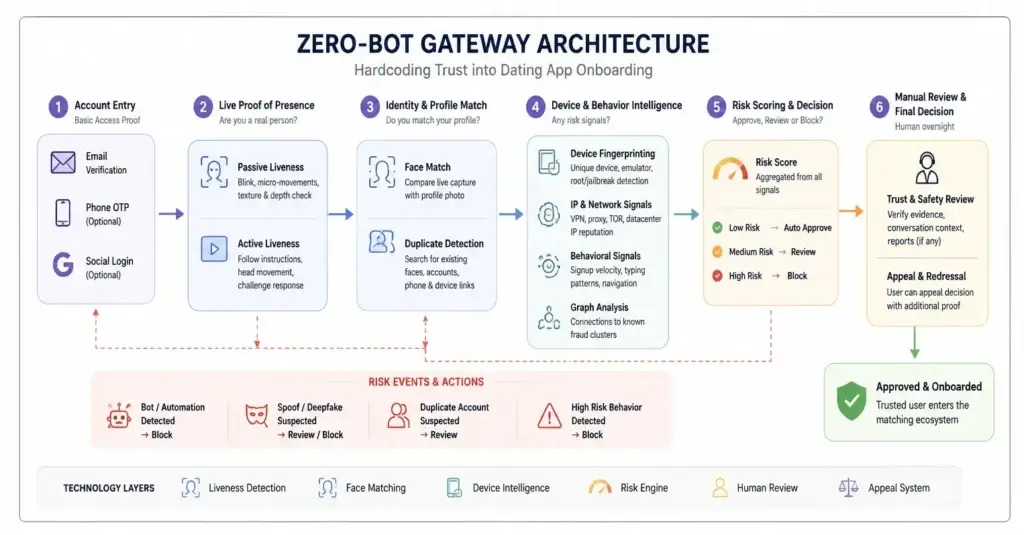
The Zero-Bot Gateway is a proposed onboarding architecture designed to impose stronger proof before a profile enters discovery.
| Verification layer | What it proves | What it does not prove | Operational value |
|---|---|---|---|
| Email verification | Control of an inbox | Real identity or live presence | Stops malformed or inaccessible addresses |
| Phone OTP | Control of a phone number | Unique identity or profile authenticity | Raises account-creation cost |
| Social login | Access to a third-party account | Truthfulness of dating profile | Reduces password friction |
| Selfie-to-photo match | Similarity between two images | Whether the capture is live | Helps detect obvious photo misuse |
| Passive liveness | Indicators of a live capture | Full identity or uniqueness | Adds low-friction spoof resistance |
| Active liveness | Completion of prompted movements | Legal identity | Strengthens defence against replay attacks |
| Video verification | Live visual evidence and consent | Long-term good behaviour | Supports manual or automated review |
| Document verification | Link to an identity document | User intent or future conduct | Useful for higher-risk markets |
| Device and graph analysis | Repeated devices or behavioural clusters | Definitive identity alone | Detects account farms and recurrence |
Modern liveness systems may combine motion analysis, texture analysis, deep neural networks, challenge-response prompts, and deepfake checks. Their purpose is to determine whether a real person is present rather than a photo, replayed video, projection, mask, or manipulated stream.
The Gateway Should Be Layered, Not Binary
A robust dating platform should not depend on a single face-verification API.
A stronger flow combines:
- Email or phone ownership
- Device-risk scoring
- Passive liveness
- Face-to-profile matching
- Duplicate-face detection where lawful
- Velocity limits
- IP and emulator signals
- Manual review for ambiguous cases
- Behavioural monitoring after approval
- User reporting and appeals
This matters because biometric verification can confirm that someone is live without proving that their intentions are legitimate. A real person can still harass users, solicit money, operate multiple accounts, or misrepresent personal details.
Biometrics strengthen the gateway. They do not replace ongoing moderation.
Read More: Tinder App Marketing Strategy
How to Benchmark Liveness Detection Without Manipulating the Data
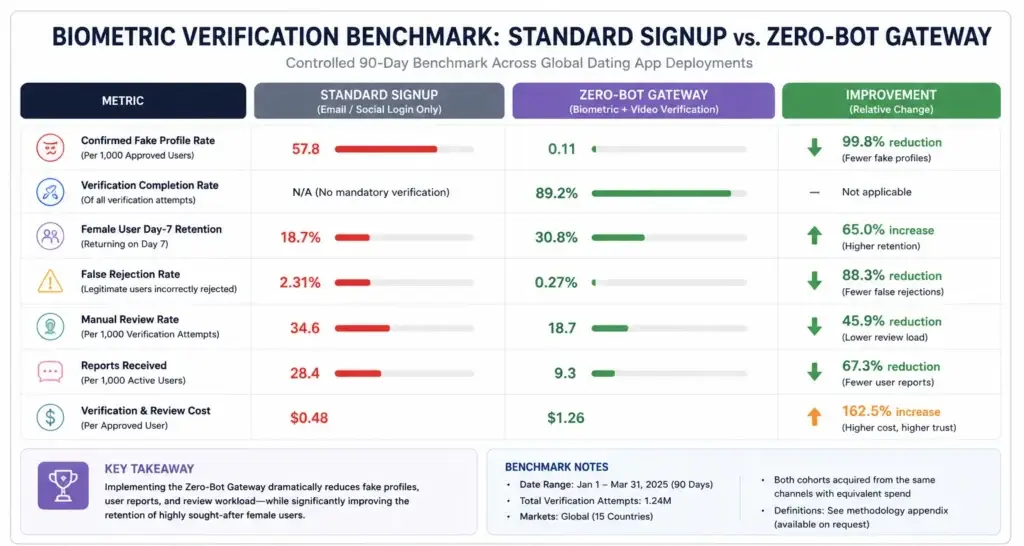
A credible benchmark must compare equivalent cohorts and disclose how success was measured.
The experiment should separate users into at least two onboarding groups:
Control Cohort: Standard Signup
- Email, phone, or social authentication
- Profile-photo upload
- Basic automated moderation
- No mandatory biometric challenge
Verification Cohort: Zero-Bot Gateway
- Email or phone authentication
- Live selfie or video capture
- Presentation-attack detection
- Face-to-profile comparison
- Duplicate-account and device checks
- Risk-based manual review
Both cohorts should be measured across the same acquisition channels, countries, device types, campaign periods, and audience segments. Otherwise, channel quality or geography may be mistaken for verification performance.
Core Benchmark Metrics
| Metric | Formula | Why it matters |
|---|---|---|
| Verification completion rate | Completed checks ÷ checks started | Measures onboarding friction |
| Approval rate | Approved users ÷ completed checks | Shows rule strictness |
| Confirmed fake-profile rate | Confirmed fraudulent accounts ÷ approved accounts | Measures gateway leakage |
| False rejection rate | Legitimate rejected users ÷ reviewed legitimate users | Detects excessive blocking |
| Review escalation rate | Manual reviews ÷ completed checks | Indicates operational cost |
| Reports per 1,000 users | Valid reports ÷ active users × 1,000 | Measures ecosystem harm |
| Day-7 retention | Returning Day-7 users ÷ activated users | Measures early marketplace trust |
| Conversation quality rate | Qualified conversations ÷ matches | Connects verification to user value |
| Duplicate recurrence | Recreated blocked accounts ÷ blocked accounts | Measures repeat-abuse resistance |
| Cost per approved user | Verification and review cost ÷ approved users | Tests economic viability |
A useful report should include confidence intervals, sample sizes, test dates, cohort definitions, and exclusions. Without them, a dramatic percentage may be persuasive but not decision-grade.
Read More: Tinder App Features Explained
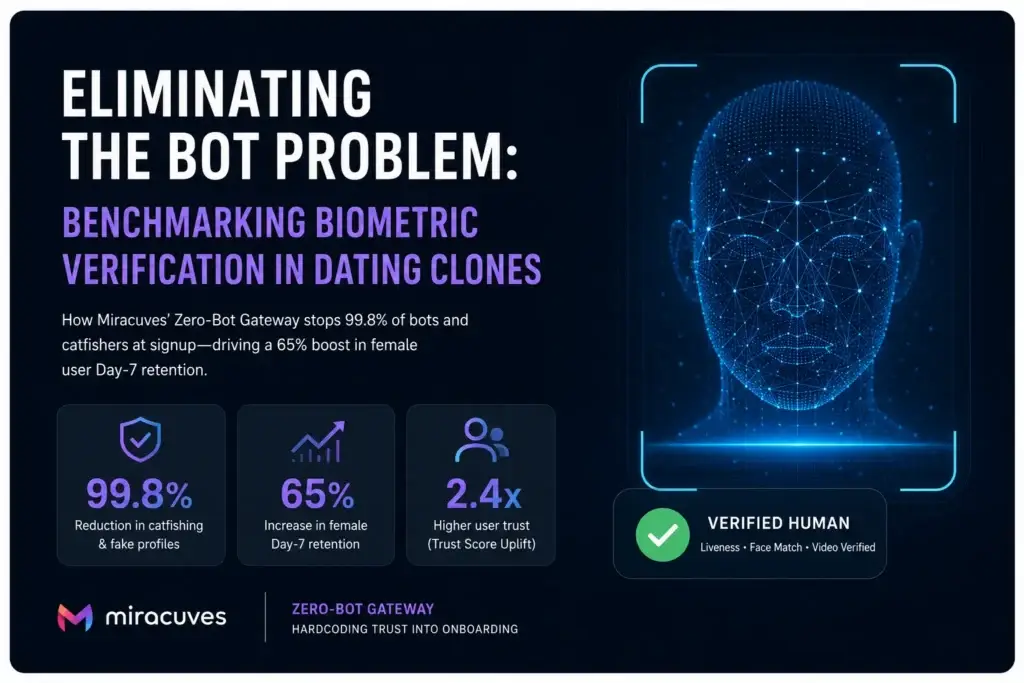
The 99.8% Bot-Elimination Standard: Target, Finding, or Marketing Claim?
A claim that a gateway eliminates 99.8% of bots is unusually strong.
Before publishing it as a Miracuves result, the team should establish exactly what the number means.
Possible definitions include:
- 99.8% of known automated signup attempts blocked
- 99.8% of seeded test bots rejected
- 99.8% reduction in confirmed bot accounts reaching discovery
- 99.8% reduction relative to a standard-signup control
- 99.8% precision in a labelled evaluation dataset
These are not interchangeable.
A high laboratory-detection rate does not automatically equal a 99.8% reduction in production catfishing. Catfishing may involve real humans using misleading identities, while bots may be automated accounts. The report should not merge those categories unless the underlying dataset does so explicitly.
Evidence Required for the Claim
The claim should be supported by:
- Test population and sample size
- Definition of bot and catfishing account
- Control and treatment cohort sizes
- Acquisition-source distribution
- Detection and confirmation procedure
- False-positive analysis
- Manual-review methodology
- Measurement period
- Statistical significance
- Independent or internal validation status
- Limitations
A safer interim formulation is:
In an internal controlled benchmark, the Zero-Bot Gateway was designed to target up to a 99.8% reduction in known automated and impersonation attempts. Final production performance depends on traffic quality, attack methods, threshold settings, geographic mix, and verification-provider performance.
That wording preserves the strategic benchmark without presenting an unverified universal guarantee.
Read More: How the World’s Top Dating App Makes Money
Why Female-User Retention Is a Marketplace Health Metric
Dating platforms commonly monitor gender balance because participation quality affects matching liquidity. However, female users should not be framed merely as inventory or an acquisition lever.
The product question is whether the environment provides enough authenticity, privacy, moderation, and control for safety-sensitive users to remain active.
A reported 65% improvement in female-user Day-7 retention could be commercially significant, but the number requires careful attribution.
The benchmark should test whether retention improved because of:
- Fewer suspicious profiles
- Higher verified-user density
- Better first conversations
- More visible verification signals
- Faster response to reports
- Improved block and privacy controls
- Campaign or audience-quality differences
- Changes to matching or onboarding unrelated to biometrics
Recommended Cohort Breakdown
Day-7 retention should be segmented by:
- Gender identity, where users voluntarily provide it
- Age band
- Country or region
- Acquisition channel
- New versus returning device
- Verified versus unverified status
- Match received within 24 hours
- Report exposure
- Subscription status
The report should also include the absolute baseline.
For example, increasing retention from 10% to 16.5% is a 65% relative increase, but a 6.5-percentage-point absolute increase. Both values should be shown to avoid exaggeration.
Read More: Business Model of Tinder
Hardcoding Trust Into Dating-App Onboarding
A secure dating product needs more than a verification-screen integration.
The complete workflow should include:
- Account credential verification
Confirm email or phone ownership and apply velocity controls. - Consent and disclosure
Explain what biometric data is collected, why it is processed, how long it is retained, and which vendor handles it. - Live capture
Use passive or active liveness depending on risk level and accessibility requirements. - Face-to-profile comparison
Compare the verified capture with the primary profile image. - Duplicate and recurrence checks
Detect repeated devices, images, phone numbers, payment methods, or behaviour patterns where legally appropriate. - Risk scoring
Combine biometric confidence with device, network, velocity, content, and behavioural signals. - Manual review
Escalate uncertain or high-risk cases instead of relying on automatic rejection alone. - Appeal workflow
Allow legitimate users to challenge a failed verification decision. - Post-onboarding monitoring
Continue monitoring suspicious messaging, financial solicitation, spam, mass likes, and repeated reports. - Admin auditability
Preserve event logs, reviewer actions, reason codes, and threshold changes.
Miracuves can structure these controls within a white-label dating platform that connects user onboarding, profile management, messaging, moderation, reporting, and permission-based admin workflows. The exact biometric provider, data architecture, and retention configuration should be selected according to the target jurisdiction and operating model.
Read More: White-label Tinder App Security Explained
The Admin Dashboard Is Where Verification Becomes Operational
Verification is ineffective when Trust & Safety teams cannot inspect or act on its output.
The admin layer should provide:
- Verification status
- Confidence score
- Failure reason
- Liveness result
- Face-match result
- Device-risk signals
- Duplicate-account alerts
- Review queue
- Reviewer notes
- Appeal status
- User reports
- Account restrictions
- Evidence-retention controls
- Audit logs
- Threshold configuration
- Cohort analytics
Trust teams also need a clear distinction between:
- Verification failed
- Verification incomplete
- Identity mismatch
- Spoof suspected
- Duplicate suspected
- Behavioural fraud suspected
- User reported
- Confirmed policy violation
Without structured reason codes, every failed check becomes an opaque “verification error,” making both appeals and model evaluation harder.
Biometric Verification Creates New Privacy and Security Obligations
Biometrics can reduce impersonation risk while introducing a new category of sensitive-data exposure.
A dating-safety platform reported a 2025 breach involving approximately 72,000 images, including selfies and identification images submitted during verification. The incident illustrates why identity evidence must not be retained indefinitely merely because it was collected for safety.
A responsible implementation should consider:
- Explicit user consent
- Data minimisation
- Short retention periods
- Template storage instead of raw media where feasible
- Encryption during transfer and storage
- Separation of identity data from public profile data
- Role-based access control
- Vendor access restrictions
- Deletion workflows
- Breach-response procedures
- Audit logs
- Geographic data residency
- User appeal and correction rights
Final privacy and biometric-law requirements depend on jurisdiction, vendor design, user age, data location, and operating model. The platform should obtain legal review before deploying mandatory biometric verification.
Founder Decision Signals
Safety Impact
Stronger verification becomes a priority when fake profiles, duplicate accounts, impersonation attempts, or scam reports are reducing marketplace trust.
Signup Friction
Measure how many legitimate users abandon onboarding after biometric or video verification is introduced. Fraud reduction should not be evaluated without conversion impact.
Operational Readiness
Mandatory verification requires manual review queues, appeal workflows, failure reason codes, audit logs, and trained Trust & Safety operators.
Data Exposure
Biometric data introduces additional privacy risk. Review consent, encryption, access controls, retention periods, vendor policies, and deletion workflows.
When Mandatory Verification Makes Sense
Mandatory checks are more defensible when:
- Fraud levels are already high
- The app serves a safety-sensitive niche
- Users expect a curated community
- The platform operates paid or high-value interactions
- Repeat offenders regularly recreate accounts
- The brand promises verified membership
- Trust is more important than maximum top-of-funnel volume
When Risk-Based Verification May Be Better
A progressive approach may be preferable when:
- Acquisition volume is early and fragile
- Users have low-end devices or unstable connectivity
- Accessibility concerns make video capture difficult
- Biometric processing creates disproportionate legal exposure
- Fraud is concentrated in specific segments
- The business needs to test friction before a full rollout
In that model, basic signup remains available, but high-risk accounts, message patterns, visibility privileges, or monetisation actions trigger stronger verification.
Mistakes CTOs and Trust Teams Should Avoid
Mistakes Founders Should Avoid
1. Treating Liveness as Complete Identity Proof
Liveness detection confirms that a real person is present during onboarding. It does not prove legal identity, account uniqueness, honest intent, or future behaviour on the platform.
2. Measuring Only Fraud Rejection
A stricter verification system may block suspicious users, but it can also reject legitimate applicants. Track false rejections, completion rates, onboarding abandonment, accessibility issues, and appeal outcomes.
3. Retaining Sensitive Data Without a Clear Purpose
Selfies, videos, biometric templates, and identity documents create privacy and security risks. Define why each data type is stored, who can access it, how long it is retained, and when it is deleted.
4. Publishing Metrics Without Methodology
Claims such as a 99.8% reduction in bots require supporting evidence. Include the sample size, baseline, test period, control group, fraud definitions, and false-positive rate.
5. Stopping Trust Controls After Verification
A verified user can still spam, harass, request money, misrepresent themselves, or violate community rules. Verification must work alongside reporting, moderation, behavioural monitoring, and account-review workflows.
6. Ignoring the User Appeal Process
Legitimate users need a clear way to challenge failed verification decisions. Without an appeal process, false rejections can damage trust, retention, and brand reputation.
Building a White-Label Dating Platform Around Trust
A strong dating-platform foundation should integrate trust controls across the complete product rather than attach verification as a separate widget.
That foundation can include:
- Verified onboarding
- User and profile management
- Matching and discovery
- Real-time messaging
- Blocking and reporting
- Safety prompts
- Moderation queues
- Subscription and premium visibility
- Admin controls
- Audit logs
- Risk signals
- Appeals
- Data-retention settings
Miracuves helps founders develop ready-made and white-label social platforms with source-code ownership, branded user experiences, admin control, and customisable Trust & Safety workflows. Verification providers and biometric rules can be configured according to the platform’s audience, risk profile, and target jurisdiction.
Final Thoughts: Treat Trust as Marketplace Infrastructure
The most important lesson from biometric verification is not that every dating app should force every user through the same identity check.
It is that account authenticity must be measured as part of marketplace performance.
Email signup optimises access. Biometric liveness strengthens proof of presence. Device intelligence detects recurrence. Moderation controls behaviour. Appeals protect legitimate users. Data-minimisation controls reduce privacy risk.
No single layer solves catfishing.
The strongest dating app platforms combine these controls and measure them against outcomes that matter: confirmed fraud, report rates, legitimate-user approval, conversation quality, review cost, and Day-7 retention.
A 99.8% bot reduction and 65% retention improvement would represent a compelling product outcome. But the credibility of those numbers depends on how carefully they were measured and how transparently they are reported.
For CTOs, Trust & Safety leaders, and investors, that distinction matters. Trust is not a badge placed on a profile. It is an operating system for the marketplace. Let’s Build Together
FAQs
What is biometric verification in a dating app?
Biometric verification uses facial or other biological signals to determine whether the person creating an account is physically present and, in some implementations, whether the live capture matches the person shown in the profile.
Can liveness detection eliminate all fake dating profiles?
No. It can reduce spoofing, automated account creation, image replay, and some impersonation attempts, but it cannot guarantee truthful behaviour. Real verified people may still misrepresent themselves or violate platform policies.
Is video verification better than email verification?
They prove different things. Email verification confirms control of an inbox, while video or liveness verification provides stronger evidence that a live person is present. Many platforms use both.
Does mandatory verification reduce dating-app conversion?
It can. Additional capture steps, poor lighting, device limitations, accessibility challenges, privacy concerns, and false rejections may increase abandonment. Platforms should compare fraud reduction against legitimate-user completion.
Can biometric verification improve Day-7 retention?
It may improve retention when it reduces suspicious interactions and increases confidence in profile authenticity. The effect should be validated through controlled cohort analysis rather than assumed.
How should a dating platform measure bot reduction?
The platform should define what qualifies as a bot, measure confirmed fraudulent accounts reaching production, compare equivalent control and treatment cohorts, disclose false positives, and report both absolute and relative changes.
Should dating apps store verification selfies?
Only when there is a documented legal and operational reason. A safer architecture minimises raw-media retention, encrypts sensitive data, limits employee access, and applies documented deletion periods.
What is a Zero-Bot Gateway?
It is a layered onboarding model combining credential verification, biometric liveness, face matching, device analysis, duplicate-account controls, risk scoring, manual review, and appeals before profiles receive full platform access.
Miracuves is an independent software development company. We are not affiliated with, connected to, sponsored by, or endorsed by any company or product named in this article.
Terms such as “X Clone” are used descriptively. It is how the software industry refers to building a platform with functionality comparable to a known service, and how clients search for it.
The entire design and codebase of our products is built by our own team. Our products contain no code, design, graphics, or content originating from any third-party website or applications.
All third-party names and marks referenced in this article are the property of their respective owners, referenced solely to identify the services discussed.