Written by the Miracuves Editorial Team. Reviewed by Sakshi Kumari, SEO Specialist, Miracuves.
Key Takeaways
- Model jobs and leases separately A failed node then hands work to another lease without losing the job’s billing history.
- Measure every node yourself Fingerprint the hardware, benchmark it, and keep checking it with hidden canary jobs whose answers you already know.
- Give every state a timeout Each dispatch state needs a clock and a default outcome, or escrow ends up stuck.
- Slash only what you can prove Downtime costs reputation and revenue; stake is for fabricated outputs, spoofed hardware and unreproducible checkpoints.
- Personal data brings GDPR Article 28 duties Requesters must authorize which providers process their jobs, and provider terms must carry the same obligations.
- Build only with supply in hand Owning the platform pays off when you control GPU supply or serve requesters a shared network cannot.
Maybe you run a group of colocation sites with spare racks, a mining operation moving into AI hosting, or a research consortium whose cards sit idle between projects. The plan is a marketplace where those machines take paid work from people you have never met. The hard part is not the storefront. It is trust in both directions: buyers need proof that their job ran on the hardware they paid for, and providers need to know they will be paid and will not lose their stake over a power cut.
This article walks through the four mechanisms that decide whether such a network survives contact with real money: how a node gets listed, how a job gets placed, how you prove the work happened, and what a provider loses for cheating. It then covers metering and pricing, data protection, and whether you should build at all. One shortcut first: if you only need GPU hours for your own models, do not build a marketplace. Rent capacity from an existing network or a cloud and spend the engineering on your model.
The objects your database has to get right
A team that starts with “users” and “machines” often discovers months later that their tables cannot express a job moving from one node to another. Write the model down before anyone designs a screen:
- Requester: the account that submits work and funds an escrow balance. Usually a team, so it needs seats, API keys and spending caps.
- Provider: the legal or pseudonymous party that gets paid. One provider can run many nodes across several sites.
- Node and GPU unit: the node is a host with an identity key, a region and a network profile. The GPU unit is what you actually schedule, with memory size, interconnect, driver version and a measured performance score that drifts.
- Offer: a provider’s standing terms for a node: price per GPU-hour, minimum lease length, allowed workload classes, permitted regions.
- Job and lease: the job is what the requester asked for. The lease binds that job to specific GPU units for a period of time.
- Stake: collateral a provider locks to become eligible for work, and the balance penalties draw from.
- Evidence record: benchmarks, heartbeats, verification results and dispute outcomes, each timestamped and tied to a node and a lease.
The split between job and lease is the one that pays off. When a node dies halfway through, you close one lease and open another for the same job, without creating a new job, losing its billing history or confusing the requester’s dashboard.
Decide early what lives on chain. A workable pattern keeps stake, escrow, penalty outcomes and payout settlement in smart contracts, while job specs, telemetry and benchmark data sit in an ordinary database such as PostgreSQL, with hashes of that data anchored on chain at intervals. Writing every heartbeat to a chain turns monitoring into a fee bill and makes the dashboard slow.
Listing a node: never trust the spec sheet
A listing form that accepts whatever a provider types is the fastest way to lose requesters. Self-reported specs drift from reality for innocent reasons (thermal throttling, an old driver, a card on a narrow PCIe link) and dishonest ones (a cheaper card reporting itself as a better model).
Fingerprint, then measure
When the node agent first starts, it records what the operating system and driver report: device model strings, memory size, driver and toolkit versions, PCIe generation and link width, host CPU and RAM. Store this as the claimed profile. It proves nothing on its own, because a modified agent can lie, but it is the baseline every later measurement is compared against.
Synthetic benchmarks then measure matrix-multiply throughput, memory bandwidth and host-to-device transfer speed. They are quick and comparable across nodes. Their weakness is that a determined cheater can recognize a known benchmark and behave well only while it runs.
Canary jobs catch what benchmarks miss
A canary is a small real workload, such as a short fine-tuning step or a batch of inference requests, whose correct output your platform already knows. Mixed into paid traffic and indistinguishable from it, canaries test speed and honesty at once. They cost compute that earns nothing, so run them often on new nodes and taper the rate as a provider builds a clean record.
Re-test at random intervals and after every driver change the agent reports. Let a stored score decay toward “unknown” when a node goes a long time without fresh evidence, so a machine that was fast in spring cannot coast on that number through a hot summer. Publish the method alongside the score: providers accept rankings when they can see which test produced the number.
Dispatch: from request to running container
A request arrives with a container image, a GPU count and memory floor, a region or residency constraint, a maximum price and a deadline. The dispatcher turns that into a lease on specific units, quickly, without placing work on machines likely to fail it. A state machine that holds up in production looks like this:
- Submitted: the spec is validated, the image digest is pinned and escrow is checked for enough balance to cover the maximum price over the minimum lease.
- Matched: candidates are filtered on hard constraints (GPU memory, region, workload class, stake level) and ranked on price, benchmark score, reputation and network distance to the requester’s data.
- Leased: the provider accepts, funds for the first billing window move from free balance into a locked lease balance, and the node receives the signed job spec.
- Pulling: the node fetches the image and input data. Timeouts are common here, so this state gets its own clock, separate from run time.
- Running: the agent sends heartbeats and resource metrics, and billing accrues per metered interval.
- Checkpointed or preempted: if the node degrades or the provider exits, the job stops at its last checkpoint and returns to Matched with that checkpoint attached.
- Completed, failed or disputed: outputs are delivered, metering is finalized, and the lease enters a challenge window before escrow is released.
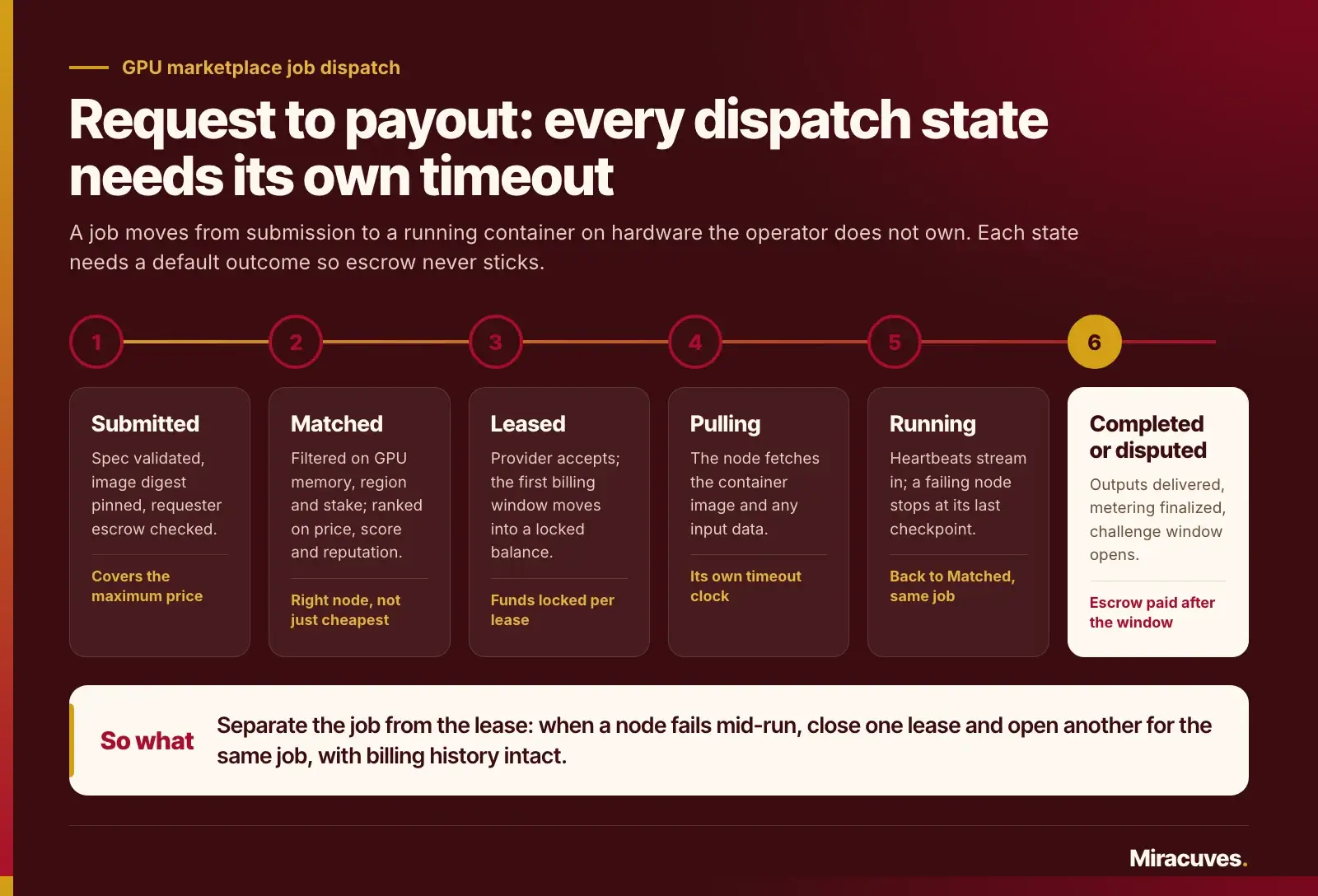
Every one of those states needs a timeout and a default outcome. A lease that ends in an ambiguous state with no rule for what happens next is how escrow gets stuck for days.
If providers run Kubernetes clusters rather than single hosts, the same rules apply one layer down. Kubernetes exposes GPUs as a custom schedulable resource through the vendor’s device plugin, expects GPUs in the container’s limits, and uses node labels and selectors to steer pods to a particular GPU type, as the Kubernetes GPU scheduling guide describes. Map your own unit classes onto those labels instead of reinventing placement inside each cluster.
Three placement problems that show up after launch
- Multi-GPU jobs. Four cards in one chassis on a fast interconnect behave nothing like four cards on separate hosts talking over the public internet. “Four GPUs on one node” and “four GPUs anywhere” are different products at different prices.
- Data gravity. A cheap node on another continent is not cheap if the job must pull a large dataset before it starts. Put estimated transfer time into the ranking.
- Urgency. Some jobs can wait an hour for a better price; others need a GPU now. A single urgency field that widens or narrows the price ceiling and the candidate pool does more for fill rates than a clever ranking formula.
How do you prove the work actually ran?
No verification method is free. Each trades compute overhead, latency and engineering effort against how much cheating it catches, so working networks combine two or three and apply them differently per workload class.
| Method | How it works | Overhead | What it catches | Weak spot | Best fit |
|---|---|---|---|---|---|
| Redundant execution | The same task runs on two or more independent nodes and outputs are compared | Doubles or triples compute on checked tasks | Skipped work, fake outputs, wrong hardware | Floating-point nondeterminism on GPUs breaks exact matching, so tolerance rules are needed | Batch inference, rendering frames, deterministic jobs |
| Canary and spot checks | Known-answer tasks hidden inside normal traffic | Low to moderate, tunable by sampling rate | Lazy or dishonest nodes over time | A node that cheats rarely can slip through for a while | Every workload class, especially new providers |
| Trusted execution attestation | Hardware signs a report of the code and environment that ran | Small runtime cost, heavy integration work | Tampered runtimes and host snooping on data | Only works on supporting hardware; trust moves to the chip maker’s signing keys | Sensitive data and regulated requesters |
| Optimistic with challenge window | Results are accepted unless someone disputes them within a set period | Very low until a dispute happens | Fraud that a watcher can prove | Needs active challengers and a cheap way to re-run work | Long training runs with saved checkpoints |
| Telemetry and reputation only | Pay on heartbeats and reported resource usage | Lowest | Outright downtime | Telemetry is self-reported and easy to fake | Low-value or hobby workloads |
Training is the awkward class. A multi-day run cannot be re-executed cheaply, and its outputs are not bit-for-bit deterministic anyway. A practical design verifies checkpoints instead: reproduce a few training steps from a saved checkpoint on a second node and compare loss values within a tolerance band. That catches a node that skipped work without paying to run the whole job twice.
Store the full verification result against the lease, not a pass or fail flag. When a dispute arrives weeks later, the resolver needs the inputs, the expected output, the returned output and the tolerance that was applied.
Slashing fraud without punishing bad luck
Slashing gives verification teeth: a provider who fakes results should lose more than cheating could earn. But a penalty system that burns stake over network blips will drain your supply side faster than any rival.
Ethereum’s proof of stake is a useful reference. According to its documentation on rewards and penalties, validators are slashed only for three provable offenses: proposing two different blocks for the same slot, double voting, and casting a “surround” vote. A slashed validator loses a small amount at once, then enters a 36-day removal period. On day 18 an extra correlation penalty applies, sized by how much stake was slashed across the network in the preceding 36 days, so an isolated mistake costs little while a mass event can cost a validator its whole balance. Two ideas transfer directly: slash only for what you can prove, and penalize harder when many nodes misbehave together, because that looks like a coordinated attack rather than bad luck.
Separate faults from fraud
- Liveness faults: missed heartbeats, a node dropping mid-job, a failed image pull. Handle with reputation loss, forfeited lease revenue and temporary delisting, not stake burns.
- Performance faults: a node running well below its listed score. Re-score and reprice it; slash only when the gap is large and the claimed profile was plainly false.
- Provable fraud: a canary answered with a fabricated output, a spoofed hardware report caught by attestation, a checkpoint a second node cannot reproduce. These are slashable.
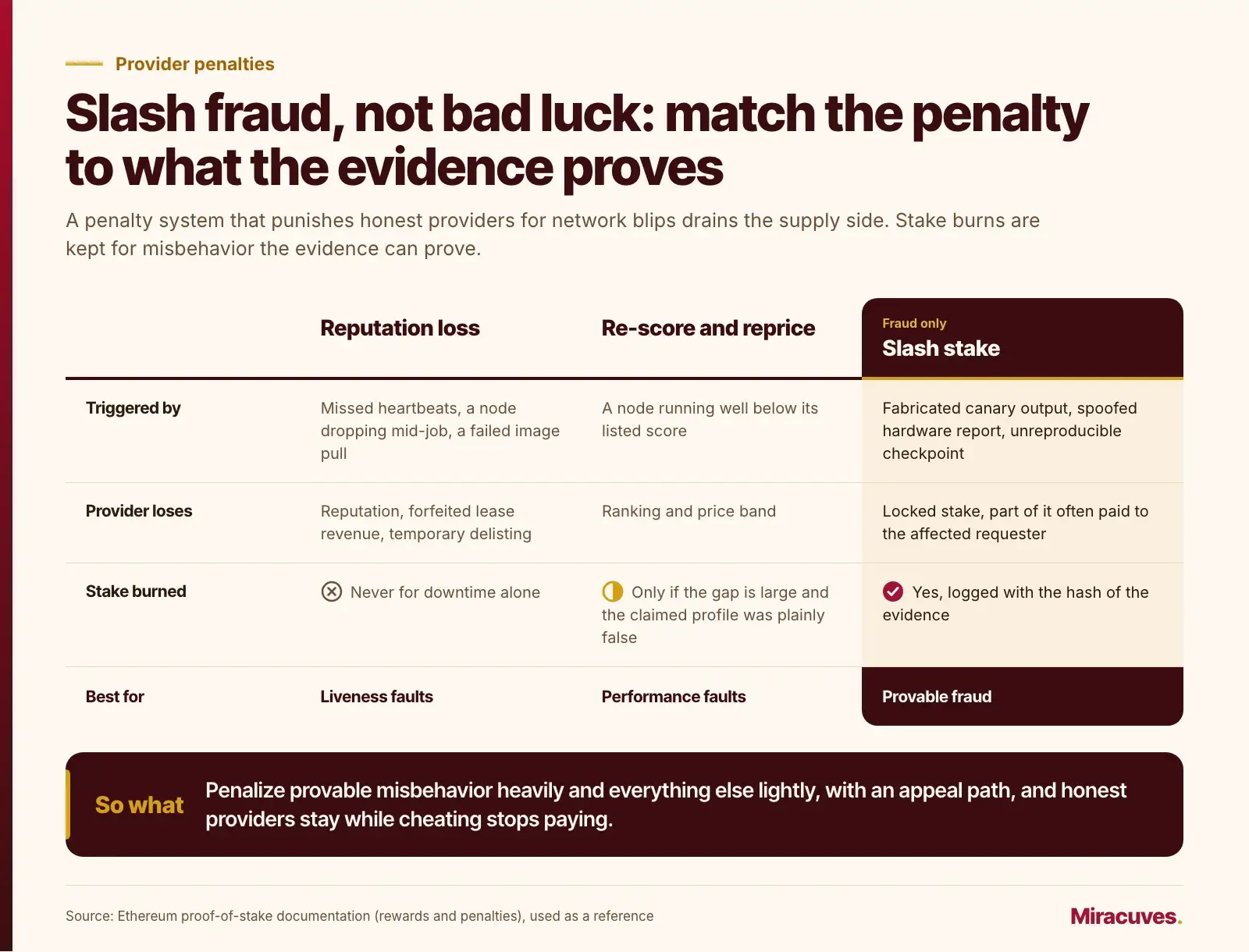
Who decides, and where the money goes
Slash automatically on clear-cut evidence. Send anything ambiguous through a dispute flow: freeze the evidence record, give the provider a fixed window to respond, and let a resolver decide. At launch the resolver is usually a staff role; an arbitration contract or token-holder vote can join later. Log every decision with the hash of the evidence it relied on, so a provider slashed three times in a month from one site stands out from three providers slashed once each.
Decide before launch where slashed funds go. One workable split is to compensate the affected requester and burn or pool the rest. Paying a share to whoever raised the dispute encourages watchers, but keep it below the cost of a false challenge so disputes never become a harassment business.
Metering, escrow and how prices get set
Billing here is metered, not invoiced. The requester pre-funds a balance, each lease locks a slice of it, and the platform settles usage per interval, often per second or per minute of GPU time.
The metering data comes from the node agent, which the provider controls, so cross-check it: against heartbeat gaps, against requester-side job logs where they exist, and against what the verification layer saw. Where the sources disagree, bill the lower figure and flag the lease for review.
Release payouts only after the challenge window closes, and hold a small rolling reserve from new providers. It slows their cash flow a little and spares you from paying for work that later proves fake. The same routing questions come up in any marketplace that holds buyer funds; this breakdown of escrow routing failures in AI marketplaces covers the ones that most often go wrong.
Settlement currency is a product decision with legal weight. Paying providers in a native token creates incentives but adds volatility and, depending on where you operate, financial regulation that needs a lawyer’s review before launch. Stablecoin or fiat payouts are easier to price, and any conversion between them is better handled by a regulated partner than by your own code.
Four pricing models and what each one asks of the software
Two public networks show the main patterns. On Akash Network, a deployment states its resources and a maximum price, providers bid at or below that cap during a short window, the requester accepts one bid to create a lease, and the provider is paid per block (roughly every six seconds) from the requester’s escrow. On Vast.ai, on-demand instances have fixed prices and high priority, reserved instances trade a commitment for a discount of up to 50 percent, and interruptible instances run on bids and can be paused when outbid or when someone requests on-demand capacity (checked November 2026).
| Model | How the price is set | What the platform must build | Fits |
|---|---|---|---|
| Fixed offer | Provider posts a price per GPU-hour for a unit class | Offer book, suggested price per class, simple metering | Launch, thin supply |
| Reverse auction | Requester posts a job and a maximum price, providers bid under it | Bid window, bid deposits, award rules, lease creation on acceptance | Batch jobs where a few minutes of delay is fine |
| Interruptible | Lowest bid-based price, preempted by higher bids or on-demand rentals | Priority queue, pause and resume, checkpoint reminders to requesters | Fault-tolerant training and rendering |
| Reserved | Discount in exchange for a prepaid term | Commitments, prepaid balances, capacity holds, refund rules | Steady inference and long training programs |
A sensible launch uses fixed offers and a platform-suggested price per GPU class, then adds auctions once supply is deep enough that bidding fills jobs faster instead of pushing honest operators into a race to the bottom. Whatever you offer, price by unit class rather than by node: a data-center card with large memory and a fast interconnect and a consumer gaming card are different products. Store the price that applied on the lease itself, so a later price change never rewrites an invoice.
Running strangers’ code on strangers’ machines
The risk runs both ways. A requester’s container could try to escape and attack the host. A provider could inspect a requester’s model weights or training data while the job runs.
On the host side, isolate each job in its own container or lightweight virtual machine, with no access to the host network, read-only base images, pinned image digests and a fresh filesystem per lease. NIST’s Application Container Security Guide (SP 800-190), published in September 2017, lists the main container risks and countermeasures, and works as a checklist when hardening the node agent.
On the requester side, be honest in the product about what a provider can see. Without hardware-backed isolation, anyone with root on the host can in principle read GPU memory. Encrypt datasets at rest and in transit, let requesters restrict jobs to vetted providers in named jurisdictions, and offer a separate confidential tier for sensitive work.
A confidential tier for private models and data
This tier is buildable on mainstream data-center hardware. In April 2024 NVIDIA announced general access to single-GPU passthrough with confidential computing on H100 GPUs (CUDA 12.4), which requires a CPU running a VM-based trusted execution environment such as AMD SEV-SNP or Intel TDX. NVIDIA’s trusted computing documentation covers how a workload verifies the GPU hardware and its security configuration before secrets are released to it. Turn that into product rules:
- Attestation is a listing attribute. A node qualifies for the tier only while its latest attestation passes, and the evidence is stored with the lease like any other verification record.
- Keys come from a key service, not the provider. The requester’s decryption keys go to the workload after attestation succeeds, so the provider never holds them in the clear.
- Price it as its own class. Confidential mode adds setup work for providers and some runtime overhead, so it is a premium class with fewer, better-vetted nodes.
- Say what it does not cover. Attestation proves which environment ran, not that the job produced the right answer. Canaries and checkpoint checks still apply.
When jobs contain personal data
If a requester sends personal data, say customer conversations for fine-tuning, your platform and its providers join a processing chain. Article 28 of the GDPR says a processor may not engage another processor without the controller’s prior specific or general written authorization (28(2)), and that the same data protection obligations must be passed down to that other processor by contract or other legal act (28(4)). For a compute network, that means requesters need to see and approve which provider classes can touch their jobs, and provider terms must carry the same obligations.
Region filters, provider vetting levels and a per-job record of where the work physically ran turn that requirement into product features. They also shorten enterprise sales calls, because “where did my data go?” gets answered with a report, not a promise.
Build it, rent it, or start from a base
Owning the platform pays off when:
- You control or can recruit supply, and the marketplace logic has to fit those providers’ contracts.
- Your requesters have rules a shared network will not meet: specific jurisdictions, vetted providers only, per-job audit logs or private settlement.
- The take rate is your business model, so dispatch, pricing and penalty rules are exactly what you compete on.
- You need your own token economics or settlement on a particular chain.
Renting capacity, or launching on top of an existing network, is the better call when you are still testing whether requesters will pay, when you have no supply relationships yet (a marketplace with software and no GPUs is an empty shop, and recruiting providers is a sales job before it is an engineering one), or when your team cannot staff ongoing protocol work. Penalty parameters, canary rates and fraud rules need tuning for as long as the network runs.
There is a middle path: launch on white-label marketplace software that already handles payments, commissions and admin controls, under your own brand, contracts and pricing, then replace modules such as the matcher or the verification layer once volume shows where the defaults fall short.
What a first release costs: an illustrative estimate
Scope is set by the verification mix, the number of workload classes and how settlement works. The phases below assume a single-node, canary-verified launch. The durations are planning assumptions, not quotes, and several phases run in parallel.
| Phase | Scope | Main cost drivers | Planning assumption |
|---|---|---|---|
| Discovery and protocol design | Data model, verification mix, stake and slashing parameters, chain choice | Workload classes, token or stablecoin settlement, legal review of payouts | 3 to 5 weeks |
| Core platform | Node agent, benchmark harness, canary scheduler, matcher, job state machine, metering | GPU classes supported, container isolation hardening, telemetry volume | 12 to 16 weeks |
| Contracts and payouts | Stake, escrow, challenge window, payout reconciliation | Chain and upgrade pattern, independent smart contract audit quoted by the auditor | 6 to 8 weeks, alongside the core |
| Apps and admin console | Requester and provider apps, role-based operations console | Number of roles, mobile scope, reporting | 8 to 10 weeks, alongside the core |
| Testnet pilot | Invited providers, canary tuning, dispute drills, load tests | Provider recruitment, support staffing | 4 to 8 weeks |
| Later releases | Multi-node training, attested tier, auctions, dispute votes | Evidence of demand from the pilot | Ongoing |
Run in sequence, discovery, core build and pilot add up to roughly 19 to 29 weeks, or about four and a half to seven months, from kickoff to a paid launch. To turn it into a budget for an in-house US team:
- Team (assumption): two distributed-systems engineers, one smart contract engineer, one DevOps engineer, one web and one mobile engineer, one QA engineer, plus half-time design and project management, about 8 people.
- Build time (assumption): 16 to 24 weeks, or 5,120 to 7,680 hours at 40 hours a week.
- Rate: the Bureau of Labor Statistics puts the median annual wage for US software developers at $135,980 in May 2025, about $65 an hour. Wages and salaries were 70.0 percent of private-industry employer compensation costs in June 2026 according to the BLS employer cost release, which gives a loaded rate near $93 an hour.
- Result: roughly $480,000 to $720,000, excluding the smart contract audit, hosting, legal review and provider incentives. Teams in other regions, or a ready-made marketplace base, bring it down considerably.
The audit and the incentive budget are the two lines that are easiest to leave out. Both scale with the value the contracts will hold and the supply you need to attract, so price them before committing to a launch date.
Where early compute networks break
- Benchmark gaming: providers tune for the known test. Counter with hidden canaries and randomized test timing.
- Supply without demand: token incentives attract idle nodes that no requester uses. Reward completed, verified work rather than uptime.
- Consumer cards in server listings: gaming GPUs with less memory and no fast interconnect listed beside data-center cards. Make unit class a hard filter, not a free-text label.
- Silent driver drift: a provider updates a driver and a requester’s image stops working. Pin compatible version ranges in the offer and re-test after every reported change.
- Dispute overload: every failed job becomes a manual review and support turns into the bottleneck. Automate the clear cases and keep people for the rest.
- One-region concentration: early supply clusters where power is cheap, and one local outage or policy change takes half the network offline. Track supply share by region and price incentives to spread it.
None of these are exotic. They are what happens when money sits next to self-reported data, and the platform’s job is to keep checking that data against something it controls.
Where Miracuves fits
Miracuves builds custom software, including blockchain and marketplace platforms, and can start a compute marketplace from a ready-made marketplace base or write it from scratch. For a network like this, the first release we would scope is the loop that proves the business: provider onboarding with a benchmark harness and canary scheduler, a matcher for single-node jobs, stake and escrow contracts, and metered payouts after the challenge window. Multi-node training, a confidential tier and dispute votes come later, once pilot traffic shows which of them requesters will pay for.
Requesters and providers get native Android and iOS apps for jobs, balances and node alerts; operations, dispute and finance staff work from a browser-based admin console with a view per role. You receive the full source code, so your own team can retune canary rates and penalty parameters as the network grows. When enterprise requesters ask about ISO 27001, SOC 2 or GDPR, we build to the controls and take you through the audit with a partner; any certificate or report is issued to your company.
If you are weighing a build, start with supply: who the first providers are, what hardware they run and which requesters they can serve. Bring that to a scoping call with our blockchain development team and we will map it to a first release and a custom quote.
Frequently Asked Questions
What is a decentralized GPU marketplace?
It is a platform where independent GPU owners list spare capacity and buyers rent it for training, inference or rendering jobs. The software checks listed hardware, places each job on a suitable node, verifies that the work ran and settles payment. Stake and escrow are usually held in smart contracts, so buyers and providers do not have to trust each other directly.
How do decentralized GPU networks verify that work was done?
A sound design combines several methods. Hidden canary jobs with known answers catch dishonest nodes over time, redundant execution compares outputs from two nodes for deterministic work, checkpoint replay re-runs a few training steps on a second node, and hardware attestation proves which environment ran. Results that nobody disputes within a challenge window are then accepted and paid.
Can GPU providers fake their hardware specs?
They can try. A modified node agent can report a better card than the one installed, and honest machines also drift through throttling or old drivers. That is why a marketplace should treat listed specs as a claim, then confirm them with its own benchmarks, randomized re-tests and canary jobs mixed into paid traffic, and let scores decay without fresh evidence.
How do providers get paid on a decentralized compute network?
The requester pre-funds an escrow balance and each lease locks part of it. Usage is metered per interval, cross-checked against heartbeats and verification data, and released to the provider after the challenge window closes. On Akash Network, for example, providers are paid per block from the requester’s escrow. Some networks pay in a native token, others in stablecoins or fiat.
Is it safe to run a private model on someone else’s GPU?
Not by default, because anyone with root on the host can in principle read GPU memory. For sensitive work, use a confidential tier: GPUs such as the H100 running in confidential computing mode alongside a CPU trusted execution environment, with keys released only after attestation succeeds. Encryption, vetted providers and region limits add further protection.
How much does it cost to build a decentralized GPU marketplace?
It depends on the verification mix, workload classes and settlement design. As an illustration, an 8-person in-house US team building for 16 to 24 weeks at a loaded rate near $93 an hour, based on BLS wage and compensation data, comes to roughly $480,000 to $720,000 before the contract audit, hosting, legal review and provider incentives.
Should I build a GPU marketplace or just rent GPUs?
If you need compute for your own models, rent it from an existing network or a cloud. Building makes sense when you control or can recruit GPU supply, need your own settlement or token rules, or serve requesters with jurisdiction and audit requirements that a shared network will not meet.
Miracuves is an independent software development company. We are not affiliated with, connected to, sponsored by, or endorsed by any company or product named in this article.
Terms such as “X Clone” are used descriptively. It is how the software industry refers to building a platform with functionality comparable to a known service, and how clients search for it.
The entire design and codebase of our products is built by our own team. Our products contain no code, design, graphics, or content originating from any third-party website or applications.
All third-party names and marks referenced in this article are the property of their respective owners, referenced solely to identify the services discussed.