

Key Takeaways
- AI-built marketplaces often fail when money routing gets complex.
- Escrow, split payments, refunds, and payouts need structured logic.
- Payment APIs provide rails, not marketplace financial architecture.
- Admin teams need clear transaction, payout, and dispute visibility.
- A marketplace clone foundation can reduce financial workflow risk.
Escrow Failure Signals
- Track where funds sit at every transaction stage.
- Map commissions, seller payouts, refunds, and dispute holds.
- Avoid manual payout fixes through spreadsheets.
- Log payment states, payout states, and admin actions.
- Test partial refunds, chargebacks, cancellations, and failed payouts.
Real Insights
- Marketplace money movement is not a simple checkout flow.
- AI can split amounts but may miss ledger integrity.
- Weak payout logic damages buyer and seller trust.
- Source-code ownership helps customize financial rules later.
- Miracuves builds marketplace apps with escrow-ready payment workflows.
AI has made marketplace prototyping faster than ever. A founder can prompt an AI tool to generate user dashboards, listing pages, booking flows, payment buttons, and even basic payout logic in a few days. That speed feels powerful in the beginning.
Then the real marketplace problem appears: money does not move in a straight line.
A buyer may pay once, but the platform may need to route funds across a seller, service provider, delivery partner, freelancer, affiliate, tax layer, platform commission, refund reserve, or dispute hold. In some cases, money must be captured today, held until delivery, partially released after milestone approval, refunded after a dispute, or split between several parties after platform fees are deducted.
This is where many AI-built marketplace startups begin to collapse. The interface works. The checkout button works. The demo looks convincing. But the financial routing underneath is fragile.
Stripe Connect and similar marketplace payment infrastructure can support complex money movement, including separate charges and transfers where one customer payment can later be transferred to multiple connected accounts. However, the platform still needs to define the business rules, ledger logic, refund behavior, payout timing, and admin controls correctly.
Payment APIs provide rails. They do not automatically design your marketplace’s financial operating model.
For founders building with AI, this creates a critical decision point: should you keep prompting, patching, and debugging financial logic, or should you migrate to a marketplace architecture that already understands escrow, split payments, admin controls, disputes, and payout workflows?
The Limits of LLMs: Why AI Cannot Map Multi-Party Financial Ledgers
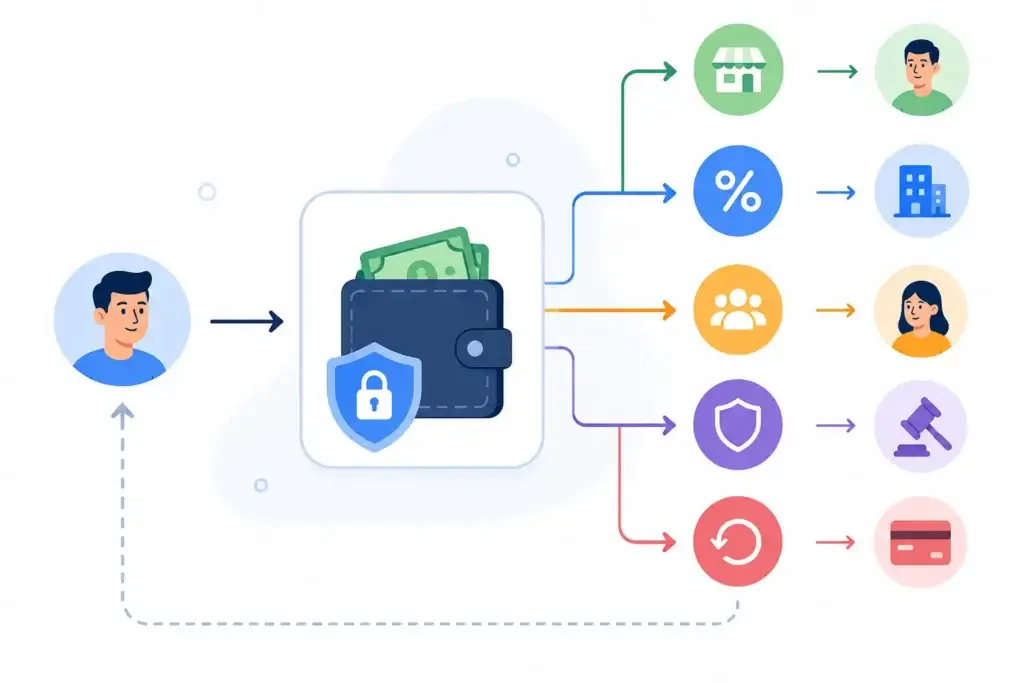
Image Source: AI-generated visual by Miracuves
Large language models are useful for generating code patterns, explaining APIs, drafting database schemas, and creating early product flows. But a marketplace financial ledger is not just a code pattern. It is a record of financial truth.
In a simple ecommerce store, the payment path may be easy to understand: customer pays the business, the business ships the product, and revenue is recorded. A marketplace is different. The platform operator may not be the final seller. The payment may involve a buyer, seller, service provider, platform, payment processor, tax layer, delivery partner, affiliate partner, refund reserve, or dispute process.
That means the system must answer questions such as:
- Who owns the money at each stage of the transaction?
- When should funds be released?
- What happens if the buyer cancels before fulfilment?
- What happens if only part of the order is refunded?
- Who absorbs chargebacks, payment gateway fees, and penalties?
- How are platform commissions calculated when discounts or coupons are involved?
- Can the admin team manually hold, approve, reverse, or adjust a payout?
An AI-generated function may split a payment into percentages, but that is not the same as marketplace payment architecture. Real routing requires transaction states, ledger entries, audit logs, payout rules, dispute states, role-based permissions, and reconciliation reports.
Stripe’s Connect documentation shows that platforms can create a charge and transfer funds to connected accounts, including multiple connected accounts in separate charges and transfers. It also notes that the platform account can be debited for Stripe fees, refunds, and chargebacks depending on the payment structure.
That detail matters because payout architecture is not only about sending money. It is also about knowing who carries financial responsibility when something goes wrong.
Why Demo-Ready Payment Logic Fails Under Real Marketplace Pressure
Most AI-generated marketplace payment logic works only for the happy path:
- A buyer pays.
- The platform takes a fixed commission.
- The seller receives the remaining amount.
That is not enough for a real marketplace.
The moment you add multiple sellers, milestone payments, late cancellations, delivery disputes, failed payouts, refunds, wallet balances, coupons, taxes, withdrawal requests, or payout delays, the logic becomes more complex.
This is why founders often feel that their AI marketplace is “almost working” for months. They are not fixing one bug. They are trying to build a financial control layer after the product has already been assembled without one.
Read More: The Un-Indexed Trap: Why AI Schemas Cause Exponential App Latency
Where Escrow Routing Breaks in AI-Built Marketplace Apps
Escrow-style routing breaks when the product has no reliable system for holding, releasing, reversing, or reconciling funds.
In many marketplace categories, buyers expect protection before funds are released. Sellers and service providers expect transparent payout timing. The platform operator needs visibility into every transaction state.
Competitor marketplace clone pages often mention escrow as a feature. But the problem is that founders do not only need the word “escrow” on a feature list. They need to know whether the marketplace can support real transaction complexity.
Common Escrow Routing Failure Points
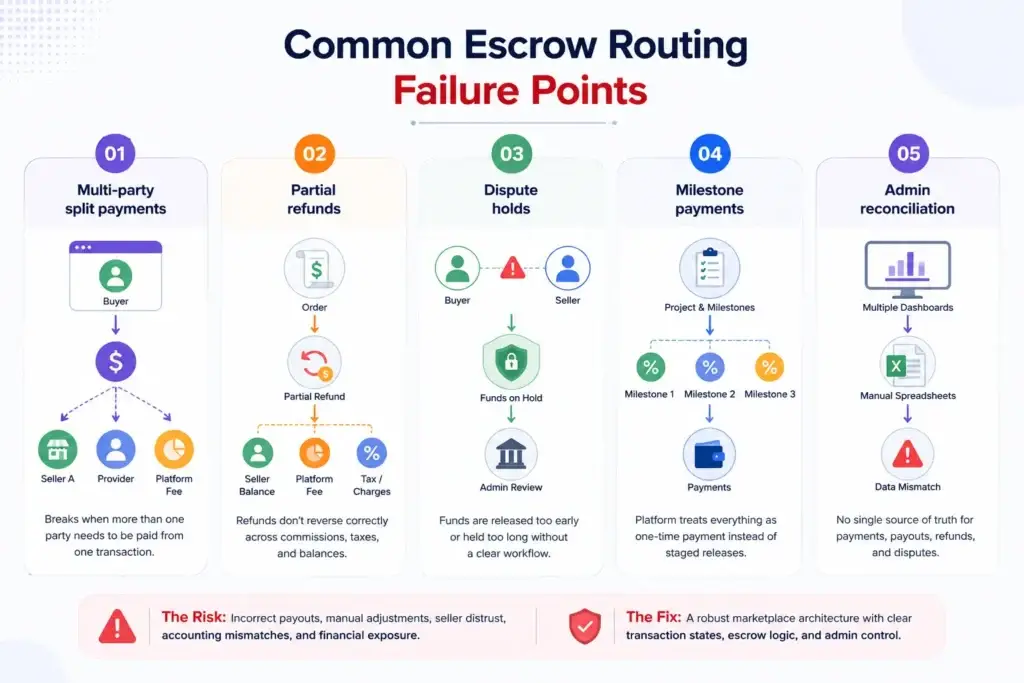
Image Source: AI-generated visual by Miracuves
| Failure Point | What Usually Happens in AI-Built Logic | Business Risk |
|---|---|---|
| Multi-party split payments | The code handles one seller but breaks when two or more parties must be paid from one transaction. | Incorrect payouts, manual adjustments, and seller distrust. |
| Partial refunds | The system refunds the buyer but does not correctly reverse commission, tax, seller balance, or platform fees. | Accounting mismatch and platform-side loss. |
| Dispute holds | Funds are either released too early or locked without a clear admin workflow. | Buyer complaints, seller frustration, and operational delays. |
| Milestone payments | The marketplace treats all payments as one-time checkout events. | Freelance, service, and B2B marketplaces cannot support staged work properly. |
| Admin reconciliation | There is no clean ledger view showing payment state, payout state, refund state, and dispute state. | The founder depends on spreadsheets to understand revenue and liability. |
The Technical Debt of Patching AI Financial Logic
Technical debt in marketplace payments is different from technical debt in a landing page or profile screen.
A broken profile image uploader is inconvenient. A broken escrow release rule can create real financial exposure.
When founders patch AI-generated payment logic, they often add quick fixes such as:
- Extra conditional statements for one refund scenario.
- Manual admin override buttons without audit logs.
- New database columns for payout status without a proper ledger model.
- Webhook handlers that update balances inconsistently.
- Temporary scripts to correct seller balances after errors.
These patches may keep the demo alive, but they weaken the product foundation.
Over time, every new marketplace rule becomes harder to implement because the original financial model was never designed around transaction states and ledger integrity.
This is the point where founders should stop asking, “Can AI generate another fix?” and start asking, “Is this architecture safe enough for real users, real money, and real disputes?”
Founder Decision Signals
Speed
If every payment change requires another round of prompting, testing, and emergency patching, the product is no longer moving fast. It is accumulating operational drag.
Cost
AI-generated code may look cost-efficient at first, but financial bugs create hidden costs through developer rework, manual reconciliation, payout disputes, and founder time.
Scalability
A marketplace cannot scale if its payment model works only for one buyer and one seller. Multi-party routing must be designed before transaction volume increases.
Market Fit
If users do not trust payouts, refunds, and dispute handling, marketplace liquidity suffers even when demand exists.
Framework: When to Stop Prompting and Start Migrating
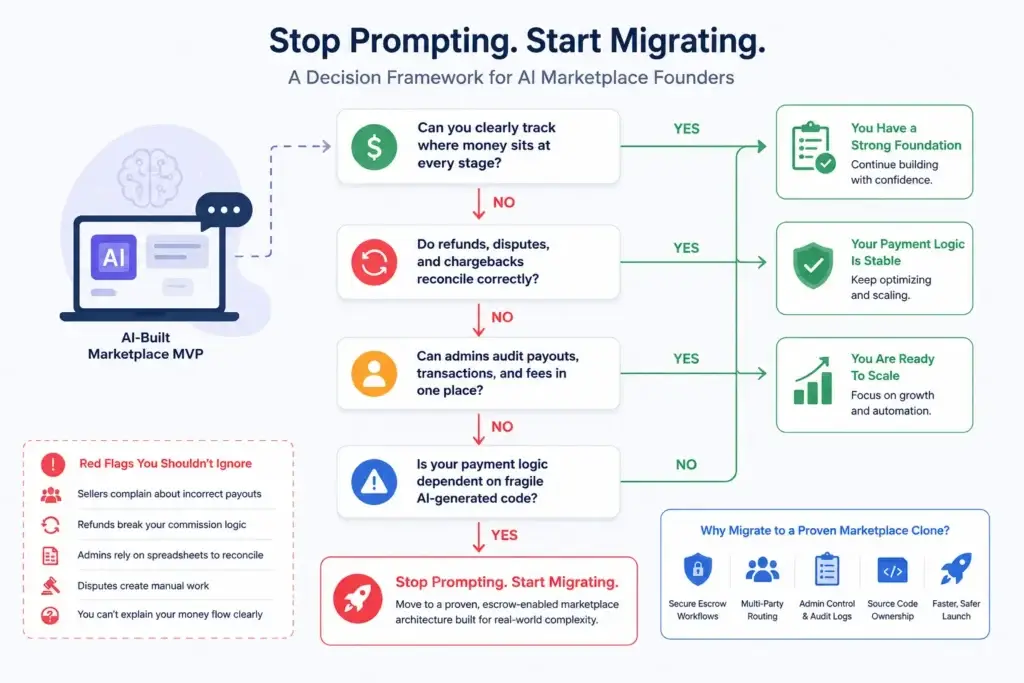
Image Source: AI-generated visual by Miracuves
AI is useful during exploration. It becomes risky when founders use it to patch financial routing without a clear architecture.
The decision is not “AI or no AI.” The better question is whether AI is helping you validate the product or masking deeper payment infrastructure problems.
Signal 1: You Cannot Explain Where Money Sits at Every Stage
A founder should be able to explain the full lifecycle of a transaction:
- Payment initiated
- Payment authorized or captured
- Funds held or pending
- Platform commission calculated
- Seller or provider payout scheduled
- Refund or dispute handled
- Final ledger state reconciled
If the team cannot explain this clearly, the issue is architectural. More prompting will not solve the absence of a transaction model.
Signal 2: Refunds and Disputes Break Your Payout Rules
Refunds expose weak payment logic quickly.
A full refund is simple. A partial refund after a seller has already been paid is not. A dispute after a milestone release is even more complex.
If every refund scenario requires manual database updates, the marketplace is not ready for scale.
Signal 3: Admin Teams Need Manual Reconciliation
Manual reconciliation is one of the strongest signs that an AI-built marketplace has outgrown its prototype stage.
If admins must compare payment gateway dashboards, seller balances, platform revenue, and spreadsheets to understand what happened, the product needs a stronger financial control layer.
Signal 4: Your Payment Logic Depends on Fragile Prompt-Generated Code
AI-generated code can be helpful, but payment logic should not be a collection of disconnected snippets.
Marketplace routing needs predictable states, testable rules, gateway-aware workflows, and audit trails. If the codebase is difficult to reason about, the founder is taking on avoidable risk.
Signal 5: You Are Building a Marketplace Category That Requires Trust
Freelance marketplaces, rental marketplaces, service marketplaces, B2B marketplaces, recommerce platforms, and high-value booking platforms often need stronger buyer and seller protection.
If trust is central to the transaction, escrow routing is not a later feature. It is part of the product foundation.
Read More: AI MVP Security Audit: The 14-Point Checklist for Founder Survival
The Escrow Standard: Why Marketplace Architecture Needs a Proven Foundation
A marketplace clone should not simply copy screens from an existing platform.
The real value is that it gives founders a proven operating structure: users, providers, listings, orders, payments, commissions, disputes, notifications, dashboards, and admin workflows already working together.
Miracuves helps founders, startups, agencies, and businesses launch digital products faster using ready-made, white-label, source-code-owned clone app solutions and custom app development services.
For marketplace founders, that matters because payment routing is not isolated from the rest of the product. It affects onboarding, listings, bookings, dispute management, seller trust, and platform revenue.
Explore Miracuves’ marketplace and clone app solutions .
What an Escrow-Enabled Marketplace Clone Should Include
| Architecture Layer | What It Should Handle | Founder Impact |
| User and provider workflows | Buyer, seller, provider, freelancer, vendor, or host roles depending on the marketplace model. | Clear separation of responsibilities across marketplace participants. |
| Transaction states | Pending, paid, held, completed, refunded, disputed, cancelled, and released states. | Better visibility into where each transaction stands. |
| Commission logic | Fixed fees, percentage commissions, subscriptions, listing fees, featured placement, or milestone-based deductions. | More flexible monetization without rebuilding payment logic each time. |
| Escrow-style workflows | Funds held until delivery, milestone approval, booking completion, or admin release depending on the business model. | Improves trust between buyers and sellers. |
| Admin control | Dispute review, payout approval, user verification, transaction reports, refund controls, and activity logs. | Reduces operational chaos as transaction volume grows. |
| Source-code ownership | Ability to customize payment rules, integrations, and marketplace workflows over time. | Protects long-term flexibility and reduces vendor lock-in. |
Why Source-Code Ownership Matters for Financial Routing
Marketplace founders often underestimate how much their payment logic will change after launch.
Early assumptions rarely survive real user behavior. Sellers may ask for faster payouts. Buyers may demand stronger protection. The platform may introduce subscriptions, cancellation fees, affiliate commissions, delivery incentives, milestone releases, or region-specific payment rules.
If the founder does not own or control the source code, every financial routing change becomes a dependency.
This is risky in marketplace businesses because revenue logic, payout logic, and trust logic evolve together.
A source-code-owned marketplace foundation gives founders more control over:
- Commission changes
- Payment gateway integrations
- Escrow-style workflows
- Refund and dispute rules
- Admin dashboards
- Role-based access
- Custom marketplace monetization
Miracuves’ white-label marketplace approach is useful for founders who want a launch-ready product foundation without surrendering long-term control over the architecture.
How Miracuves Helps Founders Move From Broken Payment Logic to a Launch-Ready Marketplace
When a marketplace founder reaches the escrow routing failure stage, the goal should not be to keep patching unstable code.
The stronger move is to preserve what has been learned from the AI prototype and migrate the business logic into a more reliable product foundation.
Miracuves helps founders build ready-made and white-label marketplace solutions with branded design, admin control, source-code ownership, and faster deployment.
For marketplace categories such as freelance platforms, service marketplaces, rental marketplaces, ecommerce marketplaces, and local service platforms, this approach helps founders avoid rebuilding core marketplace flows from zero.
For example, a freelance marketplace may need milestone payments, proposal flows, client dashboards, freelancer workflows, dispute handling, and secure payment controls.
A rental marketplace may need booking calendars, host payouts, cancellation rules, deposits, and refund workflows.
An ecommerce marketplace may need vendor commissions, order-level settlements, shipping status, refund handling, and seller dashboards.
The architecture changes by category, but the principle remains the same: marketplace money movement must be designed as part of the product foundation, not attached later as a fragile AI-generated patch.
Mistakes Founders Should Avoid
Using AI to Patch Every Payment Edge Case
Prompting another fix may solve one scenario, but it often creates new problems in refunds, disputes, payout timing, or reconciliation. Marketplace payments need system design, not endless patches.
Treating Escrow as a Feature Instead of an Operating Model
Escrow-style workflows affect buyer trust, seller payouts, dispute handling, admin controls, and platform liability. They must be connected to the full marketplace architecture.
Launching Without Admin Financial Visibility
If admins cannot see transaction state, payout state, refund state, and dispute state in one place, the marketplace will struggle as soon as transaction volume increases.
Ignoring Payment Provider Constraints
Payment providers have specific rules around connected accounts, regions, balances, fees, chargebacks, refunds, and payouts. Your marketplace architecture must respect those constraints from the beginning.
Final Thoughts: AI Can Prototype the Idea, But Marketplace Money Movement Needs Architecture
AI is useful for early exploration. It can help founders move faster, test interface ideas, and clarify user journeys.
But marketplace financial routing is not just another feature. It is the trust layer of the business.
When escrow, split payments, refunds, disputes, commissions, and payout timing begin to break, the founder is no longer facing a small development issue. They are facing an architecture decision.
The real question is not whether AI can generate another payment function. The real question is whether your marketplace has a financial foundation strong enough to support real users, real disputes, real sellers, and real revenue.
For founders who have already validated demand but are stuck in payment-routing chaos, Miracuves offers a practical next step: move from fragile AI-built logic to a ready-made, white-label marketplace clone with admin control, source-code ownership, and a more scalable architecture for escrow-enabled marketplace operations.
FAQs
What are escrow routing failures in a marketplace app?
Escrow routing failures happen when a marketplace cannot correctly hold, release, refund, or split funds between buyers, sellers, providers, and the platform. These failures often appear during partial refunds, disputes, milestone payments, multi-seller orders, or delayed payouts.
Can AI build marketplace split-payment logic?
AI can help generate early payment code or explain payment APIs, but it should not be trusted as the full financial architecture for a real marketplace. Split payments require ledger logic, transaction states, payout rules, dispute workflows, admin controls, and payment-provider compliance considerations.
When should a founder stop patching AI-generated marketplace payment code?
A founder should stop patching when refunds break payout rules, admins need spreadsheets to reconcile transactions, sellers complain about balances, disputes cannot be tracked clearly, or the team cannot explain where funds sit at every transaction stage.
Why is multi-party payment routing difficult in marketplaces?
Multi-party routing is difficult because one buyer payment may need to be divided across sellers, providers, affiliates, delivery partners, platform commissions, tax rules, refund reserves, and payout schedules. The system must also handle cancellations, chargebacks, disputes, and partial refunds.
Is Stripe Connect enough to solve marketplace escrow routing?
Stripe Connect provides powerful marketplace payment infrastructure, but founders still need to design the correct transaction logic, ledger model, admin workflows, refund rules, and payout behavior. Payment infrastructure provides the rails; marketplace architecture defines how money should move.
What should an escrow-enabled marketplace clone include?
An escrow-enabled marketplace clone should include buyer and seller workflows, transaction states, commission logic, payout rules, refund handling, dispute management, admin dashboards, activity logs, role-based access controls, and source-code flexibility for future customization.
How does Miracuves help marketplace founders with escrow and split payments?
Miracuves helps founders launch ready-made and white-label marketplace platforms with branded design, admin control, source-code ownership, and marketplace workflows that can support escrow-style payment logic, vendor/provider management, commissions, disputes, and scalable operations.
Miracuves is an independent software development company. We are not affiliated with, connected to, sponsored by, or endorsed by any company or product named in this article.
Terms such as “X Clone” are used descriptively. It is how the software industry refers to building a platform with functionality comparable to a known service, and how clients search for it.
The entire design and codebase of our products is built by our own team. Our products contain no code, design, graphics, or content originating from any third-party website or applications.
All third-party names and marks referenced in this article are the property of their respective owners, referenced solely to identify the services discussed.