
A creator membership platform is not successful because it has many features. It succeeds when the right features work together to help users discover creators, unlock paid access, and stay engaged long enough to create repeat revenue.
For founders, this distinction matters. A platform can have creator profiles, subscriptions, messaging, media uploads, payments, and an admin dashboard, but still fail if users cannot find relevant creators or if members do not understand why they should keep paying.
That is why feature planning should begin with the full user journey. A visitor arrives, explores creators, follows or previews content, chooses a membership tier, unlocks premium access, interacts with the creator, and returns because the experience feels valuable.
Miracuves helps founders build creator membership platforms with a ready-made, white-label foundation that can be customized around discovery, access control, engagement, monetization, and admin operations. The goal is not to overload the product with features. The goal is to launch with the features that move the business forward.
Key Takeaways
- Creator membership platform features should be planned around discovery, access, engagement, monetization, and admin control.
- Discovery features help new users find creators without depending only on external social media traffic.
- Access features such as free tiers, paid memberships, locked posts, and one-time unlocks help convert interest into revenue.
- Engagement tools like messaging, live sessions, comments, polls, notifications, and creator updates improve member retention.
- Founders should prioritize scalable admin, moderation, payment, analytics, and safety workflows from the beginning.
Why Feature Planning Matters Before Building a Creator Membership Platform
A creator membership platform has two sides: creators and paying members. Creators want tools to publish, price, promote, and manage their audience. Members want a smooth experience where they can discover creators, understand what is included, pay securely, and interact without friction.
The platform operator sits between both sides. They need admin control over users, creators, content, payments, reports, disputes, moderation, commissions, and platform rules.
This is why a random feature list is not enough. Founders need to ask:
- Will this feature help creators earn more consistently?
- Will this feature help members understand the value before paying?
- Will this feature increase repeat engagement?
- Will this feature create unnecessary operational complexity?
- Can the admin team manage this feature safely at scale?
A well-built creator membership platform should connect product design with business logic. Discovery should support acquisition. Access control should support conversion. Engagement should support retention. Payments should support monetization. Admin features should support platform control.
Discovery Features That Help Members Find the Right Creators
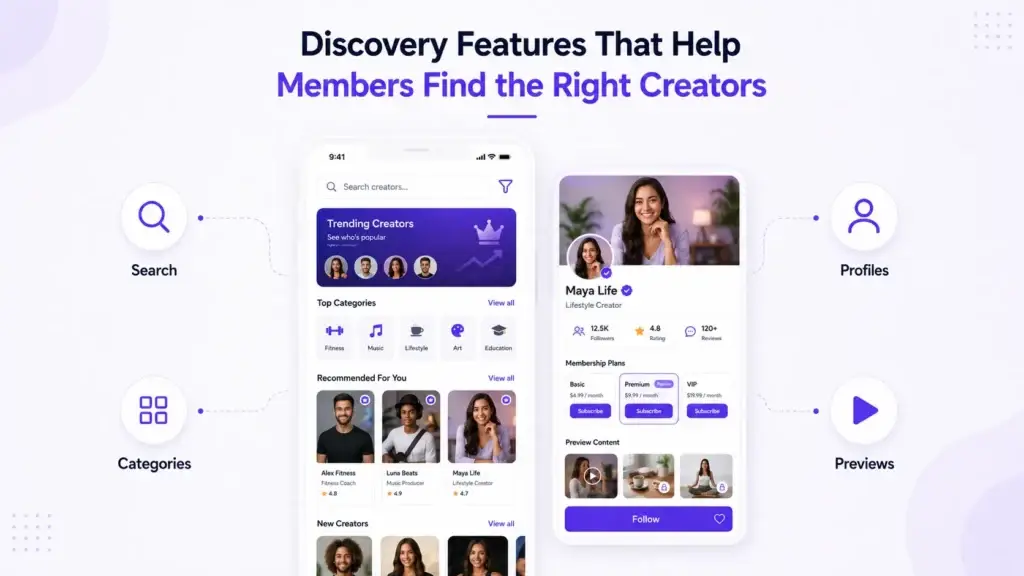
Discovery is one of the most important feature areas in a creator membership platform. Many founders assume creators will bring their own audience from social media, but that limits platform growth. If the platform itself helps users find relevant creators, it becomes more valuable to both creators and members.
Strong discovery features include search, categories, tags, creator profiles, filters, featured sections, trending creators, recommended creators, and preview content.
Search and Creator Filtering
Search should help users find creators by name, niche, category, language, location, content type, popularity, or pricing range. Basic search is useful, but advanced filtering creates a better discovery experience for users who do not arrive with a specific creator in mind.
For example, a member may want fitness coaching, music lessons, lifestyle content, premium community access, private workshops, or exclusive behind-the-scenes posts. Filters help reduce friction and move the user toward a decision.
Category and Tag-Based Browsing
Categories and tags help structure the platform. Without them, discovery becomes messy as the creator base grows.
Useful taxonomy features may include:
- Creator categories
- Content tags
- Trending topics
- Language filters
- New creator sections
- Featured creator placements
- Niche-based collections
This matters because a membership platform is not only a content library. It is a marketplace of creator-led experiences. Taxonomy helps users navigate that marketplace.
Creator Profile Pages
Creator profile pages should explain who the creator is, what members receive, which plans are available, and what type of content or engagement the creator offers.
A strong creator profile usually includes:
- Profile image and cover image
- Bio and creator introduction
- Membership tiers
- Free preview content
- Locked content indicators
- Recent posts
- Social proof signals
- Interaction options
- Subscribe or follow button
The profile page should reduce uncertainty. Before paying, users should understand what they are joining and why the membership is worth it.
Free Preview and Follow Options
Not every user will pay immediately. Free previews and follow options give users a low-friction way to enter the creator’s ecosystem.
A free tier can help creators build trust before asking for payment. It also gives the platform more engagement data, which can support better recommendations, creator ranking, and conversion insights.
For founders, this is important because paid conversion often improves when users can experience some value first.
Read more: How Does a Creator Membership Platform Combine Discovery, Memberships, and Paid Content?
Access Features That Turn Interest Into Paid Membership
Access control is the core revenue layer of a creator membership platform. It decides who can see what, when they can access it, and what they need to pay for.
The best platforms usually support more than one access model because creators have different audience sizes, content styles, and monetization strategies.
Membership Tiers
Membership tiers allow creators to offer different levels of access. A basic tier may include regular posts, while higher tiers may include private content, live sessions, community access, priority replies, or exclusive downloads.
A flexible tier system should allow creators to:
- Create free and paid tiers
- Set monthly or yearly pricing
- Edit benefits
- Restrict content by tier
- Upgrade or downgrade plans
- Manage renewal visibility
Tier flexibility matters because every creator has a different audience. A fitness coach, educator, entertainer, consultant, artist, and community leader may all need different membership structures.
Locked Content and Premium Unlocks
Locked content gives creators a way to monetize individual posts, media, guides, videos, or special updates without requiring every user to join a higher tier.
This is useful for users who are interested in one specific piece of content but not ready for a recurring subscription. It also helps creators generate revenue beyond standard membership fees.
One-Time Purchases
One-time purchases are useful for digital products, special content drops, templates, courses, event recordings, exclusive videos, or premium resources.
For founders, this adds monetization flexibility. It allows the platform to support both recurring revenue and transactional revenue.
Access Expiry, Renewal, and Upgrade Logic
Membership access must be managed carefully. The platform should handle renewals, failed payments, expired memberships, plan upgrades, downgrades, cancellations, and refund-related access changes.
This is where many early platforms struggle. If access rules are unclear, users become frustrated and creators lose trust in the platform.
A strong access system should make paid permissions automatic, transparent, and easy to manage.
Engagement Features That Keep Members Active After Joining
Getting a member to subscribe is only the first step. The bigger challenge is keeping that member engaged.
Engagement features help creators build relationships, create recurring value, and reduce churn. Without engagement, users may pay once and leave.
Direct Messaging
Direct messaging gives members a more personal connection with creators. Depending on the business model, messaging can be free, tier-based, request-based, or monetized through premium interactions.
Messaging should include controls such as inbox management, member status indicators, media sharing permissions, reporting options, and privacy settings.
For creators, messaging is a relationship tool. For the platform operator, it is also a moderation and safety responsibility.
Comments, Reactions, and Community Interaction
Comments and reactions help users feel involved. They also help creators understand what content resonates with their audience.
Useful engagement features include:
- Post reactions
- Threaded comments
- Comment moderation
- Pinned comments
- Creator replies
- Community guidelines
- Member-only discussions
These features can increase repeat visits because members come back to see responses, updates, and community activity.
Polls, Questions, and Feedback Prompts
Polls and questions allow creators to involve members in future content decisions. This improves perceived value because members feel they are shaping the creator experience.
For example, a creator can ask members what topic they want next, which live session time works best, or what kind of premium content they want included in the next release.
Live Sessions and Scheduled Events
Live sessions create urgency and real-time engagement. They can be used for workshops, Q&A sessions, coaching, performances, behind-the-scenes updates, group discussions, or exclusive member events.
Founders should ensure live features include scheduling, reminders, access control, chat moderation, replay settings, and payment rules where required.
Notifications and Re-Engagement
Notifications help bring members back to the platform. However, they should be useful, not noisy.
Effective notifications may include:
- New post alerts
- Live session reminders
- Creator reply alerts
- Membership renewal reminders
- New tier announcements
- Expiring offer notifications
- Message alerts
A thoughtful notification system can improve retention, but overuse can cause users to disable alerts or abandon the app.
Read more: Ready-Made Creator Membership Platform vs Custom Development: What Should Startups Choose?
Creator Tools That Help Creators Publish, Price, and Grow
Creators are not just users. They are the supply side of the platform. If creators cannot publish easily, manage members, understand performance, and earn with confidence, they may leave.
Creator Dashboard
A creator dashboard should give creators a clear view of their content, earnings, members, messages, subscriptions, and engagement performance.
Important dashboard modules include:
- Content management
- Membership tier management
- Earnings overview
- Subscriber/member list
- Engagement analytics
- Message management
- Payout status
- Performance insights
The dashboard should help creators make decisions, not just display numbers.
Content Upload and Scheduling
Creators need a smooth publishing workflow. The platform should support text, images, videos, audio, files, links, and scheduled posts depending on the product scope.
Scheduling is especially useful for creators who plan content calendars or serve members across different time zones.
Pricing Control
Creators should be able to set pricing for memberships, locked content, one-time purchases, premium interactions, and special offers where the platform allows it.
Pricing control helps creators test what their audience values. It also helps the platform support different creator segments instead of forcing every creator into the same model.
Analytics for Creators
Creator analytics should show what content performs, which tiers convert, where members drop off, and which engagement actions drive revenue.
Useful creator analytics may include:
- Profile visits
- Free-to-paid conversion
- Active members
- Content views
- Paid unlocks
- Revenue by tier
- Message engagement
- Churn signals
Analytics help creators improve their strategy. Better creator performance also improves platform revenue.
Admin Features That Give Operators Control Over the Platform
The admin dashboard is the control center of a creator membership platform. It helps the operator manage users, creators, content, payments, moderation, commissions, disputes, analytics, and platform rules.
Without strong admin features, the business becomes difficult to manage as activity increases.
User and Creator Management
Admins should be able to view, approve, suspend, verify, edit, or review user and creator accounts. This is especially important when the platform includes paid access, private communities, or user-generated content.
Admin controls may include:
- Account status management
- Creator approval workflows
- Verification review
- Role-based access
- Activity logs
- Profile review
- Support notes
Content and Category Management
Admins should control categories, tags, featured sections, restricted content rules, and discovery placements.
This helps the platform maintain quality while also shaping what users see first.
Commission and Revenue Controls
The platform should allow operators to define commission rules, payout logic, transaction visibility, and creator revenue reports.
Depending on the business model, commission rules may vary by creator, category, plan, promotion, or partnership arrangement.
Reporting and Analytics
Admin analytics should help founders answer business questions such as:
- Which categories attract the most users?
- Which creators convert free followers into paid members?
- Which membership tiers generate the most revenue?
- Where are users dropping off?
- Which engagement features drive retention?
- Which content types create repeat purchases?
These insights help founders improve the platform after launch.
Read more: Creator Membership Platform Business Model: How Creators, Followers, and Paying Members Connect
Monetization Features Every Founder Should Consider
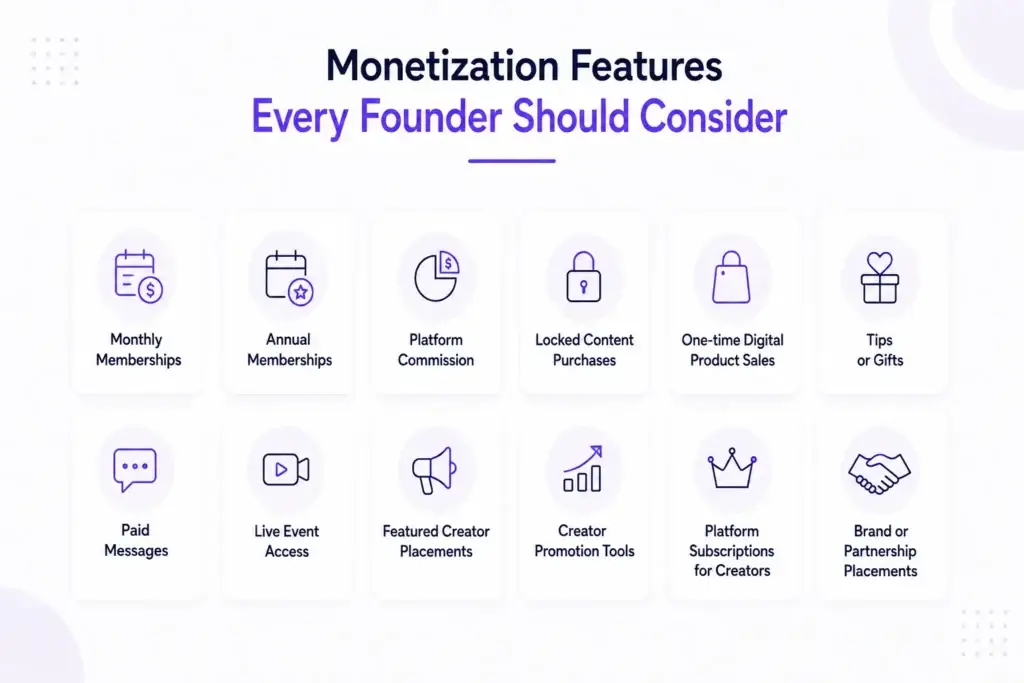
A creator membership platform should not depend on only one revenue stream. Different creators and members behave differently, so the platform should support flexible monetization.
Common monetization features include:
- Monthly memberships
- Annual memberships
- Platform commission
- Locked content purchases
- One-time digital product sales
- Tips or gifts
- Paid messages
- Live event access
- Featured creator placements
- Creator promotion tools
- Platform subscriptions for creators
- Brand or partnership placements where relevant
The right monetization mix depends on the target market. A platform for educators may prioritize courses, downloads, and community access. A platform for coaches may prioritize paid sessions and premium messaging. A platform for entertainers may prioritize memberships, live events, and exclusive content drops.
For founders, the key is to build monetization around user behavior rather than forcing every creator into the same revenue model.
Safety, Moderation, and Trust Features for User-Generated Content
Trust is not optional in a creator membership platform. When users create, upload, message, pay, and interact, the platform needs safety workflows from the beginning.
Important safety and moderation features include:
- Creator verification
- User verification where required
- Content moderation
- Abuse reporting
- Community guidelines
- Manual review queues
- Automated review support
- Comment moderation
- Message reporting
- Copyright or content ownership reporting
- Payment and payout monitoring
- Activity logs
- Role-based admin access
Founders should treat safety as part of the product foundation, not as a feature to add later. Strong moderation protects users, creators, payment relationships, and platform reputation.
Final compliance and policy requirements depend on the target market, operating model, content category, payment providers, and legal review.
Creator Membership Platform Feature Priority Table
| Feature Area | Business Value | Founder Impact |
|---|---|---|
| Search, categories, and tags | Helps users discover relevant creators faster | Reduces dependence on external traffic and improves platform stickiness |
| Free and paid membership tiers | Creates flexible conversion paths for different audience segments | Allows creators to test pricing and increase paid adoption |
| Locked content and one-time unlocks | Adds transactional revenue beyond recurring memberships | Improves monetization from users who are not ready for subscriptions |
| Messaging and creator interaction | Builds stronger creator-member relationships | Supports retention and premium engagement opportunities |
| Live sessions and scheduled events | Creates urgency and exclusive member experiences | Helps creators offer higher-value membership benefits |
| Creator dashboard | Helps creators manage content, earnings, members, and engagement | Improves creator retention and platform supply quality |
| Admin dashboard | Gives operators control over users, content, payments, and reports | Reduces operational risk as the platform grows |
| Moderation and reporting | Protects users, creators, and platform trust | Supports safer scaling of user-generated content |
Founder Decision Signals
Speed
If the goal is faster market validation, prioritize core flows first: discovery, membership access, payments, creator dashboard, admin control, and moderation.
Revenue
If monetization is the priority, include flexible tiers, one-time unlocks, wallet flows, tips, paid interactions, and commission controls.
Scalability
If the platform will grow across multiple creator categories, invest early in taxonomy, search, role-based access, analytics, and moderation queues.
Retention
If repeat usage matters, focus on messaging, notifications, live sessions, polls, creator updates, and member-only community features.
Mistakes to Avoid When Choosing Platform Features
Building monetization before discovery
Paid access is important, but users must first find creators they care about. Without search, categories, tags, previews, and profile clarity, the platform may depend too heavily on creators bringing traffic from outside channels.
Adding too many engagement features too early
Messaging, live events, comments, polls, and notifications can improve retention, but they also create moderation and support work. Founders should launch with the features that match the first target audience.
Ignoring admin operations
A creator platform is difficult to scale without admin control over users, creators, content, payments, commissions, reports, and moderation. The backend matters as much as the app experience.
Treating safety as a later upgrade
User-generated content platforms need reporting, moderation, verification, and activity logs from the beginning. Safety workflows protect trust and reduce operational risk.
How Miracuves Helps Founders Launch Faster
For founders planning a creator membership business, the biggest challenge is not understanding that subscriptions, creator profiles, payments, and messaging are needed. The real challenge is bringing these modules together into one reliable product foundation.
A ready-made solution from Miracuves can help founders move faster with white-label branding, source-code ownership, admin control, creator workflows, user access logic, monetization modules, and platform customization.
You can explore the creator membership platform solution to understand how a launch-ready product foundation can support discovery, memberships, premium content access, paid interactions, moderation, and admin operations.
If your planning is focused specifically on modules and feature depth, the creator platform feature breakdown can help you compare which features belong in your first launch version and which can be added later.
The stronger decision is not always to build every feature from scratch. For many founders, the practical path is to start with a ready-made foundation, customize it around the audience, and improve the platform after real user behavior starts coming in.
Final Thoughts: Build Features Around the Creator-Member Journey
A creator membership platform should not be planned as a long list of disconnected modules. The strongest platforms are built around the journey from discovery to access to engagement.
Discovery helps users find the right creators. Access features convert interest into paid membership. Engagement tools keep members active. Creator dashboards help creators grow. Admin controls help operators manage the platform safely and profitably.
For founders, the real decision is not simply which features to include. It is which features should be prioritized first to support launch speed, market validation, monetization, and long-term scalability.
Miracuves helps founders start with a ready-made, white-label foundation and customize it around their creator economy business model, giving them a faster path to launch without losing control over branding, admin workflows, or source code.
FAQs
What are the most important features of a creator membership platform?
The most important features include creator profiles, search, categories, membership tiers, locked content, one-time purchases, messaging, payments, creator dashboards, admin control, analytics, moderation, and reporting. The exact priority depends on the platform’s audience and monetization model.
Why is discovery important in a creator membership platform?
Discovery helps users find creators inside the platform instead of depending only on outside social media links. Search, tags, categories, featured sections, and preview content can help users explore creators before choosing a membership.
What access features should a paid creator platform include?
A paid creator platform should include free and paid tiers, locked posts, one-time unlocks, renewal handling, upgrade and downgrade flows, expired access logic, and clear membership benefits. These features help convert interest into paid access.
How do engagement features improve member retention?
Engagement features such as messaging, comments, reactions, polls, live sessions, notifications, and community discussions give members reasons to return. When members interact regularly with creators, they are more likely to continue their membership.
What admin features are needed for platform operators?
Operators need admin features for user management, creator approval, content review, category control, commission settings, payout tracking, analytics, dispute management, moderation queues, and role-based access control.
Should a creator membership platform include free tiers?
Free tiers can be useful when the platform wants to build trust before asking users to pay. A free tier allows users to follow creators, preview value, and later upgrade to paid access when they are ready.
What monetization options can a creator membership platform support?
A creator membership platform can support monthly subscriptions, annual plans, paid content unlocks, one-time digital purchases, tips, gifts, paid messages, live event access, featured placements, and platform commission models.
How can founders decide which features to launch first?
Founders should prioritize features that support the first business goal. If the goal is validation, focus on discovery, profiles, memberships, payments, content access, admin control, and moderation. Advanced engagement and analytics features can be expanded after launch.
Miracuves is an independent software development company. We are not affiliated with, connected to, sponsored by, or endorsed by any company or product named in this article.
Terms such as “X Clone” are used descriptively. It is how the software industry refers to building a platform with functionality comparable to a known service, and how clients search for it.
The entire design and codebase of our products is built by our own team. Our products contain no code, design, graphics, or content originating from any third-party website or applications.
All third-party names and marks referenced in this article are the property of their respective owners, referenced solely to identify the services discussed.