
Key Takeaways
- A ready-made creator subscription platform helps startups launch faster with core monetization workflows already planned.
- Custom development gives deeper product control but usually needs more time, budget, testing, and technical planning.
- Creators, subscribers, payment partners, moderators, support teams, and admins need connected platform operations.
- Subscriptions, paid content, creator profiles, messaging, tips, payouts, moderation, and admin control are core features.
- The better choice depends on launch speed, customization needs, compliance scope, source-code control, and startup validation goals.
Decision Signals
- Choose a ready-made platform when faster launch, proven workflows, lower early risk, and quick market validation matter most.
- Choose custom development when the product needs unique creator logic, advanced monetization, special compliance, or complex integrations.
- Creators need profile setup, paid content tools, subscription tiers, audience messaging, earnings visibility, and payout tracking.
- Subscribers need secure checkout, premium access, renewal control, content discovery, messaging, and privacy settings.
- Admins need control over users, creators, subscriptions, content reports, payments, disputes, moderation, and revenue analytics.
Real Insights
- A ready-made creator platform is useful when founders want to validate demand before investing in heavy custom engineering.
- Custom development can be powerful, but building every workflow from zero can delay creator onboarding and revenue testing.
- Payment reliability, payout rules, privacy controls, and moderation should be reviewed carefully in both approaches.
- Founders should compare total launch readiness, not only upfront development cost or feature lists.
- Miracuves builds creator subscription platforms with paid content, messaging, payments, moderation, analytics, and admin control.
Building a creator membership business is not just about launching a website with paid content. It is about creating a controlled ecosystem where creators can publish, subscribers can access premium experiences, payments can flow securely, and the platform owner can manage users, content, payouts, subscriptions, reports, and growth from one backend.
That is why many startups reach the same question early:
Should we choose a ready-made creator membership platform or invest in full custom development?
The answer depends on your launch stage, product complexity, available budget, monetization model, and how much uniqueness your business actually needs on day one. For many early-stage founders, the smarter route is not the longest build. It is the route that gets the right product into the market faster, with enough control to validate demand and improve based on real user behavior.
A ready-made creator membership platform solution can help startups move faster by starting with core workflows that are already structured, including creator profiles, subscription access, payment logic, admin controls, content management, and white-label branding. Custom development, on the other hand, can make sense when the business model is highly unique, technically complex, or dependent on proprietary workflows.
This guide breaks down both options so founders can make a practical decision before committing budget, time, and product direction.
Why Startups Are Comparing Ready-Made Creator Platforms With Custom Builds
The creator economy has changed how digital businesses are built. Instead of depending only on advertising or public social feeds, many creators now want private communities, paid access, subscriber-only content, direct engagement, and predictable recurring revenue.
That creates a strong opportunity for startups. A platform operator can build a niche creator community around fitness, education, coaching, entertainment, local talent, premium content, or professional expertise.
But the opportunity also creates a development challenge.
A creator membership platform needs more than an attractive app interface. It usually needs creator profiles, member accounts, subscription tiers, content access rules, payment workflows, creator payouts, reporting, moderation, messaging, notifications, and a powerful admin dashboard.
Building all of this from zero can take time. Starting with a ready-made foundation can reduce that initial development burden.
This is why founders compare both paths before committing budget.
What Is a Ready-Made Creator Membership Platform?
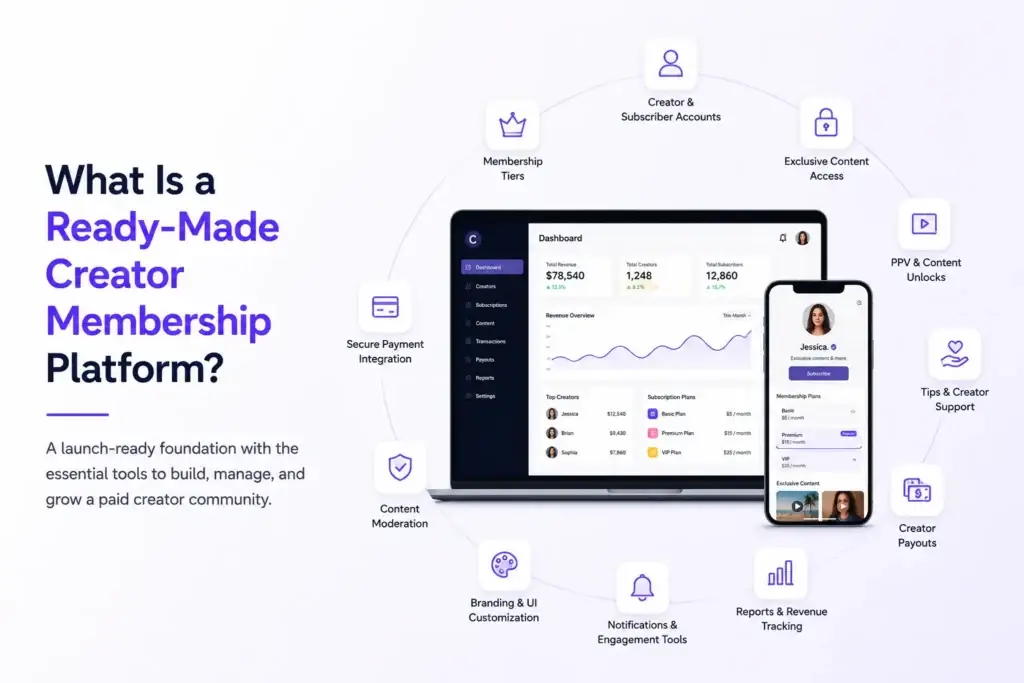
A ready-made creator membership platform is a launch-ready software foundation that already includes the common workflows needed to operate a paid creator community.
Instead of building every screen, database flow, subscription rule, and admin function from scratch, the founder starts with an existing product foundation and customizes it for brand, niche, features, design, payment flow, and business model.
A strong ready-made creator platform may include:
- Creator registration and profile management
- Subscriber registration and account access
- Paid membership tiers
- Subscriber-only content access
- Pay-per-view or one-time content unlocks
- Tips or creator support options
- Secure payment gateway integration
- Creator payout workflows
- Admin dashboard
- Content moderation controls
- Reporting and revenue tracking
- Notifications and engagement tools
- Branding and UI customization
- Source-code access where applicable
The main advantage is not that the product is “finished forever.” The advantage is that the startup does not need to spend its first phase rebuilding standard platform infrastructure.
The founder can move faster toward launch, user acquisition, creator onboarding, and revenue validation.
Read more: How Does a Creator Membership Platform Combine Discovery, Memberships, and Paid Content?
What Custom Development Means for Creator Membership Startups
Custom development means the platform is designed and built from scratch based on a unique product specification.
This can be valuable when the startup has a deeply differentiated idea, unusual user experience, proprietary technology, complex data logic, or a workflow that does not fit a ready-made foundation.
For example, custom development may make sense if the platform needs:
- A highly original creator discovery engine
- A unique revenue-sharing algorithm
- Advanced AI-based moderation workflows
- Complex creator agency management
- Custom payment logic across multiple regions
- Deep integrations with external systems
- A product experience that cannot be adapted from existing modules
The benefit is flexibility. The risk is time, budget, and execution complexity.
A custom creator membership platform requires product discovery, UI/UX design, frontend development, backend development, payment integration, admin dashboard development, QA, deployment, bug fixing, security review, and post-launch iteration.
For funded startups with a clear technical roadmap and a strong product team, this route can be powerful. For early-stage founders still validating creator supply and subscriber demand, it can become expensive too early.
Ready-Made vs Custom Development: Quick Comparison for Founders
| Decision Factor | Ready-Made Platform | Custom Development | Founder Impact |
|---|---|---|---|
| Launch Speed | Faster because core workflows already exist | Slower because every module must be planned, built, tested, and integrated | Ready-made is stronger when speed-to-market matters |
| Initial Cost Logic | More cost-efficient for validation because the foundation is already built | Higher upfront investment due to full product engineering | Ready-made helps preserve budget for marketing, creators, and operations |
| Customization | Customizable within the available product foundation | Fully flexible based on technical scope | Custom is better for highly unusual platform ideas |
| Business Validation | Helps test creator onboarding, subscriptions, and monetization earlier | Validation starts later because product development takes longer | Ready-made supports faster learning from real users |
| Admin Control | Often includes existing admin workflows for users, creators, payments, content, and reports | Admin tools must be designed and built from scratch | Admin depth should be checked before choosing either route |
| Scalability | Depends on architecture, hosting, code quality, and customization approach | Can be designed for specific scale requirements from the beginning | Both can scale when the technical foundation is planned properly |
| Source-Code Control | Strong when source-code ownership is included | Usually available if contract terms are structured properly | Founders should confirm ownership, hosting access, and future customization rights |
When a Ready-Made Creator Membership Platform Makes More Sense
A ready-made creator membership platform is usually the better choice when your startup needs speed, market validation, and operational control before heavy custom investment.
This does not mean the platform should feel generic. A good ready-made foundation can still be customized for branding, layout, creator categories, subscription structure, access rules, payment flows, and admin settings.
It makes the most sense when:
- You want to launch a first market version quickly
- Your business model is based on known creator monetization patterns
- You need subscriptions, paid access, creator payouts, and admin control
- You are still testing the right niche or creator category
- You want to spend more budget on creator acquisition and marketing
- You do not want to wait months before learning from real users
- You want source-code ownership instead of being locked into a rented platform
For many startups, the first product does not need every advanced idea. It needs enough functionality to prove that creators will join, subscribers will pay, and the platform operator can manage the business smoothly.
That is where a ready-made foundation becomes practical.
When Custom Development Is the Better Choice
Custom development is not wrong. It is simply more suitable for a different type of founder.
A fully custom creator membership platform makes sense when the product’s main advantage depends on unique technology or workflows that cannot be shaped from an existing foundation.
For example, custom development may be better if your startup is building:
- A new creator discovery model
- A specialized community engine
- A custom AI recommendation system
- A complex rights-management workflow
- A region-specific payment and payout system
- A creator agency platform with advanced permission layers
- A product that needs deep integration with enterprise software
Custom development is also better when the startup has enough funding, a strong product roadmap, and time to build before entering the market.
The main risk is not custom development itself. The risk is choosing custom development too early, before proving that the market wants the platform.
A founder can spend months perfecting features that creators and subscribers may not actually care about. That is why the decision should start with validation logic, not only technical ambition.
Core Modules Startups Should Not Build From Zero Too Early
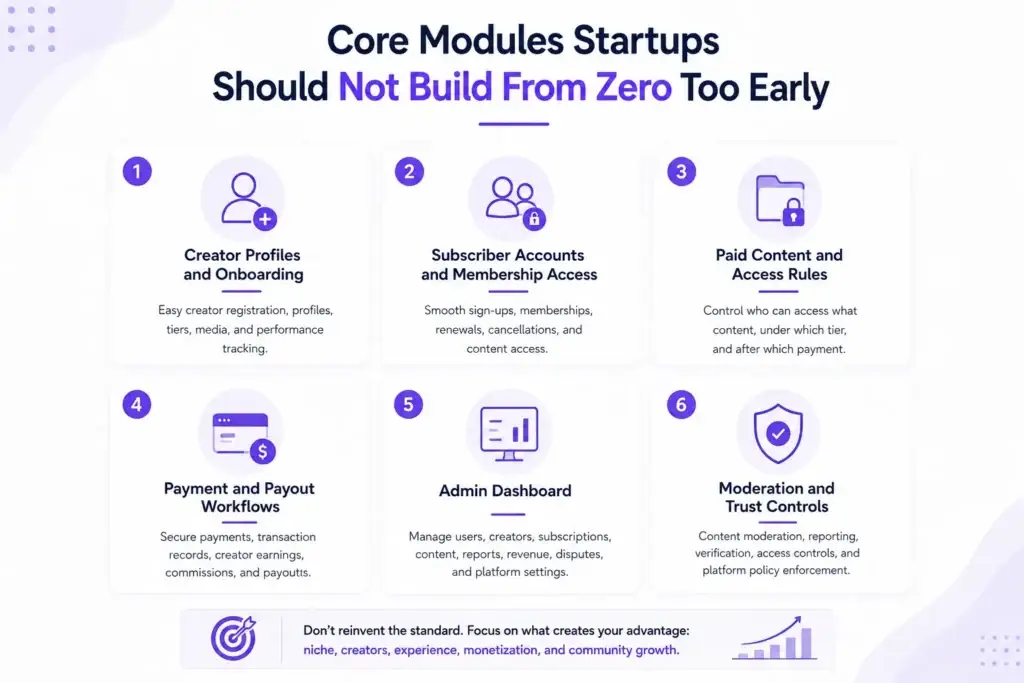
A creator membership platform has several standard modules. These modules are important, but they are not always where a startup creates its strongest differentiation.
The startup’s real advantage usually comes from niche positioning, creator acquisition, trust, user experience, monetization strategy, and community growth. Rebuilding standard infrastructure from zero can delay those business priorities.
Creator Profiles and Onboarding
Creators need a clean way to register, set up profiles, add bios, manage media, define membership tiers, and track performance.
For the founder, this is not only a feature. It is a supply-side growth engine. If creator onboarding feels difficult, the platform will struggle before subscribers even arrive.
Subscriber Accounts and Membership Access
Subscribers need smooth registration, account management, paid access, renewals, cancellations, and content visibility based on membership status.
This layer must be stable because subscription confusion can quickly create support issues, refunds, and trust problems.
Paid Content and Access Rules
The platform should control who can access what content, under which membership tier, and after which payment action.
This is a core business rule. A weak access system can damage creator trust and platform credibility.
Payment and Payout Workflows
A creator membership business needs secure payment gateway integration, transaction records, creator earnings visibility, platform commission logic, and payout management.
Final payment configuration depends on geography, provider availability, risk policies, and the operating model. Founders should confirm these details before launch.
Admin Dashboard
The admin dashboard is where the platform operator manages users, creators, subscriptions, content, reports, revenue, disputes, and moderation.
A creator membership platform without strong admin control is difficult to operate. Founders should not judge the product only by user-facing screens. The backend control layer is what decides whether the business can actually run.
Moderation and Trust Controls
Creator platforms need content moderation, abuse reporting, user verification, activity logs, access controls, and clear platform policies.
This is not only a compliance concern. It affects reputation, creator safety, subscriber trust, payment risk, and long-term scalability.
Founder Decision Signals: How to Choose the Right Path
Founder Decision Signals
Speed
Choose a ready-made platform when your biggest risk is waiting too long to validate creator demand and subscriber payments. Choose custom development when your timeline allows deeper product engineering before launch.
Cost
Choose a ready-made foundation when you want to preserve budget for creator acquisition, marketing, operations, and post-launch improvements. Choose custom when your startup has enough funding to build infrastructure from zero.
Scalability
Choose based on architecture quality, not labels. A ready-made platform can scale when built with a strong backend and source-code control. A custom platform can also fail if poorly planned.
Market Fit
Choose ready-made when your business model is clear but your niche still needs validation. Choose custom when the product itself introduces a new workflow that existing foundations cannot support.
Mistakes Startups Should Avoid Before Choosing a Build Option
Mistakes Founders Should Avoid
Building Too Much Before Validating Demand
Many founders spend heavily on advanced features before proving that creators will join and subscribers will pay. The first launch should validate the business model, not satisfy every future feature idea.
Choosing Only by Lowest Price
A low-cost build can become expensive if it lacks admin depth, payment reliability, moderation workflows, documentation, support, or source-code control. Founders should compare total operational readiness, not only upfront pricing.
Ignoring the Admin Dashboard
The admin panel decides how the operator manages creators, members, payments, content, reports, disputes, and platform rules. Weak admin control creates operational pressure after launch.
Treating Ready-Made as a Final Product
A ready-made platform should be seen as a launch foundation. The smartest founders use it to enter the market faster, then customize based on real user behavior.
How Miracuves Helps Founders Launch Faster With a Ready-Made Foundation
Miracuves helps founders build ready-made, white-label, and source-code-owned app platforms designed for faster market entry and practical business control.
For a creator membership startup, that means the founder does not need to begin with a blank codebase. Instead, the launch can start from a product foundation that already supports the major operational layers: creator workflows, subscriber access, monetization, admin management, moderation, reporting, branding, and deployment support.
Founders exploring a creator membership product can review the creator membership platform solution to understand how a launch-ready foundation can support faster execution.
If your main concern is comparing feature scope before launch, the creator platform features breakdown can help you understand which modules matter most. If your biggest concern is budgeting, the creator platform development cost guide can help frame the cost logic based on modules, integrations, branding, and customization scope.
The goal is not to avoid custom development forever. The stronger path is to avoid unnecessary custom development before the business has enough market feedback.
A ready-made foundation lets founders launch, learn, and then customize with more confidence.
Final Thoughts: Choose the Build Path That Matches Your Startup Stage
The decision between a ready-made creator membership platform and custom development is not about which option sounds more advanced. It is about which option matches your startup stage.
If your business model is based on proven creator membership workflows and your priority is faster validation, a ready-made foundation is usually the smarter path. It helps you launch sooner, test creator demand, manage subscribers, process payments, and improve the product based on actual market feedback.
If your product depends on unique technology, complex architecture, or a highly original user experience, custom development may be worth the longer timeline and larger investment.
For most early-stage founders, the practical path is simple: start with a strong foundation, validate the market, then customize based on what users actually do.
That is how startups reduce risk, protect budget, and move from idea to launch with better control.
FAQs
Is a ready-made creator membership platform good for startups?
Yes, a ready-made creator membership platform can be a strong option for startups that want to launch faster, test demand, onboard creators, and validate paid memberships before investing in full custom development.
When should a startup choose custom creator platform development?
A startup should choose custom development when the product requires unique architecture, advanced technical workflows, proprietary features, complex integrations, or a user experience that cannot be adapted from a ready-made foundation.
Can a ready-made creator membership platform be customized?
Yes. A ready-made platform can usually be customized for branding, UI design, membership tiers, monetization rules, creator workflows, payment gateways, admin controls, and launch scope. The exact customization depends on the platform foundation and selected modules.
What features should a creator membership platform include?
A creator membership platform should include creator profiles, subscriber accounts, paid membership tiers, content access rules, payment processing, payout management, admin control, reporting, notifications, moderation, and user verification workflows where relevant.
Is ready-made development cheaper than custom development?
Ready-made development is generally more cost-efficient for initial launch because the core foundation already exists. Final pricing still depends on features, integrations, branding, customization, hosting, and deployment requirements.
Does a ready-made platform limit long-term scalability?
Not always. Scalability depends on code quality, backend architecture, hosting setup, database design, API structure, and technical maintenance. A source-code-owned ready-made foundation can support future customization when built properly.
What is the biggest risk of custom development for early-stage startups?
The biggest risk is spending too much time and budget before validating creator demand and subscriber willingness to pay. Custom development can be powerful, but it should be justified by product uniqueness and business readiness.
How can Miracuves help with creator membership platform development?
Miracuves helps founders launch ready-made and white-label creator membership platforms with branded design, admin dashboards, monetization workflows, source-code ownership where applicable, and faster deployment support.
Miracuves is an independent software development company. We are not affiliated with, connected to, sponsored by, or endorsed by any company or product named in this article.
Terms such as “X Clone” are used descriptively. It is how the software industry refers to building a platform with functionality comparable to a known service, and how clients search for it.
The entire design and codebase of our products is built by our own team. Our products contain no code, design, graphics, or content originating from any third-party website or applications.
All third-party names and marks referenced in this article are the property of their respective owners, referenced solely to identify the services discussed.