

Getting a buyer to complete a purchase is only the beginning of a marketplace transaction. The real financial complexity begins when the platform must calculate seller earnings, deduct commissions, manage payment holds, process refunds, and maintain accurate records for tax reporting.
For a marketplace with multiple vendors, handling these activities manually can quickly become a source of accounting errors, delayed payments, disputes, and compliance risk. A single transaction may involve several sellers, different commission structures, payment-processing fees, and separate payout schedules.
Automating vendor payouts and escrow workflows helps operators manage these moving parts with consistent payment rules, transaction records, and clearly defined release conditions. The marketplace platform services offered by Miracuves address the broader buyer, seller, payment, and administrative workflows that support these operations.
However, automation alone does not make a platform compliant. The marketplace must also understand who legally holds customer funds, which party is responsible for tax reporting, and when payments should be paused for verification or dispute resolution.
This guide explains how marketplace operators can build more reliable payout operations while reducing avoidable financial and compliance headaches.
Key Takeaways
- Automated vendor payouts should account for commissions, refunds, adjustments, reserves, and payment-provider fees.
- Escrow and delayed payout arrangements are not automatically the same legal or financial service.
- Seller verification and tax information should be collected before a vendor becomes eligible for relevant payments.
- Marketplace ledgers should distinguish gross sales, platform revenue, and net seller earnings.
- Failed transfers, chargebacks, and reconciliation mismatches require clear exception-handling rules.
- Automation reduces repetitive work, but regulatory responsibilities still depend on the business model and jurisdiction.
Why Vendor Payouts Become Complicated as a Marketplace Grows
A small marketplace might initially process a limited number of seller payments manually. An administrator reviews completed orders, calculates the platform’s share, and initiates transfers to vendors.
This process becomes difficult to maintain when transaction volume grows or the marketplace expands into new product categories and regions.
Consider an online marketplace where one buyer purchases products from three independent sellers. Although the buyer completes a single checkout, the platform must potentially manage three vendor balances, individual delivery confirmations, different refund outcomes, and separate payout eligibility rules.
The platform also needs to track the financial events behind each transaction, not simply the final transfer amount.
Five Operational Problems That Manual Payouts Create
- Incorrect commission calculations: Sellers may have different fee agreements or category-specific deductions.
- Premature fund releases: Vendors can receive payment before a delivery dispute or return window closes.
- Incomplete financial records: Payment transfers may not match the marketplace’s order and accounting data.
- Failed payouts: Invalid bank details, verification issues, or payment-provider restrictions can interrupt transfers.
- Tax-reporting complications: Missing identity information and inconsistent transaction histories make accurate reporting harder.
The objective of payout automation is therefore not merely to send money faster. It is to create a dependable process for deciding how much each vendor has earned, when those earnings become payable, and how every transaction can be explained later.
For an example of how transaction records and seller earnings interact within a particular marketplace model, see this speciality food marketplace payout architecture guide.
How Automated Vendor Payouts Work Behind the Scenes
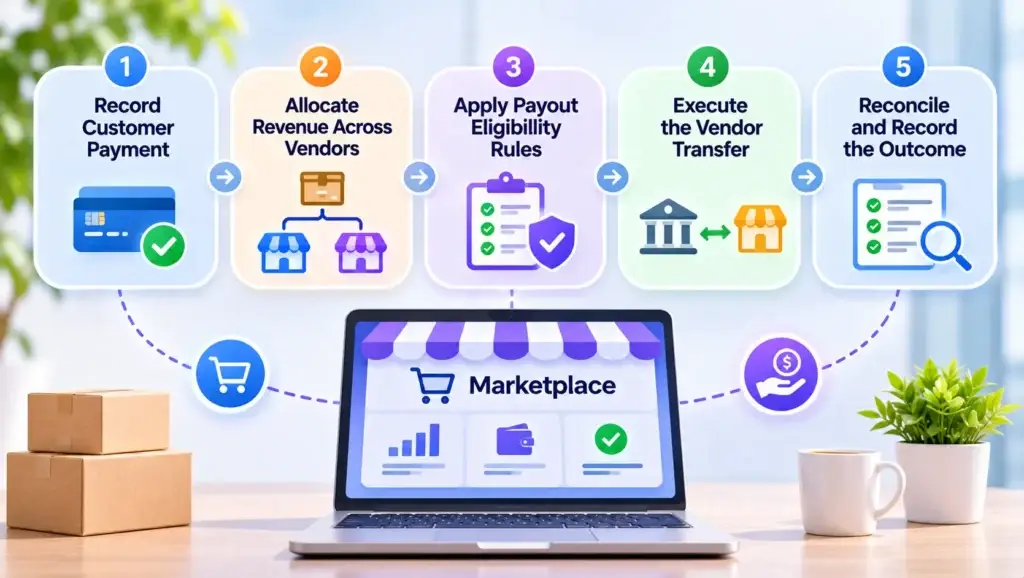
An automated payout system connects order activity with payment-provider records, vendor balances, commission calculations, and disbursement schedules.
Its core responsibility is to move a transaction through defined financial states without relying on an administrator to calculate every payment manually.
Step 1: Record the Customer Payment
When a customer completes checkout, the marketplace records the transaction and the payment provider processes the payment according to the configured integration.
The system should preserve the original amount, currency, order identifier, payment reference, payment status, and relevant seller allocations.
A successful checkout event does not necessarily mean funds have settled or become available for payout. Payment capture, settlement, availability, and seller disbursement are separate events.
Step 2: Allocate Revenue Across Vendors
For an order containing items from multiple sellers, the system should calculate each seller’s share independently.
Each allocation can include the seller’s gross order value, applicable discounts, refunds, commissions, processing fees, adjustments, and resulting payout entitlement.
These calculations should follow the marketplace’s contractual fee rules rather than relying on manual spreadsheet formulas.
Step 3: Apply the Payout Eligibility Rules
Not every completed payment should immediately trigger a vendor transfer.
The platform may require successful payment settlement, verified seller identity, delivery confirmation, expiration of an agreed inspection period, or resolution of an outstanding dispute.
Only after the required conditions are satisfied should the relevant balance become eligible for disbursement.
Step 4: Execute the Vendor Transfer
Once the vendor balance becomes payable, the configured payment provider can initiate the transfer according to the agreed payout schedule and available provider capabilities.
Some marketplaces use scheduled disbursements, while others support faster payouts for eligible sellers.
The marketplace should retain the payment provider’s transfer identifier and final status rather than assuming that a submitted payout instruction represents a successful bank deposit.
Step 5: Reconcile and Record the Outcome
The payout workflow is not complete until the platform can match its internal transaction records against the payment provider’s settlement and transfer information.
Successful transfers, failed transfers, reversed transactions, and outstanding balances should remain visible to the finance or operations team.
Read More: Online Retail Marketplace Architecture: Catalog, Seller Operations, Orders, Payments, and Delivery
Automated Payout Calculation: A Practical Example
Consider a hypothetical transaction where a customer pays $200 for products sold by two vendors.
For illustration, Vendor A sells $120 worth of products and Vendor B sells $80. The marketplace applies a 10% commission to both sellers and allocates a total of $6 in processing fees between them.
Example: Splitting a $200 Marketplace Order
Illustrative amounts in USD, assuming a 10% commission and $6 in allocated payment fees.
| Transaction Component | Vendor A | Vendor B | Total |
|---|---|---|---|
| Gross sales | $120.00 | $80.00 | $200.00 |
| Marketplace commission | $12.00 | $8.00 | $20.00 |
| Allocated processing fees | $3.60 | $2.40 | $6.00 |
| Net seller payable | $104.40 | $69.60 | $174.00 |
In this simplified example, the platform records $20 in gross commission revenue, $6 in processing fees allocated to vendors, and $174 as the combined seller payable amount.
The calculation assumes no shipping charges, sales tax, discounts, refunds, reserves, or further adjustments. Actual accounting treatment depends on contracts, jurisdiction, and which party is responsible for each fee.
This distinction is one of the most important reasons to maintain transaction-level records rather than relying exclusively on final bank transfers.
Escrow, Payment Holds, and Delayed Payouts: Know the Difference
Escrow is frequently used as a general description for withholding seller earnings until a transaction is completed. However, marketplace operators should distinguish between legally structured escrow services and ordinary payment-provider payout controls.
What Is True Escrow?
Under a formal escrow arrangement, funds are held by an authorised or otherwise legally permitted party according to agreed conditions, with release dependent on the relevant contractual requirements.
Applicable licensing, custody, and money-transmission rules vary by jurisdiction and transaction structure.
What Is a Delayed Marketplace Payout?
A delayed payout generally means the seller’s transfer is scheduled or restricted until specified conditions are satisfied, using the mechanisms supported by the payment provider.
The payment provider may continue to hold or administer the relevant funds according to its account structure and terms. A marketplace should not assume it can indefinitely hold customer money simply by changing a software setting.
How Should Operators Choose a Release Rule?
The answer depends on what the marketplace is selling and what evidence can establish successful fulfilment.
Matching Payment Release Rules to Transaction Risk
| Marketplace Activity | Possible Release Trigger | Key Risk |
|---|---|---|
| Physical goods | Confirmed delivery plus agreed review period | Returns and damaged items |
| Freelance services | Approved milestone or deliverable | Disputed service quality |
| Equipment rentals | Rental completion and agreed inspection | Damage claims and deposits |
| Digital products | Verified delivery and applicable dispute rules | Fraud and chargebacks |
These are operational examples, not universal legal requirements. The marketplace’s release policy must be consistent with its seller agreement, buyer terms, payment-provider capabilities, and local laws.
For a closer look at the operational consequences of incorrectly configured holds and disbursements, explore the escrow routing failure decision framework.
How to Reduce Tax and Compliance Problems Before Paying Vendors
Tax and compliance issues are easier to manage when the marketplace collects accurate information throughout the transaction lifecycle.
Waiting until the end of the financial year to identify sellers, reconstruct gross sales, or resolve missing records creates avoidable administrative pressure.
Collect Seller Identity and Tax Information Early
The onboarding process should request the information required for the seller’s location, business type, payment setup, and applicable reporting obligations.
Depending on the jurisdiction and provider, this may include legal names, business registration details, taxpayer identification numbers, verified bank accounts, and beneficial ownership information.
Verification status should be connected to payout eligibility so that unresolved mandatory checks can prevent disbursement when required.
Identity verification requirements are not identical across all marketplaces. A platform should determine which obligations apply to its operating model and what responsibilities its payment provider assumes.
Understand the Difference Between Gross Sales and Net Payouts
The amount a vendor receives in a bank account may differ significantly from the transaction amount recorded for accounting or tax reporting.
For example, a seller can generate $1,000 in gross transaction value but receive less after commission deductions, payment fees, refunds, and other agreed adjustments.
Different tax regimes may require reporting gross payment amounts, seller consideration, transaction counts, fees, or other specific figures.
The system should therefore retain both the original transactions and the adjustments that explain the final payout.
Account for US Tax-Information Reporting
In the United States, marketplace payment activity may involve Form 1099-K reporting, depending on how payments are processed and which entity is responsible for reporting.
For third-party settlement organisations, the federal Form 1099-K reporting threshold generally applies when gross payments exceed $20,000 and the number of transactions exceeds 200 in a calendar year. Card-payment transactions follow different reporting rules, and state requirements may differ.
Marketplace operators should confirm the current obligations for their specific payment arrangement rather than assuming the marketplace itself is always the filing party.
Official reference: IRS guidance on Form 1099-K.
Consider European Seller Reporting Under DAC7
For marketplaces operating in or facilitating relevant activity connected to the European Union, DAC7 may create seller-information collection and reporting obligations.
The rules cover specified activities, including the sale of goods, personal services, property rental, and rental of transport.
Reporting can involve seller identity information, consideration paid or credited, transaction activity, and certain platform fees or taxes.
DAC7 is an information-reporting framework; it does not itself impose a new tax on seller income. Eligibility, exclusions, and reporting obligations require jurisdiction-specific assessment.
Official reference: European Commission DAC7 guidance.
Do Not Confuse Automated Reporting With Automatic Compliance
Software can organise transaction data, collect seller information, generate reports, and flag missing records. It cannot independently determine every legal obligation affecting the marketplace.
Sales taxes, VAT, GST, withholding obligations, information returns, and payment-services regulation may require separate assessments.
Before expanding into a new jurisdiction, operators should confirm their responsibilities with qualified tax and legal professionals and their payment provider.
What Happens When a Refund or Dispute Occurs After Payout?
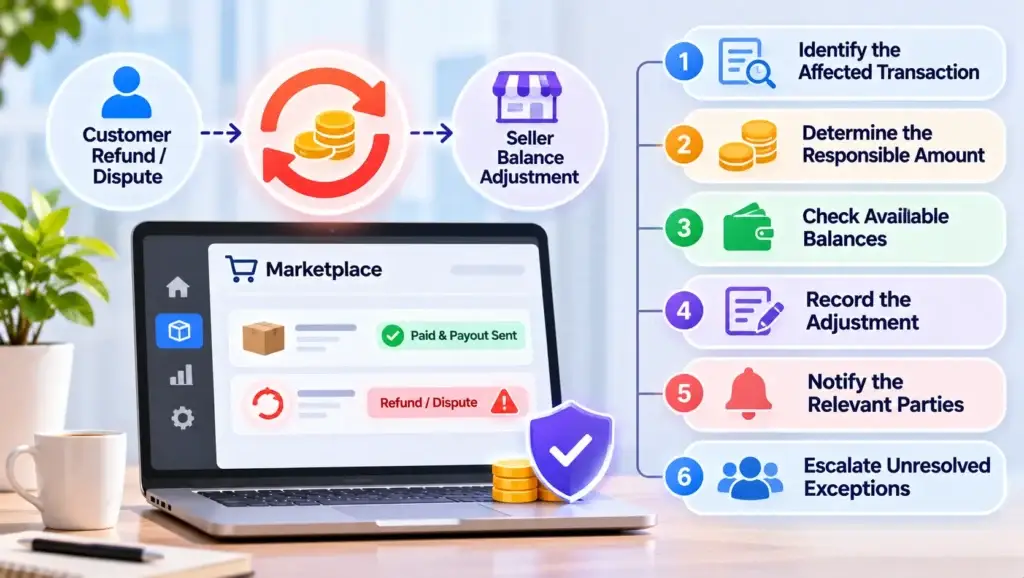
One of the most difficult payout situations occurs when a seller has already received funds but the customer subsequently receives a refund or initiates a chargeback.
Without clear recovery rules, the marketplace may be left with a financial shortfall.
Use a Consistent Exception-Handling Workflow
- Identify the affected transaction: Link the refund or dispute to the original order, payment, and seller allocation.
- Determine the responsible amount: Apply the agreed rules for seller liability, platform fees, payment fees, and refund adjustments.
- Check available balances: Determine whether the provider permits a reversal, reserve adjustment, or offset against future earnings.
- Record the adjustment: Preserve the original transaction and create a traceable correction rather than silently modifying historical records.
- Notify the relevant parties: Explain the reason for the deduction or balance adjustment.
- Escalate unresolved exceptions: Route cases requiring review to an authorised administrator.
Where contractually permitted and supported by the provider, a marketplace may use rolling reserves, delayed disbursements, or negative-balance recovery mechanisms to manage financial exposure.
These controls should not be introduced without clear vendor terms and appropriate review of their legal and commercial implications.
Read More: Food Delivery Marketplace Architecture: Ordering, Dispatch, Tracking, Payments, and Settlement
Why Marketplace Payout Automation Needs a Reliable Ledger
A payment dashboard can show how much money was transferred, but it does not necessarily explain every financial obligation behind the transfer.
That is why a reliable internal ledger is essential.
A well-designed ledger records separate financial events for payments, seller allocations, commissions, refunds, reserves, and disbursements. Instead of repeatedly overwriting balances, it preserves the history needed to understand why the balance changed.
Track the Financial State of Every Transaction
A transaction can move through several stages:
- Payment initiated
- Payment confirmed or captured
- Funds settled or available under provider rules
- Seller allocation calculated
- Payout eligibility verified
- Payout requested
- Payout completed, failed, or reversed
- Financial records reconciled
Other events, such as a refund, dispute, or verification hold, may interrupt the sequence.
Not every payment provider exposes identical states, so the marketplace should map its internal status model to the actual provider lifecycle.
Prevent Duplicate Payouts
Payment integrations frequently use asynchronous notifications called webhooks.
A webhook may be delivered more than once, or events may arrive in an unexpected order. The marketplace should not create another payout simply because an event was received again.
Idempotency controls, unique transaction references, verified webhook signatures, and controlled retry logic help prevent duplicate financial actions.
These safeguards become especially important when sellers receive thousands of payments or the platform processes multiple currencies.
Reconcile Against the Payment Provider
Automated reconciliation should compare internal ledger entries with available provider statements, settlement reports, transfers, fees, refunds, and reversals.
Any mismatch should enter an exception queue for review. The platform should avoid automatically treating an unmatched transaction as successful.
A useful reconciliation process can answer three questions: What did the customer pay? What did the seller become entitled to receive? What did the payment provider actually disburse?
For further technical context, the payout API integration guide for digital marketplaces explains how automated transfers, payment statuses, and reconciliation records fit into broader platform operations.
Which Payout Controls Should Be Automated and Which Need Human Approval?
Not every financial action should happen without oversight.
Routine calculations and scheduled payments are good candidates for automation. Unusual financial activity, conflicting records, and sensitive account changes may require additional approval.
Automation vs. Human Oversight
| Workflow | Recommended Control |
|---|---|
| Routine commission calculations | Automated calculation using documented fee rules |
| Scheduled eligible seller payments | Automated transfers within approved policies |
| Seller bank account changes | Reverification and risk-based approval |
| Large or unusual payout requests | Risk review according to configured thresholds |
| Refunds exceeding available seller balances | Exception handling and authorised escalation |
| Ledger or settlement mismatches | Automated detection with human investigation |
The goal is to reduce unnecessary administration without removing accountability for important financial decisions.
A Practical Checklist for More Reliable Vendor Payout Operations
Before activating automated payouts, marketplace operators should be able to answer the following questions.
Founder Decision Checklist
- Does our payment provider support the required seller onboarding and payout arrangement?
- Have we confirmed who legally holds customer funds?
- Are commission and processing-fee rules documented for each relevant category?
- Can the system identify when each vendor becomes eligible for payment?
- Are refunds, disputes, payout failures, and reversals accounted for?
- Do seller balances reconcile with the payment provider’s records?
- Have applicable tax-reporting and identity-verification obligations been reviewed?
- Can authorised administrators investigate and resolve payout exceptions?
- Are vendor-facing payment statements understandable and accurate?
- Have payout workflows been tested with simulated failures before going live?
Common Mistakes That Create Payout and Compliance Headaches
Using Bank Transfer Records as the Only Financial History
A bank deposit does not provide the complete picture of the orders, fees, refunds, and adjustments associated with a seller’s earnings.
Maintain transaction-level records that explain how each payout amount was calculated.
Releasing Funds Before Dispute Rules Are Satisfied
Premature payments can make refunds and chargebacks harder to recover.
Define payout eligibility using operational evidence, provider capabilities, and agreed buyer and seller terms.
Assuming the Payment Provider Handles Every Tax Obligation
Payment providers may offer onboarding, verification, reporting, and tax-document services, but the platform’s obligations depend on the account structure and applicable law.
Document who is responsible for collection, reporting, filing, and correction workflows.
Ignoring Multi-Currency Settlement Differences
Cross-border transactions may involve currency conversion, exchange-rate differences, transfer delays, and additional provider fees.
Preserve transaction currency, settlement currency, applicable exchange rates, and relevant fee information where needed for accurate reconciliation.
Automating Financial Decisions Without an Audit Trail
Financial automation should make transactions more traceable, not less transparent.
Important changes, approvals, payout adjustments, and administrative actions should be recorded with appropriate timestamps and access controls.
Turning Payout Policies Into Reliable Platform Workflows
A marketplace may have clear commercial rules on paper but still struggle to enforce them consistently across sellers, payment events, and administrative processes.
For example, a service marketplace might release payments after milestone approval, while a retail marketplace might use delivery confirmation and an agreed dispute window. Both require a connection between order status, payment-provider capabilities, seller eligibility, and financial reporting.
This is where the underlying platform architecture matters. Teams evaluating marketplace payment and operational workflows should look beyond checkout and examine how seller balances, payment exceptions, and payout controls interact.
Miracuves supports marketplace platforms with buyer, seller, and administrative workflows, including configurable commission and payout logic. Its ready-made marketplace foundations are positioned around a six-working-day build timeline for agreed standard scope, while additional integrations and compliance-related customisation are assessed separately.
The distinction matters: platform configuration does not replace payment-provider approval, legal review, tax advice, or other externally controlled requirements.
Final Thoughts: Automate Payments Without Losing Financial Control
Automating vendor payouts and escrow-related workflows is not simply a technical convenience. It is an operational decision that influences seller trust, accounting accuracy, dispute management, and the marketplace’s exposure to financial risk.
The strongest approach is to define payout rules before automating them, maintain accurate transaction records, distinguish payment-provider responsibilities from platform responsibilities, and design exception handling alongside normal transaction processing.
When these foundations are in place, a marketplace can reduce repetitive administration while making its financial activity easier to track, review, and explain.
Frequently Asked Questions
How can vendor payouts be automated in a multi-vendor marketplace?
A marketplace can automate payouts by connecting order records, commission calculations, seller verification, payout eligibility rules, and payment-provider transfer APIs. Automated reconciliation should confirm the actual payout outcome and identify exceptions that require review.
Is escrow necessary for every marketplace transaction?
No. Some marketplaces use immediate or scheduled seller disbursements, while others require conditional release arrangements. Formal escrow and delayed payout mechanisms are different and may have different legal requirements. The appropriate approach depends on the marketplace’s transaction risks and operating model.
3. What happens if a customer requests a refund after the vendor has been paid?
The marketplace must determine the responsible party under its seller agreement, refund policy, and payment-provider rules. Recovery may involve transfer reversal, adjustment of future seller earnings, use of an agreed reserve, or manual resolution. Every adjustment should remain traceable.
Are marketplace operators responsible for issuing Form 1099-K?
Responsibility depends on the payment arrangement and the applicable reporting rules. In some setups, the payment settlement entity or payment provider handles reporting; in others, the platform has responsibilities. Operators should verify the applicable requirements with their provider and tax adviser.
What seller information should be collected before automated payouts?
Depending on the jurisdiction and provider, required information may include a verified legal name, address, taxpayer identification number, business registration details, bank account information, and beneficial ownership information. Collect only what is necessary and protect it using appropriate access and data-security controls.
How can a marketplace prevent duplicate vendor payouts?
Duplicate payouts can be reduced through unique transaction identifiers, idempotent payment operations, verified webhook handling, controlled retries, and reconciliation with payment-provider records. A repeated notification should not automatically create another transfer.
Does payout automation guarantee tax or regulatory compliance?
No. Automation can improve recordkeeping, verification workflows, reporting preparation, and operational consistency. Actual obligations depend on jurisdiction, business structure, transaction type, and financial partners. Legal and tax review remains necessary.
What should founders prioritise before activating automated seller disbursements?
Founders should confirm their payment-provider model, seller verification requirements, commission calculations, release conditions, refund and dispute policies, reconciliation controls, and applicable reporting responsibilities. Testing failed payments and disputed transactions before activation is particularly important.
Miracuves is an independent software development company. We are not affiliated with, connected to, sponsored by, or endorsed by any company or product named in this article.
Terms such as “X Clone” are used descriptively. It is how the software industry refers to building a platform with functionality comparable to a known service, and how clients search for it.
The entire design and codebase of our products is built by our own team. Our products contain no code, design, graphics, or content originating from any third-party website or applications.
All third-party names and marks referenced in this article are the property of their respective owners, referenced solely to identify the services discussed.