Prypco Clone App - Multi-Product Property Investment Platform
Built by Miracuves, this Prypco clone for fractional property comes ready-made and white-label: investor web app, native Expo app for iOS and Android, agent workspace and an operator console of forty-six suites, with source you own, live on your infrastructure in six working days.
Each property sits in its own SPV with share classes, investors subscribe from a multi-currency wallet, and rental distributions are calculated, approved and released in batches on a double-entry ledger. Sanctions and PEP screening is scoped separately. Pointing tokenization at a live XRPL network or adding a ninth language is scoped and priced in writing, usually within 2-8 weeks.
Launch in 6 Days with
- Source Code
- Investor Web App
- iOS + Android App
- Operator Console
- Agent Workspace
- Prisma Schema
StackExpo · React Native · Next.js 15 · React · PostgreSQL · Prisma · XRPL
Example event feed (illustrative)
- KYC file clearedCompliance
- Subscription paid from walletInvestments
- Register entry appended for the allocationRegister
- NFToken certificate issuedTokens
- Token operation awaiting second signerDual control
- Distribution batch releasedFinance
- Gold order filled at spreadmx Mint
- Mortgage application matchedmx Mortgage
- Agent commission advance approvedmx One
- Unit resale bid acceptedMarketplace

- 11Product Linesproperty, marketplace, exits, distributions, gold, mortgage, golden visa, agents, services, wills and CRM
- 3Ways Outa secondary marketplace, exit windows and share-weighted sale votes
- 0%Revenue Share With Miracuvesno cut of what you raise and no fee per investor
- 8Interface LanguagesEnglish, Arabic, Spanish, French, Hindi, Mandarin, German and Portuguese
- 6Days to Launchand if the delay is ours, we keep going free
- $6,999Paid Once, Not Rentedsource code yours, no per-seat fee, no monthly rental
Live in six working days, or we keep working free until you launch. Every build carries 60 days guidance, 6 months bug fixes and 12 months updates.Verify every figure
The Register Is the Record
Ownership lives in an append-only PostgreSQL register, the legal source of truth. XRPL tokens and NFToken certificates mirror it, on a sandbox until you point it at a live chain.
Software, Not a Regulated Entity
No authority has licensed or approved this platform and it holds no client money. The license to raise capital, the SPVs and your AML policy remain the operator's to put in place.
Four Providers, Your Keys
Stripe, Razorpay, Plaid and NOWPayments are implemented behind one interface and run on your own accounts; verifying callback signatures against your processor is named go-live work, not assumed done.
01See it live
Live in Action
Prypco Clone Demo - Investor, Operator, Finance & Agent
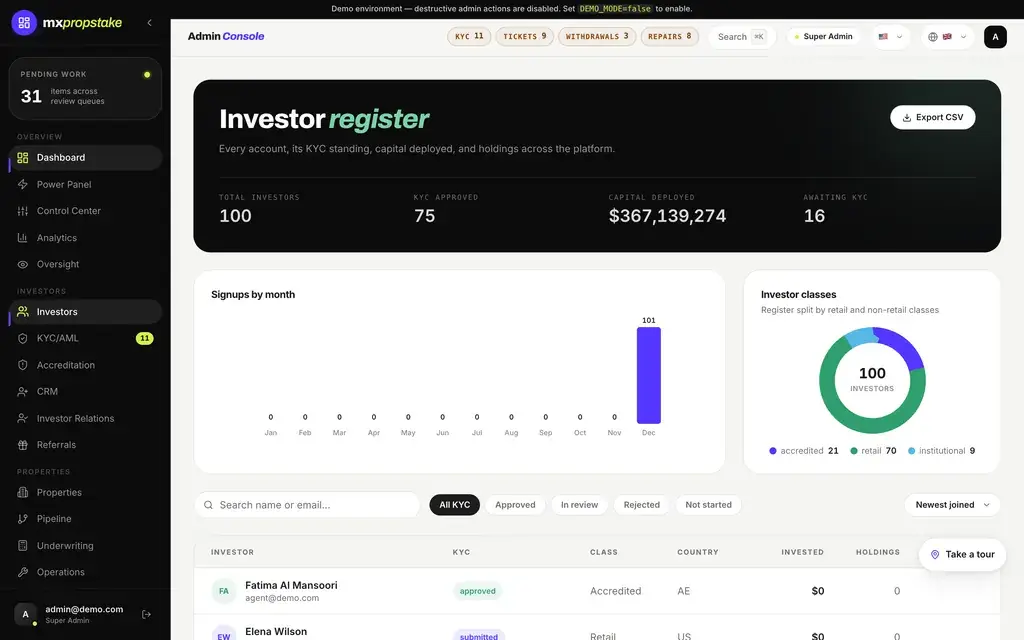
Miracuves runs its Prypco clone demo on live infrastructure, seeded and deliberately read-only, so review the flows rather than trying to complete them. Seven role logins exist on the same environment: investor, agent, operations, finance, compliance, investment director and super admin. Start with the investor app, then sign in to the console and view that same property from the operator's side.
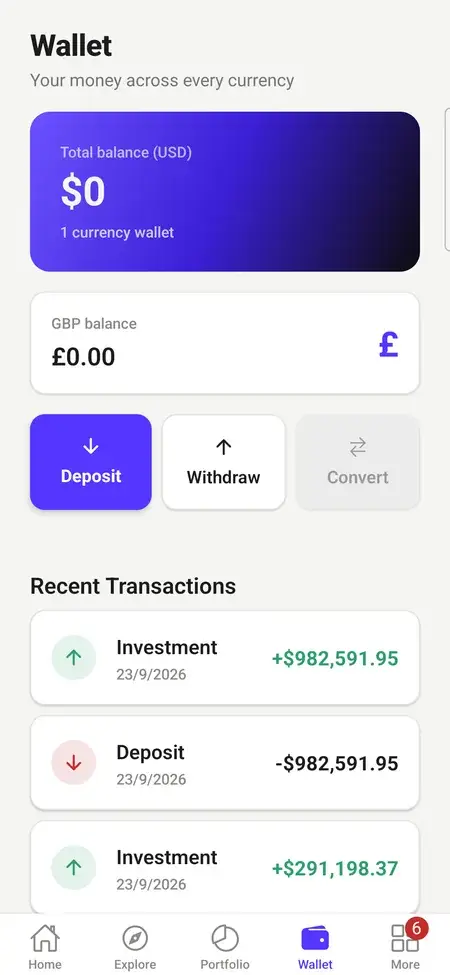
Prypco Clone - Catalog, Wallet, Gold & Exit
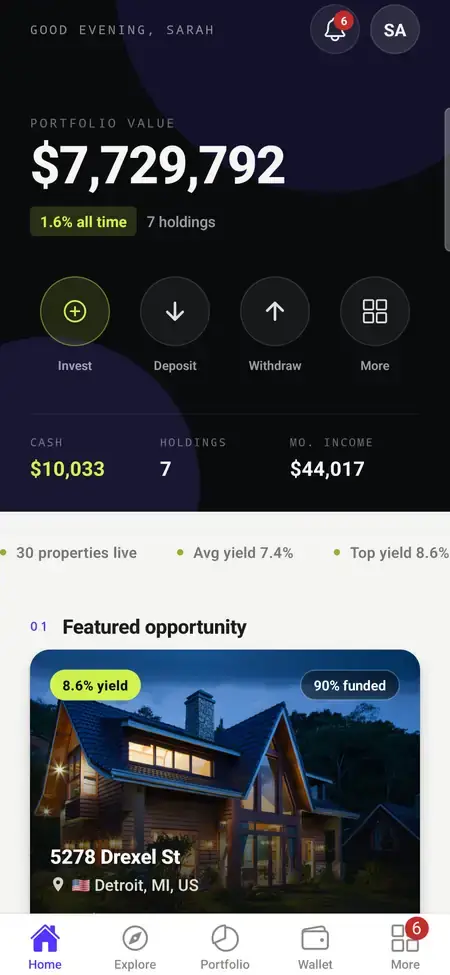
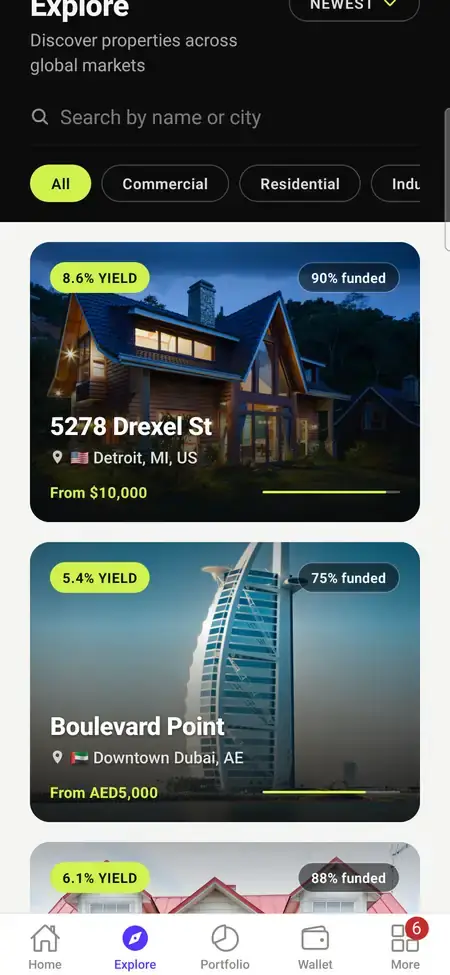
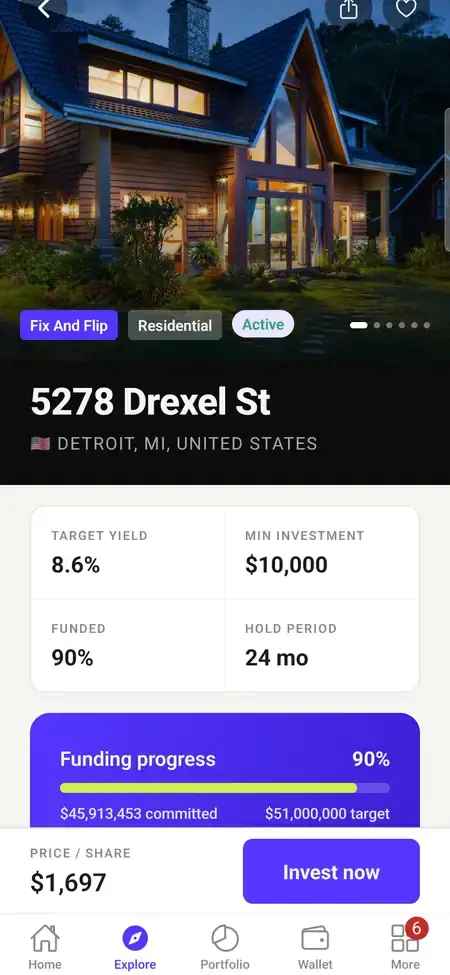
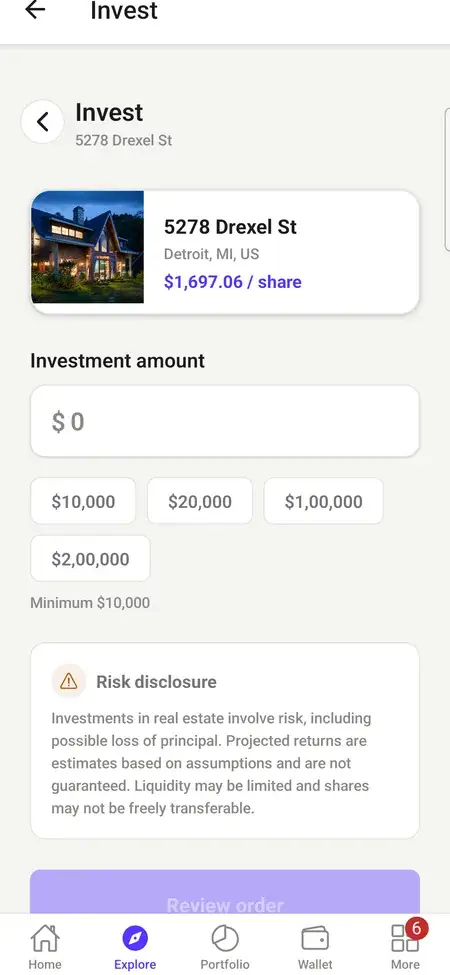
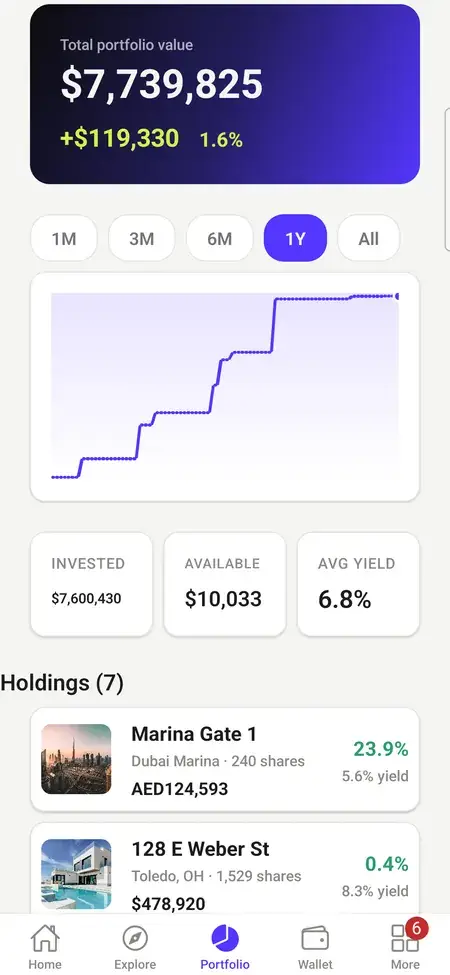
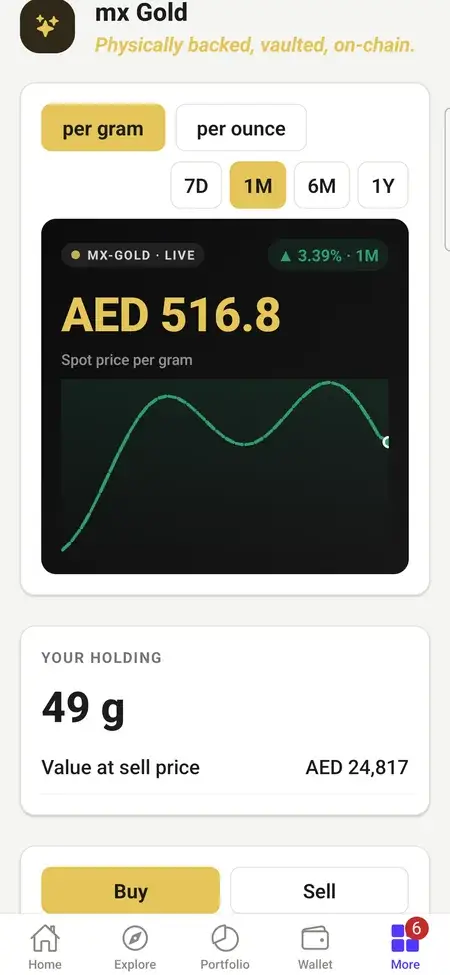
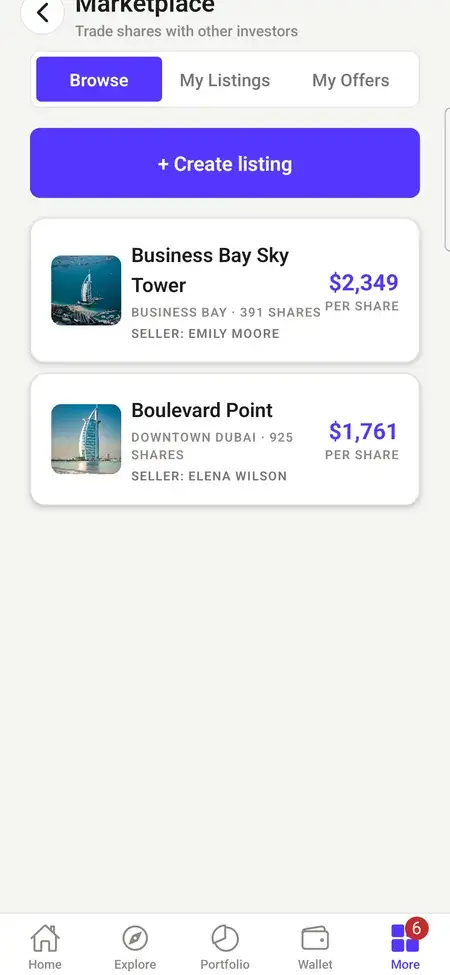
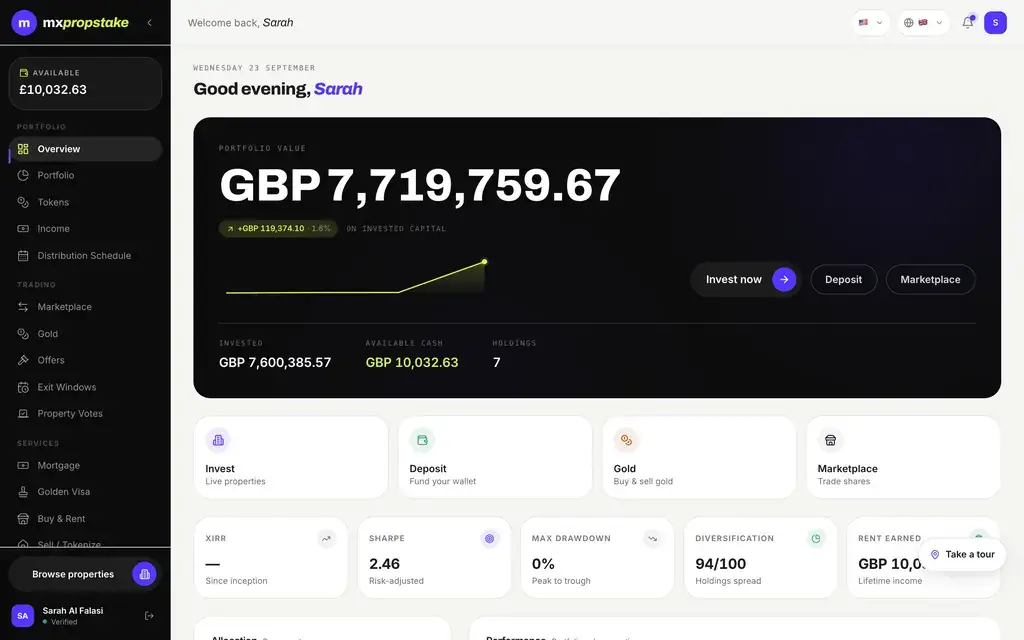
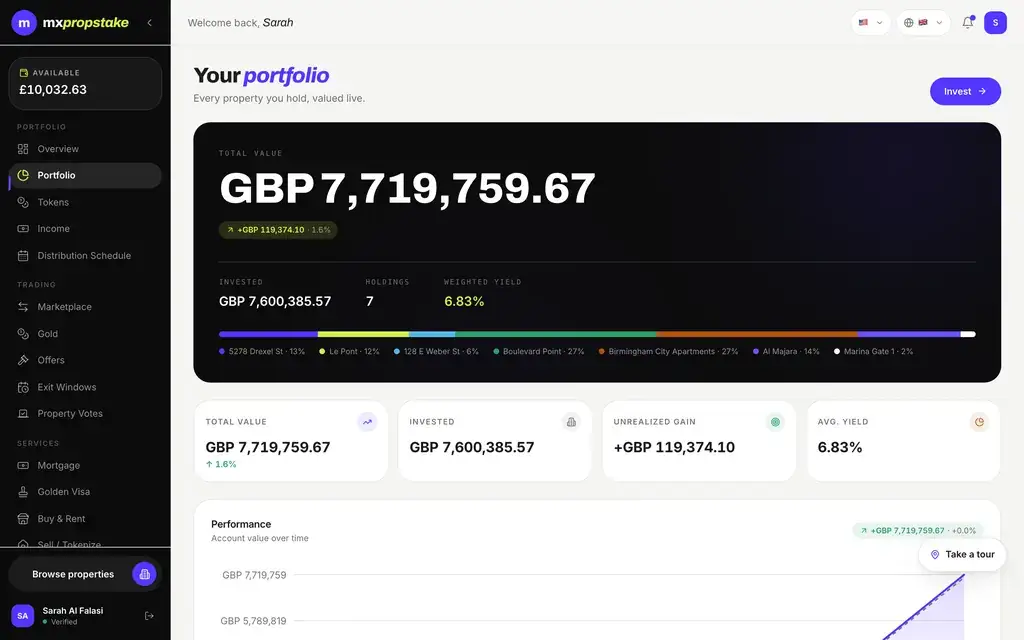
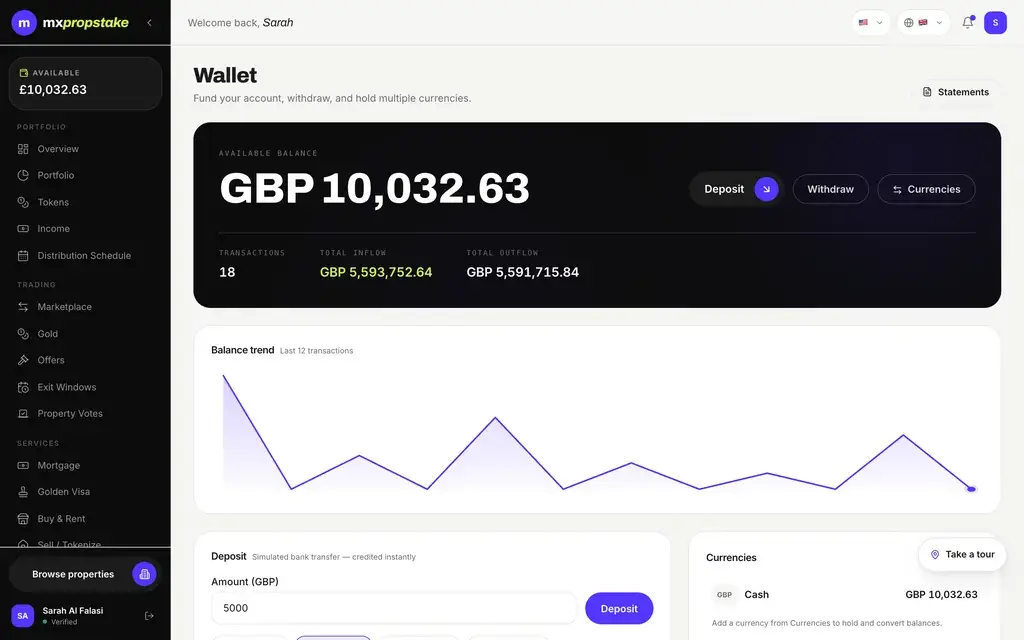
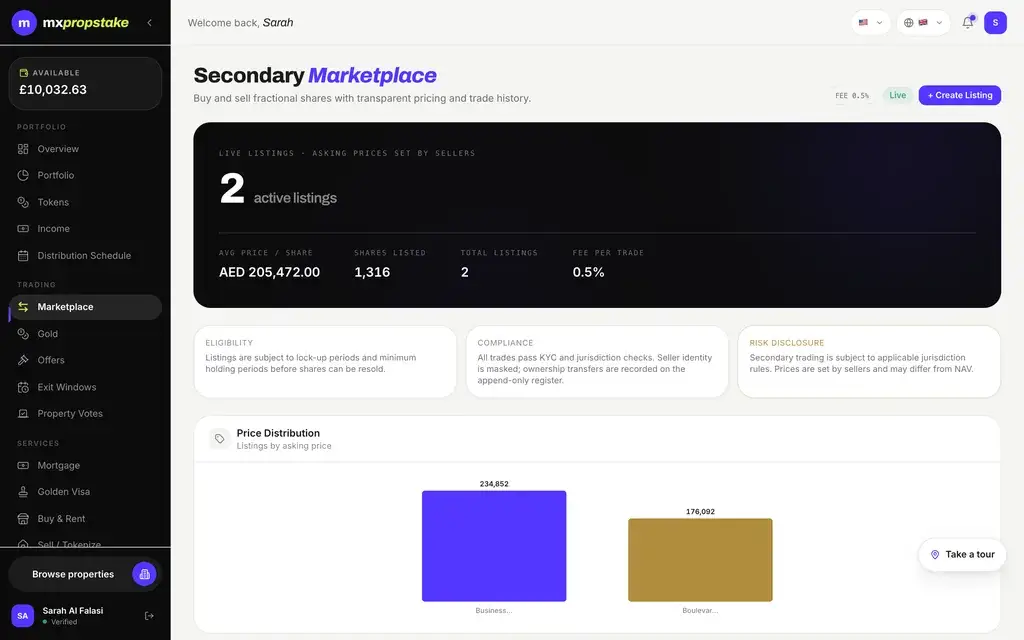
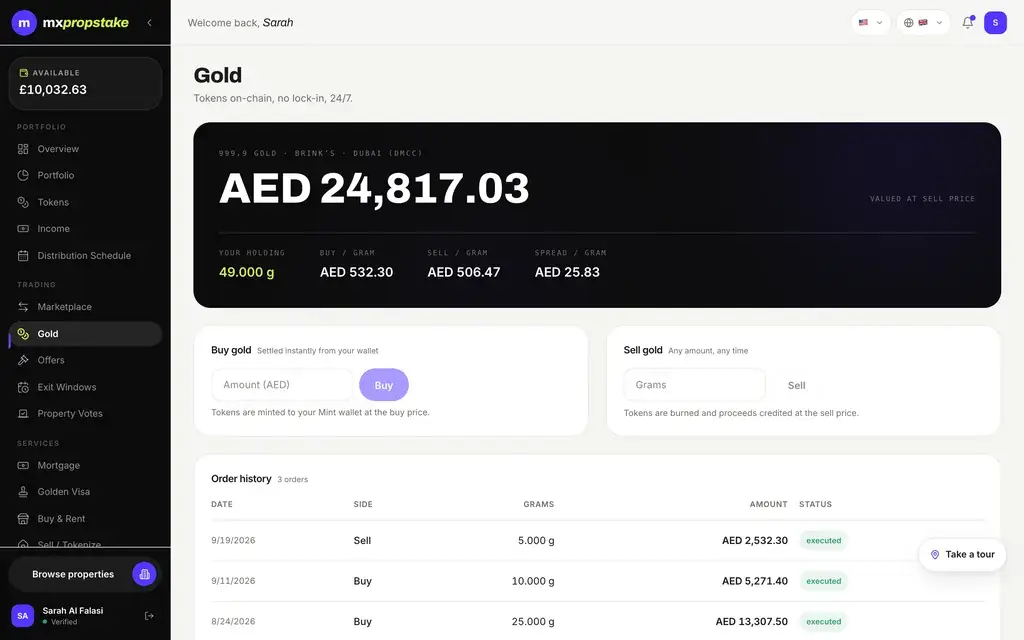
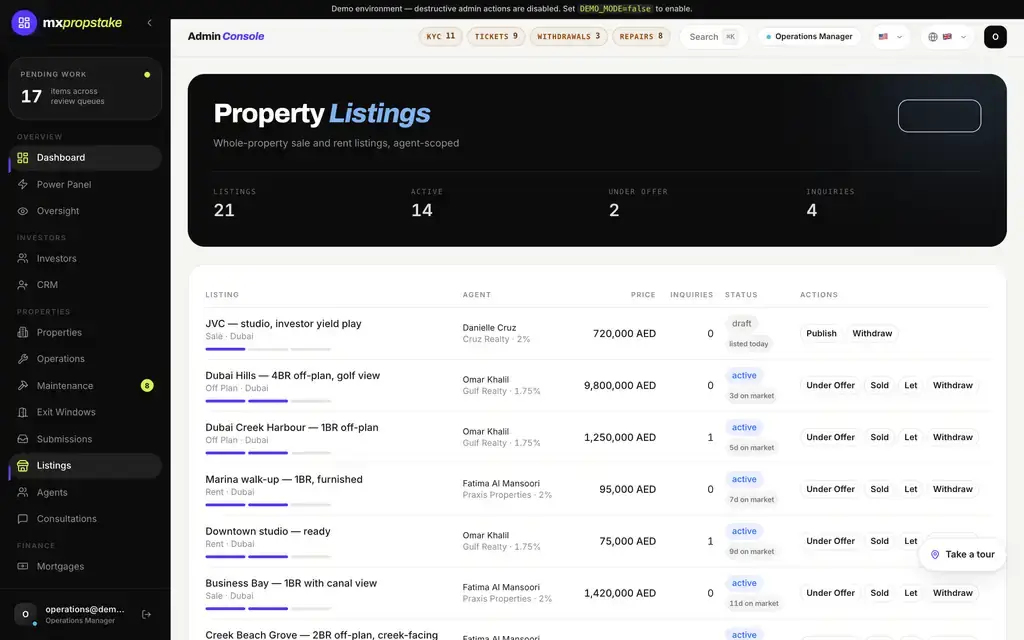
What an investor sees, and the reason the multi-product argument is not a slide. Onboarding and KYC, then a catalog of specific properties, each with its own projections and documents; a subscription flow where the agreement is attached; a wallet that holds multiple currencies; a portfolio with certificates and income; a secondary marketplace to sell into; and in the same account a vaulted gold holding, a mortgage application and a golden-visa pipeline.
- 1Start the investor app from a browser window
- 2Log in with the investor credentials provided below
- 3Review: Catalog, Wallet, Gold, Marketplace
investor@demo.com | Demo1234!
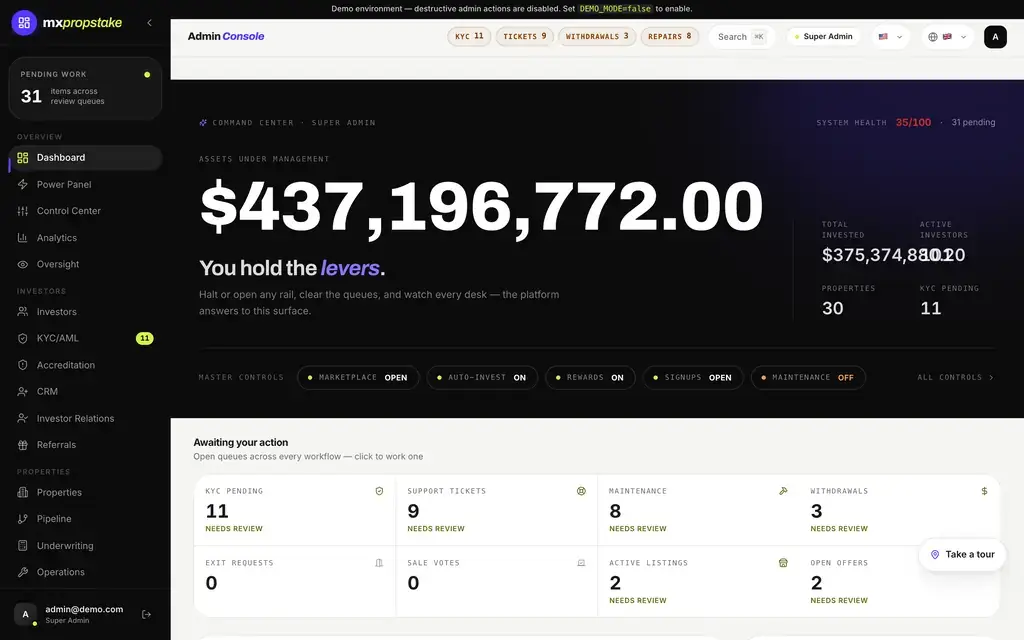
Prypco Clone - Pipeline, Underwriting, Register & Flags
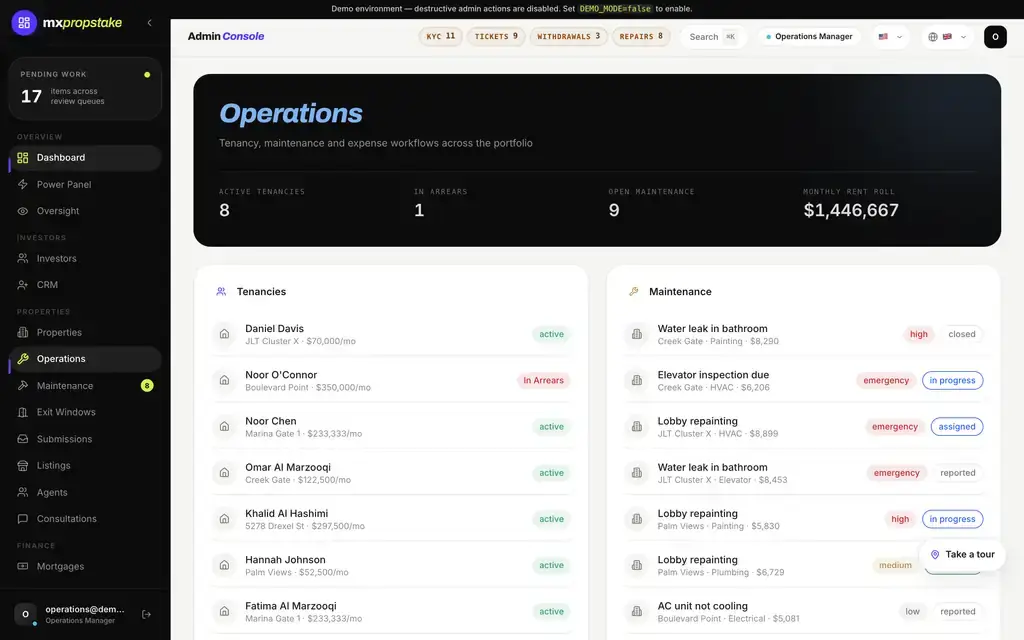
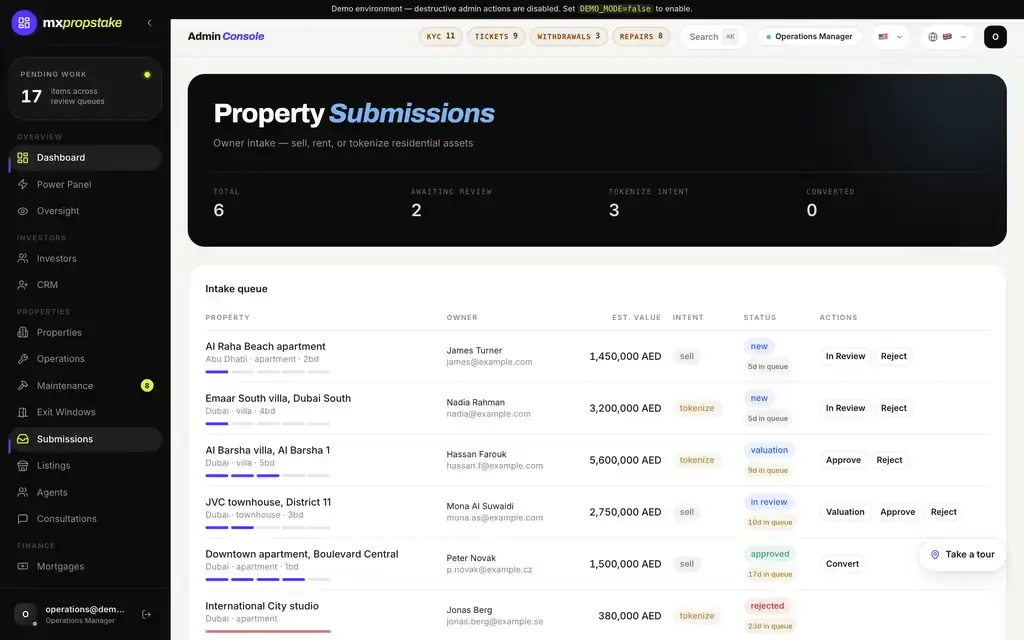
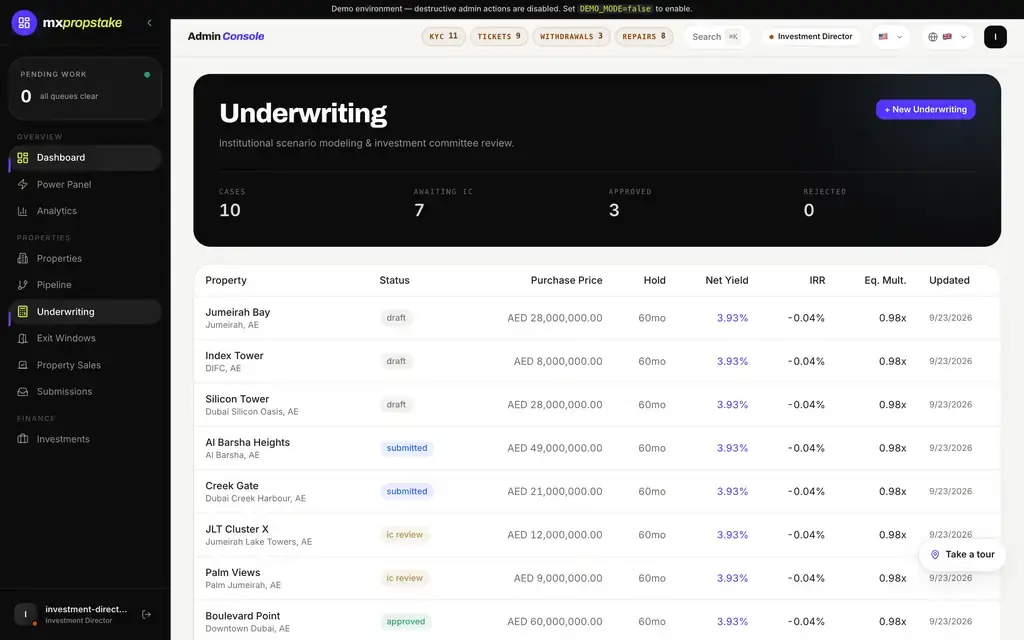
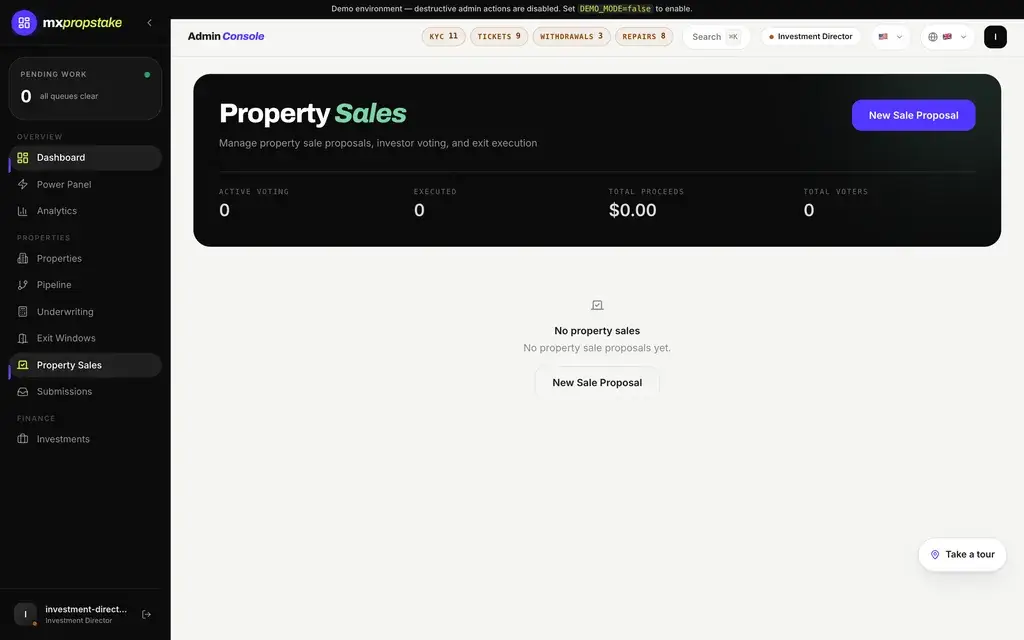
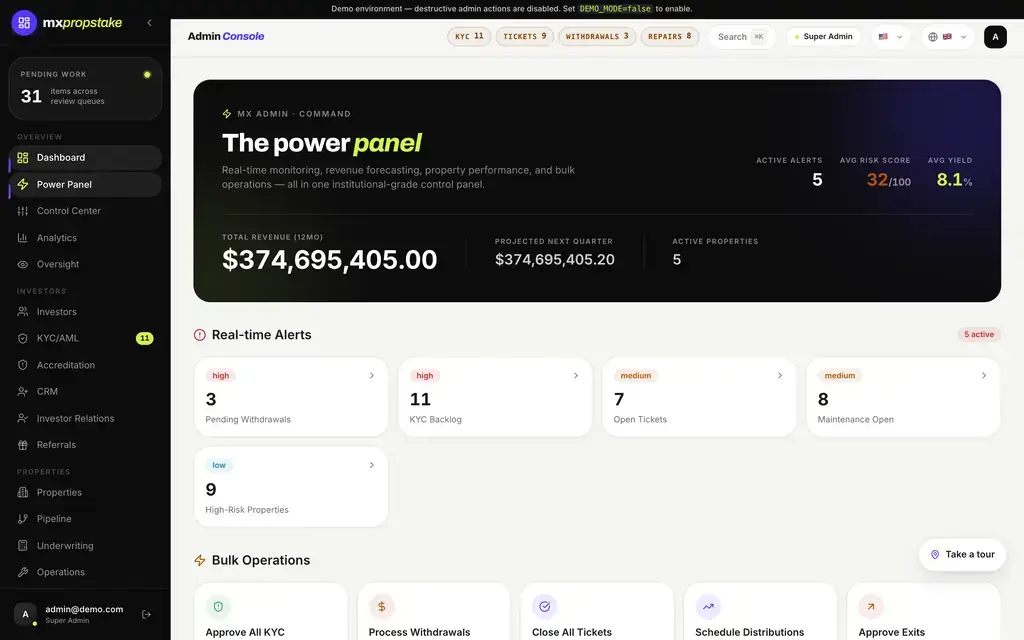
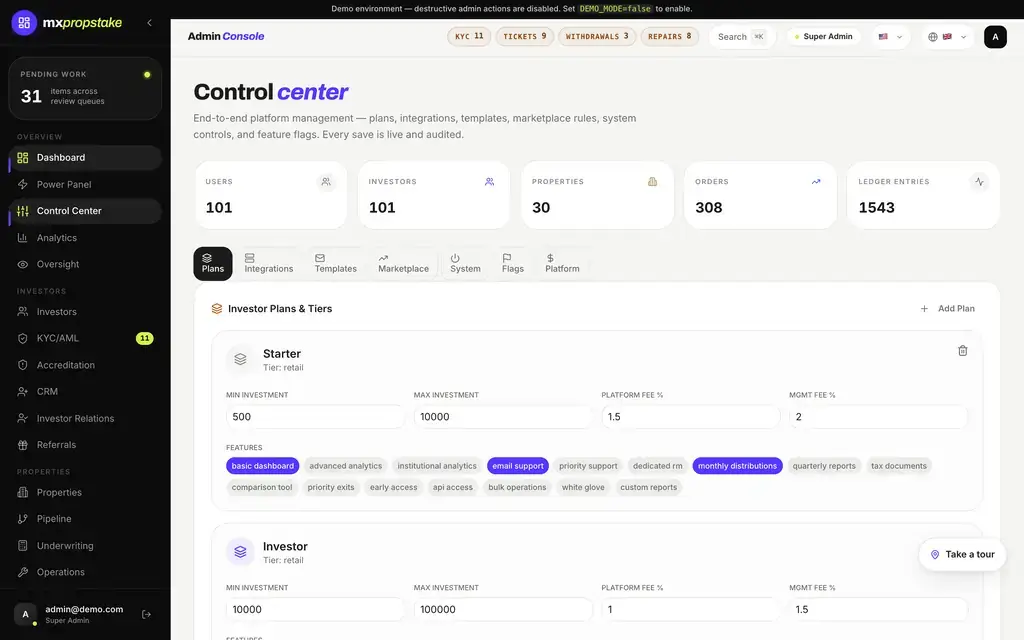
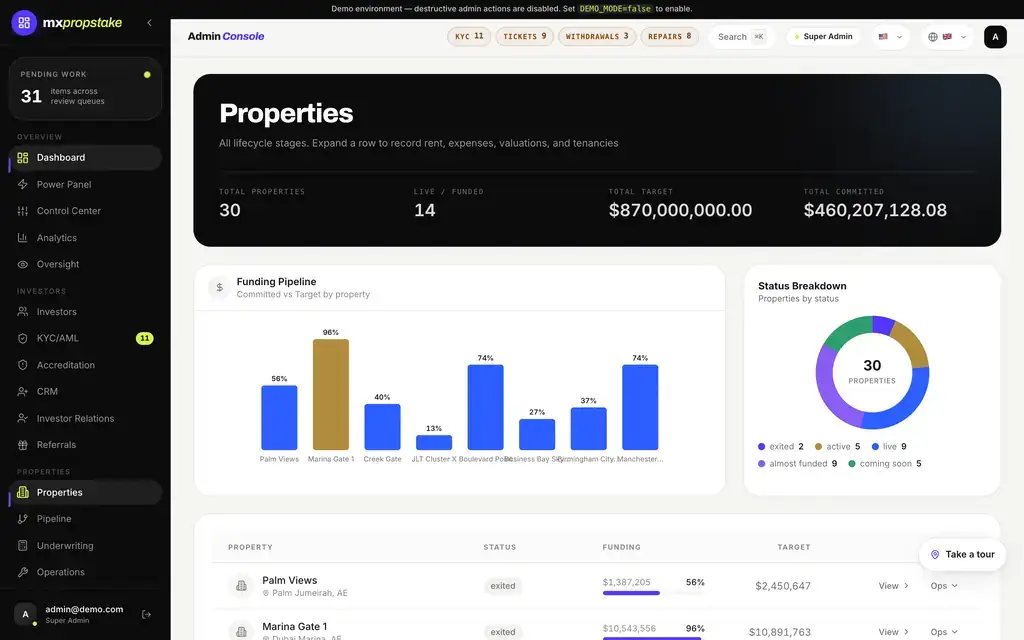
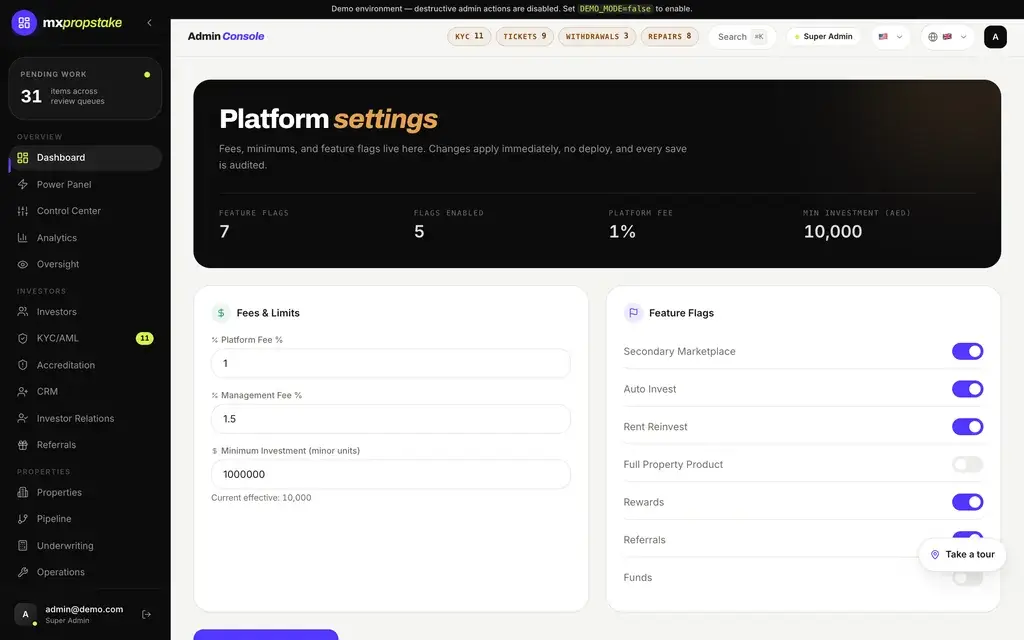
Where the platform is actually run, across forty-six suites. Deal pipeline and underwriting, investment committee review, the property record, the append-only ownership register, tenancy and rent roll, the control center and power panel, and the feature flags that decide which of the eleven product lines are switched on in your deployment at all.
- 1Launch the operator console in a browser tab
- 2Login with the super admin credentials below
- 3Review: Pipeline, Register, Control Center, Flags
admin@demo.com | Demo1234!
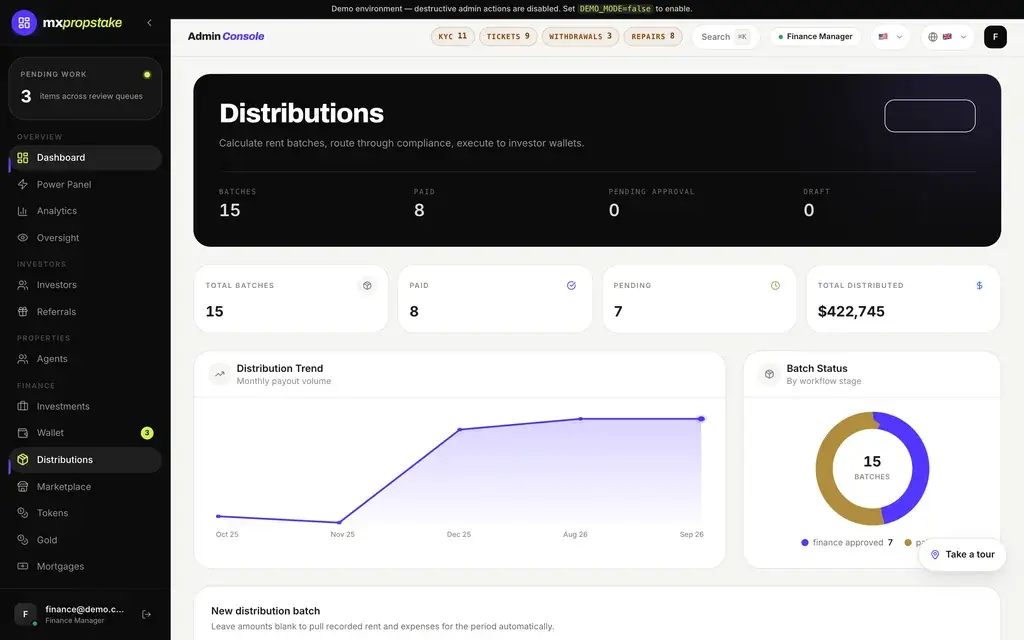
Prypco Clone - Ledger, Fees, Distributions & Gold
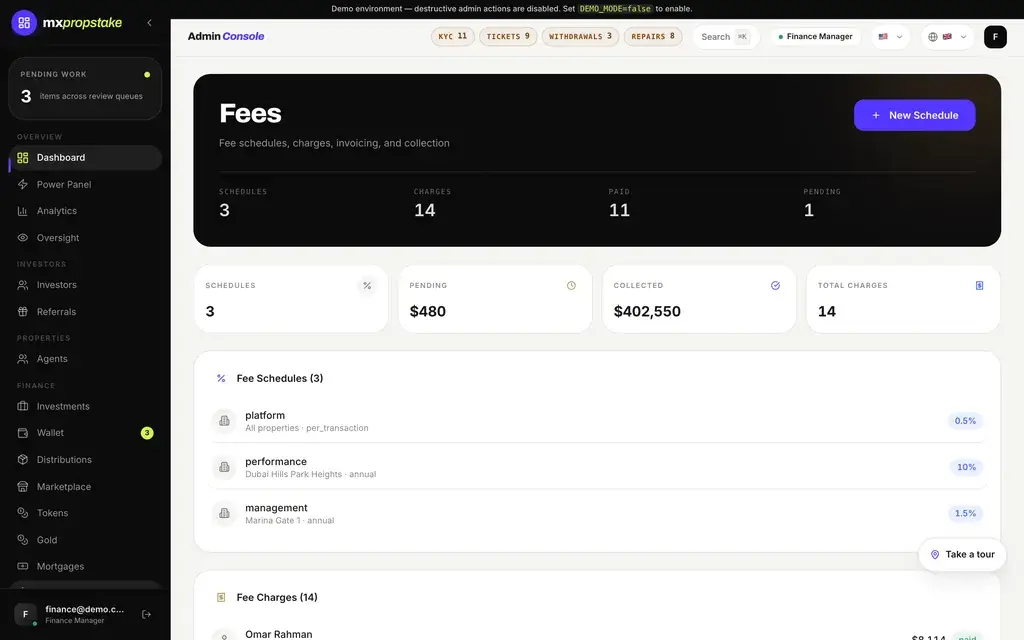
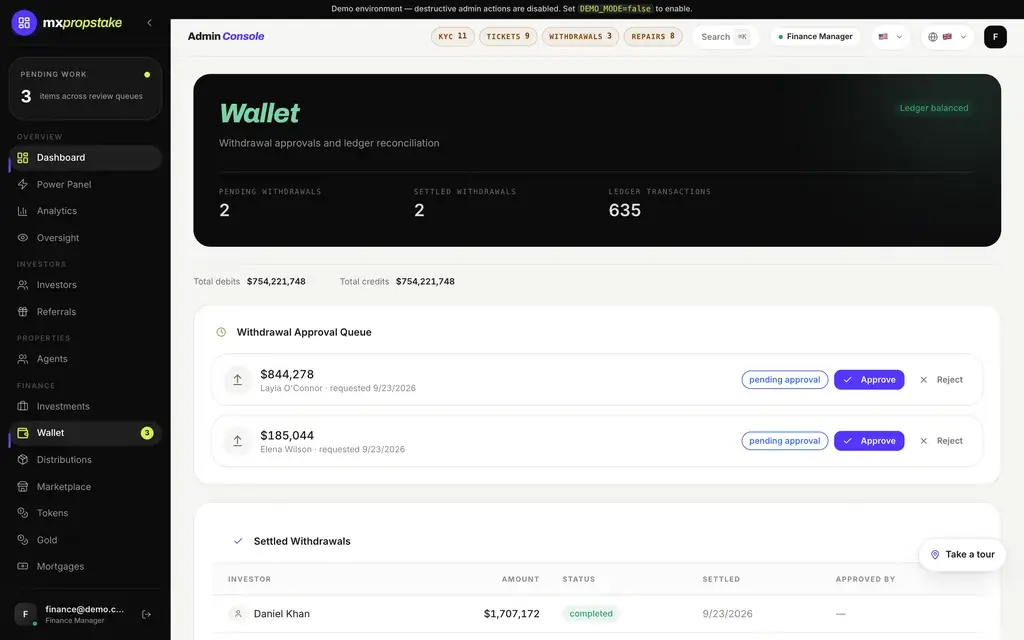
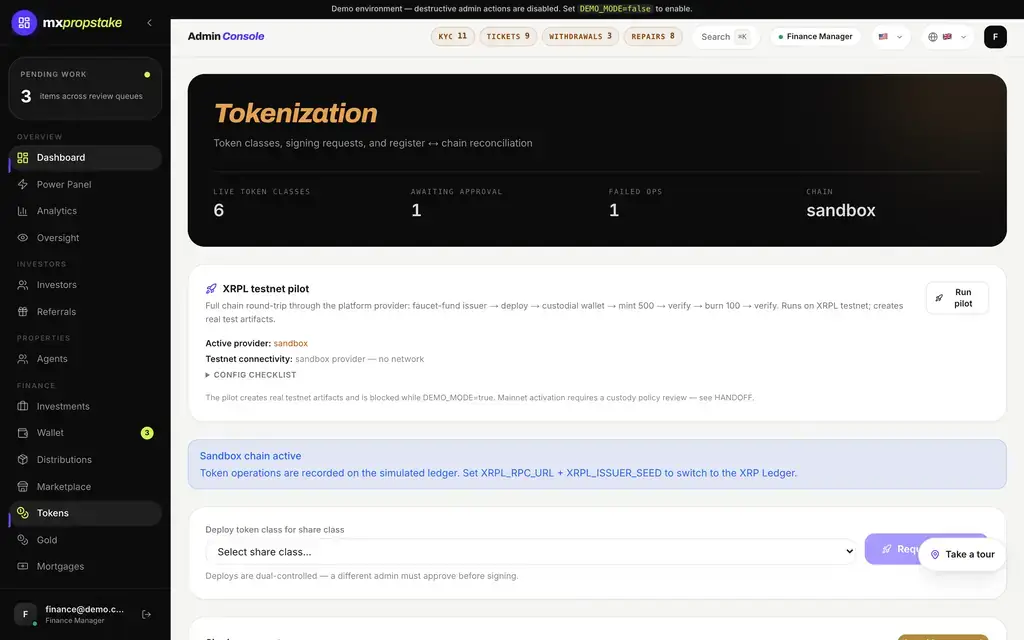
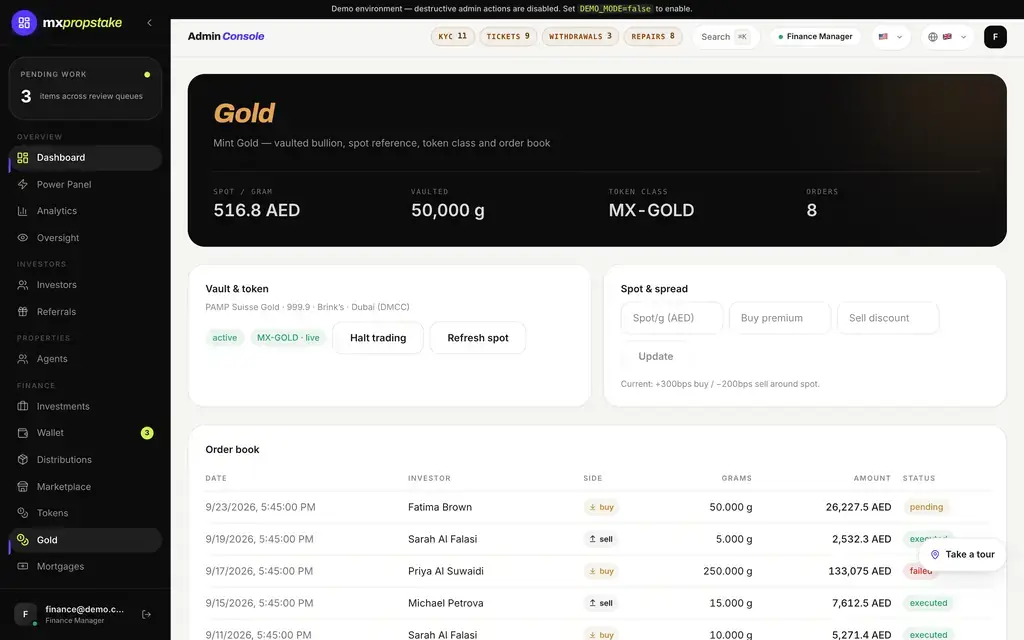
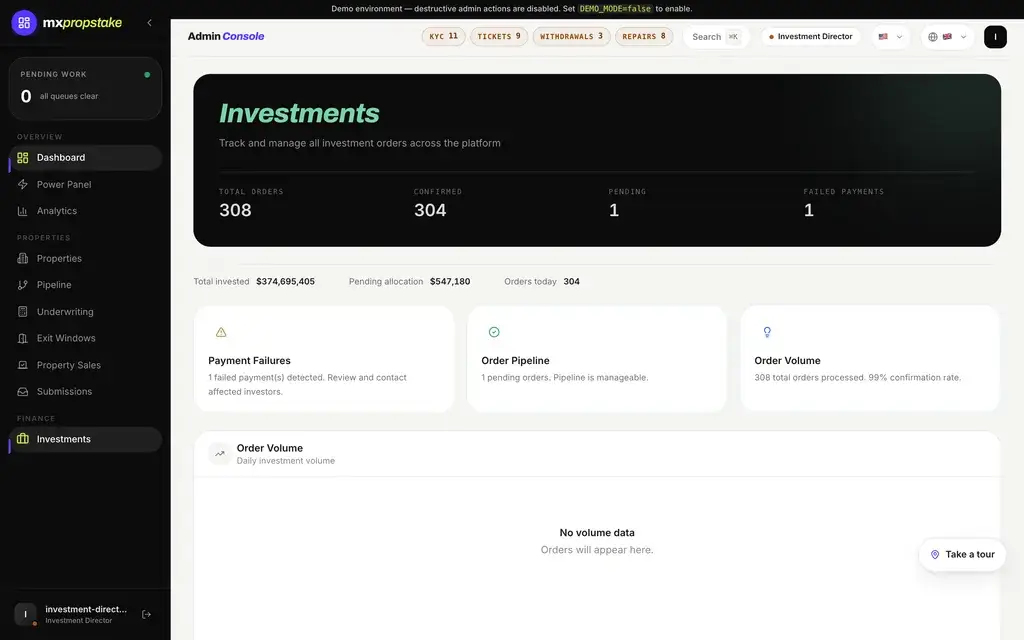
The money surface, and the part that deserves the closest attention. A double-entry ledger behind every number, ten fee types configured as schedules rather than written in code, distribution batching from calculation through approval to release, the withdrawal approval queue, the gold order book with its spread, and the tokenization suite with its sandbox label showing plainly.
- 1Bring up the finance console from your browser
- 2Sign in with the finance credentials shown below
- 3Review: Fees, Distributions, Wallet, Gold
finance@demo.com | Demo1234!
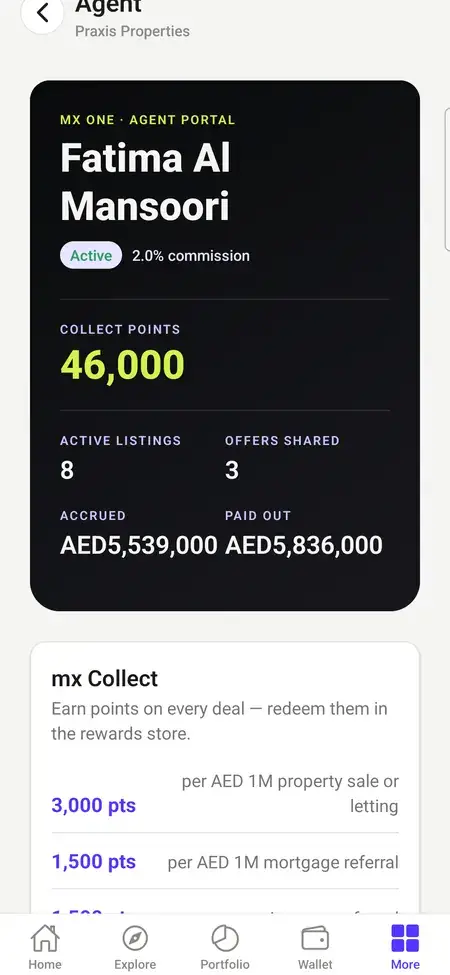
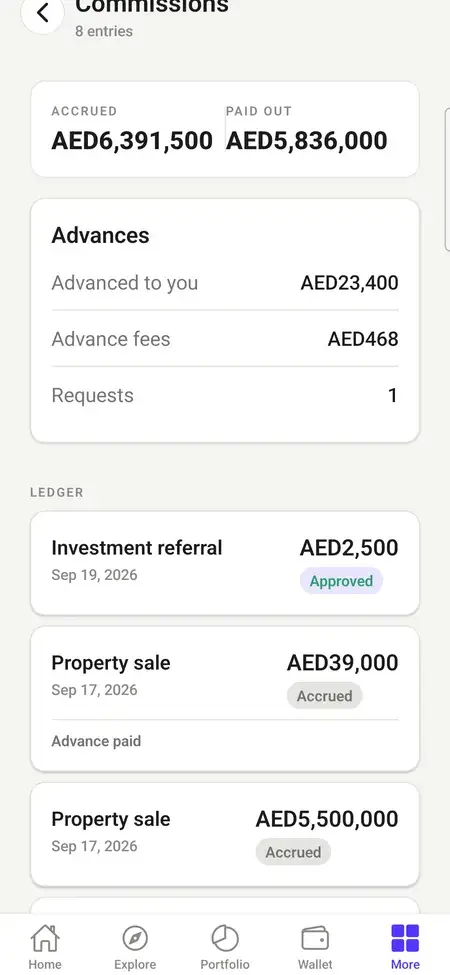
Prypco Clone - Commissions, Advances, Collect & Referrals
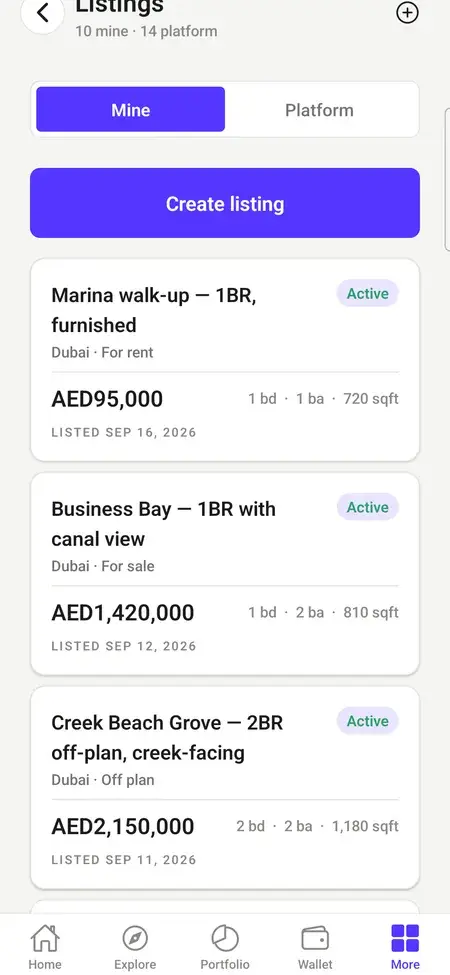
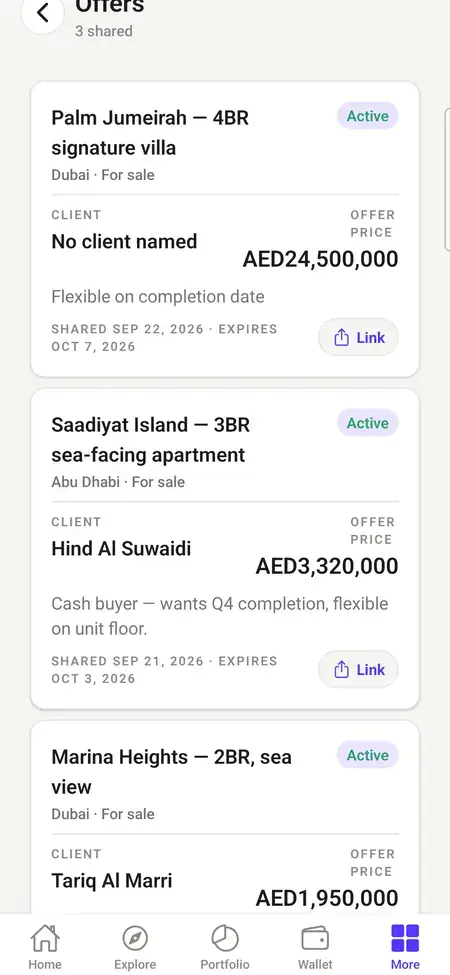
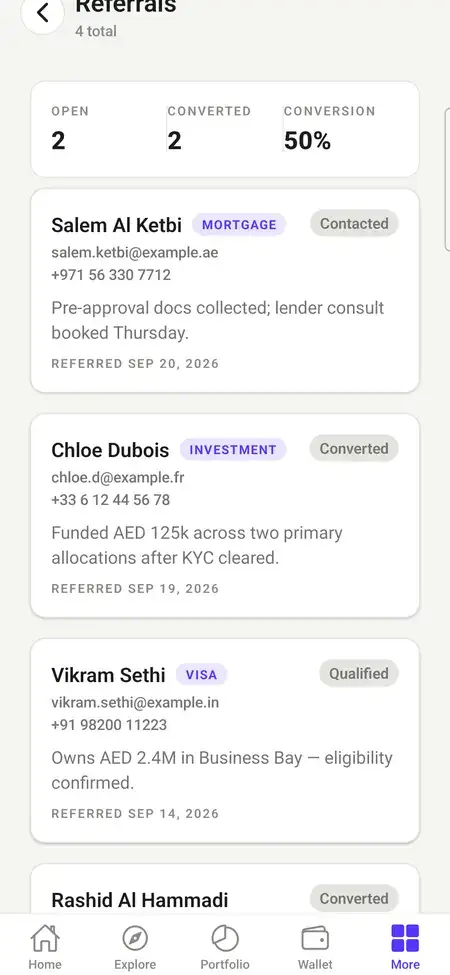
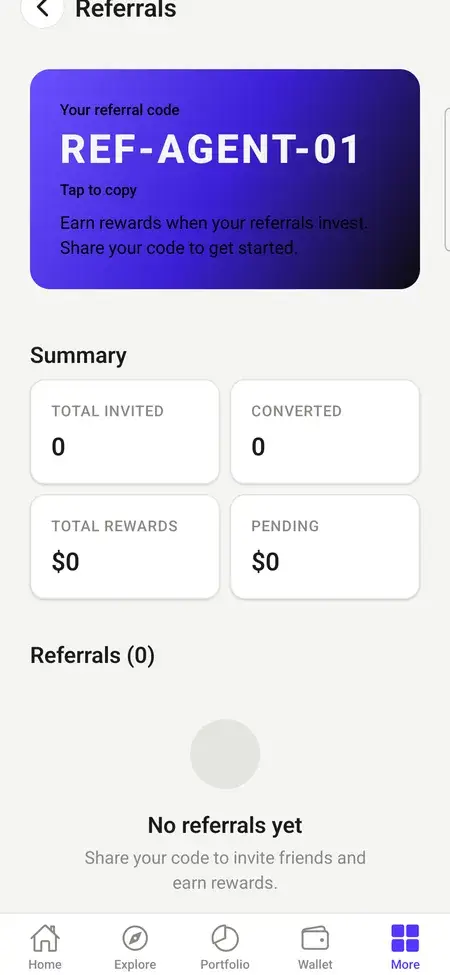
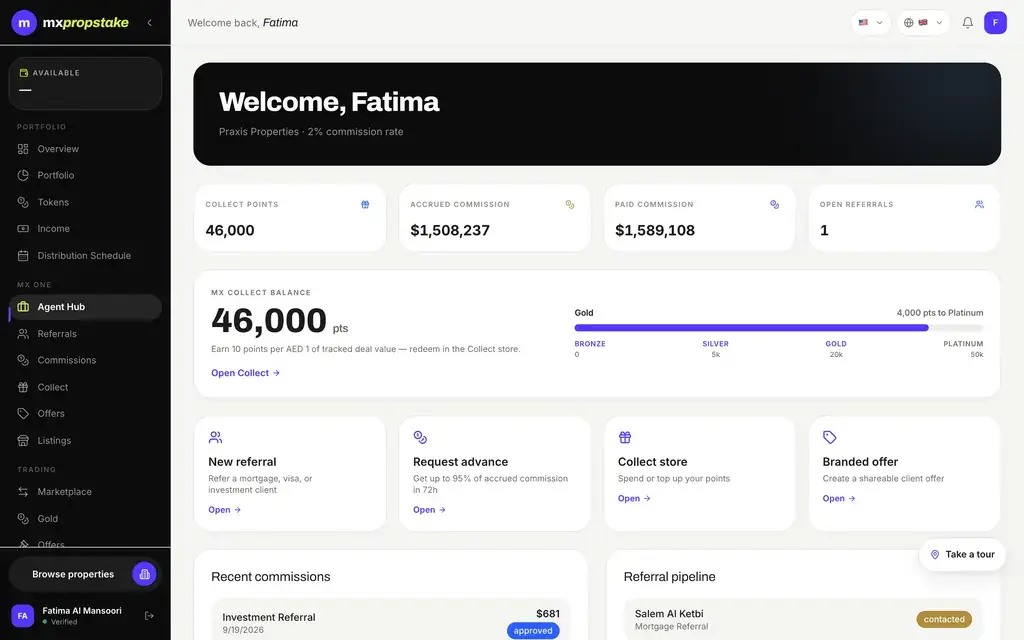
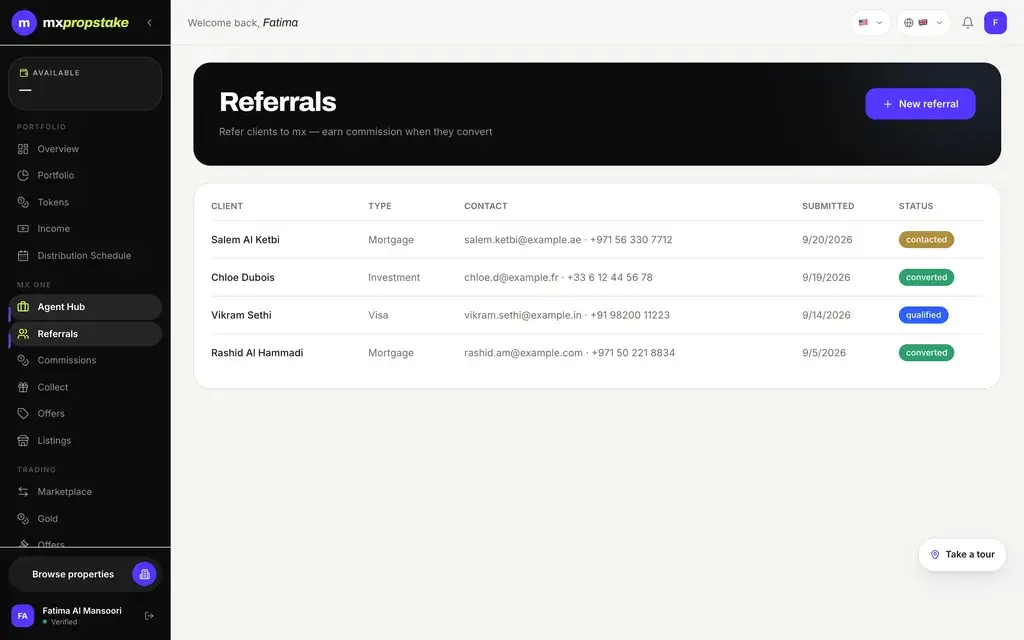
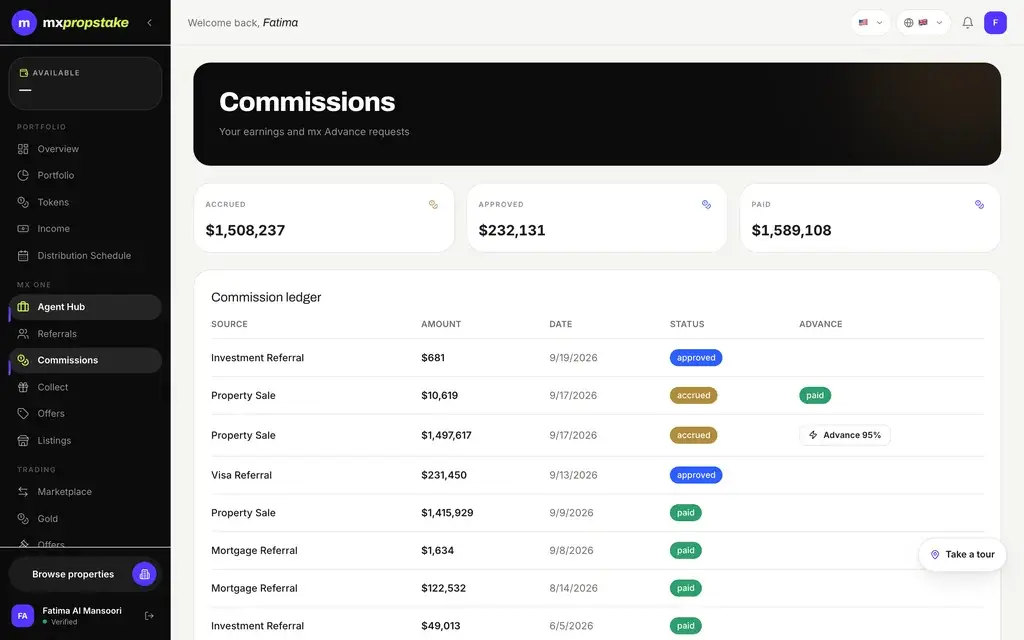
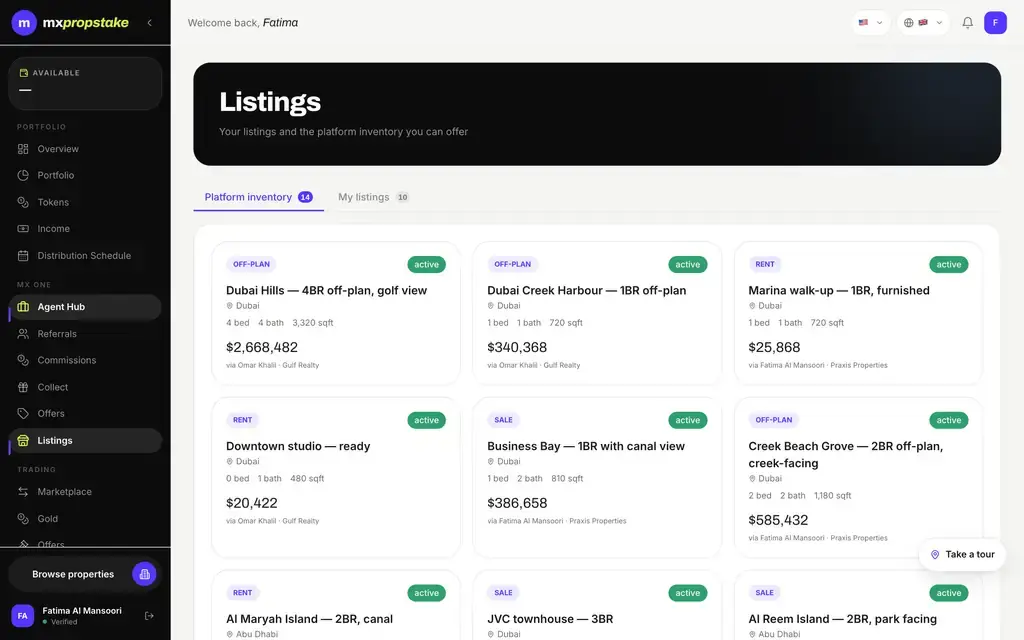
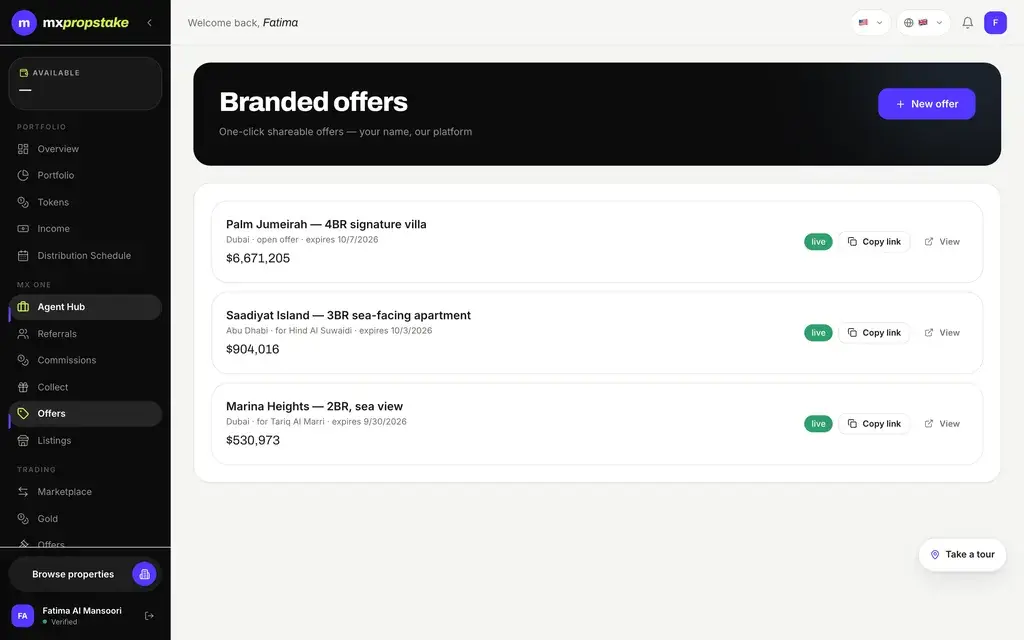
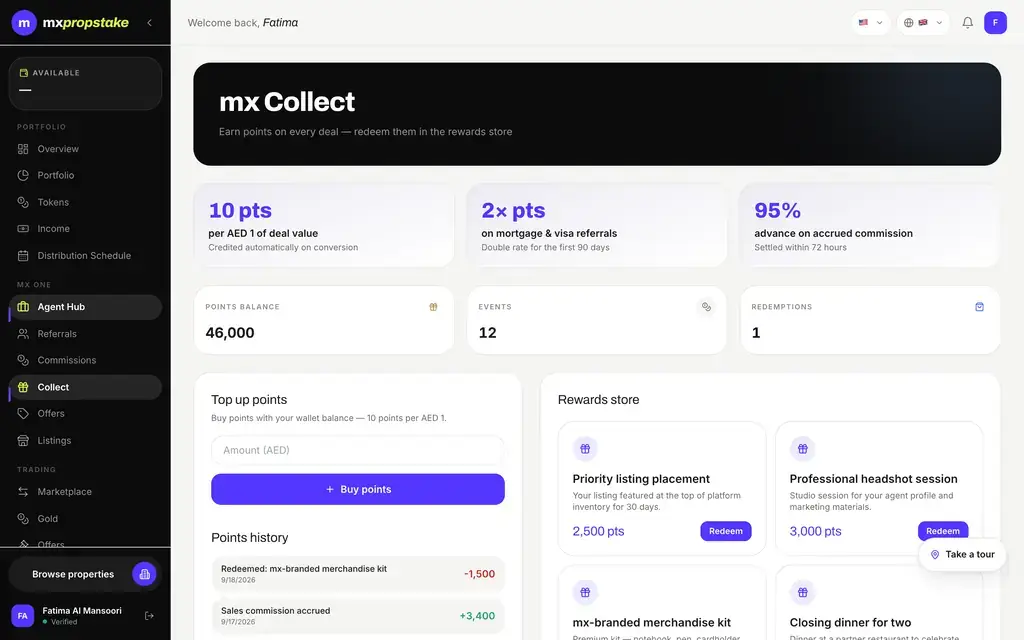
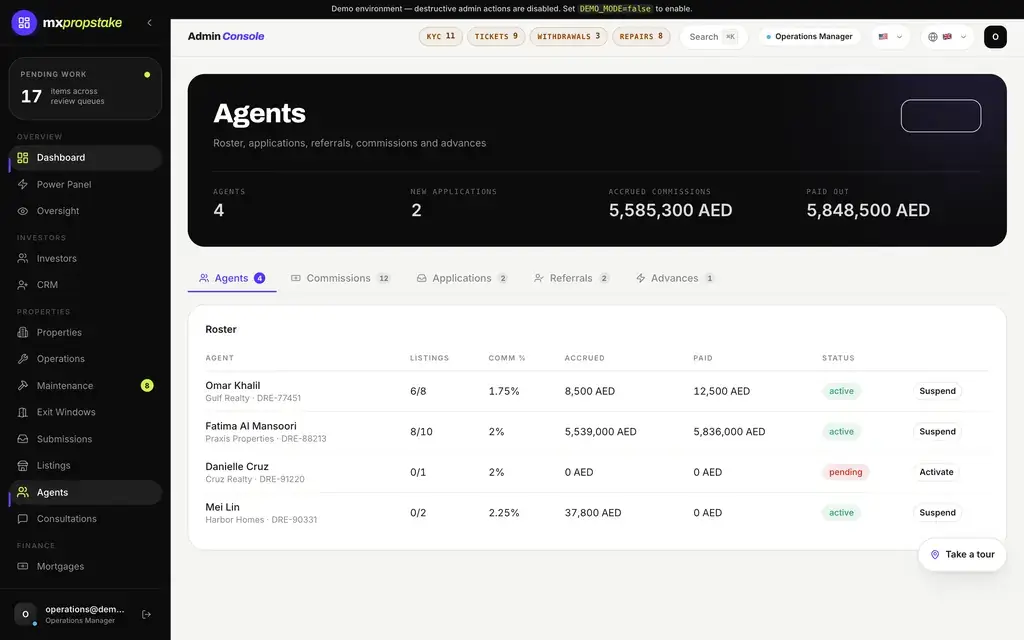
The distribution channel, which most fractional platforms run on spreadsheets and lose agents to. An agent sees their own listings, the branded offers they can share with a client, a commission ledger split by product, a referral tree, points toward program tiers, and a request for an advance against commission they have earned but not yet been paid.
- 1Open the agent workspace in your browser
- 2Login with the agent credentials below
- 3Review: Listings, Offers, Commissions, Advances
agent@demo.com | Demo1234!
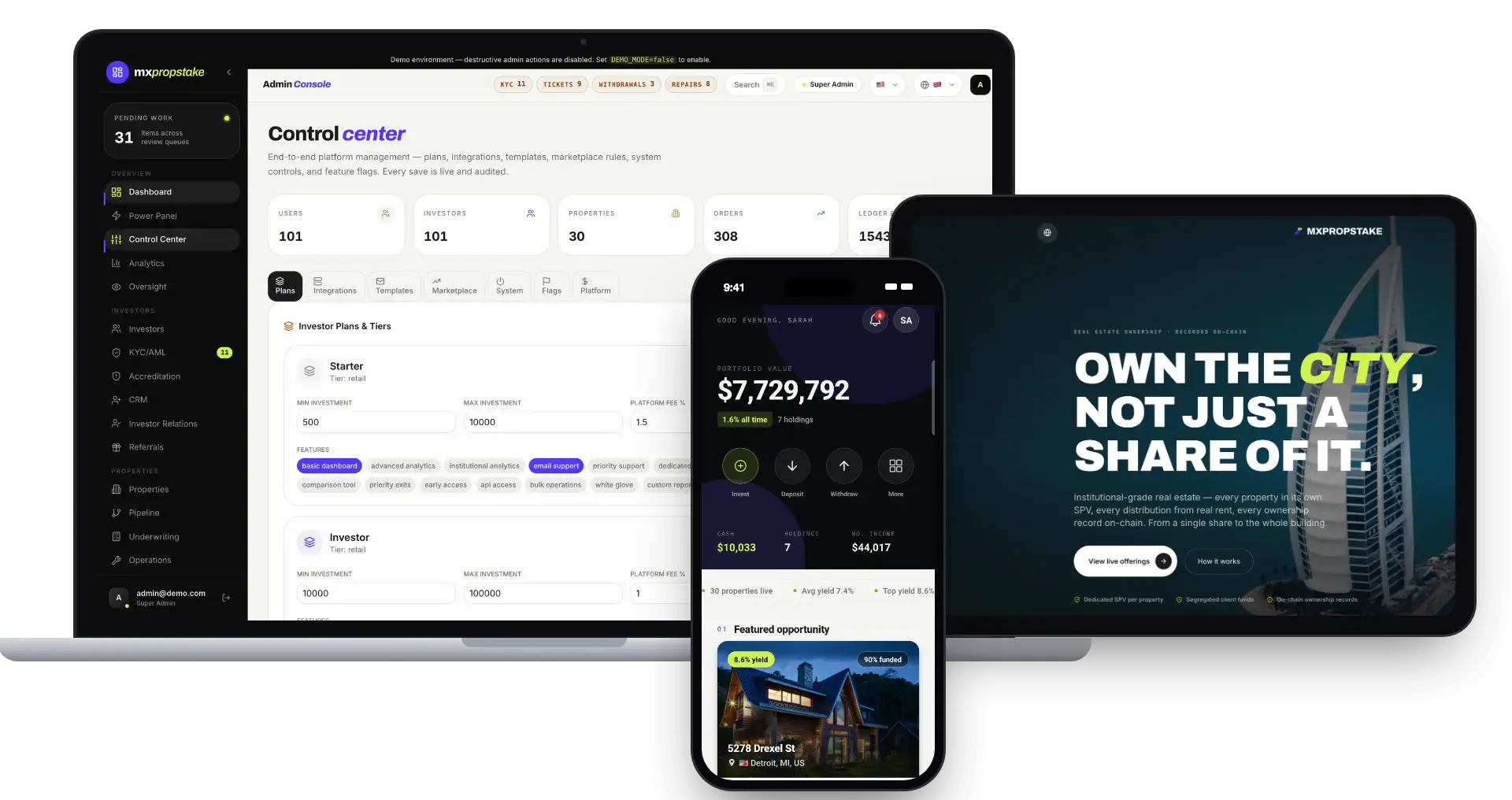
Running Product Tour
Video Demo of a Property Investment App Like Prypco: Invest, Certify, Distribute & Exit
This tour covers the parts that determine whether a platform of this kind holds up, instead of listing features. It starts in the console at the control center, where feature flags choose, from the eleven product lines, the ones this deployment runs. Next, an investor subscribes to one property using the wallet; the order carries the agreement, and the allocation is written to the ownership register while a certificate is issued within the same transaction. The finance console then assembles a distribution batch and keeps it on hold until approval, after which it is released against the ledger. The final stop is the tokenization suite, which shows the sandbox label on screen and leaves a token operation waiting on its second signer. If any single step matters to you more than the others, arrange a call and we will walk through that one with real data loaded.
Book a Free Strategy CallScreen-by-Screen Index
Prypco-Like App Flows - Investor, Agent, Operator & Admin
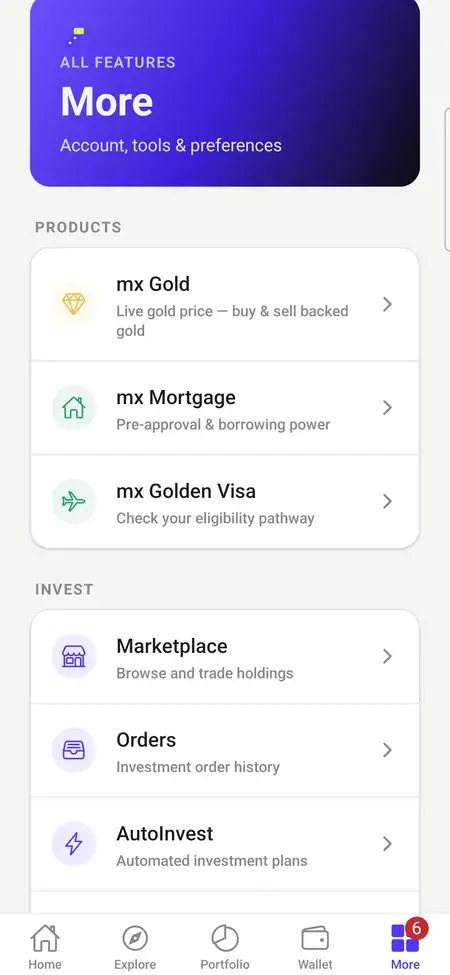
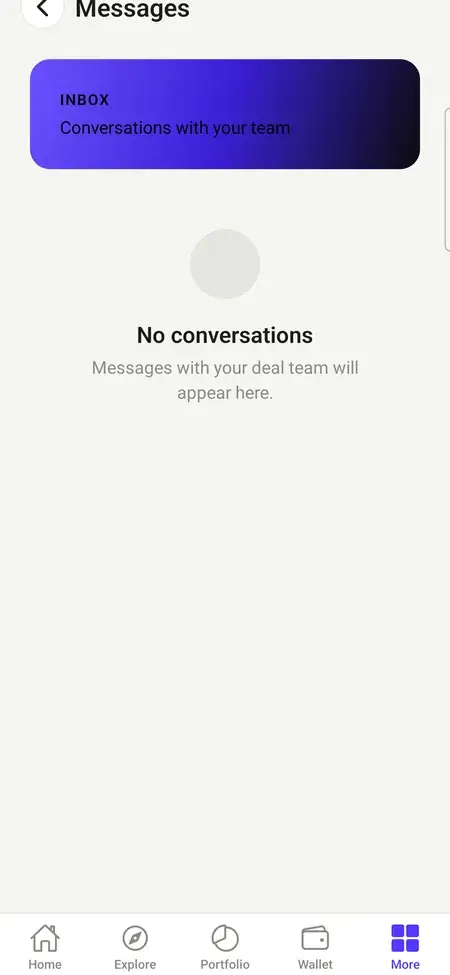
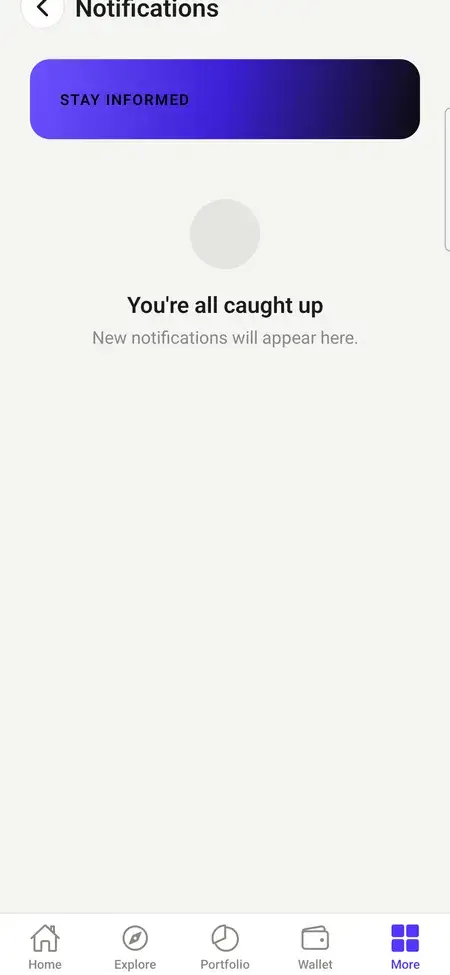
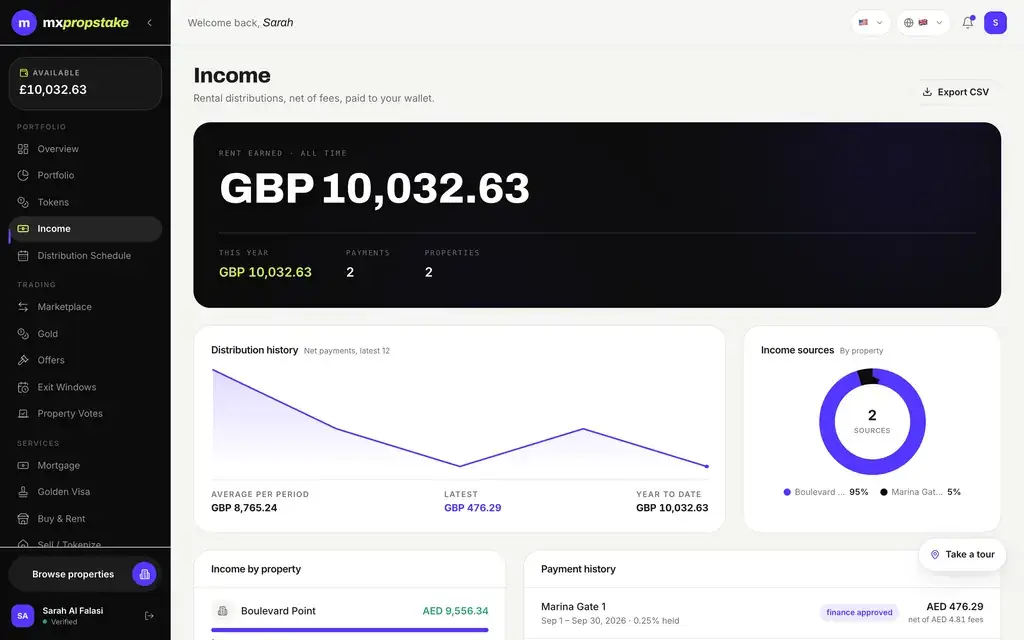
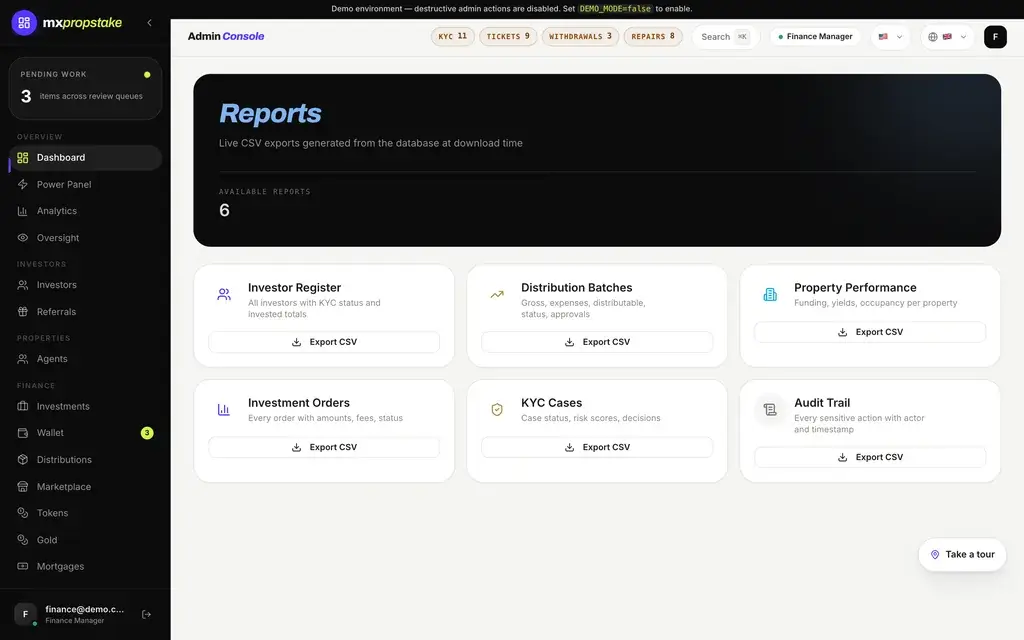
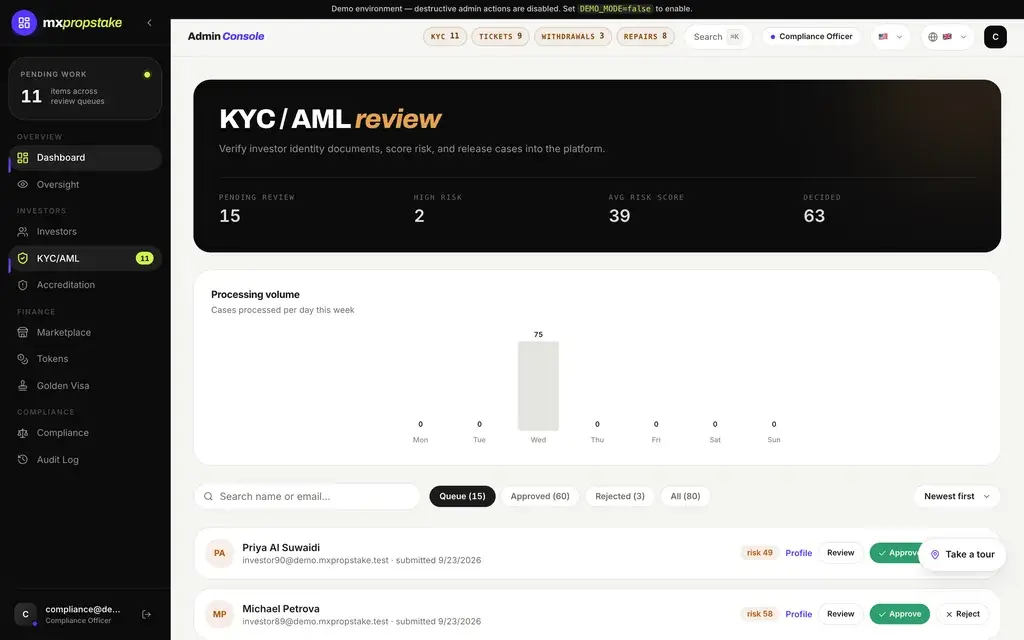
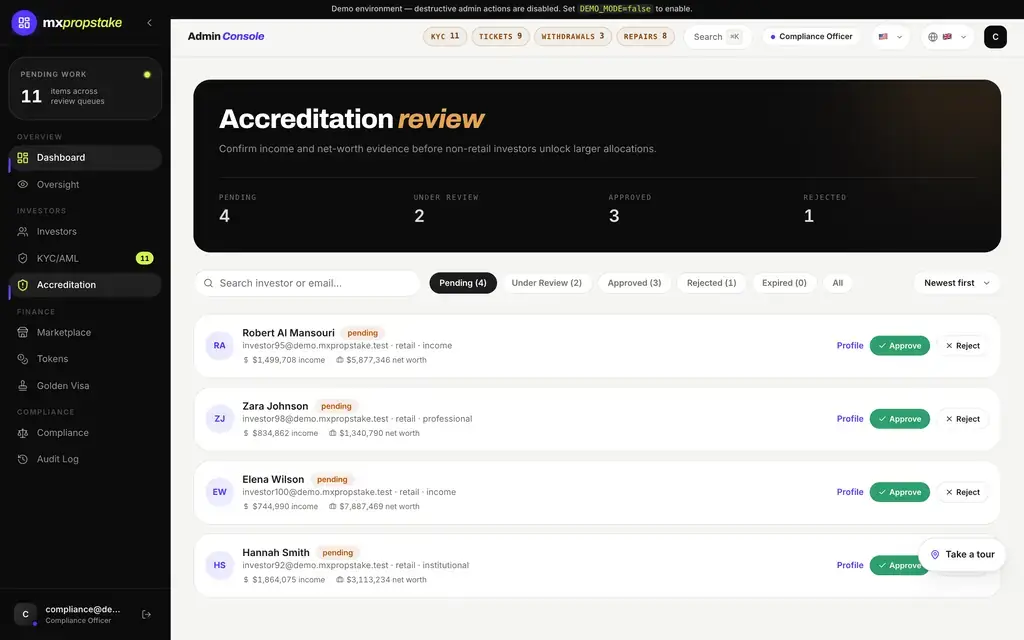
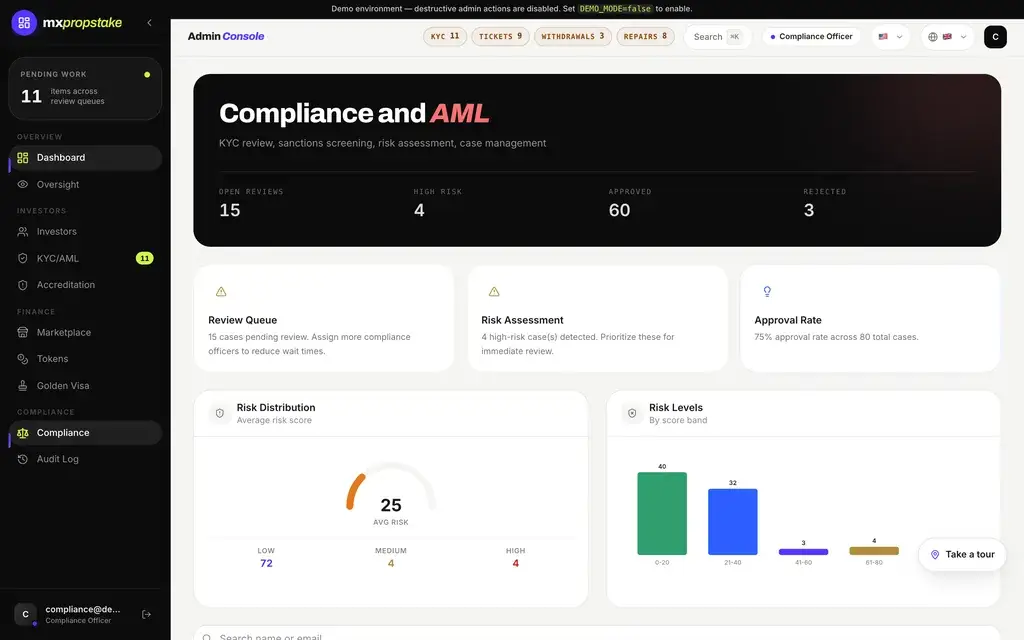
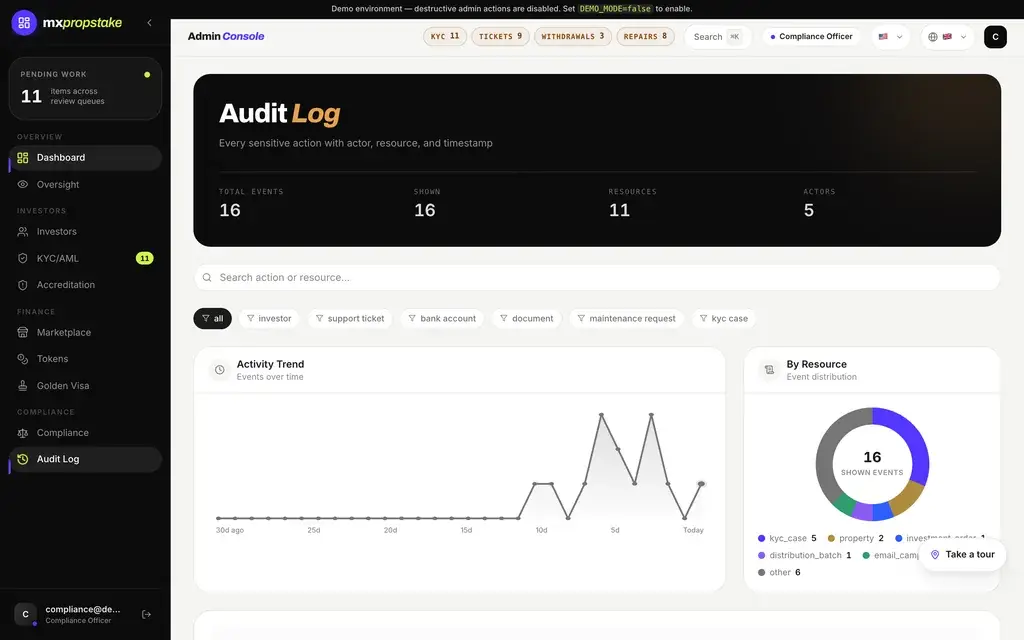
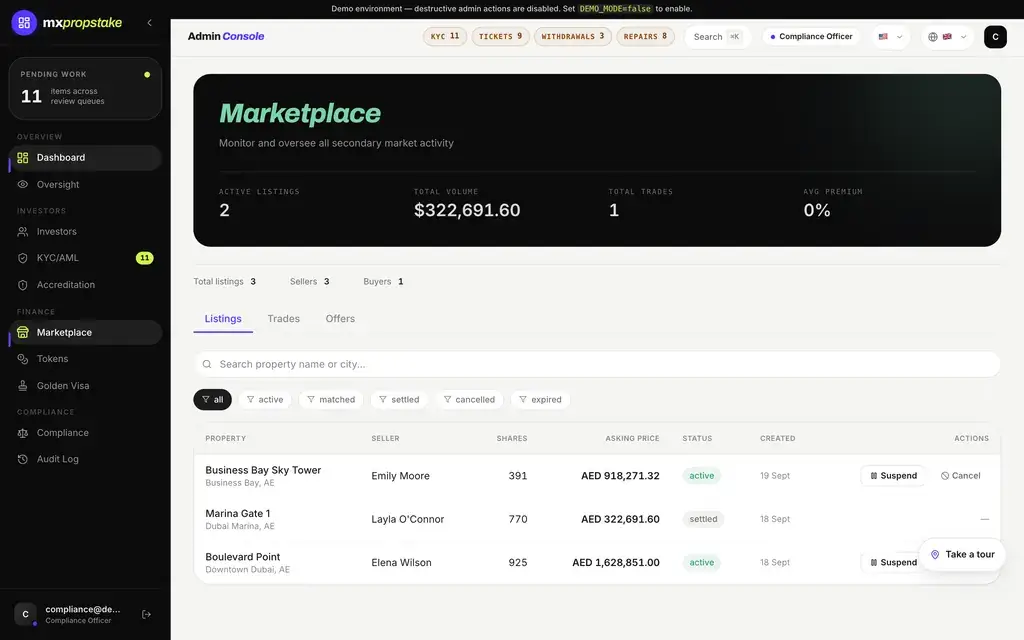
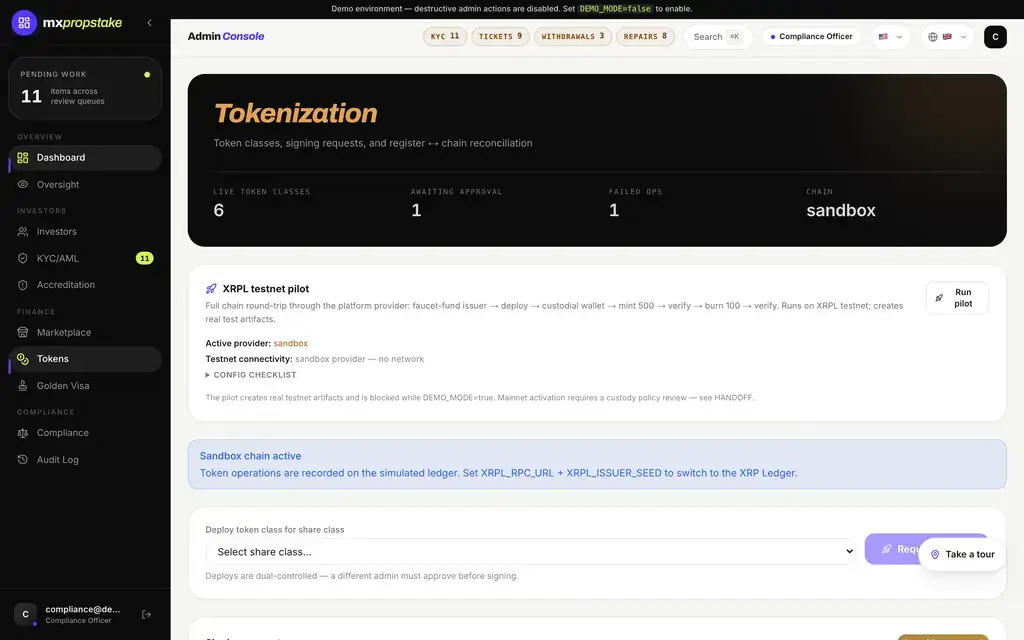
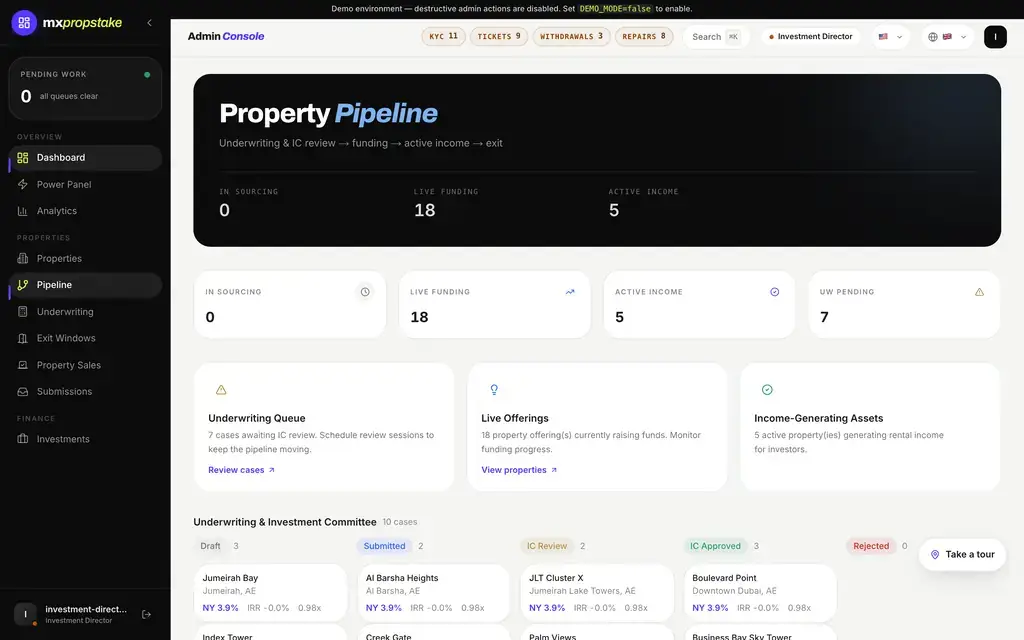
The Prypco clone app Miracuves delivers puts nine role surfaces over one versioned API of 299 routes. Two of them are native: the investor app and the agent workspace, built on Expo and React Native rather than wrapped in a WebView. The other seven are web consoles, one per role, drawn from the same forty-six suites: the investor dashboard, the agent console, operations, finance, compliance, investment direction and super admin. Every one of them reads the same ledger and the same append-only register.
Step through the flows below to trace a single property: a developer submits it, underwriting and committee approval follow, then an investor subscribes using a multi-currency wallet, a certificate is issued, the distribution batch pays out, and the share eventually trades on the secondary market. At every stage the register, ledger and audit trail stay one and the same set of records, which is the whole reason to buy this instead of assembling it.


02Proof
Client Voices
Prypco Clone Client Reviews - Real Platforms, Outcomes So Far
Feedback from operators who launched investment, banking and property platforms with Miracuves, quoted word for word from our testimonials page.
“We had a hard regulator date for a cross-border neobank. Accounts ledger, KYC and card issuing came off their shelf; we added the corridor FX engine and our partner bank's settlement layer. We hit the milestone with room to spare, which would not have happened from a standing start.”
“RFQ, matching and post-trade reporting was our long pole. Their OTC module covered it, and we layered on our compliance checks and multi-leg settlement. First counterparties were trading within weeks and we saved a third of the engineering budget.”
“Multi-currency accounts, cards and KYC existed on the base. Our work was our own rails and the compliance surface our regulator wanted to see. Live inside a month with the audit trail designed in rather than bolted on.”
“Listings, search, media handling and enquiries were all ready. Our work was the local property types, the map behaviour and how agents actually get leads. Live inside a month.”
Illustrative Scenario
Prypco Clone Modeled Reference - Multi-Product Platform Operator
What you see is a reference deployment built as a model, not work done for a client, and it carries that label on purpose. It demonstrates the platform configured for an operator planning to earn from several products off one verified investor they already acquired: fractional property comes first, with a mortgage pipeline and vaulted gold alongside. All capabilities named belong to the base build and can be seen in the demo. The operator does not exist, and no number shown below reflects a client outcome.
Platform Operator
How this platform is configured for an operator running property, gold and mortgages against one verified investor base.

- A separate vendor and a separate reconciliation for every product
- An operator console that was never finished, so the business runs on exports
- An agent channel tracked in spreadsheets, losing agents to the friction
- One verified investor able to hold property, gold and a mortgage application
- Every fee across every product posting to the same ledger
- A register that answers who owned what on a given date as a query
- Eleven product lines sharing one wallet, one KYC pass and one ledger
- Feature flags deciding which lines this deployment runs at all
- Ten fee types configured as schedules across nine revenue rails
- Agent commissions, advances and point tiers handled in-product
- XRPL tokenization mirroring the register, running against its sandbox
A model deployment for reference, not real client work. All named capabilities are in the base build, and the operator is fictional.
03The product
The Basics
What Exactly Is a Prypco Clone App?
A Prypco clone app is a platform for fractional property investment, and the version Miracuves builds runs eleven product lines on a single investor account. Investors hold a share of one identified building instead of a unit in a blind fund, receive the portion of the rent that is theirs, and can resell the share to another investor, with no need to wait until the whole asset is sold. This build goes further than that definition: the same verified investor can also hold vaulted gold, apply for a mortgage, run a golden-visa application and write a will, which is why it is eleven product lines rather than one.

Built for Web, Mobile and the Operator
A Next.js 15 investor experience across 160-plus routed pages, a native Expo client with sixty-plus screens, an agent workspace and a forty-six-suite operator console, all over one versioned API of 299 routes and one PostgreSQL domain of 108 models.
Eleven Products on One Chassis
Property, marketplace, exits, distributions, gold, mortgage, golden visa, agents, services, wills and CRM share one wallet, one identity check and one ledger, so a second product line costs configuration rather than a vendor.
Financial Truth as a Design Constraint
A double-entry ledger under every number and an append-only ownership register as the legal record, with payment, allocation and certificate committed in a single transaction. Tokenisation mirrors that register rather than replacing it.
Eleven Products, One Chassis
Why the Breadth Changes the Financials
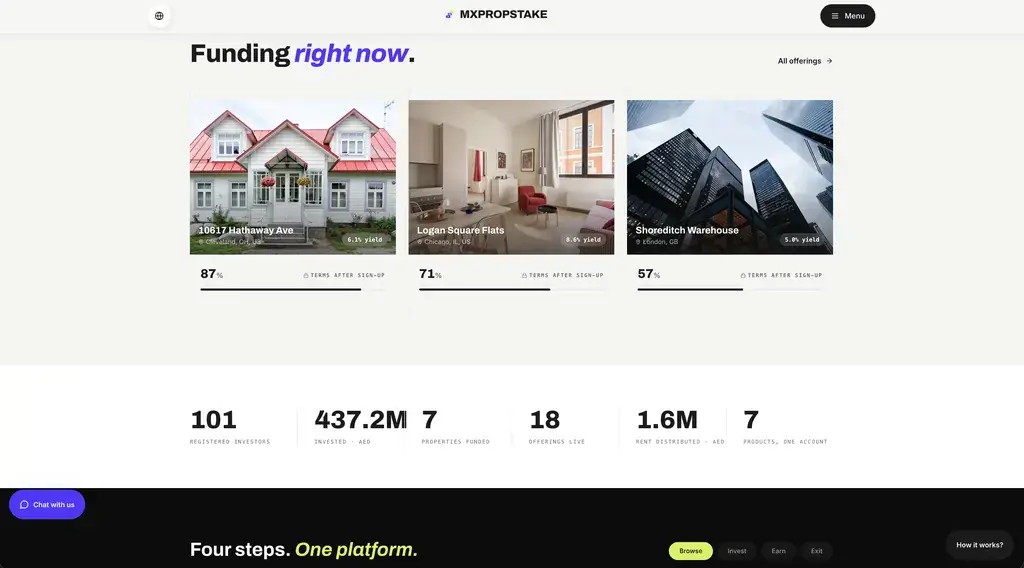
What makes this build different from a fractional property app lies beyond the investment mechanic, which is the same everywhere. It is what sits beside it. Winning a verified investor is the most expensive thing an operator does, and that cost is identical whether the investor goes on to buy one product or five. A platform that can only sell them a share of a building has to win them again for the next product, from a different vendor, with a different identity check and a different ledger. This one can place property, vaulted gold, a mortgage, a golden-visa application and a will against the identity it already holds.
- 01Eleven product lines on one investor account
- 02Forty-six operator suites from day one
- 03Append-only register with certificates
- 04XRPL tokenisation with a deterministic sandbox
- 05Eight locales including Arabic right-to-left
In this category, the useful question for any vendor is not whether they support fractional property. It is whether the second product shares the wallet, the identity check and the ledger with the first, or whether it is a separate system you will be reconciling by hand within a year. Here it shares all three, and the feature-flag suite in the demo will show you which lines are switched on in about two minutes.
Everything Included
Prypco Clone Features - Property, Liquidity, Products & Channel
All of this ships in the base build of Miracuves' Prypco clone and can be seen in the read-only demo. It runs in the order an operator encounters things: the product family first, since that choice defines the business, followed by ownership and money, and finally how an investor gets out.
Eleven Product Lines, One Wallet
The reason to buy this rather than a fractional property app. Property, the secondary marketplace, exit windows, rental distributions, vaulted gold, mortgages, golden visa, the agent network, real-estate services, wills and CRM are eleven revenue-bearing lines on one chassis, sharing one wallet, one identity check and one ledger. Each one can be switched off per deployment from the feature-flag suite.
- Eleven lines live on a single investor account
- One KYC pass serves every product
- Feature flags turn any line on or off
- Customer acquisition cost amortises across the family
Fractional Ownership With an SPV Behind It
Investors own a share of one identified building, not a unit in a blind pool. Each property is wrapped in its own special-purpose vehicle with share classes, a published valuation and a document set, so what the investor holds is a defined interest in a defined asset rather than an exposure to a fund.
- SPV per property with share classes
- Published valuations feeding positions
- Per-property and per-investor document vault
- Subscription agreement signed inside the flow
An Append-Only Ownership Register
Ownership is appended rather than edited in place, which is the difference between answering a reviewer and having to reconstruct history for them. A query tells you who owned what on a given date. The register is the legal source of truth on this platform, and everything else, including the chain, mirrors it.
- Append-only ownership records
- Certificates issued on allocation
- Audit search across ownership history
- The register decides, the chain mirrors
Payment, Allocation and Certificate in One Transaction
A signed payment webhook drives allocation, the ownership write and certificate issuance inside a single database transaction. There is no intermediate state in which the money arrived but the ownership did not record, which is the failure mode that produces the support tickets and the restatements in this category.
- Signed webhook verification on the money path
- Allocation and ownership write atomically
- Certificate issued in the same transaction
- Idempotency keys on externally driven writes
A Double-Entry Ledger Under Every Number
Every monetary event posts balanced double-entry rows: subscriptions, fees, distributions, currency conversions, gold spreads, agent commissions and advances. Balances are computed from the entries instead of being kept as a stored number that a process can let drift, which is the only arrangement that makes reconciliation possible at all.
- Ledger accounts, transactions and entries
- Balances derived, never stored
- Every fee and spread posts like everything else
- Reconciliation checks run in the quality gate
Three Ways Out, Not a Promise of Liquidity
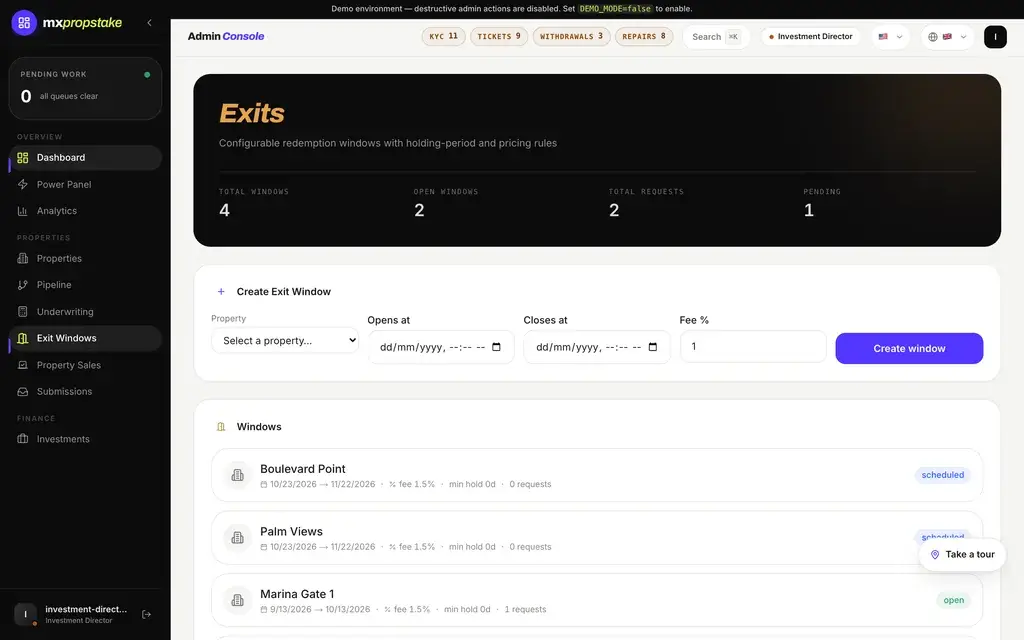
Liquidity is the hardest problem in fractional property and the one most platforms answer with a sentence. Here it is three mechanisms: a secondary marketplace where investors list and settle against the register, scheduled exit windows with a published pricing method, and whole-asset sales decided by share-weighted investor vote.
- Marketplace listings, offers and settled trades
- Exit windows with pricing method and fee set per window
- Minimum holding days enforced per window
- Property sale votes weighted by shares held
Rental Distributions as a Batch Engine
Rent is collected per tenancy, expenses feed the net-income computation, and a distribution batch calculates each investor line, passes review and approval, then executes against the ledger with a receipt an investor can open. Investors who opted into rent reinvestment have their share rolled back into holdings automatically.
- Batches and per-investor lines with receipts
- Expenses feed net income per property
- Rent reinvestment plans run automatically
- Distribution schedule visible to the investor
mx Mint, mx Mortgage, mx Golden Visa and mx Will
The four adjacent products that normally mean four vendors and four reconciliations. Vaulted fractional gold with live pricing and an operator-set spread, a mortgage application matched against a lender product catalog, a golden-visa pipeline linked to eligible properties, and a guided will service with advisor booking.
- Gold orders priced from a metals feed with your spread
- Mortgage lender and product catalog in admin
- Visa applications linked to eligible properties
- Will consultations booked into advisor calendars
mx One: An Agent Channel That Pays Itself
Most operators run their agents on spreadsheets and lose them to the friction. Here an agent gets a mobile workspace with their listings, branded client offers, a commission ledger split by product, a referral tree, points toward program tiers and the ability to request an advance against commission earned but not yet paid.
- Commission records with per-product events
- Advances against future commission, tracked to recoupment
- Point events driving program tiers
- Agent referrals kept distinct from investor referrals
XRPL Tokenization With the Sandbox Stated
Tokenisation here is real rather than decorative: XRPL issued-currency tokens with authorized trust lines, which gives compliance-gated holding at protocol level, NFToken certificate offers as title anchors, a dual-control signing queue on every mutation and a chain-event indexer. It ships against a deterministic sandbox, and the admin screen says so.
- Issued tokens gated by authorized trust lines
- NFToken certificates as title anchors
- Dual-control signing queue on every chain mutation
- Deterministic sandbox included; a live chain is your configuration
Eight Languages, Arabic Right-to-Left
Eight locales ship across web, mobile and the console, with Arabic rendered right-to-left as an architectural property rather than a translation layer dropped into a left-to-right shell. At request time, the country profile, base currency and interface locale come from configuration rather than constants.
- English, Arabic, Spanish, French, Hindi, Mandarin, German, Portuguese
- Right-to-left layout mirrored, not merely translated
- Locale and currency resolve from configuration
- A second market is a settings pass, not a fork
A Native App, Not a Wrapper
Sixty-plus screens on Expo and React Native for iOS and Android, hitting the same production API as the web rather than rendering it in a WebView. Push notifications with device registration, biometric unlock against the device keystore, document capture for KYC, and deep links that resolve a web property URL into the native screen.
- 60+ native investor and agent screens
- Same API as web, no WebView wrapper
- Biometric unlock and secure token storage
- Deep links resolve into the matching native screen
the software is delivered complete and tailored per operator: provider accounts, jurisdictions, fee schedules, the selection among the eleven product lines and the security hardening covered later on are all set up with you during delivery.
Where Operators Make Money
Prypco Clone Revenue Models - Nine Rails, Ten Fee Types, One Investor
A fractional property app like Prypco, as Miracuves builds it, earns in nine places rather than one, and that is the whole commercial argument for breadth. Winning a verified investor costs the same whether they buy one product or five, so an operator who can place property, gold, a mortgage and a visa application against that single registered identity amortizes the acquisition across a family instead of renting each product from a different vendor.
You set every rate shown below. Not one of them earns the platform a share, and no runtime license or per-investor fee is billed, so whatever you design before launch is what you still run at scale.
- 01
Management and Performance Fees
The recurring base of the model: a management fee charged against holdings on a schedule you set, and a performance fee on realized outcomes. Both are fee types on a schedule rather than numbers written into the code, so the terms change in the console.
- 02
Transaction Lifecycle Fees
Platform, acquisition, disposition and servicing fees charged at subscription, at acquisition, on disposal and against servicing events. Each computation is recorded as an auditable charge carrying its own status history.
- 03
Exit, Early-Exit and Marketplace Fees
A fee percentage set per exit window, an early-exit charge where an investor leaves inside the minimum holding period, and listing plus transaction fees on the secondary market. Liquidity is a product you can price.
- 04
FX Spread and the Gold Spread
The margin on every conversion, which is the gap from the rate you quote to the rate you obtain, plus the spread on a gold order, which is the difference between the metals feed price and the price you show. Both post to the ledger like every other movement.
- 05
Agent Channel Economics
Commission earned per product and per event, advances against future commission that recoup automatically, point events driving program tiers, and agent referrals tracked separately from investor referrals.
- 06
Placement, Promos and Referrals
Sponsored marketplace listings that sort first until they expire, partner ad slots with impression and click counters, promo codes with validity and usage limits, and a referral program with a reward catalog budgeted as acquisition cost.
| Revenue stream | How it is charged | Take rateTypical range | What sets the ceiling |
|---|---|---|---|
| Management and Performance Fees | A yearly administration percentage plus a share of any gain realized when the property is sold. | 0.5% a year from year 2, plus 7% of gains over cost (PRYPCO Blocks). | Peer comparison. Stake lists 0.25% a year for new listings and Fundrise charges 0.85% plus 0.15%, so PRYPCO Blocks' 0.5% sits between them. |
| Transaction Lifecycle Fees | One-off charges at acquisition, covering the platform entry fee and identity and AML checks. | 1% entry fee plus 0.2% KYC and AML at acquisition (PRYPCO Blocks). | Cost recovery. The PRYPCO costs article lists valuation, trustee, legal and SPV setup as pass-through items inside the funding target, which an operator has to separate from its own margin. |
| Exit, Early-Exit and Marketplace Fees | A percentage taken at scheduled exit windows, with marketplace fees where investors trade among themselves. | 2.5% of the greater of funding target or sale value (PRYPCO Blocks). | Lock-in design. PRYPCO Blocks pairs exit windows with a one-year lock-in, and Stake's help center sets its exit fee at the same 2.5%, so market habit is a single rate. |
| FX Spread | Margin taken on every conversion in a multi-currency wallet, charged inside the exchange rate. | Stripe UAE lists 1% for converting plus 1% for foreign cards. | Stacking. Stripe lists conversion and international-card charges separately, so a foreign-card top-up can pass through both, near 2% combined, ahead of anything you add. |
How to read this. PRYPCO Blocks percentages come from its published fee calculation article and the companion fees and costs article, which lists pass-through property costs without rates. Fundrise numbers are from its help center; the Stake comparison is from its fee article. Currency data is from Stripe and its Adaptive Pricing docs. All are operator-set commercial terms, not regulated caps. Gold spreads, agent commissions and promo placement have no public benchmark, so they are left out. Treat the figures as raw material for your own model; they promise no income.
Prypco Clone Revenue Model, Stage by Stage
The Prypco clone Miracuves delivers carries all nine revenue rails behind the control center's feature flags, so operators who stage them earn each new line from investors who already passed KYC.
One market, property only
Lead with the platform fee at subscription and the management fee as holdings mature, keeping the other ten lines off at the flag.
Second and third lines
After a full distribution cycle reconciles, switch on mx Mint and mx Mortgage, so shareholders can buy vaulted gold at your quoted spread and apply for a mortgage from the lender product catalog.
Full family with agents
With all eleven lines live, mx One commissions bring in investors and inventory, while sponsored listings, partner ad slots and promo codes become budgets you tune by market.
Each management, exit, FX and gold charge posts as balanced entries your auditor can trace, with no share going to Miracuves.
No Dev Team Needed to Operate
Admin Panel for an App Like Prypco - Flags, Register, Distributions & Tokens
Miracuves equips the Prypco clone operator with a console of forty-six suites, and the one you touch first is the control center, because its feature flags decide which of the eleven product lines this deployment runs at all. After that the work settles into the pipeline, the register, distributions, fees and the compliance queues.


Your Team's Daily Toolkit
- 01
Control Center and Feature Flags
Which of the eleven product lines your deployment runs, which permissions each role carries, which investor plans exist and what the marketplace rules are. This is the first screen that matters, because it decides what your platform actually is.
- 02
Pipeline, Underwriting and Properties
Developer submissions arriving as drafts, structured underwriting with yield and hold assumptions, investment committee review, and the property record that becomes an SPV with share classes and a published valuation on approval.
- 03
Distributions and the Ledger
Batch construction, per-investor lines, review and finance approval before release, receipts an investor can open, and the double-entry ledger that every one of those movements posts against.
- 04
Fees and Monetization
Ten fee types configured as schedules, every computation recorded as an auditable charge, plus the gold spread, agent commission terms, promo codes, sponsored placement and partner ad slots in one view.
- 05
KYC, Accreditation and Compliance
Case queues with screening behind them, accreditation review, investor restrictions, and the risk distribution across the book. The queue is the product here, not a list of statuses.
- 06
Exits, Sales and the Marketplace
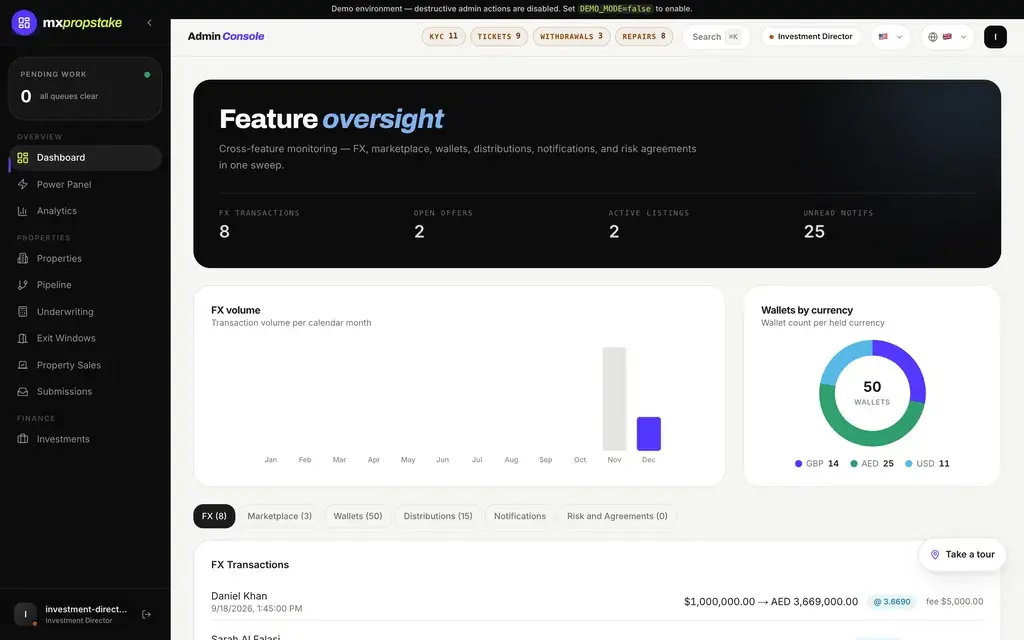
Scheduling exit windows with their pricing method and fee, processing requests through to settlement, proposing a whole-asset sale and collecting share-weighted votes, and overseeing secondary market volume.
- 07
Tokens Under Dual Control
Token classes and wallets, a signing queue that holds every chain mutation for a second signer, and a chain-event indexer reconciling observed on-chain state. The sandbox label is shown plainly on the screen.
- 08
Audit, Oversight and the Power Panel
A tamper-evident history of admin actions, cross-platform health indices, and the elevated-power operations: pending withdrawals, KYC backlog, open tickets and exit requests with bulk approval under audit.
Leads and Support Desk
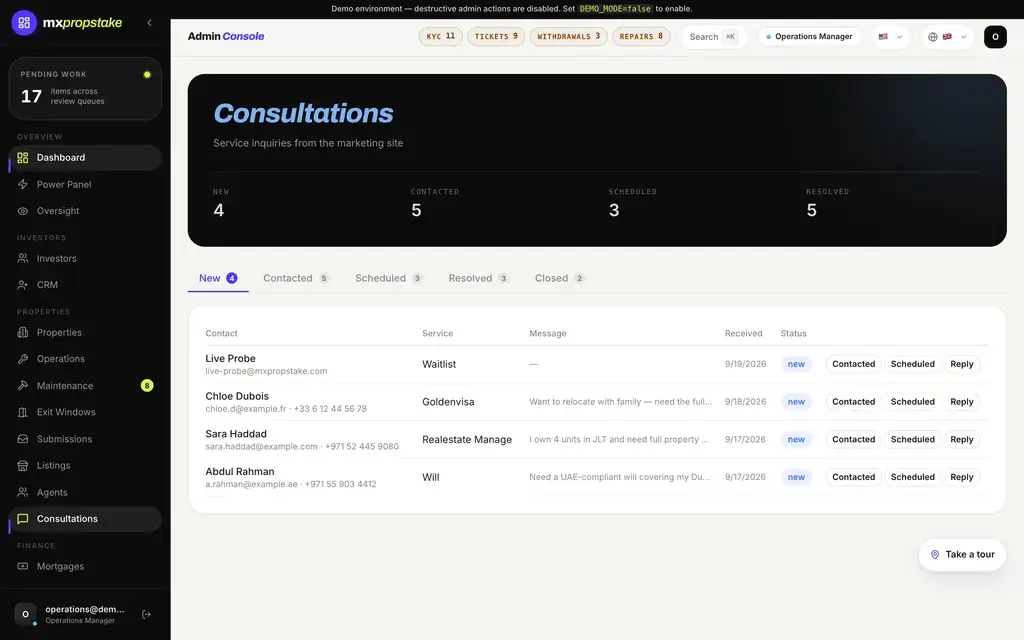
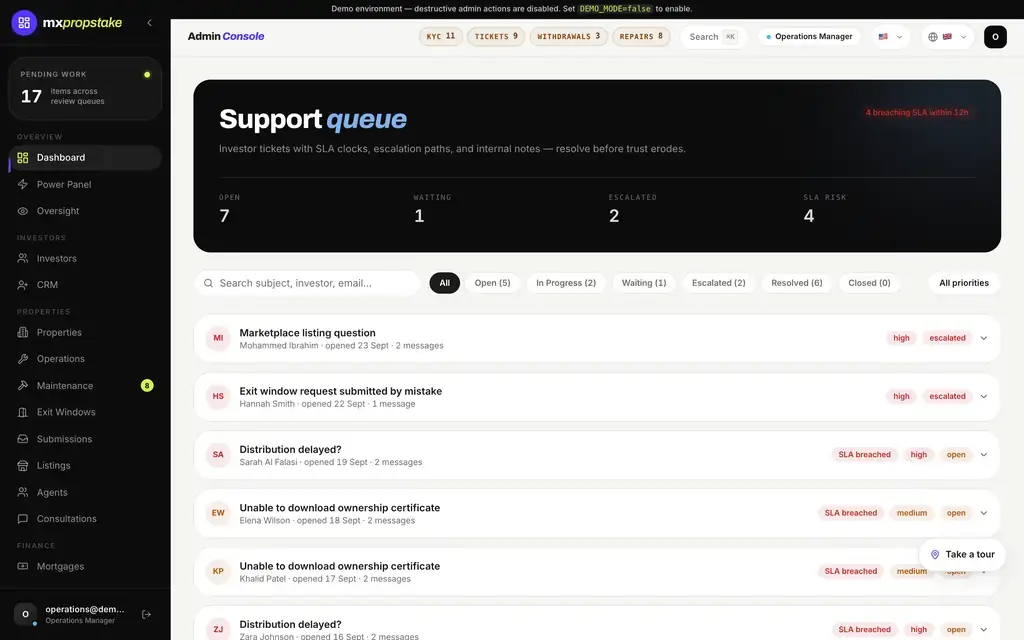
A helpdesk sits beside leads, stages, a contact log and tags; it offers queues, macros, CSAT and SLAs, because retail investors generate a volume of support requests that has to be handled somewhere.
- Country profiles, currencies and minimums
- Interface locales including Arabic RTL
- Per-market eligibility and suitability gates
- Configurable fee schedule and FX spread
Reports and Data Downloads
Per-investor statements, activity feeds and tax summaries.
- Deal pipeline and underwriting
- Investment committee review and decisions
- Ownership register and certificate issue
- Distribution batching with approvals
Have developers? During delivery the role catalog is mapped onto how your company actually works, so releasing a distribution, reviewing a KYC case, editing a fee schedule or co-signing a token operation each follow rules you set, enforced per route instead of by default.
Book a Free Strategy Call04Contents and pricing
The Full Package
Everything You Receive - The Prypco Clone Script, Release & Hosting
One price from Miracuves covers the whole Prypco clone script, with each component listed below included. No tier holds anything back, nothing reports home, and nothing turns into a recurring fee once you are live. Third-party running costs remain yours, and none flow to us: hosting with PostgreSQL, storage for documents and verification evidence, identity and screening vendors per check, your processor and payouts, email and push, plus managed custody if tokens leave the sandbox.

Entire Code Handover
The web app, operator console, agent surfaces and mobile client are transferred outright, along with the Prisma schema and its migrations, with no encrypted modules anywhere in the code.
- Handover includes source for every surface
- No obfuscation, no runtime license
- No fee per investor or per transaction
- Extend it, rebrand it or fork it freely

The Database Tier
A 108-model PostgreSQL schema with Prisma migrations, covering the ledger, the ownership register, token classes, fee schedules, distributions, KYC cases and every product line.
- 108 models with migrations, not a dump
- Ledger, register and token tables included
- Seed and demo tooling for safe staging
- Reconciliation checks you can run yourself
The Mobile Client
An Expo and React Native application for iOS and Android with sixty-plus screens, including the agent workspace, built against the same API as the web.
- 60+ native screens for both platforms
- EAS build configuration included
- Push, biometrics and deep links wired
- Store signing and release handled as its own work

The Admin Workspace
Forty-six suites with role dashboards for operations, finance, compliance, investment direction and super admin, which is the part an in-house build reaches last.
- 46 suites across the whole lifecycle
- Five role dashboards plus super admin
- Audit log and dual-control operations
- Feature flags and platform settings

The Chain Layer
XRPL provider with issued tokens, authorized trust lines, NFToken certificates, a dual-control signing queue and a chain-event indexer, plus the deterministic sandbox it runs against by default.
- XRPL provider implemented, not stubbed
- Dual-control signing queue included
- Deterministic sandbox for demo and staging
- Live chain activation is your configuration
Provider Abstractions
Four payment providers, identity verification, S3-compatible storage, SMTP email, notifications, metals pricing, AI and maps, each behind an interface with health surfaced in admin.
- Stripe, Razorpay, Plaid and NOWPayments implemented
- Identity, storage, email and push abstracted
- Credentials held in a secrets layer
- Your own accounts and keys at deployment
$ ls docs/ The Documentation Pack
Ten documents including the solution overview, PRD, ERD, API collection, schema reference, feature catalog, technical dossier, whitepaper, developer security handbook and the VAPT compliance review.
- Security handbook and VAPT review included
- Schema and API references for your engineers
- Written for diligence, not for marketing
- Findings graded by severity, not summarized
Hosting and Rebranding
Branding on one design system, eight locale dictionaries, CMS pages and email templates editable in admin, deployed as an isolated sibling with its own database, providers and jurisdiction profile.
- Design tokens on a single shared system
- Eight locales, Arabic right-to-left among them
- CMS, announcements and email templates in admin
- Isolated per-operator deployment, not shared tenancy
In the box: you get a complete application plus the documents that a compliance or technical reviewer will request, and the sections that follow set out the provider and licensing steps you complete before public money arrives.
Book a Free Strategy CallPlain Price Packages
What Is the Price of Building a Fractional Property Platform for 2026?
Miracuves sets one fixed price for all of it: the investor experience, the operator console with forty-six suites, the agent workspace, a native mobile client, every one of the eleven product lines, the complete source and deployment onto your own infrastructure. It carries no runtime license, no fee per investor and no cut of what you raise. Configuration done during delivery, described further down, is quoted with you as its own line.
Professional
ReadyMade Plug-and-Play EditionRight choice if: multi-product investment operators, developers & tokenisation ventures
Your own branding goes on the solution exactly as shown in our demo, and it is self-hosted on your side.
Get StartedEnterprise
Tailored, Licensed & Large-VolumeRight choice if: Syndicators, family offices, asset managers & institutional sponsors
Custom builds are available to match your situation and business needs.
Request a QuotePrypco Clone Development Cost in 2026
Miracuves prices the Prypco clone at $6,999, paid once, for the investor web app, the native Expo app, the agent workspace, the forty-six-suite operator console, all eleven product lines and the complete source. Your brand goes on every investor and agent screen, live on your infrastructure in six working days. No runtime license, per-investor fee or cut of capital raised follows.
What moves your total sits outside the software invoice
- Hosting with PostgreSQL, plus storage for documents and verification evidence
- Identity and screening vendors, billed per check
- Your payment processor, payouts, email and push
- Managed custody once tokens leave the sandbox
- Your license, SPV formation and legal counsel in each market
Chain activation on XRPL testnet or mainnet, a new market with its own currency and eligibility rule, or Enterprise SSO for the operator console each get a written quote, typically 2-8 weeks.
Compare Your Options
Ready-Made Prypco Clone vs Custom Development vs SaaS
Launching a multi-product property investment platform like Prypco means owning the code through a ready-made clone from Miracuves, commissioning it or renting a tenant slot. These are the trade-offs, row by row.
| Criteria | MiracuvesReady-Made Prypco Clone | Custom Development | SaaS |
|---|---|---|---|
| Launch time | Branded in 6 days, all eleven lines included | Custom modules take 2-8 weeks, quoted in writing | Tenant slot, vendor pace |
| Upfront cost | $6,999, fixed | Defined by a written quote | Subscription with onboarding |
| Source code ownership | Unencrypted source plus 108-model schema | As your contract states | Code and register stay hosted by them |
| Customization | Feature flags, fee schedules, code-level changes | Specified from zero | Inside a shared product |
| Ongoing fees | Nothing metered per investor or seat | Change requests billed | Usually rises with investors or assets |
| Branding & app-store listing | Isolated deployment under your brand | Your brand when shipped | Shared infrastructure, your logo |
| Best for | Operators running several property products | One-off product designs | Exploring the market first |
Where It Plays Well
Use Cases for a Prypco-Style Platform - Products, Channel, Tokenization & Scale
Swipe · 6
The core case behind this page: a registered, verified investor who holds vaulted gold, fractional property and an open mortgage application under a single account. The operator earns from all three without contracting three vendors, and without having to reconcile three separate systems.

A developer converts standing inventory into fractional offerings rather than discounting it, runs the raise through the partner submission and underwriting pipeline, and distributes through a commissioned agent network inside the product.

A venture issuing share tokens against SPVs on XRPL, with authorized trust lines gating who may hold them and NFToken certificates anchoring title, while the append-only register remains the legal record and the signing queue stays under dual control.

A precious-metals clientele already trusts the operator with a store of value. mx Mint sits beside fractional property on one account, so the same wallet funds a gram of vaulted gold and a share of a building.

A consultancy productises the residency-by-investment pipeline: eligible properties surfaced, applications captured with their documents, consultations booked, and the qualifying investment held on the same platform that files the application.

A closed platform for a known investor list, with per-holding documents, valuation history and expense detail one level below a deliberately simple surface, deployed as an isolated sibling with its own database and providers.

Prypco Clone Business Model: Three Ways to Run It
Every model below starts from one KYC-verified investor holding property, gold, a mortgage and a golden-visa application at once, and one Miracuves deployment serves three kinds of operator.
Licensed platform
A proptech founder with a license path earns management, transaction, exit and FX fees on sourced properties, then places gold, mortgages and golden-visa applications against the investors it already holds.
Developer-led
A developer fractionalizes its own standing inventory instead of discounting it, raises through the partner and underwriting pipeline, and sells through a commissioned mx One agent network.
Private label
A family office or syndicate moves an existing book onto its own walled-off deployment, inviting only its own investors, where the append-only register and approved distribution batches replace spreadsheet bookkeeping.
Whichever model you pick, you set rates, minimums and eligibility gates in the console, and the capital you raise never carries a Miracuves cut.
A private syndicate moving an existing book onto software has no use for acquisition features and every use for the register. What matters is the ownership record that only appends, the audit trail and the distribution batch, which take the place of a spreadsheet no auditor can follow.
Because Miracuves leaves minimums, eligibility gates and country settings under operator control, one deployment can serve both a retail market with small tickets and an accredited market with large ones, concurrently, and neither has to give ground.
Market Timing
Why Launch a Multi-Product Fractional Property Platform in 2026?
Fractional property works commercially where ordinary buyers are priced out because property is costly, and where rental yield is high enough to merit distributing. What decides whether a platform survives in that market is a different question, and Miracuves designed this Prypco clone around it: whether it can earn more than once from an investor it has already paid to acquire. A single-product platform cannot, which is why the operators who last tend to be the ones who added gold, lending or residency services beside the property itself.
01One Acquisition Cost, Eleven Products
The economics that decide whether a platform in this category survives. Winning a verified investor is expensive and the cost is the same whether they buy one product or five. An operator who can place property, gold, a mortgage, a visa application and a will against that one registered identity amortises the acquisition across a family rather than renting each product from a different vendor.
02The Operator Half Is the Moat
Consumer fractional platforms proved the demand years ago. What almost nobody productised is the operator job: sourcing, underwriting, committee review, SPV creation, KYC queues, allocations, certificates, distributions, exits and reporting. It takes engineer-years and has no consumer-visible payoff, which is exactly why it is usually still a spreadsheet.
03Regulators Increasingly Ask for Systems
Audit trails, dual-control on sensitive operations, screening records and reconciliation evidence get requested during licensing and audit. A platform that produces those as a by-product of ordinary operation changes the conversation from promises to artefacts.
04Liquidity Design Drives Reinvestment
An investor who cannot see a way out does not reinvest and does not refer. Marketplace, scheduled exit windows and share-weighted sale votes are the visible mechanics that sustain a second cheque, and they are the hardest thing to retrofit onto a live platform.
05Capital Is Mobile-First and Multilingual
The corridors where fractional property is growing fastest expect a native app and their own language, Arabic right-to-left among them. Shipping web-first and promising an app later concedes the market the product was built for.
06Tokenization Without the Usual Failure
The common mistake is making the chain the source of truth and discovering that a reorganisation, a lost key or a protocol change is now a legal problem. Here the register decides and the chain mirrors, which keeps tokenisation a feature instead of a liability.
Reasoning Behind the Returns
Data Models
API Routes
Operator Suites
Product Lines
None of this makes the software simpler. Hard problems here have never been about the property listing page; they sit in the cap table, in distribution runs, in the KYC file and in beneficial ownership. A second product line makes each of those harder, unless from the outset every line draws on one ledger, one wallet and one identity record.
Industries
Industries We Serve
Fractional property is the core, but the chassis underneath it serves anyone whose business is placing a verified investor into an asset and then servicing that position. The eleven product lines mean the same deployment can face a property buyer, a gold buyer, a mortgage applicant and a visa applicant without becoming four systems.
The pattern repeats wherever ownership must be recorded, income must be distributed and an investor eventually wants out. Where your market differs is in the jurisdiction, the providers and the products you switch on, which is configuration rather than a different codebase.
one platformMXPropstake
- 01FrFractional Real Estate
- 02PpReal Estate Tech Ventures
- 03ReReal Estate Development
- 04BaBrokerage & Advisory
- 05AwAsset & Wealth Management
- 06FoWealth Management Offices
- 07TvTokenisation Ventures
- 08GcGold & Commodities
- 09MdMortgage Distribution
- 10IgImmigration & Golden Visa
- 11WsWills & Succession
- 12PmProperty Management
06Under the hood
From Intake to Payout
From Setup to Payout: How the Prypco Clone Configures, Sources, Raises & Distributes
Here is how the Prypco clone app from Miracuves works across six steps: choose which of the eleven product lines you run, then follow the money to investors and a share changing hands on the secondary market.
The Back-Office Cycle
Swipe · 6
- 1Choose Your Property Products
Before a property exists you decide which of the eleven product lines your deployment runs, which markets you sell into and what each one prices in. Feature flags, country profiles and the platform settings suite carry those decisions, so the answer is configuration rather than a branch of the codebase.
- Feature flags switch product lines on or off
- Country profiles with their own base currency
- Operator-set minimums and eligibility gates
- Eight interface locales including Arabic right-to-left
- 2Source and Underwrite Properties
A developer or broker submits stock through the partner surface into the pipeline instead of emailing a spreadsheet. It is underwritten with structured data, reviewed by the investment committee, and on approval wrapped in an SPV with share classes, a valuation and an offering.
- Submissions land in the pipeline as drafts
- Structured underwriting with yield and hold assumptions
- Investment committee review and approval recorded
- SPV, share classes and valuation created on approval
- 3Investor KYC and Wallet Funding
The investor onboards, submits KYC through the app with document capture, and is reviewed as a case in the compliance queue with screening behind it. Accreditation is captured where the jurisdiction asks for it. The wallet funds by card, bank or crypto through whichever provider you activated.
- KYC cases with screening and a review queue
- Accreditation capture and review
- Four payment providers implemented behind one interface
- Multi-currency wallet with FX and a configurable spread
- 4Allocate Shares and Issue Certificates
The signed payment callback drives allocation, the append-only ownership write and certificate issuance in one database transaction, and mints the mirroring token where tokenisation is switched on. Auto-invest plans run the same path on a schedule.
- Allocation, ownership and certificate commit together
- Append-only register as the legal record
- NFToken certificate mirror where enabled
- Auto-invest plans with operator-visible pipelines
- 5Manage Rent and Pay Distributions
Tenancies, rent receipts, expenses and maintenance are kept in the very system that raised the money. A distribution batch computes each investor line from net income, passes review and finance approval, then executes against the ledger with receipts and optional rent reinvestment.
- Tenancy, rent roll and expense recording
- Batches with per-investor lines and receipts
- Review and finance approval before release
- Rent reinvestment rolled back into holdings
- 6Resell on the Secondary Market
Investors list on the secondary marketplace and settle against the register, take a scheduled exit window at a published pricing method, or vote their shares on an operator-proposed sale of the whole asset. Each route carries its own configurable fee.
- Marketplace listings, offers and settled trades
- Exit windows with pricing method, fee and minimum holding days
- Share-weighted votes on whole-asset sales
- Settlement pays out against the ownership register
How It's Built
Architecture Behind the Platform - Computed Balances & Approval Gates
- 01Layer 01
One Domain, Many Surfaces
Investor web, the native app, the agent workspace and forty-six operator suites all sit on a single versioned API and a single PostgreSQL domain, so an ownership row, a property or an investor means the same thing wherever it is read.
- 02Layer 02
Balances Computed, Never Saved
Amounts are stored as integer minor units, and each movement of money posts balanced double-entry rows. Balances are the sum of their entries, not a figure a background job can let drift, so reconciliation becomes a check instead of an investigation.
- 03Layer 03
Ownership Records Append Only
The register only ever gets appended to, never edited in place, and certificates are issued on allocation, so who owned what on a particular date can be answered without reconstructing history from backups.
- 04Layer 04
Duplicate-Safe External Events
Idempotency keys cover order placement and any write driven by a provider callback; a duplicated webhook, a double submit or a retry therefore ends in one outcome, never two allocations.
- 05Layer 05
Approval Gates the Money Paths
Withdrawals, distribution release and every chain mutation need dual control as part of the flow itself, not as a policy document, and during delivery the role catalog is mapped onto your real approval chain.
- 06Layer 06
The Chain Mirrors, the Register Decides
Tokens and NFToken certificates reflect the legal register rather than replacing it, and the signing queue holds every mutation for a second signer. A chain problem stays an operational problem instead of becoming a title dispute.
Under the Hood
The Stack Behind a Multi-Product Property App: PostgreSQL, Next.js, Prisma, Expo & XRPL
Miracuves kept the Prypco clone stack familiar wherever possible, since here a compliance reviewer counts as much as an end user. Prisma over PostgreSQL, Next.js App Router for each web surface and Expo on mobile are tools reviewers know and local hires can maintain. The only unusual layer, the chain, sits beside the money path rather than inside it.
Web & Admin Workspace
- An App Router that serves the public, investor and admin surfaces
- 160+ routed pages in the audited build
- Forty-six operator suites on one shell
- One shared design system across every surface
API Surface
- 299 route groups and endpoints
- Web, mobile and admin consume the same API
- Idempotency keys on externally driven writes
- Outbound webhooks and an outbox for your own systems
Records & Funds
- 108-model schema with Prisma migrations
- Double-entry ledger accounts, transactions and entries
- Append-only ownership register
- Money held in integer minor units
Smartphone App Tier
- 60+ native screens, not a WebView wrapper
- Push with device registration
- Biometric unlock against the device keystore
- Deep links resolving web URLs into native screens
Chain Layer
- Issued tokens with authorized trust lines
- NFToken certificate offers as title anchors
- Dual-control signing queue and chain-event indexer
- Sandbox provider for demo and staging, no chain dependency
Providers
- Four payment providers implemented behind one interface
- KYC, storage, email, push, metals, AI and maps abstracted
- Credentials in a secrets layer rather than in code
- Provider health visible in admin so nothing is silently off
nothing here is exotic, by design. Reviewers in compliance already understand PostgreSQL and a double-entry ledger, developers skilled in React Native and Next.js are plentiful in each market the platform targets; the chain layer, meanwhile, may stay sandboxed indefinitely with no effect on any investor-facing flow.
Build to Scale
Scaling Under Load: Document Volume, Batch Runs & Derived Balances
This load profile differs from a consumer marketplace. Traffic stays modest and predictable, while the batch work, document volume and reporting are the heavy parts and the things to size infrastructure for.
The distribution run has the widest blast radius: it moves money and affects every investor holding a given property simultaneously. First it calculates, then it pauses for review and finance sign-off, and only then does it execute against the ledger, because a duplicate run does far more harm than a delayed one.
The same discipline covers marketplace settlement and exit windows: shares move on the append-only register and the matching ledger entries post in the same transaction, so a half-settled trade cannot exist.
Chain operations are deliberately off the critical path. A certificate is issued inside the allocation transaction, while the token that mirrors it is queued for a second signer, so chain latency never stands between an investor and their ownership.
Scaling out to more than one application instance moves the rate limiter and the WebAuthn credential store to Redis, a scoped add-on listed further down.
The Dividend Cycle
No other job has a wider blast radius. Every investor in a property is touched at once, and the job moves money, computing each line from net income, waiting for review and finance approval, then executing against the ledger. It is idempotent by construction because a repeat run is far worse than a slow one.
Marketplace Settlement
Listings, offers and counters resolve into a trade that must move shares on the append-only register and post the matching ledger entries together. Settlement is transactional for the same reason allocation is: a half-settled trade is a dispute rather than a bug.
Exit Window Processing
A window gathers requests against a valuation date and a published pricing method, then settles them as a batch under the configured fee and minimum holding period. The volume arrives in bursts at the close rather than evenly.
Certificate and Token Issuance
Certificate issuance rides inside the allocation transaction, while the chain mirror is queued as a token operation awaiting a second signer. Chain latency therefore never blocks an investor from owning something.
Document and Media Volume
Per-property galleries, valuations and due-diligence packs plus per-investor certificates, statements and tax documents accumulate faster than the row count suggests. Storage is S3-compatible and scoped per investor, with magic-byte validation on upload.
Reporting Across Currencies
Because investors hold in more than one currency, portfolio analytics and tax summaries compute per investor rather than once per property. That is batch work rather than request work, and it is the quiet cost of a multi-currency book.
Reporting across currencies is the hidden cost. Tax summaries and portfolio analytics must be computed for each investor and not once for each property, which makes them batch work and not request work for books spanning more than one currency.
these properties follow from the design of the base build, and delivery comes with load tests sized to the volumes you anticipate.
07Security and compliance
Built to Be Audited
Security for a Fractional Property App Like Prypco: Documented, Graded and Configured With You
Security on the Prypco clone Miracuves hands over comes with paperwork rather than assertions. You get a developer security handbook and a VAPT review covering compliance, mapped to the OWASP top ten, so your security team can read documents instead of reverse-engineering a codebase. The review speaks candidly, and the section below draws straight from it.
- 01 · Documented
Recorded, Never Merely Stated
Ten technical documents ship with the code, the developer security handbook and a VAPT compliance report among them. Your security team gets papers to assess instead of source to unpick, and the review is frank enough for this page to cite its findings, not just its verdict.
- Screening Against Sanctions and PEP Lists: The screening provider you choose connects as its own scoped work package, with match handling and a reviewer queue defined, which regulators generally expect before you go live.
- 02 · Sessions
Identity and Session Controls
Database-backed sessions, WebAuthn passkeys, TOTP two-factor with backup codes, device registration and rate limiting, with mobile credentials held in the device keystore behind a biometric unlock rather than in application storage.
- KYC Provider and Evidence Retention: Connecting your identity provider with verified callbacks, defining how a match is handled, and setting the retention your regulator expects on the evidence those checks produce.
- 03 · Ledger
Financial Integrity by Construction
Double-entry throughout, balances derived from entries, idempotency on externally driven writes, and allocation, ownership and certificate issuance committed in one transaction. Projections are labeled as projections wherever they appear.
- Payment Callback Verification Against Your Processor: Your processor's real signing secret, raw-body signature verification and settlement reconciliation are wired to your own account before anything takes money.
- 04 · Dual Control
Role Segregation
Role dashboards per function, dual control on withdrawals, distribution release and every chain mutation, and approval records attached to the sensitive actions rather than kept in a mailbox.
- Access Control Wired to Your Organization: Route-level permission enforcement mapped to your real approval chain: who releases a distribution, who signs the second half of a token operation, who may change a fee schedule, who reviews a KYC case. The role catalog ships; binding it to your people is delivery work.
- 05 · Evidence
Evidence That Survives a Reviewer
Audit logging across admin actions, distribution batches and lines with receipts, fee charges carrying their status history, and chain events recorded against observed on-chain state. The evidence is a by-product of operating rather than something assembled under pressure.
- Chain Activation, If You Want It: Tokenisation runs against a deterministic sandbox out of the box. Pointing it at testnet or mainnet means an RPC endpoint and an issuer account held in the secrets layer, plus a key-custody decision that is yours to make. The local vault in the build is not production custody.
- 06 · Graded
What the Review Actually Found
The VAPT review grades each finding by severity, and every High item maps to the delivery work listed below.
- Horizontal Scale Before Volume: Running more than one application instance moves rate limiting and the WebAuthn credential store to Redis, a known and scoped piece of work.
The architecture already contains the controls that a regulated investment operator is typically asked about. Sessions are database-backed; sign-in offers multi-factor with TOTP, plus backup codes and WebAuthn passkeys; the ledger is double-entry, and writes driven from outside use idempotency; every chain mutation, distribution release and withdrawal requires dual control; and the ownership register is append-only. Connections to your live providers and the policies your organization enforces are set up with you as itemized delivery work, and every item is closed before the platform reaches a real investor.
Discuss Security & Compliance With UsRegulatory Note
Compliance for a Prypco Alternative: What the Software Covers, Licensing and Licensed Partners
A Prypco clone is a software product and gives you no right to raise capital. Miracuves builds and hands over the platform layer, which covers the property catalog and record, onboarding and KYC workflows, subscription and allocation, the operator console, a secondary marketplace, distribution batching, a double-entry ledger, and an ownership register that is append-only. Regulated activities include offering property shares to the public, running an investment or crowdfunding platform, holding or safeguarding investor money, arranging deals in securities, and checking investors against sanctions lists. They belong with a licensed entity: your own company holding the authorization, or a partner such as a licensed bank, custodian, broker-dealer or platform operator. The software itself is not an issuer, platform operator or adviser, and Miracuves takes none of those roles.
“Ready” means the architecture is built to the controls those frameworks require: payment credentials tokenized at the processor rather than stored as card numbers, encryption in transit and at rest, role-based access with segregated admin roles, append-only audit records and environment separation. It is not a certificate. Miracuves holds no PCI-DSS or ISO 27001 certification on your behalf and displays no compliance badge without the certificate behind it. Certification is issued to the operating entity, against its own environment, processes and hosting. On this build several of those controls are configured to your organization during delivery: route-level permissions, provider signature verification and enforced platform policy are listed in the security section above.
Capabilities Built Into the Code
The source code you receive is yours, and it covers an operator console of forty-six suites, a secondary marketplace and distribution batching. It also includes XRPL tokenization against its sandbox, certificates issued from an append-only ownership register, share classes and property-level SPVs, onboarding and KYC workflows, and subscription agreements with evidence. Multi-currency wallets run on the double-entry ledger, and eleven product lines share one chassis.
What Only Licensing Provides
This covers the authority to offer property shares publicly, run a crowdfunding or investment platform, arrange or advise on investments, safeguard or hold client money and report to a regulator. It rests with a licensed entity of your own or a licensed partner, and software cannot stand in for it.
Customer Funds and Sanctions Checks
Client money is neither held nor safeguarded by the platform, and it performs no sanctions or PEP screening. Investor money belongs with a bank, payment institution or licensed custodian, following the safeguarding rules of your regulator; connecting a screening provider is its own separate work item.
Your Country Sets the Route
Requirements differ by market. In the UAE, DFSA (DIFC) or ADGM FSRA permissions for crowdfunding and investment platforms are required, plus VARA in Dubai if shares are tokenized. In the US, Regulation A+ or Regulation D offerings are one path; the other is SEC Regulation Crowdfunding, run via a funding portal that is registered, and a broker-dealer joins in when required. In Saudi Arabia the Capital Market Authority rules apply. Work out the route together with a licensed partner, or with counsel who knows financial services; Miracuves does not advise on legal, licensing or regulatory matters.
08Grow the platform
- Eleven product lines
- Append-only register
- XRPL, sandbox by default
- Forty-six operator suites
How add-ons work
- 1Lock-down and integration first
The first two items have to be done before any real money moves.
- 2Sized & priced individually
Each item is scoped and priced separately in writing.
- 3Merges into your code
You own the source for these just as you do for the core.
Go Further
Add-Ons for a Prypco-Like Platform - Hardening, Providers, Chain & Scale
The Miracuves base package for a Prypco-like platform covers all of the above. The items below are quoted and scoped apart from it. Any deployment planning to accept real money needs the first two, which is why they lead the list instead of closing it.
Pause on hover · drag through the cards
- 01To finish pre-launch
The Pre-Go-Live Security Sweep
Permissions enforced at the route level in each of the forty-six operator suites and tied to your actual approval chain: the person who releases a distribution, the reviewer of a KYC case, whoever may alter a fee schedule, and whoever gives the second signature on a token operation. It leads the list because every deployment that takes real money needs it.
Hardening · Go-Live Checkpoint - 02To finish pre-launch
Production Vendor Integration
Connect your payment processor, verifying raw-body signatures and reconciling settlements, along with your identity provider, with genuine callback verification and evidence retention. The platform stays a demonstration, not a working operation, until both run against your own accounts.
Vendors · Production Integration - 03Regulatory & enterprise needs
PEP and Sanctions Lookups
Integrating a screening provider, deciding what happens on a match and creating the review queue make up a defined work package, one most regulators will expect to see in place prior to operating.
Watchlist Screening · Sanctions & PEP - 04Regions & distribution
Chain Activation Beyond the Sandbox
Tokenisation runs against a deterministic sandbox out of the box, and the admin screen says so. Pointing it at XRPL testnet or mainnet means an RPC endpoint and an issuer account held in the secrets layer, plus a key-custody decision that is yours to make. The local vault in the build is not production custody.
Chain · XRPL Activation
- 05Regions & distribution
Horizontal Scale Before Volume
When traffic calls for more than one application instance, this add-on moves the rate limiter and the WebAuthn credential store to Redis, scoped and priced in writing.
Scale · Multi-Instance - 06Regions & distribution
Additional Markets and Locales
The interface comes in eight locales, and Arabic mirrors the whole layout instead of only swapping words. Opening a market adds its currency, minimum ticket, eligibility rule and reporting needs, while a ninth language needs translation and a layout check on each surface.
Regions · Added Jurisdiction - 07Regions & distribution
Store Release Process, Included
Your copy of the source builds the Expo app for iOS and Android, EAS configuration included. Code signing, store listings and releases to your own Apple and Google accounts come with the package, while review moves at the pace the two stores set.
Phone · Included - 08Regulatory & enterprise needs
Enterprise SSO and Assessment Support
Operator console access brought under your identity provider, something institutional buyers ask about, and support for your penetration test or regulatory application from the same handbook and VAPT review the platform already publishes.
Enterprise · SSO & Review
Related Fintech & Property Platforms
Across Fintech & Real Estate? Four Neighboring Property and Investing Platforms.
A capital platform can take many forms, and fractional property is just one. Should your plans reach beyond real estate, the products below are built on similar foundations and link up with it readily.
01Wealth and investment management for retail savers, covering funds, goals and portfolio tracking.
Explore Solution
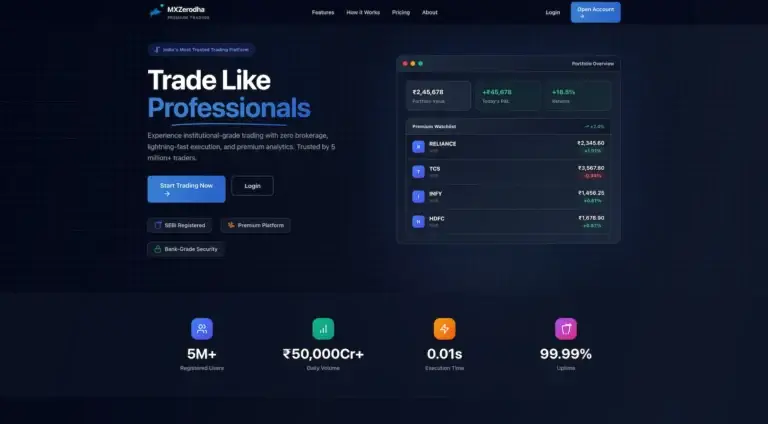
02Built as a discount brokerage, it covers trading, margin and reporting for retail investors trading at high volume.
Explore Solution
03For operators selling markets instead of property: trading in forex and CFDs, supported by multi-account structures plus risk controls and settlement.
Explore Solution
04A portal for listing and discovering property, offering search, lead capture and agent tools; it serves as the entry point ahead of a fractional raise.
Explore Solution09The business case
Market Benchmarks
Independent Benchmarks for the Fractional Property Market - 2025-2026 Data
The revenue models above are ours, whereas the figures below are not. They originate with Fundrise, Deloitte and two government bodies from Dubai, namely the Dubai Land Department and the Dubai Media Office, presented as each published them, so anyone can test the business case against checkable sources.
Real Estate Tokenization Reaching $4tn by 2035
The Center for Financial Services at Deloitte forecasts US$4 trillion in tokenized real estate by 2035, against under US$0.3 trillion in 2024, which is a 27 percent compound annual growth rate. Loans and securitizations account for the most, at US$2.39 trillion, then comes US$1 trillion in private real estate funds; land and projects under construction total US$50 billion.
Dubai Property Tokenization May Reach 7% by 2033
By 2033, the Dubai Land Department expects tokenized assets to make up as much as 7 percent of the real estate market in Dubai, roughly AED 60 billion. Its pilot began on 25 May 2025 on the Prypco Mint platform and offered tokenized shares of ready properties starting at AED 2,000, with dirham settlement and no cryptocurrency involved, alongside VARA and the Dubai Future Foundation, plus Central Bank of the UAE.
Dubai Property Transactions Worth AED 917bn in 2025
According to the Dubai Media Office, 2025 saw over 270,000 real estate transactions valued at AED 917 billion, a 20 percent rise year on year. About 193,100 investors took part, 24 percent above 2024, and 129,600 of them were new to the market.
Roughly 1% Per Year on a Platform at Scale
On its real estate funds, Fundrise lists an annual advisory fee of 0.15 percent plus a flat management fee of 0.85 percent per year, which comes to about US$10 yearly per US$1,000 invested. That makes it a handy reference for how slim a management fee gets when a fractional platform operates at scale.
Deloitte Center for Financial Services, Digital dividends: How tokenized real estate could revolutionize asset management, 24 April 2025 - deloitte.com
Dubai Land Department, DLD launches the MENA's first tokenized real estate project through the Prypco Mint platform, 25 May 2025 - dubailand.gov.ae
Government of Dubai Media Office, Dubai's real estate market records new historic milestone, 12 January 2026 - mediaoffice.ae
Fundrise, What are Fundrise's fees?, help center, accessed October 2026 - fundrise.com
Every number is the publisher's own estimate, forecast or published fee, left as it was. Together they depict the market and reveal nothing about how a platform Miracuves builds performs; none of them projects revenue for your business.
Reasoning Behind the Returns
Market Appeal, Earning Potential & What Operators Can Expect
Appetite among retail investors for fractional property is not the commercial issue in this space. What matters is servicing them correctly at small ticket sizes, since keeping an accurate register, paying out cleanly and holding a defensible audit trail cost the same however small the average investment gets. The usual remedy is breadth: additional products sold to the same verified investor.
- 01
Nine Rails, Not One Fee
Management and performance, the transaction lifecycle fees, exit and early-exit charges, FX spread, marketplace listing and transaction fees, the gold spread, agent channel economics, paid placement and the referral economy. A platform leaning on a single platform fee is exposed to a slow quarter in a way one running nine rails is not. One fee engine serves every line, so a second or third product adds configuration rather than another billing system. Most operators switch on the home-market platform fee first and the management fee as holdings mature.
- 02
Fees Are Schedules, Not Code
Ten fee types are configured as schedules with a frequency and a charging basis, and every computation is recorded as an auditable charge with its own status history. Tuning the business model for a new market is a console task rather than a release.
- 03
The Channel Pays for Itself
Agent commissions are earned per product and per event, advances against future commission are recouped automatically, and point events drive program tiers. The channel cost is visible in the ledger rather than discovered at month end.
- 04
Growth Levers Are Inventory
Promo codes, sponsored marketplace listings that sort first, and partner ad slots with impression and click counters are revenue and acquisition instruments the operator controls, not features a vendor rations.
- Management and Performance Fees
- Transaction Lifecycle Fees
- Exit, Early-Exit and Marketplace Fees
- FX Spread and the Gold Spread
- Agent Channel Economics
- Placement, Promos and Referrals
Lasting strength comes from running the operation whose figures reconcile.
- 01A license in a market where entry is genuinely difficult
- 02A one-time purchase that includes the transferred source
- 03A register and distribution record a buyer can put through diligence
- 04Investors who have already received correct payouts on several occasions
Treat the three configurations that follow as illustrations, not promises and not client figures. The levers are named in each so your own numbers can replace ours, and every rate is yours to set instead of being taken off before it reaches you.
One market, one currency, a handful of assets. An operator proving the funnel: fractional property only, the other ten lines switched off at the flag, a low minimum ticket and a small number of buildings. Platform and management fees carry the model, and the marketplace stays quiet until the first cohort wants out, since nothing exists to trade before then. The work of this year is servicing quality, not fundraising velocity.
Three lines against one verified investor. The same investor base, three revenue rails instead of one. Gold earns on the spread per order, mortgages earn through the lender product catalog, and property continues to earn management and transaction fees. Nothing new needs to be acquired, verified or reconciled, because all three run on one wallet and one identity.
Every line on, mx One for distribution. The platform was designed around this configuration: each product line enabled, a commission-based agent network supplying investors and inventory, agent advances that keep them funded enough to close deals, plus paid placement and promo budgets tuned market by market. A developer is not needed to set the economics of any of these; the console handles them.
10Why Miracuves
Why Miracuves
Miracuves Compared with Other Prypco Clone Developers
What Draws Operators to Us · Where It Differs
- 01
We Name Every Go-Live Step
Every step that comes before real money, from access control and payment callbacks to KYC and screening, is named on this page, which also states that tokenization runs on a deterministic sandbox by default, with XRPL activation as a scoped option. Your engineers can check each step against the VAPT review in the documentation pack.
- 02
Eleven Lines, Already Built
Gold, mortgage, golden visa, wills, the agent network and the marketplace are in the build you evaluate rather than on a roadmap. Each one a competitor adds later is a new vendor, a new contract and a new reconciliation surface. Every operator receives an isolated sibling deployment with its own database, credentials, branding and jurisdiction profile, not a tenant slot, and the VAPT review ships in the documentation pack so your engineers can check the claims against the code.
- 03
Counts You Can Verify in an Afternoon
108 data models, 299 API routes, 46 operator suites, 60-plus mobile screens and 8 locales are properties of the codebase you receive. Your engineers can confirm every one of them without taking our word for it.
- 04
Financial Correctness as a Constraint
A double-entry ledger and an append-only register are close to impossible to retrofit onto a live platform. They are here from the start because the alternative is a rewrite the first time an auditor asks a hard question.
- 05
Source Code Belongs to You
The codebase transfers outright, deployed as an isolated sibling with its own database and providers. No per-investor meter on your own book, no encrypted modules, no runtime license to renew.
- 06
The Console Exists on Day One
An in-house build reaches the operator console last, which means running the business on spreadsheets for the first year. This inverts that order, which is the single biggest difference between buying and building here.
How to Choose a Prypco Clone Development Company
Before you shortlist anyone to build a Prypco-style platform, ask which register, ledger and distribution claims your engineers can test in the demo and the source.
What to look for Miracuves
- Proof in the product Seven role logins on a read-only demo
- Counts you can check 108 models and 299 route groups across 46 suites, recountable in the source
- Source ownership Unencrypted source, transferred outright
- Diligence documents Developer handbook, VAPT report and eight further documents
- Time to launch A branded deployment in six working days
- Support after launch 60 days guidance, 6 months bug fixes, 12 months updates
Walk away from any vendor who
- Makes the blockchain the legal record instead of mirroring a register
- Stores balances instead of deriving them from ledger entries
- Runs gold or mortgages as separate systems you reconcile by hand
- Ships the investor app as a WebView wrapper and calls it native
- Hands over encrypted modules or meters you per investor
Compare Us and See Why Clients Rate Us as the #1 Partner for Ready-Made Clones
| Criteria | MiracuvesMiracuves Prypco Clone | Generic Clone Script | Custom Dev Agency |
|---|---|---|---|
| Time to Launch | 6 days (branded deployment) | Unknown / DIY | 6-9+ months |
| Source-Code Ownership | Full | Often limited / encrypted | Usually yes |
| Product Lines Included | Eleven on one chassis | One (property listing) | Whatever you fund |
| Operator Console | 46 suites, 5 role dashboards | Basic admin, if any | Built last, if at all |
| Financial Core | Double-entry ledger, append-only register | Order table and a status column | Depends entirely on the team |
| Liquidity Mechanics | Marketplace, exit windows, sale votes | Usually none | Scoped and billed separately |
| Monetization | Nine rails, ten fee types, operator-set | One hardcoded fee | Whatever is specified |
| Mobile App | 60+ native screens on the same API | WebView wrapper or none | A second project |
| Security Posture | Documented (handbook, VAPT review) | Undisclosed | Varies by engagement |
Changelog
Release Log - Past Versions & Updates of the Multi-Product Build
| Version | Date | What’s New |
|---|---|---|
| v2026.1 | Sep 2026 | Built on the current design. Eleven product lines, 108 data models and 299 API routes, forty-six operator suites, XRPL tokenization against a deterministic sandbox, Arabic right-to-left among eight locales, and the ten-document technical suite including the VAPT review. |
Let’s build together
Take your idea all the way to a production system.
Tell us which of the eleven product lines you intend to run, and in which market. We will map the rest.
- Reply in 24 hrs
- Free consultation
- No lock-in contracts
- Full source code ownership
11Learn more
Blog & Resources
Recent Insights & Guides on Property Investment Apps
Longer reads on the parts of this category that decide whether a platform works: where property supply actually comes from, what investor acquisition costs and how it is amortized across more than one product, and why repeat investing rather than first-cheque volume is the number that matters after year one.
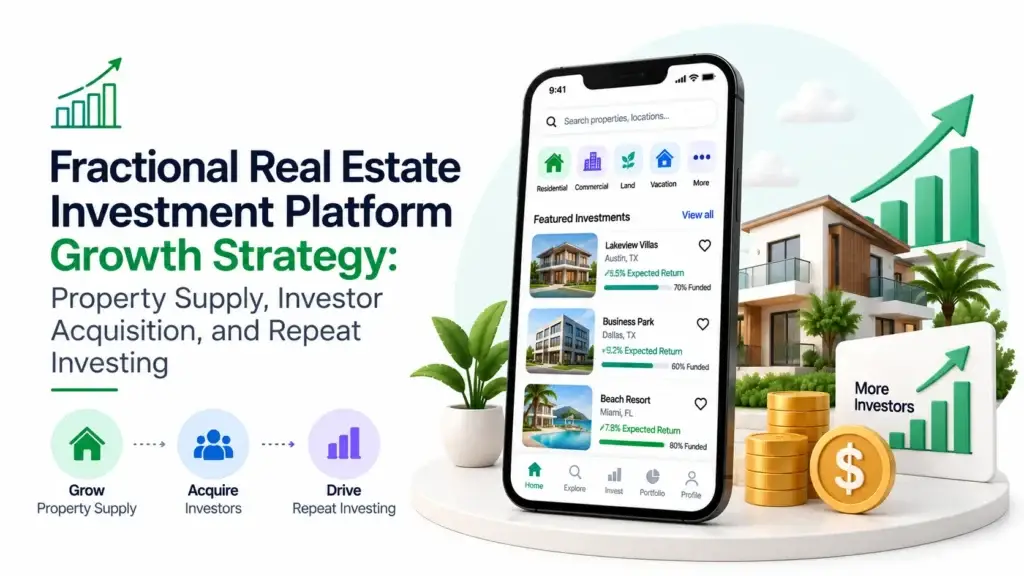

Product4 questions
01What Is Meant by a Prypco Clone App?
Fractional property investing is what a Prypco Clone App delivers: an investor buys a stake in one specific building instead of a pooled-fund unit, collects a proportional part of the rent, and may pass the share to another investor with no need to wait for the entire asset to sell. The Miracuves Prypco Clone extends past this definition. One registered, verified investor can additionally hold vaulted fractional gold, file a mortgage application, begin a golden-visa application and finish a will, while the operator can route everything through a commissioned agent network. A single ledger, wallet and identity check serve all Eleven revenue-bearing product lines.
02What sets this apart from your Fundrise Clone and GetStake Clone?
All three are fractional property platforms, and all three ship with a double-entry ledger and an append-only ownership register, so the core is comparable. The difference is breadth and depth. This build is a larger codebase: 108 data models against 77, 299 API route groups against 229, forty-six operator suites, and sixty-plus native mobile screens. It adds the ten product lines that sit beside property, gold, mortgage, golden visa, wills, services, the agent network with commission advances, CRM, the secondary marketplace and governed exits. It also ships an implemented XRPL tokenisation layer. If your plan is fractional property alone, the other two are the better fit and cost less. If your plan is a multi-product investment platform, this is the one built for it.
03What are the eleven product lines, and do I have to run all of them?
Fractional property investment, the secondary marketplace, exit windows and liquidity governance, rental distributions, mx Mint for vaulted gold, mx Mortgage, mx Golden Visa, mx One for the agent network, mx Real Estate services, mx Will, and CRM with investor relations. You do not have to run all of them. The feature-flag suite in the admin console switches each line on or off per deployment, so you can launch on property alone and enable a second line later as a flag plus a provider credential rather than as a development project.
04Is the mobile app native, or a wrapper around the website?
Native. It is an Expo and React Native application for iOS and Android with more than sixty screens, consuming the same production API as the web rather than rendering web pages inside a WebView. It carries push notifications with device registration, biometric unlock against the device keystore, secure token storage, document and image capture for KYC, and deep links that resolve a web property URL into the matching native screen. The agent workspace is part of it, which matters because agents work from phones.
Money, liquidity & tokenisation4 questions
05How does the platform keep the money correct?
Each monetary event posts balanced double-entry rows covering subscriptions, the ten fee types, distributions, currency conversions and gold spreads, as well as agent commissions and advances. Money is stored in integer minor units and balances are derived from the sum of their entries rather than stored as a number a background job can drift. A signed payment callback drives allocation, the ownership write and certificate issuance inside a single database transaction, so there is no state where the money arrived but the ownership did not record. Unit tests cover the financial engine and the permission logic, and ledger reconciliation checks run in the quality gate. During diligence you can trace any investor number from the screen to its ledger entries.
06What is the answer to the liquidity problem?
Three mechanisms rather than a promise. Investors can list a holding on the secondary marketplace, receive offers and settle the trade against the ownership register, with listing and transaction fees you configure. They can take a scheduled exit window, which carries its own valuation date, published pricing method, exit fee percentage and minimum holding period, all set per window by the operator. Or the operator can propose a sale of the whole asset and collect share-weighted investor votes, with settlement paying out against the register. No platform can promise a buyer for every share on every day. This one makes the mechanics visible, scheduled and governed, which is what sustains a second cheque.
07Is the blockchain real, and do I have to use it?
It is implemented rather than stubbed, and no, you do not have to use it. The tokenisation layer is XRPL: issued-currency tokens with authorized trust lines, which gives compliance-gated holding at protocol level, NFToken certificate offers as title anchors, a dual-control signing queue on every mutation, and a chain-event indexer. It ships running against a deterministic in-memory sandbox, and the admin screen says sandbox on it. Pointing it at testnet or mainnet is configuration: an RPC endpoint and an issuer account held in the secrets layer, plus a key-custody decision that is yours. The local vault in the build is not production custody. The important design point is that the append-only register is the legal source of truth and the chain mirrors it, so a chain problem never becomes a title dispute.
08How does the platform make money, and who sets the rates?
Nine operator-configurable revenue rails carrying ten fee types: management and performance, the transaction lifecycle fees of platform, acquisition, disposition and servicing, early-exit charges, FX spread, marketplace listing and transaction fees, the gold spread, agent channel economics, and growth levers such as promo codes, sponsored listings and partner ad slots. You set every rate. Fees are configured as schedules with a frequency and a charging basis, and each computation is recorded as an auditable charge with its own status history, so tuning the model for a new market is a console task rather than a release. Miracuves takes no share of your revenue and there is no per-investor or per-transaction fee.
Regulation & launch4 questions
09Does any authority license or regulate this platform?
The short answer is no, and it matters more than anything else on this page. Miracuves Prypco Clone is software. No jurisdiction has authorized, licensed or regulated it, it holds no client money, while purchasing it grants no right to raise capital anywhere. Its purpose is to serve as the record-keeping and control system a regulated operator needs: an SPV-per-property structure, case queues for KYC and screening orchestration, accreditation capture, separation of roles and dual control over sensitive operations, audit logging, plus a ledger designed to generate reconciliation evidence. You remain responsible for picking the jurisdiction, setting up the SPVs, obtaining the license and applying your own AML policy. Records those processes require come from the platform, though it does not stand in for legal advice.
10What did the security review actually find?
The build ships with a developer security handbook and a VAPT compliance review mapped to the OWASP top ten, and every finding is graded by severity. The High items are the delivery work named on this page: route-level permission enforcement bound to your approval chain, payment callback verification against your own processor, your identity provider with verified callbacks and evidence retention, and the multi-instance step that moves the rate limiter and the WebAuthn credential store to Redis. We would rather you read that list now than discover it during your own penetration test.
11What must happen before real investor money goes live?
Four things, and none of them is a surprise. Your own provider accounts wired and verified, which means your payment processor, verifying raw-body signatures, and your identity provider with real callbacks. Route-level permission enforcement mapped to who in your organization may release a distribution, change a fee schedule or sign the second half of a token operation. A sanctions and PEP screening provider connected as its own work package, with match handling and a review queue defined, because most regulators will expect it. And your legal setup: jurisdiction, SPV formation and license. With those four in place, the platform runs as a live operation.
12What gets configured at delivery and is not shipped switched on?
Branding and design tokens, which of the eleven product lines your deployment runs, your fee schedules across the nine rails, your country profiles and base currencies, your locales, your roles and the approval chain behind them, your CMS content and email templates, and every external provider credential: payments, identity, storage, email, push, metals pricing, AI and maps. The code for all of it is written and the abstractions are in place, with provider health surfaced in the admin console so nothing is silently misconfigured. What remains at deployment is your accounts, your keys and your jurisdictional decisions.
Source, go-live & Miracuves8 questions
13Is the full source code handed over?
Yes - all of it, delivered at handover: web platform, operator console, agent surfaces and mobile client, plus its migrations and the Prisma schema of 108 models, provider abstractions and tooling. Modules are never encrypted, nothing is obfuscated, and no runtime license needs renewing. Each operator gets an isolated sibling deployment with its own database, provider credentials, branding and jurisdiction profile, instead of a tenant slot on shared infrastructure. Since you hold the code, customization can go deeper at code level. Nothing is metered per investor or per seat on your own book.
14How long until a Prypco Clone is launched?
Six days for a branded deployment, which is the standard ready-made delivery window and excludes app store approval, which is outside anyone's control. That window covers branding, your configuration, the product lines you are switching on and deployment to your environment. It is deliberately not the same thing as being ready to take public money: the provider wiring, permission enforcement, screening and legal setup described above sit between a branded deployment and a live platform, and their length depends on your jurisdiction and your vendors rather than on us.
15What should a realistic first year involve?
One market only: the property line by itself, few assets, and the remaining ten lines turned off by a flag. Platform and management fees support the model during the quiet marketplace period, since no trading happens before the first cohort looks to exit. Nearly all the work that year is servicing: showing that distributions reconcile, that your register survives scrutiny, and that anyone wanting out gets an honest answer. Operators who put year one into fundraising speed instead of servicing quality often find the gap when fixing it costs the most.
16When does the second product line make sense?
Once the first cohort has been serviced through at least one full distribution cycle and the operational rhythm is proven. The argument for adding gold or mortgages is not that they are lucrative on their own, it is that they earn against an investor you have already acquired, verified and built trust with. The acquisition cost is already sunk; the second line monetises it. Switching one on is a flag and a provider credential rather than a project.
17Why pick Miracuves for a Prypco clone?
Because of what this page is willing to tell you before you pay. It names the delivery work that stands between the build and real money, ships the VAPT review itself instead of a reassuring summary, states that tokenisation runs against a sandbox until you configure a chain, and says plainly that no license anywhere comes with the software. The counts it claims, 108 data models, 299 API routes, 46 operator suites, 60-plus mobile screens and 8 locales, are properties of the codebase you receive and your engineers can verify every one of them in an afternoon. You get the source outright, deployed in isolation, with no revenue share. A vendor who shows you only a feature list is not being kinder to you.
18How much does a Prypco clone cost?
A fixed $6,999 pays for the whole Prypco Clone: investor web experience, operator console with forty-six suites, agent workspace, native mobile client, all eleven product lines, complete source and deployment on your own infrastructure. Nothing is metered per investor, there is no runtime license, and Miracuves takes no percentage of capital raised. Configuration done during delivery, such as provider wiring and permission enforcement, is quoted with you.
19Is a ready-made Prypco clone better than custom development?
Usually, since the slowest parts to build are already working: an append-only ownership register, computed balances, distribution runs with dual control, a secondary market and an agent channel. A branded deployment takes six days. Custom development fits only a product design the eleven lines cannot express, and that work gets a written scope, usually two to eight weeks.
20What is the step-by-step process to launch my Prypco clone?
Walk the read-only demo through its seven role logins. Decide which product lines you switch on, then send your brand, jurisdiction profile and hosting details. We brand, configure and deploy an isolated instance in six days. Provider wiring, route-level permission enforcement, screening and your legal setup follow before public money, on a timeline set by your jurisdiction and vendors, and app store approval sits outside our window.
Go Deeper on the Prypco Clone
Find a market overview, pricing on this page and custom development help here.
Disclaimer
Miracuves is an independent software development company. We are not affiliated with, connected to, sponsored by, or endorsed by Prypco.
Read our full Legal Notice & Disclaimer →“Prypco Clone” is used descriptively. It is how the software industry refers to building a platform with functionality similar to Prypco, and how clients search for it.
The entire design and codebase is built by our own team. The product contains no code, design, graphics, or content originating from the Prypco website or applications.
Prypco and all other third-party names and marks are the property of their respective owners, referenced here solely to describe the category of software offered.