
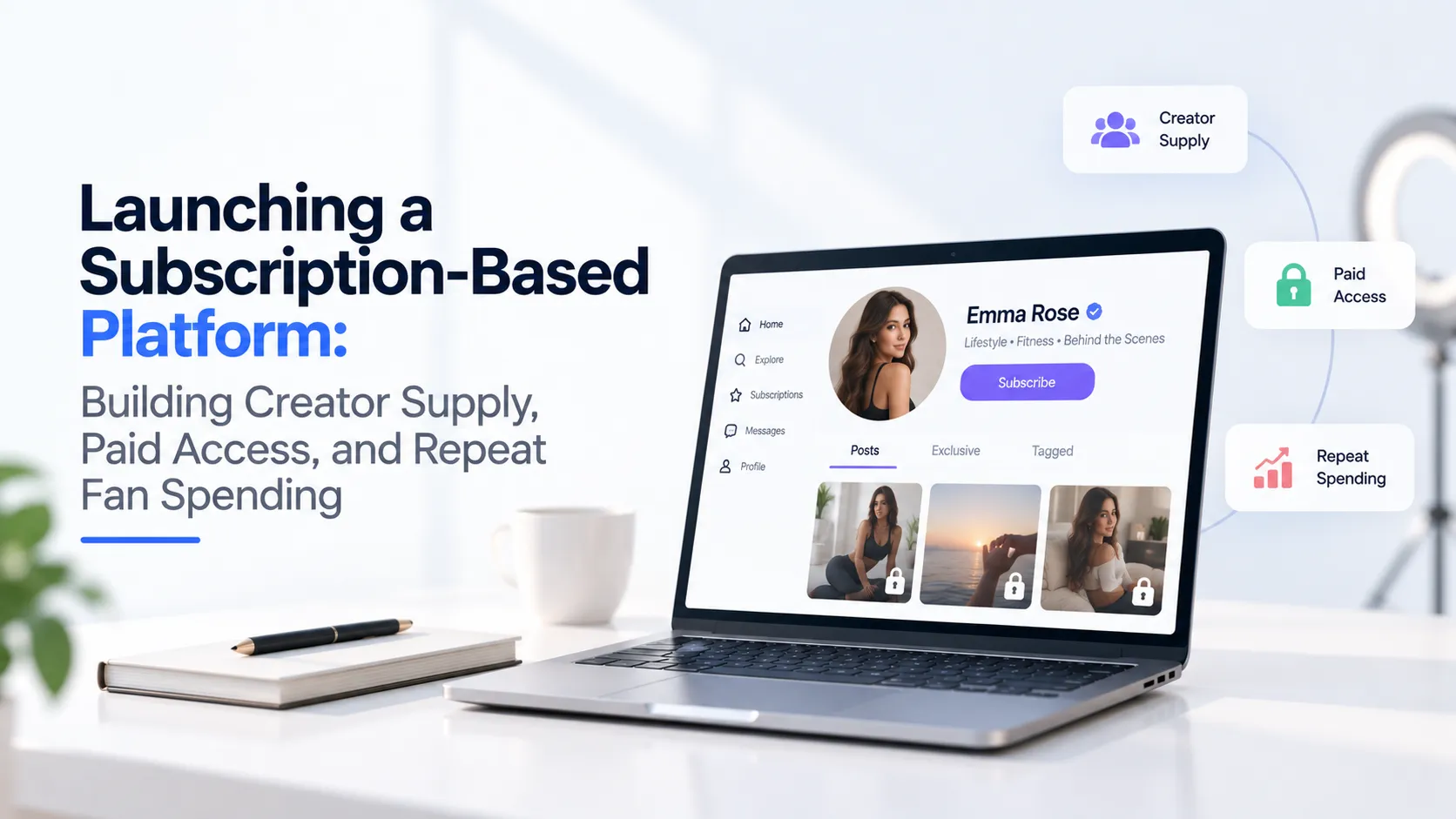
Key Takeaways
- A successful subscription-based platform begins with creators who can consistently give fans a strong reason to pay.
- Paid access should clearly explain what subscribers receive through memberships, premium content, messaging, or live sessions.
- Repeat fan spending can come from renewals, pay-per-view unlocks, tips, paid messages, bundles, and digital products.
- Transparent creator earnings, commissions, deductions, refunds, and payout statuses strengthen long-term creator trust.
- Sustainable growth requires creator supply, fan value, monetization, retention, moderation, and administration to work together.
Launch Readiness Signals
- Select early creators based on audience trust, niche relevance, content consistency, and monetization readiness.
- Define free previews, subscription tiers, premium unlocks, paid interactions, tips, and live-access rules.
- Test recurring payments, one-time purchases, failed transactions, refunds, commissions, and creator payouts.
- Prepare content moderation, creator verification, user reporting, dispute handling, and administrative permissions.
- Track creator activation, fan conversion, renewal rates, repeat purchases, payout completion, and subscriber retention.
Real Insights
- A large creator audience does not guarantee revenue when followers are passive or premium value is unclear.
- The first fan payment demonstrates interest, while repeat spending demonstrates lasting trust and value.
- Depending entirely on subscriptions can limit revenue when fans also value direct interaction and one-time purchases.
- Launching too many features cannot compensate for weak creator supply, unclear positioning, or unreliable payment workflows.
- Miracuves develops white-label creator monetization platforms with subscriptions, premium access, fan engagement, payments, payouts, admin controls, source-code ownership, and 6-day delivery for ready-made launch scopes.
A normal social app usually depends on attention. A subscription-based creator platform depends on willingness to pay.
That single difference changes the entire product strategy.
On a free social network, users may scroll, like, follow, comment, and leave without spending anything. On a paid access platform, fans need a stronger reason to act. They are not just consuming content; they are deciding whether a creator deserves monthly payment, one-time unlocks, tips, or premium interaction.
For founders, this means the platform cannot be built only around uploads and profiles. It needs a complete monetization environment where creators can package value, fans can pay safely, and the platform operator can manage trust, content access, payouts, and user behavior.
A strong subscription-based platform usually combines:
- Creator profiles
- Free previews
- Paid memberships
- Locked posts
- Premium media unlocks
- Direct fan messaging
- Tips and paid requests
- Live engagement
- Wallet or payment workflows
- Creator earnings dashboard
- Admin moderation and reporting
- Payout and refund controls
The business opportunity is not simply creating another content app. The opportunity is building a controlled digital economy where creators bring supply, fans bring recurring demand, and the platform earns from every successful exchange.
The Real Foundation: Creator Supply Comes Before Fan Monetization
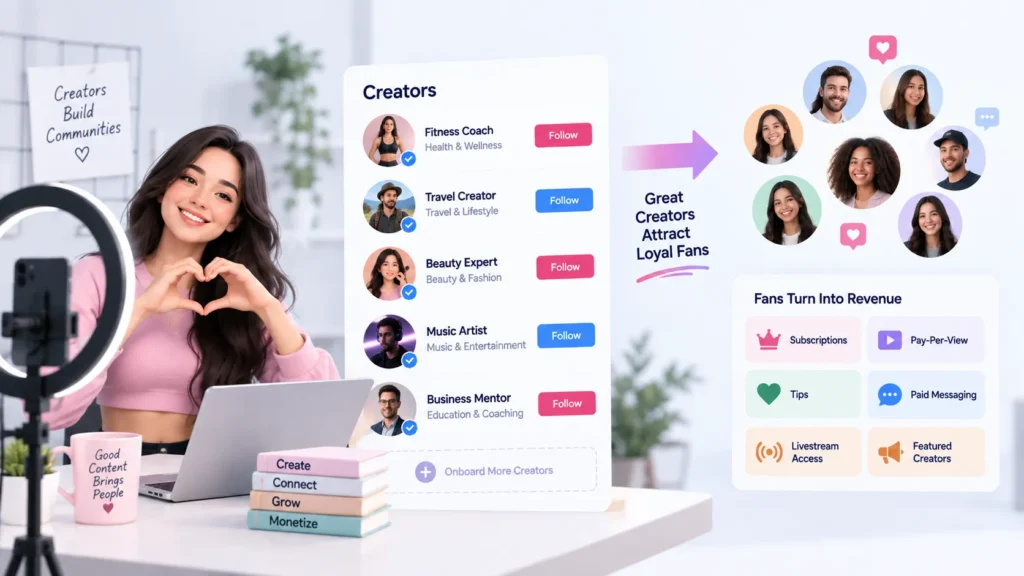
Image Source: AI-generated visual by Miracuves
Many founders begin with the wrong question: “How do we get fans to pay?”
The better first question is: “Which creators will give fans a strong reason to subscribe, unlock content, send tips, or pay for direct interaction?”
Creator supply is the inventory of a direct-to-fan platform. Without active and monetization-ready creators, even a polished platform can feel empty. Fans do not pay for the technology itself. They pay for exclusive content, personal access, entertainment, connection, interaction, and experiences associated with creators they value.
This is why platforms following an OnlyFans-style model must define their creator-supply strategy before finalizing discovery, subscriptions, pay-per-view access, messaging, payments, moderation, and promotional workflows.
What Makes Creator Supply Valuable?
Not every creator is equally suitable for a paid-access platform. A creator with millions of followers may struggle to generate subscriptions if the audience is passive or accustomed only to free content. A smaller creator may perform better when they have a loyal fan base, a distinctive identity, consistent publishing habits, and strong direct engagement.
High-value creator supply usually includes creators who have:
- A loyal audience that actively responds to their content
- A clear reason for fans to pay beyond freely available posts
- The ability to publish exclusive photos, videos, livestreams, or updates consistently
- A strong personal brand or recognizable creator identity
- Comfort with direct fan engagement and private messaging
- The ability to create different levels of free, subscriber-only, and pay-per-view content
- A willingness to promote their paid profile through external social channels
- The ability to maintain subscriber interest after the first payment
- A clear understanding of content policies and community standards
- The willingness to complete identity, age, and consent verification where required
Founders should evaluate creators based on monetization readiness rather than follower counts alone. Useful indicators include audience engagement, content consistency, fan loyalty, willingness to promote, subscription potential, and the ability to produce premium content regularly.
A strong initial creator group gives fans a reason to join, improves the quality of the content feed, and creates the first subscription and PPV transactions needed to validate the platform.
Creator Supply Models Founders Can Use
Different direct-to-fan platforms can use different creator-acquisition models depending on their positioning, permitted content, geographical market, and moderation capacity.
| Creator Supply Model | How It Works | Best For | Founder Risk |
|---|---|---|---|
| Invite-only creators | The platform launches with selected, verified creators who match its positioning and content standards. | Premium creator networks, exclusive fan communities, models, performers, and established influencers | Creator acquisition may be slower, and early content variety may be limited |
| Open verified onboarding | Creators can apply to join, but publishing and payouts begin only after identity and eligibility checks. | Platforms seeking faster marketplace growth across multiple creator categories | Requires stronger verification, moderation, reporting, and content-review systems |
| Agency-led supply | Creator agencies, talent managers, or entertainment networks onboard and manage groups of creators. | Models, entertainers, influencers, performers, and professionally managed creator communities | The platform may become dependent on a small number of agency relationships |
| Category-focused supply | The platform recruits creators from one defined category, such as adult content, glamour, fitness, music, cosplay, lifestyle, or entertainment. | Founders building a differentiated direct-to-fan platform around a specific audience interest | A narrow category may limit total market size and require specialized payment or moderation workflows |
| Regional creator supply | The platform focuses on creators from a specific country, language, culture, or regional entertainment market. | Local fan communities and underserved regional creator markets | Requires localized payments, payouts, moderation, customer support, and content policies |
| Anchor-creator model | The platform launches around a small number of recognized creators who attract the first wave of paying fans. | New platforms that need immediate credibility, content, and audience attention | Growth can become too dependent on a few creators, especially if they leave |
| Adult-creator-focused supply | The platform onboards verified adult creators and builds content, payment, consent, moderation, and privacy workflows around their needs. | Adult subscription communities, models, performers, and premium private-content platforms | Requires strict age assurance, participant consent, content moderation, privacy protection, and compatible payment processing |
The right supply model depends on what the founder wants to prioritize: premium quality, rapid growth, category expertise, regional reach, adult-creator support, agency partnerships, or marketplace scale.
A platform can also combine different approaches. For example, it may begin with invite-only anchor creators, introduce agency partnerships, and later open applications through a controlled verification process.
The goal is not simply to onboard as many creators as possible. The goal is to build an active, trusted, and commercially viable creator base that consistently gives fans a reason to subscribe, purchase premium content, and return.
Read More: How Can a Subscription-Based Platform Keep Creators Active and Subscribers Engaged?
Paid Access Design: Why Fans Need Clear Value Before They Subscribe
Paid access is more than locking content behind a button. It is the structure that tells fans what they get, why it matters, and why they should keep paying.
A weak paid access model says: “Subscribe for exclusive content.”
A stronger paid access model says: “Subscribe to receive weekly behind-the-scenes videos, private updates, member-only live sessions, early content drops, and direct creator interaction.”
The second version is more specific, easier to understand, and easier to sell.
Core Paid Access Layers
A subscription-based creator platform should give creators flexible ways to package value.
Important paid access layers include:
- Free profile content: Helps fans discover the creator before paying.
- Subscription posts: Gives members recurring access to premium updates.
- Tiered memberships: Allows creators to price different access levels.
- Premium unlocks: Lets fans pay separately for selected content.
- Paid messages: Turns direct interaction into a monetization channel.
- Tips and gifts: Allows fans to support creators without a fixed purchase.
- Live access: Creates time-sensitive premium engagement.
- Custom requests: Lets fans pay for personalized content or services where legally and operationally appropriate.
This is where founders need to think carefully. If everything is included in the subscription, the platform may limit extra spending. If everything is locked separately, fans may feel overcharged. The best structure balances predictable recurring revenue with optional premium spending.
Repeat Fan Spending: The Real Revenue Engine
A subscription platform becomes stronger when fans spend more than once.
The first payment proves interest. Repeat spending proves trust.
Repeat fan spending can happen through monthly renewals, one-time unlocks, direct messages, premium content bundles, live events, tips, merchandise, coaching, digital downloads, and special access campaigns. The goal is not to pressure users into paying constantly. The goal is to create enough meaningful moments that paying again feels natural.
What Encourages Fans to Spend Repeatedly?
Fans are more likely to continue spending when the platform supports:
- Regular creator updates
- Clear membership benefits
- Personal interaction opportunities
- Limited-time premium drops
- Transparent pricing
- Easy payment flows
- Trustworthy content delivery
- Strong notification loops
- Creator consistency
- Refund and dispute clarity
Repeat spending is not created by payment features alone. It is created by a product experience that keeps fans emotionally or practically invested.
Fan Spending Loops Founders Should Build Around
| Spending Loop | What Fans Pay For | Why It Works | Platform Revenue Opportunity |
|---|---|---|---|
| Monthly membership | Recurring access to creator content | Predictable and familiar | Platform commission or subscription fee |
| Premium unlocks | Specific posts, videos, files, or bundles | Lets fans pay for high-value content | Transaction commission |
| Paid messaging | Direct creator interaction | Feels personal and immediate | Message fee or wallet deduction |
| Live sessions | Time-sensitive creator access | Creates urgency and community | Ticket fee, tips, or session commission |
| Tips and gifts | Voluntary creator support | Low-friction fan appreciation | Microtransaction revenue |
| Digital products | Guides, templates, courses, media packs, or fan bundles | Expands beyond subscriptions | Marketplace commission |
| Creator promotion | Featured placement or discovery boost | Helps creators grow inside the platform | Creator-side revenue stream |
The strongest platforms do not depend on one monetization layer. They give creators multiple ways to earn and fans multiple reasons to return.
Pricing Strategy: How Creators Should Package Paid Access
Pricing affects subscription conversion, creator earnings, renewals, and churn. If the price is too high, fans may hesitate. If it is too low, creators may struggle to produce premium content consistently.
An OnlyFans-style platform should let creators combine recurring subscriptions with PPV content, paid messages, tips, and livestream access.
Creators should be able to configure:
- Free or paid profiles
- Monthly subscription prices
- Multi-month bundles
- Limited-time discounts
- New-fan offers
- PPV post pricing
- Locked media messages
- Tips and custom requests
- Automatic renewals and cancellations
The platform should clearly show what a subscription includes and which content requires an additional payment. Fans should understand the price, billing frequency, access period, and renewal terms before paying.
Different creators may need different pricing strategies. A scalable creator monetization platform should let operators control commissions, pricing limits, refunds, and discount rules while allowing creators to test what their fans value.
Creator Retention Matters as Much as Fan Retention
Most founders focus on fan acquisition, but creator retention is just as important. If high-quality creators leave, fans leave with them.
Creators stay when they can earn, understand their numbers, trust the payout system, manage their audience, and feel protected by platform rules.
What Creators Need From the Platform
A creator dashboard should not only show posts and earnings. It should help creators operate their business.
Useful creator-side workflows include:
- Profile setup and verification
- Subscription plan management
- Content upload and scheduling
- Paid post publishing
- Fan list segmentation
- Message management
- Earnings reports
- Payout status
- Refund visibility
- Content performance analytics
- Moderation and blocking controls
- Promotion tools
A creator who understands what content converts, which fans spend, and when payouts are expected is more likely to keep building on the platform.
Trust, Safety, and Moderation Are Revenue Protectors
Subscription platforms deal with premium content, fan payments, private interactions, creator earnings, and user-generated media. That makes trust a business requirement, not a secondary feature.
Founders should plan trust and safety before launch, especially if the platform supports sensitive content, creator identity verification, paid private communication, or regional payment providers.
Important trust layers include:
- Creator verification
- Fan account controls
- Content moderation workflows
- Abuse reporting
- Comment and message controls
- Copyright or content ownership reporting
- Secure payment gateway integration
- Encrypted data transfer
- Role-based admin access
- Audit logs
- Payout monitoring
- Refund and dispute management
The platform does not need to overcomplicate safety from day one, but it does need clear operating rules. Weak moderation can damage creator trust, fan trust, payment provider relationships, and long-term brand value.
Read More: How a Subscription-Based Platform Connects Creators, Subscribers, Paid Content, and Fan Payments
Founder Decision Signals
Speed
If creators are ready and the niche is validated, waiting months to launch can delay market learning. A ready-made platform foundation helps founders test paid access faster.
Cost
Building subscriptions, paid unlocks, messaging, wallets, payouts, moderation, and admin workflows from scratch can increase cost. A launch-ready foundation can reduce avoidable rebuild work.
Scalability
The platform should support creator growth, fan transactions, media workflows, payment activity, and admin control without forcing manual operations for every small change.
Market Fit
The strongest signal is not app downloads alone. It is whether creators publish consistently and fans renew, unlock, message, tip, or buy again.
Admin Control: The Layer That Keeps the Business Manageable
A subscription-based platform needs a strong admin layer because the operator must manage more than users and content.
The admin dashboard should help the business control creators, fans, earnings, access rules, reports, commissions, platform policies, disputes, content flags, payment status, and growth data.
Key admin capabilities include:
| Admin Capability | Business Value | Founder Impact |
|---|---|---|
| Creator approval | Controls supply quality | Helps maintain marketplace trust |
| Fan management | Supports account safety and support | Reduces user conflict and abuse |
| Content moderation | Protects platform reputation | Helps manage sensitive or restricted content |
| Subscription controls | Manages recurring access rules | Supports predictable revenue workflows |
| Commission settings | Controls platform monetization | Lets founders adjust business model over time |
| Payout management | Builds creator trust | Reduces confusion around earnings |
| Refund and dispute tools | Handles transaction issues | Improves operational reliability |
| Analytics dashboard | Shows creator, fan, and revenue behavior | Helps founders make growth decisions |
| Role-based access | Limits internal team permissions | Improves operational security |
Without admin control, the founder becomes dependent on developers for every operational change. That slows down the business and makes scaling harder.
Monetization Models for a Subscription-Based Creator Platform
The subscription model is the base, but it should not be the only monetization path. Founders should build a platform where revenue can grow across different user behaviors.
Common monetization models include:
1. Platform Commission
The platform takes a percentage from creator earnings. This is simple to understand and aligns platform revenue with creator success.
2. Creator Subscription Fees
Creators pay the platform for access to premium tools, advanced analytics, promotional features, or expanded storage.
3. Fan Membership Revenue
Fans pay monthly or annually for access to specific creators, communities, or premium platform experiences.
4. Paid Content Unlocks
Fans pay separately for premium posts, media bundles, digital products, or special releases.
5. Paid Messaging and Requests
Creators can monetize direct interaction, custom replies, private media, or personalized requests based on platform rules.
6. Live Events and Premium Sessions
The platform can support ticketed live sessions, paid calls, workshops, exclusive streams, or community events.
7. Promotion and Discovery Tools
Creators can pay for featured placement, category boosts, campaign visibility, or profile promotion if the platform has meaningful discovery traffic.
8. Creator Commerce
Creators can sell digital products, templates, guides, merchandise, coaching packs, or premium fan bundles.
A founder does not need to activate every revenue stream at launch. The better approach is to start with the monetization layers that fit the niche, then expand once creator and fan behavior becomes clear.
Ready-Made Foundation vs Custom Development: What Founders Should Decide
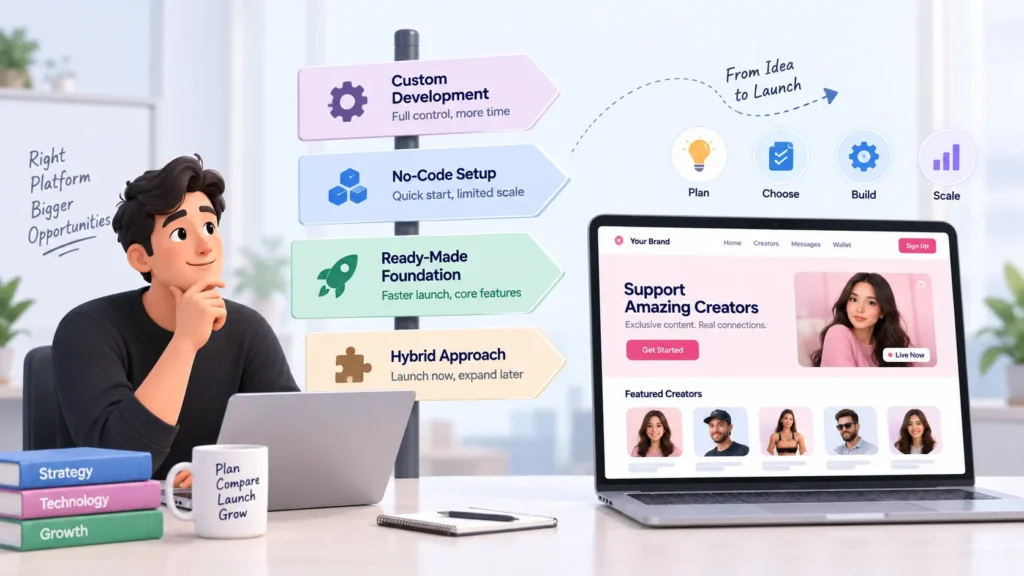
Image Source: AI-generated visual by Miracuves
A subscription-based creator platform can be built from scratch, assembled from third-party tools, or launched using a ready-made white-label foundation.
The right choice depends on speed, budget, customization depth, and how much operational risk the founder wants to absorb early.
| Build Option | Best For | Advantages | Limitations |
|---|---|---|---|
| Fully custom development | Funded teams with unique product requirements | Maximum design and architecture control | Longer timeline, higher planning effort, more upfront risk |
| No-code or plugin setup | Testing simple content membership ideas | Fast setup for basic use cases | Limited scalability, weaker app experience, less control |
| Ready-made white-label foundation | Founders who want faster launch with core platform workflows already built | Faster deployment, source-code ownership, admin control, branded experience | Customization scope should be planned clearly |
| Hybrid approach | Founders who want speed now and deeper customization later | Launch faster, then extend based on market feedback | Requires a strong technical foundation |
For many founders, the practical question is not “Can this be built from scratch?” It can. The better question is whether building every subscription, paid access, messaging, payout, moderation, and admin workflow from zero is the smartest first move.
Miracuves helps founders launch a white-label creator monetization setup with source-code ownership, branded design, admin control, and 6-day delivery for ready-made solutions. For teams that already know their niche and want to move faster, a premium creator platform foundation can reduce the time between planning and market validation.
What to Prioritize Before Launch
A founder should avoid launching with too many features and too little strategy. The first version should prove that creators can publish, fans can pay, and the operator can manage the platform.
Before launch, prioritize:
- Creator onboarding: Can creators set up profiles, pricing, content, and payout details easily?
- Paid access clarity: Do fans understand what is free, what is paid, and what happens after subscribing?
- Payment readiness: Are subscriptions, one-time purchases, refunds, and payout workflows clear?
- Content protection: Are premium posts, private media, and paid access rules handled properly?
- Admin visibility: Can the operator see users, creators, payments, disputes, reports, and platform activity?
- Moderation workflows: Can flagged content, user abuse, and creator disputes be managed?
- Retention triggers: Are notifications, creator updates, renewal reminders, and engagement loops planned?
- Niche positioning: Does the platform have a clear reason to exist beyond being a generic creator app?
Launching without these foundations can create operational friction quickly. A creator platform is not only a front-end experience. It is a payment, content, trust, and community system.
Common Mistakes Founders Should Avoid
Starting With Too Broad a Creator Category
A generic platform is harder to position, harder to market, and harder to seed with valuable creators. A focused niche gives fans a clearer reason to join and creators a stronger reason to promote.
Treating Subscriptions as the Only Revenue Model
Subscriptions create recurring revenue, but fan spending often expands through premium unlocks, tips, messages, bundles, and live access. A single revenue layer can limit platform growth.
Ignoring Payout Transparency
Creators need visibility into earnings, deductions, payout status, and refund impact. If creators do not trust the money flow, they will not keep building on the platform.
Launching Without Moderation Rules
Paid access platforms need clear content, user, and payment rules. Without moderation workflows, the platform can face reputation, safety, and operational risks.
How Miracuves Helps Founders Launch Faster
Miracuves helps founders move from creator platform idea to launch-ready execution with a white-label, source-code-owned product foundation. Instead of starting with a blank development roadmap, founders can begin with core creator, fan, payment, admin, and monetization workflows already structured for faster deployment.
A ready-made Miracuves solution can support:
- Branded creator and fan experience
- Creator profiles and content publishing
- Subscription and paid access workflows
- Premium content unlocks
- Fan engagement tools
- Payment and payout logic
- Admin dashboard control
- Moderation and reporting workflows
- Source-code ownership
- Customization support
- 6-day delivery for ready-made launch scope
For founders evaluating a subscription-led creator app, this reduces the pressure of building every module from zero while still allowing the platform to be shaped around a specific niche, market, or monetization model.
Final Thoughts: Build for Creator Supply, Paid Access, and Repeat Spending
A subscription-based creator platform is not successful because it has locked content. It becomes successful when creators see earning potential, fans see ongoing value, and the platform operator can manage payments, access, trust, moderation, and growth with confidence.
For founders, the smarter approach is to think beyond the app interface. The real business depends on creator supply, pricing flexibility, repeat fan spending, transparent payouts, admin control, and a clear niche strategy.
Miracuves helps founders launch faster with white-label creator platform solutions built for branding, monetization, source-code ownership, and operational control. When the foundation is ready, founders can spend more time refining the creator economy model and less time rebuilding basic platform workflows from scratch.
FAQs
What is a subscription-based creator platform?
A subscription-based creator platform is a digital platform where creators earn from fans through recurring memberships, paid content, premium access, direct interaction, tips, live sessions, or digital products. The platform gives creators tools to publish, price, engage, and monetize their audience.
How does a creator subscription platform make money?
A creator subscription platform can earn through platform commissions, monthly memberships, paid content unlocks, creator promotion fees, paid messages, live sessions, tips, digital product sales, and premium creator tools. The best revenue model depends on the niche and fan spending behavior.
What should founders prioritize before launching a paid access platform?
Founders should prioritize creator onboarding, subscription logic, payment workflows, content access rules, payout transparency, moderation, fan engagement, and admin control. These foundations help the platform operate smoothly once creators and fans start transacting.
Why is creator supply important for a subscription platform?
Creator supply matters because fans pay for access to creators, not just for the platform itself. A strong creator base gives the platform valuable content, audience pull, and monetization potential. Without the right creators, paid access becomes difficult to sell.
How can a platform increase repeat fan spending?
Repeat fan spending can increase through recurring subscriptions, premium unlocks, direct messaging, creator bundles, live sessions, tips, limited-time offers, and consistent creator engagement. The platform should make repeat payment feel valuable, clear, and trustworthy.
Is a ready-made creator platform better than custom development?
A ready-made platform can be better for founders who want faster launch, lower early-stage development complexity, and core monetization workflows already included. Custom development may be useful for highly unique product models, but it usually requires more planning, time, and budget.
What features are useful for creator retention?
Creator retention improves when the platform provides clear earnings reports, payout visibility, content tools, pricing control, fan management, analytics, moderation support, and promotion options. Creators are more likely to stay when the platform helps them grow their income.
Can Miracuves help launch a subscription-based creator platform?
Yes. Miracuves helps founders build white-label creator monetization platforms with subscription workflows, paid access, fan engagement tools, admin control, branded design, source-code ownership, and 6-day delivery for ready-made launch scope.
Miracuves is an independent software development company. We are not affiliated with, connected to, sponsored by, or endorsed by any company or product named in this article.
Terms such as “X Clone” are used descriptively. It is how the software industry refers to building a platform with functionality comparable to a known service, and how clients search for it.
The entire design and codebase of our products is built by our own team. Our products contain no code, design, graphics, or content originating from any third-party website or applications.
All third-party names and marks referenced in this article are the property of their respective owners, referenced solely to identify the services discussed.