

Key Takeaways
- A subscription-based platform should protect creator accounts, subscriber profiles, premium content, payments, and personal data through layered security controls.
- Core protections include strong authentication, encrypted data, secure payment processing, content access rules, fraud monitoring, account recovery, and role-based permissions.
- Security should be integrated into onboarding, subscriptions, paid content delivery, messaging, creator payouts, data storage, moderation, and admin workflows from the beginning.
Security & Protection Signals
- Creator account protection can include multi-factor authentication, secure password storage, session controls, suspicious-login alerts, device management, and reliable account recovery.
- Paid content protection may use subscription checks, PPV permissions, signed media access, watermarking, download controls, secure storage, and monitoring for unauthorized sharing.
- Payment and subscriber data security should cover trusted payment gateways, transaction verification, encryption, tokenization, fraud detection, payout controls, privacy settings, and audit logs.
Platform Risk Insights
- Admins should monitor failed payments, chargebacks, unusual login activity, payout anomalies, permission changes, content reports, account abuse, and suspicious transactions.
- Regular backups, access reviews, security testing, incident response plans, data minimization, moderation workflows, and compliance checks can reduce operational and privacy risks.
- Miracuves develops customizable subscription-based platforms with secure accounts, protected paid content, payment controls, subscriber data management, creator payouts, moderation, analytics, and admin security tools.
A subscription-based platform is not just a content website with a payment button. It is a trust system where creators upload valuable content, subscribers pay for access, payments move through multiple workflows, and the platform operator becomes responsible for privacy, access control, moderation, and financial records.
That is why security should be planned before launch, not added after the first problem appears.
For founders building a paid creator platform, the biggest question is not only “Can users subscribe?” The stronger question is: can the platform protect creator accounts, restrict paid content correctly, process payments safely, manage payout changes, and keep subscriber data private as usage grows? If you are evaluating a secure creator monetization platform, the security layer should be reviewed alongside subscriptions, paid content access, creator payouts, and admin control.
This guide explains the security layers that matter most for a subscription-based platform and what founders should investigate before choosing a product foundation, development team, or launch-ready creator monetization system.
Why Security Is a Revenue Layer in Subscription-Based Platforms
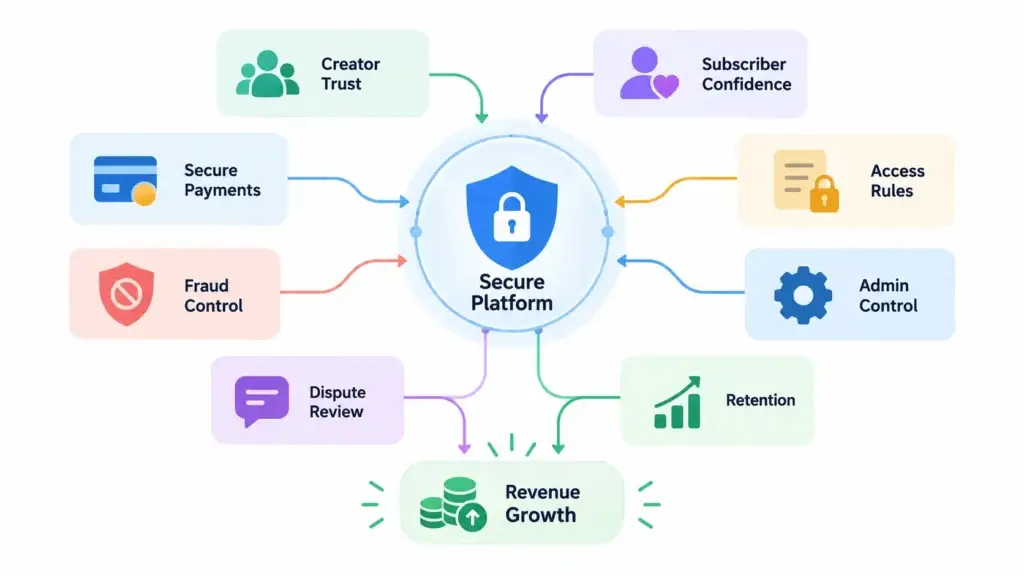
Security is often treated as a technical checklist, but in a subscription-based creator platform, it is directly connected to revenue.
If creators do not trust the platform, they will not upload premium content. If subscribers do not trust payment and privacy systems, they will not subscribe. If payment partners see weak fraud controls or unclear transaction records, the platform may face operational friction. If admins have excessive access, insider misuse becomes a business risk.
A strong security foundation protects more than data. It protects creator income, subscriber confidence, platform reputation, payment continuity, and long-term retention.
For a founder, this means security should be part of the product model from day one. The platform should be designed around who can access what, how paid access is verified, how payments are recorded, how disputes are investigated, and how suspicious activity is detected.
What Actually Needs Protection?
A subscription-based platform usually has four sensitive layers: creator accounts, paid content, payments, and subscriber data. Each layer carries a different type of business risk.
| Platform Layer | What Can Go Wrong | Security Priority |
|---|---|---|
| Creator accounts | Account takeover, payout changes, unauthorized messages, content deletion | Strong login protection, MFA, recovery controls, activity alerts |
| Paid content | Unauthorized access, scraping, link sharing, mass downloads | Access rules, signed media URLs, watermarking, anti-abuse monitoring |
| Payments and payouts | Failed renewals, fake webhook events, payout fraud, chargebacks | Secure gateway flow, webhook validation, ledger accuracy, payout approval |
| Subscriber data | Privacy leaks, exposed messages, unnecessary data retention | Encryption, privacy controls, restricted admin access, data minimization |
| Admin dashboard | Staff misuse, excessive permissions, sensitive data exports | Role-based access, audit logs, approval controls, session restrictions |
Founders should not evaluate security as one broad feature. They should evaluate it by workflow. A platform may have secure login but weak payout controls. It may have payment integration but poor webhook validation. It may store content privately but allow admins to access more data than they need.
Founders who want a deeper view of the platform structure can review the full creator platform feature stack to understand how user accounts, paid media, subscriber access, creator dashboards, wallets, payouts, moderation, and admin controls work together.
The safest approach is to map every sensitive action and ask: who can perform it, what permission is required, what gets logged, and what happens when something looks suspicious?
Creator Account Protection Starts With Login, Recovery, and Payout Safety
Creator accounts are among the most valuable assets in a subscription-based platform. A creator account may contain premium media, subscriber relationships, private messages, earnings history, payout settings, and brand identity.
If an attacker gains access, the damage can go beyond a single login event. They may change payout details, message subscribers, delete content, leak private media, or damage the creator’s reputation.
A secure creator account system should include:
- Multi-factor authentication for creators and admins
- New-device login alerts
- Session history and active-device visibility
- Remote logout from other devices
- Rate limits for failed login attempts
- Secure password reset workflows
- Strong email-change and phone-change verification
- Extra verification before payout changes
- Account recovery review for suspicious cases
- Activity logs for sensitive account actions
Account recovery deserves special attention. Many platforms focus on password strength but overlook recovery abuse. If support teams can reset accounts too easily, attackers may bypass normal login controls by manipulating customer support, email access, or identity verification.
For founders, the practical question is simple: if a creator loses access or an attacker tries to take over the account, does the platform have enough control to prevent damage, investigate the event, and restore trust?
Paid Content Protection Requires More Than Hiding Media Behind a Paywall
Paid content is the core product asset in a subscription-based platform. If premium content becomes accessible through public URLs, weak storage rules, poor API checks, or reused links, the platform’s monetization model becomes vulnerable.
A paywall should not simply hide a button on the frontend. The backend must verify access every time a subscriber requests restricted content.
A deeper look at subscription-based platform architecture can help founders understand why entitlement checks, protected storage, APIs, user permissions, and media delivery rules need to work together instead of being handled as separate features.
For example, before showing a private image, video, message attachment, livestream replay, or premium post, the system should confirm whether the viewer has:
- An active subscription
- A completed pay-per-view purchase
- Access through a paid message
- Permission from a creator-specific campaign
- Admin or moderation rights for a valid operational reason
The system should also separate access rules for subscribers, creators, moderators, support teams, finance teams, and platform administrators. Everyone should not see everything.
Useful paid content protection layers include:
- Private media storage instead of public folders
- Signed or short-lived media URLs
- Server-side entitlement checks
- Pay-per-view unlock validation
- Download restrictions where relevant
- Personalized watermarking options
- Bot and scraper detection
- Rate limits on media requests
- Alerts for unusual access patterns
- Abuse reporting and takedown workflows
No platform can fully stop screenshots or screen recording after content has been viewed. The practical goal is to reduce unauthorized access, discourage redistribution, identify suspicious behavior, and give creators a clear process for reporting misuse.
This is where product architecture matters. A serious creator subscription platform needs content access logic built into the backend, not patched into the interface later.
Payment Security Must Cover Subscriptions, Wallets, Refunds, and Payouts
Payment security in a subscription-based platform is not only about adding a payment gateway. The platform may need to manage recurring subscriptions, pay-per-view unlocks, wallet credits, tips, gifts, refunds, disputes, creator commissions, payout requests, and transaction histories. Because each monetization flow creates a different access, accounting, and fraud-control requirement, founders should map the creator subscription business model before finalizing payment and payout workflows.
Each money movement should be traceable.
A secure payment workflow should include:
- Trusted payment gateway integration
- Tokenized or hosted payment handling where possible
- Subscription status checks before access is granted
- Webhook authentication before updating payment status
- Protection against duplicate webhook processing
- Clear transaction records for every purchase
- Refund and chargeback tracking
- Platform commission calculations
- Creator earning records
- Reconciliation between platform records and payment provider records
Webhook security is especially important. When a payment provider sends an event such as “subscription paid,” “refund created,” or “payment failed,” the platform should verify that the event is authentic before changing a user’s access, wallet balance, or subscription state.
If webhook validation is weak, attackers may attempt to manipulate payment events or unlock access without real payment.
Creator payout workflows need another layer of protection. Before payout details are changed, the platform should require additional verification and notify the creator. For larger withdrawal requests, founders may also need manual review, cooling-off periods, temporary holds, or approval workflows.
The goal is not to slow down legitimate creators. The goal is to prevent account manipulation, fraudulent withdrawals, inaccurate balances, and payment disputes that are difficult to investigate later.
Subscriber Data Privacy Builds Trust Before the First Renewal
Subscribers share sensitive information when they join a paid creator platform. This may include login details, subscription history, payment activity, messages, purchase records, profile information, and privacy preferences.
If subscriber data is mishandled, the platform risks more than a technical breach. It risks loss of user trust, refund pressure, legal exposure, and negative brand reputation.
Strong subscriber data protection should include:
- Encrypted data transfer
- Encrypted sensitive data storage
- Secure password handling
- Restricted access to subscriber records
- Privacy-conscious profile settings
- Clear consent flows
- Minimal data collection
- Defined data retention rules
- Account deletion or data request workflows where required
- Secure handling of private messages and attachments
Data minimization is a practical business principle. The platform should not collect or store sensitive information unless it has a clear operational purpose. The less unnecessary data stored, the lower the exposure if something goes wrong.
Founders should also define who inside the business can access subscriber records. Customer support may need limited account information. Finance teams may need transaction details. Moderators may need report-related context. No team should receive broad access by default.
Admin Panel Security Can Decide Whether the Platform Stays Governable
The admin dashboard is one of the most sensitive parts of a subscription-based platform. It can control users, creators, content, payments, withdrawals, moderation decisions, platform settings, reports, subscriptions, and business analytics.
If admin access is weak, even strong user-facing security may not be enough.
A secure admin panel should include:
- Unique admin accounts instead of shared logins
- Mandatory multi-factor authentication
- Role-based access control
- Permission-based dashboards
- Sensitive-action audit logs
- Limited export permissions
- Approval workflows for high-risk actions
- Session timeout rules
- IP or device restrictions where needed
- Immediate access removal when staff leave
- Review of inactive admin accounts
Audit logs should show who performed an action, when it happened, what changed, and which account, payment, content item, or setting was affected. This helps the platform operator investigate disputes, detect misuse, and maintain accountability.
For a founder, the key question is not only whether an admin panel exists. The key question is whether the admin panel gives the right people the right level of control without exposing sensitive workflows unnecessarily.
Content Moderation, Verification, and Abuse Reporting Are Security Functions Too
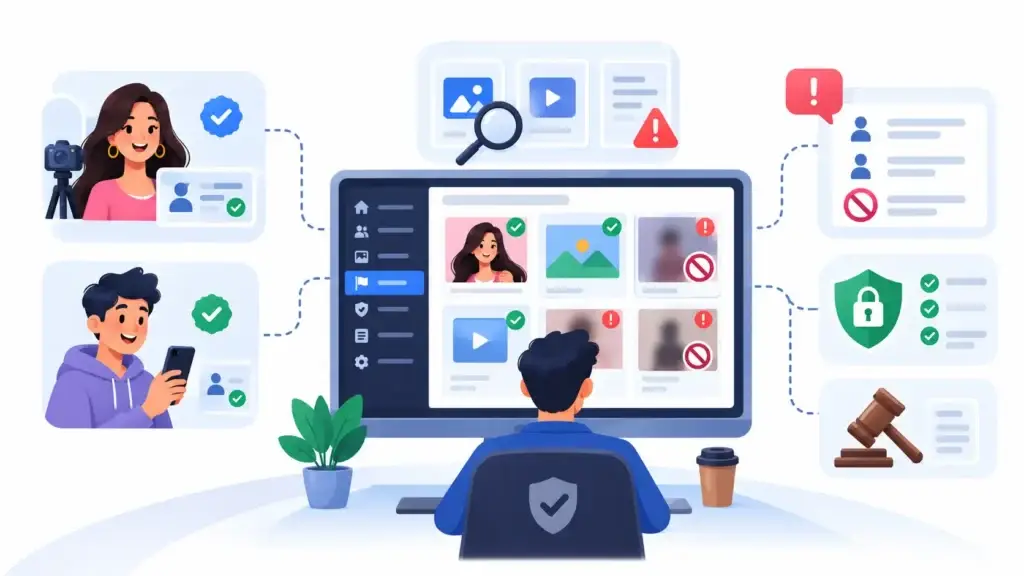
Many founders separate moderation from security, but in a subscription-based creator platform, they are closely connected.
A creator platform may need to handle user reports, copyright concerns, impersonation, spam, harassment, prohibited content, fake accounts, payment abuse, and suspicious creator activity. Without governance workflows, the platform becomes harder to operate safely.
Strong moderation and privacy controls also support creator retention and subscriber loyalty, because users are more likely to stay when the platform feels safe, governed, and professionally managed.
Important moderation and verification layers include:
- Creator verification workflows
- Subscriber age or eligibility checks where required
- Content review queues
- Abuse reporting tools
- Takedown request workflows
- Copyright complaint handling
- Comment and message moderation
- Block and restriction controls
- Repeat-offender policies
- Regional content controls where relevant
- Records of moderation decisions
Verification should also be separated by role. General subscriber signup is different from creator onboarding. A creator may need identity checks, payout ownership validation, content policy acceptance, and additional review before monetization is enabled.
Legal and operational requirements vary by market, content category, payment provider, and business model. Founders should treat compliance as a configurable workflow that requires legal review, policy clarity, and operational discipline.
Security Checklist for Founders Before Launch
Before launching a subscription-based platform, founders should check whether the product foundation can support the following controls:
| Security Area | Questions to Ask Before Launch |
|---|---|
| Creator accounts | Does the platform support MFA, login alerts, device history, and secure account recovery? |
| Paid content | Are media files protected by backend access checks and short-lived links? |
| Subscriptions | Does the system verify payment status before granting access? |
| PPV unlocks | Are one-time purchases recorded and checked before content is shown? |
| Payments | Are gateway events authenticated and protected against duplicate processing? |
| Payouts | Are payout changes logged, verified, and protected by approval controls? |
| Subscriber data | Is sensitive data encrypted, minimized, and accessible only by permission? |
| Admin access | Are roles separated across moderation, support, finance, and technical teams? |
| Audit logs | Can the platform investigate payment, content, account, and admin events? |
| Abuse handling | Are reporting, review, restriction, and takedown workflows available? |
| Backups | Are database and media backups planned, protected, and tested? |
| Updates | Is there a process for patching, monitoring, and improving security after launch? |
These security decisions also affect creator platform development cost factors, because protected media delivery, payment gateway workflows, verification, admin permissions, audit logs, moderation controls, and payout security can change the final build scope.
This checklist helps founders compare platforms beyond surface-level features. A subscription platform may look polished on the frontend but still fail under account abuse, payment disputes, content leakage, or admin misuse.
Founder Decision Signals: When Security Should Shape the Build Strategy
Security priorities change depending on the platform model. A solo creator community does not have the same risk profile as a multi-creator subscription marketplace. A regional fan platform does not have the same payment and verification needs as an international creator network. This is also where choosing the right creator platform development team matters, because security architecture, payment workflows, moderation controls, and admin permissions should be planned before launch.
Founders should pay attention to these decision signals:
You Need Stronger Account Protection If Creators Control High-Value Earnings
If creators depend on the platform for serious income, account takeover becomes a major business risk. MFA, payout-change verification, session controls, and account recovery policies should be treated as core features.
You Need Stronger Content Protection If Premium Media Drives Revenue
If paid media is the main value proposition, content access rules must be backend-driven. Secure storage, permission checks, signed URLs, watermarking, and anti-scraping controls become essential.
You Need Stronger Payment Governance If the Platform Supports Multiple Revenue Streams
Subscriptions, PPV content, paid messages, tips, calls, gifts, wallets, and creator payouts create more transaction complexity. The platform needs accurate records, reconciliation, refund tracking, and fraud monitoring.
You Need Stronger Admin Controls If a Team Will Operate the Platform
As soon as moderators, support agents, finance teams, and operations managers are involved, role-based access becomes critical. Staff should only access the workflows they need to perform their job.
How Miracuves Helps Founders Build Safer Creator Subscription Platforms
Miracuves helps founders move faster with ready-made and white-label creator platform foundations that include branded user experiences, source-code ownership, admin control, monetization workflows, and faster deployment.
For founders planning to launch a branded creator monetization platform, Miracuves can support essential workflows such as creator profiles, subscription access, pay-per-view content, paid messaging, wallet payments, payouts, moderation, verification, analytics, and admin governance.
The value is not only speed. A launch-ready product foundation helps founders avoid rebuilding common creator-platform workflows from zero while still allowing customization around branding, business model, payment requirements, content policies, and operational rules.
For ready-made scope, Miracuves highlights 6-day solution delivery, giving founders a faster path to validate demand while still reviewing the control layers that matter for security, content access, payments, and admin operations.
Explore the Miracuves creator monetization platform if your team wants a branded, source-code-owned product foundation with creator, subscriber, payment, content, and admin workflows already structured for launch.
Mistakes Founders Should Avoid
Treating Security as a Post-Launch Upgrade
Security becomes harder to fix after users, creators, payments, and private content are already active. Access rules, data structure, admin roles, and payment records should be planned before launch.
Protecting Login but Ignoring Account Recovery
Attackers often look for weak recovery workflows. Password resets, email changes, phone changes, and support-assisted recovery should include verification and logging.
Using Public Media Links for Paid Content
Premium content should not rely on permanent public links. The platform should verify entitlement before serving paid media and should use controlled delivery methods.
Giving Every Admin Too Much Access
Support, finance, moderation, and technical teams need different permissions. Broad admin access increases insider risk and makes incidents harder to investigate.
Assuming Payment Gateway Integration Means Payment Security
A gateway is only one part of payment security. The platform must also validate events, track transactions, manage refunds, reconcile records, and protect payout changes.
Final Thoughts
A subscription-based platform becomes valuable when creators trust it with their content, subscribers trust it with their payments and privacy, and the operator can manage risk without losing control.
The strongest platforms protect creator accounts, paid content, payment workflows, subscriber data, and admin access as connected parts of the same product system. Security is not one feature. It is the foundation that allows monetization, retention, and platform growth to work safely.
Once the platform is secure, founders can expand into creator monetization strategies such as subscriptions, paid messages, pay-per-view content, tips, bundles, exclusive communities, and premium creator experiences.
For founders, the right decision is not simply to launch quickly. The right decision is to launch with the right control layer. Miracuves helps founders start with a ready-made, source-code-owned creator platform foundation that can be customized around brand, monetization, governance, and launch priorities.
FAQs
What is subscription-based platform security?
Subscription-based platform security means protecting creator accounts, paid content, subscriber data, payment workflows, payouts, messages, admin access, and moderation systems. It ensures that only authorized users can access private content, manage accounts, process payments, or view sensitive records.
How can a platform protect creator accounts?
A platform can protect creator accounts with multi-factor authentication, secure password reset flows, new-device alerts, session controls, activity logs, payout-change verification, and suspicious-login monitoring. Account recovery should also be carefully controlled because weak recovery workflows can create takeover risk.
How should paid content be protected?
Paid content should be protected with private storage, backend access checks, signed or short-lived media links, subscription validation, pay-per-view unlock checks, watermarking options, rate limits, and anti-scraping monitoring. The platform should verify access before serving premium media.
What makes payment security important in a creator subscription platform?
Payment security protects subscription renewals, pay-per-view purchases, wallet balances, tips, refunds, chargebacks, creator earnings, and payout requests. Secure payment workflows reduce fraud, improve transaction accuracy, and help the platform investigate disputes.
How can subscriber data be kept private?
Subscriber data can be protected through encrypted transfer, secure storage, restricted admin access, minimal data collection, clear privacy settings, retention rules, and account deletion workflows where required. Teams should only access subscriber information needed for their role.
Why is admin dashboard security important?
The admin dashboard can control users, creators, payments, content, reports, payouts, and moderation decisions. If admin access is too broad or poorly logged, the platform becomes vulnerable to misuse, data exposure, and operational mistakes.
Can a ready-made creator platform still be secure?
Yes, a ready-made creator platform can be secure when it includes strong authentication, role-based access, payment controls, protected media delivery, audit logs, moderation workflows, and regular updates. Founders should evaluate the actual architecture and control layers, not just the frontend demo.
Does Miracuves support secure creator platform launch workflows?
Miracuves supports creator platform workflows such as subscriptions, paid content access, payments, creator payouts, moderation, verification, admin control, and source-code ownership. Ready-made scope can support faster launch with 6-day delivery, while additional customization depends on the selected features, integrations, and operating model.
Miracuves is an independent software development company. We are not affiliated with, connected to, sponsored by, or endorsed by any company or product named in this article.
Terms such as “X Clone” are used descriptively. It is how the software industry refers to building a platform with functionality comparable to a known service, and how clients search for it.
The entire design and codebase of our products is built by our own team. Our products contain no code, design, graphics, or content originating from any third-party website or applications.
All third-party names and marks referenced in this article are the property of their respective owners, referenced solely to identify the services discussed.