
Key Takeaways
- AI tools create fast prototypes but still need strong product logic.
- No-code platforms reduce coding but require workflow configuration.
- Pre-built clones start from a higher feature completion baseline.
- Launch velocity depends on complete workflows, not only fast screens.
- A white-label clone helps non-technical founders reduce product assembly lag.
Stack Selection Signals
- Choose AI tools for quick demos, drafts, and experiments.
- Choose no-code when visual control matters more than deep backend control.
- Choose clones when multi-role workflows are already known.
- Check admin dashboards, payments, roles, and notifications early.
- Compare total setup time, testing effort, ownership, and customization scope.
Real Insights
- The fastest screen is not always the fastest product.
- Feature completion matters more than tool popularity.
- No-code still demands product architecture thinking.
- Source-code ownership supports long-term startup control.
- Miracuves builds white-label clone app foundations for faster market validation.
Startup founders are no longer choosing between “hire developers” and “learn to code.” The stack selection question has changed.
Today, an early-stage founder can use generative AI tools, visual no-code platforms, low-code builders, freelance developers, custom teams, or ready-made clone app solutions. Each path promises speed. Each path sounds cheaper than traditional development. Each path claims it can help you launch faster.
But speed alone is not the real question.
The better question is: how much of the product is actually complete before you begin?
That is where the Feature Completion Baseline matters.
A generative AI tool can help you create code, screens, logic, and prototypes faster, but the founder still needs to describe every feature precisely, test the output, repair gaps, manage integrations, and keep prompting until the product behaves correctly.
A no-code platform can help non-technical operators build visually, but the founder still has to configure screens, database structure, workflows, conditional logic, payments, notifications, admin flows, and user journeys.
A pre-built white-label clone app starts from a different baseline. The core product system already exists. Customer flows, admin control, service logic, dashboards, and monetization workflows are already part of the foundation within the selected product scope.
That is why founders comparing AI tools, no-code platforms, and pre-built clones should not only ask, “Which tool is faster?”
They should ask, “Which path removes the most product development lag before I even start?”
Miracuves helps founders launch ready-made, white-label, source-code-owned app solutions across delivery, marketplace, fintech, entertainment, mobility, ecommerce, and on-demand categories. For non-technical operators trying to validate a market faster, the right white-label foundation can reduce the hardest early-stage gap: getting from idea to a complete working product.
The Stack Selection: Choosing Your Startup’s Technical Engine
A startup’s technical engine is not just a tool. It becomes the operating base for how fast the founder can test demand, collect feedback, change the product, control costs, and scale operations.
Early-stage founders often think the stack decision is purely technical:
- Which platform is easier?
- Which tool costs less?
- Which one can build the app fastest?
- Which option requires fewer developers?
Those are useful questions, but they are incomplete.
The real decision is operational.
A founder does not only need a screen. They need a working product system. That system may include user registration, service listings, search, payments, order tracking, booking flows, notifications, reviews, admin dashboards, dispute handling, reports, commissions, content moderation, and role-based access.
This is where many stack comparisons become misleading. A tool can help you build faster, but the founder still carries the responsibility of defining what should be built.
For a non-technical operator, that difference matters.
An AI app builder can generate a promising first version, but the founder may still need to explain every exception. What happens when a payment fails? What happens when a vendor cancels? What happens when a driver rejects an order? What happens when a user uploads unsafe content? What happens when the admin needs to refund, suspend, verify, approve, or adjust?
A no-code tool gives visual control, but visual control still requires product architecture decisions. Screens need database fields. Buttons need workflows. Workflows need conditions. Conditions need testing. Testing reveals edge cases. Edge cases create new workflows.
A white-label clone solution takes another route. Instead of asking the founder to design every operational flow from zero, it starts with a known product model. A food delivery app already understands customer, restaurant, delivery partner, and admin workflows. A ride-hailing app already understands rider, driver, booking, location, payment, and dispatch logic. A short video app already understands uploads, feeds, creators, engagement, moderation, and admin control.
That is why the stack decision should begin with one practical question:
How much product logic do you want to create before you can start selling, testing, or onboarding users?
Read More: Passing the Enterprise IT Review: The Architecture Choice for B2B SaaS
Why “Launch Velocity” Is More Important Than Tool Popularity
Founders on IndieHackers, Product Hunt ,Reddit, and startup communities often compare tools based on excitement. One week, AI coding agents dominate the conversation. Another week, no-code platforms feel like the fastest path. Then a founder discovers clone apps and realizes the issue was never the tool itself.
The issue was completion.
Launch velocity is not the same as generation speed.
An AI tool may generate a landing page in minutes. That does not mean the marketplace, booking engine, wallet logic, admin panel, verification flow, notification system, and payment workflow are production-ready.
A no-code platform may help a founder build screens quickly. That does not mean the app is operationally complete.
A pre-built clone app may not feel as experimental as AI generation, but it can give a founder something more valuable: a complete starting system.
For founders, launch velocity means:
- Fewer blank-page decisions
- Fewer missing workflows
- Less dependency on trial-and-error configuration
- Faster demo readiness
- Faster user onboarding
- Faster investor or partner validation
- Faster market feedback
This is especially useful when the founder is not trying to invent a completely new interaction pattern. Most marketplace, delivery, rental, mobility, fintech, social, and creator apps follow known workflow structures. The differentiation usually comes from market, branding, pricing, community, operations, supply, service quality, and distribution.
In that case, building the entire product foundation from zero may not be the smartest use of early-stage time.
Extraction Matrix: Out-of-the-Box Features, Deployment Speed, and Cost Logic
The strongest way to compare these options is to extract what is already complete before the founder starts working.
This is the Feature Completion Baseline.
| Comparison Variable | Generative AI Tools | Visual No-Code Platforms | Miracuves White-Label Clones |
|---|---|---|---|
| Starting point | Prompt-based generation | Blank or template-based visual builder | Pre-built app foundation |
| Feature completion baseline | Low to medium; output depends on prompt quality and iteration | Medium; templates may help, but workflows still need configuration | High; core system workflows are already built within the selected product scope |
| Founder effort | Write precise prompts, review outputs, test logic, fix gaps, manage code or integrations | Configure screens, data, logic, workflows, payments, roles, and integrations | Customize branding, features, content, business rules, and launch scope |
| Best for | Technical founders, rapid prototypes, small tools, code-assisted experimentation | Operators who want visual control and can spend time configuring systems | Founders who want a faster route to a working business-ready app model |
| Early product lag | High if the product has many roles, workflows, and edge cases | Medium to high depending on product complexity | Lower because major product flows are already available |
| Admin dashboard readiness | Must be generated, configured, or custom-built | Must be configured visually | Usually part of the ready-made app foundation |
| Marketplace or multi-role logic | Requires detailed prompting and testing | Requires careful workflow and database setup | Already structured for the selected clone category |
| Payment and monetization flows | Must be specified and integrated | Must be configured using platform logic and integrations | Can be included as part of the productized foundation, depending on scope |
| Scalability control | Depends on code quality, architecture, and review | Depends on platform limits, configuration, and exported code options | Stronger when source code ownership and customisation are included |
| Best founder profile | Technical or semi-technical founder | Patient non-technical builder or product operator | Non-technical founder, agency, startup, or business operator seeking faster launch |
| Main risk | Prompt gaps, incomplete logic, fragile output, technical debt | Configuration complexity, workflow sprawl, platform dependency | Choosing the wrong clone scope or underplanning customization |
| Strategic advantage | Fast ideation and generation | Visual ownership without deep coding | Fastest feature completion baseline |
The key difference is not whether AI or no-code can build something. They can.
The real difference is how much the founder must still complete before the product becomes usable.
For a landing page, internal tool, simple directory, or small workflow, AI and no-code may be enough. For a multi-role app such as food delivery, ride-hailing, grocery delivery, fintech wallet, rental marketplace, doctor booking, ecommerce marketplace, or short video platform, the operational burden grows quickly.
That is where a pre-built clone foundation becomes more practical.
Read More: The Opportunity Cost of a Broken App: Why Fixing AI MVPs Kills Market Share
The Feature Completion Baseline Explained
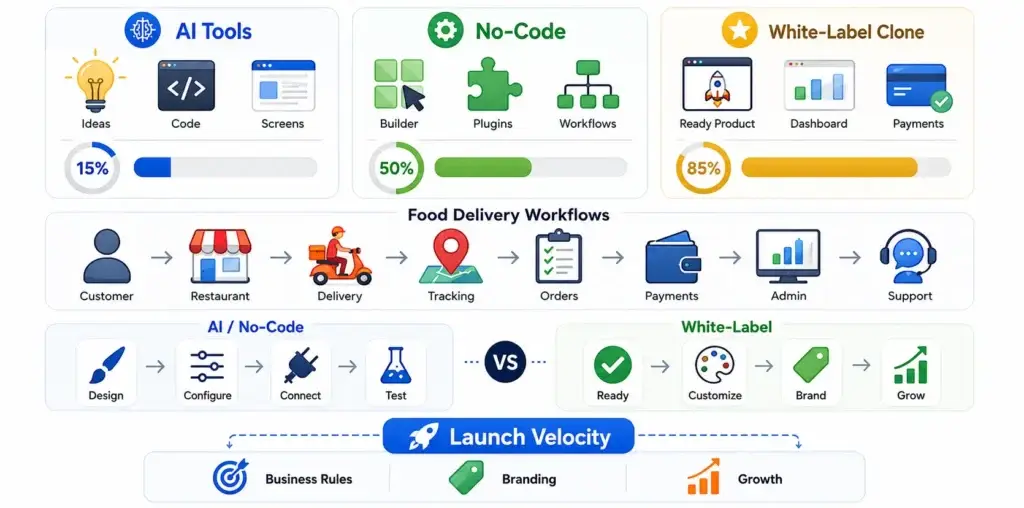
Image Source: AI-generated visual by Miracuves
The Feature Completion Baseline is the percentage of core product functionality that exists before customization begins.
Think of it like this:
- If you use an AI tool, your baseline may start with ideas, code snippets, screens, or generated modules.
- If you use no-code, your baseline may start with a visual builder, plugins, templates, and workflow tools.
- If you use a white-label clone, your baseline starts with a working product category already structured around known user flows.
This distinction is important because startup teams often underestimate hidden development work.
For example, a founder building a food delivery platform may think the product is simple:
Customer chooses food. Restaurant accepts order. Delivery partner delivers. Customer pays.
But the operational system is much deeper:
- Customer registration
- Restaurant onboarding
- Menu management
- Delivery partner registration
- Location tracking
- Order assignment
- Order status updates
- Payment gateway integration
- Commission logic
- Promo codes
- Ratings and reviews
- Cancellation rules
- Refund workflows
- Admin dashboard
- Reporting
- Support and dispute handling
In a no-code or AI-first path, each of these has to be designed, generated, configured, connected, and tested.
In a white-label clone path, these workflows already exist as part of the selected product model. The founder can spend more time on business rules, branding, market positioning, and growth instead of basic product plumbing.
That is the real launch velocity advantage.
AI Tools: Fast Generation, But Prompt-Heavy Completion
Generative AI tools are powerful. They can help founders write code, generate landing pages, create UI concepts, draft product requirements, debug errors, and explore technical possibilities quickly.
For early ideation, AI tools are excellent.
They help founders move from “I have an idea” to “I can see something on screen” faster than almost any previous technology shift.
But AI generation has a hidden workload: precision.
A founder must explain the product in enough detail for the AI tool to generate something useful. When the product is simple, this works well. When the product has multiple user roles, business rules, payment conditions, admin permissions, and exception handling, the prompt burden grows.
A founder may need to specify:
- User roles
- Screen behavior
- Database structure
- Payment logic
- Notifications
- Security rules
- Error handling
- API behavior
- Admin permissions
- Business workflows
- Edge cases
- Deployment requirements
The product may look impressive early, but production readiness requires testing and refinement.
AI tools are strongest when the founder knows what to ask for. They are weaker when the founder expects the tool to discover the entire product architecture alone.
For technical founders, AI can compress development time. For non-technical operators, AI can create momentum but also confusion. The founder may not know whether the generated code is scalable, secure, maintainable, or complete.
That does not make AI a bad choice. It makes AI a tool, not a finished product strategy.
Best use cases for AI tools:
- Landing pages
- Simple web apps
- Internal admin tools
- Early prototypes
- Product requirement drafts
- Code assistance
- UI experiments
- Feature ideation
- Technical documentation
- Simple automation workflows
Where AI tools can struggle:
- Multi-role marketplaces
- Payment-heavy systems
- Location-based apps
- Fintech workflows
- Complex booking engines
- Delivery dispatch logic
- Advanced admin dashboards
- User-generated content moderation
- Production-grade security planning
- Long-term maintainability
Founder takeaway:
AI helps you move faster when you already understand the product. It does not automatically remove product architecture work.
No-Code Platforms: Visual Control, But Configuration Takes Time
No-code and low-code platforms are useful because they reduce the need to write code from scratch. They give founders visual tools to create screens, databases, workflows, and integrations.
For non-technical founders, this can feel empowering. You can drag elements, create pages, define data, build conditional flows, and publish without managing a traditional engineering team.
But no-code does not remove product work. It changes the form of product work.
Instead of writing code, the founder configures logic visually.
That still requires decisions:
- What data should be stored?
- Which users can access which screens?
- What happens after each button click?
- How are payments confirmed?
- How are notifications triggered?
- How should admins approve or reject users?
- What happens when an order, booking, or listing changes status?
- Which edge cases need fallback workflows?
The challenge is not that no-code is slow. The challenge is that visual configuration still takes time, especially for products with many roles.
A simple booking form may be easy. A complete marketplace with users, providers, payments, schedules, reviews, disputes, and admin control is a different problem.
No-code platforms work best when the founder has patience, structured thinking, and a product that fits the platform’s strengths.
Best use cases for no-code platforms:
- Directories
- SaaS dashboards
- Internal tools
- Simple marketplaces
- Booking workflows
- Form-based products
- Early validation apps
- Community platforms
- Lightweight ecommerce experiments
Where no-code can become difficult:
- Complex multi-role workflows
- Heavy custom logic
- Deep backend customization
- Advanced mobile performance requirements
- Large-scale marketplace operations
- Source code ownership needs
- Complex compliance workflows
- Real-time dispatch or location-heavy apps
- Highly differentiated product architecture
Founder takeaway:
No-code gives non-technical founders more control, but it still requires weeks of visual product assembly for complex apps.
Pre-Built Clone Apps: The Strongest Feature Completion Baseline
Pre-built clone apps solve a different problem.
They are not blank builders. They are not prompt engines. They are product foundations.
A clone app does not mean copying another brand blindly. In a serious startup context, it means using a proven product structure as a launch-ready foundation and customizing it for a specific market, brand, audience, and monetization strategy.
This is why white-label clone apps are useful for founders who want to move faster.
A TikTok-style platform already needs creator profiles, uploads, feeds, likes, comments, discovery, moderation, and admin control.
A ride-hailing platform already needs riders, drivers, booking flows, location logic, fare handling, trip status, ratings, and admin oversight.
A food delivery platform already needs customers, restaurants, delivery partners, menus, orders, payments, tracking, commissions, and support workflows.
A rental marketplace already needs hosts, guests, listings, calendars, bookings, payments, reviews, and disputes.
Instead of spending weeks or months assembling these basics, the founder starts closer to launch.
Miracuves’ white-label clone approach is built around this idea: help founders move from concept to a branded, customizable, source-code-owned product foundation faster. This is especially useful when the founder’s real differentiation is not the basic workflow but the market, niche, pricing, operations, supply, brand, and go-to-market strategy.
Extraction Table: Feature Completion by Product Layer
| Product Layer | AI Tools | No-Code Platforms | Miracuves White-Label Clones |
| User app screens | Can generate or assist, but needs review | Built visually, often screen by screen | Already available within selected app scope |
| Admin dashboard | Must be specified and built | Must be configured | Included in the app foundation where relevant |
| Role-based workflows | Needs detailed prompting and logic checks | Requires visual workflow setup | Already mapped for category-specific roles |
| Payment flow | Needs integration planning and testing | Requires plugin or integration setup | Can be integrated/customized based on scope |
| Notifications | Must be generated or integrated | Must be configured | Typically part of app workflow planning |
| Listings/catalogs | Needs database and UI structure | Requires setup and linking | Already available in marketplace/product clone models |
| Reviews/ratings | Must be generated and tested | Requires workflow configuration | Commonly included for marketplace and service models |
| Tracking/status logic | Requires precise architecture | Complex to configure for real-time use cases | Built into delivery, mobility, and booking categories where relevant |
| Monetization settings | Must be designed | Must be configured | Can support commissions, subscriptions, fees, ads, or other models depending on solution type |
| Branding | Needs UI updates | Configurable | White-label branding-ready |
| Source code ownership | Depends on tool and export setup | Depends on platform | Positioned as source-code-owned when included in Miracuves scope |
| Launch readiness | Depends on completeness and testing | Depends on configuration depth | Faster because core foundation already exists |
This table shows why founders should be careful with surface-level speed claims.
A tool can create quickly. A platform can configure quickly. But a complete app business needs more than screens.
It needs finished workflows.
Read More: The Auto-Commit Disaster: Managing Git Conflicts in AI-Generated Repos
The Strategic Choice for Non-Technical Operators
Non-technical founders often face a difficult tradeoff.
They want control, but they do not want to spend months learning product architecture. They want speed, but they do not want a fragile app. They want cost efficiency, but they also want a system that can support real users.
That is why the right decision depends on the founder’s operating profile.
Choose AI tools when:
- You are technical or semi-technical.
- You understand how to review generated output.
- You are building a simple product.
- You want to experiment quickly.
- You can handle debugging and iteration.
- You are comfortable managing code, prompts, and deployment decisions.
Choose no-code when:
- You want visual control.
- Your product has moderate complexity.
- You can spend time learning the builder.
- You are comfortable configuring workflows.
- You do not need deep custom backend control early.
- You want to validate a simpler app before investing more.
Choose a pre-built clone when:
- You want a complete product foundation faster.
- Your app follows a known business model.
- You need user, provider, vendor, driver, merchant, creator, or admin workflows.
- You want white-label branding.
- You want source-code ownership.
- You want to reduce early product development lag.
- You are more focused on market validation than tool experimentation.
For founders launching marketplaces, delivery platforms, ride-hailing apps, fintech products, social apps, rental platforms, or creator platforms, the white-label route can be more practical because the product structure is already known.
The founder’s energy can shift from “How do I build this?” to “How do I position, launch, sell, and operate this?”
That is a better use of early-stage time.
Founder Decision Signals
Use these signals before choosing your stack.
| Decision Signal | What It Means | Best-Fit Path |
| You need a demo this week | You need something visual and interactive for feedback | AI tools or white-label clone, depending on complexity |
| You want to build everything yourself | You are comfortable learning the system deeply | No-code |
| You need a full marketplace | You need multi-role workflows and admin control | Pre-built clone |
| You have technical review ability | You can inspect and fix generated output | AI tools |
| You need source code ownership | You want long-term control over the product foundation | White-label clone or custom development |
| You are validating a known app model | The business model already exists in another market/category | Pre-built clone |
| You need deep differentiation from day one | Your product logic is highly unique | Custom development or AI-assisted custom build |
| You need faster market entry | You want to reduce product assembly time | Pre-built white-label clone |
Why Pre-Built Does Not Mean Generic
Some founders worry that a clone app will make their startup feel generic.
That only happens when the founder treats the clone as the final product instead of the foundation.
The smarter approach is to use the pre-built system for speed and customize the business layer for differentiation.
Differentiation can come from:
- Niche audience
- Local market focus
- Better supply onboarding
- Better pricing model
- Stronger trust and verification
- Better operational support
- Superior content strategy
- Specific vertical features
- Branding and user experience
- Community-led growth
- Partner integrations
- Monetization strategy
For example, a rental marketplace foundation can become a boat rental app, luxury stay platform, equipment rental marketplace, student housing platform, or event space booking app. The core mechanics may be similar, but the market strategy changes everything.
A delivery app foundation can become a food delivery platform, grocery app, pharmacy delivery app, courier app, or hyperlocal quick commerce product.
A creator platform foundation can become a short video app, fan community, niche content network, education creator app, or local creator marketplace.
The point is not to copy. The point is to avoid rebuilding common infrastructure that does not need to be reinvented.
That is where Miracuves’ ready-made app approach helps founders move faster while still allowing customization around brand, workflow, modules, and business model.
Cost Logic: What You Are Really Paying For
Founders often compare AI, no-code, and pre-built clones only by subscription or development cost. That is too narrow.
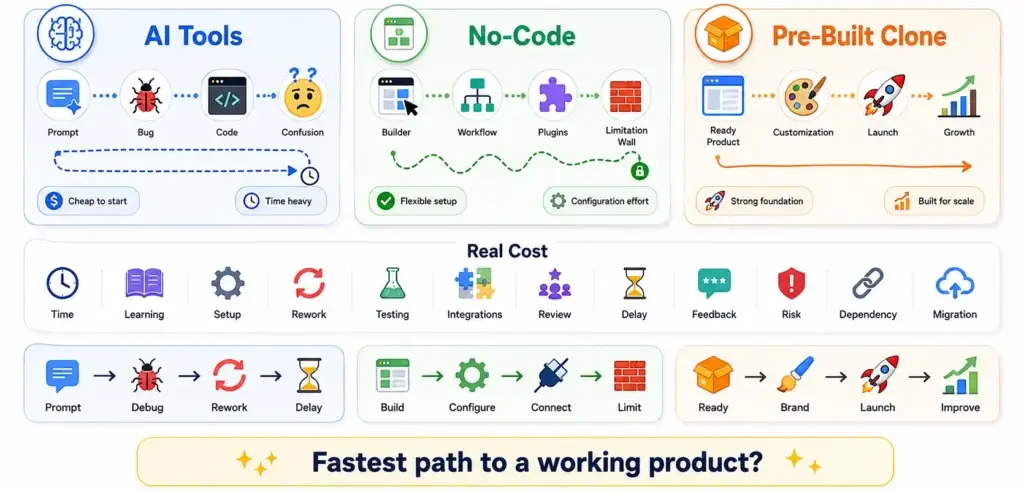
The real cost includes:
- Founder time
- Learning curve
- Configuration effort
- Rework
- Testing
- Integrations
- Technical review
- Missed launch windows
- Delayed user feedback
- Product uncertainty
- Vendor dependency
- Future migration cost
AI tools may look inexpensive at the start, but if a non-technical founder spends weeks prompting, debugging, and trying to understand broken workflows, the real cost increases.
No-code platforms may look affordable, but if the founder spends weeks configuring logic and later hits platform limits, the cost includes both time and restructuring.
Pre-built clones may require more upfront commitment than a simple no-code subscription, but they can reduce product assembly time because the foundation already exists.
The founder’s real question should be:
What is the fastest path to a working product that I can control, brand, test, and improve?
Pricing for Miracuves solutions depends on selected features, integrations, tech stack, customization, and launch scope. Founders should ask Miracuves for the latest quote based on the selected product model and business requirements.
Common Mistakes Founders Make When Choosing a Stack
Mistake 1: Choosing the tool before defining the product system
A founder may choose AI or no-code because it feels fast, then later realize the product needs admin roles, payments, approvals, disputes, tracking, and verification. The right stack should match the product’s operational complexity.
Mistake 2: Confusing prototype speed with launch readiness
A clickable demo is not the same as a working app business. Launch readiness means users can complete real workflows and admins can control the system.
Mistake 3: Underestimating admin dashboard complexity
Most founders focus on the customer-facing app. But the admin panel is where the business actually operates. Without strong admin control, the founder cannot manage users, payments, listings, vendors, orders, disputes, reports, or abuse effectively.
Mistake 4: Ignoring source code ownership
Early convenience can become long-term dependency. If the founder plans to scale, customize deeply, or raise investment, source-code ownership can become strategically important.
Mistake 5: Building from zero when the product model is already proven
If the app follows a known model, rebuilding every core workflow from scratch may delay market validation. A ready-made foundation lets the founder spend more time on positioning, operations, and growth.
Miracuves Perspective: Start With the Right Baseline
The strongest startup stack is not always the newest tool. It is the path that gives the founder the right baseline for the business they are trying to launch.
AI tools are excellent for ideation and assisted development.
No-code platforms are useful for visual builders who want hands-on control.
Pre-built white-label clones are strongest when the founder wants a working product foundation faster, especially for known app categories with repeatable workflows.
Miracuves helps founders, startups, agencies, and businesses launch ready-made clone app solutions with white-label branding, source-code ownership, admin dashboards, and customization support. For ready-made solutions where applicable, Miracuves can support a 6-day launch path, depending on selected modules and final customization scope.
The strategic advantage is simple:
You do not start from a blank page. You start from a product foundation that already understands the category.
Final Recommendation: Match the Stack to Your Launch Risk
If your biggest risk is “Can I create a quick prototype?” AI tools may be enough.
If your biggest risk is “Can I visually build and control my first version?” no-code may be enough.
If your biggest risk is “Can I launch a complete app business without losing months to product assembly?” a pre-built white-label clone is the stronger option.
Founders should not choose based on hype. They should choose based on feature completion, operational control, ownership, and launch urgency.
For non-technical operators, the fastest path is often not the tool that creates the first screen fastest. It is the path that gets the entire product system closest to completion before work begins.
That is where Miracuves’ white-label clone app model creates leverage.
It helps founders skip the slowest part of early product development and move closer to the real work: validating demand, onboarding users, building supply, improving operations, and growing the business.
If you are comparing AI tools, no-code platforms, and pre-built clone apps, start with the feature completion question. Miracuves can help you identify whether your idea is better suited for a ready-made white-label clone, a customized app foundation, or a more flexible development path.
FAQs
Are AI app builders better than no-code platforms for startups?
AI app builders are useful for quick generation, code assistance, and early prototypes. No-code platforms are better when founders want visual control over screens, data, and workflows. For complex startup apps, both paths still require product planning, testing, integrations, and refinement.
What is the fastest way for a non-technical founder to launch an app?
For a simple app, AI tools or no-code platforms may be fast enough. For a multi-role app such as food delivery, ride-hailing, marketplace, rental, fintech, or creator platform, a pre-built white-label clone can be faster because the core workflows are already available within the selected solution scope.
What is the Feature Completion Baseline?
The Feature Completion Baseline measures how much of the product is already complete before customization begins. AI tools start with generation, no-code starts with visual configuration, and pre-built clones start with a ready-made product foundation.
Do no-code platforms remove the need for development work?
No. No-code platforms reduce the need to write code manually, but founders still need to configure screens, databases, workflows, payments, permissions, and integrations. For complex apps, this configuration can take significant time.
Are pre-built clone apps only for copying existing platforms?
No. A clone app should be used as a product foundation, not as a blind copy. Founders can customize branding, workflows, features, monetization, niche positioning, and market strategy while avoiding the need to rebuild common app infrastructure from zero.
Why does source code ownership matter for startup apps?
Source code ownership gives founders more control over customization, scaling, migration, and long-term product direction. It can be important when the business needs deeper flexibility beyond a closed platform or subscription-based builder.
When should a founder choose custom development instead?
Custom development is better when the product has highly unique logic, deep technical differentiation, unusual workflows, or complex integrations that do not fit existing product models. For known app categories, a ready-made foundation may be a faster first step.
How can Miracuves help founders choose the right development path?
Miracuves can review the app idea, business model, feature scope, and launch urgency to suggest whether a ready-made clone, white-label solution, or custom development path is more suitable.
Miracuves is an independent software development company. We are not affiliated with, connected to, sponsored by, or endorsed by any company or product named in this article.
Terms such as “X Clone” are used descriptively. It is how the software industry refers to building a platform with functionality comparable to a known service, and how clients search for it.
The entire design and codebase of our products is built by our own team. Our products contain no code, design, graphics, or content originating from any third-party website or applications.
All third-party names and marks referenced in this article are the property of their respective owners, referenced solely to identify the services discussed.