Key Takeaways
- A broken AI app costs more than developer repair hours.
- Failed onboarding, weak AI output, and crashes drain launch momentum.
- Paid traffic becomes wasted spend when the product cannot convert.
- Every failed session gives competitors a chance to capture users.
- A white-label AI foundation can reduce market-share bleed.
Market-Share Bleed Signals
- Track burned ad spend from traffic hitting broken flows.
- Measure lost signups, failed activations, and abandoned trials.
- Review AI response quality, latency, and usage failures.
- Calculate competitor capture and future reacquisition cost.
- Compare daily repair cost against relaunch speed.
Real Insights
- Your competitor does not wait while you debug.
- AI product trust breaks faster when output feels unreliable.
- More ads only increase losses when activation is broken.
- Repair mode becomes risky when the foundation keeps failing.
- Miracuves builds white-label AI app foundations with admin control and source-code ownership.
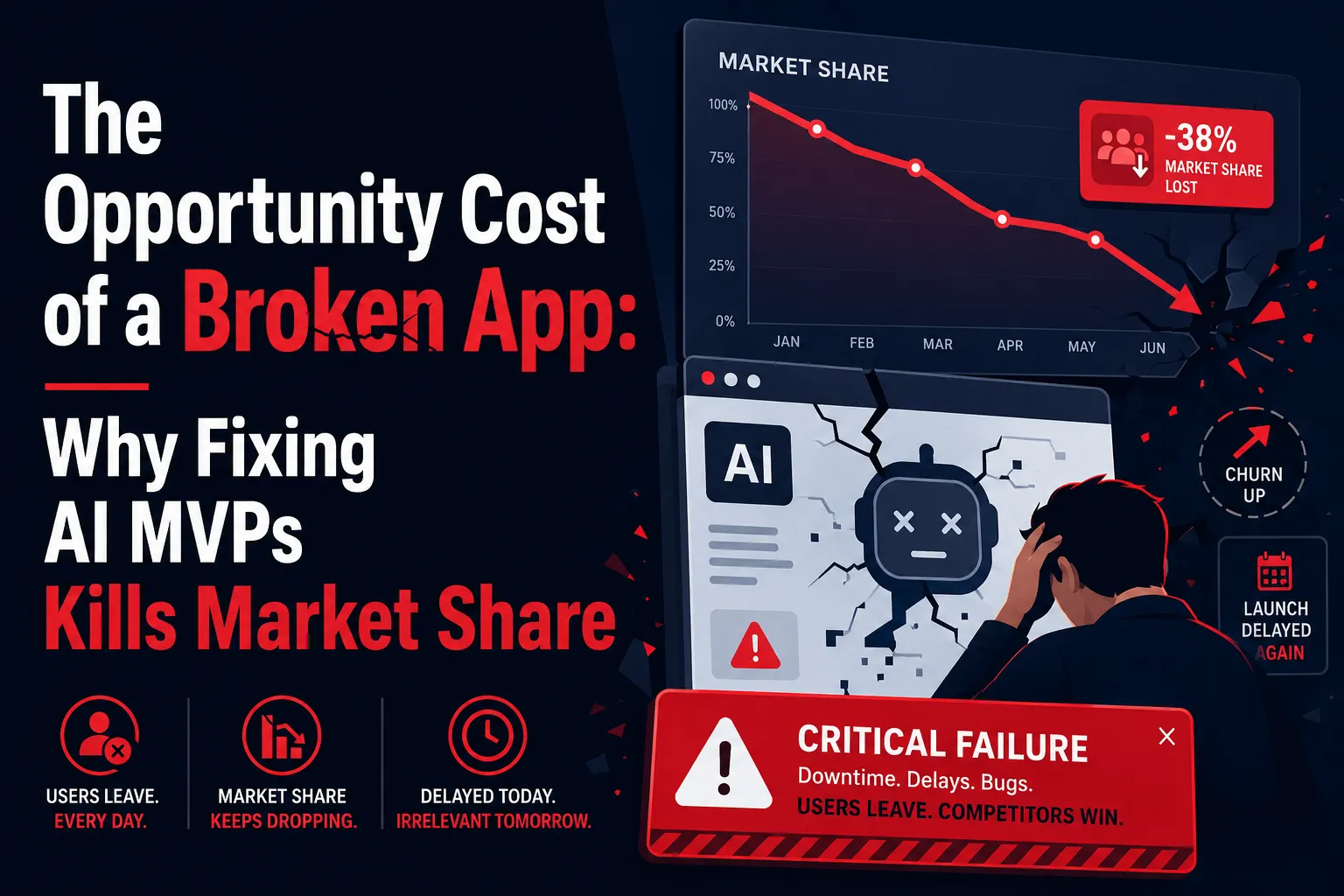
Most founders calculate development cost before launch. Very few calculate the cost of a failing launch after users, ads, influencers, investors, early customers, and competitors are already watching.
That is where the real damage begins.
When your AI app is down for maintenance, showing errors, producing poor responses, breaking during onboarding, or failing under real user traffic, the cost is no longer limited to developer hours. You are paying for lost trust, wasted traffic, abandoned signups, negative first impressions, and competitor advantage.
For founders in AI, this is especially dangerous. The market is crowded, user patience is low, and competitors can capture attention quickly. If your app fails while a competitor’s product works, the user does not wait for your bug fix. They move.
That is why the real question is not, “Can we fix this AI MVP?”
The sharper question is:
“How much market share are we bleeding every day while we try?”
Miracuves helps founders avoid that bleed with ready-made and white-label AI app solutions that can be branded, customized, and deployed faster than building everything again from zero. For founders already stuck in repair mode, the goal is not perfectionism. The goal is recovery.
The Real Problem Is Not a Broken AI MVP. It Is Market-Share Bleed.
Market-Share Bleed Formula
| Loss Variable | How to Calculate It | Founder Impact |
|---|---|---|
| Burned Ad Spend | Daily ad spend × percentage of traffic affected by product failure | Shows how much acquisition budget is being wasted on a weak product experience. |
| Lost Revenue | Lost users × expected conversion rate × average revenue per user | Shows how much money the app could have earned if users reached value successfully. |
| Reputation Damage | Negative experiences × estimated recovery cost per user | Shows how much trust the founder may need to rebuild after a poor launch. |
| Competitor Capture Cost | Lost qualified users × future reacquisition cost | Shows the cost of winning back users who moved to another product. |
| Developer Repair Cost | Developer hours × hourly cost + QA cost + delay cost | Shows the direct technical cost of staying in repair mode. |
A broken AI MVP feels like a technical problem on the surface.
The login flow fails.
The chatbot response is slow.
The AI output is inconsistent.
The payment flow breaks.
The admin panel cannot track usage properly.
The product crashes during demo calls.
But for a founder, these are not just bugs. They are business leaks.
Every hour your app underperforms, users are forming opinions. Every failed session weakens confidence. Every broken workflow reduces the chance that a visitor becomes a paying customer. Every delay gives competitors more room to capture the same demand.
This is the part most startup failure content ignores. Founders do not lose because they had one bug. They lose because the market keeps moving while they are stuck debugging.
A broken AI app affects four business layers at once:
| Business Layer | What Breaks | Founder Impact |
|---|---|---|
| Acquisition | Paid traffic lands on a weak product | Marketing budget gets wasted |
| Activation | Users cannot complete the first useful action | Signups fail to convert |
| Trust | AI output feels unreliable or unstable | Users doubt the product |
| Competitive Position | Competitors keep serving the same market | Market share shifts away |
The painful part is that founders usually notice the development issue first, but the market-share loss is already happening silently.
Read More: The Auto-Commit Disaster: Managing Git Conflicts in AI-Generated Repos
The True Cost of Downtime: Burning Ad Spend on a Failing UI
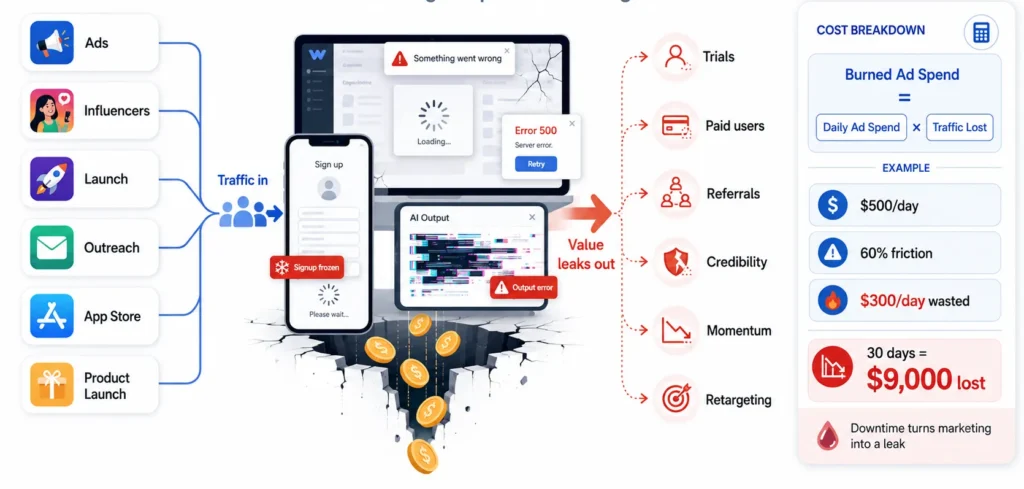
Image Source: AI-generated visual by Miracuves
Paid marketing makes a broken AI MVP more expensive.
If you are running ads, influencer campaigns, launch posts, cold outreach, App Store campaigns, or Product Hunt-style promotions, every click matters. But when traffic lands on a failing UI, you are not buying growth. You are buying disappointment.
Let’s say a founder spends money to bring users into an AI writing tool, AI chatbot, AI assistant, AI image platform, or AI productivity app. The user arrives with intent. They want to test the promise. They expect fast onboarding and a clear result.
Then the app fails.
Maybe the signup form freezes. Maybe the AI takes too long to respond. Maybe the output is irrelevant. Maybe the app looks unfinished. Maybe the dashboard throws an error. Maybe the user pays and cannot access the feature.
That ad click is gone.
But the loss is bigger than the click cost. The founder also loses:
- The potential trial signup
- The chance of a paid conversion
- The retargeting value of a satisfied visitor
- The possibility of referral sharing
- The credibility of the campaign
- The momentum of the launch window
A failing UI turns marketing into a leak.
Here is the simple formula:
Daily Burned Ad Spend = Daily Ad Spend × Percentage of Traffic Lost Due to Product Failure
Example:
If a founder spends $500 per day on launch traffic and 60% of visitors experience friction because the AI MVP is unstable, the burned ad spend is:
$500 × 60% = $300 per day wasted
That may not sound fatal for one day. But over 30 days, that becomes:
$300 × 30 = $9,000 in wasted acquisition spend
And that does not include lost revenue, support load, refund requests, negative comments, or competitor migration.
This is why founders must stop treating broken app performance as a small technical delay. If marketing has started, every product issue has a revenue consequence.
Calculating Lost Revenue While Your AI App Is Under Maintenance
Lost revenue is not only the money users failed to pay today.
It is also the revenue they would have generated over time if they had activated properly.
For AI apps, this matters because monetization often depends on repeat usage. A user may start with a free trial, upgrade to a monthly plan, buy credits, unlock premium AI responses, purchase document processing, or subscribe to team access.
If the first experience fails, the founder loses the first transaction and the future value.
Use this formula:
Daily Lost Revenue = Lost Signups × Expected Conversion Rate × Average Revenue Per User
Example:
Assume your AI app receives 1,000 visitors per day.
Because the product is unstable:
- 400 users abandon before signup
- 200 users fail during onboarding
- 100 users test the AI but do not trust the output
That means 700 users are either lost or weakened before monetization.
If only 5% of those users would have converted and your average first-month revenue is $20:
700 × 5% × $20 = $700 daily revenue loss
Over 30 days:
$700 × 30 = $21,000 lost first-month revenue
Now add lifetime value. If those users could have stayed for three months, six months, or longer, the real loss grows quickly.
This is the founder’s uncomfortable truth:
A broken AI MVP does not just delay revenue. It deletes revenue that was already within reach.
Reputation Damage: The Cost Founders Rarely Put in the Spreadsheet
Reputation damage is harder to calculate, but it can be more dangerous than lost ad spend.
A user who sees a normal app bug may think, “This product needs work.”
A user who sees a broken AI app may think, “This product is not intelligent, not safe, not reliable, and not worth trusting.”
That reaction is more severe because AI products make a promise of intelligence. Users expect the app to understand intent, respond quickly, generate useful output, and handle data responsibly. When the app fails, the user does not only blame the interface. They question the entire product idea.
Reputation damage appears in many forms:
- Lower conversion rates after early bad reviews
- More refund requests
- Lower demo-to-close rates
- Reduced investor confidence
- Negative social comments
- Poor App Store or review platform signals
- Higher customer support burden
- Lower willingness to share or refer the product
For early-stage founders, reputation is not a soft metric. It is launch currency.
A clean first impression can compound. A failed first impression can follow the product into every future campaign.
Read More: The Migration Disaster: How a Simple AI Prompt Deleted a Production Database
Why AI App Bugs Hurt More Than Normal App Bugs
AI app bugs are different because they affect trust at the intelligence layer.
In a normal marketplace, delivery, booking, or ecommerce app, users may tolerate a small UI issue if the core transaction still works.
In an AI app, the core product is often the response itself.
If the AI gives weak answers, hallucinates, forgets context, exposes poor prompt handling, delays responses, or breaks during multi-step tasks, users immediately question whether the product can be trusted for real work.
Common AI launch failures include:
| AI App Failure | User Reaction | Business Risk |
| Slow response time | “This is not usable.” | Low retention |
| Poor output quality | “The AI is not smart enough.” | Weak conversion |
| Broken chat history | “I cannot rely on this.” | Low repeat usage |
| Failed file upload | “This cannot handle my workflow.” | Lost premium users |
| Payment-access mismatch | “This feels risky.” | Refunds and disputes |
| No admin visibility | “The team cannot manage usage.” | Operational blind spots |
| Weak guardrails | “This may be unsafe.” | Trust and compliance concerns |
This is why AI founders need more than a demo that works once. They need a product foundation that can handle real users, real sessions, real usage patterns, and real business pressure.
The Market-Share Bleed Formula Founders Should Use
Founders need a simple way to calculate whether they should keep fixing the broken MVP or switch to a stronger deployment base.
Use this formula:
Market-Share Bleed = Burned Ad Spend + Lost Revenue + Reputation Damage + Competitor Capture Cost + Developer Repair Cost
Let’s break it down.
1. Burned Ad Spend
This is the money spent sending users to an app that cannot convert them.
Formula:
Daily Ad Spend × Failure-Affected Traffic %
2. Lost Revenue
This is the revenue you could have earned if the app worked correctly.
Formula:
Lost Users × Expected Conversion Rate × Average Revenue Per User
3. Reputation Damage
This is the decline in trust caused by poor first impressions.
Formula:
Negative Experiences × Estimated Recovery Cost Per User
Recovery cost may include retargeting, support time, discounts, founder calls, refund handling, or brand rebuilding.
4. Competitor Capture Cost
This is the cost of winning back users who moved to a competitor during your downtime.
Formula:
Lost Qualified Users × Future Reacquisition Cost
If you originally paid $5 to acquire a user, winning them back later may cost more because they already have another solution.
5. Developer Repair Cost
This is the direct cost of fixing the unstable product.
Formula:
Developer Hours × Hourly Cost + QA Cost + Delay Cost
The mistake founders make is looking only at developer repair cost.
But in a live or semi-live launch, the real cost is much wider.
Cost Analysis Example: 30 Days of Repair Mode
Here is a practical scenario.
A founder launches an AI assistant app with a small paid campaign. The product is not completely broken, but it is unstable enough to damage conversion.
Assumptions:
- Daily visitors: 1,000
- Daily ad spend: $500
- Percentage of traffic affected by glitches: 60%
- Lost users due to poor experience: 700 per day
- Expected conversion rate: 5%
- Average first-month revenue per user: $20
- Daily developer repair cost: $300
- Estimated daily reputation recovery cost: $200
- Estimated competitor capture cost: $250 per day
| Loss Category | Daily Cost | 30-Day Cost |
| Burned ad spend | $300 | $9,000 |
| Lost revenue | $700 | $21,000 |
| Developer repair cost | $300 | $9,000 |
| Reputation recovery cost | $200 | $6,000 |
| Competitor capture cost | $250 | $7,500 |
| Total Market-Share Bleed | $1,750/day | $52,500/month |
This is a sample model, not a universal price claim. Your actual numbers depend on traffic, conversion rate, pricing, ad spend, user intent, and product category.
But the logic is clear.
If your broken AI MVP is costing you thousands every week, the question is no longer, “Can we keep fixing it?”
The question becomes, “Why are we still letting the market bleed?”
Read More: Escaping the Prompt Loop: How to Debug and Extract Logic from Cursor Builds
Fixing Versus Replacing: When Repair Mode Becomes a Growth Trap
Not every broken AI MVP should be abandoned.
Some products only need focused fixes:
- A better onboarding flow
- Payment integration correction
- Prompt improvement
- Latency optimization
- API usage monitoring
- UI cleanup
- Admin dashboard improvement
But repair mode becomes dangerous when the foundation is unstable.
Warning signs include:
- Every fix creates a new bug
- The app works in demo but fails with real users
- Developers cannot explain the root cause clearly
- The AI workflow lacks proper logging or monitoring
- The backend cannot handle expected traffic
- The admin panel does not show user behavior
- Payment, access, and usage limits are not connected properly
- The founder has already delayed launch multiple times
- Marketing is live but conversion data is unreliable
At that point, patching becomes a trap.
You are not improving the product. You are paying to preserve a weak foundation.
A founder should be honest about the difference between a fixable product and a failing base.
Ready-Made AI Clone Deployment Changes the Cost Equation
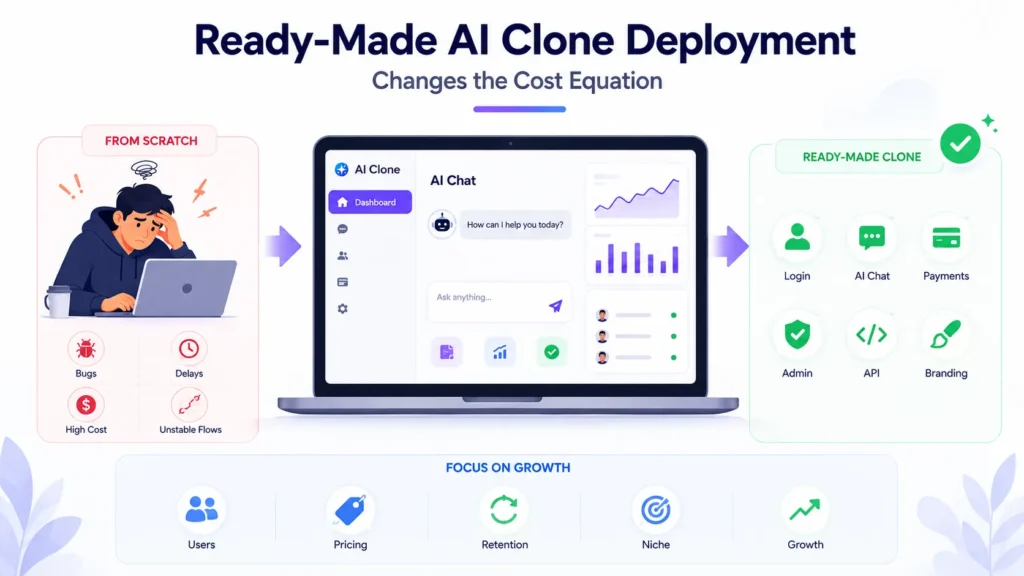
Image Source: AI-generated visual by Miracuves
A ready-made AI clone app changes the founder’s decision from “How long will it take to rebuild?” to “How fast can we relaunch with a working foundation?”
That shift matters.
With a white-label AI clone foundation, the founder does not start from a blank screen. Core flows can already exist, such as:
- User login and profile management
- AI chat or prompt interface
- Conversation history
- Subscription or credit-based monetization
- Admin dashboard
- User management
- API integration layer
- Usage controls
- Branding and theme customization
- Source-code handoff
- Web or mobile deployment path
This does not mean every business should use the same app. It means founders can start from a proven base and customize the business layer instead of rebuilding the plumbing from zero.
For AI founders, that can protect launch momentum.
Instead of spending weeks repairing unstable signup, dashboard, payment, AI response, and admin flows, a founder can focus on positioning, user acquisition, pricing, retention, niche workflows, and market capture.
That is where the real growth work happens.
Stopping the Bleed: Instant Market Capture via Miracuves Deployment
When a launch is already failing, speed becomes a survival variable.
Miracuves helps founders move faster with white-label AI and clone app solutions built for branded deployment, admin control, source-code ownership, and faster market validation.
For AI founders, relevant Miracuves paths include:
- Generative AI App Development for founders building LLM apps, AI agents, RAG assistants, copilots, and ChatGPT-style products.
- LLM App Development for product teams that need custom GPT-powered applications, RAG pipelines, and AI workflows.
- AI Agent Development for businesses automating support, sales, research, operations, or internal workflows.
- ChatGPT Clone App for founders who want a ready-made AI chatbot-style product foundation.
- Clone App Development for founders comparing ready-made platforms against custom development.
The point is not to copy another product blindly.
The smarter move is to use a proven app model as a launch-ready foundation, then customize it around your market, audience, pricing, workflow, AI use case, and brand.
If your current AI MVP is already damaging conversions, a Miracuves white-label clone deployment can help you stop the bleed and return to market with a stronger base.
Founder Decision Signals: When to Stop Patching and Relaunch
Founders often keep fixing because stopping feels like failure.
But in reality, switching from a broken foundation to a stronger deployment base can be a strategic recovery move.
Use these decision signals.
| Decision Signal | Keep Fixing If… | Relaunch With Ready-Made Foundation If… |
| Bug depth | Issues are isolated and easy to test | Bugs appear across multiple modules |
| Launch pressure | Marketing has not started yet | Ads, demos, or waitlist traffic are already active |
| User trust | Users are still completing core actions | Users abandon before value is delivered |
| Developer clarity | The team knows the root cause | The team keeps patching symptoms |
| Revenue impact | No serious conversion loss yet | Paid users, trials, or leads are being lost daily |
| Competitive pressure | The market is still open | Competitors are already capturing demand |
| Founder focus | Product work is strategic | Founder time is consumed by damage control |
The strongest founders are not the ones who stubbornly patch forever. They are the ones who protect market timing.
Mistakes Founders Should Avoid During a Broken AI Launch
Mistake 1: Spending More on Ads Before Fixing Activation
If users cannot experience value, more traffic only increases the loss. Fix the first-use journey before scaling acquisition.
Mistake 2: Treating AI Output Quality as a Minor Bug
For an AI product, output quality is the product. If users do not trust the response, they will not trust the platform.
Mistake 3: Ignoring Admin Control
Without admin visibility, founders cannot see where users fail, which prompts break, which subscriptions convert, or which accounts need support.
Mistake 4: Rebuilding Everything Custom Without Calculating Delay Cost
Custom rebuilding may be right for some products, but not when the market window is closing. Compare rebuild time against daily opportunity cost.
Mistake 5: Assuming Early Users Will Come Back Later
Some will. Many will not. First impressions matter more in crowded AI markets because users have alternatives.
Why Source-Code Ownership Matters After a Failed AI MVP
When an AI launch fails, founders need control.
They need to change flows, improve prompts, adjust pricing, add integrations, monitor usage, and scale infrastructure without being trapped by a vendor or no-code limitation.
Source-code ownership matters because it gives the founder long-term flexibility.
A source-code-owned AI app foundation can help with:
- Custom branding
- Workflow customization
- API replacement or expansion
- Model provider flexibility
- Security improvements
- Admin dashboard changes
- Usage tracking
- Monetization experiments
- Future feature development
- Technical handoff to an internal team
This is especially important when the first product attempt exposed weaknesses. The recovery product should not create a new lock-in problem.
Miracuves positions source-code ownership as part of the founder’s control layer, not just a technical deliverable.
The Business Case for Deploying a White-Label AI Clone
A white-label AI clone is not valuable because it is a shortcut.
It is valuable because it reduces avoidable delay in areas that are already known.
Founders do not need to reinvent login, dashboard, basic AI chat flow, subscription access, user management, admin control, and branding infrastructure every time. They need to differentiate where the market cares:
- The niche problem
- The AI workflow
- The user experience
- The pricing model
- The data layer
- The prompt strategy
- The customer acquisition engine
- The retention loop
- The brand trust
A ready-made app foundation gives founders more time to focus on those differentiators.
That is how a struggling AI founder moves from repair mode to market recovery.
Final Thoughts: Your Competitor Does Not Wait While You Debug
The cost of a broken AI MVP is not just the developer invoice.
It is the ad spend that does not convert.
The users who do not return.
The demos that lose confidence.
The reviews that weaken trust.
The competitors who capture demand while you are still fixing core flows.
Founders must stop measuring failure only in code issues. The real measurement is market-share bleed.
If your AI app is broken but your market is moving, every day matters.
The stronger decision may not be another patch cycle. It may be a clean relaunch with a ready-made, white-label, source-code-owned AI app foundation that lets you recover speed, regain trust, and compete again.
Miracuves helps founders move from broken launch to market-ready deployment with AI app development, white-label clone solutions, admin control, and faster execution.
When the market is already bleeding, the winning move is not to keep explaining the delay.
It is to stop the bleed.
If your AI MVP is costing you users, revenue, and launch momentum, talk to Miracuves about a white-label AI clone or custom AI deployment path.
FAQs
What is the opportunity cost of a broken AI MVP?
The opportunity cost of a broken AI MVP is the total value a founder loses while the product fails to convert users. It includes burned ad spend, lost revenue, user churn, reputation damage, support burden, and competitor capture.
Why does a broken AI app damage trust faster than a normal app?
A broken AI app damages trust faster because users expect intelligence, speed, accuracy, and reliability. If the AI output is poor or the workflow breaks, users question the entire product promise.
Should founders keep fixing a broken AI MVP?
Founders should keep fixing only if the issues are isolated, measurable, and easy to resolve. If every fix creates new bugs or the foundation fails under real users, a relaunch with a stronger app base may be more practical.
How do I calculate market-share bleed?
Use this formula: Market-Share Bleed = Burned Ad Spend + Lost Revenue + Reputation Damage + Competitor Capture Cost + Developer Repair Cost. This gives a clearer view of the true cost of staying in repair mode.
Can a white-label AI clone help recover a failed launch?
Yes, a white-label AI clone can help founders recover faster when the current app foundation is unstable. It provides a ready-made base that can be branded, customized, and improved for the target market.
What should an AI founder check before relaunching?
Founders should check onboarding, AI response quality, payment access, admin control, usage tracking, data security, API stability, user support flows, and monetization logic before relaunching.
Does Miracuves build AI clone apps?
Yes. Miracuves offers AI development services, LLM app development, AI agent development, and ChatGPT clone solutions for founders who want a faster route to launch with source-code ownership and branded deployment.
Is rebuilding from scratch better than using a ready-made AI app?
Rebuilding from scratch may be better for highly unique products with complex proprietary workflows. A ready-made AI app is often better when the founder needs faster validation, proven core flows, branding, admin control, and reduced launch delay.
Miracuves is an independent software development company. We are not affiliated with, connected to, sponsored by, or endorsed by any company or product named in this article.
Terms such as “X Clone” are used descriptively. It is how the software industry refers to building a platform with functionality comparable to a known service, and how clients search for it.
The entire design and codebase of our products is built by our own team. Our products contain no code, design, graphics, or content originating from any third-party website or applications.
All third-party names and marks referenced in this article are the property of their respective owners, referenced solely to identify the services discussed.