

Real-time microblogging platforms are often associated with fast updates, short opinions, breaking conversations, and quick reactions. That speed is still important. It is what makes a public conversation platform feel alive. But founders building the next generation of social publishing products should not think only in short posts. Users increasingly want spaces where they can react quickly, explain deeply, build credibility, publish original ideas, and keep their best content discoverable beyond the first few minutes of the feed.
This is where the relationship between short posts and long-form articles becomes important. Short posts help a platform move in real time. Long-form articles help a platform build depth, trust, and long-term value. A strong microblogging platform does not need to choose one format over the other. It needs a product structure where both formats support different user behaviors without creating clutter, confusion, or moderation risk.
For founders, this is more than a content-design decision. It affects user retention, creator monetization, feed quality, search visibility, moderation workload, profile value, notification logic, and the overall business model. If the platform only supports quick posts, creators may outgrow it. If the platform only supports long-form publishing, real-time engagement may feel slow. The stronger approach is to design a system where short posts drive immediacy and long-form articles build authority.
This guide explains how a real-time microblogging platform can support both formats, what product decisions matter, and how founders can think about content architecture before investing in development.
Key Takeaways
- Short posts create real-time energy, fast reactions, daily activity, and lightweight community participation.
- Long-form articles create depth, authority, search value, creator credibility, and stronger evergreen content.
- A scalable microblogging platform should separate quick publishing, thread-based discussion, and article publishing without making the user experience feel fragmented.
- Founders should design feed logic, profile structure, moderation workflows, analytics, and monetization around both content types from the beginning.
- Miracuves helps founders launch real-time social platform foundations faster with white-label branding, source-code ownership, admin control, and 6-day delivery where relevant.
Why Short Posts Still Matter in a Real-Time Microblogging Platform
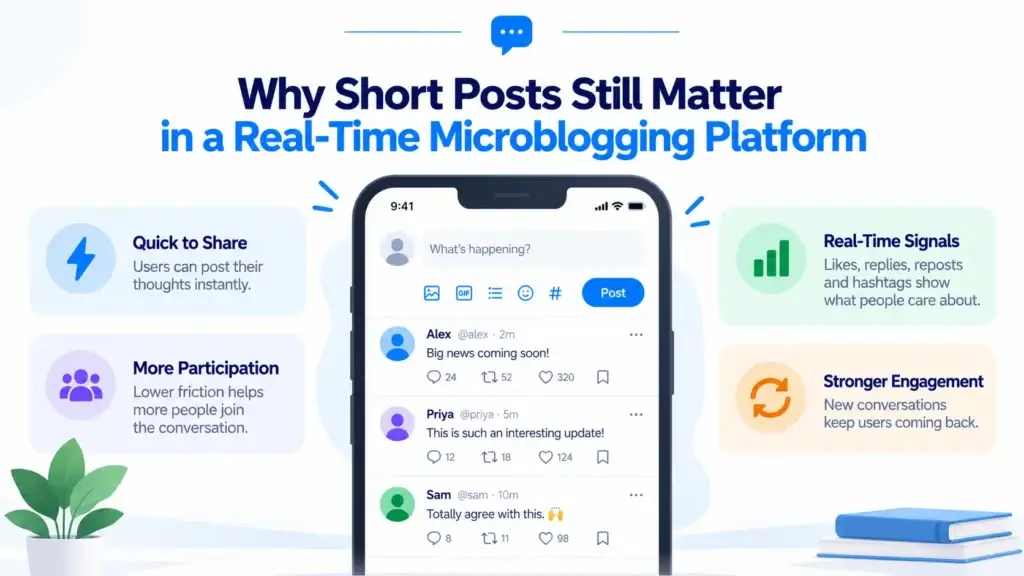
Short posts are the heartbeat of a real-time microblogging platform. They make the product feel active because users can publish quickly without planning a full article. A founder can share a product update, a journalist can post a developing story, a creator can react to an audience question, and a community member can join a conversation without needing to write a complete essay.
This low-friction publishing experience matters because participation is the hardest part of any social product. Users may be willing to read long content, but they are more likely to post when the action feels simple. A short-post composer reduces the mental barrier. The user does not need a title, structure, formatting, or full argument. They only need a thought worth sharing.
Short posts also help the platform understand what people care about in the moment. Likes, replies, reposts, bookmarks, follows, mutes, hashtags, mentions, and quick reactions become signals for the feed. These signals help the platform decide which topics are gaining attention, which creators are becoming relevant, and which conversations should surface to more users.
For platform operators, short posts create daily engagement loops. Users return because the conversation changes constantly. Every refresh can bring a new opinion, update, question, announcement, or response. That real-time quality is difficult to replicate with only long-form publishing.
Where Short Posts Create Business Value
Short posts are not valuable only because they are quick. They create business value because they increase publishing frequency, improve network effects, and keep the content graph active. A platform with frequent short posts has more signals for recommendations, more reasons for users to check notifications, and more opportunities for creators to stay visible between bigger content drops.
- Daily activity: Short posts give users a reason to return often.
- Conversation velocity: Replies and reposts help topics spread quickly.
- Creator visibility: Creators can stay active without producing full articles every day.
- Audience testing: Creators can test ideas before expanding them into longer content.
- Trend discovery: Operators can identify what topics are gaining traction across the network.
For a founder, this means short posts should be treated as a core product layer, not as a minor feature. The composer, feed, notification logic, profile layout, and moderation tools should all support fast publishing cleanly.
Why Long-Form Articles Are Becoming Important for Social Platforms
Short posts create movement, but they do not always create depth. A creator may need more space to explain a framework, share a detailed announcement, publish a research-backed opinion, document a founder journey, write a tutorial, or build thought leadership around a niche. If the platform does not support long-form publishing, those users may move their deeper content elsewhere and use the microblogging product only as a distribution channel.
That is a missed opportunity. Long-form articles can turn a real-time platform into a stronger publishing ecosystem. Instead of sending users away to read deeper content, the platform can keep the audience inside its own environment. This helps creators build authority and gives the platform more durable content that can be discovered later.
Long-form articles also support professional and niche communities. A finance community may need market analysis. A healthcare community may need detailed explainers. A developer community may need technical breakdowns. A founder network may need essays, launch notes, hiring posts, and investor updates. In each case, short posts are useful for conversation, but long-form content is useful for expertise.
Long-Form Content Helps a Platform Move Beyond the Feed
A feed is excellent for immediacy, but it is not always the best place for evergreen value. Posts disappear quickly as new content arrives. Long-form articles can have a longer shelf life when they are organized through profiles, topic pages, search, bookmarks, collections, and related content modules.
This matters because platform value should not depend only on what happened in the last hour. A strong social publishing product should also preserve the best thinking created by its community. If creators publish high-quality articles, guides, explainers, and essays, those assets can continue attracting attention long after the initial conversation ends.
From a commercial perspective, long-form publishing can improve creator retention. Serious creators want a place where their best content has structure, permanence, and discoverability. If your platform provides only short updates, creators may see it as a promotion channel. If it also supports articles, they may see it as a home base.
Short Posts vs Long-Form Articles: The Real Product Difference
The difference between short posts and long-form articles is not only word count. It is a difference in user intent, discovery behavior, interface design, moderation workflow, and monetization potential. A short post is usually written for immediacy. A long-form article is usually written for explanation, authority, or long-term reference.
If a founder treats both formats the same, the product experience can become messy. A 40-word post and a 2,000-word article should not always behave identically inside the feed. They may need different previews, reading states, analytics, sharing formats, notification triggers, and moderation rules.
Short Posts vs Long-Form Articles in a Microblogging Platform
| Content Format | Primary User Intent | Platform Value | Founder Consideration |
|---|---|---|---|
| Short Posts | Quick reaction, update, opinion, question, announcement, or conversation starter. | Creates real-time activity, frequent engagement, reply chains, and daily network movement. | Needs fast composer UX, feed ranking, notifications, moderation queues, and low-friction interaction. |
| Threads | Step-by-step explanation or extended thought broken into smaller connected posts. | Bridges quick posting with deeper storytelling while keeping the format conversational. | Needs clear thread navigation, numbering, collapse/expand behavior, and shareable thread views. |
| Long-Form Articles | Detailed explanation, opinion piece, guide, analysis, report, or creator essay. | Builds authority, evergreen discovery, profile depth, and stronger creator value. | Needs editor tools, drafts, formatting, article pages, reading analytics, SEO fields, and moderation depth. |
| Hybrid Posts | A short feed post that introduces or summarizes a longer article. | Connects real-time discovery with deeper content consumption. | Needs rich previews, article cards, click tracking, bookmarks, and related content suggestions. |
How Both Formats Can Work Together Without Confusing Users
The biggest product risk is not adding long-form articles. The risk is adding them without a clear content hierarchy. Users should instantly understand what they are seeing, why it appears in the feed, and what action they can take next. A short post should feel fast. A long-form article should feel readable. A thread should feel connected. A profile should organize all of them without becoming crowded.
A strong platform can solve this by designing separate but connected publishing paths. The user can start with a quick post, expand a thought into a thread, or publish a full article when the content needs structure. Each format should have its own purpose, but they should all connect back to the same account identity, follower graph, notification system, moderation layer, and analytics dashboard.
1. Use a Simple Composer for Short Posts
The short-post composer should be fast, visible, and easy to use. It should support text, media, mentions, hashtags, polls, links, and content warnings without overwhelming the user. The goal is to help users publish quickly while still giving operators enough control to manage safety and abuse.
For founders, the composer is one of the most important engagement surfaces in the product. If publishing feels difficult, the network becomes passive. If publishing feels natural, users contribute more frequently and the feed becomes more active.
2. Use Threads for Connected Thoughts
Threads are useful when a user wants more space but does not need a formal article. They allow creators to break a longer idea into connected posts while still keeping the rhythm of a real-time conversation. A thread can explain a product update, summarize a live event, share a story, or expand a viewpoint step by step.
From a product perspective, threads need clean navigation. Users should be able to read the full sequence, reply to a specific part, share the full thread, bookmark it, and understand where they are in the sequence. Without this structure, threads can feel messy and difficult to follow.
3. Use Long-Form Articles for Durable Knowledge
Articles should feel different from posts. They need titles, formatting, cover images, sections, embeds, drafts, preview modes, and possibly SEO fields if public discovery matters. They also need article pages that are easy to read, share, save, and discuss.
The article experience should not simply be a large text box inside the normal post feed. Long-form content deserves a reading environment. That means spacing, typography, table support, embedded media, author information, estimated reading time, related posts, and a comment or reply layer that does not distract from the main content.
4. Connect Articles Back to the Real-Time Feed
Long-form content should not live in isolation. When a creator publishes an article, the platform can automatically generate a feed post preview. This lets the article enter real-time discovery without forcing users to read the full piece immediately. The feed post can show the title, summary, cover image, author, reading time, topic, and engagement actions.
This hybrid model is powerful. It lets short-form discovery introduce long-form depth. Users can react quickly, bookmark for later, share the article, or open the full page when they have time. For creators, this means one long-form asset can generate multiple engagement moments.
How Feed Design Should Handle Short and Long Content
Feed design becomes more important when multiple content formats exist. A feed filled only with short posts can move quickly. A feed that includes long articles needs stronger layout decisions so users are not overwhelmed. The platform must balance speed, readability, and relevance.
The simplest approach is to show long-form articles as cards instead of full content blocks inside the feed. The card can include a strong preview and a clear call to read more. This keeps the feed lightweight while still giving long-form content visibility.
The feed should also understand user behavior. Some users prefer quick updates. Others prefer deeper reading. A real-time microblogging platform can use follows, bookmarks, dwell time, topic preferences, muted words, and engagement history to personalize how often article cards appear.
Feed Signals That Matter for Short Posts
- Replies and reply speed
- Reposts or shares
- Likes and quick reactions
- Mentions and hashtag activity
- Freshness of the post
- Relationship between viewer and author
- Conversation momentum
Feed Signals That Matter for Long-Form Articles
- Click-through rate from article cards
- Reading time and completion depth
- Bookmarks and saves
- Shares to external channels
- Quality of replies or comments
- Follower growth after reading
- Topic relevance and evergreen value
The mistake many founders make is measuring all content with the same engagement logic. A short post may succeed because it receives quick replies in five minutes. A long-form article may succeed because it is saved, read deeply, and shared over several days. Both are valuable, but they should not be evaluated the same way.
Profile Design: Where Short Posts and Long-Form Articles Become a Creator Portfolio
On a real-time microblogging platform, the profile is more than a bio page. It is the creator’s public identity, content archive, credibility layer, and monetization surface. If the platform supports both short posts and long-form articles, the profile should help visitors understand the creator quickly.
A clean profile can separate content into tabs or filters such as Posts, Replies, Articles, Media, Bookmarks, and Highlights. This matters because not every visitor has the same intent. Some want to see recent thoughts. Some want to read the creator’s best long-form work. Some want to check credibility before following, subscribing, or tipping.
For professional creators and niche experts, long-form articles can make the profile more valuable. A creator who publishes thoughtful analysis should not have that content buried under hundreds of short posts. The platform should allow pinned articles, featured posts, collections, and topic-based organization.
Founder Insight: Profiles Should Support Trust, Not Just Activity
A profile full of short posts shows activity. A profile that also includes structured articles shows expertise. When users are deciding whether to follow, subscribe, verify, or engage with a creator, that difference matters.
This is especially important for platforms built around professional communities, paid creator networks, regional experts, founders, analysts, educators, journalists, or association members. In those cases, the profile should function as a trust layer. Short posts show the creator is present. Articles show the creator has depth.
How Long-Form Articles Change Moderation Requirements
Moderating short posts is already complex because volume is high and conversations move quickly. Long-form articles add a different type of moderation challenge. They may include more claims, links, embedded media, screenshots, sensitive topics, or detailed arguments. A moderation system designed only for short posts may not be enough.
Founders should think about moderation before launching long-form publishing. The platform may need content warnings, reporting flows, review queues, blocked words, link checks, author-level restrictions, edit history, visibility controls, and audit logs. The longer the content, the more important context becomes.
For example, a short post may be removed quickly based on a clear violation. A long-form article may require deeper review because the issue could be in one section, one embedded link, or one claim inside a larger piece. The moderation workflow should allow reviewers to understand what was reported and why.
Useful Moderation Layers for Both Formats
- Content reporting: Users should be able to report posts, articles, profiles, replies, and messages.
- Review queues: Operators need a structured place to review reported content.
- Account status controls: Warnings, restrictions, suspensions, and reinstatements should be recorded clearly.
- Audit history: Admin actions should leave records so decisions can be reviewed later.
- Content warnings: Creators should have a way to label sensitive or restricted content where relevant.
- Visibility controls: Operators may need to reduce reach, hide content, or limit distribution without deleting everything immediately.
Moderation should not be treated as an afterthought. It directly affects trust, creator safety, advertiser confidence, paid membership value, and the platform’s long-term reputation.
Monetization: Why Supporting Both Formats Can Improve Revenue Options
Short posts and long-form articles can support different revenue models. Short posts are strong for engagement-based monetization, creator tipping, promoted updates, paid replies, sponsored conversations, and fast community interaction. Long-form articles are better suited for subscriptions, gated content, premium analysis, newsletters, member-only publishing, and expert-led communities.
This matters because early-stage social platforms often struggle when they depend only on advertising. A new platform may not have enough scale to make advertising meaningful at the beginning. But it may still have creators, experts, niche communities, or professional members who can create paid value through deeper content, direct support, premium access, or membership tiers.
A platform that supports both formats gives operators more room to test revenue models. Short posts keep the community active. Long-form articles give users something worth paying for, saving, sharing, or returning to. Together, they create a stronger monetization foundation than either format alone.
Content Format and Monetization Fit
| Revenue Model | Works Better With | Why It Fits | Platform Requirement |
|---|---|---|---|
| Creator Tips | Short posts and articles | Users can reward a quick insight or a detailed article. | Tip button, wallet/payment integration, creator records, transaction history. |
| Paid Subscriptions | Long-form articles | Readers are more likely to pay when creators publish deeper, recurring value. | Membership tiers, gated content, subscriber-only posts, access rules. |
| Promoted Posts | Short posts | Quick updates can be boosted into relevant feeds. | Promotion controls, targeting rules, budget settings, analytics. |
| Premium Communities | Both formats | Short posts support daily conversation while articles provide expert depth. | Private spaces, member access, content permissions, moderation tools. |
| Newsletter-Style Publishing | Long-form articles | Articles can be delivered to followers or paying members as recurring insight. | Article editor, email or in-app delivery, subscriber lists, scheduling. |
Miracuves supports this type of thinking through platform foundations that include social publishing, admin control, source-code ownership, and monetization-ready workflows. For founders who want to move faster, a ready-made foundation can reduce the time spent rebuilding basic social infrastructure and leave more room for positioning, community strategy, and feature customization.
Analytics Should Measure Speed and Depth Separately
Analytics become more useful when the platform understands that short posts and long-form articles behave differently. A short post may produce rapid engagement and then fade. An article may grow slowly, earn bookmarks, drive profile follows, or bring users back over time. If both are judged only by likes, the operator may misunderstand what is working.
Founders should separate real-time engagement metrics from deep-content metrics. This helps creators understand what to publish next and helps operators improve the product experience.
Useful Metrics for Short Posts
- Impressions in the first hour
- Reply rate
- Repost rate
- Profile visits from posts
- Follower growth after viral posts
- Hashtag participation
- Notification-driven return visits
Useful Metrics for Long-Form Articles
- Article opens
- Average reading time
- Scroll depth
- Completion rate
- Bookmarks and saves
- Shares from article page
- Subscriber conversion after reading
- Return visits to evergreen articles
When creators can see the difference between fast engagement and deep engagement, they make better publishing decisions. Some creators may post daily and publish one article per week. Others may write detailed articles and use short posts only for distribution. The platform should support both behaviors.
Discovery: Helping Users Find Both Real-Time and Evergreen Content
Discovery is where many content platforms either become useful or become noisy. If the feed only prioritizes the newest posts, long-form content may disappear too quickly. If the platform over-promotes articles, the real-time feel may slow down. The discovery system should understand the role of each content type.
For short posts, discovery can depend heavily on freshness, relationships, topics, and conversation momentum. For articles, discovery should also consider long-term relevance, reading quality, bookmarks, shares, and topic authority.
Discovery Surfaces That Can Support Both Formats
- Main feed: Shows a mix of short posts, threads, and article cards.
- Following feed: Prioritizes people and communities the user already chose.
- Topic pages: Collects posts and articles around a shared subject.
- Creator profiles: Organizes a creator’s posts, replies, articles, and highlights.
- Search: Helps users find names, topics, posts, and deeper articles.
- Bookmarks: Allows users to save both quick posts and long-form content.
- Notifications: Alerts users when creators publish important posts or articles.
The goal is not to force every user into the same reading pattern. Some users want quick updates. Some want deep content. Some want both depending on the moment. The platform should let discovery adapt to those different behaviors.
Founder Decision Signals
Speed
If your platform depends on daily participation, short posts and real-time feeds should be part of the core experience from the beginning.
Depth
If your platform targets experts, creators, journalists, founders, educators, or professional communities, long-form publishing can increase authority and retention.
Monetization
If revenue may come from memberships, creator subscriptions, tips, or premium communities, deeper content can make paid access easier to justify.
Moderation
If users can publish both fast updates and detailed articles, the platform needs stronger reporting, review, account status, and audit workflows.
Technical Considerations for Supporting Both Content Types
Supporting short posts and long-form articles is not just a front-end design task. The backend must understand different content structures, permissions, media handling, editing rules, and performance needs.
Short posts require fast writes, fast reads, feed generation, reply structures, counters, mentions, and notifications. Long-form articles require draft storage, rich text support, slug generation, preview cards, reading pages, media embeds, revisions, and possibly SEO metadata. If the platform is not designed carefully, adding long-form publishing later can become expensive because the original data model may not support it cleanly.
Content Model
The platform should define whether posts, threads, and articles are separate content objects or different content types under one publishing model. A unified content model can simplify permissions and analytics, while separate models can make article-specific features easier to manage. The right decision depends on the product roadmap.
Editor Experience
Short posts need a lightweight composer. Articles need a richer editor with drafts, formatting, headings, embeds, previews, and autosave. Trying to use the same interface for both can make quick posting feel heavy and long-form writing feel limited.
Permissions and Access
If the platform includes paid tiers or creator subscriptions, access rules become important. Some articles may be public. Others may be available only to subscribers or specific member groups. The backend should enforce these permissions consistently, not only hide content in the interface.
Performance
Feeds should remain fast even when article cards, media previews, and engagement counters are included. Long-form article pages should load cleanly, especially on mobile. If article previews slow down the main feed, users may feel the platform is heavy.
Search and Indexing
Long-form articles can create stronger discovery opportunities if they are structured properly. Clean titles, slugs, meta fields, author pages, categories, and internal links can make articles more useful for both users and search engines. Short posts may be better for internal search and trend discovery, while articles can support longer-term public visibility.
Where Founders Often Go Wrong
Many founders think of microblogging platforms as simple feed products. They focus on posting, liking, replying, following, and notifications. Those features are important, but they are not the full product. The hard part is building a publishing ecosystem that can support identity, trust, monetization, moderation, and content depth as the community grows.
Mistakes Founders Should Avoid
Treating long-form publishing as just a bigger post box
Articles need structure, drafts, formatting, reading pages, previews, analytics, and moderation depth. A large text field is not enough.
Letting articles overwhelm the real-time feed
Long-form content should appear as readable previews or cards, not as huge blocks that slow down quick browsing.
Using the same analytics for every content format
Short posts and articles create value differently. Likes alone cannot measure deep reading, saves, authority, or subscriber conversion.
Ignoring moderation complexity
Longer content can carry more risk, more links, more claims, and more context. The admin workflow must support review and accountability.
Adding monetization after the content model is already fixed
If paid access, tips, subscriptions, or premium articles may matter later, permissions and transaction logic should be considered early.
How a Real-Time Platform Can Introduce Long-Form Content Gradually
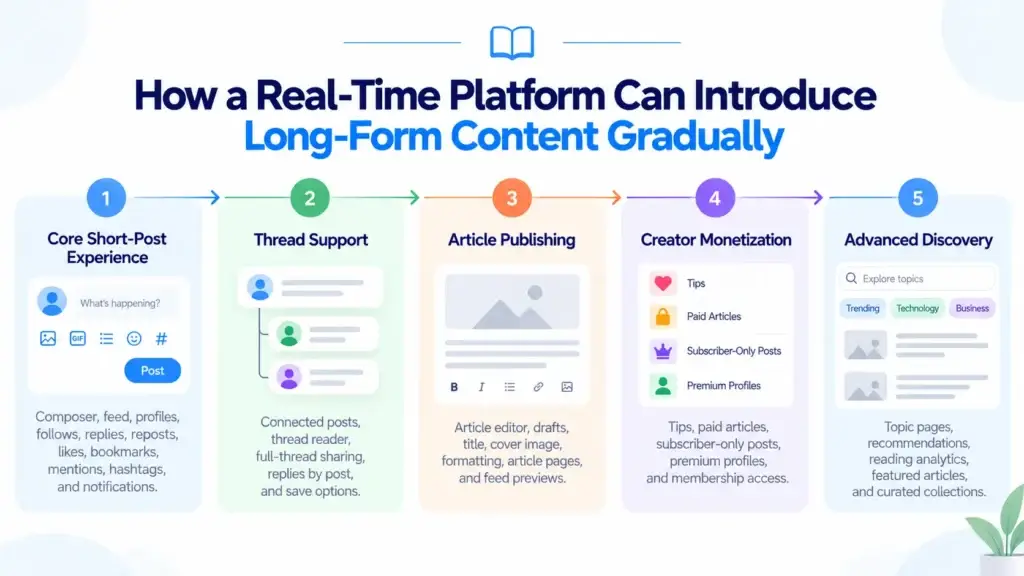
Founders do not always need to launch every content format at once. The better approach is to understand which format creates the most value for the first audience and then expand from there. A creator-led platform may need article publishing early. A breaking-news community may need short posts and threads first. A professional network may need both from the beginning.
A practical rollout can start with short posts, replies, reposts, media, and threads. Once users begin forming communities around topics, the platform can introduce long-form articles for creators, verified members, or paid tiers. This phased approach prevents overbuilding while still leaving room for deeper publishing later.
A Practical Feature Roadmap
- Phase 1: Core short-post experience — composer, feed, profiles, follows, replies, reposts, likes, bookmarks, mentions, hashtags, and notifications.
- Phase 2: Thread support — connected posts, thread reader, full-thread sharing, replies by post, and save options.
- Phase 3: Article publishing — article editor, drafts, title, cover image, formatting, article pages, and feed previews.
- Phase 4: Creator monetization — tips, paid articles, subscriber-only posts, premium profiles, and membership access.
- Phase 5: Advanced discovery — topic pages, recommendations, reading analytics, featured articles, and curated collections.
This roadmap helps founders avoid building a heavy publishing system before they have community signals. At the same time, it prevents the platform from becoming trapped in short-post-only behavior if the audience later needs depth.
When Should a Platform Prioritize Short Posts?
A platform should prioritize short posts when immediacy is the main value. This applies to communities built around live updates, local events, creator announcements, audience reactions, public debates, daily networking, niche discussions, or time-sensitive information.
If users need to publish quickly and respond quickly, the short-post experience should be extremely strong. The composer should be easy to open, the feed should be fast, replies should feel natural, and notifications should bring users back into active conversations.
Short posts should also come first when the founder is still validating the community. They reveal what users want to discuss, which topics create reactions, who the early power users are, and what content behaviors appear naturally.
When Should a Platform Prioritize Long-Form Articles?
A platform should prioritize long-form articles when expertise, trust, education, or paid knowledge is central to the business model. This applies to expert communities, founder networks, analyst groups, industry associations, paid creator spaces, media-led communities, and educational networks.
If users are expected to pay for insight, the platform needs formats that support serious publishing. Short posts can tease an idea, but articles can deliver the full value. A creator who wants to charge for analysis, guides, opinion pieces, lessons, or private updates needs more than a standard post composer.
Long-form articles should also be prioritized when the platform wants to build search visibility, evergreen content, or creator portfolios. Posts may drive conversation today, but articles can keep bringing value tomorrow.
How Miracuves Helps Founders Build Flexible Social Publishing Platforms
Building a real-time social publishing platform requires more than a feed. Founders need account systems, profiles, content publishing, moderation, notifications, admin control, monetization logic, mobile experience, and a backend that can support future growth. When both short posts and long-form articles are part of the roadmap, the product foundation becomes even more important.
Miracuves helps founders launch faster with ready-made and white-label app foundations that can be customized around the target community, monetization model, branding, and operational needs. For relevant ready-made solutions, Miracuves offers a 6-day delivery timeline, source-code ownership, branded deployment, and admin control so founders can move from planning to market validation faster.
If you are evaluating a real-time public conversation product, you can explore Miracuves’ launch-ready public conversation platform to understand how a ready-made foundation can support faster deployment. For teams planning detailed publishing, account control, verification, and creator workflows, the feature breakdown can help clarify what needs to be included. If monetization is part of the roadmap, the business model guide explains how member-led revenue can work before a platform depends on advertising scale.
Final Thoughts: The Strongest Platforms Combine Speed With Depth
The future of microblogging is not only about shorter posts or longer articles. It is about giving users the right format for the right moment. A short post is useful when the idea is immediate. A thread is useful when the thought needs sequence. A long-form article is useful when the creator needs depth, structure, and lasting visibility.
For founders, the important decision is not simply whether to add more content formats. The real decision is how those formats will work together inside the product. The feed, profile, composer, editor, discovery system, analytics, moderation tools, and monetization layer should all understand the difference between fast engagement and deep value.
A real-time microblogging platform that supports both short posts and long-form articles can serve quick conversations without losing serious creators. It can keep the platform active while also building a library of durable, high-value content. That balance is what turns a simple feed into a stronger social publishing ecosystem.
FAQs
Can a real-time microblogging platform support both short posts and long-form articles?
Yes. A real-time microblogging platform can support both formats if the product separates quick posting, threads, and article publishing clearly. Short posts should stay fast and lightweight, while long-form articles need a richer editor, dedicated reading pages, previews, bookmarks, and deeper analytics.
Why should a microblogging platform include long-form articles?
Long-form articles help creators publish deeper insights, guides, essays, announcements, and premium content. They also improve profile authority, evergreen discovery, and monetization options such as subscriptions, paid articles, and member-only publishing.
Do long-form articles slow down a real-time feed?
They can if they are displayed poorly. The better approach is to show articles as cards or previews inside the feed. This keeps browsing fast while still giving users a path to deeper content when they want to read more.
What is the difference between a thread and a long-form article?
A thread is a connected sequence of short posts, usually designed for conversational reading. A long-form article is a structured piece of content with a title, sections, formatting, media, and a dedicated reading page. Threads are better for real-time explanation, while articles are better for durable knowledge.
How can creators monetize short posts and long-form articles?
Short posts can support tips, promoted updates, paid interactions, and community engagement. Long-form articles can support subscriptions, gated content, premium analysis, paid communities, and newsletter-style publishing. A platform that supports both formats gives creators more ways to earn.
What features are needed for long-form publishing in a social platform?
Useful features include drafts, rich text editing, headings, cover images, media embeds, article previews, reading pages, bookmarks, author profiles, topic tags, moderation tools, and analytics such as reading time, scroll depth, and saves.
Should founders launch short posts first or long-form articles first?
It depends on the audience. If the platform depends on real-time conversation, short posts should come first. If the platform targets experts, paid creators, professional communities, or educational content, long-form publishing may need to be included earlier.
Miracuves is an independent software development company. We are not affiliated with, connected to, sponsored by, or endorsed by any company or product named in this article.
Terms such as “X Clone” are used descriptively. It is how the software industry refers to building a platform with functionality comparable to a known service, and how clients search for it.
The entire design and codebase of our products is built by our own team. Our products contain no code, design, graphics, or content originating from any third-party website or applications.
All third-party names and marks referenced in this article are the property of their respective owners, referenced solely to identify the services discussed.