
X Clone App - White-Label Social Platform Built on Paid, Verified Accounts
A launch-ready public conversation platform where the account, not the advertisement, is the thing being sold. Membership resolves into three tiers checked on the server, verification is granted by an operator rather than set in a database, and money moves between members through creator subscriptions and tips from the first week.
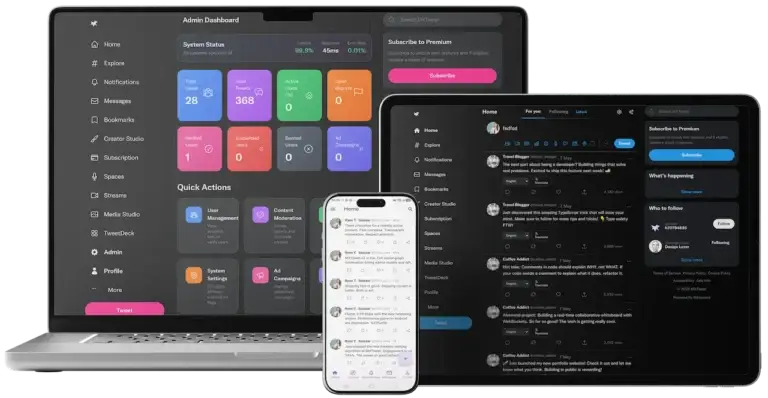
Three surfaces on one Firebase core. A Next.js web application, a Flutter mobile application and an operator console all read the same REST API under /api/v1/, so an entitlement, a badge or a block behaves identically wherever a member meets it.
Go Live in 6 Days with Paid TiersVerified AccountsCreator SubsTipsOwned SourceWhite-Label
⚡ Platform at a Glance
3
Paid Tiers
Free, Premium at $9.99 and Pro at $29.99
2
Ways to Get Paid
creator subscriptions and direct tips
28
Mobile Screens
a real Flutter app in source, not a web wrapper
15
Console Pages
reports, verification, members and the audit trail
What a Paid Account Unlocks
Tiers are enforced by the server rather than hidden in the interface, and verification is an operator decision with a record behind it. The badge means something because you control what earns it.
Revenue From Members, Not Advertisers
Creator subscriptions and tips move value between people already on the network, so the platform earns from an engaged hundred instead of waiting for an advertiser to arrive.
Own the account, not just the feed








Live in Action
X Clone Demo - Member, Conversation, Operator Console & Android
Every surface below is the shipped build on live infrastructure. The run worth doing here is the membership one: sign in, look at what the account carries, then open the operator console and watch verification and account status from the side that grants them.
MEMBER EXPERIENCE
X Clone - Account, Feed & Profile
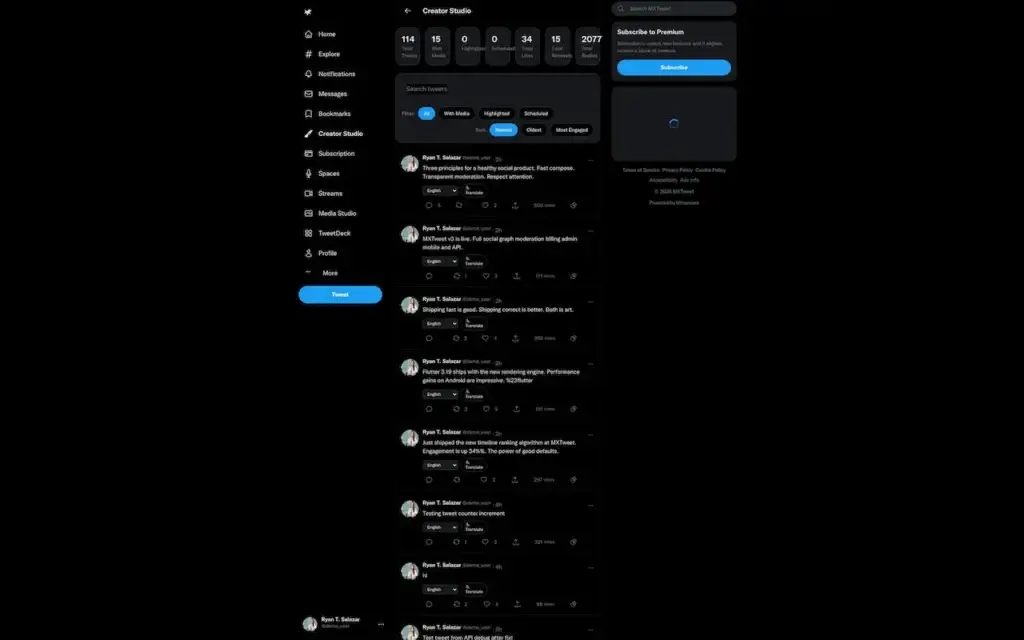
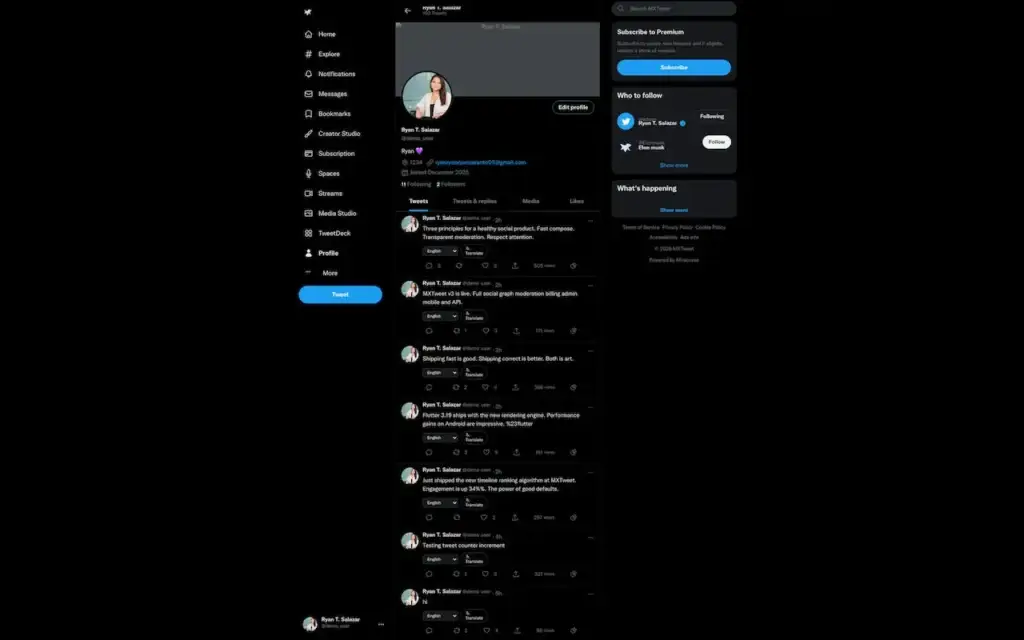
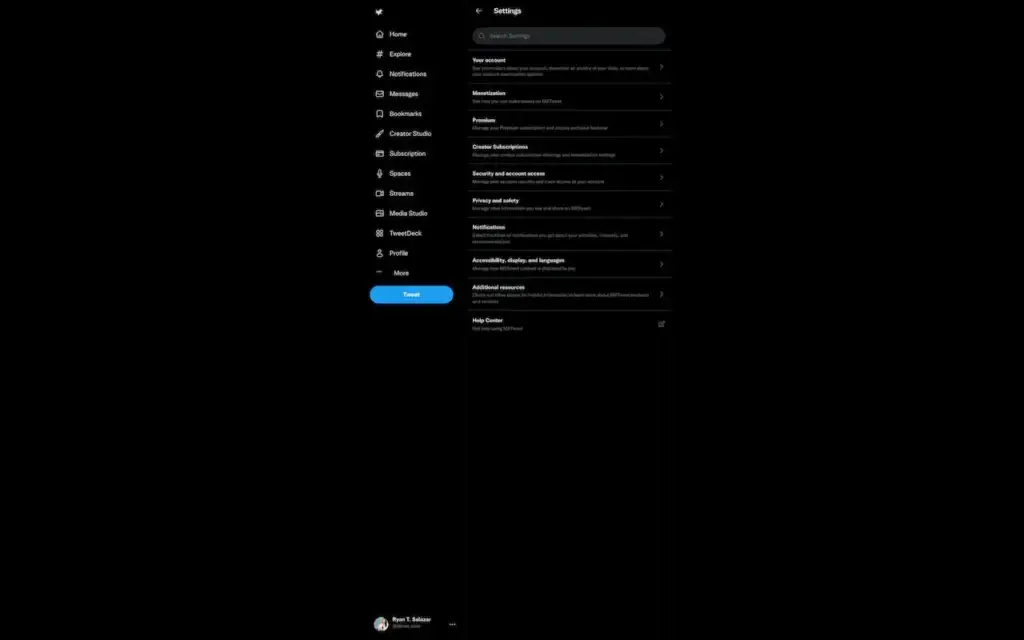
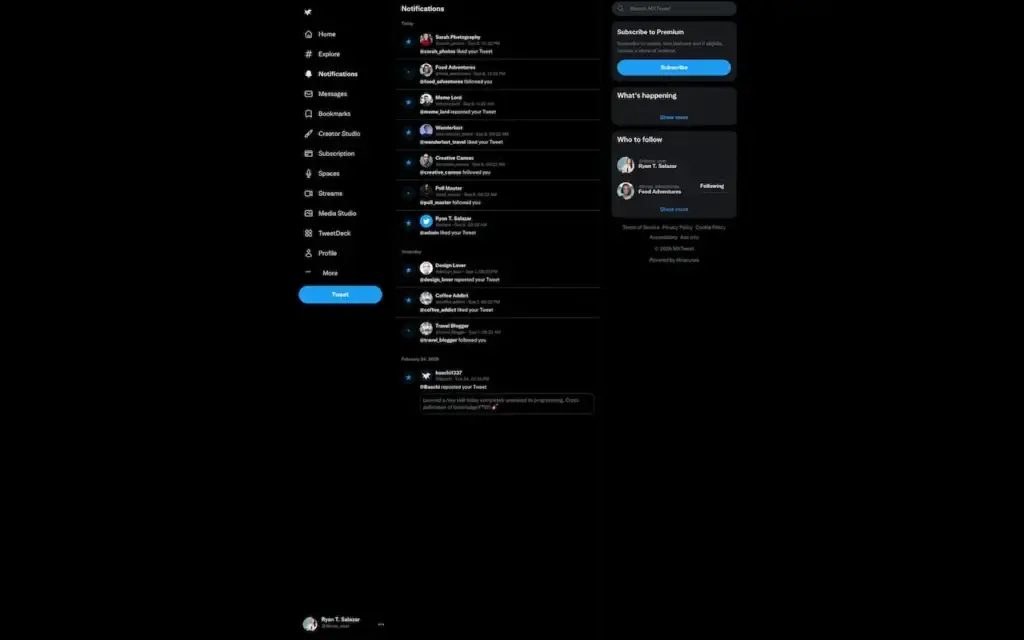
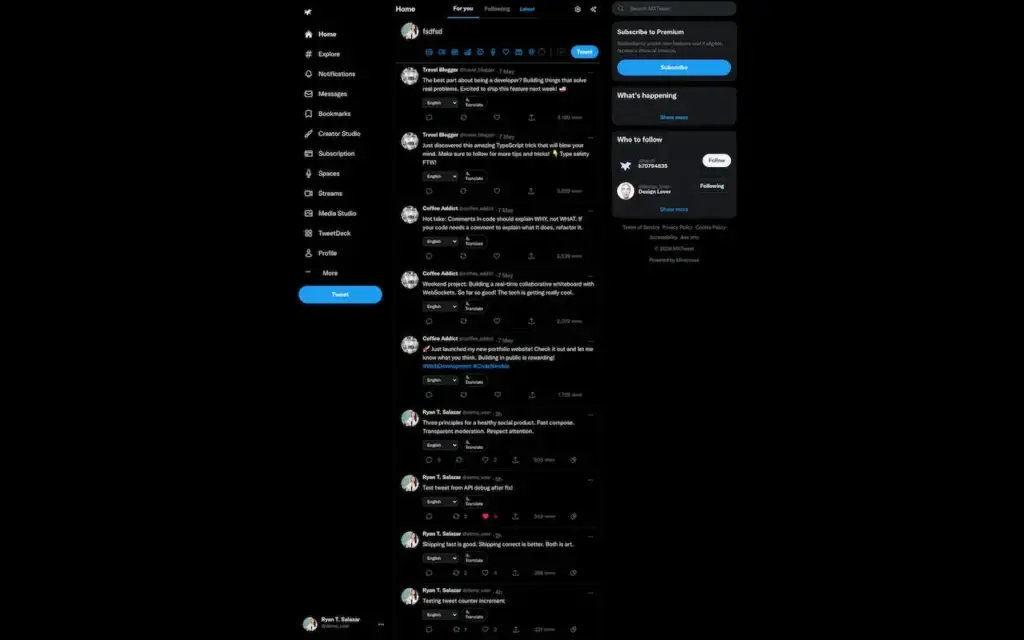
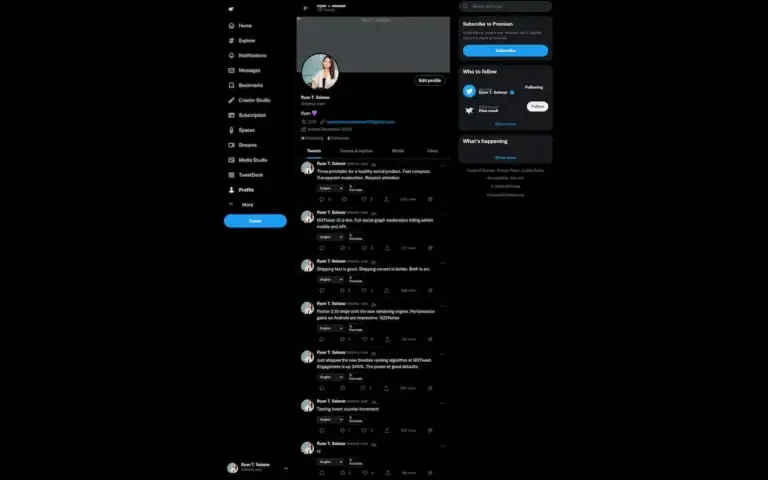
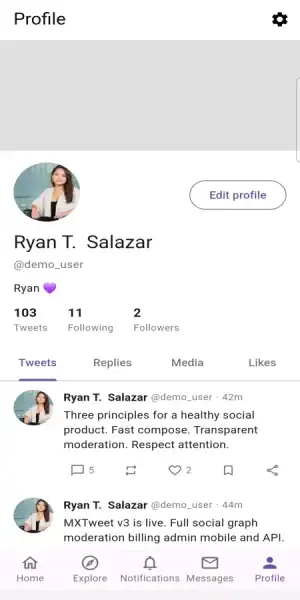
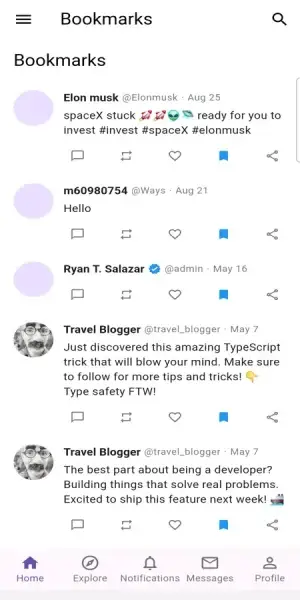
The member surface. A profile with display name, bio, avatar and banner, timeline and privacy preferences on the account record, the For You, Following and Bookmarks feeds, and a composer covering text, images, video, audio, GIFs, polls, quotes and threads.
-
Open the web app in your browser
-
Login with the member credentials below
-
Try: set preferences, post, bookmark, follow
-
Try: demo@mxtweet.com / Demo@123
RELATIONSHIPS & MESSAGING
X Clone - Follows, Blocks & Direct Messages
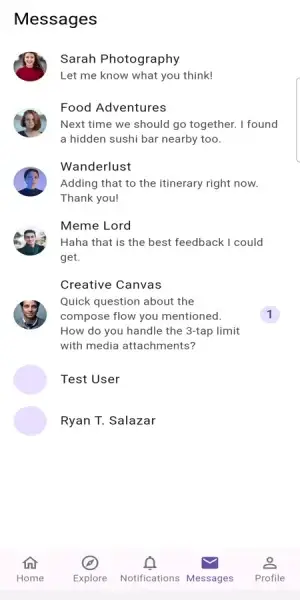
The two-account surface, which is where the social graph becomes visible. Follow, list, block and mute the first account as explicit records, then open a direct conversation carrying audio messages, reactions, read receipts and live typing.
-
Login as the second member in a private window
-
Follow, list, then block and mute the first account
-
Open a DM: send audio, react, watch read receipts
-
Try: test@mxtweet.com / Test@123
OPERATOR CONSOLE
X Clone - Verification, Status & Audit
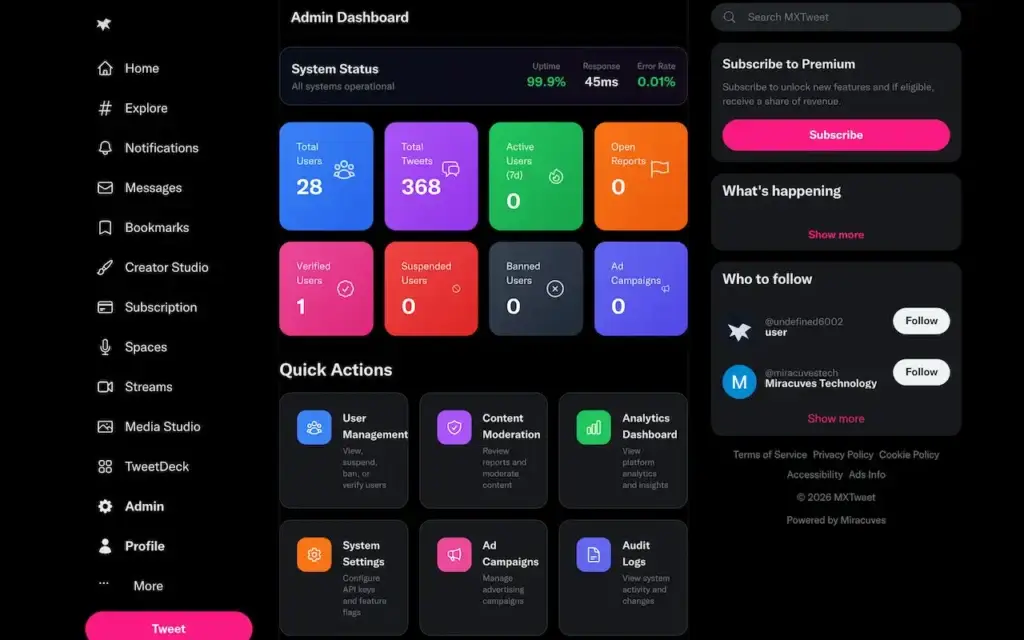
The side that decides what an account is worth. Grant a verification badge, change an account status with a reason recorded, work the report queue, and read the audit log naming which administrator did what, to whom and why.
-
Login with the admin credentials below
-
Grant a verification badge and record the reason
-
Check the audit log for the action you just took
-
Try: admin@demo.com / Admin@123
MOBILE APPLICATION
X Clone - Flutter App for Android
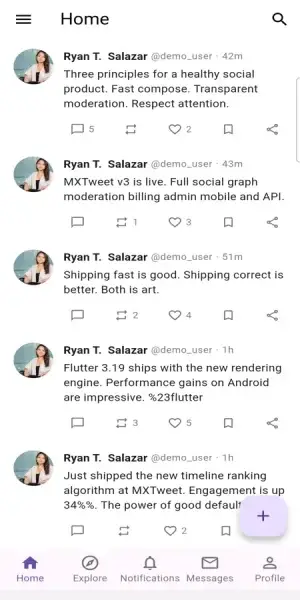
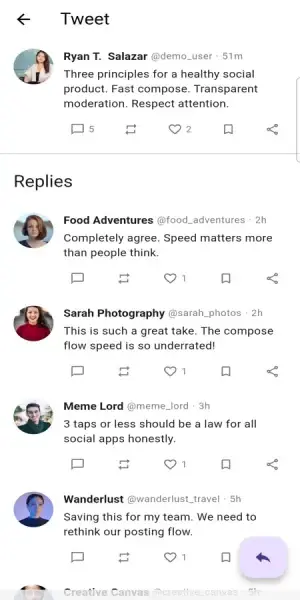
The native surface, shipped as source rather than a wrapper around the website. Twenty-eight screens against the same REST API, so a tier change or a new entitlement lands on the phone and the browser from one contract.
-
Install the Android build from the app portal
-
Login with the same member credentials
-
Confirm the entitlements match the web account
-
Same credentials as the member demo
What Actually Has to Work
Membership Is the Hard Part, Not the Timeline
Anyone can render a feed. What decides whether a social product has a business is whether an account can be charged, upgraded, verified, restricted and refunded without a developer, and whether every one of those decisions leaves a record somebody can review a year later. That machinery is in this build rather than on a roadmap.
Entitlements That Cannot Drift
One Account, Every Surface
A member record carries the tier, the verification state, the account status, the preferences and the counters. The Next.js web application, the Flutter application and the operator console all read it through the same REST surface under /api/v1/, with ownership checks applied in one place.

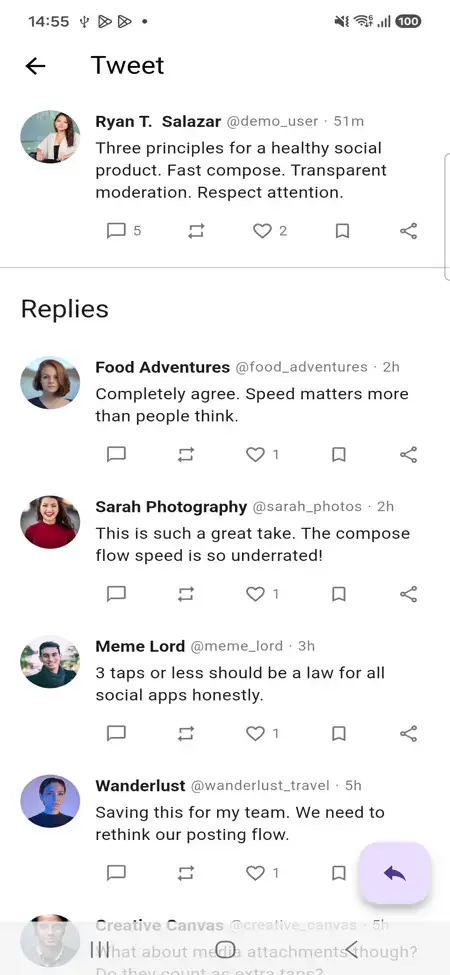
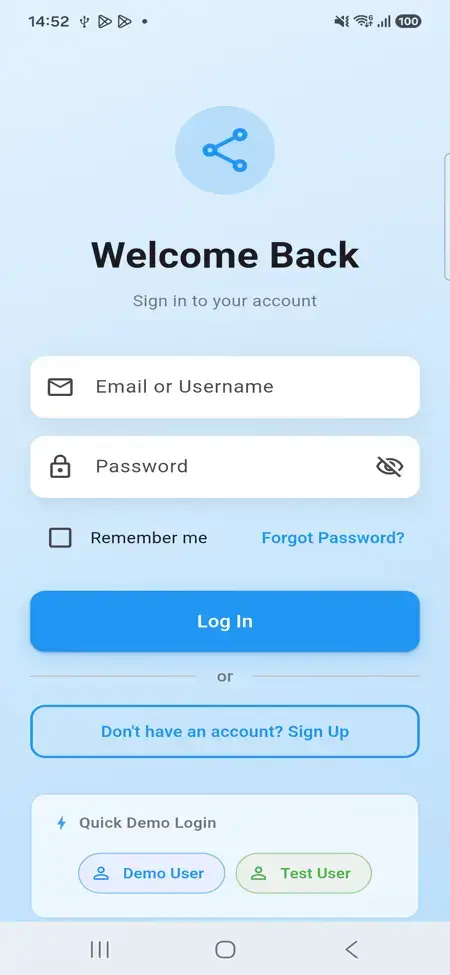
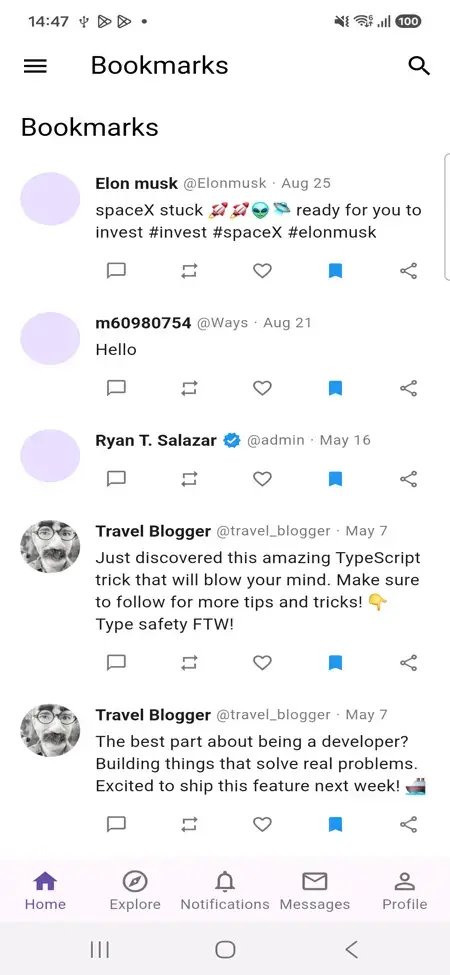
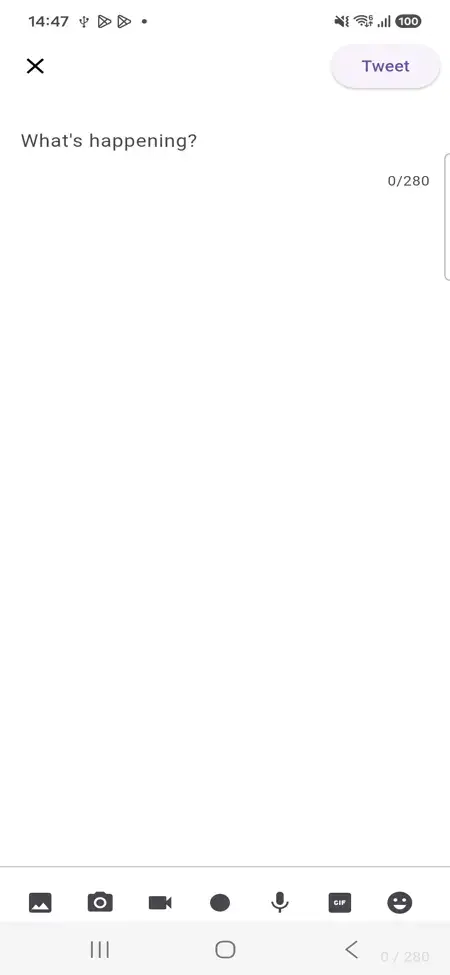
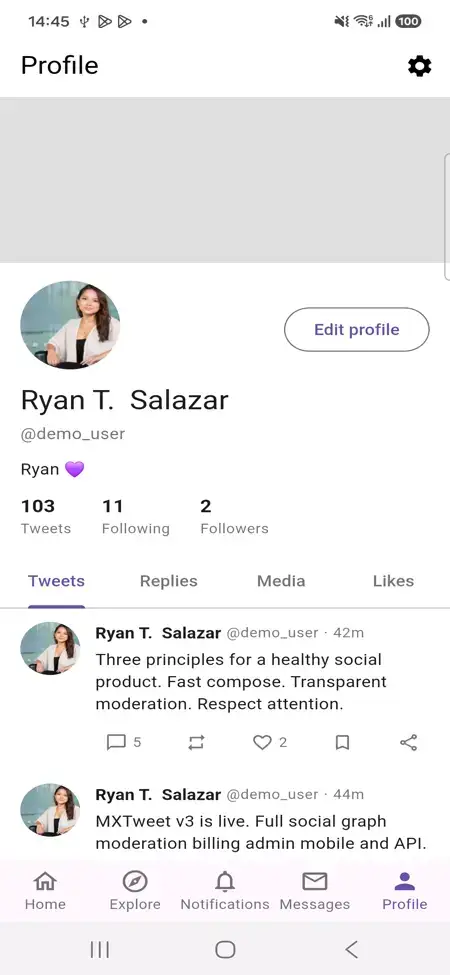
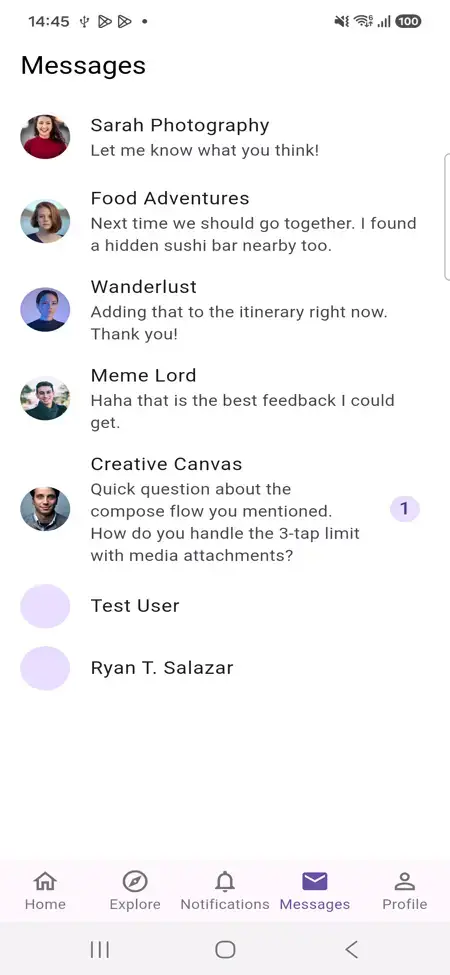
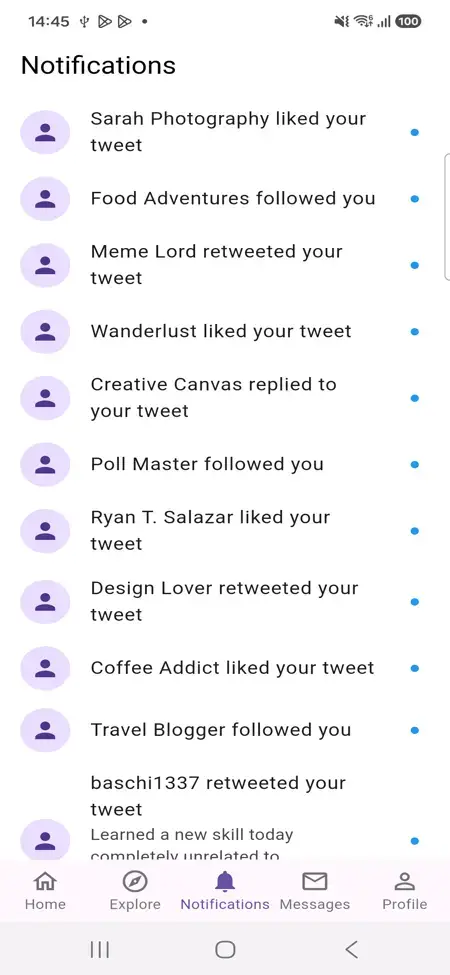
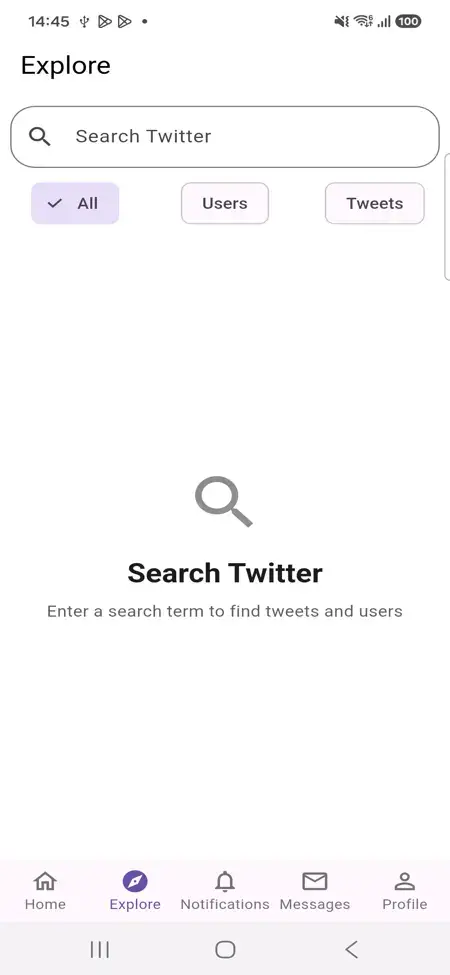
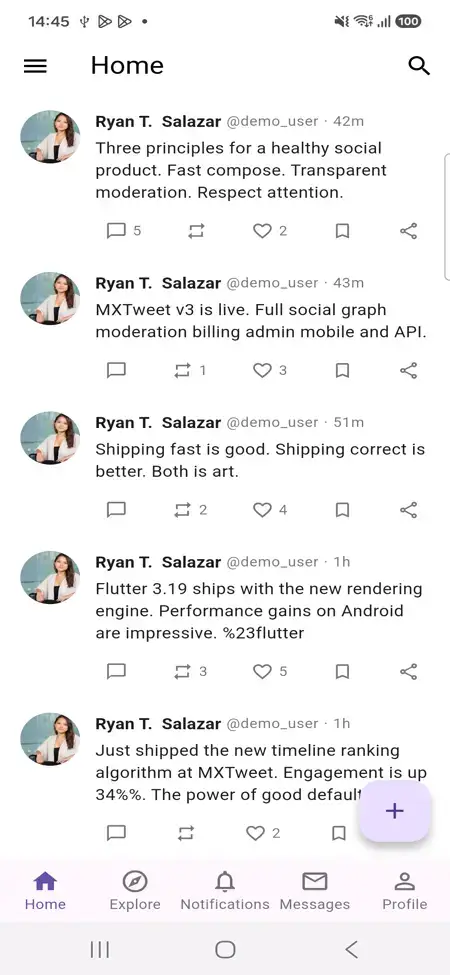
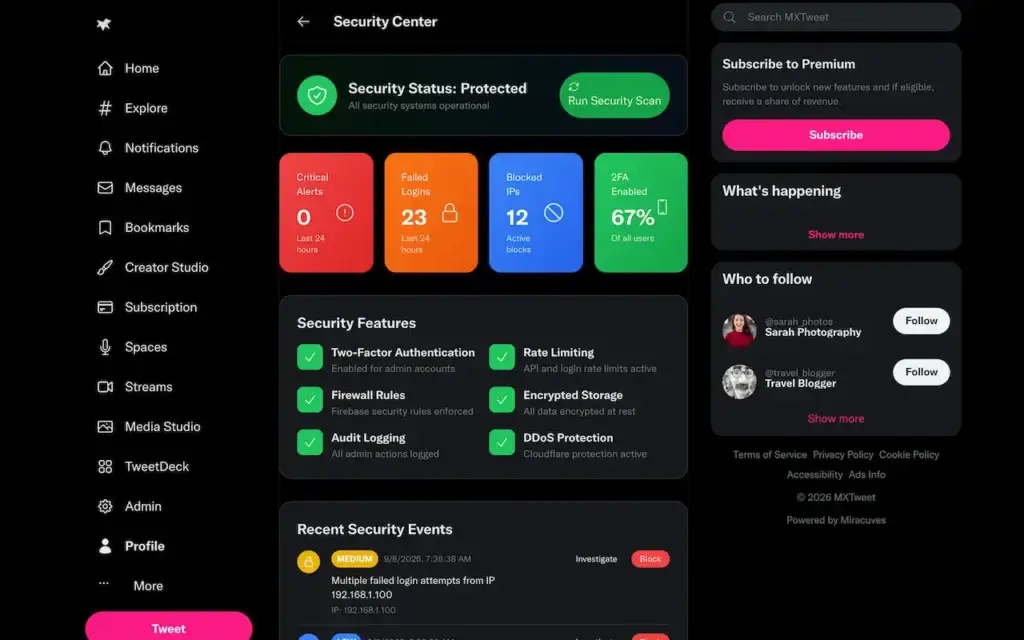
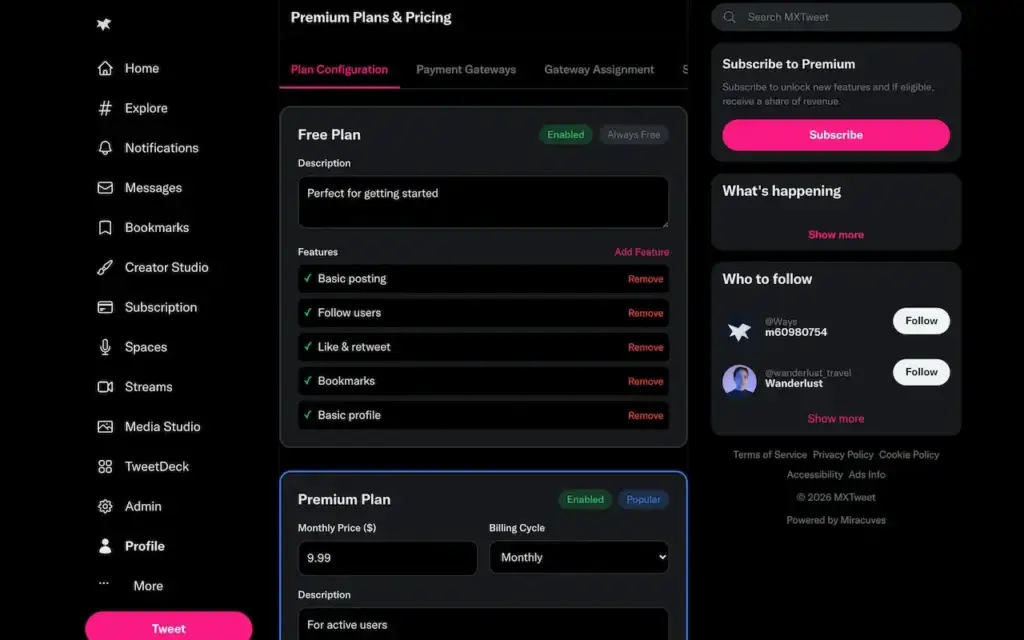
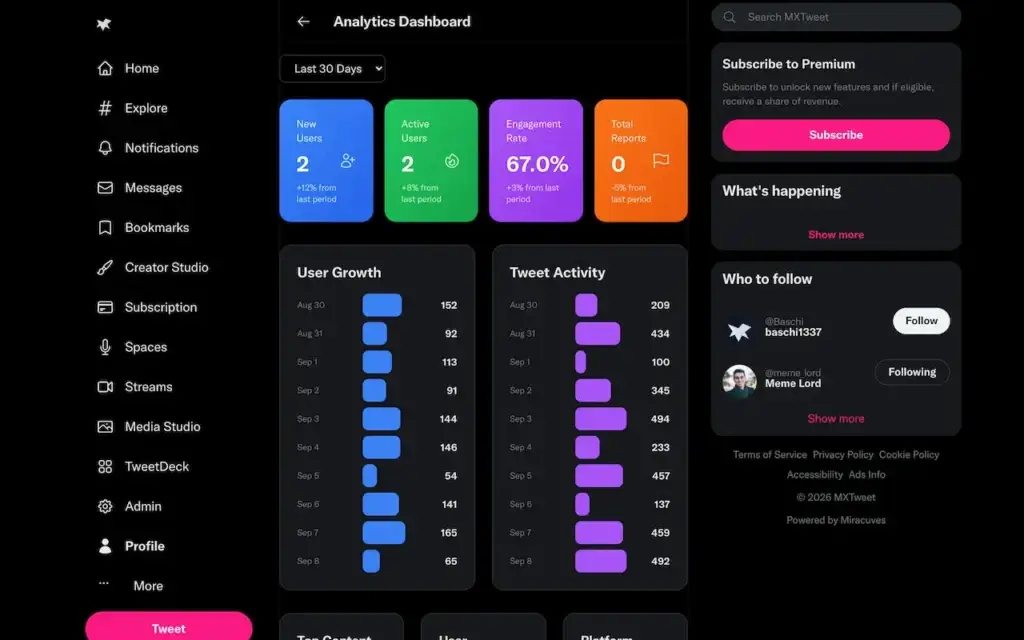
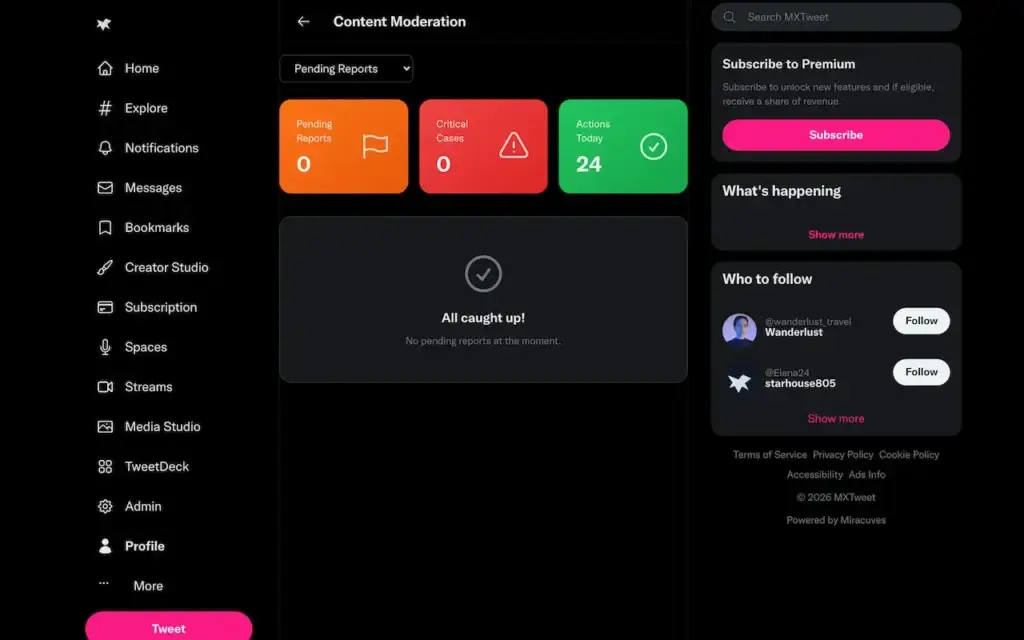
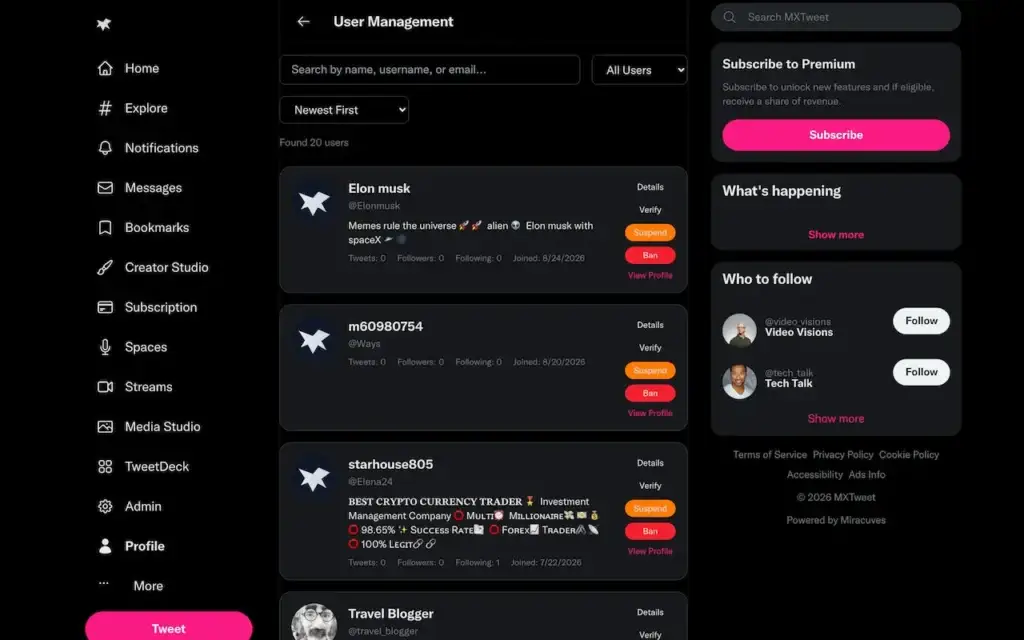
That is what stops the failure this category is full of: a paid feature that works on the website and not in the app, or a suspension that takes effect in one client and not the other. There is one contract, so an entitlement is either true everywhere or false everywhere.
Not Just the Front End
The Membership Layer Is Yours Too
Plenty of vendors will hand over a feed and keep the part that decides who is allowed what. Here the entitlement logic, the verification workflow and the payout relationships transfer with everything else, along with the Firestore rules and indexes underneath them. Nobody upstream can reprice your tiers, redefine what a badge means, or take a percentage of what your members pay you.
How an Operator Configures It
Modelled Reference Deployment
An illustrative configuration rather than a client engagement: how the shipped platform is set up for an operator whose plan is membership revenue first, with tips live at launch, verification opened once there is a reason to want a badge, paid tiers introduced against real usage, and advertising left switched off entirely.
Illustrative
Paid Membership Network
How the shipped platform is configured for an operator whose revenue comes from members rather than advertisers: tips live at launch, verification opened once a badge is worth having, paid tiers introduced against real usage, and the ad desk left switched off entirely.
- Members who will pay for a network but not for advertising to be removed
- Verification that means something rather than a flag set in a database
- Paid features that cannot be unlocked by a modified client
- Charge for membership from the first month rather than after growth
- Give creators a way to earn on the network in week one
- Keep every privileged decision explainable months afterwards
- Three tiers with entitlement checks resolved on the server
- Creator subscriptions and tips settling between two members
- Verification granted through an operator review with a reason
- Follows, lists, blocks and mutes stored as explicit records
- Audit entries naming the administrator, the target and the reason
This is a modelled reference deployment, not a client engagement. It shows how the shipped platform would be configured for this market, using platform properties rather than reported outcomes.
Read This Before You Buy
What This Is, and What It Is Not
Clone is the industry term for software written to work like a product people already recognize. It names the functional target, not the provenance of the code, and everything here is an original implementation on Next.js, Flutter and Firebase.
Not Affiliated With X or Twitter
Independent software written to a functional target. Nothing here originates from the X or Twitter website or applications, and the name appears descriptively because it is the phrase that describes the category and the phrase buyers type.
Not a Rented Platform
The web app, the Flutter app, the API layer, the console and the Firestore configuration all transfer. What that buys you specifically is control of your own pricing, since no vendor sits between you and your members.
Not an Audience
Supply and demand is the hard half of a social product and software cannot solve it. You get the surfaces, the membership economics and the moderation tooling; assembling the community is the job that starts after deployment.
The Honest Version
What You Are Actually Buying
What arrives is a network whose membership machinery is finished rather than sketched: plans resolved server-side, badges granted through a review somebody signs their name to, creator earnings modelled as relationships instead of receipts, and a record behind every decision an operator makes.
-
Three tiers with server-side entitlement checks
-
Verification badges granted on operator approval
-
Creator subscriptions and member-to-member tips
-
Follows, lists, blocks and mutes as explicit records
-
Login history with device, location and outcome
What does not arrive is people. No codebase supplies the thing a social network actually runs on, and a vendor who lets you believe otherwise is selling something they cannot deliver.
The Full Surface
Features That Decide Whether Members Pay
A profile page is not a membership system. What follows is what sits on and around the account record, which is what determines whether a network can charge for itself, defend itself and explain itself.
Three Tiers, Checked Server-Side
Free, Premium at $9.99 and Pro at $29.99, with entitlements resolved on the server rather than in the client. A member cannot unlock a tier by editing a request, and you can reprice without a deployment.
- Free, Premium at $9.99, Pro at $29.99
- Entitlement checks run on the server
- Repricing and regating without a release
- Plan state held on the member record
Verification You Actually Grant
A badge is assigned through an operator review with a reason recorded, not a boolean somebody sets in the database. That is what makes verification worth paying for and worth trusting.
- Verification badges granted on approval
- Operator decision with a reason recorded
- Review queue rather than a database flag
- Badge state readable by every client
Paid Followings as a Relationship
Subscriber ids live on the creator record, so a paid following is a first-class object the platform can read, count and settle against rather than a payment log sitting off to one side.
- Creator subscriptions via subscriber ids
- Paid followings as a first-class relationship
- Tips on a post or a profile
- Both settle between two members
Tips Move First
A one-off payment on a post or a profile asks nothing of a member who arrived yesterday. On a young network it is reliably the line that moves before anyone is ready to subscribe.
- Follows and followers as records
- Lists holding member ids
- Blocks and mutes stored explicitly
- Privacy preferences on the account
The Graph Is Explicit
Follows, lists, blocks and mutes are stored as records rather than derived. Blocking is a fact the platform can enforce everywhere instead of a filter one client remembers to apply.
- Login history with IP and user agent
- Device, browser, location and timestamp
- Success and failure both recorded
- Two-factor fields on the member record
Account Status With Reasons
Suspend, ban and restore each carry a recorded reason, so an appeal has something to review and a support desk has something to quote back.
- Account status control with reasons
- Suspend, ban and restore as operator actions
- Appeal review with something to read
- Audit entry written on every change
Login History as Evidence
IP, user agent, device, browser, location, timestamp and outcome per sign-in. When an account is disputed or compromised, support reads a record instead of guessing.
- Text, images, video, audio and GIFs
- Polls with timed expiry
- Quote posts and threads
- Scheduling and content warnings
An Audit Log That Answers Questions
Administrator id, action, target member, target post, target report, reason and timestamp on privileged actions, so "who verified this account and why" still has an answer months later.
- For You algorithmic timeline
- Following chronological timeline
- Bookmarks as a saved feed
- Per-member timeline preferences
One Composer, Ten Post Types
Text, images, video, audio, GIFs, polls, quote posts, threads, scheduling and content warnings publish from one control, so a member never hunts for a different surface.
- Direct and group conversations
- Audio messages and reactions
- Read receipts through readBy arrays
- Live typing via a typingUsers map
Three Named Timelines
For You, Following and Bookmarks are distinct feeds rather than one opaque ranking, which is the difference between a feed members trust and one they suspect.
- Full-text search across posts and people
- Hashtag extraction and trending
- Saved searches per member
- Composite indexes behind the queries
Messaging With Presence
Conversations carry audio, reactions, read receipts through readBy arrays and live typing through a typingUsers map, so a thread is a real object rather than a chat log.
- Per-user notification subcollection
- Mentions, replies, follows and likes
- Cursor paging through history
- Push delivery to the mobile client
Counters, Not Fan-Out Queries
Likes, reposts, quotes, replies and views are denormalized onto the documents the feed already reads, which is what keeps the timeline cheap as the graph grows.
- Report queue with member submissions
- Hide, unhide, delete, suspend, ban
- Audit entry on every resolution
- Separate operator authentication path
One thing this list does not include: live audio rooms. The Firestore rules define a spaces collection, but the surface on top of it is a scoped extension rather than a switch, so it appears under Add-Ons and nowhere else. The same applies to automated moderation and a video transcoding pipeline.
How Operators Earn
X Clone Revenue Models - Tiers, Creator Subscriptions, Tips & Beyond
The search demand around this brand is overwhelmingly people asking what the app is and what it does, which is a useful clue about the business: on a network people are still working out, the first money almost never comes from advertisers. It comes from the members themselves.
Subscription Tiers
Free, Premium at $9.99 and Pro at $29.99, with entitlements checked on the server. The line that needs an audience least, because it sells to members you already have rather than to a market you still have to reach.
Creator Subscriptions
Subscriber ids held on the creator make paid followings a first-class relationship. The operator takes a share of a transaction between two members that it never has to fund itself.
Tips
Direct member-to-creator payments on a post or a profile. Low friction and no commitment, which is why this is usually the first line to show revenue on a network that launched last month.
Verification as a Paid Signal
Because badges are granted through operator review rather than set as a flag, verification can carry a price or ride on a tier. It is a membership product, not a database column.
Ad Campaigns
Promoted posts, banners and sponsored placements with budgets, daily caps, spend tracking and targeting keywords. Present in the build and worth switching on once attention exists to sell.
Developer Access and Licensing
Scoped OAuth applications with rate-limited keys, and the whole platform re-deployable under a second brand. Both are yours to price, because you own the source outright.
That is what this configuration leads with. Three of the five lines below need no third party at all, because they settle between the operator and people who are already signed in. The advertiser and developer lines exist in the same build and are where a mature network goes next.
Run It Without a Developer
X Clone Operator Console - Verification, Status, Reports & Audit
Fifteen admin pages on an authentication path separate from member accounts. On a membership-led network the console is where the product actually is: it decides who is verified, who is restricted, what a tier costs and what happened last Tuesday.
Operator Console Sections
Verification Review
Badge assignment as an operator decision with a record behind it, which is the whole reason a verification badge carries any weight.
Account Status Control
Suspend, ban and restore with reasons recorded, so a restriction can be explained and an appeal can be answered.
Report Queue
Member reports arrive as records to work through, with resolution actions attached rather than a free-text status field.
Five Resolution Actions
Hide, unhide, delete, suspend and ban, so a moderator can respond proportionately instead of choosing between nothing and removal.
Audit Log
Administrator id, action, target member, target post, target report, reason and timestamp on every privileged operation.
Login History
IP, user agent, device, browser, location, timestamp and outcome per sign-in, for disputes and compromised accounts.
Member Directory
List, search and detail views over the membership, with the tier, the badge state and the account status visible together.
Platform Analytics
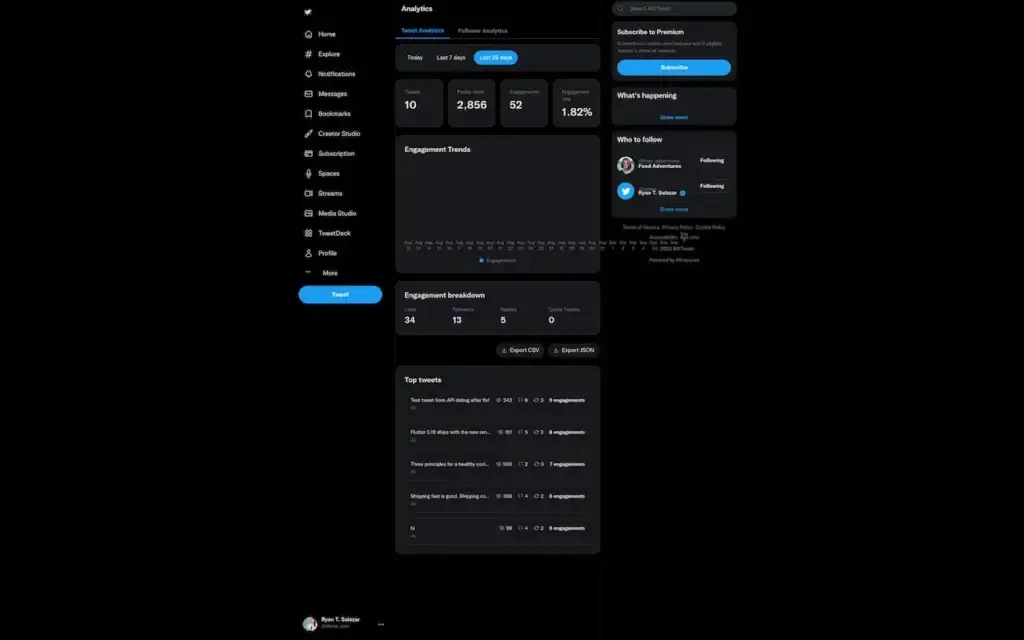
Activity and growth statistics for the people who have to report on the network rather than only run it.
Separate Admin Auth
The console does not share a session with member accounts, so a compromised member cannot reach operator tooling.
- Member list, detail and account status changes
- Verification review and badge assignment
- Suspension and ban management with reasons
- Report queue with hide, unhide, delete, suspend and ban
- Appeal review against a recorded reason
Ads and Keys Oversight
Campaign budgets and spend, plus which OAuth applications exist and what rate limits their keys carry, for when those lines are switched on.
- Platform statistics and activity analytics
- Audit log viewer across privileged actions
- Login history with device and location
- Settings and platform configuration
- Ad campaign and developer key oversight
Need deeper governance? Admin authentication is separate from member authentication, and every privileged action writes an audit entry naming the administrator, the target and the reason. Role granularity finer than that is configuration we scope with you rather than something that arrives switched on.
Transparent Pricing
How Much Does It Cost to Build a Social Media App Like X in 2026?
The number depends entirely on what you count as finished. A membership-led social network is not just a feed: it is tiered entitlements enforced server-side, a verification workflow with a review queue, creator subscriptions and tips settling between members, account status control with recorded reasons, an audit trail, and all of it consistent across a web app, a mobile app and an operator console. Quoted from scratch that is tens of thousands and several months. Here it is the same surface, already built, at one fixed price.
Not sure which option
is right for you?
Talk to us - we'll understand your goals, timeline, and budget, and point you to exactly what you need. No upselling, just honest advice.
The Full Package
What's Included - X Clone Source Code, Apps & Deployment
Everything transfers, and on a membership network one part of that matters more than the rest: the prices, the entitlements and the rules deciding who earns a badge are your commercial model. They should not live inside software controlled by somebody who can change them.
The Membership Layer
Plans, entitlement enforcement, the verification queue, subscriber relationships and tips. The half of a social build that gets under-scoped and then rewritten.
- Plan held on the account and enforced server-side
- Three tiers priced from configuration, not code
- Verification queue with the reason recorded
- Subscriber ids and tip records that settle between members
Complete Application Source
Browser client, mobile client, API and console, transferred outright, with nothing charged per seat and no share of your revenue.
- Next.js application on React 18.2
- 68 pages facing the member
- 190 components behind them
- TypeScript 4.7 with SWR for fetch and cache
Firestore Configuration
Rules, composite indexes and typed converters, which is reliably the first thing a from-scratch attempt gets wrong.
- 64 handlers under /api/v1/
- A single response envelope across all of them
- Cursor paging wherever order matters
- Ownership confirmed on every write
Member Web Application
Sixty-eight pages spanning feed, composer, profiles, lists, bookmarks, notifications, messaging and account settings.
- Firestore as the data layer
- Security rules and composite indexes included
- Typed converters in src/lib/types/
- Counters denormalized for feed reads
Flutter Mobile Client
Twenty-eight screens on the shared API, delivered as source so the two clients cannot quietly diverge.
- Flutter client, 28 screens
- Same REST surface as the browser
- Android build supplied
- iOS available as scoped work
Operator Console
Fifteen pages on their own authentication path, with a verification queue and a complete audit trail.
- Fifteen console pages
- Console authentication kept separate from members
- Verification, status and report queues
- Audit viewer and sign-in history
Developer Platform
OAuth applications, SHA-256 hashed keys and per-key limits, ready for the point you open the network to others.
- Twelve Cloud Functions
- Firebase Authentication including Google sign-in
- OAuth applications with hashed keys
- PM2 and environment-driven configuration
Documentation
Schema, ERD, the API collection, a security handbook and VAPT reference material.
- Schema and ERD references
- API collection
- Security handbook
- VAPT reference material
Want to see it running first? Open the member, second-account and operator logins above, then grant yourself a badge from the console and reload the member profile. Watching verification travel from a review queue to a member record is the quickest way to understand how the membership layer is put together.
Explore Every Angle of the X Clone
Four deeper guides covering features, cost, choosing a builder, and how a membership network earns before advertising is worth switching on.
Features
Membership is the hard part: three server-side tiers, entitlements that resolve identically on every surface, and badges that travel with the account, over 15 operator console pages.
See the full breakdown→Development Cost
One fixed price for all three tiers, weighed against agency and freelancer quotes, with creator payout operations and live audio rooms named openly as outside the base build.
See exact pricing→Development Company
What a membership network has to get right, provider by provider: where a paid feature is gated, what changing a tier price costs, and whether the entitlement layer transfers with you.
Compare options→Business Model
Why advertising does not work at launch size, and the three levers that need nobody else: tips, subscription tiers and creator subscriptions, with verification as the lever that follows.
See the playbook→Know Your Buyer
Who Is Our X Clone App Built For?
This suits operators whose members will pay for something other than the absence of advertising. If your plan begins with an ad sales team, the emphasis is wrong and we would point you elsewhere on this site.
Paid Community Operators
Creator-Led Networks
Professional and Members Bodies
Regional Social Operators
Publishers Moving Off Rented Ground
Agencies and White-Label Resellers
It suits them because the membership machinery is finished. There is no phase where the network works but cannot charge, and no phase where it charges but cannot verify, restrict or explain an account.
Where It Fits
X Clone Use Cases - Membership, Creators, Verification & Regional
Charge for membership from the start. Three tiers with entitlements resolved server-side mean the free tier is a choice you make rather than a limitation you are stuck with, and repricing is a form field rather than a release.
Paid Membership Networks
Put creators at the centre instead. Subscriber ids on the creator record and tips on any post or profile let somebody earn on the network in week one, with the operator taking a share of a transaction it never had to fund.
Creator-Led Platforms
Sell verified identity. Because a badge is granted through an operator review with a reason recorded, verification is a product you can define, price and defend rather than a flag with no story behind it.
Verified Identity Networks
Run a members-only square for an association or a profession, where account status control, recorded reasons and an audit trail are the features that get the project approved internally.
Association Squares
Enter a market the incumbents serve badly. Tier pricing in the local currency, local payment rails, local moderation policy and local language are configuration on a codebase you own.
Regional Launches
Deploy the same platform under several brands, each with different tier prices and a different verification policy, without negotiating a sub-licence for any of them.
Multi-Brand Deployments
Every one of these is the same deployment with different surfaces emphasized. Owning the source is what lets the product follow the market you actually find rather than the one you guessed at.
Membership-funded social is not a fringe idea any more. Enough audiences have watched a rented platform change its terms that paying for a network with predictable rules is now an ordinary thing to ask people to do.
Market Timing
Why Launch a Social Platform in 2026?
People are now used to paying for a social account. Verification, higher limits and creator subscriptions have all been normalized by the incumbents, which means an operator no longer has to explain why membership costs something.
Paying for an Account Is Normal Now
The behaviour is established, which removes the hardest part of a membership business. You are asking for something people already do somewhere else.
Verification Became a Product
Once a badge is something granted rather than earned by fame, it is a membership tier with a review behind it. That is a line of revenue and a reason to stay.
Creators Want a Bigger Share
Paid followings and tips are established behaviour. The question a creator asks now is what percentage they keep and how quickly they are paid.
Predictable Rules Are a Feature
Every operator who built on rented ground has watched the terms move. A network that cannot be repriced from outside is a genuinely different offer.
Revenue Before Scale
Tips and a single tier monetize an engaged hundred. A membership network does not need millions of members before it earns anything.
Six Days to a Branded Deployment
The software is not the bottleneck. What decides the outcome is how quickly you start learning from members who actually pay.
Platform by the Numbers
What the incumbents also normalized is the risk. Pricing, verification rules and API terms have all moved without notice, and each move sent a cohort of members and creators looking for somewhere with rules that hold still.
Under the Hood
X Clone Tech Stack - Next.js, Flutter, Firebase & TypeScript
Deliberately unremarkable choices, because the team that inherits this has to hire for it. TypeScript across the web surface and the API, Dart on mobile, and a managed backend that takes a category of infrastructure work off a small team entirely.
Membership & Entitlements
Firestore · server-side checks
- Plan held on the account record and resolved server-side
- Badge state and its recorded reason stored alongside
- Subscriber ids on the creator for paid followings
- Account status consulted before any mutation runs
Web Application
Next.js · React 18.2 · TypeScript 4.7
- 68 pages facing the member
- 190 components behind them
- SWR 1.3 handling fetching and cache
API Layer
Next.js API routes under /api/v1/
- 64 handlers spread over eleven route families
- Zod checking every body and query
- A single success, data, error, meta envelope
Identity & Access
Firebase Authentication · OAuth 2.0 · API keys
- Email, password and Google sign-in
- verifyIdToken through the Admin SDK in middleware
- Keys SHA-256 hashed, each with its own rate limit
Mobile Application
Flutter
- 28 screens against the shared REST surface
- Android supplied, iOS available as scoped work
- Entitlements identical to the web client
Deployment
PM2 · Linux · Cloud Functions
- Twelve Cloud Functions
- Configuration driven by environment
- Firestore rules and indexes kept as code
Why this stack: On a membership platform the riskiest code is whatever decides who may do what. Putting identity on managed Firebase Authentication and resolving entitlement on the server means that judgement happens once, in code you can read, instead of being reimplemented three times by three clients that each end up believing something slightly different.
End to End
How the X Clone Works - Join, Verify, Upgrade & Earn
The path below is the shipped flow rather than an idealised diagram. Each step maps to routes that exist and records that are written, which is what makes the demo above worth opening.
Member Journey, From Signup to Paid
Join and Verify
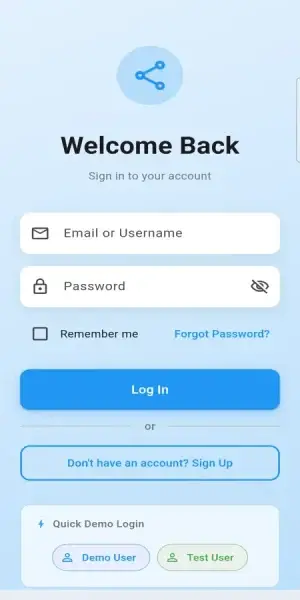
A member signs up through Firebase Authentication with email and password or Google sign-in. The session is a Firebase ID token that middleware verifies on every request through the Admin SDK.
- Email, password and Google sign-in
- Token verification in middleware on every call
- Account status checked before any mutation
- Login history recorded with device and location
Build a Profile
Profile, preferences and privacy settings are written to the member record alongside the counters the feed will later read rather than compute.
- Display name, bio, avatar and banner
- Timeline, notification and privacy preferences
- Two-factor fields, phone, email, timezone, language
- Counter fields initialized on the document
Post and Converse
Verification is an operator decision rather than a database flag. A request enters a review queue and a badge is granted with a reason recorded against it.
- Verification review queue in the console
- Badge granted on approval, with a reason
- State readable by web, mobile and console alike
- Audit entry naming the administrator
Follow and Message
Tiers are resolved on the server, so an entitlement cannot be unlocked by editing a request, and the price is a setting rather than a deployment.
- Free, Premium at $9.99 and Pro at $29.99
- Entitlement checks server-side on every call
- Repricing and regating without a release
- Plan state held on the member record
Monetize the Audience
The creator economy is a relationship on the data model, not a payments log bolted alongside it, so the platform can count and settle against it.
- Creator subscriptions via subscriber ids
- Tips on any post or profile
- Both settle between two members
- Operator takes a share it never had to fund
Moderate and Account For It
Reports enter a queue and resolve through five actions, and every privileged action leaves a record. This is what makes a paid network defensible when somebody disputes a decision.
- Hide, unhide, delete, suspend and ban
- Account status changes carry recorded reasons
- Audit entries naming admin, target and reason
- Login history available for disputes
Notice how early the money appears. A member can be earning or paying long before the network is large, which is the whole argument for leading with membership.
How It's Built
X Clone Platform Architecture & Data Flow
Entitlements Resolved Once
The tier, the badge and the account status are read from the member record behind the same API every client uses, so a paid feature cannot be true on the web and false on the phone.
Middleware as the Gate
Firebase Admin SDK verifyIdToken runs in middleware, checking the token, confirming account status and attaching member context before any handler sees the request.
Two Ways to Authenticate
Firebase Bearer tokens for members and x-API-Key for integrators, so a third-party product never needs a member session to read public data.
Denormalized for Reads
Counters and arrays live on the documents the feed already loads, so the timeline is a read of records rather than an aggregation across collections.
Real-Time Where It Matters
Firestore snapshot listeners drive feeds, notifications and messages, so presence is a property of the data layer rather than a socket tier to operate.
Privileged Actions Leave Records
Verification, suspension, bans and report resolutions all write audit entries. The architecture assumes somebody will ask why, months later.
Performance Targets
Built to Scale - Denormalized Reads, Cursor Paging & Managed Infrastructure
The load on a social network is lopsided. Something is composed once and then read by everyone who follows the author, so almost every design decision below is about making that read cheap rather than making the write clever.
Engagement counts live on the same documents the timeline already pulls, which removes the per-render aggregation that quietly destroys naive implementations at precisely the point they start attracting traffic.
A membership network adds a second hot path that a purely public one does not have: the question of whether this member is allowed this thing. It resolves from the account record the request has already loaded, so gating a feature costs nothing extra per call.
Paging is by cursor wherever order matters. An offset is simply the wrong tool against a feed, because content arrives between one page and the next and the offset then repeats or skips it without complaint.
The composite indexes behind timeline, search and notification queries are written as part of the build, rather than discovered the week a page starts timing out in production.
Reads Come First
Counts and engagement arrays sit on the documents the feed already loads, because a timeline is a read problem long before it is anything else.
Gating Costs Nothing Extra
Tier and status resolve from the account record the request already has, so a paid feature check adds no lookup to the path.
Cursors, Never Offsets
Timelines, notifications and search all page by cursor, which is the only approach that survives content arriving mid-scroll.
Indexes Written Up Front
Timeline, search and notification queries have their composite indexes defined in the build rather than added under pressure.
Presence Without a Socket Tier
Snapshot listeners carry feeds, notifications and messaging, so there is no separate realtime service to run and monitor.
The Ceiling, Stated
Managed infrastructure has limits at very large scale. We name them here rather than discovering them together later.
Choosing Firestore removes a whole category of work from a team that has not yet proved the product. Nothing to size, patch or fail over while the open question is still whether members will pay.
The cost of that choice is a ceiling, and we would rather name it than let you find it. Managed infrastructure trades headroom for speed, which is the right trade at launch and a decision worth revisiting deliberately rather than a limitation to discover.
Built to Be Audited
X Clone Security - Documented, Not Decorated
Two things on this platform are worth attacking, and they are the two things it sells: the entitlement that decides what an account can reach, and the badge that decides whether anyone believes it. Both live on a record the member would dearly like to edit, so how those checks are enforced deserves inspection rather than reassurance.
Charging Members Is an Integration
The Firestore Rules Are the Perimeter
Multi-Factor Exists, Enforcement Does Not
Throttling Needs Your Numbers
Moderation Is People Plus Tools
Testing Is Yours to Commission
Entitlements Resolved on the Server
Included. The plan and the account status are read and enforced server-side before a gated action runs, so a modified client or a hand-edited request buys a member nothing.
Identity Verified in Middleware
Included. verifyIdToken through the Firebase Admin SDK runs ahead of every handler, confirming the token, checking account status and attaching member context.
Writes Check Ownership
Included. Mutations on posts, accounts and conversations confirm the caller owns the record instead of trusting an id the client supplied.
Decisions Leave Records
Included. Badge grants, suspensions, bans and report resolutions each write the administrator, the action, the target and the reason, which is what makes a contested decision reviewable.
Requests Are Validated
Included. Zod schemas check bodies and query parameters at the API boundary rather than trusting shape.
Secrets Management
Configuration required. Configuration is environment-variable driven, which is right for a codebase and not sufficient for production. Moving credentials into a managed store is a deployment step we do with you.
The PRD specifies its own claim vocabulary – Included, Supported, Configuration required – and the entries below use it exactly as written. Where something is deployment work, it is labelled deployment work.
Go Further
X Clone Add-Ons - Payments, Moderation AI, Media & Enterprise
What ships is enough to launch and charge for. What follows is what operators come back for once they know which direction their network is growing in, priced separately so nobody pays for a capability their model does not need.
Connecting a Payment Processor
The first thing nearly every operator here needs. Tiers, subscriptions and tips wired to your processor, with the local rails, retry handling and cross-border tax treatment that charging members actually involves.
Paying Creators Out
Settlement schedules, statements, minimum thresholds and the earnings reporting a creator will ask for within a month. It sits on top of the subscription and tip records rather than inside them.
Moderation Classification
Machine triage of text and imagery ahead of the human queue, so moderators judge the ambiguous cases instead of reading everything that arrives.
Video Delivery at Volume
Transcoding, thumbnailing and CDN distribution, which becomes the largest single cost on any network where video takes hold.
Live Audio Rooms
The Firestore rules define a spaces collection, and that is all. Building the live audio surface on top of it is a scoped extension, which is why it appears here and never in the feature list.
Deeper Analytics
Cohort retention, tier conversion funnels and creator earnings reporting, beyond the activity statistics the console already carries.
iOS Build and Submission
The Flutter codebase supports it. Producing, signing and shepherding the build through review is a defined piece of work with a defined price.
Localization and Enterprise SSO
Multi-language and right-to-left interface for a regional launch, plus SAML or OIDC where the platform runs as an internal members network beside an existing identity provider.
Building a Social Product? We Have the Whole Category Covered.
Membership-led is one shape a social network takes. If your plan leads with advertising, photos, professional identity or private communities instead, the emphasis is different and so is the page.

Twitter Clone
The same platform, presented around the ad desk and the developer API rather than the membership layer.
Threads Clone
Text-first social platform with ad accounts, campaigns and consent-gated messaging.

Instagram Clone
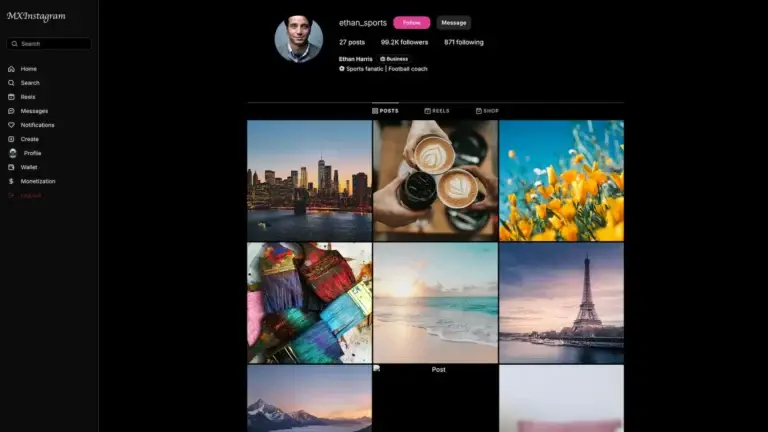
Photo and video social platform with stories, reels, creator tools and a shopping surface.

Reddit Clone
Community platform with subreddits, voting, moderation tooling and threaded discussion.
The Commercial Case
Marketability, Revenue Potential & Business Prospects
The commercial question for a membership network is not whether people will pay for social software, because they demonstrably already do. It is whether you can give a specific group a reason to pay you rather than to keep paying somebody else.
Revenue Before Scale
Tips and a single tier monetize an engaged hundred. You do not need millions of members before the platform earns anything at all.
Members Pay More Predictably Than Advertisers
Subscription revenue arrives monthly and is forecastable. Ad revenue depends on a market you do not control and does not exist at small scale.
Verification Is Margin
A badge granted through review costs an operator minutes and can carry a price or a tier. Few lines on a social platform have that shape.
No Platform Risk
Owned source on your infrastructure. Nobody can reprice your tiers, change your verification rules or revoke your API access.
Enable tips on day one, because a tip asks nothing of a member who arrived yesterday and needs no commitment on either side. Watch what the free tier does for a few weeks, then introduce Premium against whatever people actually keep coming back for, since entitlements are server-side and repricing needs no release. Verification usually follows, because by then a badge means something and can ride on a tier or carry its own price. Creator subscriptions come once there are creators worth subscribing to, which is a supply question rather than a software one. Advertising and developer access are last and are the lines that need scale. The constraint is almost never the platform, since all five surfaces are in the build. It is audience, and audience is the work you do after deployment.
Because advertising does not work at the size you will actually launch at. An advertiser buys attention, and attention has to exist and be measurable before anybody will pay for it, which realistically means months of growth before the first campaign is worth selling. Membership revenue has no such threshold: a hundred engaged people can produce tips and subscriptions in the first month. There is also a strategic reason. A network funded by its members answers to its members, and the rules can stay stable because no advertiser is asking you to change them. That stability is the actual product a lot of people are shopping for right now, and it is difficult to offer if your revenue depends on somebody else buying your audience.
Example Revenue Scenarios
This build shortens the part of that problem that is software. Tiers, verification, subscriptions and tips are present from launch, so revenue can begin with the first hundred engaged members instead of waiting for an advertiser who will not look at a network this size.
Membership Launch
Revenue Lines Live
Tips from week one, a single paid tier once there is a reason to upgrade.
An operator opening a paid community, taking tips immediately because they ask nothing of a new member, and introducing Premium once the free tier has shown what people actually come back for.
Creator Network
Revenue Lines Live
Subscriptions and tiers carrying the business, verification priced alongside.
A creator-led network where paid followings are the majority of revenue, tiers segment the audience, and a verification badge is a product with a review behind it rather than a decoration.
Mature Membership Network
Revenue Lines Live
Advertising and developer access added on top of member revenue.
An operator whose membership base is now worth selling access to, running typed ad campaigns against a real audience and opening scoped API keys to products built on the network.
Why Miracuves
Miracuves vs Other X Clone Developers
There are several ways to get a social platform, and they fail in different places:
What you are comparing
Freelancer
Quick to a working feed and slow to everything after it. Entitlement enforcement, a verification queue and an audit trail are where the estimate doubles and the delivery date stops meaning anything.
Agency
The full scope at full price, usually tens of thousands over several months, with research you have already done itemized back to you.
Generic Clone Script
Demos well, breaks commercially. Tier checks in the client, verification as a boolean nobody reviews, and no audit trail, which becomes your problem the first time a decision is disputed.
Build In-House
The right answer when social infrastructure is what your company is for. An expensive detour when the product you actually care about is the community.
Miracuves
One fixed price, six working days to a branded deployment, the source in your hands, and a page that tells you which parts are configuration instead of implying everything is switched on.
What Actually Differs
Not the timeline, which everybody manages. Whether a tier can be bypassed, whether a badge is worth having, and whether you can explain a suspension to the person you suspended.
Compare & Discover Why Clients Choose Us as
#1 Ready-Made Clone Solution Partner
| Criteria | Miracuves X Clone | Generic Clone Script | Custom Dev Agency |
|---|---|---|---|
| Time to Launch | 6 days (Production) | Unknown / DIY | 6-9+ months |
| Source-Code Ownership | ✔ Full | Often limited / encrypted | Usually yes |
| Feature Depth (X-like) | High (feed, live, monetization) | Basic (upload & feed only) | Depends on budget |
| Security & Compliance | Strong (ISO mindset, GDPR-ready) | Minimal | Varies widely |
| Scalability & Performance | Cloud & CDN-optimized | Rarely considered | Depends on architecture |
| Monetization Options | Multiple (ads, gifts, subs) | Limited / needs custom work | Custom (more time & cost) |
| Admin & Analytics | Full-fledged dashboard | Very basic or missing | Custom build (extra cost) |
| Cost vs Speed vs Quality | Balanced | Cheap but risky | High cost, slow |
| Ongoing Support & Updates | Available with clear plans | Usually none | Depends on contract |
Ask each option the same question: what happens when a member tries to use a paid feature they have not paid for. A freelancer will usually have hidden the button. An agency will have built it properly and charged for the discovery you already did. A generic script will have checked the tier in the browser, which means the first curious member unlocks everything and tells the rest.
Industries
Industries We Serve
A paid conversation network is not industry-specific, but the membership rules, the payment rails and the compliance posture are. These are the sectors where operators most often charge for the square rather than sell advertising against it.
- 💬 Paid Communities
- 🎨 Creator Networks
- 💼 Professional Bodies
- 🎓 Education & Alumni
- 📰 Media & Publishing
- 🏢 Enterprise & Internal
- 🌍 Regional Networks
- ⚽ Sports & Fandom
- 🎮 Gaming Communities
- 🛡️ Advocacy & Nonprofit
- 🔬 Research & Academia
- 🏛️ Public Sector & Civic
Each of these deployments is the same platform with different switches thrown, which is what owning the source is for.
Changelog
X Clone Release Log - Version History & Updates
| Version | Date | What's New |
|---|---|---|
| v2026.1 | Sep 2026 | Initial release. Three server-side tiers, verification review, creator subscriptions and tips, ten post types, three timelines and a 15 page console. |
Blog & Resources
X Clone App - Latest Insights & Guides
Writing on membership-funded social platforms: what people will pay for on a network, how verification becomes a product, and what changes when your revenue comes from members rather than advertisers.
Last Updated on September 18, 2026 by sakshi Key Takeaways A real-time microblogging platform connects…
Last Updated on September 18, 2026 by sakshi Key Takeaways A successful real-time microblogging platform…
Last Updated on September 18, 2026 by sakshi Key Takeaways A real-time microblogging platform requires…
Why Startups Choose a Ready-Made Real-Time Microblogging Platform Over Custom Development
Last Updated on September 18, 2026 by sakshi Key Takeaways A ready-made real-time microblogging platform…
Last Updated on September 17, 2026 by sakshi Key Takeaways Real-time microblogging platforms can generate…
FAQ
X Clone FAQ - Membership, Verification, Monetization & Deployment
The questions buyers actually ask, answered without hedging. Where the answer is that something is configuration rather than a default, it says so.
It is a public conversation platform whose membership layer is the product. Accounts resolve into three tiers, Free, Premium at $9.99 and Pro at $29.99, with entitlements checked on the server rather than in the browser. Verification badges are granted through an operator review with a reason recorded. Creators earn through subscriptions held as subscriber ids on their own record and through tips on any post or profile. Around that sits the full conversation surface: a composer covering text, images, video, audio, GIFs, polls, quote posts and threads, For You, Following and Bookmarks timelines, a social graph of follows, lists, blocks and mutes, and direct messaging with audio, reactions, read receipts and live typing. It ships as a Next.js web application, a Flutter mobile application and a fifteen page operator console on a shared REST API, with full source ownership.
It is the same platform at the same price, and we would rather say that plainly than invent a difference. X is what Twitter is called now, so these are not two products. What differs is which half of the build each page leads with, and that follows what people searching each name actually want. The Twitter Clone page is written for the buyer asking how the network makes money from advertisers and developers, so it leads with the typed ad campaign engine and the scoped API platform. This page is written for the buyer whose plan is to charge members, so it leads with tiers, verification, creator subscriptions and tips. Both surfaces exist in both deployments. Tell us which half your business starts with and we configure accordingly.
No. Miracuves is an independent software company, and this platform has no affiliation, connection, sponsorship or endorsement from X or Twitter. The name appears here descriptively, because it is both how the software industry names this category of product and the phrase buyers actually search for. Nothing in the codebase, the design, the graphics or the content came from the X or Twitter website or applications.
$3,699, once, as a fixed figure rather than an opening one. That buys the web application, the Flutter application, the API layer, the operator console, the Firestore rules and indexes, and six working days of branded deployment. Nothing is charged per seat, no revenue share applies, and we take no percentage of what your members pay you. Costs move only when you add integration work: connecting a payment processor beyond the referenced Stripe setup, creator payout operations, automated moderation, a media pipeline, an iOS submission or localization for a particular market.
Three tiers ship: Free, Premium at $9.99 and Pro at $29.99. The important part is where they are enforced. The plan sits on the member record and entitlement checks run on the server before a gated action executes, so a member cannot unlock a paid feature by editing a request or by using a modified client. Because the gating is server-side rather than compiled into the interface, changing what a tier costs or what it includes is an operator decision rather than a deployment. Charging for those tiers needs a payment processor wired, which is integration work rather than something switched on out of the box.
Verification is granted rather than detected. A request enters a review queue in the operator console, an administrator approves it, and the badge is written to the member record with a reason recorded and an audit entry naming who did it. Every client reads the same state, so the badge appears consistently on web and mobile. Because it is a workflow you control rather than a flag in a database, you decide what earns it, and you can attach it to a paid tier or price it on its own. That is what makes it worth something to a member.
Two ways, and both settle between members rather than through an advertiser. Creator subscriptions are held as subscriber ids on the creator record, which makes a paid following a first-class relationship the platform can count and settle against rather than a payment log sitting off to one side. Tips are one-off payments on a post or a profile, and on a young network they are usually the first line to show revenue because they ask no commitment from anybody. The operator takes a share of both. Paying creators out on a schedule, with statements and thresholds, is an operations layer we scope on top rather than something included.
Yes, and it is the half of the product most clone scripts never build. Reports land in a queue as records to work rather than as mail to read, and close through five graded actions: hide, unhide, delete, suspend and ban. Status changes carry a written reason, which is what gives an appeal something to actually examine. Behind all of it, privileged actions write an audit entry capturing the administrator, the action, the target account, post or report, the reason and the time. Sign-ins are recorded with IP, user agent, device, browser, location and outcome for disputes, and the console authenticates on a path of its own. Automatic classification of abusive content is an integration rather than a default, and we would rather state that than imply the software polices itself.
For the social experience and for entitlements, yes. The Flutter client covers 28 screens over the same REST surface at /api/v1/, so a tier, a badge or a block resolves identically whichever one a member opens. The operator console is deliberately absent from the app: reviewing a verification request or judging a report needs a screen with room for context, not a phone. Android ships with the build; an iOS build and its store submission is scoped separately.
Everything that runs. The Next.js application and its 68 pages and 190 components, the 64 API handlers, the Flutter client and its 28 screens, the fifteen console pages, the twelve Cloud Functions, and the Firestore rules, composite indexes and typed converters that hold it together. The transfer is outright, so extending it, rebranding it, sub-licensing it to a partner or handing the whole thing to a different development team are all decisions you make alone. Concretely, it also means nobody upstream can decide what your Premium tier costs.
Six working days to a branded platform running on your infrastructure, covering branding, configuration, your Firebase project, payment credentials and the Android build. It excludes anything scoped as an integration, so payment rails past the referenced setup, automated moderation and enterprise SSO sit outside it, as does App Store review, which nobody controls. Larger custom work runs two to eight weeks and gets quoted in writing before it starts.
Members, which is the answer that matters most and the one no vendor can sell you. After that: connecting a payment processor beyond the referenced Stripe setup, creator payout operations, automated content moderation, video transcoding and CDN delivery, live audio rooms, an iOS build and submission, enterprise SSO, and analytics deeper than the console’s own statistics are each scoped as separate work. The account record carries two-factor fields but does not enforce them, which matters most for the operator logins that can grant badges and ban people. And moving secrets out of environment variables into a managed store is a deployment step rather than a default.
Let's turn your idea into
a live platform.
Get a free consultation, a clear timeline, and honest answers. We'd rather earn your trust than rush a sale.
Go deeper on this platform
The detail pages, and where it fits.
Business Model
Why advertising does not work at launch size, and the three levers that need nobody else: tips, subscription tiers and creator subscriptions, with verification as the lever that follows.
See the playbook→Media and entertainment
See the industry→ ProductFeatures
Membership is the hard part: three server-side tiers, entitlements that resolve identically on every surface, and badges that travel with the account, over 15 operator console pages.
See the full breakdown→Miracuves is an independent software development company. We are not affiliated with, connected to, sponsored by, or endorsed by X.
“X Clone” is used descriptively. It is how the software industry refers to building a platform with functionality similar to X, and how clients search for it.
The entire design and codebase is built by our own team. The product contains no code, design, graphics, or content originating from the X website or applications.
X and all other third-party names and marks are the property of their respective owners, referenced here solely to describe the category of software offered.