
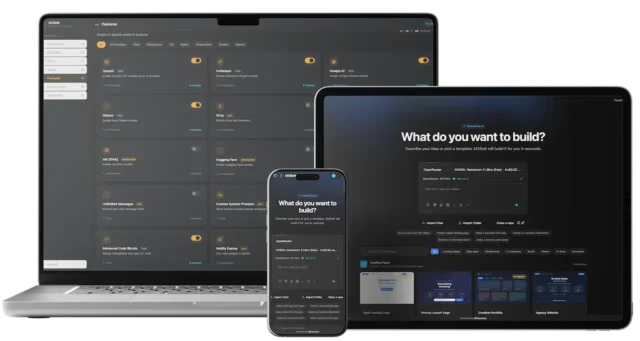
AI Integration Services
Existing AppsCRMsERPsHelpdesksOnline Stores
Miracuves adds AI to software you already run - your web or mobile app, website, CRM, ERP, helpdesk, online store or internal tools - without rebuilding it. We choose the feature worth shipping first, route every call through a model gateway so providers can be swapped, cap the running cost, mask personal data and hand over 100% of the code.
- 9,000+ projects since 2010
- Keys in your name
- 100% source ownership
- NDA before access
- Existing systemsApps, CRMs, ERPs, helpdesks, stores
- Model gatewayProviders swapped in configuration
- 2-8 WeeksCustom integration; larger scopes quoted
- Cost capsA monthly limit per AI feature
- PII maskedBefore text leaves your system
Your API Keys
Provider accounts in your name
NDA Day One
Signed before system access
Full Source Code
Gateway, prompts and evals
60-Day Support
Production watched after go-live
100% IP Ownership
Assigned at project start
Reviewed on Clutch
Third-party client reviews




Miracuves provides AI integration services for teams that already run software: we add search, summaries, drafting, classification, extraction or an assistant to your existing app, website, CRM, ERP, helpdesk or store without rebuilding it. Every call runs through a model gateway with cost caps, provider fallback and PII masking. Custom work takes 2-8 weeks, scoped in writing, and you own 100% of the code.
Our integration approach
How Miracuves adds AI to software you already run - without a rebuild
An AI integration starts with your product, not with a model. We read how your app, CRM or helpdesk already stores records and handles permissions, then add one AI feature where people already work: a summary on the ticket screen, a drafted reply inside the CRM, a search box in the store that understands what shoppers mean. Your database, login and existing screens stay as they are.
Every model call goes through a small gateway service we add beside your system. It holds the prompts, masks personal data, enforces rate limits and a monthly cost cap, logs each request and moves to another provider when one is slow or down. Swapping OpenAI for Claude, Gemini or a self-hosted Llama model becomes a configuration change, not a rewrite of your application.
Who this service is built for: Product and engineering leads who already run software with real users - a SaaS product, a mobile app, a WordPress or Shopify store, a Salesforce or HubSpot CRM, an ERP, a Zendesk helpdesk or an internal tool - and want to integrate AI into that existing app rather than replace it. Starting a new AI product from zero? Our AI development page is the better fit. If your vendor's own AI add-on already does the job, we will say so before you pay for custom work.
- Feature shortlist: each candidate scored on usage, data access and risk before anything is built
- Model gateway: one internal API between your app and every AI provider
- Scoped data access: read-only service accounts, user permissions respected, PII masked
- Cost control: rate limits, response caching and a monthly cap per feature, with alerts
- Evaluation set: real examples from your own system, scored before and after every prompt change
Why integrate AI with Miracuves
- Custom AI integration2-8 weeks
- Model providersSwappable via gateway
- Your existing systemKept, not rebuilt
- Provider accounts and keysIn your name
- Running cost per featureCapped and logged
- Code, prompts, eval sets100% yours
"A helpdesk integration of this kind adds ticket summaries and drafted first replies inside the agent's existing screen, reading plan details from the CRM. What it targets: an agent approves or edits every draft, no customer email or phone number reaches the provider unmasked, and if every provider fails the sidebar simply hides and the helpdesk works as it did before."
No product yet?
Ready-made AI products - if you are starting from zero
This page is for software you already run. With nothing to integrate into yet, three ready-made AI products ship in 6 working days, and three more catalog platforms show where AI is usually added.
Browse all 90+ ready-made solutionsChatGPT Clone
Your own branded AI chat assistant with multi-language support and API access, ready to put in front of your users.
Bolt.new Clone
Prompt-to-app builder with many LLM providers behind one model picker and credit metering for AI spend.
HeyGen Clone
Script to avatar-presented video, translated versions and exports, with API metering in the admin.
Amazon Clone
Multi-vendor marketplace whose AI module drafts product copy, SEO text and image alt text on your own OpenAI key. Meaning-based product search and review summaries can be added after launch as custom work.
Byjus Clone
Learning platform whose page lists AI-powered progress analytics and AI study plans. An AI tutor over your own lessons, or quiz drafting for teachers, is custom work.
Practo Clone
Doctor booking and teleconsultation; its page lists an AI symptom checker and a Health AI chatbot add-on. Visit-note summaries and intake assistants are custom AI work with a clinician in the loop.
Honest noteThe ChatGPT, Bolt.new and HeyGen products are AI products end to end. The Amazon, Flipkart and Etsy bases also ship an AI catalog-copy module that runs on your own OpenAI key. Any AI a product page does not list, and any system you already run, is custom integration work of 2-8 weeks, scoped in writing. If your CRM or helpdesk vendor's own AI add-on already covers the task on your plan, we will point you to it before you spend on custom work.
Integration options
Custom AI integration vs vendor AI add-on vs in-house build - which fits your system?
Many CRMs, helpdesks and store platforms now sell their own AI add-on, and some teams can wire a model in themselves. This is how the three routes compare when AI has to work inside software you already run.
Custom AI integration
Built into your own system
Vendor AI add-on
Your CRM or helpdesk's own AI
In-house build
Your engineers, from scratch
The feature needs data from more than one system · you want to choose and switch model providers · personal data must be masked or kept in your own cloud · you need per-feature cost caps and request logs you can audit.
Your helpdesk or CRM vendor's AI add-on already does the job on your current plan · the feature lives in one tool and needs no outside data · your own team has the time and AI experience to own it. Ask us which route fits →
AI integration guide
What to know before you hire an AI integration company
This page is for teams that already run software. These are the questions to settle before any AI feature goes into it: which feature, which provider, what data, what it costs to run and what happens when it fails.
Which AI feature should you add to your existing app first?
Pick the task where people already spend time on repetitive text work and where a wrong answer is cheap to catch before it matters. Six kinds of feature cover most briefs to add AI to software that is already live:
- Search: find products, tickets or documents by meaning rather than exact words, often backed by retrieval over your own content.
- Summaries: a ticket thread, call transcript or long CRM history reduced to five lines.
- Drafting: first replies, product descriptions or follow-up emails that a person approves.
- Classification: routing tickets, scoring leads or flagging risky orders.
- Extraction: pulling fields from invoices, forms and emails into your ERP, a job for NLP as much as for chat models.
- Assistants: a chat panel that answers from your data and, as an AI agent, takes permitted actions.
Why route AI calls through a model gateway instead of calling OpenAI directly?
Calling one provider's API straight from your app is fine for a prototype. It becomes a problem when prices change, a better model appears, the provider has an outage or a customer asks where their data went. A gateway is a small service between your app and every provider: your code calls one internal endpoint, and the gateway picks the model, applies the prompt version, masks personal data, counts tokens and logs the result.
The practical gain: moving from OpenAI to Claude, Gemini or a self-hosted Llama model, or splitting traffic between them, becomes a configuration change tested against your evaluation set. Without a gateway, every model change means editing and redeploying application code in several places.
How does AI in your CRM or ERP read data without exposing it?
The integration gets its own service account with the narrowest scopes the system allows, read-only unless the feature must write back. Where the platform supports it, queries run as the signed-in user, so a sales rep's assistant never sees records their role cannot open.
Before any text leaves your infrastructure, the gateway masks names, emails, phone numbers and card or ID numbers, and restores them in the answer where needed. Provider accounts are opened in your company's name, and we review each provider's current data-use terms with you before go-live. Where regulation or a customer contract rules out an outside provider, the same gateway points at an open model in your own cloud. We build to the controls GDPR or HIPAA require; certification stays with your own audit.
What does an AI integration cost to run each month, and how do you cap it?
Running cost is separate from the build. Hosted models bill per token, so the monthly bill depends on how many users trigger the feature, how much text each call sends and which model answers. Long CRM histories pasted into every prompt are the usual reason a first invoice surprises a team.
We keep it predictable four ways: send only the fields the task needs, cache repeated answers in Redis, route simple jobs such as tagging to a smaller model and save the larger one for drafting, and set a hard monthly cap per feature with alerts well before it is reached. Before you commit, we estimate the monthly running cost in writing from your real volumes.
What happens when the AI provider is slow, down or wrong?
Treat the model as an outside dependency that will sometimes fail. Every call has a timeout. When a provider times out, returns a rate-limit error or goes down, the gateway retries once and then moves to the next provider on the route. If all of them fail, your app shows the screen it showed before the integration, so work carries on without AI.
Wrong answers need a different guard. Output is checked against a schema before your app uses it: a ticket category must be one of your categories, an extracted amount must be a number. Anything that writes to a customer record or sends a message waits for a person's approval until the evaluation scores show it can run on its own.
How do you evaluate an AI API integration company before you sign?
Ask how they will test the feature on your data, not for a chatbot demo. A credible AI API integration company answers these in writing. If you are still deciding what to build at all, start with AI consulting instead.
- Which examples from your own system go into the evaluation set, and what score counts as ready?
- Can you switch model providers without touching application code?
- Whose name are the provider accounts and API keys in?
- How are personal data, rate limits and monthly cost caps handled?
- What is handed over - code, prompts, evaluation sets, runbooks - and can your team change a prompt without calling them?
Integration architecture
How the AI layer sits beside your existing system
Your application never talks to a model directly. It talks to an integration layer we add beside it, and that layer owns everything that changes often: prompts, providers, limits and logs. Three decisions shape it.
- 01
Gateway - one endpoint, many providers
Your app calls one internal endpoint per feature, such as /summarize-ticket. The gateway maps it to a versioned prompt and a provider route - for example OpenAI first, Claude as fallback, a self-hosted Llama model for records that must stay in your cloud. Each route carries its own timeout, retry rule and token budget.
- 02
Data access - scoped reads, masked text
Connectors read from your CRM, ERP, store or database through their official APIs with read-only service accounts. Permission checks run before retrieval and a PII filter runs before the prompt is built, so the model only sees what the requesting user is allowed to see, with names and contact details masked.
- 03
Output handling - validated before your app uses it
Responses come back as structured JSON and are checked against a schema. Invalid output is retried once, then routed to a person or dropped in favor of the rule-based path your app already had. Every request, response, cost and latency figure is logged for audit and feeds the evaluation set.
Provider API keys shipped in frontend code. The whole customer record pasted into every prompt. No timeout, so one slow provider freezes checkout or the ticket screen. No budget, so a loop or a scraper runs up the bill overnight. Prompts edited in production with nothing to test them against. Each is cheaper to prevent in week one than to discover on the first invoice.
# Model gateway: one call site, swappable providers# Pattern Miracuves adds beside an existing backendfrom gateway import providers, budget, redact, log_callfrom gateway.errors import Timeout, RateLimited, ProviderDownROUTE = ["openai:main", "anthropic:main", "local:llama"]async def complete(feature: str, prompt: str, tenant: str): budget.check(feature, tenant) # monthly cap per feature safe = redact(prompt) # emails, phones, IDs masked for target in ROUTE: try: out = await providers[target].call(safe, timeout=8) log_call(feature, target, out.usage) return validate(feature, out.text) # schema check except (Timeout, RateLimited, ProviderDown): continue # next provider return fallback(feature) # app works without AIWays to work with us
Three ways Miracuves adds AI to your product
Every engagement is contracted with Miracuves as a company: integration, backend and QA engineers working to one written scope, with provider accounts and code held in your name. Pick the model that fits where your product is today.
Ready-Made AI Product
For teams with no software to integrate into yet: Miracuves deploys the ChatGPT clone, the Bolt.new clone or the HeyGen clone under your brand, with its user apps and admin panel, in 6 working days. AI features beyond the base product are custom work.
- Catalog from $2,199; each AI product priced on its page
- Three ready-made AI products to choose from
- Your brand, domain and configuration applied
- Admin panel included with every delivery
- Full source code · NDA · 60-day support
Custom AI Integration
Miracuves adds one or more AI features to software you already run - the gateway, connectors into your systems, prompts, the evaluation set and the screens where users see the result. Integration, backend and QA engineers with one project lead.
- Written scope and running-cost estimate before any payment
- Works with your existing codebase, CRM, ERP or store
- Weekly demo on your staging environment
- Provider accounts and API keys in your company's name
- Code, prompts and eval sets · IP 100% yours
AI Integration Care
After launch, Miracuves keeps the integration healthy: tuning prompts against the evaluation set, moving features to newer or cheaper models, watching the cost and error dashboards and adding your next AI feature.
- From $2,299/month, with 2 weeks notice to cancel
- Monthly cost and quality report per AI feature
- Provider changes tested before users see them
- Direct line to the engineers who built it
- Hours scale up or down as features grow
Quality Standards
How Miracuves checks an AI integration before your users see it
An AI feature can pass every normal software test and still return a bad answer. So each integration clears two kinds of check before handoff: the usual engineering checks on the gateway and connectors, and quality checks on what the model actually returns for your own data.
- Evaluation set - real examples from your system, scored for each featureEvaluation
- Prompt versioning - every prompt change re-scored before releasePrompts
- Output schema checks - invalid model output never reaches your databaseValidation
- PII masking tests - seeded personal data checked in every outgoing requestPrivacy
- Timeout and fallback drills - each provider failure simulated on stagingResilience
- No keys in client code - provider keys held only in server-side secretsSecurity
- Cost and latency dashboards live before launch, with cap alertsDelivery
Enforced QA Gates
Six gates before an AI feature goes live
Every connector, prompt and gateway rule has to clear all six gates before the integration is switched on for real users.
Review on Connectors and Gateway
A senior Miracuves engineer reviews every change to the gateway, the connectors into your systems and the prompt files. Any change that gains write access to a CRM, ERP or store record gets a second reviewer.
Scored Against Your Evaluation Set
Each feature runs over an evaluation set built from your own tickets, records or products, and you see the scores. A prompt or model change that lowers the agreed score does not ship.
Load and Rate-Limit Tested
Realistic traffic is replayed through the gateway to confirm timeouts, queueing and provider rate limits behave, and that the pages and endpoints you already had stay as fast when the AI is slow.
Handover Package, Not Just a Repo
Source code, prompt library, evaluation set with scores, gateway configuration, the list of connector credentials, the running-cost model, an outage runbook and a short guide to editing prompts safely.
Staged Rollout Behind a Flag
The feature goes live behind a feature flag: internal users first, then a share of real users, then everyone. The same flag is the off switch if anything looks wrong.
60 Days of Watched Production
Through the 60-day support window we track cost per feature, error and fallback rates, latency and how often people edit or reject AI drafts, and fix issues before they spread.
Technology Stack
The integration stack Miracuves works with
Chosen to match the language and cloud your system already runs on - we add a layer beside your code, not a new platform under it.
Our Process
From first call to AI inside your product - step by step
Every AI integration follows five steps. You always know which of your systems we need access to, what is being built that week and how the feature scores on your own data. The 6-day figure belongs only to ready-made platforms; integrations into your software run on milestones within 2-8 weeks.
- Step 01
Brief & NDA
Tell us the system and the task on WhatsApp. NDA signed before any document or system access is shared, then a call on your stack.
- Step 02
Feature & Scope
One feature chosen, data access mapped, running cost estimated. No payment before scope is agreed.
- Step 03
Gateway & Build
Gateway, connectors and prompts built against your staging copy, with a weekly demo on your data.
- Step 04
Evaluate & Harden
Scored on the evaluation set, PII and fallback drills run, load tested against your traffic.
- Step 05
Rollout & Handoff
Released behind a flag, code and prompts handed over, then 60 days of active support.
Integration time depends on access to your systems
Most calendar risk sits in access, not in code: a sandbox or staging copy of your CRM, ERP or store, API credentials with the right scopes, provider accounts in your company's name, and a person who can say whether an AI answer is right. We send the full access list after the first call so you can start on it straight away.
Transparent Pricing
What AI integration services cost at Miracuves
Integration prices can be named early because the drivers show up on the first call: how many systems the AI touches, whether it only reads or also writes, and how its output is checked. No hidden fees after scope is agreed.
Ready-Made Platform
$2,199 from
Fixed price · 6 day delivery · no product needed yet
- Any of 90+ catalog platforms
- AI-first products: ChatGPT, Bolt.new, HeyGen
- Your brand and domain applied
- Full source code at handoff
- 60-day post-launch support
- Custom AI features quoted separately
Custom AI Integration
Custom Quote
Scoped in writing · milestone billing
- Integration, backend and QA engineers
- Built into your existing software
- Gateway with fallbacks and cost caps
- Evaluation set scored on your data
- Code, prompts and eval sets transferred
- Milestone billing as features land
AI Integration Care
$2,299 /mo
Monthly retainer · 2 weeks notice to cancel
- Prompt tuning against your eval set
- Model and provider updates tested first
- Monthly cost and quality report
- Your next AI feature each cycle
- Direct access to the integration team
- All code and prompts stay yours
Why Miracuves publishes pricesAn integration price you can see early lets you compare it honestly with switching on your vendor's AI add-on or building it in-house. If your scope needs more, we name the system, connector or review step that drives the extra cost.
What affects AI integration cost at Miracuves
A ready-made platform keeps its fixed catalog price while your scope matches the base. A custom integration scales with: the number of systems the AI reads from or writes to, how complete and documented their APIs are, whether output is only shown to people or written back into records, how many features share the gateway, the evaluation and human-review work each feature needs, and whether any model must be self-hosted.
Typical AI integration budget ranges
- Ready-made platformfrom $2,1996 days; each AI product is priced on its own page
- Custom AI integration$8,000-$25,0002-8 weeks depending on scope
- AI integration carefrom $2,299/month for tuning, model updates and new features
Every integration quote is written before payment, with the monthly model running cost estimated alongside it.
Example engagement
What an AI integration looks like at Miracuves
An illustrative example of a typical project of this kind, with client details anonymized. Figures show what this kind of build targets, not a named client's results.
A B2B software company runs Zendesk for support and HubSpot as its CRM. Agents re-read long ticket threads and look up each customer's plan in the CRM before replying. The goal: AI inside the existing helpdesk screen, with no new tool for agents to learn.
- 01
The Challenge
Threads run long, the customer's plan and history sit in the CRM, and the quality of first replies depends on who is on shift. The helpdesk's own AI add-on can summarize a ticket but cannot see CRM data, and customer emails and phone numbers must not reach an AI provider unmasked.
- 02
What Miracuves Builds
A gateway service beside the helpdesk, read-only connectors to both systems, a ticket summary and a drafted first reply in the agent's sidebar, PII masking before every call, OpenAI as the primary provider with Claude as fallback, and a monthly cost cap with alerts.
- 03
What the Build Targets
An agent approves or edits every draft before it is sent. The evaluation set comes from past tickets, with the ready score agreed in writing. If both providers fail, the sidebar hides and the helpdesk works as before. Code, prompts and the evaluation set are handed over at the end.
- Integration typeHelpdesk + CRM AI features
- Example timeline6 weeks
- Models routedOpenAI · Claude as fallback
- Systems connectedHelpdesk · CRM (read-only)
- Human reviewEvery drafted reply
- Source code100% client-owned
Client Reviews
What clients say about connecting their own systems
Named Miracuves clients, in their own words. They built products with us rather than buying this exact service, but each one connected its own data, model or system to something that already existed - the same move an AI integration makes. Read every testimonial on our client testimonials page.
"Appointments, doctor profiles and consultations were all ready. What we needed on top was the pharmacy side: prescriptions flowing to fulfilment, and stock the clinics could actually see."
"We were running client management and invoicing by hand alongside the register. Miracuves deployed and configured WHMCS against our own workflow and connected it to the registry, so a registration and its billing are one record now. A short, contained piece of work that removed a recurring monthly chore."
"Live GPS tracking, bookings, driver and customer apps and the admin dashboard were all in place. We reshaped the workflows to our bid-and-ride model and wired in our own payments and notifications. Live inside a month on infrastructure that was already proven."
Why Miracuves
Six places to check us before you ever call us
Each one is either run by someone else or open to anyone. Check them in any order; the whole list takes about a minute.
Why clients choose MiracuvesCompany registration
Miracuves Solutions Pvt. Ltd., CIN U62099MH2023PTC406639. Search the CIN on the Ministry of Corporate Affairs portal.
mca.gov.in 02Every number, sourced
Projects, clients, prices and timelines, each one defined and sourced on our public facts ledger.
miracuves.com/facts 03Reviews on Clutch
Client reviews published by Clutch, an independent B2B review platform, not by us.
clutch.co 04Reviews on GoodFirms
A second, separate review platform. Read what clients wrote there too.
goodfirms.co 05The product itself
Web app, admin panel and APK with printed credentials. Try the real thing before a single call.
miracuves.com/solutions 06Clients, by name
Named clients describing their launches, in their own words.
miracuves.com/client-testimonialsThree promises we would stake the company on
Every promise on this site rests on these three. Each one is something you can check, not something you have to take on trust.
01People you can name
Our leadership is public, with real LinkedIn profiles, not a stock-photo team page. A named team works your build and sends you progress on WhatsApp every working day.
Meet the leadership02Proof over promises
Every number we publish, pricing, timelines, project counts, is defined and sourced on a public facts ledger. If we can't back a claim, we don't make it.
Read the facts ledger03A process with a deadline
Ready-made platforms go from kickoff to live deployment in 6 working days, guaranteed: miss it for reasons on our side and we work free until launch. Custom builds get a fixed quote after a free feasibility study.
Get a feasibility study
Industries
Industries we build AI integrations for
Where the records live, and the rules on who may see them, change by industry. These pages show where AI features usually plug in for each one.
Healthcare & Life Sciences
AI inside EHR and clinic software: visit-note summaries, intake extraction and coding suggestions, with a clinician approving.
View industryTelemedicine
Pre-visit intake chat and post-call summaries added to the video and booking tools you already run.
View industryFintech
Document extraction, support replies and transaction tagging wired into your core systems, with every call logged for audit.
View industryRetail & E-commerce
Meaning-based search, product copy and review summaries added to Shopify, WooCommerce or a custom store.
View industryMedia & Entertainment
Auto-tagging, transcripts and moderation queues connected to your existing CMS and upload pipeline.
View industryCreator Economy
Caption, script and reply drafting inside the creator dashboard you already operate.
View industryTransportation & Mobility
Dispatcher assistants and trip-issue triage added to current dispatch and support tools.
View industryFood & Beverage
Menu Q&A, order-issue triage and review summaries connected to your ordering and POS data.
View industryRelated Services
Other AI services that sit next to an integration
An integration touches your backend, your data and often a chat or voice channel. These are the services that usually work alongside it.
Frequently Asked
Questions about AI integration services
Something not covered here? Ask on WhatsApp and you will usually have an answer within two hours.
Ask us directlyCan you add AI to our existing app without rebuilding it?
Yes, that is what this service is for. We add a gateway service beside your current backend and connect it through your existing APIs, so your database, login and screens stay as they are. The only changes inside your app are the new AI touchpoints, such as a summary panel or a draft button, and each one sits behind a feature flag you can switch off.
How much do AI integration services cost at Miracuves?
If you have no product yet, a ready-made platform from our catalog starts from $2,199 and ships in 6 working days; the AI products are priced on their own pages. A custom AI integration into software you already run typically costs $8,000-$25,000 and takes 2-8 weeks, depending on how many systems the AI reads from or writes to, how its output is checked and whether any model is self-hosted. Ongoing AI integration care starts from $2,299/month. Every quote is written before payment, with no surprise invoices after kickoff.
Which systems can Miracuves integrate AI into?
Web and mobile apps built by us or by others, WordPress and WooCommerce sites, Shopify stores, CRMs such as Salesforce and HubSpot, helpdesks such as Zendesk, ERPs with a usable API, internal tools, and channels such as Slack and WhatsApp. If a system offers an API, webhooks or a database we can read safely, it can usually take an AI feature.
Do we need our own OpenAI or other AI provider account?
Yes, and we recommend it. Provider accounts and API keys are opened in your company's name, so usage is billed to you directly and access stays with you if you ever change vendors. We configure the accounts, set spending limits on the provider side as well as in our gateway, and keep keys only in server-side secrets.
Can you integrate ChatGPT into Slack, WhatsApp or our website chat?
Yes. ChatGPT integration for business usually means calling the same OpenAI models through the API, grounded in your own content, inside a channel your team or customers already use. For a customer-facing assistant with handoff to a person, see our chatbot development service; for phone calls, see AI voice agents.
What do you need from our side to start?
A named owner who knows the workflow, access to a staging or sandbox copy of each system involved, API documentation or credentials with the right scopes, a few dozen real examples of the task done well, and the provider accounts, which we can help you open. Missing access is the most common cause of delay, so we send the full list after the first call.
Who owns the code, prompts and evaluation sets after handover?
You do, completely. The gateway code, connectors, prompt library, evaluation set with its scores and all configuration are transferred to your repository, and an IP assignment is signed at the start of the project. Your engineers can change a prompt, add a provider or retire a feature without needing us.
Will adding AI slow down our existing app?
It should not, and we test for it. AI calls run in the background wherever the screen allows, every call has a timeout, and answers stream in where users wait for them. Before launch, load tests replay your real traffic through the gateway to confirm that the pages and endpoints you already have keep their current speed.
Where is Miracuves based, and how do you work across time zones?
Miracuves is headquartered in Mumbai, India, with a presence in New York, and delivers integration work remotely. Since 2010 the company has delivered 9,000+ projects for 6,000+ clients in 20+ countries. First response is under 2 hours, Mon-Sat 10:00-19:00 IST, and the weekly demo is booked in a slot that suits your team.
Can you take over an AI integration another team started?
Yes. We begin with a short review of the existing code: where API keys live, how prompts are stored, whether calls have timeouts and budgets, and how personal data is handled. You get a written list of fixes ordered by risk. Most takeovers move the existing calls behind a gateway first and add an evaluation set before any new feature is built.
Get Started
Ready to add AI to the software you already run?
Tell us which system you run and the task you want AI to take on. We will confirm the right first feature, the provider route, the monthly running cost and the timeline in writing, before you commit to anything.
NDA signed before you share system access or data
Page reviewed by the Miracuves AI Integration Team · Last updated September 2026 · Clutch & Google Reviews
