
Key Takeaways
- Coaching data is more intimate than ordinary app data. A food diary, a weight trend and a private chat with a coach together describe a person’s habits, body and worries, so the damage from a leak is personal, not just financial.
- Most real incidents are access mistakes, not hacks. A coach who can open every member, a session that never ends or an export nobody audits causes more harm than an exotic exploit.
- Identity must come from the server. The safest builds take the user from the session and re-check role and ownership on every action, never from a value the app sends.
- The AI coach is a data path, not just a feature. Decide what it can see, show members that list, cap its daily use and treat its replies as general guidance, not medical advice.
- Export and deletion are part of security. A member who can download their data and ask for deletion, with a window to change their mind, turns a vague privacy promise into a workflow you can show.
- Card numbers should never reach your platform. Hand payment to the processor, store only references and verify every webhook signature before a plan changes.
- An audit trail answers the hard question. When something looks wrong, a log of who changed a price, plan or payout tells you what happened in minutes.
- Launch week is a short operator checklist. Move staff onto named accounts, confirm where the database lives and prove a backup restores before the first real member signs up.
Open any weight-loss coaching app on a member’s phone and you are looking at a diary of a person’s week: what they ate at midnight, how much they weighed on Monday, which days they skipped, and the message they sent their coach after a bad day. Apps in the style of Noom collect exactly this kind of record, and members hand it over because the coaching only works if it is honest.
That is why the question in the title deserves a better answer than a badge or a checklist copied from a banking app. Safety in this category is about who can see what, for how long, and what happens when a member wants their data back. This guide walks through the coaching-specific risks, the controls that address each one, and a checklist you can use whether you buy, build or commission an app.
If you are weighing a launch, the ready-made route is described on our page for a ready-made weight-loss coaching app. Here we stay on the security question and use the MXHealthy build as the worked example, citing only documented controls.
Why Coaching Apps Need a Different Security Mindset
A typical shopping app protects a card number and an address. A coaching app protects a story. The sensitivity comes from combination: a single weigh-in means little, but a year of weigh-ins beside food logs, mood notes and chat threads describes a life. Anyone who obtains that combination, whether an attacker, a curious employee or an advertiser, learns things the member never meant to share widely.
Three features of the category raise the stakes. First, members are often emotionally invested and may disclose more than they would in a forum. Second, coaches are human and need real access, so the design has to limit them without blocking their work. Third, an AI coach reads the member’s day to answer questions, which creates a new route for data to travel.
The commercial side matters too. A coaching business lives on trust and renewals, a point we explore in our look at how the coaching business model earns its revenue. One public incident can undo a lot of acquisition spend, so security belongs in the business plan, not only in the engineering backlog.
Think in layers, not features
Useful security thinking for this category has four layers: who the user is, what they may touch, where their data travels, and how you prove all of it afterward. The rest of this guide follows that order.
What a Weight-Loss Coaching App Actually Stores
Before choosing controls, list what you hold. Operators are often surprised by how much a coaching product accumulates in a few months. The table below groups the main data types, explains why each is sensitive and states who should be able to read it.
| Data type | Why it is sensitive | Who should see it |
|---|---|---|
| Food diary and meal photos | Shows habits, routines, cultural and religious eating patterns, and sometimes disordered eating signals | The member, and the assigned coach |
| Weight, measurements and trend | Body data that many people hide from family; a leak can cause shame or discrimination | The member, and the assigned coach |
| Private coach chat | Free text where members disclose stress, health worries and family details | The member and the coach in that thread |
| AI coach prompts and replies | Questions typed to a machine feel private and can include anything | The member; operators only through deliberate, audited tooling |
| Screening answers and risk band | A questionnaire result that can imply a health condition | The member, plus the named reviewer who handles escalations |
| Account identity and sessions | The key to everything above; takeover exposes all of it | The member; hashed secrets visible to no one |
| Plan, billing and order records | Reveals what the member pays for and when | The member and the operator’s finance staff |
Notice how few rows have a broad audience. The design goal is a short list of readers for every row, enforced by the application rather than by a policy document that people forget.
The Regulatory Reality Check, Without the Alphabet Soup
Founders often ask which certificate they need. The honest answer is that it depends on your market, your buyers and what you claim, and a product page cannot settle it for you. What you can do is understand the direction of travel. In the United States, the Federal Trade Commission has stated that its Health Breach Notification Rule reaches health apps, and that an unauthorized disclosure of health information to a third party can count as a breach, not only a hack. You can read the agency’s own explanation in its business guidance on the updated rule and the final rule in the Federal Register.
The practical lesson is simple. Sharing member data with advertising or analytics partners without clear consent is a legal and reputational risk in its own right, even when nobody breaks in. A coaching app should therefore send as little member data to third parties as possible, and the operator should know every outside service that receives any.
MXHealthy makes no certification claim, and neither should an operator who has not earned one. What it offers is a documented set of controls, mapped against the OWASP Top 10 risk list, plus export and deletion workflows that support privacy requests. Your own counsel decides what your local rules require, and responsibility for local health-claim and data-protection compliance stays with the operator.
Third-party tools are data paths too
Analytics kits, advertising pixels and crash reporters are easy to add and hard to remove. In a coaching app each one can quietly carry event names, screen titles or identifiers that reveal what a member is doing. A member who opens the weight screen and triggers a tracking event has told a third party something about their body. Keep a written inventory of every outside service, record what each receives, and prefer a short list. The MXHealthy build is designed with a deliberately small footprint: one database, one weekly scheduled task, one payment webhook and no queue or search service, so there are fewer places for member data to wander.
That small footprint is also an advantage when you answer a partner’s questionnaire. A short architecture is easier to describe, easier to review and easier to defend than a sprawl of services that nobody on the team can list from memory.
Account Takeover: Guarding the Front Door
Every piece of data in the previous table sits behind a login, so account takeover is the first risk to close. Attackers use reused passwords from other breaches, guess common ones, or trick members into handing over codes. The defenses are well understood, and the useful question is how a build applies them.
Passwords and sessions
In the MXHealthy build, passwords are hashed with a current key-derivation scheme plus a unique salt for every record, so there is no plaintext copy anywhere. The session lives in an HTTP-only, same-site cookie, which means scripts in the page cannot read it, and no session tokens sit in browser storage where injected code could lift them. Each session also checks whether the account is active, paused or canceled, which stops a canceled member from carrying on with an old login.
Why server-side status checks matter
Because identity is read from the server session and roles are checked on every action, a change an operator makes in the console is enforced by the server itself. Pause a member, cancel an account or remove a coach’s role, and the next request is judged against the new state. Nothing depends on the app hiding a screen or on a member closing their browser.
Social sign-in
The platform supports Google and Apple sign-in once the operator supplies those credentials. Social sign-in can reduce weak passwords, but it moves part of the trust to the identity provider, so keep the keys in environment settings and rotate them if a team member leaves.
Coach Access Scope: The Quiet Risk
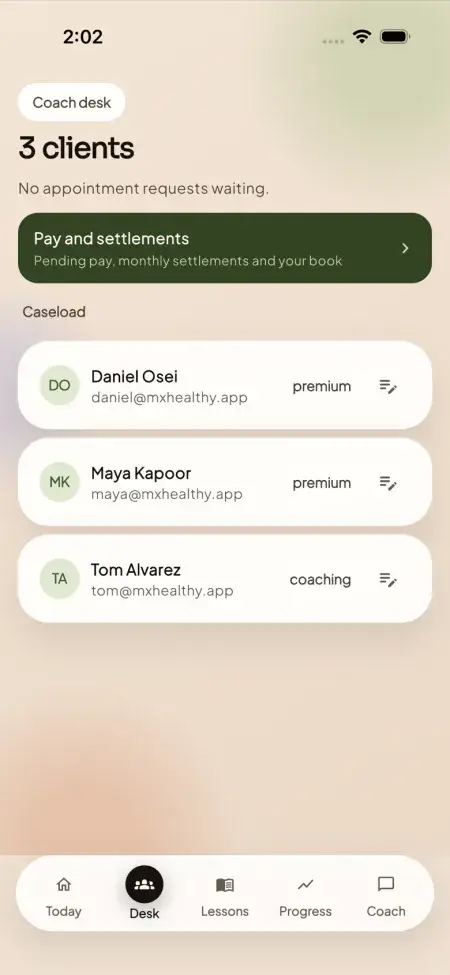
In a coaching product the largest internal risk is rarely an outside hacker. It is an over-broad permission. If every coach can open every member, one curious employee or one stolen coach login exposes the whole base. The control that matters is object-level scoping: a coach sees the members assigned to them and nobody else.
MXHealthy models this with three roles, member, coach and admin, and a caseload link that ties each member to a coach. Reads for a coach are limited to that caseload, and members see only their own rows. Identity always comes from the server session rather than from anything the app sends, and the role is checked on both the page and every action behind it. That second check is the one weaker builds skip: hiding a button is not a permission.
Questions to ask about coach access
- Can a coach open a member who is not on their caseload by editing a URL or an ID?
- What happens to access when a coach is reassigned or leaves?
- Are notes and chat history visible to the next coach, and is that a deliberate choice?
- Does the operator console show who changed a coach’s rate or assignment?
The last question links to a theme we return to below: an audit trail. For a deeper look at who owns the data once coaches and clinics are involved, see our guide to nutrition app security and data ownership.
Private Chat and the AI Coach
The chat thread is where members are most candid, so it gets the same scoping as the rest of the record: a member and their coach in a thread, and nobody else by default. The AI coach adds a second reader, and here a few specific design choices decide whether members can trust it.
Show members what the coach can see
MXHealthy includes a transparency panel that lists exactly what the AI coach can read when it answers, such as calories, protein, water and the weight trend. Disclosure of this kind removes a common worry. A member who knows what the coach reads can decide what to type with confidence. The AI coach gives general guidance and is not medical advice, and the interface says so beside the conversation.
Cap the spend and the exposure
The platform enforces per-member daily limits on AI calls and tokens, with a graceful message at the cap. Caps protect your bill, and they also limit how much data an abused or compromised account can push through the AI path in a day. The operator connects and pays for the AI provider and chooses which one, so read that provider’s data terms before launch and tell members plainly that an outside service processes their questions.
Treat prompt content as untrusted
Anything a member types can contain instructions aimed at the model. The OWASP project describes this as prompt injection and recommends layered defenses: constrain the model’s role, validate its output with ordinary code, apply least privilege and treat the model like an untrusted user. For a coaching app that means the AI should only ever receive the data it needs for the answer, and it should never be given the ability to change a plan, a price or another member’s record.
MXHealthy keeps the AI in an advisory lane. Plan, price and payout changes live in the operator console and are written to an audit trail, so a clever prompt has nothing to hijack.
One more point on chat: decide how long conversations are kept and who can search them. A coach who leaves should not carry a private archive away, and an operator who can search every thread needs a reason and a record. Settle these rules while the member base is small, because they are far harder to impose later.
Food Diary, Weight Data and Uploads
The diary and the weight trend are the heart of the product, and the same principles apply: server-side ownership checks, parameterized queries and careful handling of anything a member uploads. MXHealthy reads and writes through parameterized SQL everywhere, which removes the most common route to injecting commands into the database. The web layer escapes user content by default, and the platform renders no raw HTML from member input, which closes the usual script-injection door.
Uploads deserve their own attention because meal photos and profile images are files from strangers. The build checks the file type against an allow-list, enforces a size ceiling and normalizes the image. Every file is served through a route that checks authorization first, so a guessed link does not open someone else’s photo. As volume grows, media can move from the database to object storage on the documented scale path.
Weight data gets one extra consideration: presentation. The weekly-average trend view shows direction without fixating on a single reading, which is kinder to members and also reduces the temptation to screenshot and share a raw number. It is a design choice, not a security control, but it shows how trust and safety overlap in this category.
Payments: Keep Card Data Out of the Platform
Payment security is a short topic when the architecture is right. Card numbers never touch the platform; the build stores provider references only, and plans, trials and store orders are charged through the operator’s own Stripe account. Each webhook arrives with a signature that the platform verifies before a plan changes, and processing is idempotent by reference so a repeated event cannot grant a plan twice. The weekly cron task is protected by a shared secret compared in constant time.
Operator-entered keys, such as the payment and AI provider keys, are shown masked once saved, while deployment secrets stay in environment settings, not in the database or the code. Payment methods and local currency handling are a separate topic, so we leave them to other guides in this series.
Export, Deletion and Audit: The Controls Members Notice
Members rarely read security documents, but they notice whether they can leave. Two workflows turn privacy from a promise into a feature. The first is a self-service export of a member’s data as a JSON file, controlled by a feature switch and recorded in the audit log. The second is an account deletion request where a grace window lets the member change their mind, so an impulsive tap does not destroy a year of history and a genuine request is still honored.
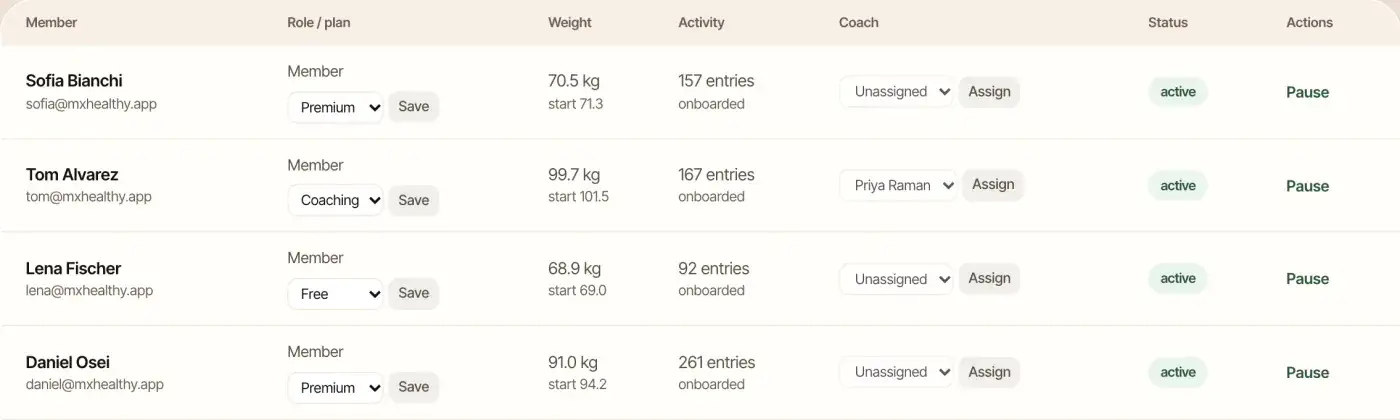
These workflows support privacy requests; they do not replace legal advice. They give you something concrete to show a member, a partner or a regulator who asks how requests are handled.
The operator audit trail
The console records the actor, the action and the detail whenever someone changes a plan, a price, a payout, a feature switch, a product, an order or a screening. Month-close records are frozen once finalized, and clinical reviews are attributable to the person who made them. This matters most on the bad day. When a price looks wrong or a payout is disputed, an audit trail turns a long argument into a lookup.
A small detail with large effect: screening escalations pass through a named reviewer and carry a timestamp and a note. The platform does not diagnose anyone and does not claim to, and the clinical review of escalations stays with the operator’s team.
Common Security Mistakes in Coaching Apps
Reviewing how weight-loss programs get into trouble, the same handful of mistakes appear again and again. None of them requires a skilled attacker, which is exactly why they are worth a section of their own.
One shared admin login
A single login that three staff members share destroys the audit trail, because the log shows a name that belongs to nobody. Give every operator their own account and remove it the day they leave.
Coach access that grows by accident
Teams often begin with a small coaching group where everybody sees everything, and the habit survives into a base of thousands. Scope access from the first day, because loosening a rule later is easy and tightening one after a leak is painful.
Demo data left in production
Demo accounts with simple passwords are useful during sales conversations and dangerous afterward. A buyer of a Noom-style coaching product should treat rotation of those logins as the first task on the launch list, not the last.
An AI feature with no limits
Without caps, a stolen member account or a runaway script can push thousands of requests through the AI path and run up the provider bill overnight. Daily per-member limits are a cheap defense, and a clear message at the cap keeps real members informed instead of confused.
Treating privacy as a page
A privacy policy on its own does nothing. The test is whether a member can export their record, ask for deletion and see the result, and whether staff can show the log of what happened. Build the workflow first and describe it second.
An Operator Security Checklist
Use this table when you evaluate any coaching app, including your own. The right column states how the MXHealthy build addresses each item, so you can compare it with whatever else you are considering.
| Area | What to verify | How MXHealthy handles it |
|---|---|---|
| Identity | Server-side identity, hashed secrets, safe cookies | Identity from the session, hashed secrets with unique salts, HTTP-only same-site cookie, no tokens in browser storage |
| Role scoping | Coaches limited to their members, checked on every action | Member, coach and admin roles with caseload scoping, checked on pages and actions |
| Injection | Parameterized queries, escaped output | Parameterized SQL throughout and no raw HTML from member content |
| Uploads | Type, size and authorized serving | Allow-list, size ceiling, normalization and an authorizing route |
| AI coach | Visible scope, limits, advisory role | Transparency panel, daily per-member call and token caps, general guidance only |
| Payments | No card data, signed webhooks | Provider references only, signature-checked and idempotent webhooks |
| Privacy workflows | Export and deletion that work | Audited JSON export and a deletion request with a grace window |
| Accountability | Who changed what | Operator audit trail and frozen month-close records |
| Secrets | Masked and kept out of code | Keys masked after save, deployment secrets in the environment |
What is the operator’s job, not the vendor’s
No product removes the operator’s duties. You choose and pay the hosting, the payment account, the email and push providers and the AI provider. Data residency follows the place where you host the database. You curate the foods, lessons and content, you review screening escalations and you meet your local rules for health claims and data protection. Document these before launch so no one assumes someone else owns them.
Launch Week: The Operator’s Last Mile
The controls above arrive with the product. A few last steps belong to the operator, because they depend on your own team, hosting and providers rather than on the software.
- Replace the demo logins used during evaluation with named accounts for each staff member, and remove access the day someone leaves.
- Choose the region that hosts your database and list who holds its credentials, since that settles data residency and your breach exposure.
- Schedule backups and prove that a restore works. A backup nobody has restored is a hope, not a control.
- Rehearse an incident: who is told, in what order, and what you say to members.
- Review every outside service that receives any member data, including the AI provider, and delete anything you cannot justify.
Run this list again after each major change, and keep a dated record of the answers. A page of notes with names and dates is more persuasive to a partner than any slide about commitment to security.
Founder Decision Signals: Is Your Coaching App Safe to Launch?
Access Is Scoped
Can you show that a coach reaches only assigned members, and that the role is checked on every action, not just on the screen?
Sessions Are Safe
Are cookies HTTP-only, tokens kept out of browser storage and cancelled accounts blocked on every request?
AI Scope Is Visible
Can a member see what the AI coach reads, and is there a daily cap on calls and tokens?
Members Can Leave
Does the app offer a working export and a deletion request with a grace period?
Changes Are Logged
Would you find out within minutes who changed a price, plan or payout last week?
Launch Steps Are Done
Are staff on named accounts, the database location confirmed and a restore test done?
How Miracuves Helps
Miracuves builds the ready-made weight-loss coaching app on MXHealthy, so the controls described above arrive in the product instead of on a wish list. You get Android and iOS apps together, a browser-based member experience, coach tooling plus a 14-area operator console, built with Next.js, TypeScript, PostgreSQL and Flutter, with Stripe for payments and full source code. The fixed one-time price is $3,399, and the ready-made build goes live in 6 working days of Miracuves work, with store review separate.
Custom work, such as a new lesson track or a different coaching tier, typically takes 15 to 30 days and up to 45 to 60 days for larger scope. English and Hindi are included, with Indian foods in the catalog. Optional extras are available as paid add-ons: smart scale and CGM sync, native wearable adapters, live video coaching and group classes, a video lesson studio, a corporate wellness portal and regional language packs, each costed before work starts.
Support is built into every project: 60 days of dedicated platform guidance, 6 months of priority bug resolution and 12 months of continuous product evolution. For the broader category context, see our healthcare solutions, and for a step-by-step view of the build itself read how to build a weight-loss coaching app. You can also review the facts we publish on our facts page.
Final Thoughts
Safety in a weight-loss coaching app comes down to restraint. Show each person only what they need, prove every change, keep card data and secrets out of reach, and give members a way to take their data and leave. None of this needs exotic technology, which is good news for anyone building a Noom-style coaching business on a fixed budget. It needs a build that treats access, sessions and audit as first-class features and an operator who finishes the go-live checklist.
Miracuves presents MXHealthy as that starting point: a documented set of controls, a clear list of what stays with you, and a fixed price and timeline so security work is not squeezed out by budget. Book a short walkthrough and we will show the member side, the coach desk and the console side by side and answer your security questions against the live product.
Frequently Asked Questions
Is a weight-loss coaching app safe for members to use?
It can be, if the operator controls who can read each record. Look for coach access limited to assigned members, safe session handling, card data kept with the payment processor, and a working data export and deletion process. No app is risk free, so ask for these controls in writing.
What data does a coaching app collect that needs protecting?
Food diaries and meal photos, weight and measurements, private coach chat, AI coach questions, screening answers, account details and billing records. Together they describe a person’s habits and health concerns, so each should have a short list of permitted readers.
Can a coach see every member in the app?
In a well-built app, no. Coaches should only reach the members on their own caseload, and the server should check that on every action, not just hide screens. Ask a vendor to demonstrate a coach trying to open an unassigned member.
Does the AI coach read my private messages?
In the MXHealthy build the AI coach answers from the member’s day, such as intake, protein, hydration and where the weight line is heading, and a panel shows what it can see. It gives general guidance and is not medical advice. Operators should also tell members that an outside provider processes AI questions.
How should a coaching app handle account takeover?
Store passwords with a modern salted hash, keep sessions in HTTP-only cookies rather than browser storage, read identity from the server session and check account status on every request. MXHealthy works this way, so a canceled account cannot keep using an old login.
Can members download or delete their data?
They should be able to. MXHealthy offers a self-service export as a JSON file and an account deletion request that includes a grace window and a cancel option. Both actions are recorded so the operator can show how requests were handled.
Does a security-ready coaching app need a certificate before launch?
That depends on your market, your buyers and the claims you make, so ask your own counsel. MXHealthy does not claim any certification. It documents its controls and maps them to the OWASP Top 10 risk list, and the operator stays responsible for local rules.
What should I check before I buy a ready-made coaching app?
Ask for a demonstration of role scoping, session handling, upload checks, the AI coach limits, export and deletion, and the audit trail. Then agree who owns hosting, backups and staff accounts once you go live.
How does Miracuves help with coaching app security?
Miracuves delivers the MXHealthy ready-made build with these controls included, together with the Android and iOS apps, coach tools, the 14-area console and the complete source code. Support covers 60 days of dedicated platform guidance, 6 months of priority bug resolution and 12 months of continuous product evolution. The fixed price is on the solution page.
Miracuves is an independent software development company. We are not affiliated with, connected to, sponsored by, or endorsed by any company or product named in this article.
Terms such as “X Clone” are used descriptively. It is how the software industry refers to building a platform with functionality comparable to a known service, and how clients search for it.
The entire design and codebase of our products is built by our own team. Our products contain no code, design, graphics, or content originating from any third-party website or applications.
All third-party names and marks referenced in this article are the property of their respective owners, referenced solely to identify the services discussed.