Key Takeaways
- Pick a niche before a tool. A coaching business that serves one group well, such as busy professionals or new parents, is easier to price, market and coach than one that serves everyone.
- Sell a program, not hours. A clear offer with a start, a middle and a weekly rhythm retains clients longer than open-ended chat access.
- Know the scope line. Coaches give education and accountability. Diagnosis, treatment and medical advice belong to licensed professionals, and licensing rules vary by state and country.
- Coach pay shapes margin. A flat retainer, a per-client rate, a per-appointment fee and commission all react differently as your caseload grows. Model them before you hire.
- Build the content once. A lesson library, meal plans and check-in prompts let each coach handle more clients without the quality dropping.
- The app is the operating system. Food logs, lessons, coach messages, billing, store orders and reports in one place replace a patchwork of spreadsheets, chat groups and payment links.
- Your first 100 clients come from a few channels done well. Referrals, content, partners and a free trial that shows the product beat scattershot advertising.
- Track retention before revenue. Weekly active logging, check-in completion and month-three renewal tell you whether the business will compound.
- A ready-made platform removes the build from your plan. Miracuves ships a branded Android, iOS, web and coach setup in 6 working days, so the first month goes to coaching, not engineering.
Most people who want to start an online nutrition coaching business already have the hard part: they know food, they can read a client’s day and they get results from conversation. What they lack is the machinery around the craft. Who logs the food, who answers at 4 pm on a Tuesday, where the lessons live, how the card gets charged and how you tell, on a Friday, which clients are drifting.
That machinery is the business. A coach with thirty clients and no system runs a stressful job. A coach with the same clients on a branded app runs a company that can grow past one pair of hands. This guide walks from zero to the first hundred clients: niche, offer, scope, hiring, content, pricing, tools, launch and the metrics that matter.
It is written for founders and coaches starting out, including those who plan to hire other coaches. If you already run a dietitian practice and want to move it into an app, read our guide on launching a branded client app for a dietitian practice instead. If you are still choosing a route for the technology, a ready-made nutrition coaching platform is the fastest of the three options, and we explain why later.
Where we quote a market or regulatory fact, the source is linked. Where we describe a Miracuves product detail, it is a detail of the product as it ships.
Why Start an Online Nutrition Coaching Business Now?
Demand for food guidance is steady, and the people who deliver it are professionals in a growing field. The US Bureau of Labor Statistics reports about 86,300 dietitian and nutritionist jobs in 2025, a median pay of $76,400 a year and projected growth of 8% from 2025 to 2035, which it describes as much faster than average for all occupations (BLS Occupational Outlook Handbook). That figure covers licensed and credentialed roles, not the wider coaching market, but it shows how much weight people place on professional food guidance.
Online delivery changes the economics for the coach. A clinic is limited by rooms and hours. An online program is limited by how well you structure attention. Clients log meals on their phones, read lessons on their own time and message when they need a nudge, so a coach spends minutes on each client per week rather than a full appointment.
Three shifts make the timing good for a new business:
- Clients expect an app. A PDF meal plan and a group chat on a messaging app feel unfinished next to a branded app with a food diary and a progress chart.
- Subscriptions beat one-off sessions. Monthly plans create steady income and give you months of data on each client.
- Software is no longer the barrier. You can launch a full member app, coach workspace and billing without hiring a development team.
The risk is not demand. It is building a business that depends on you answering every message. The rest of this guide is about avoiding that trap.
Choose a Niche Before You Choose a Tool
“Weight loss for everyone” is not a niche. It is a crowded category that you will struggle to rank for, advertise against or explain in one sentence. A niche is a specific person with a specific problem and a reason to trust you.
Four ways to define a niche
- By life stage. New parents, perimenopause, retirees, students, shift workers.
- By lifestyle. Frequent travelers, desk-bound professionals, night-shift nurses, athletes in off-season.
- By food culture. Vegetarian households, regional cuisines, families who cook traditional meals. A food catalog that includes the dishes your clients actually eat matters more than any slogan.
- By goal type. Building consistent habits, learning portion sizes, planning family meals, eating well on a budget.
Test the niche with a simple check: can you describe your ideal client’s Tuesday in three sentences? If you can, you can create content they recognize themselves in. If you cannot, the niche is still too broad.
Your credentials decide your promise
What you can promise depends on what you are qualified to do. A registered dietitian can work in medical nutrition therapy where the law allows it. A certified nutrition coach or a trainer with a nutrition certificate usually works on habits, education and accountability. Both can build a real business. The difference is the wording of your offer, which the scope section below covers.
Design an Offer People Can Understand
An offer is the answer to “what do I get, for how long, and what does it cost?” Vague offers lead to vague results and vague renewals. Strong offers have a beginning, a middle and a weekly rhythm.
Most online nutrition businesses end up with a version of these four formats:
| Format | What the client gets | Coach time | Best for |
|---|---|---|---|
| Self-guided plan | Food diary, calorie and macro targets, lessons, meal plans, community | Almost none after setup | Budget-conscious clients, a lead-in to paid tiers |
| Guided plan | Everything above plus weekly check-ins and message replies within a set window | 15 to 30 minutes per client per week | The core of most businesses |
| Intensive program | Fixed length program with scheduled calls, a coach who reads the diary before each one | Several hours per client over the program | Clients with a deadline or a complex situation |
| Group or cohort | A shared start date, lessons released weekly, a community and group Q&A | One coach, many clients | Building momentum and lowering the cost per client |
The platform side of this ladder maps to three plan types already built into MXHealthy: free, premium and coaching, each carrying separate monthly and annual prices plus trial days. You price and rename them in the operator console without waiting for an app release.
What a good offer includes
- An assessment. A short intake that captures goals, diet, restrictions, sleep and stress turns a stranger into a starting plan on day one. In MXHealthy, twelve intake questions turn into daily targets for energy, macros, water and steps.
- A weekly rhythm. One lesson, one check-in and one review a week gives clients a reason to open the app.
- A defined end or renewal point. Say when the first program finishes and what comes next, so renewal is a natural step rather than an awkward sales call.
- Clear boundaries. State response times and what the program does not cover.
Know Your Scope: Coaching Is Not Medical Advice
This is the section new founders skip, and it is the one that protects the business. Online nutrition coaching sits close to healthcare, so you need to know where education ends and clinical practice begins.
Licensing varies by place
The BLS notes that many states require dietitians and nutritionists to be licensed, while some require only registration or certification to use a title, and a few do not regulate the occupation (BLS). The Academy of Nutrition and Dietetics adds that “registered dietitian nutritionist” is a legally protected title that requires an accredited graduate degree, supervised practice and a national exam, while “nutritionist” has no standardized meaning (Academy of Nutrition and Dietetics). Rules in other countries differ again. Before you draft a single line of marketing, check what your region says about who may give individualized dietary advice and who may use which title, and shape your offer to match.
Claims need evidence
The US Federal Trade Commission says health benefit claims generally need competent and reliable scientific evidence, and that a testimonial does not replace that evidence (FTC health products compliance guidance). In practice, that means no promised pounds lost, no “results in 30 days” headline and no dramatic before-and-after photos presented as typical.
Build offers around what you control: the structure of the program, the frequency of contact, the quality of the lessons and the support you provide. Describe outcomes as things clients work toward, never as things you guarantee.
What the platform should and should not do
A nutrition coaching app supports behavior change. It does not diagnose or treat. MXHealthy is built on that line: its progress screens describe projections as estimates, its health screening questionnaire derives a risk band and routes flagged answers into a review queue that a person works through, and its AI coach gives general guidance and is not medical advice. A good app makes it easy to hand a client to a clinician. It never pretends to be one.
You remain responsible for the rules of your market: reviewing screening escalations, curating the foods and lessons you publish and choosing the payment and AI providers you connect. Put the scope statement in your terms, in onboarding and in your coach handbook.
Hire and Pay Coaches Without Losing Your Margin
You can start alone. Plan, though, for the day your caseload fills, because that is when growth stalls for most solo coaches. Hiring the second coach is the moment the business separates from you.
What to look for
- Credentials that match your promise. If you sell guidance from registered professionals, every coach must hold that credential. Verify it, do not assume it.
- Coaching style over résumé length. The best coaches ask good questions and keep clients talking. Run a trial week with a few real clients.
- Comfort with written coaching. Online coaching is mostly short messages and diary reviews. Test writing clarity.
- Willingness to follow your method. Consistency across coaches is what makes a brand.
Pay models and what they do to margin
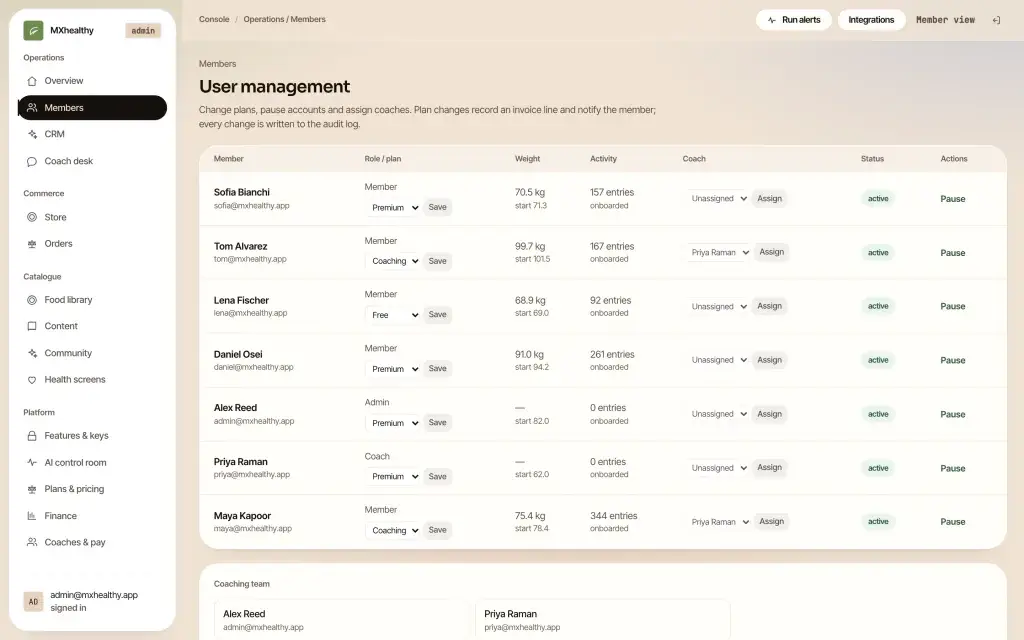
MXHealthy supports four coach pay models, and the operator console records itemized monthly settlements for each coach. The right model depends on how you want incentives to behave.
| Pay model | How it works | Margin behavior | Watch out for |
|---|---|---|---|
| Retainer | A fixed monthly fee per coach | Predictable cost, but margin improves only if the coach carries a full caseload | Paying for idle capacity early on |
| Per member | A set amount for each active client | Cost scales with revenue, so margin stays steady | Coaches may avoid high-effort clients |
| Per session | A fee for each scheduled appointment | Fits intensive programs with calls | Cost can rise quickly if clients over-book |
| Commission | A share of revenue from attributed plans or store sales | Aligns coach and company, since pay follows revenue | Needs clear attribution rules |
Coach commission in this platform is money you, the operator, pay to coaches. It is a cost that climbs as coaches carry more clients, never a cut taken out of their earnings. Miracuves keeps none of your subscription, coaching or store income either.
In the console every monthly settlement carries a reference number and passes three states, draft, approved and paid, and coach payouts can be sent through Stripe Connect, so paying a growing team stays a routine monthly step.
Build the Program Content Once
Content is what lets one coach serve many clients. Without it, every client conversation starts from scratch, and your best coach becomes your bottleneck. With it, the coach’s time goes to the parts only a human can do: noticing, encouraging and adjusting.
The four content assets
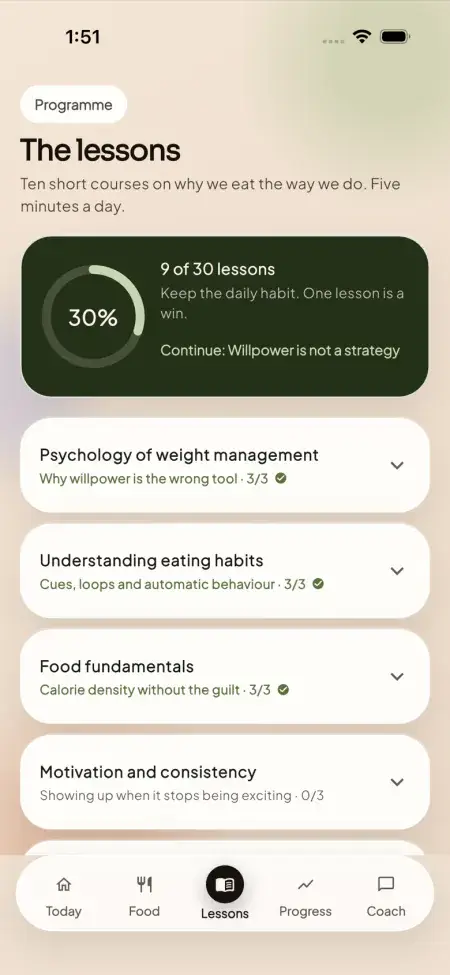
- A lesson library. Short, plain-language lessons on habits, hunger, portions, eating out and setbacks, each ending in one quiz question. MXHealthy ships with 10 courses and 30 lessons that you can edit, reorder or replace from the console, so your own method becomes the curriculum.
- Meal plans and recipes. A recipe library with macros per serving, weekly plans that auto-fill, and shopping lists generated from the plan. Put in the dishes your niche eats. The platform includes Indian foods in its catalog, so food logging fits home cooking rather than forcing menu-style entries.
- Check-in prompts. A fixed set of weekly questions about energy, sleep, stress and adherence makes reviews fast and consistent.
- A coach handbook. Response times, tone, escalation rules and what is out of scope. This is the document that makes five coaches sound like one brand.
Language is part of content. The platform runs in English and Hindi, which matters if you serve households that think about food in more than one language. More languages are available as an add-on regional language pack covering Tamil, Telugu, Bengali, Marathi, Arabic and Spanish.
Video is a common request. Lessons today are text with quizzes. A video lesson studio is available as an add-on if your method is better taught on camera, and you can start with text and add video once you know which lessons clients replay.
Set Your Pricing and Plan Tiers
Price from three numbers: what a client is worth to you, what a coach costs per client and what your niche will pay. Then keep the ladder simple. Three tiers is a good default because it matches how people decide: a free way in, a main plan and a premium plan.
| Tier | Typical contents | Role in the business | Example price point (illustrative) |
|---|---|---|---|
| Free | Targets, limited food logging, some lessons, a limited meal plan | Lead capture and trial of the product | No charge |
| Premium | Full logging, full lessons, meal plans, AI guidance, community, progress tracking | The volume plan most clients buy | $19 to $39 a month |
| Coaching | All of Premium, with a human coach, check-ins and priority messages | Your highest revenue per client | $99 to $249 a month |
The price points above are examples to show the shape of a ladder, not benchmarks. Test your own. Annual plans, set as a separate price per tier, lift cash flow and retention, and trial days per tier let you decide how long a new member explores before paying.
Add revenue lines after the core works
- Coupons for launch offers and partner codes, with caps so a promotion cannot run away.
- A health store for products you trust, with stock, shipping zones, free-shipping thresholds and coach attribution on the basket line.
- Group programs run as a cohort with a fixed start date.
- Employer or partner plans. Employer programs run on the corporate wellness portal add-on, which brings seat-based billing, team challenges and reports for HR.
We cover plan ladders, trial design and coaching fees in detail in our guide to nutrition app monetization, so this section stays at the founder-planning level. If you are still weighing budget, the nutrition app development cost guide compares the three routes over a full year.
Currency matters too. MXHealthy handles card payments through Stripe and includes rupee checkout, so a founder serving India can charge in rupees from day one without bolting on a second system.
Why the App Is the Operating System of the Business
A coaching business has five jobs that must run every day: onboard clients, capture what they eat, deliver lessons, keep coaches and clients talking, and get paid. Most new founders cover them with five separate tools and a lot of copy-pasting. Every seam between tools is a place where a client falls through.
One platform closes those seams. Here is how the jobs map to a single product, using MXHealthy as the example:
| Business job | Without a platform | With one platform |
|---|---|---|
| Onboarding | Intake form, then manual targets in a spreadsheet | 12-question assessment produces calorie, macro, water and step targets, stored with the member |
| Capturing intake | Photos in a chat group | Food diary with search, barcode scan, photo and natural-language logging, plus custom foods; green, yellow and orange bands show calorie density before logging |
| Teaching | PDFs and email | Courses and lessons with quizzes, managed from the console |
| Communication | Several chat apps | AI and human coach share one thread; the coach reads the diary, targets and messages before replying |
| Getting paid | Payment links and invoices | Free, premium and coaching tiers, trials, annual plans and invoice history via Stripe, plus rupee checkout |
| Seeing the business | Guesswork | Finance by month, at-risk queue, coach settlements and audit trail |
Ask the AI coach about a hard afternoon and it replies using that client’s logged calories, protein, water and weight trend, while a transparency panel lists what it can see. It gives general guidance and is not medical advice. Daily per-member call and token caps keep AI spend predictable.
What coaches and operators actually use
- Coach portal. A desk, a caseload, each member’s detail and earnings.
- Operator console. Its fourteen areas cover members, content, foods, coaches, finance, store, orders, AI routing and feature switches, with changes to prices, trials and coupons going live without a store update.
- CRM. An at-risk queue built from behavior, per-member notes and follow-up tasks with owners and due dates.
- Privacy tools. Self-service data download and an account deletion request with a grace period.
Choose Your Route: Ready-Made, Custom or a Subscription Tool
Once the business plan is clear, you choose how to get the technology. There are three routes, and the right one depends on how unusual your method is and how fast you want to start.
| Route | Time to launch | Cost shape | Ownership | Best when |
|---|---|---|---|---|
| Ready-made, branded platform | Days | One-time fixed price | Full source code | Your method fits a standard coaching flow |
| Custom build | Months | Scoped project fee | Yes, if contracted | Your workflow is truly unique |
| Subscription coaching tools | Days to weeks | Monthly fee per seat or client, forever | Usually none | You are testing the idea with a handful of clients |
For most founders, the first route fits. The core of a coaching business is common ground: assessment, food diary, lessons, coach threads, billing. Your differentiation is your method, your niche and your coaches, and those live in the content and the brand, not in custom code.
Custom work still has a role. Miracuves scopes extra features in writing, where typical custom work takes 15 to 30 days and a bigger scope 45 to 60, so you can start ready-made and extend as your needs become clear. The broader guide to starting a health and wellness platform business covers the wider landscape if you also plan fitness or mindfulness lines.
Your Launch Plan: The First 30 Days
A launch plan keeps a founder from polishing forever. The goal of the first month is not perfection. It is a working service with a handful of real clients.
| Week | Focus | Output |
|---|---|---|
| Week 1 | Brand, accounts and configuration | Your name, colors and icons on the apps; developer accounts and Stripe set up; prices and trials entered in the console |
| Week 2 | Content and coaches | Lessons edited to your voice, recipes and foods loaded for your niche, coach handbook written, coach accounts created |
| Week 3 | Friends-and-family pilot | 10 to 15 pilot clients using the app; fix confusing steps; collect first-impression notes |
| Week 4 | Store submission and soft launch | App store review (separate from build time), landing page, first paid clients |
Build time is no longer the long pole. A ready-made Miracuves build is live in 6 working days of Miracuves work, with app store review separate and outside our control. Developer accounts and company verification can take longer than the build itself, so start them early and use the pilot weeks to wait productively.
What to test in the pilot
- Can a new client finish the assessment and log a first meal in under ten minutes?
- Do clients find the foods they actually eat?
- Does a coach reply within the response window you promised?
- Does the first check-in feel useful to a client who had no prior relationship with you?
How to Win Your First 100 Clients
A hundred paying clients is a realistic first milestone for a focused coaching business, and it is enough to prove the model. Most founders get there with a small set of channels run consistently, not a broad set run lightly.
Channels that work early
- Personal network and referrals. Your first ten clients usually come from people who already trust you. Ask for referrals at the two-week mark, when clients first feel progress.
- Educational content. Short posts, videos and newsletters aimed at your niche’s Tuesday. Content builds trust before the first message.
- Partners. Gyms, clinics, schools, community groups and employers who want a nutrition offer for their members but do not run one. Employer deals that need per-seat billing and HR reporting use the corporate wellness portal add-on.
- A free tier that demonstrates the product. Let people set targets and log food for free, then show the value of coaching once they are using the app.
- Trial offers. Trial days per tier let a visitor feel the daily rhythm before paying.
Make the first 100 sustainable
Acquisition is half the job. A client who quits in week three is more costly than one never signed, because you paid to acquire and onboard them. Use the CRM’s at-risk queue to find clients who stopped logging, send a nudge and have the coach follow up personally. Automatic engagement nudges fire from adherence signals, for example a skipped weigh-in, so a coach spends time on conversations, not on hunting for who went quiet.
Resist the urge to run paid ads before the offer converts. If a friendly audience will not buy, a cold audience will not either. Fix the offer first, then spend.
Metrics That Show Whether the Business Will Compound
Revenue is a lagging number. By the time it dips, the cause is weeks old. Track a short list of leading metrics weekly and the business becomes easier to steer.
| Metric | What it tells you | Healthy direction |
|---|---|---|
| Assessment completion | Whether onboarding is clear | Rising, with few drop-offs on any one question |
| Weekly active loggers | Whether clients engage between check-ins | Stable or growing share of members |
| Check-in completion | Whether coaching rhythm is working | High and consistent across coaches |
| Trial-to-paid conversion | Whether the product and offer match | Rising as you refine onboarding |
| Month-three retention | Whether clients see value past the novelty | The single best leading sign of lifetime value |
| Coach caseload and response time | Whether you can add clients without quality loss | Within the limits in your handbook |
| Contribution per month | Revenue minus coach pay, card fees and store costs | Positive and rising |
The operator console gives you finance by month with net revenue, refunds, payouts and monthly recurring revenue, along with revenue by plan, so these numbers sit in one place. You close each month to freeze the period, which keeps your records clean when you need to compare periods or answer a question from an accountant.
Treat the metrics as a conversation with your coaches, not a scoreboard. If one coach’s clients log more often, find out what they do and teach it to the rest.
Founder Decision Signals: Is Your Coaching Business Ready to Launch?
Niche Is Specific
Can you describe your ideal client’s ordinary Tuesday in three sentences, and does your offer fit it?
Scope Is Written Down
Do your terms, onboarding and coach handbook say plainly what the program does and does not cover in your region?
Pay Model Is Modeled
Have you run your coach pay model at 10, 30 and 100 clients to see what happens to margin?
Content Exists
Are lessons, recipes and check-in prompts ready before the first client arrives?
Platform Fits the Method
Does one product handle assessment, logging, lessons, coaching and billing, or are you gluing tools together?
Retention Is Measured
Will you know your month-three retention and weekly active rate before you spend on ads?
How Miracuves Helps You Launch
Miracuves built MXHealthy as the operating system for a nutrition and coaching business, and we offer it as a ready-made nutrition coaching platform you own. It is listed in our healthcare solutions category alongside other ready-made health apps.
- Fixed one-time price. $3,399, paid once, not rented. No per-seat fee and no monthly platform rental.
- Live in 6 working days. The ready-made build is live in 6 working days of Miracuves work, with app store review separate.
- Android and iOS apps, always together. Alongside them come a browser version for members, a role-gated coach portal and an operator console of 14 areas.
- Full source code. Your platform, your hosting, your member data on your own instance.
- Modern stack. Next.js, TypeScript, PostgreSQL and Flutter, with Stripe plus rupee checkout, an English and Hindi interface, and Indian dishes ready in the food catalog.
- Controls you can describe to a client. Role-based access, sessions checked on every request, parameterized SQL, an audit trail on plan, price, payout and feature changes, and self-service data export and deletion requests for members.
- Custom work when you need it. Extra features are scoped in writing: 15 to 30 days for most, 45 to 60 days for the larger ones.
- Support after launch. 60 days of dedicated platform guidance, then 6 months of priority bug resolution and 12 months of continuous product evolution.
Six add-ons extend the platform when your plan calls for them: wearable adapters, smart scale and CGM device sync, live video coaching with group classes, a video lesson studio, a corporate wellness portal and regional language packs. Every one of them is a paid add-on, so you pay only for the pieces your method needs.
You can test the product before you talk to anyone. The published demo has member, coach and operator logins, so you can follow a client from first assessment to coach reply and then open the console to see where prices and trials are set. Our portfolio shows other platforms we have launched, and the consultation page is the way to book a walkthrough.
Final Thoughts
An online nutrition coaching business is built from a small number of decisions made in the right order: a specific niche, an offer with a rhythm, a scope you can defend, coaches paid in a way that scales, content that carries the method and an app that ties it together. None of them needs custom software, and every one of them is easier on a platform that already runs the daily machinery.
Start narrow, launch with a pilot, watch retention and add revenue lines once the core works. Miracuves gives you the platform, the apps and the source code, so your first month is spent on clients instead of on code.
Frequently Asked Questions
Do I need to be a registered dietitian to start an online nutrition coaching business?
It depends on where you and your clients live and on what you promise. Many places regulate who may give individualized dietary advice or use titles such as dietitian. Many coaches work on habits, education and accountability without clinical claims. Check your local rules and shape your offer to match them.
How many clients can one coach handle online?
It depends on the program. A guided plan with weekly check-ins and replies within a set window often needs 15 to 30 minutes per client per week, so caseload is a time budget, not a fixed number. Set a limit in your coach handbook, watch response times and adjust it as your lessons and templates mature.
How much should I charge for online nutrition coaching?
Price from three numbers: the monthly cost of a coach per client, what your niche will pay and what the client is worth over the first year. Many businesses use three tiers, a free tier, a main plan and a coaching plan. Test prices with a pilot group, and use trials and annual prices to see what converts.
What can an app do that a spreadsheet and chat group cannot?
An app gives each client a calorie and macro budget, a food diary, lessons, meal plans and a coach thread in one place, and it gives you a view of who is engaged. It also handles plans, trials, coupons and billing, and it keeps a record of every change to prices and payouts.
Can I run my coaching business in Hindi as well as English?
Yes. The platform runs in English and Hindi, and its food catalog includes Indian foods, so clients can log home-cooked meals. Rupee checkout is included alongside card payments. More languages are available through an add-on language pack.
How quickly can a branded coaching app go live?
A ready-made Miracuves build is live in 6 working days of Miracuves work, starting when your brand files, hosting and accounts are in hand. App store review is separate, and company verification for developer accounts can take longer than the build, so request those accounts early. Custom features add 15 to 30 days.
Do I own the app and my client data?
Yes. A Miracuves build comes with full source code and runs on your own instance and database, so member data stays with you. Members can download their own data or request account deletion, and the audit trail records who changed a price, payout or feature.
Should I use a subscription coaching tool or my own branded app?
A subscription tool can be a cheap way to test the idea with a few clients. A branded app suits you once the business is real, because you keep your brand in the app stores, own the code and data and avoid per-seat fees that grow with your caseload. Compare the total over three years.
What does an AI coach do in a nutrition coaching app?
It answers questions from the member’s own data, such as calories left, protein against target and weight trend, and it suggests general next steps. It supports your coaches by handling routine questions. It is not a clinician, and you decide which provider powers it.
Miracuves is an independent software development company. We are not affiliated with, connected to, sponsored by, or endorsed by any company or product named in this article.
Terms such as “X Clone” are used descriptively. It is how the software industry refers to building a platform with functionality comparable to a known service, and how clients search for it.
The entire design and codebase of our products is built by our own team. Our products contain no code, design, graphics, or content originating from any third-party website or applications.
All third-party names and marks referenced in this article are the property of their respective owners, referenced solely to identify the services discussed.