
Key Takeaways
- Revenue is five lines, not one. Subscriptions carry the base, a coaching tier lifts revenue per member, a store and paid programs add margin, and employer deals, run through the corporate wellness portal add-on, add volume.
- Public numbers show the scale. The category leader reported about $400 million in 2020, and a third-party estimate puts 2023 near $1 billion with about 1.5 million paying subscribers.
- Price ladders do the heavy lifting. The category leader lists $70 for a monthly plan and $209 for a year, so the annual plan is worth about a quarter of twelve monthly payments.
- Coaching is the ARPU ceiling and the cost line. A coaching member can pay three times the premium price, but every coach hour is a payout you owe.
- A worked 12-month model is below. 1,000 trial starts a month, 35% converting, 12% monthly churn: about $626,000 of revenue and $339,000 left after coach pay, card fees and acquisition.
- Churn and trial conversion move the result most. Cutting monthly churn from 12% to 8% lifts the year by about $70,000, and a 25% trial conversion cuts it by about $148,000.
- Billing practice is part of the model. The category leader agreed to a $62 million settlement in 2022 over automatic renewals, so clear renewal terms are revenue protection, not paperwork.
- Everything is a runtime setting. Prices, annual plans, trial days, coupons, shipping and coach pay change in the operator console without a release.
If you search for the Noom revenue model, you usually want one answer: where does the money come from, and how much of it stays? The honest answer is that a coaching app earns from five lines at once, and each line has its own price, its own cost and its own failure mode. This guide takes them one by one, then builds a 12-month revenue model for a founder’s own coaching app, with every assumption visible so you can replace it with yours.
It sits next to our system-level view in the business model breakdown of the category leader, which covers the whole value chain. Here the focus is arithmetic: plans, trials, coaching tiers, a store, paid programs and employer deals. If you want to own a ready-made weight-loss coaching app instead of renting one, the numbers below show what that app has to earn to be worth running.
A caution on sources. Noom is private, so most revenue figures are reported or estimated rather than audited. Every public number below is linked, and every number for your own app is labeled as an assumption.
How the Noom Revenue Model Is Built: Five Lines on One Account
Start with the shape. A behavior-change coaching business has one recurring base and four expansion lines. The base is the subscription. The expansion lines are a human coaching tier, physical or digital products sold to the same members, paid programs outside the plan, and group or employer deals.
The scale is real. Wikipedia records reported revenue of $400 million for Noom in 2020, and the research firm Sacra estimates about $1 billion in 2023 on roughly 1.5 million paying subscribers. Those are third-party figures, but they tell a founder the model works at volume when acquisition is funded and retention holds.
| Revenue line | What the member pays | Who sets the price | Main cost it carries |
|---|---|---|---|
| Subscription plans | Monthly or annual, per tier | Operator, at runtime | Card fees, AI usage, hosting |
| Coaching tier | Higher monthly price for human replies and appointments | Operator | Coach pay |
| Store and supplements | One-time orders on top of the plan | Operator | Product cost, shipping, returns |
| Paid programs and challenges | One-time fee for a defined program | Operator | Content and coach time |
| Employer and group deals | Seats billed to a company through the corporate wellness portal add-on | Negotiated | Sales time, reporting |
The rest of this guide works through the table row by row. Keep one rule in mind: the subscription is the engine, and every other line is judged by whether it raises revenue per member without raising churn.
Line One: Subscription Plans, Annual Pricing and Free Trials
Subscriptions carry the base because they repeat. A member who stays six months pays you six times, and nothing else in the model compounds like that. Three decisions shape this line: how many tiers, how long a billing term, and how long a trial.
A three-tier ladder is enough
Three rungs, free, premium and coaching, are enough for most founders. Free gives members the assessment, a limited meal plan and basic logging so they can feel the product. Premium adds the full meal plans, the lesson library and the AI coach. Coaching adds a human who reads the diary and replies in the same thread.
More tiers rarely help. Each extra price point is another line in your support answers, your coupons and your finance report, and members tend to stall in front of five choices.
Annual plans trade price for cash and retention
The public pricing of the category leader shows the logic. Sacra lists a $70 monthly plan and a $209 annual plan, about $17.42 a month. That is a 75% discount against paying monthly for a year, which looks steep until you see what it buys: twelve months of cash on day one, no monthly cancel decision, and a lower processing cost per dollar because one charge replaces twelve.
For your own ladder, set the annual price between 40% and 60% of twelve monthly payments, then test. The right number is the one where the annual plan takes a large share of new buyers without pulling down total revenue per cohort. Because annual and monthly prices are separate settings per tier in the operator console, you can change either one without a release.
Trials: length and cost
Sacra describes a 7 to 14 day trial period for the category leader. A trial is a cost, not a gift: during it the member uses AI coach calls, storage and sometimes human attention, and pays nothing. Set trial days per tier, shorter on coaching than on premium, because coach time is the expensive part.
Measure two numbers from the first week: the share of trial starts that become paying members, and the cost of getting each trial start. Their ratio is your cost to win a paying member, and it appears again in the worked model.
Rupee and dollar ladders
If your members are in India, price the ladder in rupees. The platform includes rupee checkout alongside Stripe, so an Indian member pays a rupee price through a local payment flow while an international member pays by card. Keep the two ladders consistent in value, not in conversion, since purchasing power differs.
Line Two: The Premium Coaching Tier and Coach Economics
The coaching tier is where revenue per member rises fastest, and where margin can disappear if you are careless. A member on a coaching plan gets human replies that sit alongside the AI coach in one conversation, appointments with a join link, and a coach who sees the diary, targets and messages before answering.
Pricing the tier
In the worked model below the coaching tier costs $79 a month against $24 for premium, about 3.3 times as much. That multiple is an assumption, but the principle holds: the tier must pay for a coach and still leave a margin, so it is priced from coach cost upward, not from a competitor downward.
Four ways to pay a coach
The operator console supports four coach pay models: a flat monthly retainer, pay per assigned member, pay per booked session, or commission. Each one shifts risk differently.
| Pay model | Cost behavior | Best when | Watch out for |
|---|---|---|---|
| Retainer | Fixed per coach per month | You want committed, available coaches | You pay even when the caseload is thin |
| Per member | Rises with caseload | Caseloads vary week to week | Cost grows as fast as revenue, so margin stays flat |
| Per session | Rises with appointments | Coaching is session-led | Members book fewer sessions than you modeled |
| Commission | Share of attributed sales | Coaches also sell store products | Can reward selling over coaching quality |
Each month’s settlement lists its lines and moves through draft, approval and payment, and the approved amount can reach each coach by Stripe Connect. You see coach cost per member every month instead of discovering it at year end.
One structural point matters for your model: coach commission is money you pay coaches, not a fee you take from them. Treat it as a cost line that scales with how busy your coaches are, and size the tier price to cover it.
The AI coach protects coach time
An AI coach that answers from the member’s own day (what they ate, how protein compares with the target, water intake and the weight trend) handles the routine questions so human coaches focus on the members who need them. It gives general guidance and is not medical advice, and the product says so on screen. A daily cap on each member’s AI calls and tokens keeps that cost bounded, which matters because your AI provider bills by usage.
Line Three: The Store, Supplements and Coach-Attributed Sales
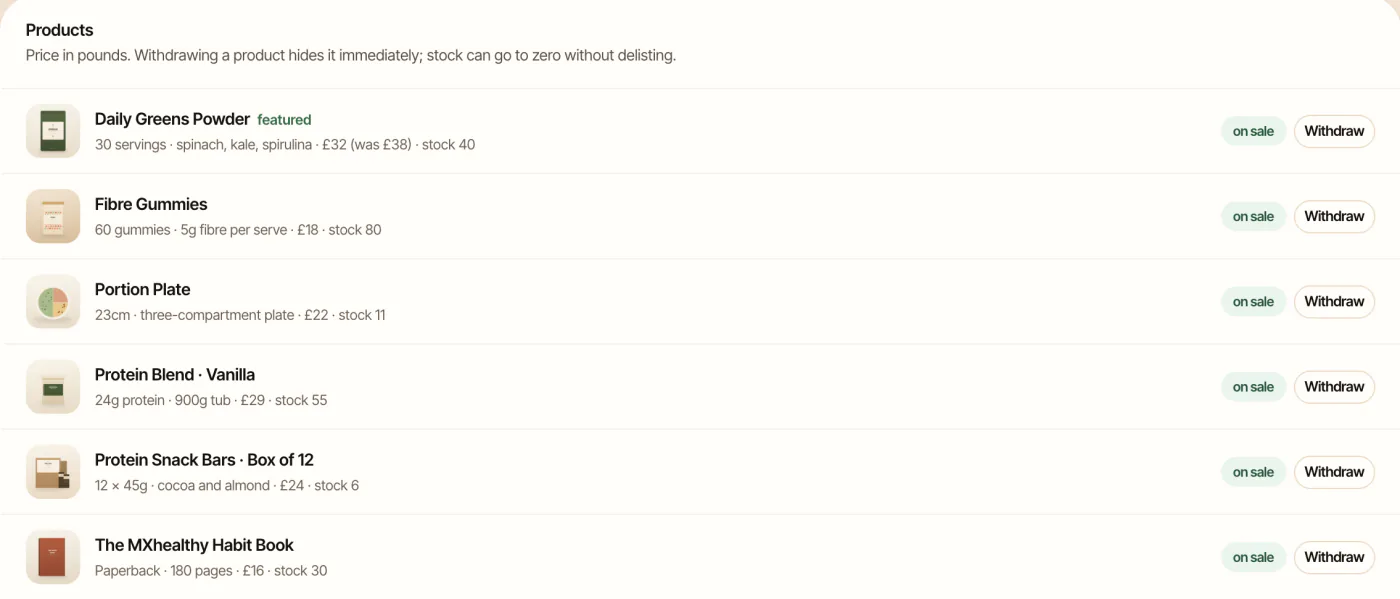
A store turns a coaching relationship into product revenue. The platform includes a native store where products are grouped by category and carry a price, a compare-at price and a stock state, plus one basket that follows the member between web and app, delivery zones with a minimum order for free shipping, and capped percentage coupons. Orders carry a five-stage tracker from placed to delivered.
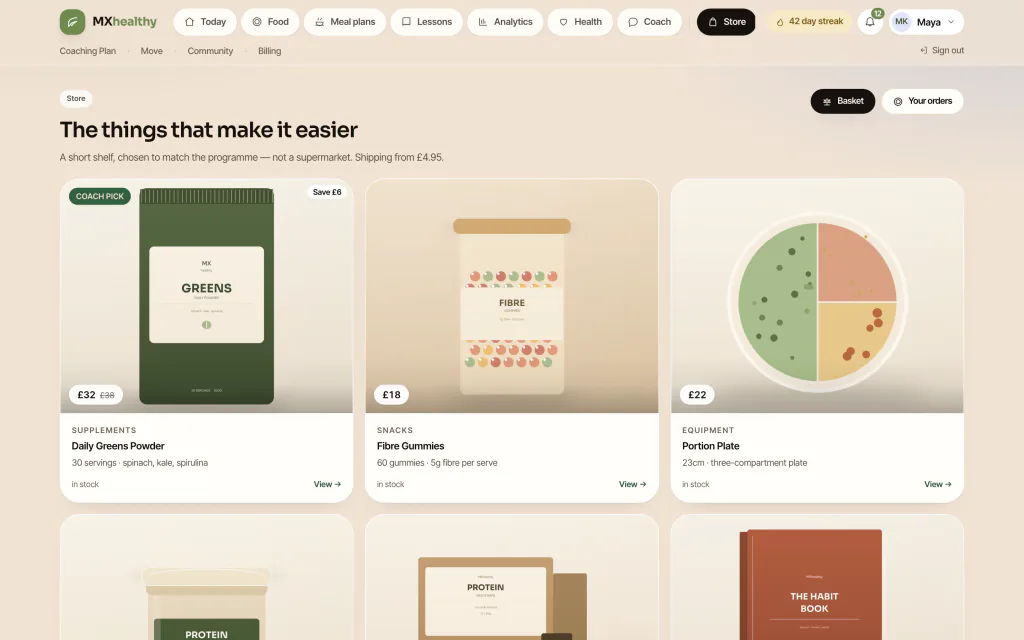
Store income is margin, not revenue. If a product sells for $34 and costs you $19 to buy, pack and ship, the line earns $15, and a coupon or a return shrinks that further. The worked model counts only the margin share for that reason.
Coach-attributed sales
The coach id travels from the basket line to the order, so you can see which coaches drive product sales and pay a commission rate per product or per coach. This is useful, but it needs a rule: coaches are paid for outcomes in adherence and satisfaction first, and a sales commission second, or members will feel sold to.
Keep supplements honest
Supplements are health-claim sensitive. Sell them with plain descriptions and no promises about weight loss or medical effect, and prefer products that support the habits the lessons teach, such as portion plates or meal-prep tools. A store that overreaches damages the coaching brand that pays your subscriptions.
Card payment for the store connects through your own payment account, and card numbers never touch the platform; it keeps provider references only.
Line Four: Paid Programs, Challenges and Add-On Income
Programs sit outside the plan. A six-week challenge, a seasonal reset or a themed course can be sold as a one-time fee to members and non-members. They add revenue without touching the monthly price, which protects the ladder from discount pressure.
Challenges are already part of the platform, with progress tracked for each member, coins that members redeem for rewards, and a leaderboard they choose whether to join. A paid challenge uses those mechanics and adds a price and a start date. Because the lesson library is managed from the console, a new program is a content job, not a development job.
In the worked model, 3% of active members buy a $39 program each month. That is a modest assumption, and it contributes about $21,000 over the year, which is why programs are an extra, not a base.
Platform add-ons as a revenue extension
Some revenue lines need modules that are not in the base build. Miracuves offers six paid add-ons: wearable device adapters, a smart scale and CGM sync module, live video coaching and group classes, a video lesson studio, a corporate wellness portal, and regional language packs. Each is an add-on, priced separately, and each opens a line a base subscription cannot reach. Live group classes, for example, support a premium-plus price, and a video lesson studio supports a course library you can sell on its own.
Decide an add-on by the revenue it unlocks, not by how impressive it sounds. If you cannot name the price you would charge for the thing it enables, wait.
Line Five: Corporate and Employer Deals
Employers buy seats. The reported enterprise side is described by Sacra as a fraction of its consumer revenue, which tells you where to put your effort first: consumers pay for most of the business, and employer deals are a later expansion.
The platform’s plans and admin tools serve employer buyers as a customer type, but employer billing, team challenges and HR reporting come with the corporate wellness portal add-on, which includes per-seat billing. Plan for that module before you promise a company seat pricing.
Employer deals change your cost shape. They take sales time and reporting effort, but they carry lower acquisition cost per member and often better retention, because the employer promotes the program. Model them as a separate scenario, not folded into the base case. A single 300-seat deal at an assumed $4 per seat per month would add $14,400 a year, small against the base case, which is exactly why they come later.
The Costs That Shrink Revenue Before You Count Profit
Gross revenue is a vanity number. Five costs sit between it and what you keep.
- Card processing. At Stripe’s standard US rate of 2.9% plus 30 cents per domestic card charge, a $24 monthly plan costs about $1.00 to collect, or 4.2% of the payment.
- Store billing. If members subscribe inside a mobile app through Apple or Google billing, a commission applies. Apple’s Small Business Program lowers the standard rate for developers under 1 million dollars in annual proceeds. Check each store’s current rules for digital subscriptions before you pick where members pay.
- Coach pay. The largest cost in the coaching tier, covered above.
- AI usage. Billed by your AI provider per token, bounded by per-member daily caps.
- Refunds and chargebacks. Recorded against revenue in the finance report, so net revenue, not gross, is the number you read.
Billing practice deserves its own line. Wikipedia records that Noom agreed to a $62 million class-action settlement in February 2022 over automatic subscription renewals. The lesson for a founder is practical: show the renewal date, the price and the cancel path before the first payment, and keep the wording identical in the app and at checkout. That is cheaper than any settlement and it reduces refund requests.
A Worked 12-Month Revenue Model for Your Own Coaching App
Here is a model you can copy into a spreadsheet. Every input is an assumption, labeled as such. Replace them with your own numbers as soon as you have 60 days of data.
The assumptions
| Input | Value | Why this value |
|---|---|---|
| New trial starts per month | 1,000 | A steady acquisition target, flat for 12 months |
| Trial to paid conversion | 35% | A middle case; test between 25% and 45% |
| Monthly churn of paying members | 12% | Implies an average paying life of about 8.3 months |
| Plan mix | 85% premium, 15% coaching | Most members stay on the lower tier |
| Premium price | $24 a month | Assumption, set at runtime |
| Coaching price | $79 a month | About 3.3 times premium |
| Coach pay | $30 per coaching member a month | Per-member pay model |
| Store | 6% of active members order each month, $34 average, 45% margin | Margin counted, not sales |
| Paid programs | 3% of active members buy a $39 program each month | One-time purchases |
| Card fees | 2.9% + 30 cents per charge | Stripe US standard rate |
| Cost per trial start | $15 | Assumption; the sensitivity table varies it |
Paying members arrive in the month their trial converts. That simplification slightly flatters month one but does not change the shape of the year.
What the year looks like
| Month | Paying members | Subscription revenue | Store margin | Program revenue | Card fees | Coach pay |
|---|---|---|---|---|---|---|
| 1 | 350 | $11,288 | $321 | $410 | $474 | $1,575 |
| 3 | 929 | $29,962 | $853 | $1,087 | $1,259 | $4,181 |
| 6 | 1,562 | $50,379 | $1,434 | $1,828 | $2,117 | $7,030 |
| 9 | 1,994 | $64,294 | $1,830 | $2,333 | $2,702 | $8,971 |
| 12 | 2,288 | $73,776 | $2,100 | $2,677 | $3,101 | $10,294 |
Months 2, 4, 5, 7, 8, 10 and 11 follow the same curve; the table shows five checkpoints to keep it readable. Across all twelve months the totals are:
| Line | 12-month total |
|---|---|
| Subscription revenue | $587,726 |
| Store margin | $16,730 |
| Program revenue | $21,322 |
| Total revenue and margin | $625,778 |
| Card fees | -$24,700 |
| Coach pay | -$82,008 |
| Contribution before acquisition | $519,070 |
| Trial acquisition (12,000 starts at $15) | -$180,000 |
| Contribution after acquisition | $339,070 |
Hosting, staff, tax and the one-time build price are outside this table, so read the last row as the cash available to cover them. By month 12 the subscription run rate is about $73,800 a month with 2,288 paying members, and subscriptions are 94% of the year’s revenue and margin. That is the point of the model: the other lines matter, but they are small beside the base.
Sensitivity: what moves the answer
| Change from the base case | Paying members at month 12 | 12-month revenue and margin | Contribution after acquisition |
|---|---|---|---|
| Base case | 2,288 | $625,778 | $339,070 |
| Monthly churn 8% instead of 12% | 2,766 | $710,306 | $409,184 |
| Monthly churn 16% | 1,918 | $555,689 | $280,932 |
| Trial conversion 25% | 1,634 | $446,985 | $190,764 |
| Trial conversion 45% | 2,941 | $804,572 | $487,376 |
| Cost per trial start $25 | 2,288 | $625,778 | $219,070 |
| Cost per trial start $40 | 2,288 | $625,778 | $39,070 |
Two patterns stand out. First, acquisition cost is the sharpest lever: at $40 per trial start the same year leaves almost nothing. Second, conversion and churn compound, so the cheapest improvements are often in the first week of onboarding and the lessons, not in the price. The platform’s 12-question assessment, daily budget, lessons and coach nudges are all aimed at that early habit.
Unit Economics per Paying Member
Annual totals hide the number that decides whether you can scale: what one paying member earns and costs. Using the same assumptions:
- Blended monthly revenue per member: about $32.25, from 85% on premium and 15% on coaching.
- Blended monthly costs per member: about $4.50 of coach pay and $1.24 of card fees, leaving about $26.50 of contribution.
- Cost to win a paying member: $15 per trial start divided by 35% conversion is about $43.
- Payback: $43 divided by $26.50 is about 1.6 months.
- Lifetime contribution: $26.50 times an average paying life of about 8.3 months is about $221, or roughly 5.2 times the cost to win the member.
A ratio near five is comfortable, but notice how fragile it is. If the cost per trial start doubles and conversion drops to 25%, the cost to win a member goes from $43 to $120 and the ratio falls below two. Check these three numbers monthly, not yearly.
Reading the Finance Report as the Model Runs
A revenue model is useful only if the running business reports against it. The operator console includes a finance view by month: net revenue, gross, refunds, payouts, contribution, monthly recurring revenue, month-on-month change and revenue by plan. A month-close step freezes the period so earlier figures do not shift.
Check each month against the model in four steps:
- Compare paying members with the model’s curve; a gap in month two usually means a conversion problem, not a retention one.
- Compare revenue by plan with your assumed 85/15 mix; a heavier coaching share raises revenue and coach cost together.
- Compare payouts with coach pay per member; settlements show the line items.
- Compare refunds with your trial and renewal wording; rising refunds point to unclear terms.
Every price, trial, coupon, shipping rate and coach pay model is a runtime setting with an audit trail, so you can act on what the report shows the same day. For the operator-side view of plan ladders, trials and coupons in more depth, see our monetization playbook for nutrition apps.
Where Most Revenue Models for Coaching Apps Go Wrong
- Modeling revenue, not contribution. A model that stops at gross revenue ignores coach pay and acquisition, which together took 42% of revenue in the worked year.
- Assuming flat churn. Early churn is usually higher than later churn. Track cohorts, not averages.
- Treating the store as a second business. It is a margin line. If it needs its own team to work, it is probably a distraction.
- Pricing the coaching tier from rivals. Price it from coach cost and caseload, then check the market.
- Ignoring renewal clarity. A confusing renewal produces refunds and complaints long before it produces a legal problem.
- Launching three lines at once. Start with subscriptions, add coaching when the base converts, and add the rest once you have a retention curve.
Founder Decision Signals: Can Your Revenue Plan Carry a Launch?
Plan Ladder Is Written
Can you list each tier with its monthly price, annual price and trial length on one page, with the reason for each gap between them?
Churn Has a Number
Do you know the share of paying members who cancel each month, or an honest assumption you will replace after 60 days of real data?
Coach Cost Is Modeled
Is coach pay per member, per session or retainer written into the model before you price the coaching tier?
Trial Cost Is Capped
Have you set a ceiling for what one trial start may cost, and a week when you will stop spending if the ceiling is hit?
Renewal Terms Are Plain
Will members see the renewal date, price and cancel path before they pay, in the same words in the app and at checkout?
Second Lines Are Optional
Would the model still work on subscriptions alone, with the store, programs and employer deals as upside?
How Miracuves Helps You Run This Model
Miracuves builds on MXHealthy, one codebase for the native Android and iOS apps, a responsive web app, a role-gated area for coaches, and an operator console with 14 areas for you. It is built with Next.js, TypeScript, PostgreSQL and Flutter, accepts Stripe card payments alongside rupee checkout, offers Hindi beside English, and lists Indian dishes among its foods. You can see it as a ready-made coaching app with full source code, priced once at $3,399 with no revenue share.
For the revenue model above, the useful parts are specific. Three tiers, each with monthly and annual prices and its own trial length. A coaching tier with four coach pay models and itemized settlements. A native store with coupons, shipping zones and coach-attributed sales. A finance view by month. All of it changes at runtime, not through a release.
The ready-made build is live in 6 working days of Miracuves work, with app store approval on its own track. An extra tier or a fresh lesson track counts as custom work and runs 15 to 30 days, and larger scopes take 45 to 60. Support runs for 60 days of dedicated platform guidance, 6 months of priority bug resolution and 12 months of continuous product evolution. The six add-ons above are available as paid add-ons when a revenue line needs them. If you are comparing routes, our buyer guide to coaching app scripts and the wider healthcare solutions category show what else is available, and the consultation page lets you book a walkthrough on your own numbers.
Final Thoughts
The Noom revenue model is less a trick than a discipline: a subscription base priced with care, a coaching tier priced from coach cost, a few margin lines on top, and a habit of reading net numbers every month. The public figures show what the category can reach. The worked model shows how much of the first year’s money comes from three inputs, churn, trial conversion and cost per trial start.
Build your own version of the table before you build anything else. If it works at 16% churn and a $25 trial cost, you have a business worth launching. Miracuves is the fastest way to put that business in members’ hands: a fixed one-time price, source code you own, and a platform where every number in your model is a setting you control.
Frequently Asked Questions
How does Noom make money?
Public reporting describes a subscription base with monthly and annual plans, a coaching tier, add-on programs and employer deals. Sacra estimates about 1 billion dollars of revenue in 2023, though Noom is private and the figures are third-party estimates.
What is a good free trial length for a weight-loss coaching app?
Sacra describes a 7 to 14 day trial period for the category leader. Pick the shorter end for tiers that include human coach time, since coaching is the expensive part, and measure the share of trial starts that become paying members before you extend it.
How much should a coaching tier cost compared with a premium tier?
Price it from coach cost upward. In the worked model the coaching tier is about three times the premium price, which covers a per-member coach payment and leaves margin. Your multiple depends on coach pay and caseload.
What matters more in a coaching app, churn or trial conversion?
Both compound, but acquisition cost per trial start was the sharpest lever in the worked model. Within what you control after launch, early retention and trial conversion usually respond fastest to better onboarding and lessons.
Can I sell physical products inside a coaching app?
Yes. The platform includes a native store with prices, stock, shipping zones, coupons and coach-attributed sales. Count only margin in your model, and avoid health or weight-loss claims in product descriptions.
Can I charge members in rupees?
Yes. The platform includes rupee checkout alongside Stripe card payments, so you can run a rupee price ladder for Indian members and a card-priced ladder for international members.
Can I add employer billing later?
Yes. Seat-based billing for companies, HR reports, team challenges and employer plans all come with the corporate wellness portal, a paid add-on. Plan it as a second-phase revenue line after the consumer base converts.
How do I pay coaches in a coaching app?
Coaches can be paid by retainer, by rate per member, by rate per session or by commission, set in the operator console. Each monthly settlement lists its line items and records a reference once it is paid.
Will the AI coach take over from human coaches?
No. It answers routine questions from the member’s own diary, using general guidance and not medical advice, so human coaches spend their time on members who need them. Per-member daily caps keep AI usage cost bounded.
What does a ready-made coaching app cost to launch?
Miracuves sells it for a single fixed fee listed on the solution page, with full source code and Android and iOS apps included, live in 6 working days of Miracuves work. There is no revenue share.
Miracuves is an independent software development company. We are not affiliated with, connected to, sponsored by, or endorsed by any company or product named in this article.
Terms such as “X Clone” are used descriptively. It is how the software industry refers to building a platform with functionality comparable to a known service, and how clients search for it.
The entire design and codebase of our products is built by our own team. Our products contain no code, design, graphics, or content originating from any third-party website or applications.
All third-party names and marks referenced in this article are the property of their respective owners, referenced solely to identify the services discussed.