Written by the Miracuves Editorial Team. Reviewed by Ashish Khan, SEO Analyst, Miracuves.
Key Takeaways
- A working prototype proves demand, not production readiness. Use prompt-to-app tools to learn which workflows customers value, then check whether those workflows can be maintained and changed safely.
- Own more than the exported code. Put the repository, infrastructure, database, and key accounts under company control. Document how to deploy the app, and collect IP assignments from everyone who touched the code.
- Fix the risks that can hurt the business first. Review authentication, database access rules (Row Level Security on Supabase-backed builds), exposed secrets, payment failures and data-loss risks before any cosmetic cleanup.
- Keep what customers have validated. Add tests around critical workflows, make deployments repeatable, and replace only the parts that cannot be made reliable.
- Explain the technical debt before fundraising. Not every seed investor audits the source code. Be ready to explain what was generated, what engineers reviewed, what remains fragile and your plan for it. A written technical-debt register helps more than it hurts.
If you built your first product with a prompt-to-app tool and a seed round is a few months away, you probably have one question: is this thing good enough to raise on, or will an investor’s technical adviser find a rewrite hiding behind the demo? This guide helps you answer that before anyone else does. By the end you should know what to check, what to fix first, and whether to keep, harden or rebuild what you have.
An honest starting point: not every seed investor audits source code. Clean code is not a universal condition for a seed check. The useful question is whether your technology carries hidden risk that gets harder to explain once an investor, a technical adviser, an enterprise customer or your first senior engineer looks underneath the interface.
Prompt-to-App Tools and Production Software Do Different Jobs
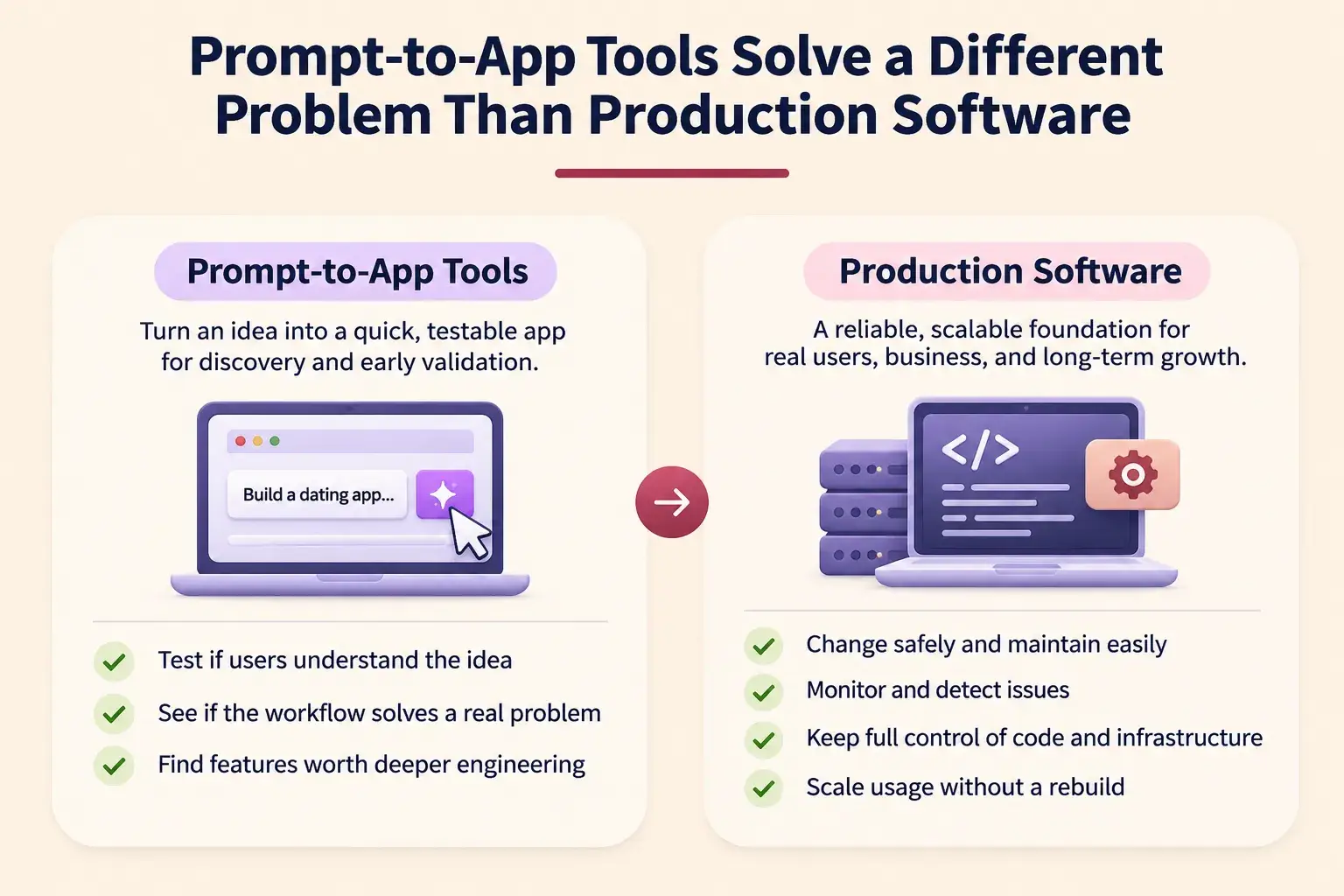
Prompt-to-app tools compress the distance between an idea and evidence. You can describe a workflow, generate screens, connect a database, add sign-in and put something in front of users within days. That lets you test whether people understand the concept, whether the workflow solves a real problem and which features deserve real engineering. For discovery, that is exactly the right tool.
Production software has another job. Once customers depend on the product, staff run their day through it, money moves through it or sensitive data enters it, the software becomes infrastructure. The test stops being “does the feature work in the demo?” and becomes:
- Can we change it safely?
- Can another engineer understand it?
- Will we know when it breaks?
- Do we control the code and the infrastructure?
- Can usage grow without rebuilding the foundation?
None of this makes AI-assisted building a mistake. Professional teams use AI throughout development too. The difference is not whether AI wrote part of the code. It is whether the result is controlled, understood and operable as a business asset.
Will Seed Capital Buy Growth or Pay for a Rewrite?
Early shortcuts are often rational. Accepting manual steps, temporary integrations, thin test coverage or a rough database design makes sense while you are still learning whether anyone wants the product. That trade-off changes once you have evidence of demand.
Picture two founders, each with 500 active users. Founder A knows where the shortcuts are. The company owns the repository, sign-in and payment flows have been reviewed, critical paths have automated tests, and a second engineer can deploy the app. Founder B has the same user count, but the product lives mainly inside the tool that generated it. Nobody has read the backend closely, production credentials sit in configuration files, and moving off the platform could mean rebuilding large parts of it.
Both have validated a market. Only one has reduced the technical uncertainty of the next stage. That matters because seed money is meant to move the company forward: product, distribution, hiring and revenue. Imagine raising to hire two salespeople and ship three major features, then hearing from your first engineering hire that the app cannot safely carry those plans. A large share of the round now goes to reconstruction. The first version being fast was never the problem. Missing the point where validation infrastructure needed to become growth infrastructure was.
So ask yourself one question before you start the raise:
That answer says more about production readiness than whether the code was written by a person, generated by AI or assembled in a visual builder. The table shows where the two kinds of software usually differ.
| Area | Prompt-Built Prototype | Production Software |
|---|---|---|
| Primary objective | Validate the idea quickly | Operate reliably and change safely |
| Source code | Generated, sometimes held inside the platform | In a company-controlled repository |
| Testing | Mostly manual clicking | Critical flows covered by repeatable tests |
| Security | Platform defaults, often unreviewed | Permissions, secrets and sensitive data deliberately protected |
| Deployment | One button in the builder | A documented, reproducible release process |
| Monitoring | Users report problems | Errors, crashes and system health visible to the team |
| Knowledge | Concentrated in the person who prompted it | Transferable to new engineers |
| Technical debt | Mostly invisible | Known, prioritized and written down |
The right-hand column does not mean a seed-stage startup needs enterprise architecture. Overengineering a young product wastes capital as surely as underengineering it. Aim for proportional engineering: enough discipline to protect the areas where failure would hurt the company.
What “Clean Source Code” Should Mean to a Founder
“Clean code” is not about perfect naming or elegant abstractions. For fundraising it means one thing: another competent engineer can inspect, run, change and deploy the codebase without the original builder translating every decision. Six properties matter more than cosmetic polish.
1. The company controls the repository
The code lives in a company-owned account. You know who has access, who contributed, which branch is production and how changes reach users. A ZIP download from a builder is better than nothing, but it is not the same as a maintained repository with real history.
2. Someone can explain the architecture
You do not need to explain every function. Someone on the team should be able to say where user data is stored, how authentication works, how the frontend talks to the backend, which third-party services are critical, how payments and other sensitive actions are processed, where production runs and what happens when a deployment fails. If the answer to most of those is “the tool handles that,” an adviser will see dependency risk.
3. The business logic is readable
In many startups the valuable part is not the interface but the rules underneath it: matching, pricing, scoring, permissions, workflow automation or specialized data processing. Those parts deserve clear boundaries and the most careful engineering, because they are closest to what makes the company worth funding.
4. Critical user flows are tested
You do not need thousands of tests to look mature. You need automated checks on the flows that would cause real damage if they broke: sign-up and login, payments and subscriptions, permissions, record creation and updates, important calculations, checkout or booking, key integrations and account recovery. Tests are what let a team keep moving fast without turning each release into a gamble.
5. Secrets and production access are controlled
API keys, database credentials and payment secrets never appear in frontend code or get committed casually. Production access is limited to the people who need it. This is not investor theater; it keeps one leaked credential from becoming a company-level incident.
Generated code needs this review in particular. In Veracode’s 2025 GenAI Code Security Report, published in July 2025, researchers ran 80 security-sensitive coding tasks through more than 100 large language models and found that the generated code introduced a security flaw in 45% of cases. A working demo tells you nothing about whether access control, input handling and secrets management will hold.
6. Deployment is repeatable
A growing company cannot depend on one person remembering twelve undocumented steps to ship an update. A written, repeatable build-test-deploy process makes hiring easier, removes key-person dependency and lowers the chance of breaking things while you iterate.
What Investors and Their Technical Advisers Look For
There is no formal standard for seed-stage technical due diligence, and depth varies widely by investor and product. When someone does look, the questions are practical and usually come down to five:
- Can the company keep shipping? A fragile system turns every feature into a regression; a maintainable one turns money into product progress.
- Does the company control its technology? Who owns the code, who contributed, which outside services it depends on, and whether it keeps running if a tool or contractor disappears.
- Is there an expensive rewrite behind the demo? Technical debt is normal. Undiscovered debt is the worry. “This area is temporary, here is why we accepted it, and here is the plan” is a very different answer from silence.
- Will more users break it? Nobody expects a seed company to plan for hundreds of millions of users, but meaningful growth should not immediately overwhelm the database or the core workflows.
- Are the obvious security risks managed? A marketing utility and an app holding health, financial or identity data carry very different risk. What counts is evidence that the team knows which data and actions matter most.
Those questions translate into seven red flags worth resolving before a funding process starts:
- You cannot export or independently run the code. The company depends on the builder more than the product suggests.
- Nobody can explain the backend. The interface works while database, authorization or API behavior stays a mystery.
- Production credentials are exposed or shared casually. A development shortcut has become a security issue.
- Every feature touches the same tangled code. Small changes break unrelated things.
- No repeatable tests cover critical workflows. Each release rests on manual confidence.
- Nobody knows what the dependencies are. You cannot say which packages and services you rely on, what they cost or how hard they would be to replace.
- Only the original builder can operate the product. Whether that is a founder, a freelancer or an AI workspace, concentrated knowledge is continuity risk.
None of these means the product must be thrown away. They mean you need a technical plan you can explain.
Tool-Specific Checks: Lovable, Bolt, Replit and Similar Builders
Each builder stores code, data and secrets differently, so the first checks depend on the tool. The table reflects each vendor’s documentation as of November 2026; export and hosting features change often, so confirm against the current docs before you rely on it.
| Builder | How it typically works | What to verify before due diligence |
|---|---|---|
| Lovable | App code generated in the builder, often with a Supabase backend. Projects sync two ways with a GitHub repository, which can sit under a GitHub organization. | The repository belongs to a company-owned GitHub organization. Row Level Security is on for every exposed table. Only the publishable (public) key appears in client code, never a secret or service-role key. |
| Bolt | Full-stack project built in the browser. Bolt can create a private GitHub repository and keep it in two-way sync, and only the project owner can connect or manage that integration. | The GitHub connection belongs to a company account, not one founder’s personal login. A fresh clone builds and runs outside Bolt. You know where the database and hosting live. |
| Replit | Code, secrets, database and deployment managed in one workspace, with optional two-way Git sync. | Secrets sit in the platform’s secret store, not in source files. Replit’s docs note that copying a project does not carry over secrets, the database or deployment configuration, so you need a written plan to recreate each one elsewhere. |
| AI coding assistants in your own repository | Code lives in a company repository from the first commit. | Export is not the issue. Review history, test coverage and who approved generated changes are. |
The Row Level Security check deserves its own mention. A client-side key is only safe when database policies hold, and Supabase’s own guidance is to enable RLS on every table in an exposed schema; a table without it can be read and written by any role that has a grant on it. When that step is missed, the result is serious. CVE-2025-48757, published in May 2025, records that insufficient Row Level Security policies in Lovable-generated sites through April 15, 2025 let remote unauthenticated attackers read or write arbitrary database tables. Lovable disputes the entry, on the grounds that each customer is responsible for protecting their own app’s data, which is the point: the responsibility sits with you. Checking RLS is one of the quickest tests you can run on a prompt-built app before an adviser does.
The Seed-Readiness Folder to Prepare
Fundraising prep usually means the deck and the financial model. A software startup should add a light technical evidence folder. None of it needs to be long; it needs to exist.
| Artifact | What It Helps Demonstrate |
|---|---|
| Company-controlled repository with real commit history | Ownership, continuity and traceability |
| One-page architecture overview | The team understands the system |
| Local setup and deployment instructions | A new engineer can work and release independently |
| Environment-variable and secrets inventory | Configuration and credentials are under control |
| Critical-flow test suite | Confidence in the behavior that matters |
| Dependency and license inventory | Awareness of external code and services |
| Infrastructure and access map | Who can touch production, and where it runs |
| Known technical-debt register | Engineering self-awareness |
| Contributor IP assignments and an AI-use note | The company owns what it says it owns |
The technical-debt register is the most underrated item. Founders often assume that admitting weaknesses makes the company look less capable. Usually the opposite happens. Every young product has compromises, and being able to separate deliberate shortcuts from unknown problems shows judgment.
Keep, Harden or Rebuild the Prompt-Built App?
This should not be an ideological call. Base it on the product’s real risk and on where your differentiation lives.
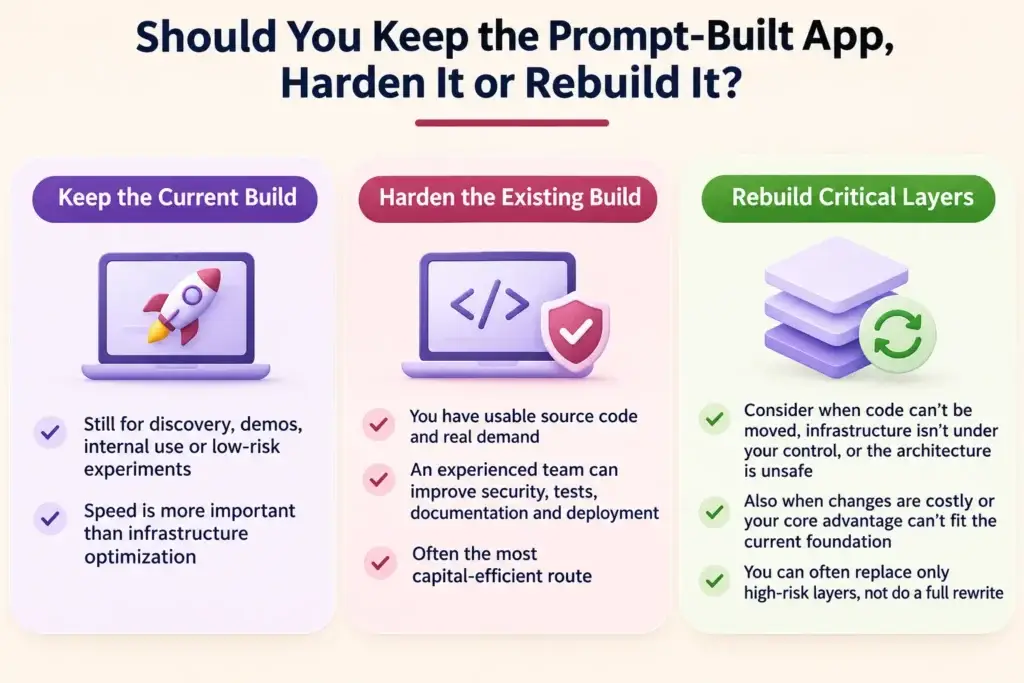
Keep the current build while the app is still mainly for discovery, demos, internal workflows or low-risk experiments, and speed still matters more than infrastructure.
Harden the existing build when the tool gives you usable source code and the product has shown real demand. An experienced team can review the architecture, isolate the important modules, fix security issues, add tests and document deployment without destroying what works. This is often the most capital-efficient route.
Rebuild critical layers when the code cannot be moved, the company does not control essential infrastructure, the authorization or data model is unsafe, every material change keeps getting more expensive, or your real competitive advantage cannot be built cleanly on the current foundation. Even then, a full rewrite is rarely required. The smarter move is usually to keep validated screens and user behavior and replace only the layers that carry the most risk.
If you harden, do it in this order
The biggest mistake is treating professional engineering as a reset. Your prototype already taught you which workflows customers value. Keep that learning and work through risk by business consequence:
- Freeze what users validated. Document the workflows customers actually use before changing architecture.
- Take control of the assets. Move the repository, infrastructure, domains, app-store accounts, databases and critical third-party accounts into company ownership.
- Audit risk by consequence. Authentication failures, exposed secrets, payment errors and data-loss risks come before cosmetic refactoring.
- Protect the proprietary core. The logic that differentiates you gets stronger architecture than admin screens or utilities.
- Test critical paths so the team can refactor safely.
- Make releases observable and repeatable, with a dependable deployment process, logs, crash reporting and basic monitoring.
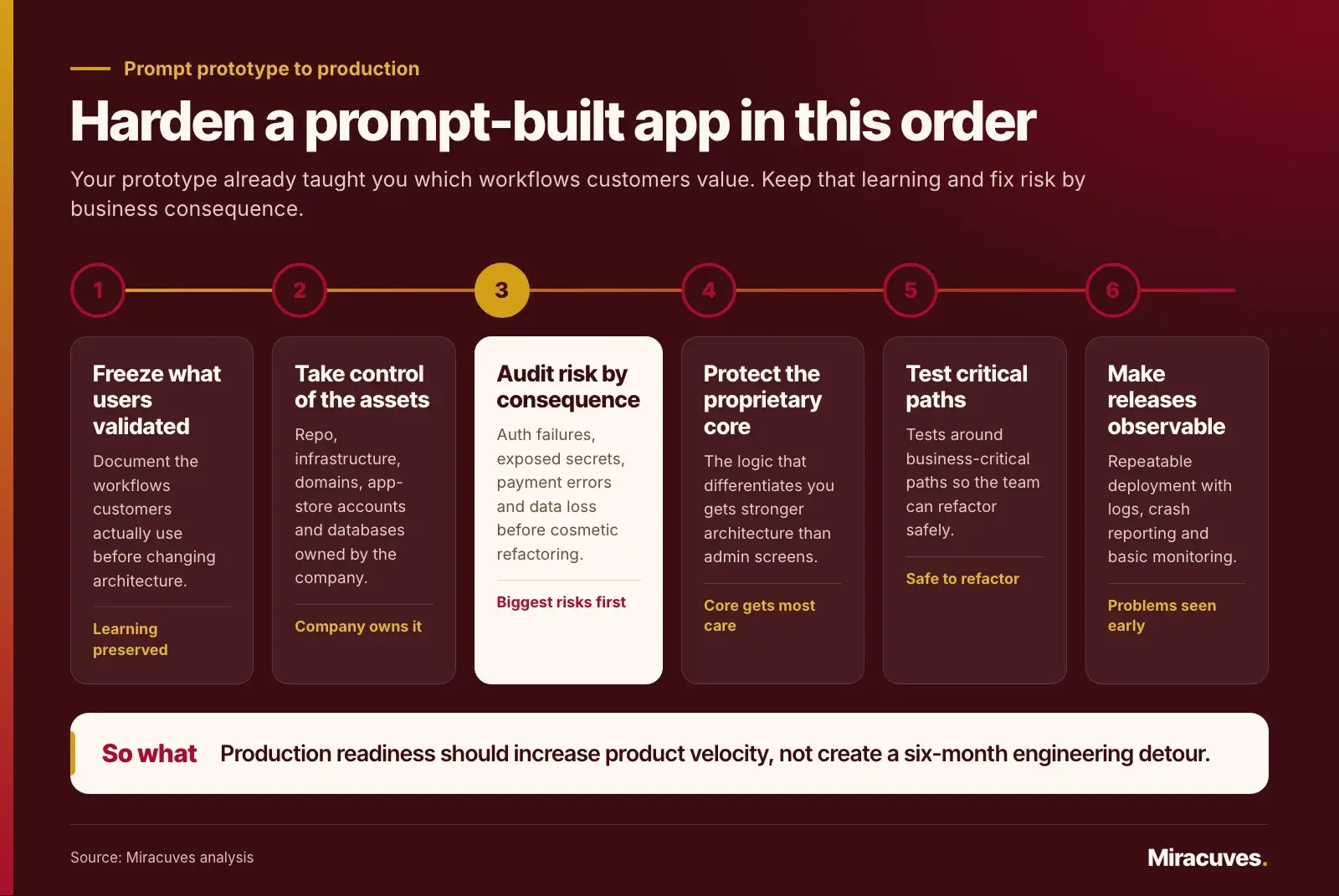
Throughout all six steps, keep shipping. Production readiness should increase product velocity, not create a six-month engineering detour. If usage is already outgrowing the prototype, the guide to why AI-generated MVPs break at scale and how to fix them covers the database, query and infrastructure failures that usually appear first.
Who Owns AI-Generated Code? The IP Questions Investors Now Ask
A founder can hold every source file and still lack meaningful control of the product. AI generation adds a newer diligence question: how much of this codebase did AI write, and what does the company actually own?
In the United States, the Copyright Office’s January 2025 report, Copyright and Artificial Intelligence, Part 2: Copyrightability, concluded that copyright requires human authorship and that, with current generally available technology, prompts alone do not give a user enough control over the output. Human-authored expression that is perceptible in the output, creative selection or arrangement, and creative modifications of AI output can still be protected, case by case. Other countries are still settling their positions, so treat this as context, not legal advice.
The practical result is that a prompt-built product’s defensibility rarely rests on copyright in generated lines. It rests on human-written core logic, data, know-how, brand and clean contracts. That is why diligence focuses on records:
- Accounts: the repository, cloud, app-store, domain and database accounts belong to the company, not to a founder’s personal login or a contractor.
- Builder terms: what the tool’s terms say about ownership of generated output and project data, and what happens to hosting if the subscription ends.
- Contributor agreements: signed IP assignment from every founder, employee and freelancer who touched the code.
- Open-source licenses: generated code pulls in packages, so keep a dependency and license inventory.
- An AI-use note: commit history or a short README section showing which modules were generated and which engineers reviewed or rewrote.
There is no accepted safe percentage of AI-generated code. What reassures a technical adviser is evidence that people reviewed, tested and can explain the generated parts, especially authentication, payments and data access. For the contract side of a handover, see the guide to source-code ownership in app development, and take material legal questions to qualified counsel.
Where Miracuves Fits
A prompt-to-app tool can be the right first move. An engineering team becomes useful once you know what customers value and need that validated behavior turned into software that lasts. For a hardening project, that is where Miracuves usually comes in: a custom app development engagement that starts with the asset and risk review above, then moves to backend restructuring, authentication and data-access fixes, tests on critical flows, a deployment pipeline and monitoring, while keeping the screens and workflows your users already know. Custom work is scoped separately for each product.
Not every founder heading into a raise needs a bespoke rebuild. If your business model matches a proven software pattern and your edge is distribution, operations or brand rather than proprietary workflows, starting from an owned, ready-made foundation can remove months of commodity development. Miracuves’ ready-made solutions can be prepared for launch in 6 working days where the existing product fits the required model. If your differentiation lives in algorithms, workflows or user experience nobody else has, custom engineering matters more.
Whichever route you take, the goal before a seed round is not a flawless codebase. It is knowing what you own, what is fragile, which shortcuts were deliberate and what has to change as usage grows, so another capable team could keep building without rediscovering how everything works.
Frequently Asked Questions
Can a startup raise seed funding with an app built using prompt-to-app tools?
Yes. How the first version was built does not decide whether a startup can raise. Investors weigh the market, traction, team and risk. As the company matures, though, founders should be ready to explain who owns the code and accounts, how security is handled, how the system is structured and how it will be maintained once engineers join.
Do seed investors inspect a startup’s source code?
Not always. Many seed investors never open the repository, and the depth of technical diligence varies by investor, stage, product and risk. When a technical adviser does look, the questions are usually about ownership, security, unknown technical debt, scalability and whether anyone besides the original builder understands the system.
How much of my app can be AI-generated before investors worry?
There is no accepted threshold. Advisers care less about the percentage than about whether people reviewed, tested and can explain the generated code, especially authentication, payments and data access. Keep a short record of which modules were generated and which engineers reviewed or rewrote. In the US, the Copyright Office says that, with current tools, prompts alone do not give enough control to make you the author of AI output.
Is exporting code from an AI app builder enough to establish ownership?
No. An export is one part of operational ownership. You also need the repository, cloud, database, domain and app-store accounts under company control, signed IP assignments from every contributor, a reading of the tool’s terms on generated output, a dependency and license inventory, and proof that another team can run the product without the builder account.
Should founders rebuild a prompt-generated app before fundraising?
Usually not by default. If the code can be exported, understood and improved, targeted hardening is often the most capital-efficient route. A deeper rebuild makes sense when the product is locked to a platform, has unsafe authorization or data design, gets more expensive with every change, or cannot support the proprietary workflows the company depends on.
What technical debt is acceptable at seed stage?
Some debt is normal, because early teams deliberately trade polish for learning speed. The real risk is debt nobody understands. Keep a short register listing each important compromise, why you accepted it, what it would cost the business if it failed and when you plan to address it. Investors read that as judgment, not weakness.
Miracuves is an independent software development company. We are not affiliated with, connected to, sponsored by, or endorsed by any company or product named in this article.
Terms such as “X Clone” are used descriptively. It is how the software industry refers to building a platform with functionality comparable to a known service, and how clients search for it.
The entire design and codebase of our products is built by our own team. Our products contain no code, design, graphics, or content originating from any third-party website or applications.
All third-party names and marks referenced in this article are the property of their respective owners, referenced solely to identify the services discussed.