



























Key Takeaways
- AI-generated MVPs can help founders validate product ideas quickly, but working prototypes may lack the architecture needed to support growing users, transactions and business operations.
- Common scalability problems include tightly connected application components, inefficient database queries, weak authentication, limited error handling and missing performance monitoring.
- Founders should evaluate code quality, database structure, API performance, security controls and infrastructure readiness before moving an AI-generated application into production.
- A scalable MVP does not require complex infrastructure from the beginning, but it needs a maintainable foundation that supports future features, higher traffic and reliable operations.
Common Architecture Problems in AI-Generated MVPs
- AI-generated applications may combine business logic, database operations and user interface code too closely, making future updates, testing and debugging more difficult.
- Poor database indexing, repeated queries and inefficient data relationships can increase response times as customer records, transactions and application activity grow.
- Incomplete authentication, missing authorization checks, exposed credentials and insufficient input validation can create security risks when prototypes become public applications.
- Limited automated testing, inconsistent error handling and missing application monitoring can make production failures harder to detect, investigate and resolve.
Architecture Fixes Founders Should Prioritize Before Launch
- Separate core business logic, API services and database access into maintainable components so developers can improve individual features without disrupting the entire application.
- Review database schemas, optimize important queries and introduce caching or background processing where performance testing identifies genuine bottlenecks.
- Strengthen production security with role-based access controls, secure secret management, server-side validation, dependency checks and appropriate data protection measures.
- Before launch, establish automated tests, deployment pipelines, backups, error tracking and realistic load testing to identify critical issues and prepare the MVP for sustainable growth.
Building a working application with AI has become remarkably fast. A founder can describe an idea, generate interfaces, connect a database, integrate authentication, and demonstrate a usable product without following a traditional software development process.
But launching an application and operating one reliably are two different challenges.
A prototype might work perfectly with ten test accounts and struggle when hundreds of customers begin using the same features. Pages slow down, database requests pile up, payment confirmations arrive twice, background tasks fail, and seemingly minor updates break existing functionality.
These are not always problems with AI-generated code itself. They often result from architectural decisions that were never tested against real production conditions.
Understanding AI-generated MVP scalability issues before launch helps founders avoid expensive interruptions, protect customer trust, and make better engineering decisions.
The objective is not to replace everything AI helped build. It is to identify which parts of the application need stronger foundations before growth exposes their weaknesses.
Why AI-Generated MVPs Often Work in Demos but Struggle in Production
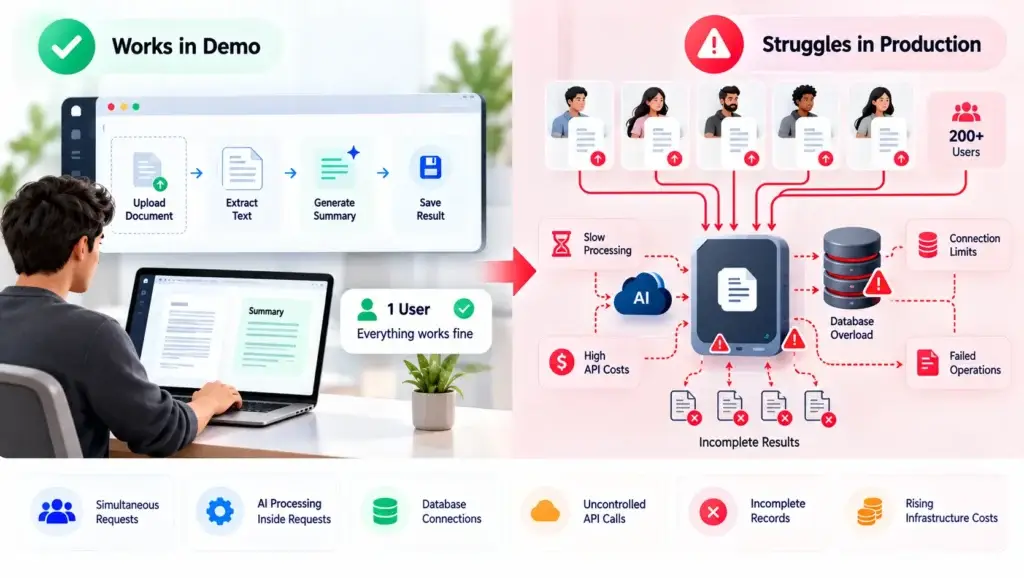
AI-assisted development is particularly effective at accelerating visible progress. It can produce functional interfaces, connect APIs, generate database operations, and implement common application workflows. However, faster code generation does not eliminate the need for architectural planning, testing, and technical oversight as an application moves toward production.
However, the development process often concentrates on whether a requested feature works rather than how the entire system behaves under changing conditions.
Consider a founder building an AI-powered document analysis platform.
The application allows users to upload documents, extract text, generate summaries, and save results.
During testing, everything appears functional because only one person uploads a document at a time.
Now imagine 200 users uploading large documents within a short period.
The application may suddenly encounter:
- Simultaneous requests competing for limited resources
- Expensive AI processing performed inside web requests
- Database connections remaining occupied too long
- Uncontrolled calls to external AI APIs
- Failed operations that leave incomplete records
- Rising infrastructure and processing expenses
The individual features may still be correctly implemented. The problem is that the system was not designed to coordinate them under concurrent use.
This distinction matters.
Functional correctness tells founders whether a feature works. Architectural readiness tells them whether it will continue working under realistic operating conditions.
For a deeper explanation of the underlying engineering limitations, see our guide to AI-generated backend architecture challenges.
Eight Architecture Problems That Can Prevent an AI-Built MVP From Scaling
1. Database Queries Become Bottlenecks as User Activity Increases
Database performance problems often remain invisible during early demonstrations.
A generated application may retrieve complete records when it only needs a few fields. It might perform repeated queries inside loops or search large tables without suitable indexes.
With a small dataset, these operations can appear harmless.
As records and concurrent users increase, the same requests may consume substantially more database resources.
For example, an application displaying customer orders might execute one query to retrieve the orders and a separate query to retrieve details for each order.
This is commonly called an N+1 query problem.
A page displaying 50 orders could generate dozens of unnecessary database requests.
Architecture fixes before launch:
- Identify the application’s most frequently executed queries.
- Examine query execution plans for expensive operations.
- Add indexes based on actual filtering, joining, and sorting patterns.
- Retrieve related records efficiently instead of repeatedly querying them.
- Introduce pagination for growing lists.
- Review connection pooling and transaction durations.
- Test using a dataset that resembles expected production volume.
Database bottlenecks are not always caused by slow queries. Applications using managed PostgreSQL services can also experience connection exhaustion when concurrent requests or serverless functions create more database connections than the available capacity supports. Founders using Supabase should understand how connection pooling and database concurrency limits influence backend stability before increasing traffic.
Not every query needs optimization. Founders should prioritize operations that are frequent, slow, or important to core user journeys.
2. Business Logic Becomes Difficult to Maintain
AI-generated applications can accumulate business rules across unrelated files.
For instance, subscription validation may appear in a frontend component, an API endpoint, and a billing callback.
Initially, the application works.
Later, a founder changes the subscription policy. One part of the system reflects the new rule while another continues using the previous version.
This creates inconsistent behavior and increases the risk of regressions.
Architecture fixes before launch:
Group the application into clear responsibilities:
- Presentation layer for the user interface
- API layer for requests and responses
- Business services for application rules
- Data access layer for persistence operations
- Background workers for asynchronous processing
- Integration adapters for external systems
These boundaries do not require an unnecessarily complicated architecture.
A well-organized modular monolith can provide an effective foundation for an early-stage product.
The important principle is simple: a business rule should have a clear owner rather than be duplicated across the codebase.
3. Too Many Tasks Run Inside User Requests
A common architectural weakness is making users wait while the application completes expensive work.
Imagine a customer submitting a file for analysis.
The backend receives the file, extracts its contents, sends information to an AI model, waits for the response, creates a report, saves the result, and finally replies to the user.
This may be acceptable during development.
But when many people submit files simultaneously, request processing time increases and backend resources remain occupied.
Some requests may fail because of timeouts, even though the underlying processing could have completed successfully.
Architecture fixes before launch:
Move suitable long-running operations into background jobs.
A more reliable flow looks like this:
- The user submits a request.
- The API validates the request and saves a job record.
- The system places the job in a queue.
- A background worker processes the operation.
- The application updates the job status.
- The user receives the result or a completion notification.
Background processing is especially valuable for document conversion, AI inference, report generation, media processing, bulk notifications, and external integrations.
Queues also need operational safeguards, including retry policies, dead-letter handling, job visibility, and idempotency to prevent duplicated side effects.
Moving tasks into a queue without these controls can merely relocate the original reliability problem.
4. APIs Lack Controls for Sudden Traffic
An AI-built application may function correctly when API endpoints receive requests at a predictable pace.
However, real production traffic is rarely perfectly distributed.
Some users refresh repeatedly. Others submit multiple requests in quick succession. Automated clients may generate bursts of activity.
Without appropriate controls, these requests can overwhelm services or exhaust external API allowances.
Architecture fixes before launch:
Introduce:
- Rate limits appropriate to endpoint sensitivity
- Request timeouts
- Payload size restrictions
- Input validation
- Concurrency limits for expensive operations
- Retries with backoff for recoverable failures
- Circuit breakers where external dependency failures could cascade
These controls should distinguish between normal usage and potentially abusive or unexpectedly expensive activity.
For an AI-powered application, limiting concurrent model requests may be more valuable than simply increasing web server capacity.
5. Authentication Works but Authorization Is Incomplete
User authentication answers one question:
Who is making this request?
Authorization answers a different question:
What is this user permitted to access or change?
An application may correctly require users to log in while failing to verify whether they own the requested records.
For example, a user might access another customer’s document by changing an identifier in an API request.
This is a security problem rather than a conventional performance bottleneck, but it becomes more dangerous as the application acquires more users and sensitive data.
Architecture fixes before launch:
- Enforce permissions on the server.
- Apply ownership checks to every sensitive data operation.
- Test whether one account can access another account’s records.
- Use role-based or policy-based authorization where appropriate.
- Restrict privileged operations.
- Store sensitive credentials on the server.
- Record important administrative actions.
- Verify data isolation before accepting real customers.
Before launch, founders should verify whether users can access another account’s private records, whether database permissions enforce ownership, and whether API credentials remain protected. A structured pre-launch security validation checklist provides a practical way to identify these weaknesses before the application starts handling real customer information.
Founders should not treat a functional login screen as evidence that the application has a secure access-control architecture.
6. The Application Cannot Recover Cleanly From Failures
Early prototypes often assume that every operation will succeed.
Production systems must account for network interruptions, failed payments, interrupted deployments, temporary service outages, and requests that users accidentally submit twice.
Consider a subscription platform.
A user completes payment, but the payment provider’s callback is delayed. The application assumes the payment failed and allows the user to retry.
If the original callback eventually arrives, the system must know how to reconcile the events without activating or charging the account incorrectly.
Architecture fixes before launch:
Introduce explicit state management, idempotency keys, durable records of important events, and carefully designed retry behavior.
For payments and other high-impact workflows, the system should distinguish between:
- Requested
- Processing
- Confirmed
- Failed
- Cancelled or reversed
External integrations should be designed around the possibility of delayed, duplicated, or out-of-order messages.
This is particularly important for marketplaces, financial products, booking platforms, and subscription applications.
7. Infrastructure Depends on a Single Fragile Runtime
A prototype may run successfully on one application instance with local storage and temporary in-memory state.
As traffic grows, the founder may attempt to add more application instances.
That can expose hidden dependencies.
For example, a user’s session may exist only in the memory of the first instance. When their next request reaches another instance, the session appears to be missing.
Likewise, files saved on one server may not be accessible from another.
Architecture fixes before launch:
Where scaling requirements justify it:
- Keep application instances stateless where practical.
- Use shared or appropriately managed session storage.
- Store persistent files in durable object storage.
- Separate configuration from application code.
- Ensure database connections are controlled across instances.
- Use load balancing when multiple application instances become necessary.
- Configure health checks and deployment recovery procedures.
Founders do not need a large distributed system on day one.
They need to avoid design choices that make modest infrastructure changes unnecessarily disruptive.
Preparing an application for growth also means planning how it will be deployed, monitored, updated, and recovered when infrastructure fails. A reliable release process should account for environment configuration, persistent storage, health checks, database migrations, and rollback procedures. Founders can use a production architecture and deployment framework to understand how these operational components work together beyond the initial application build.
8. AI Usage Costs Rise Faster Than Customer Growth
AI-powered applications introduce another scaling consideration: the cost and reliability of inference.
Every generation request may consume tokens, external API capacity, processing time, or specialized infrastructure resources.
If an application repeatedly sends unnecessarily large prompts or allows unrestricted requests, operational expenses can rise rapidly.
A product can remain technically available while becoming financially difficult to operate.
Architecture fixes before launch:
- Measure model usage by feature and user segment.
- Set quotas or usage limits aligned with the business model.
- Choose appropriate models for different workloads.
- Reduce unnecessary prompt context.
- Cache outputs only where correctness, privacy, and freshness permit.
- Monitor cost per successful operation.
- Design fallback behavior for external model outages.
- Prevent unlimited automated retries.
For founders, AI infrastructure scalability includes both performance and unit economics.
The key question is whether the business can support the cost of delivering each additional successful customer action.
Architecture Comparison: Prototype Decisions vs. Production-Ready Decisions
The following table shows how everyday engineering choices influence an application’s ability to handle growth.
| Architecture area | Common prototype approach | More reliable production approach |
|---|---|---|
| Database | Unoptimized queries and growing tables | Query profiling, suitable indexes and pagination |
| Backend structure | Business rules scattered across files | Clear modules and centralized business logic |
| Long-running tasks | Processing during API requests | Background jobs with controlled retries |
| Traffic management | No explicit request limits | Rate limiting, timeouts and concurrency controls |
| Data access | Authentication without complete ownership checks | Server-enforced authorization policies |
| External integrations | Assume every request succeeds | Idempotency, state tracking and recovery |
| Infrastructure | Local state tied to one instance | Durable storage and controlled scaling |
| AI model usage | Unrestricted inference requests | Usage visibility, limits and cost controls |
A production-ready foundation does not require every advanced infrastructure component immediately.
It requires engineering decisions that match expected usage, failure impact, and the company’s available resources.
What Founders Should Measure Before Increasing Traffic
Scalability should be tested with evidence rather than assumed from a successful demonstration.
Four categories of measurements are particularly useful.
Response-Time Performance
Measure how long important operations take.
Track the median response time and higher-percentile latency, such as p95, to understand both typical performance and slower requests.
For example, a request with a p95 latency of two seconds means approximately 95% of measured requests completed within two seconds.
The acceptable target depends on the product and the user experience.
A payment confirmation, document analysis request, and dashboard search may have very different performance requirements.
Error Rates and Reliability
Record the percentage of requests that fail and distinguish between infrastructure errors, expected validation failures, and external service failures.
Track whether operations can recover safely.
A system that returns quickly but loses data is not production-ready.
Resource Consumption
Monitor CPU, memory, database connections, queue depth, storage utilization, and external API usage.
These measurements help identify the component that becomes constrained as traffic increases.
Cost per Successful Action
For applications with AI inference or expensive integrations, track the infrastructure and model costs associated with a successfully completed operation.
A founder should understand not only whether the application can handle additional requests, but also whether doing so remains economically sustainable.
How to Load Test an AI-Generated MVP Before Launch
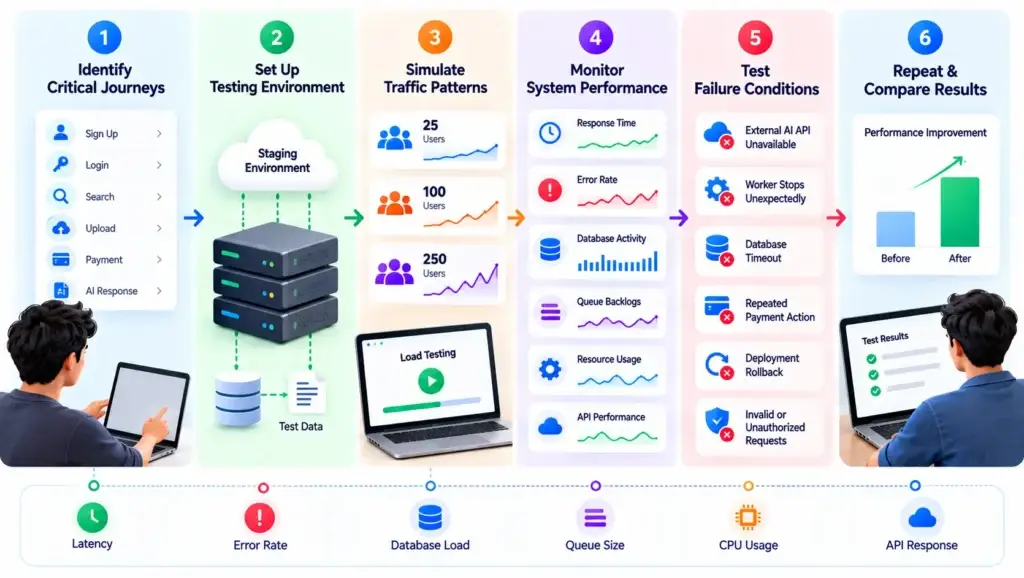
Load testing helps determine how an application behaves when several users perform actions at the same time.
The goal is not to generate the highest possible traffic number. It is to discover where application performance, reliability, or data integrity deteriorates.
Step 1: Identify Critical User Journeys
Select workflows that would directly affect customers or revenue.
Examples include registration, login, search, document upload, checkout, payment confirmation, and AI-generated responses.
Step 2: Build a Realistic Testing Environment
Use staging infrastructure that reflects production architecture closely enough to expose relevant bottlenecks.
Populate databases with representative test records.
Use synthetic or appropriately anonymized data rather than sensitive customer information.
Step 3: Simulate Different Traffic Patterns
Evaluate gradual growth, short bursts, and sustained activity.
For example, a team could test 25, 100, and 250 simulated concurrent users.
These are illustrative testing scenarios, not universal capacity targets. The correct workload should come from expected usage patterns and business requirements.
Step 4: Monitor the System During Testing
Track latency, error rates, database activity, queue backlogs, external service failures, and resource usage.
If response times deteriorate, identify the constrained component before increasing infrastructure capacity.
Step 5: Test Failure Conditions
A useful production-readiness exercise also examines what happens when:
- An external AI API becomes unavailable
- A background worker stops unexpectedly
- A database connection times out
- A user repeats a payment-related action
- A deployment needs to be rolled back
- The application receives malformed or unauthorized requests
The system should degrade predictably rather than silently corrupt data or expose sensitive information.
Step 6: Repeat the Test After Making Changes
Load testing becomes valuable when teams compare results before and after targeted improvements.
A database index, adjusted worker concurrency limit, or corrected API retry policy should produce measurable evidence of improvement.
A useful load test should reveal more than the maximum number of requests an application can handle. It should show how database pressure, request failures, external dependencies, and recovery behavior change as real-user activity increases. Understanding the common causes of application crashes under concurrent traffic helps founders translate load-testing results into targeted engineering improvements.
Founder Decision Signals: What Should Be Fixed Before Launch?
Not every architectural weakness has the same urgency.
A founder should prioritize issues based on customer impact, likelihood of failure, and the difficulty of recovering once real data enters the system.
Critical Security & Data Risks
If the application exposes sensitive data, allows unauthorized access, risks data loss, or processes financial transactions incorrectly, resolve these issues before launch. These failures can directly damage customer trust and require immediate attention.
Core Workflow Reliability
If essential features such as registration, payments, document processing, or AI-generated responses fail under expected traffic, prioritize backend stability, error handling, and recovery mechanisms. Critical user journeys should perform reliably before real customers arrive.
Scalability & Performance
If response times increase, database queries slow down, or background jobs accumulate during simulated traffic spikes, identify the underlying bottlenecks. Optimize queries, introduce appropriate processing controls, and establish measurable capacity limits before expanding infrastructure.
Maintainability & Launch Readiness
If the application works reliably but contains duplicated logic, tightly coupled modules, or minor technical debt, document these issues and prioritize improvements according to business impact. Avoid delaying launch for low-risk changes while ensuring the architecture can support future development.
This framework helps founders avoid two opposite mistakes.
The first is launching a fragile system because its interface looks finished.
The second is delaying market entry to solve hypothetical scaling problems that may never become relevant.
The strongest approach is risk-based engineering: fix what threatens the initial launch, measure likely capacity constraints, and preserve flexibility for future development.
Why Adding More Servers Does Not Always Solve Scaling Problems
When an application slows down, increasing server resources can appear to be the obvious solution.
Sometimes additional resources help. If the application is constrained by available compute and can distribute requests efficiently, horizontal or vertical scaling may improve performance.
But infrastructure expansion cannot automatically fix inefficient database access, duplicate payment processing, blocked queues, or unauthorized data access.
For example, doubling application instances may increase the number of simultaneous connections competing for the same database.
If the database is already the bottleneck, this change can make the situation worse.
Founders should identify the limiting component before choosing the solution.
In practical terms:
Measure the bottleneck first. Fix the architecture where necessary. Expand infrastructure when evidence supports it.
This usually produces a more predictable result than attempting to solve every slowdown through additional hosting capacity.
Should Founders Replace the Entire AI-Generated Architecture?
Not necessarily.
AI-generated code may contain useful interface components, validated product workflows, functional integrations, and business logic worth preserving.
Replacing the entire application without understanding the problems can waste valuable development work.
A focused approach is often more appropriate.
For example, the frontend may function well while the backend needs stronger database access patterns and asynchronous processing.
In that scenario, improving backend boundaries may be more sensible than recreating every screen.
However, if the application has deeply coupled modules, inconsistent data structures, and unreliable core workflows, more substantial restructuring may be necessary.
The correct decision depends on technical evidence, not the fact that AI was used during development.
Founders should prioritize retaining working functionality while correcting the parts that create measurable risk.
When an existing application requires substantial architectural changes, founders may also need to evaluate whether targeted improvements or a more structured development approach will deliver better long-term results. Professional custom AI application development can be relevant when the product requires new AI capabilities, redesigned backend workflows, or deeper integration with existing business systems.
A Practical Pre-Launch Architecture Readiness Checklist
Before opening an AI-generated application to a wider audience, founders can use the following checklist.
Database and Data Integrity
- Critical queries have been reviewed against representative data.
- Important constraints and indexes are in place.
- Backup and restore procedures have been tested.
- Concurrent updates do not create inconsistent records.
Backend and API Reliability
- Expensive background operations are separated from interactive requests where appropriate.
- APIs have suitable validation, timeouts, and rate limits.
- Retry behavior cannot create unintended duplicate side effects.
- Critical dependencies have defined failure handling.
Security and Access Control
- Authorization is enforced on the server.
- Sensitive credentials are not exposed in frontend assets.
- Users cannot access other users’ private records.
- Administrative permissions are restricted and reviewable.
Testing and Deployment
- Critical workflows have automated tests.
- Representative load testing has been completed.
- Application errors and resource consumption are observable.
- Deployments can be rolled back safely.
- Another developer can deploy the application using available documentation.
AI-Specific Operations
- Model requests have appropriate limits.
- Processing costs can be measured.
- External model failures have defined handling.
- User data is handled according to the product’s privacy and security requirements.
For a complementary operational checklist, see the AI codebase handoff checklist.
A checklist is not proof that a system can support unlimited traffic. It is a structured way to identify important launch risks and determine what evidence is still missing.
How Founders Can Strengthen an AI-Built Product Without Delaying Launch Unnecessarily
The most productive improvement plan begins with a clear understanding of the application’s first real operating conditions.
A founder launching a small private beta does not need the same infrastructure as an established platform serving large numbers of simultaneous users.
However, both need trustworthy data handling, reliable authentication, sensible failure recovery, and visibility into operational problems.
A practical launch strategy is to:
- Define the expected first-stage traffic and the most important user journeys.
- Identify failures that could cause security exposure, financial loss, or permanent data damage.
- Fix those risks before inviting real users.
- Validate performance under representative workloads.
- Document capacity limits and warning thresholds.
- Establish a process for monitoring and improving the system after launch.
Miracuves helps founders take this engineering-first approach when an AI-built application needs professional technical support.
Rather than assuming a complete rebuild is necessary, teams can evaluate the existing foundation and prioritize changes that make the application more stable and maintainable.
For founders who are still evaluating their product foundation, ready-made AI platforms may provide an alternative to developing every core component from scratch. Miracuves offers a 6-working-day deployment route for suitable ready-made solutions, depending on product fit and customization requirements. Applications requiring extensive architectural changes or custom development should be assessed separately.
The objective should remain the same regardless of the implementation approach: preserve the value of the product while reducing avoidable risks.
Final Thoughts: Build for Reliable Growth, Not Theoretical Unlimited Scale
AI-assisted development can shorten the distance between a founder’s idea and a working application.
But the long-term quality of a digital product depends on more than how quickly its initial features were generated.
Database efficiency, secure access controls, reliable background processing, failure recovery, observability, and deployment discipline determine whether the application can grow without creating unnecessary operational problems.
The strongest pre-launch decision is not to overengineer everything.
It is to understand how the product behaves, identify the failures that matter most, and strengthen the architecture before those failures affect customers.
A founder who can explain the application’s capacity limits, recovery behavior, and scaling priorities is better prepared to launch than one relying only on a successful demo.
Need Engineering Support Before Your AI-Built Product Goes Live?
If pre-launch testing reveals unresolved database bottlenecks, authorization vulnerabilities, unstable workflows, or architecture limitations, founders may need a deeper engineering assessment before releasing the application. Miracuves provides technical assessment and stabilization support for AI-built products, helping teams evaluate the existing codebase, identify high-risk weaknesses, and determine whether targeted improvements or broader restructuring are appropriate.
FAQs
Why do AI-generated MVPs struggle to scale?
AI-generated MVPs can struggle because their architecture is often validated around individual features rather than realistic concurrent usage. Inefficient database queries, synchronous processing, missing API limits, poor state management, and weak failure recovery can become visible when traffic grows. AI-generated code is not inherently unscalable, but production readiness must be verified through engineering review and testing.
Can an AI-generated application support thousands of users?
Yes, an AI-generated application can support thousands of users if its architecture, infrastructure, and operational controls are suitable for the workload. Capacity depends on request patterns, database design, processing requirements, external dependencies, and resource allocation. The number of registered users alone does not establish how much simultaneous traffic a system can handle.
What is the biggest architecture mistake founders make before launching an AI-built MVP?
One of the most consequential mistakes is treating a successful feature demonstration as evidence of production readiness. A feature that works for a single user may behave differently under concurrent requests, large datasets, unexpected failures, or unauthorized access attempts. Founders should test system behavior rather than rely only on visual functionality.
How can founders test whether an AI-generated MVP is ready for production?
Founders should identify critical user journeys, prepare representative test data, run load and failure tests, measure latency and error rates, verify security controls, and confirm that backups and deployment recovery work. Release decisions should be based on risk and expected operating conditions rather than a fixed universal traffic benchmark.
Does an AI-generated MVP need microservices to scale?
No. Many early-stage applications can scale effectively using a well-organized modular monolith. Microservices add operational complexity, distributed communication, monitoring requirements, and additional failure scenarios. Teams should introduce distributed services when clear technical or organizational needs justify them.
Should founders rewrite an AI-generated MVP before launch?
Not automatically. If the application has useful working components and localized architecture problems, targeted improvements may be more efficient than a complete rewrite. More extensive restructuring becomes relevant when critical business logic, data models, or system boundaries cannot be maintained reliably. The decision should follow a technical assessment.
How much scalability should a founder plan for before the first launch?
Founders should plan for expected initial demand, realistic traffic spikes, and the consequences of system failure. They do not need infrastructure capable of supporting millions of users immediately. They do need a dependable foundation, measurable performance, safe data handling, and a practical path for increasing capacity as the product grows.
Miracuves is an independent software development company. We are not affiliated with, connected to, sponsored by, or endorsed by any company or product named in this article.
Terms such as “X Clone” are used descriptively. It is how the software industry refers to building a platform with functionality comparable to a known service, and how clients search for it.
The entire design and codebase of our products is built by our own team. Our products contain no code, design, graphics, or content originating from any third-party website or applications.
All third-party names and marks referenced in this article are the property of their respective owners, referenced solely to identify the services discussed.