


Key Takeaways
- Community-led growth strategy starts before launch with a focused audience, useful seed content, founding members, moderators, and referral loops.
- A smaller community with active participation can create more value than thousands of inactive signups because discussion density drives the experience.
- Founders should start with one core community instead of launching many empty categories that make the platform appear inactive.
- Moderators are growth assets because they welcome members, improve discussions, highlight useful contributions, remove spam, and create participation rituals.
- Growth should be measured through active contribution, replies, retention, referral quality, and discussion depth rather than signups alone.
Growth Signals
- Seed content should use specific questions, opinion prompts, resource threads, polls, expert discussions, and weekly rituals that make participation easy.
- The first 50–200 active members can shape community culture, contribution standards, debate quality, and member identity.
- Referral loops work better when connected to identity through founding-member invites, expert invitations, badges, ambassador programs, and topic-based links.
- Public discussions can become long-term SEO assets when they use clear topic pages, descriptive titles, structured tags, internal links, and moderated content.
- Important metrics include first post rate, first reply rate, time to first response, weekly active contributors, returning members, reply depth, and invite-to-active-user rate.
Real Insights
- Community growth is not only a marketing problem; product design, culture, moderation, onboarding, and operations all influence whether members return.
- Seed content should create conversations rather than simply fill an empty feed, so every early post should give members a clear reason to respond.
- Referral quality matters more than referral volume because active contributors create more community value than large numbers of inactive users.
- Founders should expand into additional communities only after the first community develops consistent conversations and repeat participation.
- The strongest growth sequence is: focused community → seed content → founding members → moderators → participation rituals → referral loops → retention → expansion.
Building a community discussion platform is only half the challenge. The harder part is getting the right people to join, participate, return, and invite others.
Many founders assume community growth starts after launch. In reality, community-led growth strategy begins before the first public user signs up. The early discussion structure, first members, seed content, moderation tone, onboarding flow, and referral incentives all shape whether the platform feels alive or empty.
A discussion platform does not grow like a normal content website. It grows through participation density.
That means a smaller community with 300 active members can feel more valuable than a platform with 10,000 inactive signups. The goal is not simply to attract users. The goal is to create repeated conversations that make members feel there is a reason to come back.
This guide explains how to grow a community discussion platform using seed content, founding members, moderators, identity-based referral loops, and retention metrics that matter.
Why Community-Led Growth Is Different From Normal App Marketing
Most app marketing focuses on acquisition: ads, landing pages, app store optimization, launch campaigns, influencer posts, SEO, and paid traffic.
A community discussion platform needs acquisition too, but acquisition alone does not create community value. If users arrive and see empty categories, unanswered questions, weak moderation, and no visible member identity, they leave quickly.
For founders exploring broader social product opportunities, Miracuves also offers social media Networks that can support feeds, profiles, engagement systems, community workflows, and platform-specific growth features.
Community-led growth is different because the product becomes more valuable when members contribute.
The growth loop looks like this:
- The platform attracts a specific audience.
- Members see relevant seed discussions.
- A few users reply, vote, ask questions, or share opinions.
- Moderators guide the tone and keep the space useful.
- Better conversations attract more members.
- Members invite people who improve the community.
- The archive of discussions becomes a long-term acquisition asset.
This is why founders should avoid launching with a broad, empty platform. The early goal is not to look big. The early goal is to feel active, focused, and worth joining.
Start With One Core Community Before Expanding
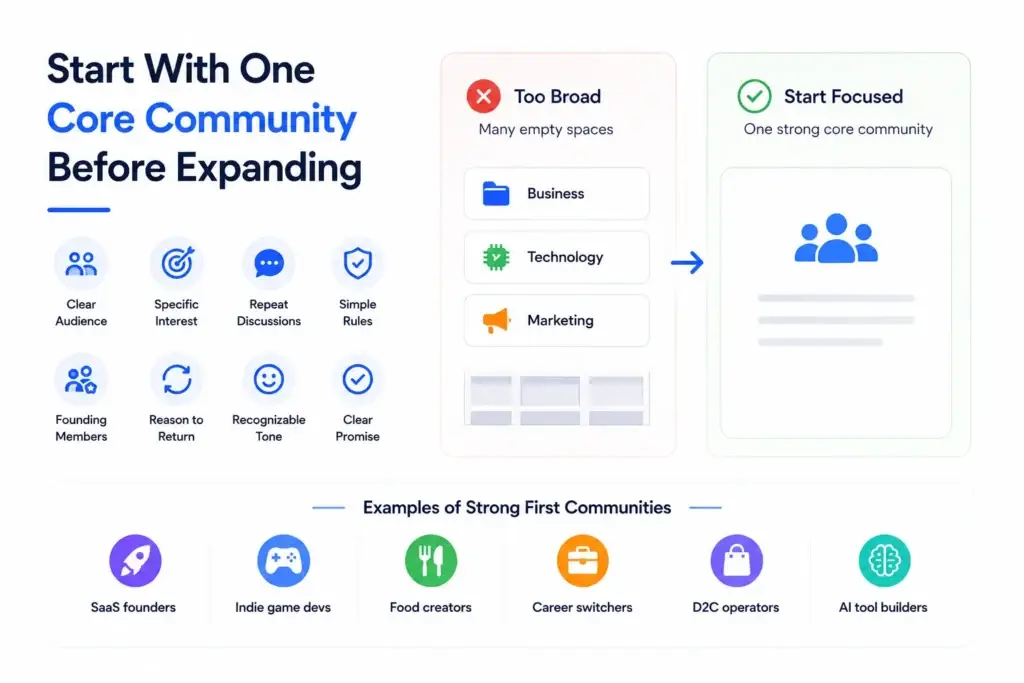
A community discussion platform can eventually support many groups, topics, or interest spaces. But early growth should usually start with one strong core community.
Launching with too many empty spaces creates a weak first impression. Users may assume the platform is inactive, even if the product itself is well built.
A focused first community should have:
- A clear audience.
- A specific problem or interest.
- A repeat discussion reason.
- A recognizable tone.
- Simple contribution rules.
- A few visible founding members.
- A reason for members to return weekly.
- A clear promise that new users understand quickly.
For example, instead of launching with broad categories like “Business,” “Technology,” and “Marketing,” a founder may start with one specific community such as:
- Bootstrapped SaaS founders sharing weekly growth experiments.
- Indie game developers discussing launch feedback.
- Local food creators sharing vendor and event opportunities.
- Career switchers preparing for product management interviews.
- D2C brand operators discussing retention and logistics.
- AI tool builders exchanging prompt workflows and product feedback.
The narrower the first community, the easier it is to create useful seed content and attract members who recognize themselves immediately.
Build a Seed Content Strategy Before Public Launch
Seed content is the content that makes a new platform feel alive before the community is fully self-sustaining.
It should not feel fake, generic, or overproduced. It should feel like useful conversation starters that real members would respond to.
Good seed content gives early users something to react to. It reduces the pressure of being the first person to post.
Types of Seed Content That Work
| Seed Content Type | Example | Why It Works |
|---|---|---|
| Specific questions | “What was the hardest part of getting your first 100 users?” | Easy to answer and personally relevant |
| Opinion prompts | “What growth tactic looks good online but rarely works in practice?” | Encourages debate and experience-sharing |
| Resource threads | “Share your favorite tools for managing community onboarding.” | Creates reusable value |
| Weekly rituals | “Monday wins: what moved forward this week?” | Builds habit and repeat participation |
| Founder logs | “What we changed this week based on member feedback.” | Shows transparency and progress |
| Expert prompts | “Ask a community operator: moderation, retention, or monetization.” | Adds authority and trust |
| Polls | “Which feature matters most for your community: search, badges, or private groups?” | Low-friction engagement |
| Member spotlights | “Meet one active contributor and what they are building.” | Builds identity and recognition |
A good seed post is specific enough to answer quickly. Broad questions often fail because users do not know where to start.
Weak prompt:
“What do you think about marketing?”
Better prompt:
“What is one channel that helped you get your first 50 active community members?”
The second prompt works because it is specific, experience-based, and useful to other members.
Read more – Community-Led Growth Strategy: Seed Content, Moderators, and Referral Loops for Discussion Platforms
Use Founding Members to Shape the Early Culture
Early members are not just users. They are culture carriers.
The first 50 to 200 active members decide how the platform feels. They set the tone for quality, kindness, debate, humor, self-promotion, feedback, and contribution standards.
A founder should not invite everyone at once. A stronger approach is to invite people who match the intended culture.
Good founding members are usually:
- Experienced enough to contribute.
- Curious enough to ask questions.
- Generous enough to reply to others.
- Respectful during disagreement.
- Aligned with the community topic.
- Willing to give feedback.
- Comfortable being early.
Founding members can be given visible recognition through:
- Founding member badges.
- Early contributor status.
- Private feedback groups.
- Access to product roadmap discussions.
- Invitations to host discussion threads.
- Moderator consideration.
- Member spotlight posts.
- Special onboarding calls.
- First access to premium spaces or tools.
Recognition matters because strong contributors often want more than visibility. They want identity, influence, and a sense that their contribution shapes the community.
Moderator-Led Growth: Why Moderators Are Growth Assets
Moderators are often treated as safety managers only. That is a narrow view.
In a community discussion platform, moderators can also become growth assets. They help shape quality, welcome new members, guide discussions, remove spam, answer common questions, and set the tone for participation.
A moderator-led growth strategy may include:
- Welcoming first-time posters.
- Moving discussions to the right topic space.
- Pinning useful threads.
- Asking follow-up questions.
- Encouraging quiet members to participate.
- Highlighting strong answers.
- Removing low-quality content early.
- Creating weekly discussion prompts.
- Running community events.
- Escalating product feedback to the founder.
Moderators reduce friction. They help users understand how to participate.
Moderator Roles and Growth Impact
Moderator-Led Growth Framework
| Moderator Action | Growth Impact | Founder Benefit |
|---|---|---|
| Welcome new members | Improves first-session comfort | Reduces early user drop-off |
| Pin strong discussions | Shows new users where value exists | Makes the platform feel useful faster |
| Ask follow-up questions | Turns thin posts into deeper conversations | Improves discussion quality |
| Remove spam quickly | Protects trust and content quality | Prevents early culture damage |
| Run weekly prompts | Creates repeat participation rituals | Builds retention habits |
| Highlight contributors | Encourages members to post better content | Creates visible contribution incentives |
| Escalate product feedback | Connects members to product improvement | Helps founders prioritize roadmap decisions |
The best moderators are not only rule enforcers. They are community gardeners. They make useful conversations easier to find and poor behavior harder to normalize.
Design Referral Loops Around Identity, Not Just Rewards
Generic referral programs often fail in community products because they feel transactional.
“Invite five friends and get a reward” may work for some apps, but communities grow better when invitations are tied to identity and belonging.
People invite others when the invite improves the community they care about.
A strong referral loop answers this question:
“Why would a member feel proud to bring someone here?”
Referral loops can be built around:
- Founding member invites.
- Expert invite programs.
- Topic-based invite links.
- Private community access.
- Contributor badges.
- Member reputation boosts.
- Invite-only discussion events.
- Ambassador programs.
- Shared resource libraries.
- Recognition for high-quality referrals.
- Moderator-nominated invites.
Strong Referral Loop Examples
| Referral Loop | How It Works | Best For |
| Founding member invites | Early users receive limited invites to bring relevant people | Private or niche communities |
| Expert invite threads | Members invite experts to answer questions | Professional, education, SaaS, or creator communities |
| Topic-based referral links | Users invite people into a specific community or discussion | Multi-topic platforms |
| Contributor recognition | Members get badges or status for bringing valuable contributors | Identity-driven communities |
| Ambassador program | Trusted members promote the platform in external groups | Founder, creator, or local communities |
| Event-based invites | Members invite others to live discussions or expert sessions | Communities with recurring events |
The key is referral quality. Ten invited members who actively participate are more valuable than 500 signups who never post.
Create Repeat Participation Rituals
Communities grow when members know when and why to return.
Repeat participation rituals give members a reason to check back without waiting for random activity.
Examples include:
- Monday goals thread.
- Weekly wins thread.
- Friday feedback thread.
- Monthly expert Q&A.
- Product teardown day.
- Local meetup planning thread.
- Resource-sharing Wednesday.
- Founder problem-solving hour.
- “Ask the moderator” thread.
- New member introduction thread.
- Community roadmap voting session.
Rituals work because they reduce uncertainty. Members do not need to wonder what to post. They know the rhythm.
A community discussion platform should make rituals easy to run through pinned posts, scheduled prompts, notifications, recurring events, and admin-controlled announcements.
Use SEO to Turn Discussions Into Long-Term Acquisition Assets
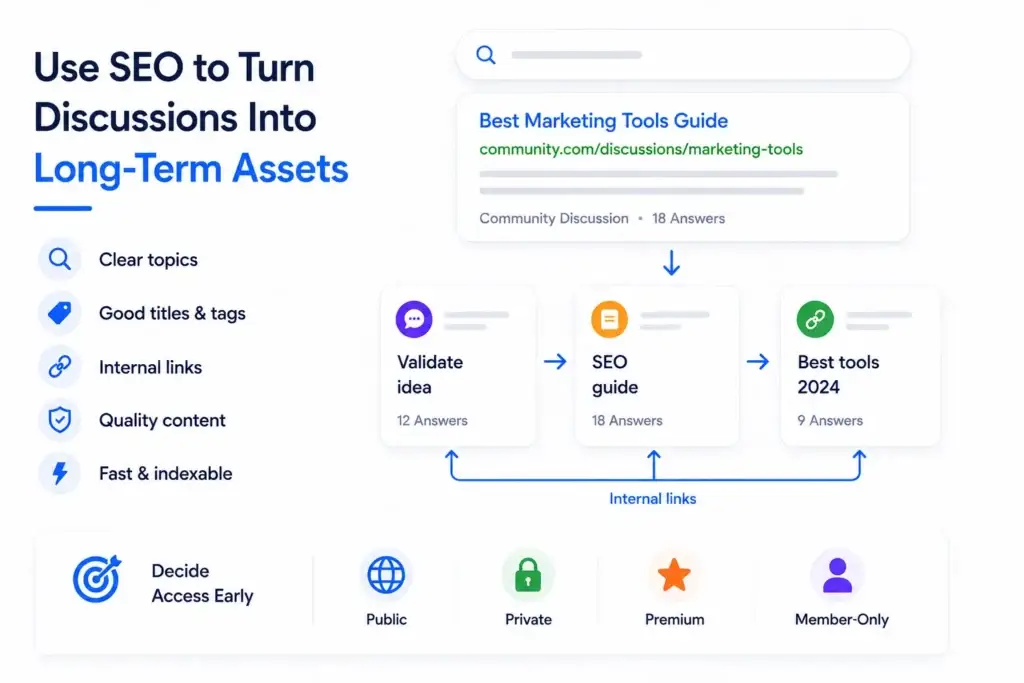
Community discussions can become powerful search assets when they are structured properly.
A platform that captures useful questions, answers, guides, and resource threads can create long-term organic discovery. But this only works if the content is indexable, organized, and high quality.
SEO-friendly community growth depends on:
- Clear topic pages.
- Descriptive post titles.
- Structured tags.
- Public discussion archives where appropriate.
- Internal links between related discussions.
- Moderated content quality.
- Search-friendly URLs.
- Fast page loading.
- Useful meta titles and descriptions.
- Avoiding thin duplicate pages.
- Keeping spam out of indexable areas.
For private communities, SEO may matter less because access is restricted. For public communities, SEO can become one of the strongest growth channels because every useful discussion can attract future members.
Founders should decide early which parts of the platform are public, private, premium, or member-only. That decision affects SEO, onboarding, monetization, and trust.
Once founders decide which discussions should stay public, private, premium, or member-only, they also need to connect that access strategy with revenue planning. For a deeper breakdown of subscriptions, premium spaces, sponsored communities, paid visibility, and other monetization routes, read the community platform business model guide.
Read more – Community Platform Features, Pricing, and Tech Stack: What Founders Should Know in 2026
Build Growth Channels Around the Community’s Niche
A community discussion platform should not market everywhere at once.
The right growth channels depend on where the target audience already spends time.
Possible acquisition channels include:
| Channel | How to Use It | Best Fit |
| SEO | Publish and index useful discussions, guides, and topic pages | Knowledge and problem-solving communities |
| Creator partnerships | Invite creators to host discussions or private spaces | Fan, education, expert, and creator-led communities |
| Email newsletters | Share weekly top threads and community highlights | Professional and learning communities |
| Social content | Turn strong discussions into short posts or carousels | Public-facing niche communities |
| Product-led invites | Invite users after they complete a meaningful action | SaaS and product communities |
| Events | Host Q&A sessions, roundtables, or challenges | Professional and high-trust communities |
| Partnerships | Co-create topic spaces with brands, educators, or operators | B2B, creator, education, and local communities |
| Ambassador programs | Let trusted members recruit and host conversations | Identity-led communities |
The strongest channel is the one that brings members who participate, not just visitors who browse.
Measure Community Health, Not Just Traffic
A community can look busy without being healthy.
Total signups, page views, and downloads are useful, but they do not tell the full story. A community discussion platform needs metrics that reveal participation quality and repeat behavior.
Important community growth metrics include:
| Metric | What It Measures | Why It Matters |
| New member activation rate | How many new users perform a meaningful first action | Shows whether onboarding works |
| First post rate | How many users create their first post | Measures contribution confidence |
| First reply rate | How many users receive a reply | Indicates whether the community feels alive |
| Time to first response | How quickly new posts get replies | Affects early user trust |
| Weekly active contributors | Users posting, replying, voting, or reporting | Measures true community participation |
| Reply depth | How many comments happen per discussion | Shows conversation quality |
| Returning member rate | How many users come back weekly or monthly | Measures retention |
| Invite-to-active-user rate | How many invited users become active | Measures referral quality |
| Moderator response time | How quickly reports are reviewed | Shows trust and safety health |
| Top discussion traffic | Which threads attract search or referral traffic | Helps identify growth opportunities |
The healthiest communities are not always the largest. They are the ones where members receive responses, see useful discussions, and feel that participation is worth their time.
Founder Decision Signals
Audience Focus
If your platform tries to serve everyone at launch, your early communities may feel empty. Start with one focused audience and expand only after participation becomes consistent.
Seed Content
If users arrive before there are useful conversations, they may not return. Seed prompts, expert threads, and weekly rituals create early participation signals.
Moderation
If the platform allows user-generated content, moderation should be active from day one. Reports, rules, and moderator actions protect trust as the community grows.
Referral Quality
A strong referral loop should attract members who improve the community, not only inflate signup numbers. Measure invited users by activation and repeat contribution.
Why Platform Foundations Matter for Community-Led Growth
Growth strategy only works when the platform can support it.
Before running seed content, moderator-led engagement, or referral campaigns, founders should make sure the product foundation has the right community platform features in place, including topic spaces, member roles, voting, notifications, moderation tools, admin controls, and monetization workflows.
If the product does not support topic spaces, voting, comments, member roles, notifications, moderation, analytics, and admin control, the founder may struggle to execute the growth plan
A community-led growth system needs product support for:
- Topic-based community creation.
- Seed post publishing.
- Pinned posts and announcements.
- Threaded discussions.
- Voting and reactions.
- Member profiles.
- Founding member badges.
- Moderator roles.
- Report queues.
- Admin analytics.
- Referral tracking.
- Invite links.
- Notification workflows.
- Search-friendly discussion pages.
- Premium or private spaces where relevant.
- Role-based access control.
Once founders understand which features are needed for growth, the next question is usually budget. To evaluate the modules, customization scope, admin controls, and launch requirements that affect investment, review the community platform development cost guide before finalizing your build plan.
If you are comparing build partners before launch, choosing a community platform development company can help you evaluate technical capability, moderation workflows, admin control, source-code ownership, and post-launch customization support before running growth campaigns.
Mistakes Founders Should Avoid
Launching with too many empty communities
A large number of inactive spaces makes the platform feel weak. Start with one focused community and expand when users create enough repeat discussion.
Treating seed content as filler
Seed content should invite useful replies, not simply occupy space. Every early post should teach, ask, challenge, or help members participate.
Waiting too long to recruit moderators
Moderators help shape tone before problems become visible. Early moderation protects culture, not just safety.
Rewarding referrals only by quantity
Referral campaigns should reward active, relevant members. A large invite list is not useful if invited users do not post, reply, or return.
Measuring growth only by signups
Signups do not prove community health. Track first replies, active contributors, returning members, reply depth, and moderator response time.
How Miracuves Helps Founders Build a Launch-Ready Community Platform Foundation
Miracuves helps founders build white-label solution platforms that are not limited to basic posting and commenting features, but are designed as a complete product foundation for launching, managing, and growing an online community business. With source code ownership, branded design, member workflows, moderation tools, admin dashboards, and monetization options, founders get the flexibility to shape the platform around their audience, niche, and business model instead of depending on a generic hosted tool.
This is especially important before running growth campaigns because marketing can only work well when the platform is ready to handle new members, active discussions, user roles, reports, referrals, premium access, and community operations from day one.
A strong foundation allows founders to test seed content, invite early members, assign moderators, manage engagement, track activity, and improve retention without rebuilding core modules later.
For founders who want to prepare the product layer before investing in acquisition, referrals, SEO, partnerships, or paid promotion, the community discussion platform solution from Miracuves is the natural next step because it connects launch speed with long-term control, customization, and scalable community growth.
Final Thoughts: Grow the Culture Before Scaling the Platform
A Reddit does not grow because it has many categories. It grows because members find conversations worth joining.
The strongest early growth strategy is simple:
Start narrow. Seed useful discussions. Invite the right founding members. Give moderators ownership. Build rituals. Reward valuable contribution. Measure participation quality. Expand only when one community has enough life to support the next.
For founders, this means growth is not only a marketing function. It is a product, culture, and operations function working together.
Miracuves can help founders build the product foundation behind that growth: topic-based communities, member roles, moderation workflows, admin control, source-code ownership, and monetization-ready features that support long-term community development.
FAQs
What is community-led growth for a discussion platform?
Community-led growth is a strategy where member participation, useful discussions, referrals, moderation, and contribution quality drive platform growth. Instead of relying only on paid acquisition, the platform grows because members create value for each other.
How do you grow a community discussion platform from zero?
Start with one focused community, invite a small group of relevant founding members, publish useful seed content, create weekly discussion rituals, recruit early moderators, and track participation quality instead of only signups.
What is seed content in a community platform?
Seed content is the first set of posts, questions, polls, guides, and discussion prompts added before or during launch. Its purpose is to make the platform feel useful and give early members something easy to respond to.
Why are moderators important for community growth?
Moderators protect quality, welcome members, guide discussions, remove spam, highlight useful posts, and create repeat engagement rituals. They help the community feel active, safe, and organized.
How can referral loops work for online communities?
Referral loops work best when they are tied to identity and contribution. Founding member invites, expert invitations, topic-based links, ambassador programs, and recognition-based referrals can bring in members who improve the community.
Which metrics matter most for community platform growth?
Useful metrics include first post rate, first reply rate, time to first response, weekly active contributors, returning member rate, reply depth, invite-to-active-user rate, and moderator response time.
Should a community platform launch with many categories?
Usually, no. A focused first community is easier to grow because users understand the purpose quickly. Too many empty categories can make the platform feel inactive.
How can Miracuves help founders launch a community discussion platform?
Miracuves helps founders launch white-label community platforms with source code, branded design, admin control, member roles, moderation workflows, voting systems, monetization options, and faster deployment support.
Miracuves is an independent software development company. We are not affiliated with, connected to, sponsored by, or endorsed by any company or product named in this article.
Terms such as “X Clone” are used descriptively. It is how the software industry refers to building a platform with functionality comparable to a known service, and how clients search for it.
The entire design and codebase of our products is built by our own team. Our products contain no code, design, graphics, or content originating from any third-party website or applications.
All third-party names and marks referenced in this article are the property of their respective owners, referenced solely to identify the services discussed.