


Key Takeaways
What You’ll Learn
- Google Gemini is an AI platform designed to power search, content generation, and enterprise applications.
- Revenue comes from multiple channels including cloud services, API usage, and enterprise subscriptions.
- Integration with Google ecosystem enhances monetization across Search, Workspace, and Ads.
- AI models are offered as services enabling developers and businesses to build scalable solutions.
- Long-term growth depends on enterprise adoption and continuous AI innovation.
Stats That Matter
- AI market size is expected to exceed $1 trillion globally in the coming decade.
- Google Cloud is a major revenue driver supporting Gemini-powered services.
- Enterprise AI adoption is rapidly increasing across industries like finance, healthcare, and SaaS.
- Generative AI tools are becoming core productivity assets for businesses worldwide.
- AI integration is shaping the future of search, automation, and digital workflows.
Real Insights
- AI monetization works best when integrated into existing high-traffic ecosystems.
- Successful platforms combine data, infrastructure, and distribution for scale.
- Enterprise-focused AI solutions drive predictable and recurring revenue.
- Developer adoption plays a critical role in platform expansion.
- Growth depends on balancing innovation, cost efficiency, and real-world use cases.
Google Gemini, the next-generation AI model developed by Google DeepMind, is not just another chatbot—it’s a full-fledged multimodal AI ecosystem designed to compete with OpenAI’s ChatGPT. From text and code generation to image analysis and enterprise integrations, Gemini is rapidly becoming a cornerstone in Google’s AI strategy across consumer, developer, and business markets.
Understanding the revenue model of Google Gemini is crucial for digital agencies, SaaS entrepreneurs, and startup founders who want to build or clone and develop similar AI platforms. With billions in AI investments and growing demand for intelligent digital assistants, the monetization strategy behind Gemini provides a valuable blueprint for profitable innovation in 2025 and beyond.
In this blog, we’ll explore what Google Gemini does, how it earns money, and how you can replicate this powerful revenue model using ready-made AI solutions from Miracuves.
What Google Gemini Does and Its Market Impact
Google Gemini is a suite of large language models (LLMs) and multimodal AI tools developed by Google DeepMind and integrated across the Google ecosystem. Unlike single-purpose chatbots, Gemini supports text, code, image, video, and audio inputs—making it versatile for developers, businesses, and everyday users alike.
From Gemini Nano in Android devices to Gemini Pro powering Bard and Workspace, and Gemini 1.5 in premium enterprise products—this AI model is embedded deeply into Google’s offerings. It’s also available via the Gemini API on Google Cloud’s Vertex AI platform, allowing third-party developers to build, scale, and monetize their own AI-powered apps.
Market Impact and Metrics
Gemini has quickly become a central pillar in Google’s generative AI strategy:
- As of early 2025, over 100 million users have interacted with Gemini-powered tools
- Google Cloud reported a 15% boost in enterprise AI adoption after Gemini integrations
- Premium Gemini Advanced subscriptions are already generating recurring revenue at scale
- Gemini’s enterprise licensing and API usage are part of a multi-billion dollar AI monetization push
This massive reach and capability make Gemini not just a model, but a revenue-generating engine for Google. For entrepreneurs looking to build AI platforms, studying how Gemini earns is key to replicating its success.
Google Gemini shows that AI success isn’t just about tech—it’s about visibility. Explore the Gemini marketing strategy and learn how to stand out among AI giants.
How Google Gemini Makes Money
Google Gemini operates on a diversified monetization strategy that spans individual users, enterprise clients, and developer ecosystems. Here are the major revenue streams:
- Gemini Advanced Subscriptions: Users pay monthly to access Gemini 1.5 Pro’s advanced capabilities through Google One AI Premium, priced at $19.99/month.
- API Usage on Google Cloud (Vertex AI): Developers and businesses pay based on token usage for integrating Gemini into apps and services.
- Enterprise Licensing: Large companies pay for customized Gemini deployments across tools like Google Workspace, BigQuery, and more.
- Workspace AI Upgrades: Google Workspace customers can upgrade to add Gemini-powered features like smart replies, AI writing assistance, and data insights.
- Advertising & Search Enhancements: Gemini improves user interactions in Search and Ads, indirectly boosting Google’s core ad revenue via better targeting and AI summaries.
- Hardware Integrations: Gemini Nano is embedded in Pixel devices, driving higher product value and potential hardware sales.
- Custom AI Solutions for Partners: Through Google Cloud, Gemini is used to power specialized solutions in healthcare, finance, and retail.
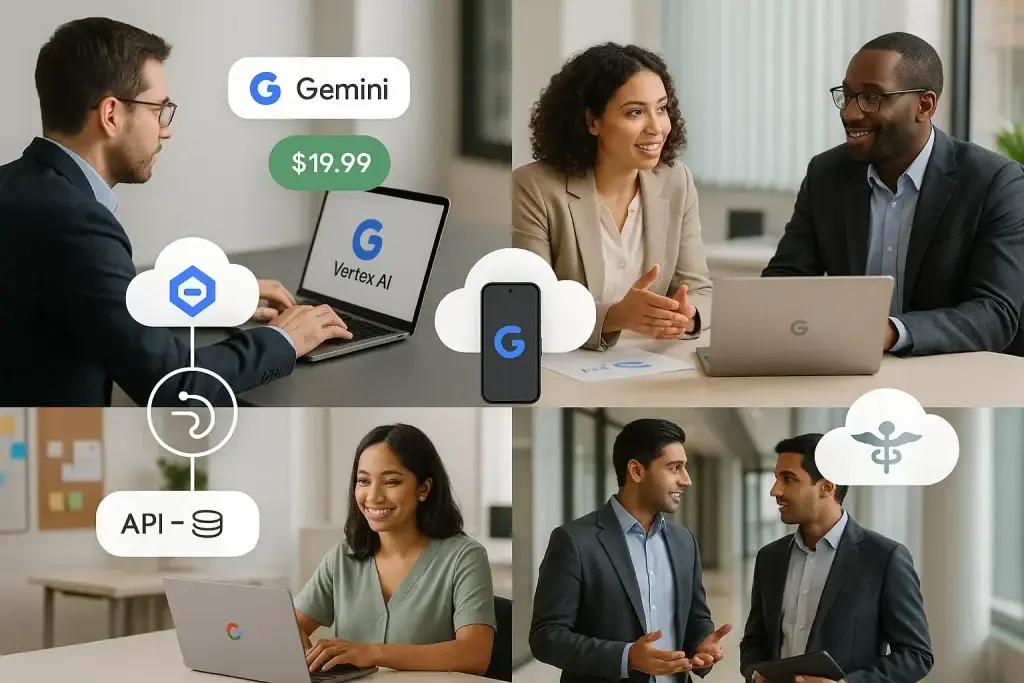
This multi-pronged model helps Google earn from every segment of its ecosystem—while also creating opportunities for startups to replicate a similar model with app clones.
Google Gemini isn’t just an AI app—it’s a full ecosystem monetized through subscriptions, cloud integrations, and enterprise tools. Dive into the Google Gemini business model to see how it drives revenue.
Detailed Breakdown of Revenue Channels
Each of Google Gemini’s revenue streams is strategically designed to monetize different user segments while reinforcing Google’s broader ecosystem. Let’s dive deeper into how each one works and why it scales.
Gemini Advanced Subscriptions
This premium plan is part of the Google One AI Premium package, which gives users access to Gemini 1.5 Pro—the most powerful version currently available. At $19.99/month, users get advanced multimodal capabilities, longer context windows, coding support, and priority access to new features.
Who pays: Individual power users, researchers, professionals
Why it scales: Recurring revenue with low churn among AI enthusiasts and productivity users
API Usage on Vertex AI
Gemini is available to developers through Google Cloud’s Vertex AI. Pricing is based on input/output token usage, which scales with volume and model version. For example, Gemini 1.5 Pro has a 1 million token context window—ideal for large-scale document analysis, RAG workflows, and AI apps.
Who pays: SaaS builders, startups, AI integrators
Why it scales: Pay-as-you-go pricing enables startups to prototype and scale without upfront costs
Enterprise Licensing
Google offers Gemini-powered features to enterprise clients across verticals. These integrations go beyond APIs—embedding AI directly into tools like Google Docs, Sheets, and Gmail.
Who pays: Large businesses, enterprise IT teams
Why it scales: High-ticket contracts and embedded AI lead to long-term enterprise lock-in
Workspace AI Upgrades
Google Workspace users can pay for Gemini features through per-seat pricing. These enhancements include smart document generation, auto-replies, meeting summaries, and AI-assisted spreadsheets.
Who pays: SMBs and mid-size organizations
Why it scales: Easy upsell to existing Google Workspace customers
Advertising and Search Enhancements
While users don’t directly pay for this, Gemini is integrated into Google Search to power generative answers, product summaries, and contextual ad displays. This leads to better user engagement and ad click-through rates.
Who pays: Advertisers indirectly
Why it scales: Even marginal gains in ad relevance significantly increase Google’s core revenue
Hardware Integrations
Gemini Nano runs on-device in Pixel phones, enabling AI features like smart replies, summarization, and voice commands—all without cloud dependency. While not a direct revenue source, it adds significant value to hardware sales.
Who pays: End users via device purchases
Why it scales: Differentiates Google hardware in a competitive market
Custom AI Solutions for Partners
Google Cloud collaborates with major enterprises to co-develop AI products using Gemini—like AI agents for customer service, fraud detection models in finance, or diagnostic tools in healthcare.
Who pays: Industry-specific enterprises
Why it scales: High-margin custom AI solutions with long development cycles and deep client engagement.
Google Gemini transforms how creators work with features like Deep Research and multimodal inputs—from parsing images to analyzing videos. Explore the full Gemini app features list that’s reshaping creativity and productivity.
Why This Revenue Model Works in 2025
Google Gemini’s revenue model thrives in 2025 because it aligns perfectly with the evolving landscape of AI adoption, digital work, and enterprise transformation. Here’s why it continues to scale and succeed:
AI Is Mainstream, Not Experimental
AI has moved beyond hype—businesses now actively invest in real-world AI tools to improve productivity, automate workflows, and enhance customer experience. With Gemini integrated into Google Workspace, businesses see immediate ROI, making paid upgrades and enterprise licensing highly attractive.
Freemium-to-Premium Conversion Is Strong
Offering free access to Gemini 1.5 through Bard and basic Workspace features helps onboard millions of users. From there, upselling to the $19.99/month premium plan or enterprise seats is seamless due to demonstrated value. The low barrier to entry fuels top-of-funnel growth.
APIs and Customization Matter
Gemini’s availability via Vertex AI lets startups and SaaS founders tap into Google’s LLM capabilities without building infrastructure from scratch. This “infrastructure-as-revenue” model is ideal in 2025, where AI is core to app development across sectors like healthcare, education, and finance.
Data Privacy and On-Device AI Are Winning Points
With growing data regulation, the inclusion of Gemini Nano for on-device processing (especially in Android and Pixel devices) aligns with privacy-first consumer behavior. This builds trust, drives usage, and supports indirect monetization via hardware and ecosystem loyalty.
Enterprise Budgets Favor AI Investment
As digital transformation accelerates post-pandemic and amid global AI competition, companies are dedicating more budget to AI solutions. Gemini’s enterprise tools, productivity enhancements, and contextual intelligence make it a top pick in B2B spending.
Global Cost Factors & Pricing Breakdown
Googlr gemini–Like App Development — Market Price
PHP/Laravel is often the most practical choice for launching a Google Gemini clone quickly and affordably. Node.js/Python becomes essential when real-time AI processing and advanced model integrations are required, while Go microservices are best suited for enterprise-scale AI platforms handling massive concurrent workloads and complex infrastructure.
Miracuves Google Gemini-Like App Solution Cost and Tech Stack
Miracuves Pricing for a Google Gemini-Like AI Platform developed in PHP/Laravel with Flutter Apps for $2,799 USD (One-Time Price) in just 6 days
Get a fully developed, deployment-ready platform modeled after Google Gemini. Built on a rock-solid PHP/Laravel foundation, this complete package includes everything you need to launch and scale:
Core Workflows: AI chat interactions, prompt handling, and multi-use AI assistance modules.
Built-in Intelligence: In-app AI response logic, prompt optimization, and scalable processing workflows.
Management Hub: Comprehensive user management, usage monitoring, and a centralized admin backend.
Launch-Ready: Fully prepped for your custom branding, configuration, and immediate market entry.
Why is it so affordable?
Most advanced AI platforms are built using expensive, high-performance architectures that require specialized machine learning engineers and infrastructure, driving costs into the tens or hundreds of thousands of dollars.
We took a smarter, more practical approach:
You Aren’t Paying for Ground-Up Development: Our AI-ready engine is already developed, battle-tested, and ready to deploy. You skip the inflated costs and long development cycles associated with building from scratch.
The Power of PHP / Laravel: We built this on one of the most reliable, globally adopted frameworks in the world. Not only does this keep our upfront costs down, but it also protects your future budget. PHP has a massive global talent pool, making it incredibly easy and cost-effective for you to find developers for future scaling or customizations. You get a scalable, AI-capable foundation without the inflated development cost.
Note: This cost is for the solution, re-branding, deployment, and source code only.
Conclusion
Google Gemini’s revenue model is a masterclass in AI monetization—spanning subscriptions, enterprise licensing, developer APIs, and ecosystem integrations. It earns by delivering real value to individuals, businesses, and developers alike, all while reinforcing Google’s AI leadership.
For startups, this model isn’t just inspirational—it’s replicable. With the right foundation, you can build a multimodal AI platform that not only functions like Gemini but earns like it too.
That’s where Miracuves makes the difference. Our Google Gemini Clone empowers you to launch faster, monetize smarter, and adapt to market shifts in 2025 and beyond.
FAQs
How does Google Gemini generate revenue?
Google Gemini generates revenue through premium subscriptions, API usage fees, enterprise licensing, Workspace upgrades, and its integration into ad-enhanced search experiences.
Is Google Gemini profitable in 2026?
While exact profit margins aren’t public, Google has monetized Gemini across cloud, workspace, and premium plans—making it a revenue-positive AI asset in 2026.
What are the main income sources for Google Gemini?
Key income sources include Google One AI Premium subscriptions, Vertex AI API usage, enterprise licensing, Workspace AI upgrades, and indirect revenue via advertising.
Can startups use the same revenue model as Google Gemini?
Yes, startups can adopt similar monetization strategies by offering AI tools through freemium models, premium upgrades, developer APIs, and custom B2B solutions.
Does Miracuves offer Google Gemini clone with monetization features?
Yes, Miracuves provides a fully customizable Google Gemini Clone with built-in monetization options such as subscriptions, enterprise plans, and API billing.
Related Articles :-
Miracuves is an independent software development company. We are not affiliated with, connected to, sponsored by, or endorsed by any company or product named in this article.
Terms such as “X Clone” are used descriptively. It is how the software industry refers to building a platform with functionality comparable to a known service, and how clients search for it.
The entire design and codebase of our products is built by our own team. Our products contain no code, design, graphics, or content originating from any third-party website or applications.
All third-party names and marks referenced in this article are the property of their respective owners, referenced solely to identify the services discussed.