
Key Takeaways
- Content discovery helps viewers find the right story before their attention drops.
- Genres, trending titles, search, watchlists, and recommendations shape the full viewing journey.
- Strong discovery improves episode continuation, paid unlocks, VIP interest, and repeat sessions.
- A vertical drama platform should show the right content in the right order, not everything at once.
- Discovery should connect catalog structure, viewer behavior, monetization, and admin control.
Discovery Signals
- Viewers need fast access to trending titles, new releases, free episodes, and continue-watching sections.
- Operators need genre tags, emotional hooks, regional rails, language filters, and campaign priority controls.
- Recommendation quality depends on clean catalog data and useful viewer behavior signals.
- Search logs help reveal what users want but cannot easily find inside the app.
- Admin controls help teams update rails, trending sections, banners, unlock status, and title visibility after launch.
Real Insights
- Discovery is not only a homepage design task; it is the operating system of the catalog.
- Weak genre planning, poor tagging, and static trending rows can reduce viewer trust and retention.
- Curated rails should come first, then behavior-led recommendations can improve as clean data grows.
- The best discovery flow helps viewers start quickly, continue naturally, and return for more episodes.
- Miracuves helps founders build vertical drama platforms with genre discovery, trending rails, search, watchlists, recommendations, analytics, and admin control.
A vertical drama streaming app succeeds when viewers can find the next story before their attention drops.
This format is fast, emotional, mobile-first, and episode-driven. Viewers usually do not want to browse for too long. They want to open the app, understand what is trending, find a genre they enjoy, and start watching quickly.
That is why content discovery is not just a design feature. It is a retention, engagement, and monetization system.
For founders, the real question is not only, “How will users browse shows?” The bigger question is, “How will the platform guide users from discovery to watching, continuing, unlocking, and returning?”
This guide explains how genres, trending titles, content rails, search, watchlists, and personalized recommendations can shape a stronger vertical drama streaming experience.
Why Content Discovery Decides Retention in Vertical Drama Apps
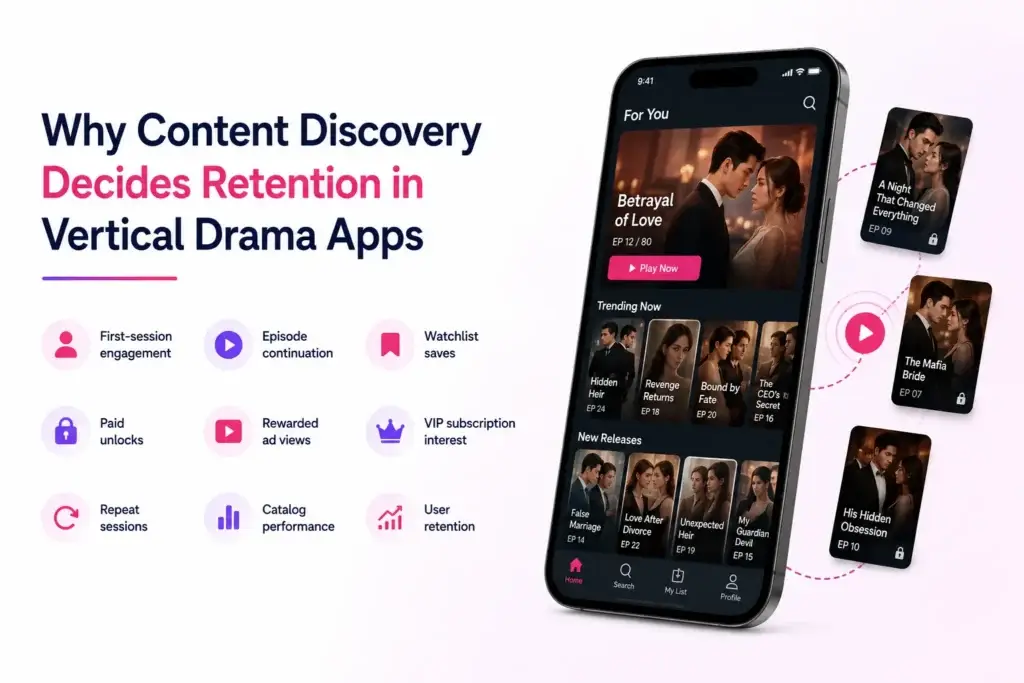
Vertical drama viewers usually open an app with limited attention. They may be watching during a break, while commuting, after seeing a teaser on social media, or when they want quick entertainment.
This means the first few taps matter.
If users cannot quickly understand what to watch, they leave. If they immediately see a story that matches their mood, they are more likely to start watching. If the first episode hooks them, they are more likely to continue. If continuation feels natural, monetization becomes easier.
Content discovery affects:
- First-session engagement
- Episode continuation
- Watchlist saves
- Paid unlocks
- Rewarded ad views
- VIP subscription interest
- Repeat sessions
- Catalog performance
- User retention
A vertical drama platform does not need to show everything at once. It needs to show the right content in the right order.
Genres Should Match Viewer Emotion, Not Just Content Labels
Genres are usually treated as simple catalog categories. In vertical drama streaming apps, they should work harder.
A viewer may not always search for “drama.” They may want revenge, betrayal, forbidden love, family conflict, fantasy escape, suspense, comeback stories, or emotional twists.
That is why genre planning should include both broad categories and emotional hooks.
Useful Genre Layers for Vertical Drama Apps
| Genre Layer | Example | Why It Matters |
|---|---|---|
| Core genre | Romance, thriller, comedy, fantasy, action | Helps users browse broad content categories quickly. |
| Emotional hook | Revenge, betrayal, forbidden love, comeback, mystery | Matches the real reason viewers tap a story. |
| Audience segment | Young adult, regional viewers, premium drama audience | Supports targeted homepage rails and campaign planning. |
| Language or region | Hindi, Spanish, Arabic, Korean-inspired, local-language titles | Improves discovery for multi-market launches. |
| Viewing mood | Quick watch, intense drama, late-night binge, light comedy | Helps users find content based on session intent. |
For founders, the important decision is simple: do not tag content only from the production team’s point of view. Tag content the way viewers think, search, and choose.
A story may belong to romance, but if the real hook is “second chance,” “secret identity,” or “family betrayal,” those tags can improve discovery and click-through.
Trending Titles Should Create Trust, Not Just Promotion
A trending section is one of the strongest discovery tools in a vertical drama app. It gives new users an easy starting point and creates social proof.
But trending should not become a static promotional row.
If every title is shown as trending, users stop trusting the section. A better approach is to combine real engagement signals with admin control.
Trending title ranking can consider:
- Recent watch starts
- Episode completion rate
- Episode-two starts
- Watchlist saves
- Search demand
- Paid unlocks
- Rewarded ad views
- VIP watch behavior
- Regional popularity
- Recency of release
- Manual editorial priority
The strongest trending sections are not fully manual or fully automated. Automation keeps the section fresh, while admin control helps the operator promote launches, seasonal campaigns, regional titles, or premium catalog content.
This matters especially during early launch. When user data is limited, the operator may need to manually create rails such as:
- Trending Now
- New This Week
- Editor’s Picks
- Top Romance Stories
- Free Episodes to Start
- Most Watched This Week
- Regional Favorites
Once enough data is available, ranking can become more behavior-led.
Read more: Vertical Drama Streaming App Retention: Reducing Drop-Off After the First Paywall
Personalized Recommendations Should Start With Clean Catalog Data
Personalized recommendations sound advanced, but the foundation is practical.
Before a platform can recommend better titles, it needs clean data about the catalog and clean signals from user behavior.
If titles are poorly tagged, recommendations become weak. If the app does not track watch behavior properly, the platform cannot understand what users prefer.
Useful catalog data includes:
- Title name
- Short description
- Genre and subgenre tags
- Emotional hook tags
- Language
- Region
- Episode count
- Episode order
- Trailer availability
- Free, locked, VIP, or ad-unlock status
- Release date
- Campaign priority
- Content rating or suitability label
Useful user behavior data includes:
- Titles opened
- Episodes started
- Episodes completed
- Drop-off points
- Genres viewed repeatedly
- Search terms used
- Watchlist saves
- Unlock behavior
- Rewarded ad activity
- VIP activity
- Skipped titles
- Return frequency
Personalization should not remove editorial control. A vertical drama platform still needs space for new releases, licensed titles, seasonal campaigns, and business-priority content.
The smarter approach is to combine curated rails with behavior-led recommendations.
Discovery Signals and Their Business Value
| Discovery Signal | What It Shows | Founder Impact |
|---|---|---|
| Episode completion | Whether the story holds attention after the first tap. | Helps identify titles that deserve homepage visibility. |
| Episode-two starts | Whether the first episode creates continuation intent. | Useful for testing story hooks before scaling campaigns. |
| Search terms | What users are actively trying to find. | Improves genre naming, content tags, and acquisition decisions. |
| Watchlist saves | Which titles create future viewing intent. | Supports reminders, notifications, and retargeting flows. |
| Unlock behavior | Where users are willing to pay, watch ads, or use VIP access. | Connects discovery quality with monetization strategy. |
| Drop-off points | Where users lose interest in the viewing journey. | Helps improve trailers, episode pacing, and rail placement. |
Home Rails Turn the Catalog Into a Viewing Journey
The home screen should not simply display every title. It should organize the catalog into a clear viewing journey.
Rails help users make faster decisions because each section gives them a reason to tap.
Useful rails for a vertical drama streaming app may include:
- Continue Watching
- Trending Now
- New Releases
- Romance Picks
- Thriller Stories
- Free Episodes to Start
- Most Unlocked This Week
- Regional Favorites
- Recently Added
- Watch Before It Leaves
- Short Episodes for Quick Viewing
- VIP Picks
Each rail should serve a business purpose.
A “Continue Watching” rail improves return sessions. A “Free Episodes to Start” rail reduces friction for new users. A “Most Unlocked This Week” rail can support monetization. A “Regional Favorites” rail helps with market-specific catalog promotion.
For a product-level view of how catalog-led discovery can be structured, explore this vertical drama streaming app solution from Miracuves.
Search and Filters Help Users Find Stories Faster
Search is not only for users who know the exact title. In vertical drama apps, viewers may search by plot, mood, character type, genre, language, or story hook.
A viewer may search for:
- revenge romance
- CEO drama
- family betrayal
- Hindi thriller
- short fantasy episodes
- new romance series
- suspense drama
- emotional love story
If the app only supports exact title search, many high-intent discovery moments may be missed.
Better search and filtering help viewers reach the right story even when they do not remember the title. This also helps the operator understand demand.
Search logs can reveal what users want but cannot easily find. If many users search for a specific genre, language, or story trope, that can guide catalog planning, localization, and content acquisition.
Read more : Vertical Drama Streaming App Growth Strategy: Turning Viral Clips Into Full-Series Viewers
Discovery Should Support Monetization Without Feeling Forced
Discovery and monetization are closely connected.
A viewer is more likely to unlock an episode, watch a rewarded ad, or upgrade to VIP access when they are already emotionally invested in a story.
This means discovery should not push payment too early. It should first create confidence.
The viewer should understand the story, sample enough to care, and then reach a natural unlock point.
Strong discovery can support monetization through:
- Free starter rails
- High-completion title sections
- Premium title rows
- VIP-friendly categories
- Rewarded-ad unlock placements
- Continue-watching reminders
- Personalized comeback prompts
- Genre-based premium recommendations
When discovery is weak, monetization feels aggressive. When discovery is strong, monetization feels like the next step in the viewing journey.
Admin Control Makes Discovery Flexible After Launch
A vertical drama streaming app should not depend on developers every time the operator wants to promote a title, update a genre, adjust a rail, or change campaign visibility.
Discovery needs admin control.
The admin dashboard should help the operator manage:
- Title listings
- Episode order
- Genre tags
- Banner placements
- Homepage rails
- Trending sections
- Coming-soon titles
- Regional visibility
- Language-based grouping
- Unlock status
- Campaign priority
- Performance reports
This matters because discovery changes constantly.
A title may trend in one region but not another. A romance series may perform better during evening sessions. A thriller may get high watch starts but low completion. A new release may need homepage visibility for the first week, then move into a genre rail.
Without admin control, the platform becomes rigid. With admin control, the operator can test, learn, and adjust faster.
You can review the related content discovery and catalog features to understand how title search, genre filters, content rails, and episode-level viewing flows can support a vertical drama catalog.
Founder Decision Signals
Speed
If your catalog is ready, you need discovery surfaces that help users start watching quickly instead of browsing endlessly.
Cost
Advanced personalization may not be necessary from day one. Many founders can begin with structured catalog rails and evolve based on real behavior.
Scalability
Discovery should support more genres, titles, languages, regions, and campaigns without confusing the viewer experience.
Market Fit
Search behavior, completion rates, and unlock patterns reveal which story types deserve more investment.
Personalized Recommendations Should Evolve in Stages
Not every vertical drama app needs a complex recommendation engine from day one.
For many founders, a staged discovery roadmap is more practical.
Stage 1: Editorial Discovery
The operator manually creates rails such as trending, new releases, romance picks, thriller picks, free-to-start titles, and coming soon.
This works well during early launch when user data is limited.
Stage 2: Rule-Based Discovery
The platform begins using simple rules such as most watched this week, most completed, most unlocked, recently added, or popular in a specific region.
This gives the homepage more freshness without requiring complex recommendation logic.
Stage 3: Behavior-Led Recommendations
The system starts using user behavior such as watch history, saved titles, completed episodes, skipped genres, search activity, and unlock patterns to suggest more relevant titles.
Stage 4: Advanced Personalization
Once the platform has enough clean data, recommendations can become more precise. The system can rank content by individual viewer preference, similar audiences, emotional hooks, language, viewing time, and monetization behavior.
This staged approach helps founders avoid overbuilding too early.
The goal is not to add advanced personalization just because it sounds impressive. The goal is to improve discovery in a way that supports retention, catalog value, and revenue.
Content Cards Need to Sell the Story in Seconds
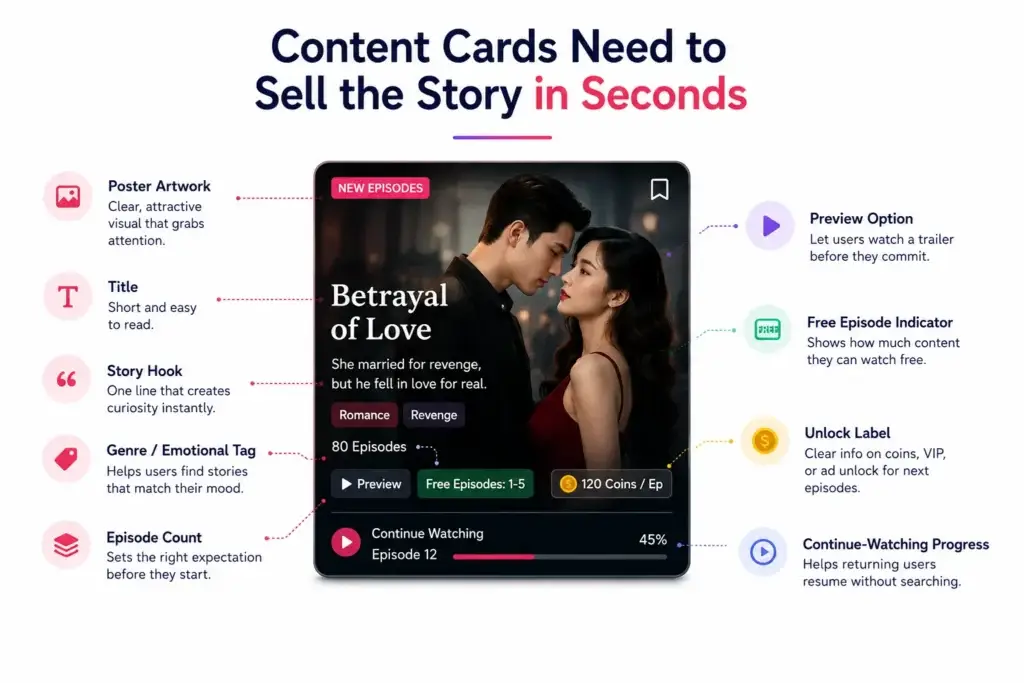
Discovery is not only about rails and recommendation logic. The content card also matters.
In a vertical drama app, users often decide from a poster, title, short hook, genre tag, and episode preview.
A strong content card should include:
- Clear poster artwork
- Easy-to-read title
- Short story hook
- Genre or emotional tag
- Episode count
- Trailer or preview option
- Free episode indicator
- VIP, coin, or ad-unlock label where relevant
- Continue-watching progress for returning users
The card should not overload the viewer. It should create enough curiosity to start the first episode.
Regional and Language-Based Discovery Can Improve Market Expansion
Vertical drama audiences are often shaped by language, culture, local tropes, and regional story preferences.
A platform that wants to expand across markets should not rely on one generic homepage for every viewer.
Regional discovery may include:
- Language-specific rails
- Localized banners
- Regional trending titles
- Market-specific genre priorities
- Subtitle visibility
- Dubbing visibility
- Region-based notifications
- Local campaign placement
A title that performs strongly in one market may not be the strongest first recommendation in another. Discovery should be flexible enough to reflect local viewer behavior.
Safety and Moderation Also Affect Discovery Quality
Discovery should not promote content blindly.
If a platform supports comments, creator uploads, user-generated trailers, regional submissions, or community features, the operator needs content safety controls.
Useful safety layers may include:
- Content moderation
- Abuse reporting
- Comment moderation
- Spam detection
- Copyright reporting workflows
- Manual review queues
- Age-gating where relevant
- Admin approval controls
For founders, this is not only a compliance consideration. It affects viewer trust, advertiser trust, platform reputation, and long-term scalability.
A title that gets high clicks but creates trust issues should not automatically dominate discovery surfaces.
Common Discovery Mistakes Founders Should Avoid
Mistakes Founders Should Avoid
Using Only Broad Genres
Broad labels such as romance or drama are useful, but they are not enough. Viewers often choose based on emotional hooks, tropes, language, and viewing mood.
Calling Everything Trending
If trending is not based on real signals or clear editorial logic, users stop trusting it. Use trending sections carefully and update them regularly.
Adding Personalization Before Cleaning the Catalog
Recommendations depend on good metadata. If titles, genres, hooks, and episodes are not structured properly, personalization becomes weak.
Ignoring Search Data
Search terms reveal what users want but cannot easily find. Ignoring this data can lead to missed content, tagging, and localization opportunities.
How Miracuves Helps Founders Plan Better Discovery Experiences
Miracuves helps founders build ready-made and white-label app foundations that can be shaped around real business goals, not just visual screens.
For a vertical drama streaming app, that means thinking through catalog structure, viewer journeys, title discovery, monetization paths, admin control, and launch priorities before the product goes live.
The strongest discovery system is not always the most complex one. Many founders should begin with a clear catalog, strong genre logic, operator-composed rails, search, watchlists, and reporting.
Then, as the platform collects real user behavior, personalization can become more advanced and more accurate.
This approach helps founders launch faster, validate viewing behavior, and avoid spending heavily on features that may not matter until the audience is active.
Final Thoughts: Discovery Is the Bridge Between Catalog and Revenue
A vertical drama streaming app does not grow only because it has episodes. It grows when viewers can discover the right story, start quickly, continue naturally, and return for more.
Genres help viewers choose by mood. Trending titles create momentum. Search helps users find intent-specific stories. Watchlists preserve future interest. Recommendations improve relevance as behavior data grows. Admin control lets the operator adjust discovery based on real performance.
For founders, the practical decision is clear: do not treat content discovery as a homepage design task. Treat it as the operating system of the catalog.
When discovery is planned well, the platform becomes easier to watch, easier to monetize, and easier to scale.
FAQs
What is content discovery in a vertical drama streaming app?
Content discovery is the system that helps viewers find what to watch through home rails, genres, search, trending titles, trailers, watchlists, continue-watching sections, and personalized recommendations.
Why are genres important in a vertical drama app?
Genres help users choose stories quickly. In vertical drama apps, genres should go beyond broad labels and include emotional hooks such as revenge, betrayal, romance, mystery, family conflict, fantasy, or regional preferences.
How should trending titles work in a drama streaming app?
Trending titles should be based on a mix of watch starts, completion rates, episode continuation, unlock behavior, recency, and editorial control. This keeps the trending section useful instead of turning it into a static promotional row.
Does every vertical drama app need personalized recommendations from day one?
No. Many platforms can begin with curated rails, genre filters, search, watchlists, and reporting. Personalized recommendations become more useful after the platform collects enough clean content metadata and viewer behavior data.
What data improves personalized recommendations?
Useful data includes watched titles, completed episodes, skipped content, search terms, genre preferences, watchlist saves, unlock behavior, ad views, VIP activity, and return frequency.
How does content discovery affect monetization?
Better discovery helps viewers find stories they care about. When users are emotionally invested, they are more likely to continue watching, unlock premium episodes, watch rewarded ads, or consider VIP access.
What is the biggest discovery mistake founders make?
The biggest mistake is treating discovery as a design layout instead of a business system. Discovery should connect catalog structure, user behavior, monetization, admin control, and retention strategy.
Miracuves is an independent software development company. We are not affiliated with, connected to, sponsored by, or endorsed by any company or product named in this article.
Terms such as “X Clone” are used descriptively. It is how the software industry refers to building a platform with functionality comparable to a known service, and how clients search for it.
The entire design and codebase of our products is built by our own team. Our products contain no code, design, graphics, or content originating from any third-party website or applications.
All third-party names and marks referenced in this article are the property of their respective owners, referenced solely to identify the services discussed.