
Wallet design in a vertical drama streaming app is not only about showing users how many coins they have. It is the system that decides how viewers unlock premium episodes, how rewards encourage repeat visits, how purchases are recorded, and how the platform operator proves that every coin movement is fair.
For founders, this matters because short episodic entertainment depends on timing. A viewer may watch a few free episodes, reach a cliffhanger, and decide whether to spend coins, earn rewards, watch an ad, or leave. If the wallet feels confusing at that moment, monetization suffers. If the wallet feels transparent, users are more likely to continue.
This is why a wallet should be treated as a core product layer, not a small add-on inside the profile screen. A strong wallet connects the viewer app, purchase flow, reward system, episode unlock engine, admin dashboard, and analytics.
For founders planning a launch-ready vertical drama streaming platform, wallet design should be discussed early because it affects monetization, retention, support, store submission, and future scaling.
Key Takeaways
- Wallet design in a vertical drama streaming app controls how users earn, buy, spend, and track coins.
- A good wallet should separate purchased coins from reward coins so pricing, expiry, refunds, and promotions remain clear.
- Unlock history helps users understand what they paid for and helps support teams resolve disputes faster.
- Reward flows such as check-ins, ad rewards, referrals, and campaigns should connect to a proper ledger, not just a temporary balance update.
- Miracuves helps founders build monetization-ready streaming platforms with wallet logic, admin control, branded design, and source-code ownership.
Why Wallet Design Matters More Than a Simple Balance Screen
Many founders first think of the wallet as a UI element: a coin number, a recharge button, and a transaction list. That is only the surface.
In a vertical drama streaming app, the wallet decides how the platform earns from users who may not want a full subscription. Some viewers want to unlock only the next episode. Some want to buy a coin pack before a new series release. Some prefer watching rewarded ads. Some come back daily to claim free coins and unlock slowly.
The wallet sits between all of these user behaviors.
A strong wallet design should answer five business questions:
| Wallet Question | Why It Matters for Founders |
|---|---|
| How does the user get coins? | Defines purchases, rewards, referrals, campaigns, and bonus credits. |
| Which coins are spent first? | Protects revenue logic and avoids confusion between paid and free coins. |
| What happens after an episode is unlocked? | Prevents users from paying twice for the same content. |
| Can the admin verify every coin movement? | Reduces support disputes and improves operational control. |
| Can the founder measure wallet-driven revenue? | Helps identify which series, offers, and rewards actually convert. |
When this logic is weak, users may not trust the platform. When it is strong, the wallet becomes a monetization engine that also improves retention.
What Users Expect From a Wallet in a Vertical Drama Streaming App
Users do not think in backend terms. They want to know four simple things:
- How many coins do I have?
- How did I get them?
- What did I spend them on?
- Why was an episode locked or unlocked?
The wallet screen should make these answers easy.
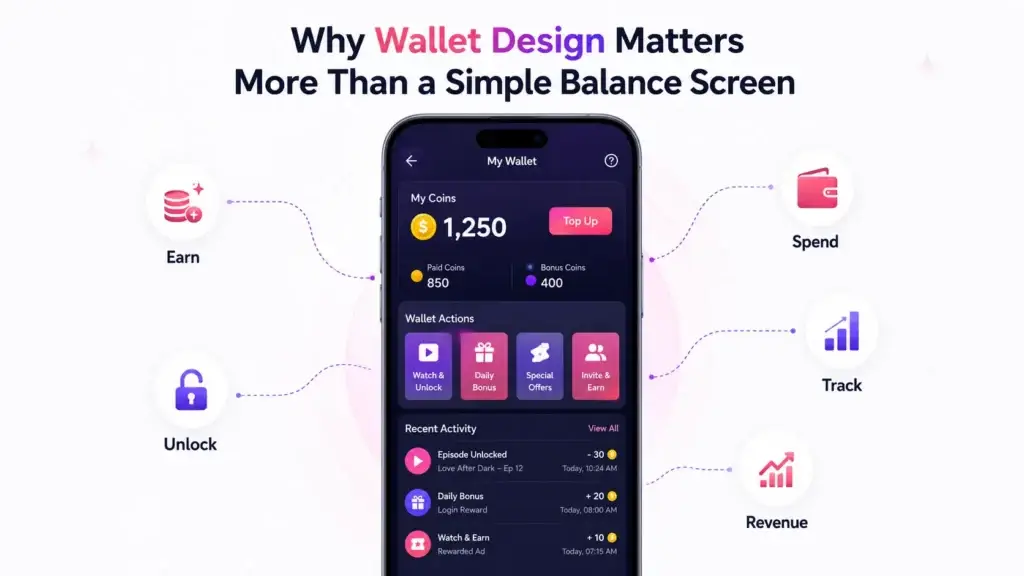
A practical user wallet should include:
- Total coin balance
- Purchased coin balance
- Reward coin balance
- Recharge or buy coins button
- Available coin packs
- Bonus coin offers
- Daily reward or campaign reward status
- Purchase history
- Reward history
- Episode unlock history
- Failed or pending payment status where needed
- Clear expiry messaging for promotional coins
The goal is not to overwhelm the user with financial-style records. The goal is to create confidence. A user should never feel that coins disappeared without explanation.
How Coin Wallet Logic Works Behind the Scenes
Behind the wallet screen, every coin movement should create a record.
This record is usually called a ledger entry. A ledger is important because it does not only store the current balance. It stores the reason behind the balance.
For example:
| Event | Ledger Type | Balance Impact |
|---|---|---|
| User buys a coin pack | Purchase credit | Coins added |
| User claims daily reward | Reward credit | Coins added |
| User watches rewarded ad | Ad reward credit | Coins added |
| User unlocks an episode | Episode unlock debit | Coins deducted |
| Admin adjusts wallet | Manual adjustment | Coins added or removed |
| Promotional coins expire | Expiry debit | Coins removed |
This is the difference between a simple wallet and a trustworthy wallet.
A simple wallet says: “User has 120 coins.”
A proper wallet says: “User has 120 coins because they bought 100 coins, earned 30 reward coins, spent 10 coins on Episode 8, and has no expired promotional coins.”
That difference matters when users contact support, when payments fail, when promotional campaigns are reviewed, or when the founder wants to understand how viewers move from free access to paid unlocks.
Purchased Coins vs Reward Coins: Why the Difference Matters
Purchased coins and reward coins should not be treated as the same thing inside the wallet.
Purchased coins usually come from a user payment. Reward coins come from actions such as daily check-ins, ad views, referrals, campaigns, or welcome bonuses. Both can help users unlock content, but they carry different business meaning.
| Coin Type | Source | Common Use | Founder Risk If Mixed |
|---|---|---|---|
| Purchased coins | User payment | Unlock premium episodes | Refunds, receipts, and paid balance tracking become unclear. |
| Reward coins | Check-ins, ads, referrals, campaigns | Retention and free unlock support | Promotions may reduce paid conversion if not controlled. |
| Bonus coins | Added during recharge offers | Purchase incentive | Users may misunderstand what expires and what does not. |
| Promotional coins | Limited-time campaigns | Re-engagement | Expiry disputes can increase if messaging is weak. |
A practical wallet often spends reward coins first before purchased coins. This gives users value from engagement rewards while preserving clarity around paid balances.
However, expiry rules must be handled carefully. Purchased coins generally need stronger protection and clearer policy treatment. Promotional or reward coins may have expiry windows, but the app should communicate this clearly before users depend on them.
How Episode Unlock History Builds Transparency
Unlock history is one of the most important wallet-related screens in a vertical drama app.
Users often watch stories across multiple sessions. They may unlock Episode 12 today, return tomorrow, and expect the app to remember that access. If unlock history is missing or unreliable, users may think they are being charged twice.
A good unlock history should show:
- Series name
- Episode number
- Unlock method
- Coins spent
- Date and time of unlock
- Whether the unlock came from coins, reward access, ad unlock, VIP access, or auto-unlock
- Access status if the platform uses time-based unlock rules
For founders, unlock history reduces support pressure. The admin team can verify what happened without checking raw database records. This is especially important when users complain about coin deductions, missing access, failed payments, or unclear reward claims.
A strong unlock history also helps with analytics. Founders can see which episode points drive payment behavior and where viewers stop unlocking. That insight can guide pricing, content licensing, release scheduling, and promotional campaigns.
Read more: What Should Founders Compare Before Choosing a Vertical Drama Streaming App Platform?
How Rewards Connect Wallet Design With Retention
Rewards are not just free coins. They are habit-building tools.
In vertical drama streaming apps, viewers often return because they are emotionally invested in a story. Rewards give them another reason to open the app even when they are not ready to spend.
Common reward flows include:
- Daily check-in coins
- Streak rewards
- Rewarded ad coins
- Referral rewards
- Welcome bonus coins
- Campaign bonus coins
- Festival or launch promotion coins
- Series-specific unlock coupons
- Limited-time bonus coin offers
The business purpose is simple: reward the behavior that supports retention.
But reward design needs limits. If rewards are too generous, users may stop purchasing coins. If rewards are too small, users may ignore them. If reward rules are unclear, users may feel manipulated.
A good reward system should define:
| Reward Rule | Why It Matters |
|---|---|
| Claim frequency | Prevents users from claiming rewards too often. |
| Reward amount | Controls the balance between retention and revenue. |
| Expiry window | Encourages timely usage without hiding conditions. |
| Eligible users | Allows targeted campaigns for new, inactive, or loyal users. |
| Abuse prevention | Reduces fake accounts, repeated claims, and reward farming. |
| Admin visibility | Helps operators measure reward cost against paid unlock conversion. |
The best reward systems do not only increase coin balances. They move users toward deeper viewing behavior.
How Purchase Flow Design Affects Conversion
Coin purchase flow is where user intent becomes revenue.
A viewer reaches a locked episode. The story is interesting. The next action must be simple: buy coins, use existing balance, watch an ad, or choose another access route. Any friction in this moment can reduce conversion.
A strong coin purchase flow should include:
- Clear coin pack pricing
- Bonus coin visibility
- Local currency display
- Store-compliant purchase flow
- Receipt confirmation
- Failed payment handling
- Pending payment status
- Balance refresh after successful purchase
- Direct return to the locked episode
- No confusing detours after payment
The return path is especially important. After a user buys coins, they should land close to the episode they wanted to unlock. If the app sends them back to a generic home screen, the platform risks losing the emotional momentum that triggered the purchase.
Founders should also connect this section to the wider business model for vertical drama streaming apps because coin packs, VIP access, rewarded ads, and episode pricing all affect each other.
Read more: Vertical Drama Streaming App Retention: Reducing Drop-Off After the First Paywall
How Unlock Rules Work Inside the Viewing Experience
The wallet does not operate separately from the player. It should connect directly to the episode lock logic.
A typical vertical drama viewing flow may look like this:
- User watches free opening episodes.
- The next episode is locked.
- The app checks whether the user has access.
- If access exists, the episode plays.
- If access does not exist, the app shows unlock options.
- User spends coins, watches an ad, or uses an active access plan.
- The app records the unlock event.
- The episode opens.
- Unlock history is updated.
- Admin analytics reflect the action.
This flow must feel instant to the viewer. But behind the scenes, the app is checking balance, access status, content pricing, campaign rules, ad limits, plan validity, and ledger records.
The smoother this feels, the more likely users are to continue watching.
Admin Controls Founders Need for Wallet Operations
Wallet design is incomplete without admin controls.
A founder or platform operator needs visibility into how coins are purchased, earned, spent, adjusted, and disputed. Without admin tools, every wallet issue becomes a developer dependency.
A useful admin dashboard should allow operators to:
- View user wallet balance
- See purchased and reward coin split
- Review wallet ledger history
- Check episode unlock history
- View coin purchase orders
- Configure coin packs
- Add or edit bonus coin offers
- Manage reward campaigns
- Set daily reward rules
- Review failed or pending transactions
- Handle manual wallet adjustments
- Track top revenue episodes
- Monitor reward usage
- Export reports where needed
- Limit staff access through role-based controls
Founder Decision Signals
Speed
If the wallet, rewards, purchases, and unlock engine are already structured, founders can focus faster on catalog, pricing, branding, and launch execution.
Cost
Wallet complexity affects development cost because every purchase, reward, expiry, unlock, and admin adjustment needs reliable backend logic.
Scalability
A ledger-based wallet is easier to scale because it records why balances changed instead of relying only on one editable balance number.
Market Fit
Wallet analytics help founders understand whether users prefer buying coins, earning rewards, watching ads, or choosing broader access plans.
Wallet UI Patterns That Improve User Trust
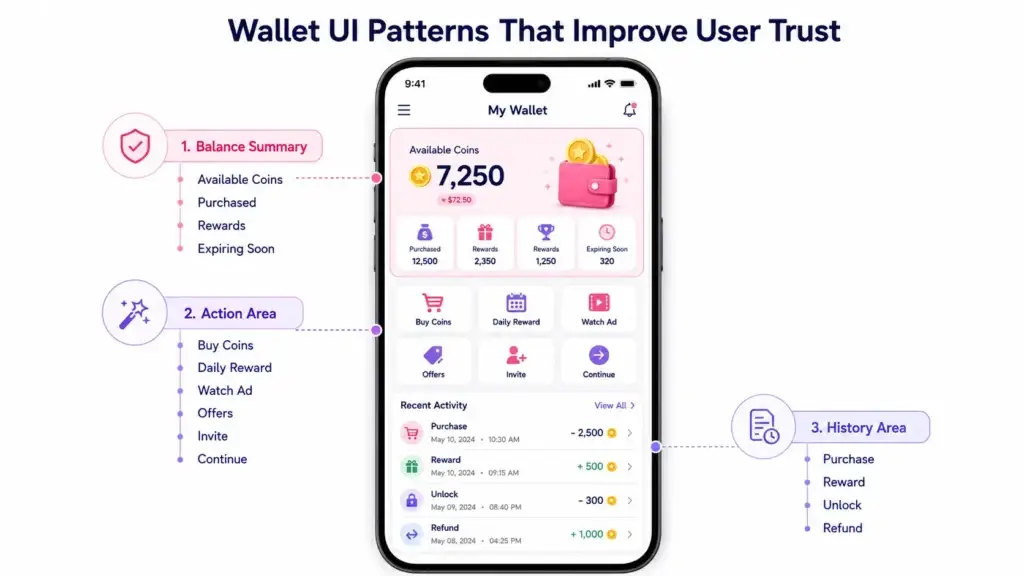
The wallet interface should be simple, but not vague.
A strong wallet screen usually includes three layers:
1. Balance Summary
This is the first thing users see. It should show available coins clearly. If reward and purchased coins are separated, the UI should explain the difference without using technical language.
Example labels:
- Available Coins
- Purchased Coins
- Reward Coins
- Expiring Soon
- Bonus Coins
2. Action Area
This section helps users move quickly.
Common actions include:
- Buy Coins
- Claim Daily Reward
- Watch Ad to Earn
- View Offers
- Invite Friends
- Continue Watching
The action area should not look crowded. The highest-value action can change based on user state. A new user may see “Claim Welcome Reward,” while a viewer at a locked episode may see “Buy Coins to Continue.”
3. History Area
This section builds confidence.
Users should be able to view:
- Purchases
- Rewards
- Unlocks
- Expired coins
- Refund-related changes if applicable
- Admin adjustments if visible to the user
A clean history screen prevents confusion and reduces support tickets.
Wallet Ledger vs Simple Balance: What Founders Should Choose
A simple balance may work for a small prototype, but it becomes risky once users start paying.
| Approach | How It Works | Best For | Risk |
|---|---|---|---|
| Simple balance | Stores only the current coin amount | Early testing with no real payment complexity | Hard to audit and difficult to resolve disputes |
| Ledger-based wallet | Records every credit and debit with a reason | Monetized streaming apps with purchases, rewards, and unlocks | Requires better backend planning |
| Split-balance wallet | Tracks purchased, reward, bonus, and promotional coins separately | Apps with campaigns, paid coins, and expiry rules | Needs clear UI and admin reporting |
| Analytics-linked wallet | Connects wallet events to content performance | Growth-focused platforms | Requires event tracking discipline |
For a monetized vertical drama streaming app, a ledger-based wallet is usually the safer product decision. It supports trust, reporting, support, and future monetization experiments.
Common Wallet Design Mistakes That Hurt Revenue and Trust
Mistakes Founders Should Avoid
Mixing Paid and Free Coins Without Clear Rules
When purchased coins, reward coins, and bonus coins are treated the same way, refund handling, expiry logic, campaign performance, and user trust become harder to manage.
Not Showing Unlock History
If users cannot see which episodes they unlocked, they may assume the platform charged them unfairly. Unlock history protects both the viewer experience and the support team.
Adding Rewards Without Measuring Their Cost
Rewards can improve retention, but they can also reduce paid coin purchases if the platform gives away too much access without tracking conversion impact.
Sending Users Away After Purchase
After buying coins, users should return directly to the locked episode or series context. A poor return flow can break purchase momentum.
How Wallet Analytics Help Founders Improve Monetization
Wallet analytics turn user behavior into business decisions.
A founder should not only ask, “How many coins were sold?” A better question is, “Which content, reward, and unlock paths created profitable continuation?”
Important wallet metrics include:
| Metric | What It Reveals |
|---|---|
| Coin pack purchase rate | Whether users are willing to pay for episode access |
| Reward claim rate | Whether users notice and value reward mechanics |
| Reward-to-purchase conversion | Whether free coins lead to paid unlocks later |
| Episode unlock rate | Which story points create strong continuation intent |
| Failed purchase rate | Whether payment friction is hurting revenue |
| Unlock method split | Whether users prefer coins, rewards, ads, or broader access |
| Expired reward coins | Whether campaigns are being claimed but not used |
| Support disputes by wallet event | Whether wallet UI or rules need improvement |
These insights help founders improve pricing, reward campaigns, release schedules, and content acquisition decisions.
Security and Trust Considerations for Wallet Design
Even when the wallet uses platform coins rather than real-money balances, users still associate it with value. That means the app should treat wallet data carefully.
Useful trust layers include:
- Secure payment gateway integration
- Encrypted data transfer
- Activity logs
- Role-based admin access
- Audit-friendly wallet ledger
- Clear purchase receipts
- Fraud monitoring signals
- Abuse reporting for reward farming
- Admin permission controls
- Transparent user-facing history
The goal is not to make exaggerated compliance claims. The practical goal is to build a wallet foundation that supports safer operations, clearer records, and better user confidence.
How Miracuves Helps Founders Build Wallet-Ready Streaming Platforms
Miracuves helps founders launch branded streaming products with the operational layers needed for monetization, admin control, and faster validation. For vertical drama platforms, that means the wallet cannot be treated as an afterthought.
A strong foundation should connect:
- Coin purchase flow
- Reward wallet logic
- Episode unlock rules
- Watch and unlock history
- Admin wallet inspection
- Coin pack management
- Campaign controls
- Analytics and reporting
- User support visibility
- Source-code ownership
Miracuves’ ready-made and white-label approach can help founders move faster because the platform foundation already includes key app flows, backend logic, and admin workflows. Final pricing and scope should always be confirmed based on selected features, integrations, branding, and customization requirements.
Final Thoughts: The Wallet Is Where Monetization Becomes Measurable
In a vertical drama streaming app, the wallet is not just a place where coins sit. It is where user intent, episode access, reward psychology, payment behavior, and platform trust come together.
A well-designed wallet helps users understand their balance, rewards, purchases, and unlocks. It helps founders manage pricing, campaigns, support, and analytics. It also protects the business from confusion that can reduce revenue or damage trust.
The stronger decision is not to add a wallet late in development. The stronger decision is to design the wallet as part of the app’s monetization foundation from the start.
FAQs
What is wallet design in a vertical drama streaming app?
Wallet design refers to how the app manages coins, rewards, purchases, episode unlocks, transaction records, and user-facing balance information. It includes both the wallet screen users see and the backend ledger that records every coin movement.
Why do vertical drama streaming apps use coins?
Coins allow users to unlock specific episodes without committing to a full subscription. This works well for short episodic content because viewers often decide to pay when they reach a strong cliffhanger or premium story point.
Should purchased coins and reward coins be separate?
Yes. Purchased coins and reward coins should usually be tracked separately because they have different business rules. Purchased coins are tied to payment records, while reward coins may come from check-ins, referrals, ad views, or campaigns.
What should unlock history show inside the app?
Unlock history should show the series name, episode number, unlock date, unlock method, and coins spent where applicable. This helps users avoid confusion and helps support teams verify access issues quickly.
How do rewards work with wallet design?
Rewards add coins or access benefits to the user wallet when the user completes actions such as daily check-ins, ad views, referrals, or campaign tasks. Each reward should create a wallet record so the platform can track how it affects retention and purchases.
What admin controls are needed for wallet management?
Admins should be able to view wallet balances, check ledger history, review purchases, manage coin packs, configure rewards, inspect unlock history, handle manual adjustments, and monitor wallet-related analytics.
Can wallet design affect streaming app revenue?
Yes. Wallet design affects how easily users buy coins, understand rewards, unlock episodes, return after payment, and trust the platform. Poor wallet design can reduce conversion, while a clear wallet flow can support stronger monetization.
Can Miracuves help build a wallet-ready streaming platform?
Yes. Miracuves helps founders build ready-made and white-label streaming app solutions with wallet logic, coin purchases, reward workflows, episode unlocks, admin dashboards, branding, and source-code ownership.
Miracuves is an independent software development company. We are not affiliated with, connected to, sponsored by, or endorsed by any company or product named in this article.
Terms such as “X Clone” are used descriptively. It is how the software industry refers to building a platform with functionality comparable to a known service, and how clients search for it.
The entire design and codebase of our products is built by our own team. Our products contain no code, design, graphics, or content originating from any third-party website or applications.
All third-party names and marks referenced in this article are the property of their respective owners, referenced solely to identify the services discussed.