






















Key Takeaways
- Property tokenization represents property-related ownership or economic rights through digital tokens, while fractional ownership allows multiple investors to hold defined interests in a real estate investment.
- Tokenization and fractional ownership are not competing concepts because tokenized investments can also provide fractional interests, depending on their legal structure.
- Platform founders should evaluate ownership rights, regulatory requirements, investor eligibility, transaction costs and technology complexity before selecting an investment model.
- The right approach depends on the target market, legal framework, investor expectations and whether blockchain-based recordkeeping provides a meaningful operational benefit.
Property Tokenization vs Fractional Ownership Models
- Traditional fractional ownership platforms may use special purpose vehicles (SPVs), company shares or regulated investment structures to divide property-related interests among multiple investors.
- Property tokenization platforms use blockchain-based tokens to represent defined investment rights, with token issuance, ownership records and transfers governed by the underlying legal agreements.
- Both models can support rental income distributions, property performance reporting and investment exits, but the calculation and enforcement of investor rights depend on the chosen structure.
- Tokenized assets do not automatically provide direct property ownership, instant liquidity or unrestricted trading, making clear legal documentation and transfer rules essential.
Legal, Technical and Platform Launch Considerations
- Founders should confirm property ownership structures, investor rights, securities classifications, licensing obligations and applicable real estate regulations before accepting investments.
- Platform architecture should support investor verification, ownership records, payment processing, rental distributions, transaction histories and transparent portfolio reporting.
- Tokenization introduces additional technical considerations such as smart contract security, digital asset custody, wallet management, blockchain transaction costs and compliant token transfers.
- A practical platform strategy should prioritize legal clarity, investor protection, operational reliability and sustainable costs before introducing complex tokenization or secondary-market features.
Property investing no longer needs to mean buying an entire building. Digital investment platforms are making it possible for multiple investors to participate in a single property, while blockchain technology introduces new ways of recording, representing, and transferring investment interests.
However, two concepts are frequently confused: property tokenization and fractional ownership.
Although they can work together, they are not interchangeable.
Fractional ownership describes how economic or legal interests in an asset are divided among investors. Property tokenization describes how certain ownership rights, claims, or financial interests can be represented through digital tokens.
For founders planning a property investment business, understanding this distinction is essential.
Choosing the wrong structure can create confusion around investor rights, legal documentation, asset custody, secondary transactions, and regulatory responsibilities. Even a technically sophisticated product can face serious operational problems when those foundations are unclear.
This guide explains the differences between property tokenization and fractional ownership, how the two models can intersect, and which decisions founders should resolve before bringing a property investment offering to market.
What Is Fractional Ownership in Real Estate?
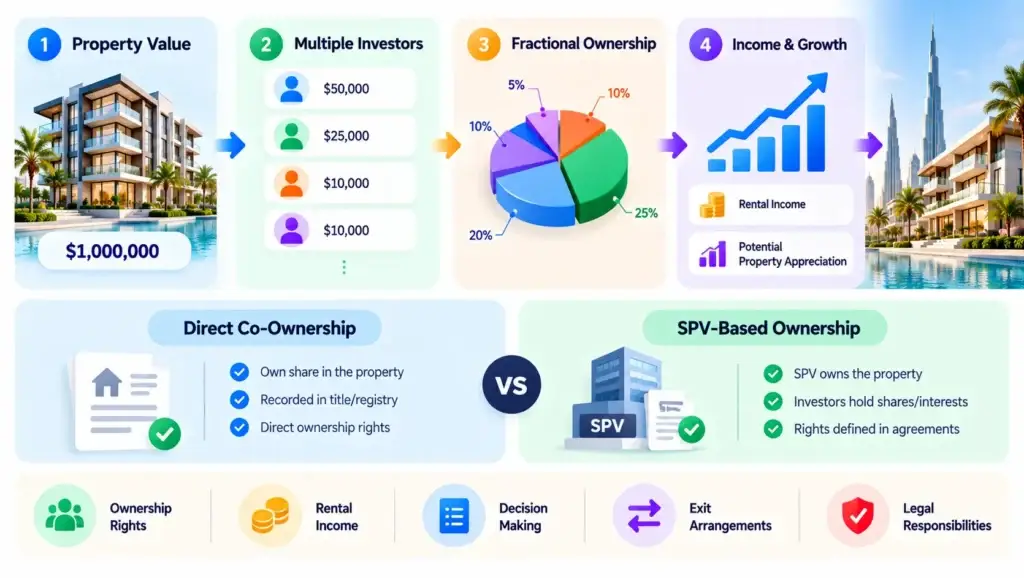
Fractional ownership in real estate is an investment arrangement that allows multiple investors to participate in the ownership or economic benefits of a single property. Instead of purchasing an entire asset independently, investors acquire defined interests based on the property’s legal ownership structure.
This approach can make high-value real estate opportunities accessible to investors who may not have sufficient capital to purchase an entire property.
How Fractional Real Estate Ownership Works
Consider a commercial property valued at $1 million.
Rather than requiring one buyer to finance the entire purchase, an investment sponsor could structure the property investment to allow multiple investors to contribute capital.
For example, an investor contributing $10,000 could receive a 1% economic interest if the full $1 million investment were divided proportionally, assuming no additional fees, debt, reserves, or differences in investment rights.
However, holding a 1% economic interest does not necessarily mean the investor directly owns 1% of the property’s legal title.
The actual ownership rights depend on how the investment is structured.
Direct Co-Ownership vs. SPV-Based Ownership
Fractional real estate investments commonly use two ownership arrangements:
1. Direct Co-Ownership
Under direct co-ownership, multiple investors hold legally recognized interests in the property itself. Their ownership may be recorded through title documents or land registries, depending on the laws of the relevant jurisdiction.
2. SPV-Based Ownership
Under an SPV-based structure, a special-purpose vehicle (SPV) legally owns the property, while investors acquire shares or other defined interests in that entity.
Their financial and governance rights are established through shareholder agreements, investment documents, and applicable corporate laws.
These structures can differ in several important areas, including:
- Ownership rights: Whether investors hold direct property interests or interests in a property-owning entity.
- Rental income: How property-generated income is calculated and distributed.
- Decision-making: Whether investors have voting rights over property sales, management, or other major decisions.
- Exit arrangements: How investors can transfer or sell their interests.
- Legal responsibilities: How ownership obligations, liabilities, and investor protections are managed.
What Should Founders Understand About Fractional Ownership?
Before establishing a fractional property investment offering, founders must clearly define what investors receive in exchange for their capital.
A transparent ownership structure should explain who legally owns the property, what economic benefits investors are entitled to, and how their interests can be transferred or redeemed.
Founder Insight: Fractional ownership is not simply about dividing a property’s value into smaller investment amounts. Its credibility depends on legally enforceable rights, transparent financial arrangements, and clearly documented responsibilities.
What Is Property Tokenization?
Property tokenization is the process of digitally representing real estate-related ownership interests, financial rights, or investment claims through blockchain-based tokens or other distributed ledger technology.
Instead of relying exclusively on conventional records, a tokenization arrangement may use digital tokens to represent specific rights connected to an underlying property or property-owning entity.
However, owning a real estate token does not automatically mean holding legal title to the underlying property.
The actual rights depend on the investment agreement, token structure, issuer, and applicable legal framework.
What Can a Real Estate Token Represent?
Depending on the legal structure, a property-related token may represent:
- Equity ownership: Shares or defined interests in a company that owns a property.
- Beneficial interests: Rights to certain economic benefits under a legally recognized investment structure.
- Contractual payment rights: Claims to specified income distributions or other payments.
- Debt interests: Financial claims connected to a property-backed financing arrangement.
- Direct property interests: Legally recognized ownership interests where local laws and official property registration systems support token-based arrangements.
These categories are not interchangeable. Each can provide different financial benefits, transfer permissions, governance rights, and legal protections.
The blockchain records the relevant digital transactions, but the legal effect of those records must be established through the applicable ownership and regulatory framework.
How Property Tokenization Works: A Simple Example
Consider a commercial property held by a legally established investment entity.
Suppose the entity creates 10,000 investment units, with each unit carrying a clearly defined set of financial and ownership-related rights.
Under an appropriate tokenization arrangement, those 10,000 units could be represented digitally by 10,000 blockchain-based tokens.
| Investment detail | Illustrative example |
|---|---|
| Underlying asset | Commercial real estate property |
| Total investment units | 10,000 |
| Digital representation | 10,000 tokens |
| Tokens acquired by an investor | 100 |
| Proportion of defined investment units | 1% |
| Actual investor rights | Determined by legal agreements and the token structure |
In this example, an investor holding 100 tokens would hold 1% of the defined investment units, assuming each token represents one unit.
However, that does not automatically establish direct ownership of 1% of the physical property.
The tokens could represent shares in the property-owning entity, contractual distribution rights, or another legally recognized financial interest.
Their legal effect depends on how the tokens are connected to enforceable ownership documentation.
Why the Legal Structure Matters More Than the Token
A blockchain token can provide a digital record of a transaction, but it cannot independently establish property ownership where the law requires additional documentation, registration, or authorization.
For example, transferring tokens between digital wallets may not legally transfer the corresponding investment rights unless the relevant agreements, transfer restrictions, and ownership records recognize that transaction.
This creates an important responsibility for founders: the digital representation must accurately reflect the rights established by the underlying investment structure.
Tokenization may support more efficient administration, transparent transaction histories, and programmable transfer controls, but these potential benefits depend on appropriate legal and operational arrangements.
Founder Insight: The real value of property tokenization is not simply converting real estate interests into digital tokens. It is creating a reliable connection between digital transactions, legally recognized investor rights, and the underlying property investment structure.
Property Tokenization vs Fractional Ownership: Key Differences
Both models can help investors participate in property opportunities without funding the entire asset. Their underlying functions, however, are different.
| Comparison factor | Fractional ownership | Property tokenization |
|---|---|---|
| Core concept | Dividing asset-related interests among investors | Digitally representing specified rights or interests |
| Blockchain requirement | Not inherently required | Commonly uses blockchain or distributed ledgers |
| Legal ownership | Depends on co-ownership, company, trust, or contractual structure | Depends on the rights attached to the token and governing law |
| Ownership records | Property registry, shareholder register, or other legally recognized records | Token ledger, potentially connected to an official or contractual register |
| Transfers | Follow governing documents and applicable law | May use digital transfers, subject to legal and technical controls |
| Rental income | Distributed according to agreed economic rights | Distributed according to rights associated with the tokenized interest |
| Liquidity | Depends on permitted exit arrangements and buyer demand | Still depends on permitted trading arrangements and buyer demand |
| Custody | Conventional recordkeeping and custody arrangements | May additionally require wallet, key, or digital asset custody arrangements |
| Main operating challenge | Ownership administration and investor governance | Aligning digital transactions with enforceable rights and compliance |
| Investor experience | Conventional digital or offline investment records | Potentially blockchain-linked records and transfers |
The distinction is straightforward:
Fractional ownership answers who owns an interest and how it is divided. Tokenization answers how an interest may be digitally represented and transferred.
A property investment can be fractional without being tokenized. It can also be both fractional and tokenized.
Can Fractional Ownership Exist Without Blockchain?
Yes. Fractional property investment existed long before blockchain technology.
Investment companies, property partnerships, co-ownership arrangements, and other structures have historically enabled multiple parties to participate in real estate assets.
Blockchain does not create the underlying concept of shared ownership.
Instead, tokenization may introduce a different mechanism for representing or administering certain interests.
For example, an SPV holding a residential property could maintain an investor register identifying each shareholder and their respective investment interests.
Rental income could be collected, expenses deducted, and distributions allocated through traditional accounting and payment systems.
None of those activities inherently requires cryptocurrency or blockchain.
When tokenization may add value
Tokenization may become relevant when founders have specific needs involving digital asset transferability, verifiable transaction histories, programmable restrictions, or integration with regulated digital asset infrastructure.
Even then, the decision should be based on a practical operating requirement.
A founder should not introduce tokenization simply because the technology sounds more innovative.
If the legal structure, investor population, and transfer arrangements do not benefit from digital tokens, additional custody, reconciliation, and compliance requirements may increase operational complexity without delivering meaningful business value. These decisions can also influence property investment platform implementation costs, particularly when blockchain integrations, financial recordkeeping, and jurisdiction-specific readiness requirements must be considered alongside the core investment structure.
What Do Investors Actually Own in Fractional and Tokenized Real Estate?
One of the most important questions in property investment is not how much someone invests, but what they legally own in return.
Property ownership and financial exposure to real estate are not always the same. An investor may receive rental income or benefit from a property’s appreciation without holding direct ownership of the building or land.
For example, when a special-purpose vehicle (SPV) purchases a commercial property, investors may acquire shares in that company rather than appear individually on the property’s title deed. Their rights are determined by the SPV’s governing documents and applicable laws.
Similarly, purchasing a real estate token does not automatically establish direct property ownership. Depending on the investment structure, the token might represent company shares, beneficial interests, contractual payment rights, or another legally recognized claim.
These distinctions become particularly important during property sales, investor exits, disputes, or platform insolvency.
Four Ownership Questions Every Founder Should Address
1. Who legally owns the property?
Identify the registered property owner and explain how investors are connected to that ownership structure. The arrangement may involve direct co-ownership, an SPV, or another legally recognized entity.
2. What financial rights do investors receive?
Clarify whether investors are entitled to rental distributions, proceeds from property appreciation or sale, interest payments, or other defined financial benefits. These rights should be documented rather than implied.
3. What decision-making authority do investors have?
Determine whether investors can vote on major property decisions, approve a sale, participate in governance, or exercise specific rights through shareholder or investment agreements.
4. What happens if the platform stops operating?
Establish whether investors’ rights remain enforceable if the technology provider or platform operator becomes insolvent. Clear ownership records, legal agreements, and continuity arrangements are essential for protecting investor interests.
Founder Insight: Investor confidence depends on legal clarity, not simply digital ownership certificates. Before launching an investment offering, founders should ensure that every ownership claim is supported by enforceable documentation and a clearly defined legal structure.
How SPVs Connect Fractional Ownership and Property Tokenization
A special-purpose vehicle (SPV) is a separate legal entity established for a particular business or investment purpose. In real estate investing, SPVs are commonly used to hold individual properties and organize investor participation.
Consider a property investment business managing three separate assets: a residential apartment building, an office property, and a retail space.
Instead of holding all three properties under one investment entity, the business might establish a separate SPV for each asset.
Each SPV could own its respective property, while investors acquire legally defined interests in the relevant entity.
Example: A Three-Property Investment Structure
| Investment entity | Underlying asset | Investor participation |
|---|---|---|
| SPV A | Residential apartment building | Investors hold defined interests in SPV A |
| SPV B | Commercial office property | Investors hold defined interests in SPV B |
| SPV C | Retail property | Investors hold defined interests in SPV C |
In a conventional fractional ownership arrangement, investor interests may be documented through shareholder registers, ownership agreements, and other legally recognized records. The legal relationship becomes particularly important in SPV ownership structures in real estate crowdfunding, where investors typically hold interests in a property-owning entity rather than direct title to the underlying asset.
In a tokenized arrangement, certain interests could also be represented digitally through blockchain-based tokens, where the legal and regulatory framework permits.
However, creating tokens does not automatically establish legal ownership of the underlying property.
The SPV’s ownership, investors’ rights, and the legal effect of token transfers must still be established through appropriate documentation and applicable laws.
Why Separate SPVs Matter for Property Investment Founders
Using separate investment entities can help founders organize property-specific financial activities, investor relationships, and governance responsibilities.
This structure may offer several operational advantages:
- Clearer asset separation: Each property’s ownership, financial records, and obligations can be administered independently.
- Transparent investor participation: Investors can identify the entity associated with their investment and understand the rights attached to it.
- Property-specific financial reporting: Rental income, maintenance expenses, reserves, and distributions can be tracked for each investment structure.
- Defined governance arrangements: Voting rights, management authority, and property sale decisions can be documented at the appropriate entity level.
Nevertheless, creating separate SPVs does not automatically eliminate financial or legal risks.
Founders must still evaluate corporate governance, taxation, insolvency rules, contractual obligations, and the enforceability of investor rights.
The objective is to create a transparent relationship between the physical property, its legal owner, and the investors who participate in its financial performance.
Does Property Tokenization Improve Real Estate Liquidity?
One of the most frequently discussed advantages of property tokenization is the possibility of making real estate interests easier to transfer.
Blockchain technology can support digital transactions and help streamline certain recordkeeping processes. However, the ability to transfer a token does not guarantee that an investor can sell it whenever they choose.
Real estate liquidity depends on more than transaction technology.
An investment must have an eligible buyer, an acceptable market price, and a legally permitted transfer mechanism.
Why Digital Transferability Is Not the Same as Liquidity
Consider an investor holding a tokenized property interest with an estimated value of $15,000.
The investor wants to exit before the underlying property is sold.
Although the token might be technically transferable between digital wallets, completing a sale may still depend on finding an eligible purchaser and satisfying the investment’s transfer requirements.
Several factors can affect the outcome:
- Transfer restrictions: Investment agreements or applicable laws may impose holding periods or resale limitations.
- Investor eligibility: Potential buyers may need to complete identity verification and meet investment qualification requirements.
- Regulatory approval: Transfers may require authorization from an issuer, registrar, regulated intermediary, or trading venue.
- Market demand: A lack of interested buyers can prevent an investor from selling at the desired price.
- Valuation uncertainty: The estimated value of the underlying property may differ from the price buyers are willing to pay.
- Transaction expenses: Administrative fees, custody charges, and other costs can influence the final proceeds.
Tokenization may improve how certain transactions are processed, but it cannot eliminate these economic and regulatory constraints.
Real-World Example: Dubai’s Property Tokenization Initiative
Dubai’s real estate tokenization initiative demonstrates how digital ownership infrastructure and regulatory oversight can develop together.
In March 2025, the Dubai Land Department launched a pilot initiative to explore real estate tokenization in collaboration with relevant public-sector partners.
In February 2026, it announced a second phase involving resale activity within a controlled secondary-market framework.
The initiative illustrates an important principle: creating a market for tokenized property interests requires more than issuing digital assets. Ownership records, transfer permissions, investor protections, and market infrastructure must operate within a defined framework.
It does not establish that all tokenized real estate investments enjoy identical legal rights or unrestricted secondary trading.
What Founders Should Understand About Investor Exits
Before offering tokenized or conventional fractional property interests, founders should define how investors may exit their positions. The practical availability of secondary-market liquidity for fractional property investments depends on eligible buyers, transfer restrictions, valuation expectations, and the legal processes governing ownership transfers.
This includes identifying permitted transfer methods, buyer eligibility requirements, potential fees, approval procedures, and any restrictions on resale.
If an investment does not provide a reliable secondary-market mechanism, that limitation should be communicated clearly.
Founder Insight: Tokenization can potentially make transfers more efficient, but liquidity ultimately depends on market participation, legal permissions, and buyer demand. Founders should explain exit opportunities realistically rather than promising instant access to invested capital.
Legal and Regulatory Considerations for Fractional Ownership and Tokenization
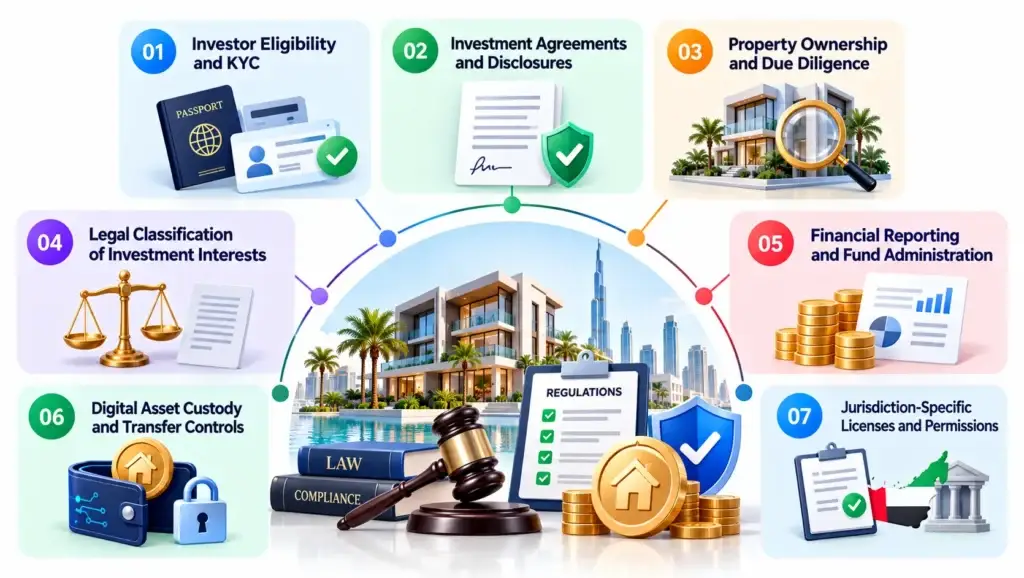
Launching a property investment offering involves more than selecting an ownership structure or developing a digital investment experience.
Founders must understand the legal obligations associated with raising capital, allocating investment interests, managing property-related financial activity, and facilitating transfers.
Depending on the jurisdiction and the rights offered to investors, fractional ownership and tokenized real estate arrangements may be subject to securities laws, collective investment regulations, property ownership requirements, anti-money-laundering rules, and other financial services obligations.
Importantly, representing an investment through blockchain tokens does not automatically change its legal classification or remove existing regulatory requirements.
For example, the US Securities and Exchange Commission has explained that securities represented through tokenization remain subject to applicable securities laws. However, the legal classification of any particular property-related token depends on its structure and the jurisdiction in which it is offered.
Seven Regulatory and Operational Areas Founders Should Evaluate
1. Investor Eligibility and Identity Verification
Determine who is permitted to invest and what verification procedures apply. Depending on the market, this may involve KYC checks, AML screening, investor classification, or suitability assessments. For platforms operating in the Emirates, UAE property investor onboarding requirements also influence how identity verification, investor eligibility, and cross-border participation are managed.
2. Investment Agreements and Disclosures
Provide documentation explaining the investment structure, legal rights, financial obligations, associated risks, applicable fees, and exit restrictions. Investors should understand the agreement before committing capital.
3. Property Ownership and Due Diligence
Verify the underlying property’s legal title, ownership history, valuation basis, and relevant financial or legal obligations. The investment offering should accurately reflect the asset and its ownership arrangements.
4. Legal Classification of Investment Interests
Establish whether investors are acquiring direct ownership, shares in an SPV, securities, beneficial interests, or contractual claims. This classification influences disclosure, registration, transfer, and operating obligations.
5. Financial Reporting and Fund Administration
Define how investment payments, property income, operating expenses, refunds, investor balances, and distributions will be recorded and reconciled. Transparent financial administration helps reduce disputes and reporting inconsistencies.
6. Digital Asset Custody and Transfer Controls
Where tokenization is involved, determine how wallets, private keys, approved transfers, lost credentials, and custody responsibilities will be managed. Blockchain records should also be reconciled with the legally authoritative ownership records where necessary.
7. Jurisdiction-Specific Licenses and Permissions
Confirm whether the investment offering, platform operator, issuer, or secondary trading arrangement requires regulatory authorization. Requirements can vary significantly depending on the location, investor category, and financial instrument involved.
Why Regulatory Planning Must Come Before Launch
Legal compliance should be treated as a foundational business requirement rather than an additional task after the investment experience has been designed.
Unclear ownership rights, incomplete investor disclosures, or inappropriate transfer arrangements can create significant financial and operational risks.
Founders should therefore work with qualified legal, financial, and regulatory advisers to establish the permitted investment structure and relevant obligations before accepting investor funds.
Key Takeaway: Whether a property investment uses conventional fractional ownership or blockchain-based tokenization, its long-term viability depends on enforceable investor rights, accurate records, responsible financial administration, and compliance with the laws of its target market.
Which Model Is More Suitable for Different Property Investment Strategies?
The useful decision is not whether blockchain is more modern than conventional recordkeeping.
It is whether the chosen structure matches the investor rights, operating model, and regulatory environment.
| Founder scenario | More suitable starting point to evaluate | Reason |
|---|---|---|
| Small, private group investing in one property | Conventional fractional ownership | Ownership and governance may be administered without digital tokens |
| Property sponsor offering interests through an SPV | SPV-based fractional investment | Establishes the legal and economic structure before considering tokenization |
| Operator with a defined digital asset use case | Tokenized investment structure | Digital representation may support the intended transfer or recordkeeping model |
| Platform seeking regulated secondary transfers | Structure designed around permitted transfer arrangements | Trading permissions and liquidity infrastructure must be established |
| Founder entering a market with limited tokenization guidance | Conventional legally recognized structure first | Reduces dependence on an unresolved token-specific framework |
These are decision prompts, not blanket recommendations. Legal feasibility and operational suitability should determine the final structure. Different real estate investment platform models may support distinct approaches to investor participation, property administration, and financial management, but the underlying ownership structure should always guide the technology selection.
Founder Decision Signals
Legal Ownership Clarity
Before choosing fractional ownership or tokenization, establish what investors legally own. Determine whether their interests represent direct property ownership, SPV shares, or contractual claims, and ensure the supporting documents clearly define those rights.
Regulatory Readiness
Evaluate investor eligibility, KYC and AML requirements, securities regulations, and property ownership laws in your target market. Tokenization does not eliminate existing regulatory obligations, so the legal structure should be validated before accepting investor funds.
Liquidity and Exit Options
Assess how investors can transfer or sell their interests, including approval requirements, holding restrictions, and secondary-market demand. Blockchain-based transfers may improve transaction efficiency, but they do not guarantee liquidity or immediate exits.
Technology and Operational Fit
Choose technology based on the investment structure rather than market trends. Conventional fractional ownership may only require reliable investor records and distribution management, while tokenized interests can introduce additional wallet security, custody, and blockchain reconciliation requirements.
Operational Risks Founders Should Not Overlook
Several problems can arise even when the legal arrangement itself is valid.
1. Conflicting ownership records
If a conventional register and a digital token ledger are both maintained, the operator must define their relationship.
A token transfer could occur while an off-chain register remains unchanged, creating uncertainty about which record has legal effect.
The relevant legal and system design must define the authoritative record, valid transfer conditions, and reconciliation process.
2. Incorrect rental distributions
Property income is rarely equal to gross rent multiplied by an investor’s ownership percentage.
Maintenance costs, taxes, insurance, vacancies, management expenses, reserves, and other deductions may affect distributable cash. Founders must also distinguish investor earnings from the fees collected by the platform operator, as different property investment platform revenue structures can introduce transaction charges, administration fees, and other deductions that must be accurately recorded and disclosed.
Investor communication should distinguish projected income from actual distributions.
For a deeper discussion of how to explain investment performance, see Miracuves’ guide to rental yield and capital appreciation.
3. Misleading liquidity assumptions
An operator should not suggest that property-linked tokens can always be exchanged instantly.
A digital marketplace may facilitate a transfer process, but the relevant rules and buyer demand still determine whether a sale happens.
4. Inadequate investor education
Investors may confuse property ownership, SPV shares, contractual income rights, and tokens.
That confusion can become a trust problem when they encounter transfer restrictions or unexpected risks.
Clear explanations, layered disclosures, and accessible documentation are essential.
5. Unclear responsibility after platform failure
Founders should consider what happens if the technology provider, issuer, property manager, custodian, or investment administrator stops operating.
Investment ownership should not be explained as though it depends only on access to an app.
The legal structure and continuity arrangements should define what survives, how records remain accessible, and who performs essential functions.
Where Technology Fits After the Ownership Model Is Defined
Once the legal structure and economic relationships are established, technology becomes the means of administering them.
At that stage, founders can assess how investors will be identified, how investments will be recorded, how agreements will be stored, how distributions will be calculated, and how approved transfers will be reflected across the relevant systems.
A conventional fractional ownership offering and a tokenized offering may share several operational requirements even though their legal structures differ.
Both models require reliable identity verification, accurate investor records, payment reconciliation, property reporting, and permission-based administrative controls. These investor ownership and financial management workflows become particularly important when a platform must coordinate property allocations, rental distributions, investment certificates, and approved ownership transfers within a consistent operating structure.
Tokenized offerings may add digital asset management and blockchain-specific reconciliation requirements.
Founders evaluating the technical implications can explore Miracuves’ guide to property investment ownership and financial record architecture.
The broader decision is whether the technology reflects the ownership arrangement accurately—not whether the product can display an investment balance.
How Miracuves supports platform execution
Miracuves provides ready-made, white-label investment platform technology for founders who have defined the investment model they intend to operate.
Its property investment platform foundation connects property participation workflows with investor administration and related financial operations.
For eligible ready-made deployments, Miracuves offers a 6-day software delivery timeline, subject to the agreed deployment scope. This does not include a guarantee of investment licensing, regulatory approval, third-party integration readiness, or permission to accept investor funds.
The practical benefit of using an existing software foundation is the opportunity to spend more of the planning effort on the matters that software alone cannot solve: legally enforceable investor rights, property acquisition, regulatory readiness, and operational governance.
A Pre-Launch Checklist for Property Investment Founders
Before launching a fractional ownership or property tokenization platform, founders must establish a clear legal framework, transparent investor rights, and reliable operational processes. A well-defined investment structure helps reduce compliance risks, prevent ownership disputes, and build investor confidence.
Use this checklist to evaluate your platform’s readiness before entering the market.
1. Legal Ownership and Investment Structure
- Verify the registered property owner and establish a legally recognized investment structure.
- Clearly define each investor’s ownership, voting, income distribution, and exit rights.
- Determine whether investors will hold direct property ownership, SPV shares, tokenized securities, or contractual investment interests.
2. Property Valuation and Investor Compliance
- Establish transparent property valuation procedures and financial disclosure standards.
- Define investor eligibility requirements and implement appropriate KYC, AML, and identity verification processes.
3. Financial Management and Ownership Records
- Establish clear procedures for rental income collection, operating expenses, profit allocation, and investor distributions.
- Maintain accurate ownership records and define how investments and ownership transfers will be legally documented.
- Establish realistic exit options, transfer restrictions, and secondary-market participation rules.
4. Digital Asset Security and Regulatory Readiness
- If tokenization is involved, establish secure wallet management, token custody, access recovery, and transaction reconciliation procedures.
- Obtain qualified legal guidance and confirm applicable regulatory approvals before accepting investor funds.
Why This Checklist Matters
A successful property investment platform requires more than an attractive investor dashboard or blockchain integration. Its long-term reliability depends on legally enforceable ownership rights, transparent financial operations, secure investment records, and realistic exit arrangements.
For founders, the priority should be establishing a trustworthy investment structure before choosing the technology that will support it.
Completing this checklist supports launch preparation but does not guarantee regulatory compliance. Final requirements depend on the jurisdiction, investment structure, and operating model.
Final Thoughts: Define Ownership Before Choosing Tokenization
Property tokenization and fractional ownership should not be treated as competing technologies.
Fractional ownership describes how an investment interest is divided. Tokenization can provide a digital representation of defined rights under an appropriate legal and operating framework.
Neither approach automatically resolves property investment risks, creates investor liquidity, or eliminates regulatory responsibilities.
For founders, the stronger starting point is to establish what investors own, what rights they receive, which records establish those rights, and how transfers and distributions will work.
Only then should the operating team decide whether digital tokenization adds enough practical value to justify its additional requirements.
The long-term objective is not simply to make property interests easier to purchase. It is to make the relationship between the asset, the investor, and the legal ownership structure clear and dependable.
FAQs
What is the main difference between property tokenization and fractional ownership?
Fractional ownership divides legal or economic interests in an asset among participants. Property tokenization represents specific rights or interests digitally, usually through blockchain-based tokens. The two approaches can be combined, but they serve different functions.
Can fractional real estate ownership work without blockchain?
Yes. Fractional property interests can be established through legally recognized arrangements such as direct co-ownership, companies, or SPVs. Blockchain is not inherently necessary to divide ownership or administer investor interests.
Does owning a real estate token mean owning part of the property’s title?
Not necessarily. A token may represent shares in a property-holding entity, a beneficial interest, a contractual claim, or another legally defined right. Direct title ownership depends on the jurisdiction, official records, and legal arrangement.
Is tokenized real estate more liquid than traditional fractional ownership?
Tokenization can support digital transfer mechanisms, but actual liquidity depends on eligible buyers, applicable restrictions, permitted trading arrangements, and market demand. Neither model guarantees a quick exit.
What is the role of an SPV in fractional property investing?
An SPV is a separate legal entity that may hold a property and issue investment interests to participants. Its governance documents establish the rights and obligations associated with those interests, subject to applicable law.
Are tokenized property investments automatically regulated as securities?
No single classification applies everywhere. Some tokenized property interests may qualify as securities or other regulated instruments, depending on the rights they provide and the jurisdiction. Their legal classification should be assessed before issuance.
Can a property investment platform support both tokenized and non-tokenized interests?
Potentially, yes. A platform may administer different legally defined investment structures if its records, permissions, workflows, and compliance arrangements accommodate them. The operator must prevent inconsistencies between investor records and legal rights.
What should founders resolve before launching a property investment offering?
Founders should establish the legal ownership structure, investor rights, asset documentation, regulatory requirements, financial controls, custody responsibilities where applicable, and realistic exit arrangements. Software selection should follow those foundational decisions.
Miracuves is an independent software development company. We are not affiliated with, connected to, sponsored by, or endorsed by any company or product named in this article.
Terms such as “X Clone” are used descriptively. It is how the software industry refers to building a platform with functionality comparable to a known service, and how clients search for it.
The entire design and codebase of our products is built by our own team. Our products contain no code, design, graphics, or content originating from any third-party website or applications.
All third-party names and marks referenced in this article are the property of their respective owners, referenced solely to identify the services discussed.