Imagine you’re planning a trip to Rome, Bali, or New York. You know you need a hotel, a few good restaurants, and maybe some top-rated things to do, but every site tells a different story. One blog says a place is amazing, a booking site says nothing useful, and social media gives you more hype than real guidance.
That’s exactly where TripAdvisor becomes useful.
TripAdvisor helps travelers compare places using traveler reviews, rankings, photos, booking links, and planning tools in one platform. On its official homepage, TripAdvisor says it has over a billion reviews and contributions covering hotels, experiences, restaurants, and more, while helping users find savings on hotels, book tours and attractions, and reserve restaurant tables.
How TripAdvisor Started and Why It Matters
TripAdvisor has grown into one of the world’s best-known travel platforms because it sits at the point where many travel decisions begin. Its official media and investor pages describe Tripadvisor Group as a company that connects people to experiences worth sharing and operates two-sided marketplaces across experiences, accommodations, restaurants, and other travel categories.
What makes TripAdvisor especially important is that it is not just a hotel site. Its live platform spans hotels, restaurants, attractions, trip planning, experiences, and community-driven rankings. The site also includes tools like Trips, its free trip planner and AI itinerary builder, which lets users save attractions, restaurants, and places to stay into one plan.
Current Impact and Why People Still Use It
TripAdvisor remains highly influential because travelers still want social proof before booking. Its platform now covers more than 9 million experiences, accommodations, restaurants, airlines, and cruises, according to its annual report, and its Travelers’ Choice awards continue to shape what people consider the best places to stay, eat, and visit.
In practical terms, that means travelers use TripAdvisor not only to book or compare deals, but to answer questions like:
Where should I stay?
What is actually worth doing there?
Which restaurants are really good?
What do other travelers honestly think?
What You’ll Learn in This Guide
By the end of this guide, you’ll understand what TripAdvisor is, how TripAdvisor works for travelers and businesses, how its business model functions, which features make it successful, what technology powers the platform, and why many entrepreneurs want to build similar travel-review and discovery platforms. TripAdvisor’s current product already shows why that model is so powerful: it combines reviews, rankings, booking links, trip planning, and discovery in one ecosystem.
What Is TripAdvisor? The Simple Explanation
What Is TripAdvisor ?
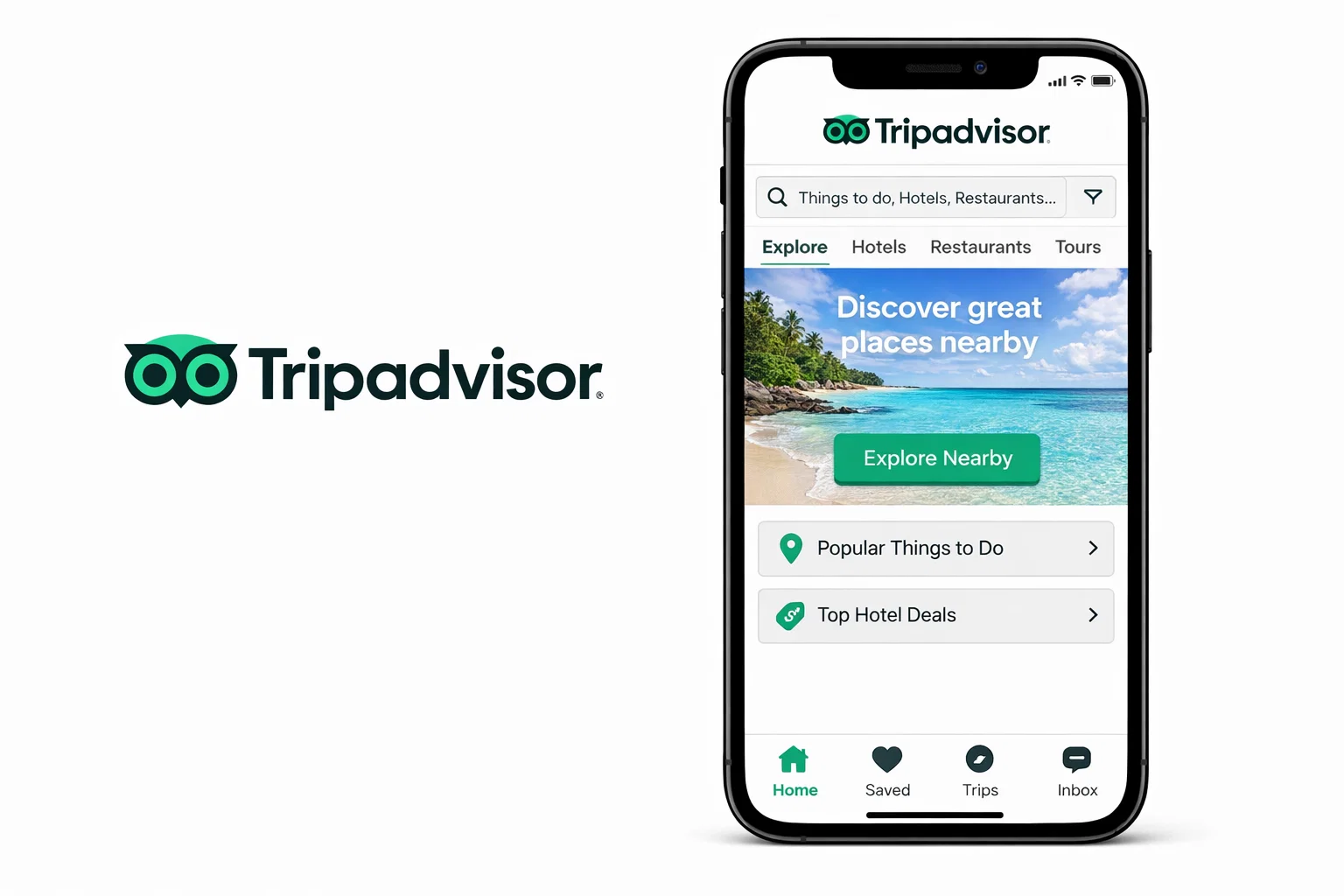
TripAdvisor is a travel discovery and planning platform where people can research hotels, restaurants, attractions, experiences, and other travel services using traveler reviews, ratings, photos, rankings, and booking links. Instead of acting only like a booking site, TripAdvisor helps users decide where to stay, what to do, and where to eat before they commit. On its official homepage, TripAdvisor says it helps users find hotel savings, book experiences, reserve tables, and use reviews from travelers around the world.
The Core Problem TripAdvisor Solves
Travel planning is hard when you do not know what is actually worth your time or money. A hotel might look good on one booking site, a restaurant might be trending on social media, and an attraction might be heavily advertised, but none of that tells you what real travelers actually experienced.
TripAdvisor solves that by gathering reviews, rankings, photos, and planning tools in one place. Its homepage says the platform includes over a billion reviews and contributions, which gives users a huge amount of real traveler feedback before they book or visit something.
In simple terms, TripAdvisor helps travelers make better decisions with more confidence.
Who Uses TripAdvisor?
TripAdvisor serves several types of users:
• Travelers searching for hotels and places to stay
• Food lovers looking for trusted restaurant recommendations
• Tourists comparing attractions and local experiences
• Families planning full itineraries
• Travel businesses trying to attract more customers
• People who want to read reviews before booking anything
Because it covers multiple categories, TripAdvisor is useful for much more than just accommodation research. Users can move from hotel discovery to restaurants, things to do, and itinerary planning inside the same ecosystem.
TripAdvisor’s Market Position
TripAdvisor remains one of the most recognized travel-review and discovery platforms in the world. Its annual report says its brands cover more than 9 million experiences, accommodations, restaurants, airlines, and cruises, which shows just how large the platform’s travel database has become.
That scale matters because it gives TripAdvisor two big advantages:
• A huge content base of traveler opinions and business listings
• A broad discovery layer across many parts of the trip, not just one category
Why Did TripAdvisor Become So Successful?
TripAdvisor became successful because it answered a simple but powerful question: “What do other travelers really think?”
Its success comes from a few key strengths:
• Massive review volume and user-generated content
• Coverage across hotels, restaurants, attractions, and experiences
• Strong trust signals through ratings and rankings
• Booking and reservation links layered on top of discovery
• A planning experience that starts before the booking stage
This is also why TripAdvisor still matters even in a world full of booking apps. People often use it earlier in the journey, when they are still deciding what is worth booking in the first place.
What Makes TripAdvisor Different from Traditional Travel Booking Sites?
Traditional booking sites mainly help users complete a transaction. TripAdvisor is different because it helps users decide what deserves their money and time before the transaction happens.
What makes it stand out is the combination of:
• traveler reviews
• rankings and ratings
• restaurant and attraction discovery
• booking and reservation links
• trip-planning tools like Trips and AI itinerary building
That mix makes TripAdvisor feel more like a travel decision platform than a simple booking engine.
How Does TripAdvisor Work? Step-by-Step Breakdown
TripAdvisor works like a travel discovery and decision platform. Instead of starting with booking alone, it helps users explore places, compare ratings, read reviews, save options, and then book or reserve through TripAdvisor or one of its partners. On its official homepage, TripAdvisor says users can find hotel savings, book tours and attractions, reserve restaurant tables, and use traveler reviews to decide where to stay and what to do.
How TripAdvisor Works for Travelers
Search and Discovery
• A traveler opens TripAdvisor and searches a destination, hotel, restaurant, or attraction
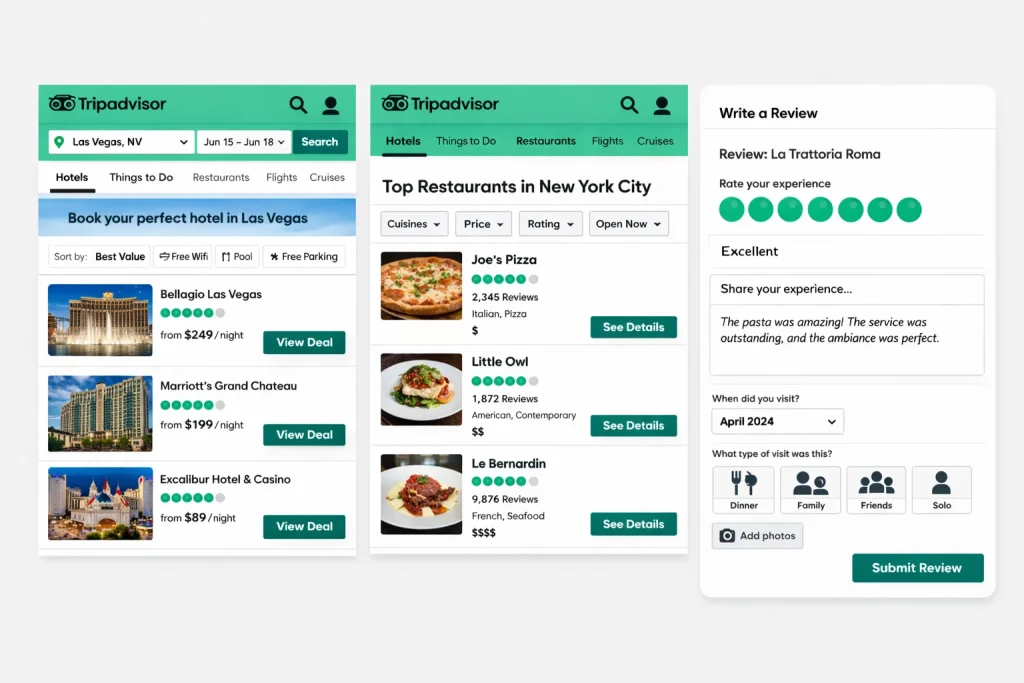
• The platform shows listings with reviews, ratings, photos, rankings, and useful filters
• Users can compare places across categories like hotels, things to do, restaurants, and experiences
TripAdvisor’s live platform is built around this discovery flow. The homepage, Hotels, Attractions, and Restaurants pages all show that users can move across multiple trip categories in the same ecosystem.
Reading Reviews and Comparing Options
• Users read traveler reviews and opinions before deciding
• They compare ratings, photos, rankings, and traveler comments
• This helps them judge whether a hotel, restaurant, or attraction is actually worth their time and money
TripAdvisor’s homepage says it has more than a billion reviews and contributions, and category pages show just how deep that review layer goes. For example, the Restaurants page says users can search among 5 million restaurants worldwide with 760 million reviews and opinions.
Booking or Reserving
• Once a traveler decides, they can use booking links or reservation tools
• TripAdvisor supports hotel deal discovery, attraction booking, and restaurant reservations through the platform and partners
• The site also states that when users book with one of its partners, they should check that partner’s site for full fee disclosures
That means TripAdvisor works as both a discovery layer and a booking/referral layer, depending on the category and partner involved.
Planning a Full Trip
• Travelers can save places they like into Trips
• They can build itineraries by adding attractions, restaurants, and places to stay
• TripAdvisor now also offers an AI itinerary builder inside Trips for personalized recommendations
TripAdvisor’s Trips page describes it as a free trip planner where users can discover and save millions of top-rated attractions, activities, restaurants, and places to stay, then organize them into an itinerary or use the AI trip builder.
How TripAdvisor Works for Businesses
Listing a Business
• Hotels, restaurants, attractions, and other travel-related businesses can get listed on TripAdvisor
• TripAdvisor’s media center says owners of hotels, airlines, restaurants, attractions, and travel resources can submit a free listing
• Businesses can also claim listings and start managing them through Tripadvisor for Business
This is important because TripAdvisor is not only a consumer platform. It is also a business visibility platform.
Managing Reputation and Visibility
• Businesses can claim their listing
• They can update details, upload photos, and reply to reviews
• They can also use Tripadvisor for Business tools to track performance and improve visibility
Tripadvisor for Business says owners can manage their presence, engage customers, track performance, and use free products after claiming their listing.
Using Business Tools and Marketing Products
• Businesses can use free and paid tools through Tripadvisor for Business
• These tools are designed to help drive bookings, improve reputation, and reach TripAdvisor’s travel audience
• The Learning Center and business resource pages also show products like Sponsored Placements and Reputation Pro
That means businesses do not just appear on TripAdvisor — they can actively market and optimize their presence there.
Technical Overview Explained Simply
At a simple level, TripAdvisor works like this:
• Travelers search for hotels, restaurants, attractions, or experiences
• The platform shows listings, reviews, rankings, and planning tools
• Users compare their options using real traveler feedback
• They can save choices into Trips or use the AI itinerary builder
• When ready, they book, reserve, or click through to a partner or provider
• Businesses manage listings, respond to reviews, and use visibility tools on the other side
That is why TripAdvisor feels bigger than a booking site. It helps travelers decide, plan, and act, while also giving businesses tools to attract and manage demand.
In simple terms, TripAdvisor is the digital layer between travel curiosity and travel action.
TripAdvisor’s Business Model Explained
TripAdvisor makes money by sitting in the middle of travel discovery, business visibility, and booking intent. It is not just a review website, and it is not just a booking site either. Its model works because millions of travelers use the platform to decide where to stay, what to do, and where to eat, while hotels, attractions, restaurants, and travel partners want access to that demand. TripAdvisor’s own company materials describe the business as operating marketplaces across experiences, accommodations, restaurants, and other travel categories.
How TripAdvisor Makes Money
• Hotel and travel partner referral revenue
• Experiences and activity booking revenue
• Restaurant reservation and dining-related monetization
• Advertising and sponsored placement products
• Subscription and software-style revenue through Tripadvisor for Business tools
That mix is what makes TripAdvisor different from a simple travel-review directory.
Hotel Meta and Referral Revenue
One of TripAdvisor’s classic revenue engines is hotel shopping and referral traffic. Travelers compare hotels, read reviews, and then click through to book with a hotel, OTA, or travel partner. TripAdvisor’s homepage says users can compare low prices on hotels from its trusted partners.
Why It Matters: TripAdvisor earns value at the exact moment when a traveler is close to making a purchase decision.
Technical Innovation: Hotel metasearch and partner-link infrastructure connect high-intent users to booking providers while keeping TripAdvisor central to the comparison stage.
Experiences and Attractions Revenue
TripAdvisor also earns from tours, attractions, and experiences. Its homepage explicitly says users can book popular tours and attractions, and its broader company positioning highlights experiences as a major marketplace category.
Why It Matters: Experiences create another large monetization layer beyond hotels, especially because they often sit at the heart of trip planning.
Technical Innovation: Experience-booking workflows turn destination discovery and review browsing into bookable activity demand.
Restaurant and Dining Revenue
TripAdvisor’s restaurant category is not just for reviews. The homepage says users can reserve tables at great restaurants, and the Restaurants section says people can search millions of restaurants worldwide.
Why It Matters: Dining is a high-frequency travel decision, and reservation intent is highly monetizable.
Technical Innovation: Restaurant discovery plus reservation flows give TripAdvisor a dining-commerce layer on top of its review base.
Advertising and Sponsored Visibility
TripAdvisor also makes money by helping businesses stand out. Tripadvisor for Business resource pages highlight tools and products such as Sponsored Placements and Reputation Pro, showing that business visibility is a direct commercial offering.
Why It Matters: Businesses want more traffic, stronger visibility, and better conversion from TripAdvisor’s large traveler audience.
Technical Innovation: Sponsored ranking and visibility tools let TripAdvisor monetize attention inside high-intent search and review environments.
Tripadvisor for Business Revenue
Tripadvisor for Business is another important part of the model. TripAdvisor says owners can claim their listing, manage their presence, engage customers, track performance, and use products designed to improve reputation and visibility.
Why It Matters: This turns TripAdvisor from a traveler-facing platform into a business-services platform too.
Technical Innovation: Dashboard tools, listing management, analytics, and review-response workflows create recurring business utility, not just one-time exposure.
Marketplace Scale That Supports the Model
This model works because the audience is huge and the content base is even bigger. TripAdvisor’s homepage says it has over a billion reviews and contributions, while its annual report says the company’s brands cover more than 9 million experiences, accommodations, restaurants, airlines, and cruises. That combination makes the platform highly valuable to both travelers and businesses.
Revenue Model Breakdown
| Revenue Stream | How It Works | Why It Matters |
|---|---|---|
| Hotel Referral Revenue | Travelers compare hotels and click through to partners | Monetizes booking intent |
| Experiences Revenue | Users discover and book attractions and tours | Expands beyond hotels |
| Dining Revenue | Users discover restaurants and reserve tables | Adds restaurant-commerce value |
| Advertising and Sponsored Placements | Businesses pay for better visibility | Monetizes traveler attention |
| Tripadvisor for Business Tools | Businesses use reputation and management products | Adds recurring B2B utility |
TripAdvisor’s business model is powerful because it monetizes trust and intent. Travelers come for reviews and rankings, then move toward booking or reservation decisions. Businesses, in turn, pay to be discovered, trusted, and chosen inside that journey. That is why TripAdvisor has remained commercially important even as travel booking apps and social media have grown.
Key Features That Make TripAdvisor Successful
TripAdvisor remains powerful because it does more than show listings. It combines reviews, rankings, planning tools, booking links, and business visibility products in one travel ecosystem. On its homepage, TripAdvisor says it has over a billion reviews and contributions, and its annual-report-based figures show coverage across more than 8 million listings and over 9 million experiences, accommodations, restaurants, airlines, and cruises. That kind of content scale is a huge part of why travelers still trust it when deciding what is worth booking.
Massive Review and Contribution Database
TripAdvisor says it has over a billion reviews and contributions across hotels, restaurants, experiences, and more.
Why It Matters: Travelers want real social proof before they spend money.
Technical Innovation: Large-scale user-generated content systems organize huge volumes of reviews, photos, ratings, and rankings into searchable decision tools.
Hotel Discovery and Price Comparison
TripAdvisor’s Hotels section says users can search 1 million hotels and motels worldwide, with rooms ranked by hundreds of millions of traveler reviews and opinions.
Why It Matters: Users can compare both value and reputation before booking.
Technical Innovation: Hotel search is layered with review-driven ranking and partner pricing comparison instead of acting like a simple directory.
Restaurant Discovery at Global Scale
TripAdvisor’s Restaurants section says users can find restaurants near them from 5 million restaurants worldwide using 760 million reviews and opinions from travelers.
Why It Matters: Dining is one of the most frequent travel decisions, and good restaurant discovery adds real trip value.
Technical Innovation: Review aggregation and location-based recommendation systems help users move from generic search to trusted local dining choices.
Attractions and Experiences Booking
TripAdvisor’s Attractions pages and homepage show that users can discover and book tours, attractions, and things to do directly through the platform and partners.
Why It Matters: This expands TripAdvisor beyond planning into actual travel commerce.
Technical Innovation: Experience listings combine ranking, review content, and bookable inventory in one flow.
Trips: Free Trip Planner
TripAdvisor’s Trips feature is positioned as a free trip planner where users can save attractions, restaurants, and places to stay into one itinerary.
Why It Matters: It helps users move from scattered browsing to a structured travel plan.
Technical Innovation: Cross-category save-and-organize tools create a persistent planning layer on top of reviews and discovery.
AI Itinerary Builder
TripAdvisor’s Trips page also says users can use its AI trip builder to get personalized travel recommendations.
Why It Matters: This makes planning faster and more personalized, especially for travelers who do not want to build an itinerary from scratch.
Technical Innovation: AI-assisted itinerary generation adds a recommendation layer on top of TripAdvisor’s massive content and review base.
Travelers’ Choice Awards
TripAdvisor’s Travelers’ Choice Awards are one of its strongest trust features. The company says the awards are based on reviews and ratings collected over a 12-month period, and its Best of the Best pages say fewer than 1% of listings achieve that milestone.
Why It Matters: Awards help travelers make faster decisions and give businesses a powerful trust badge.
Technical Innovation: Review-driven ranking systems turn community feedback into recognizable reputation signals across hotels, restaurants, destinations, and things to do.
Business Claiming and Reputation Management
Tripadvisor for Business allows owners to claim listings, manage their presence, engage customers, and track performance.
Why It Matters: Businesses do not just appear on TripAdvisor — they can actively manage how they are represented.
Technical Innovation: Business dashboards connect listing control, review response, and performance insights into one operational layer.
Sponsored Placements
TripAdvisor for Business offers Sponsored Placements that help hotels appear more prominently in search results and reach ready-to-book travelers. TripAdvisor says these products are designed to drive more direct bookings.
Why It Matters: This gives businesses a clear way to increase visibility inside a high-intent discovery environment.
Technical Innovation: Paid search-result placement blends ad-tech with traveler intent and review-driven discovery.
Community-Driven Rankings
TripAdvisor’s hotel, restaurant, attraction, and destination pages all rely heavily on ranking systems shaped by user reviews and opinions.
Why It Matters: Rankings help travelers sort large amounts of content quickly and give the platform a strong decision-making role.
Technical Innovation: Ranking algorithms convert review quality, review volume, and recent traveler sentiment into easy-to-understand ordering signals. This is partly an inference from how the platform presents rankings and awards. It is supported by the review-based award documentation.
What Sets TripAdvisor Apart
What really sets TripAdvisor apart is that it combines trust, discovery, and planning in one place. Many travel sites help users book. TripAdvisor helps users decide what is worth booking in the first place. That is why reviews, rankings, Trips, AI itinerary building, and Travelers’ Choice awards all matter so much together.
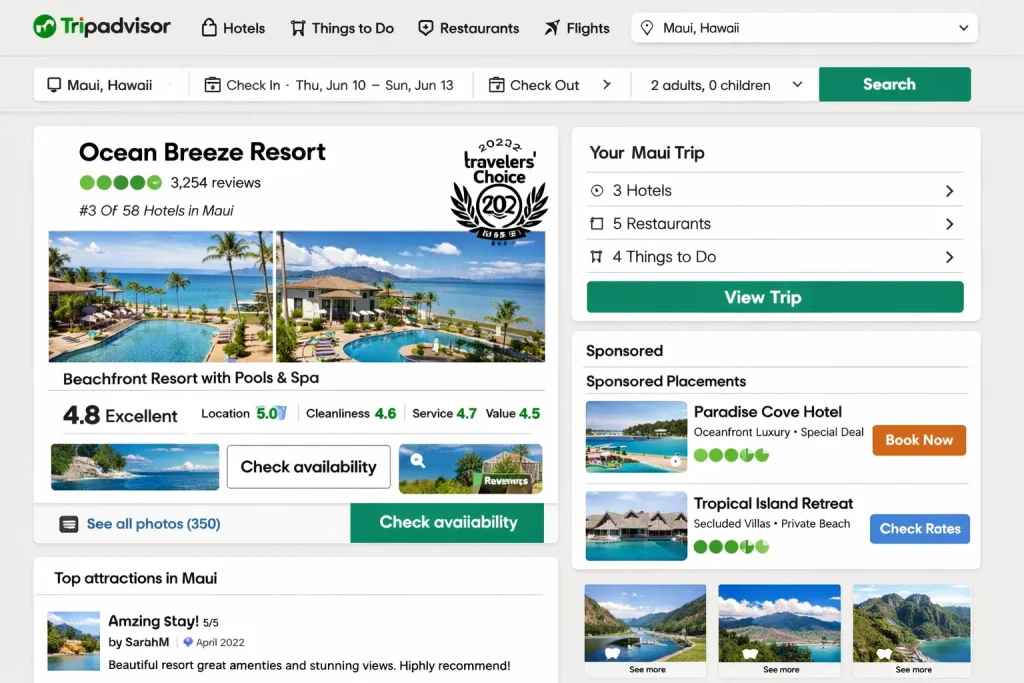
The Technology Behind TripAdvisor
TripAdvisor runs on a large travel-discovery platform built around reviews, rankings, search, planning tools, and business visibility products. What makes the technology interesting is that it does not only organize travel listings. It also has to organize trust. The platform brings together hotels, restaurants, attractions, experiences, rankings, traveler photos, booking links, trip planning, and business dashboards in one connected ecosystem. TripAdvisor’s homepage says it has over a billion reviews and contributions, while its annual report says its brands cover more than 9 million experiences, accommodations, restaurants, airlines, and cruises.
Large-Scale Review and Content Infrastructure
At the core of TripAdvisor is a massive user-generated content engine. The platform stores and organizes reviews, ratings, rankings, traveler photos, and other contributions across many travel categories. That is what allows it to function as a trust-first travel platform rather than just a listing directory.
Why It Matters: Travelers rely on TripAdvisor because they want social proof before booking or visiting something.
Technical Innovation: Large-scale content infrastructure organizes huge volumes of reviews and contributions into searchable, category-specific travel pages.
Search and Ranking Systems
TripAdvisor’s technology has to do more than display listings. It has to help users find the most relevant hotels, restaurants, and attractions quickly. That means search and ranking logic play a central role.
TripAdvisor’s Travelers’ Choice pages explain that awards are based on review quality, quantity, and recency over a 12-month period. That gives a strong clue about how the platform values and processes review signals more broadly.
Why It Matters: Rankings make an overwhelming amount of content easier to understand and use.
Technical Innovation: Ranking systems likely weigh review volume, quality, and freshness to create useful ordering and badge systems. This is partly an inference, supported by TripAdvisor’s own explanation of how Travelers’ Choice awards are determined.
Category-Specific Discovery Layers
TripAdvisor does not treat all travel content the same way. Hotels, restaurants, attractions, and experiences each have different decision patterns, so the platform builds specialized discovery layers for each one.
Its live category pages show this clearly:
• Hotels focuses on pricing, reviews, and stay comparison
• Restaurants emphasizes opinions, nearby discovery, and table reservations
• Attractions and experiences support activity discovery and booking
Why It Matters: Travelers evaluate different travel categories in different ways.
Technical Innovation: Category-specific search and content structures let TripAdvisor tailor discovery to the way users actually make decisions.
Booking and Reservation Integration
TripAdvisor is not only a review platform. It also connects users to booking and reservation flows. Its homepage says users can compare hotel savings from trusted partners, book tours and attractions, and reserve tables at restaurants.
Why It Matters: The platform can turn research into action without needing to become only a booking site.
Technical Innovation: Booking-link and reservation integrations connect review-driven discovery to conversion-focused partner or on-platform actions.
Trips Planner and Saved Content Systems
TripAdvisor’s Trips feature adds a planning layer on top of search and reviews. The Trips page says users can save attractions, restaurants, and places to stay into one free trip planner.
Why It Matters: Planning tools increase repeat engagement and keep users inside the TripAdvisor ecosystem longer.
Technical Innovation: Cross-category save-and-organize infrastructure connects hotels, restaurants, and activities into persistent itineraries.
AI Itinerary Builder
TripAdvisor’s Trips page also says users can use an AI trip builder for personalized recommendations. That shows the company is adding AI on top of its large travel-content base instead of relying only on static search and rankings.
Why It Matters: AI can reduce planning time and make TripAdvisor more useful for travelers who want guidance, not just raw options.
Technical Innovation: AI-assisted itinerary generation uses TripAdvisor’s content graph and recommendation logic to assemble destination-specific plans.
Tripadvisor for Business Technology
TripAdvisor also has a strong B2B technology layer. Tripadvisor for Business says owners can claim listings, manage presence, engage customers, and track performance. Sponsored Placements and business tools show that TripAdvisor is also a business-services platform, not only a traveler-facing website.
Why It Matters: Businesses need tools to manage reputation and visibility, not just a passive listing.
Technical Innovation: Business dashboards, listing-control systems, review-response tools, and paid visibility products create a second technology stack for suppliers and merchants.
Reputation and Trust Signals
TripAdvisor’s reputation system is one of its strongest technology assets. Travelers’ Choice, rankings, review counts, and category ratings all work together to signal trust.
TripAdvisor says fewer than 1% of listings earn the Best of the Best Travelers’ Choice distinction, which shows how powerful that signal has become inside the platform.
Why It Matters: Trust signals make users more likely to act on what they see.
Technical Innovation: Reputation-scoring and badge systems convert community sentiment into high-value decision markers.
Why This Technology Matters for Business
The technology behind TripAdvisor matters because it turns traveler opinion into business value. Reviews become rankings. Rankings become trust. Trust becomes clicks, reservations, bookings, and ad value. That is why TripAdvisor has remained so important for both travelers and businesses. It is not just organizing travel information. It is organizing travel confidence.
TripAdvisor’s Impact & Market Opportunity
TripAdvisor changed travel planning by making other travelers’ opinions a central part of the decision process. Before platforms like this became mainstream, many people relied on guidebooks, travel agents, or a few booking-site photos. TripAdvisor turned travel planning into a review-driven, ranking-driven, community-driven experience. Its homepage says it now has over a billion reviews and contributions, while its media center describes Tripadvisor Group as using rich content, travel guidance, and two-sided marketplaces across experiences, accommodations, restaurants, and other travel categories.
How TripAdvisor Disrupted Travel Discovery
One of TripAdvisor’s biggest impacts is that it helped travelers decide what is worth booking before they ever reached a checkout page. Instead of asking only “Where can I book this?”, users started asking:
• What do other travelers think?
• Is this hotel actually good?
• Is this restaurant overrated?
• Is this attraction worth my time?
That shift is exactly why TripAdvisor remains so influential. Its homepage still centers the platform around reviews, experiences, restaurant reservations, and hotel savings, which shows it continues to sit at the discovery stage of the travel journey.
Market Size and Why the Opportunity Is So Big
The opportunity around TripAdvisor is huge because it sits across multiple travel categories at once. According to its annual-report figures cited earlier, the company’s brands cover more than 9 million experiences, accommodations, restaurants, airlines, and cruises. On the consumer side, the homepage also points users toward hotels, things to do, restaurants, cruises, and destination inspiration, while the media center describes Tripadvisor Group as operating marketplaces across several travel verticals.
That means TripAdvisor does not depend on just one kind of booking behavior. It benefits from hotel intent, restaurant intent, attraction discovery, and experience planning all at once.
Why Travelers Keep Using It
TripAdvisor stays relevant because it helps travelers solve several different problems in one place:
• checking trust before booking
• comparing places using real reviews
• finding things to do in a destination
• discovering restaurants and local favorites
• organizing plans with Trips and AI itinerary building
Its Trips page positions the feature as a free trip planner and AI itinerary builder, which shows the company is moving beyond static reviews into active planning support.
Why the Model Is Still Strong
The TripAdvisor model is still strong because trust remains valuable. Travelers still want reassurance before spending money, and businesses still want visibility where trust is being formed. That is why features like Travelers’ Choice Awards and Tripadvisor for Business matter so much. TripAdvisor says Best of the Best winners are among the top 1% of places, stays, eats, and experiences, while Tripadvisor for Business says it helps businesses reach millions of travelers and manage their presence.
That combination of trust plus business visibility keeps the marketplace commercially powerful.
Opportunities for Entrepreneurs
This is exactly why so many entrepreneurs want to build TripAdvisor-like products. There is room for:
• niche review-driven travel platforms
• local restaurant and attraction discovery apps
• itinerary and trip-planning tools
• travel trust-and-ranking platforms
• business reputation and visibility products for hospitality brands
The bigger lesson is simple: if a platform can organize trust at scale, it becomes extremely valuable. TripAdvisor proved that reviews are not just content — they are a decision engine.
This massive success is why many entrepreneurs want to create similar platforms that connect travelers with hotels, restaurants, attractions, and experiences through trusted reviews and smarter planning.
Building Your Own TripAdvisor-Like Platform
TripAdvisor’s success shows that travelers do not just want booking options. They want confidence. A modern travel platform becomes much more valuable when it helps users decide where to stay, what to eat, what to do, and what is actually worth their time before they spend money. That is exactly why the TripAdvisor-style model is so attractive. Its current platform combines reviews, rankings, booking links, restaurant reservations, attractions, trip planning, and AI itinerary building in one ecosystem.
Why Businesses Want a TripAdvisor Clone
Entrepreneurs are drawn to this model because it creates value on both sides of the market.
A TripAdvisor-like platform can create strong business opportunities through:
• traveler reviews and trust-driven discovery
• hotel, restaurant, and attraction comparison
• booking and reservation referrals
• sponsored placements and business visibility products
• itinerary planning and saved-trip engagement
• business tools for reputation management and listing control
TripAdvisor’s own scale explains why this model is so powerful. The platform says it has over a billion reviews and contributions, and its broader business covers more than 9 million experiences, accommodations, restaurants, airlines, and cruises. That kind of content base creates a strong network effect: more reviews attract more users, and more users attract more businesses.
Key Considerations Before Development
Before building a TripAdvisor-style platform, a business needs to decide what kind of trust-and-discovery problem it wants to solve.
Important questions include:
• Will the platform focus on hotels, restaurants, attractions, or all of them?
• Will it be global, regional, or city-specific?
• Will reviews be open to all users, or moderated more tightly?
• Will the product stop at discovery, or include bookings, reservations, and itinerary planning?
• Will businesses get dashboards for claiming listings, replying to reviews, and buying visibility?
• Will AI recommendation or itinerary-building features be included from the start?
These decisions matter because TripAdvisor’s strength comes from combining content, trust, and action in one journey.
Cost Factors & Pricing Breakdown
Building a TripAdvisor-style travel discovery + reviews platform from scratch typically requires user-generated reviews/ratings, place listings (hotels, restaurants, attractions), map-based discovery, search + filters, saved lists, moderation + anti-spam, and (optionally) metasearch/booking redirect integrations—which makes it both content-heavy and scale-sensitive.
TripAdvisor–Like App Development — Market Price
| Development Level | Inclusions | Estimated Market Price (USD) |
|---|---|---|
| 1. Basic Reviews & Listings MVP | User login, listings directory, reviews/ratings, basic search & filters, detail pages, basic admin moderation, basic analytics | $40,000–$90,000 |
| 2. Mid-Level Travel Discovery Platform | Map view + geo filters, saved lists, alerts/notifications, richer content pages, stronger moderation workflows, better analytics | $90,000–$180,000 |
| 3. Advanced TripAdvisor-Style Ecosystem | Large-scale UGC + trust/safety, ranking & personalization, high-availability infra, metasearch/partner redirect flows, enterprise analytics | $180,000–$500,000+ |
TripAdvisor-Style Travel Platform Development
The prices above reflect the global market cost of developing a TripAdvisor-like platform, where cost increases mainly due to UGC moderation + trust systems, map/geo performance, search scalability, and optional metasearch/partner integrations.
Miracuves Pricing for a TripAdvisor (USA)–Like Custom Platform
Typical global market cost for building a TripAdvisor-style platform ranges from ~$40,000 to $500,000+ with a delivery timeline of 4–12 months for a from-scratch build.
Miracuves Price: Starts at $15,999
This is positioned for a feature-rich, JS-based TripAdvisor-style travel discovery & reviews platform that can include:
- Listings directory (hotels/restaurants/attractions) with detail pages
- Reviews, ratings, and user profiles with moderation-ready controls
- Search, filters, map view, favorites/saved lists
- Notifications and analytics dashboards (scope-based)
- A scalable base that can be extended into partner redirects/metasearch, advanced ranking, and deeper trust & safety layers as your platform grows
Note: This includes full non-encrypted source code, complete deployment support, backend setup, admin panel configuration, and publishing on the Google Play Store and Apple App Store—ensuring you receive a fully operational ecosystem ready for launch and future expansion.
Delivery Timeline for a TripAdvisor (USA)–Like Platform with Miracuves
For a TripAdvisor-style, JS-based custom build, the typical delivery timeline with Miracuves is 30–90 days, depending on content modules, moderation layers, map/geo complexity, and partner/API integrations.
Tech Stack
We preferably will be using JavaScript for building the entire solution and Flutter / React Native for apps, considering speed, scalability, and one codebase for multiple platforms. Other tech stacks can be discussed upon request- Contact us.
Essential Features to Include
A strong TripAdvisor-like platform should include:
• user reviews and ratings
• hotel, restaurant, and attraction listing pages
• ranking and sorting tools
• traveler photos and contributions
• booking or reservation links
• saved places and itinerary planning
• search filters by price, rating, and category
• moderation tools for review quality
• business dashboards for listing management
• admin tools for category control and spam prevention
More advanced features should include:
• award or badge systems like Travelers’ Choice
• AI itinerary building
• sponsored placements for businesses
• reputation-management tools
• review-response workflows
• personalized recommendation systems
TripAdvisor’s current live platform already reflects many of these features through Trips, AI trip builder, Travelers’ Choice, Tripadvisor for Business, and Sponsored Placements.
Conclusion
TripAdvisor shows that one of the most powerful businesses in travel is not just booking — it is helping people trust their choices before booking. By combining massive review volume, rankings, planning tools, restaurant discovery, attractions, and business visibility products, TripAdvisor turned traveler opinions into a global decision engine. Its current platform still reflects that strength through over a billion reviews and contributions, Trips planning tools, AI itinerary support, and broad coverage across hotels, restaurants, and experiences.
For entrepreneurs, the biggest takeaway is simple: trust is a product. When a platform helps users answer “Is this place actually worth it?” it becomes much more valuable than a directory or booking page alone. That is exactly why so many founders want to build TripAdvisor-like platforms today.
FAQs :-
What is TripAdvisor?
TripAdvisor is a travel discovery and planning platform where users can research hotels, restaurants, attractions, experiences, and other travel services using reviews, ratings, rankings, photos, and booking links. TripAdvisor says it has over a billion reviews and contributions on its platform.
How does TripAdvisor make money?
TripAdvisor makes money through hotel and travel partner referral revenue, experiences and attraction bookings, restaurant-related reservation and dining revenue, advertising products like Sponsored Placements, and business tools offered through Tripadvisor for Business.
Is TripAdvisor only for hotels?
No. TripAdvisor covers much more than hotels. Its platform includes restaurants, attractions, tours, experiences, cruises, and trip-planning tools in addition to accommodation discovery. Its annual-report figures say its brands cover more than 9 million experiences, accommodations, restaurants, airlines, and cruises.
Can I book directly on TripAdvisor?
In some cases, yes. TripAdvisor says users can compare hotel savings, book tours and attractions, and reserve restaurant tables through its platform and partners. Depending on the category, the booking or reservation may happen through TripAdvisor or a connected partner flow.
How reliable are TripAdvisor reviews?
TripAdvisor’s value comes from its scale of traveler feedback, with over a billion reviews and contributions. It also uses rankings and review-based award systems like Travelers’ Choice, which are based on review quality, quantity, and recency over a 12-month period.
What are Travelers’ Choice awards?
Travelers’ Choice awards are TripAdvisor’s recognition system for highly rated places based on traveler reviews and ratings over a 12-month period. TripAdvisor says Best of the Best winners are among the top 1% of listings on the platform.
What is Trips on TripAdvisor?
Trips is TripAdvisor’s free trip planner. The company says users can save attractions, restaurants, and places to stay, organize them into one itinerary, and use an AI trip builder for personalized recommendations.
Can businesses manage their presence on TripAdvisor?
Yes. Tripadvisor for Business lets owners claim listings, manage their presence, engage customers, track performance, and use products designed to improve visibility and reputation.
What makes TripAdvisor different from booking sites?
TripAdvisor stands out because it focuses heavily on trust, reviews, rankings, and trip planning before the booking happens. Many booking sites focus mainly on transactions, while TripAdvisor helps users decide what is worth booking in the first place. Its platform combines reviews, rankings, booking links, Trips planning, and AI itinerary building in one ecosystem.
Can I build a platform like TripAdvisor?
Yes. A TripAdvisor-like platform would usually need user reviews, ratings, listings across travel categories, ranking systems, booking or reservation links, trip-planning tools, moderation systems, and business dashboards for reputation and visibility management. TripAdvisor’s current product shows that the biggest opportunity comes from combining trust, discovery, and planning in one platform.
Related Articles :-
Miracuves is an independent software development company. We are not affiliated with, connected to, sponsored by, or endorsed by any company or product named in this article.
Terms such as “X Clone” are used descriptively. It is how the software industry refers to building a platform with functionality comparable to a known service, and how clients search for it.
The entire design and codebase of our products is built by our own team. Our products contain no code, design, graphics, or content originating from any third-party website or applications.
All third-party names and marks referenced in this article are the property of their respective owners, referenced solely to identify the services discussed.