White Label Travel Portal - Flights, Hotels, Holidays & an Agent Network You Own
Miracuves' white label travel portal is a ready-made, white-label online travel business handed over as source code you own: Android and iOS apps, a booking website, agent, corporate and supplier portals and an operator console, trading from your domain inside six working days.
Travelers pay first and a booking is issued only after the supplier confirms; if it does not, the money returns automatically. You price each category with a percentage margin, a flat fee and a floor. No inventory comes with it: supplier contracts and any IATA accreditation stay in your name, and there is no accounting module. A sub-agent tier or agent-branded sites would be custom work, quoted in writing and usually ready within 2-8 weeks.
Launch in 6 Days with
- Source Code
- Android + iOS
- Booking Website
- Partner Portals
- Operator Console
- Go-Live Support
StackReact Native · Expo · React · Tailwind · Node.js · NestJS · PostgreSQL · Redis
Running activity ticker
- Air ticket PNR generatedFlights
- Room booking locked inHotels
- Fallback vendor took overSuppliers
- Agent earnings postedAgents
- Trip pending manager sign-offCorporate
- Cashback added to walletWallet
- Motorcoach place heldBuses
- Refund sent back to walletRefunds
- Air ticket PNR generatedFlights
- Room booking locked inHotels
- Fallback vendor took overSuppliers
- Agent earnings postedAgents
- Trip pending manager sign-offCorporate
- Cashback added to walletWallet
- Motorcoach place heldBuses
- Refund sent back to walletRefunds

- 7Demo Logins, No Sales Callbilling, CEO, admin, sub-admin, vendor, agent and traveler
- 5Ways to Pay at Checkoutcard, UPI, net banking, cash and pay later
- 0%Revenue Share With Miracuvesno license fee and no charge on any booking you take
- 3Trip Services Sold Alongsidevisa guidance, currency orders and travel insurance
- 6Days to Launchand if the delay is ours, we keep going free
- $3,999Paid Once, Not Rentedsource code yours, no per-seat fee, no monthly rental
Live in six working days, or we keep working free until you launch. Every build carries 60 days guidance, 6 months bug fixes and 12 months updates.Verify every figure
Owned, Not Rented by the Month
A rented portal sells its provider's inventory at a capped margin and stops when the fee stops; here the code, the database and every supplier account are yours.
61 Providers Wired In Before Launch
Flight, hotel, bus, rail, cab and activity connectors arrive with primary and fallback roles, and switch on with supplier accounts your company holds.
Card Details Never Stored
Rupee payments run through Razorpay and other currencies through Stripe; card data stays with the gateway, and refunds or payouts wait for a finance role.
01See it live
Live in Action
Travel Portal Demo - Traveler App, Agent & Vendor Portals, Operator Console
Open every side of the Miracuves travel portal yourself. Seven live logins sit on one demo, one for each person a travel portal serves: the traveler booking a trip, the agent booking for a client, the hotel managing its rooms, and the four operator roles behind them. Book as a traveler, then sign in as the operator and see the booking appear on the other side with its payment and its margin.
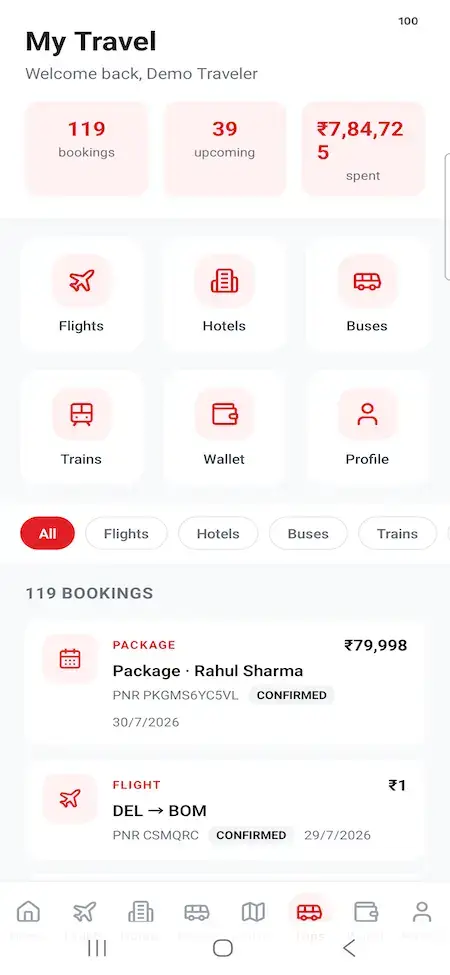
Traveler App - Search, Book & Manage Trips
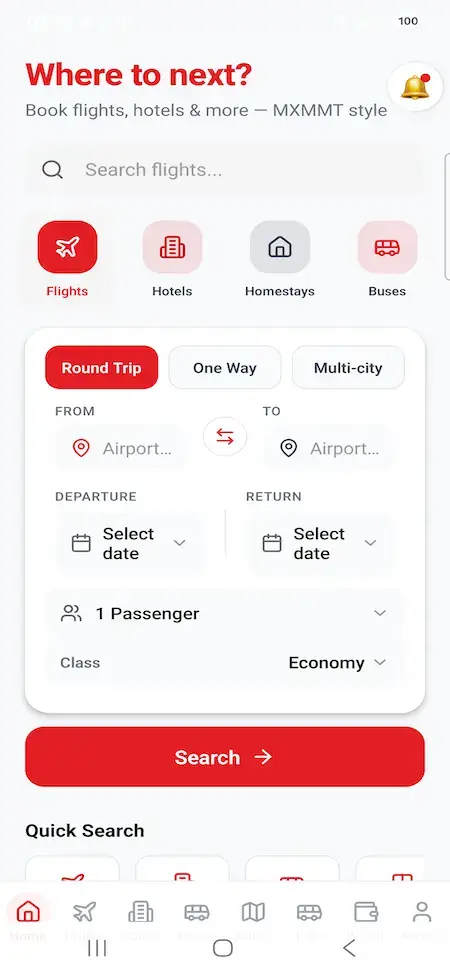
What your travelers use. Holiday packages, activities, cabs, trains, buses, hotels and flights can all be searched, filtered and sorted; travelers pick their seats and rooms, pay with a wallet, a promo code or a gift card, and then handle support tickets, loyalty tiers, refunds and every booking from one dashboard.
- 1Visit the demo login screen
- 2Use the traveler login listed below to sign in
- 3Explore: Flights, Hotels, Holidays, Wallet
customer@mxmmt.demo | DemoPass123!
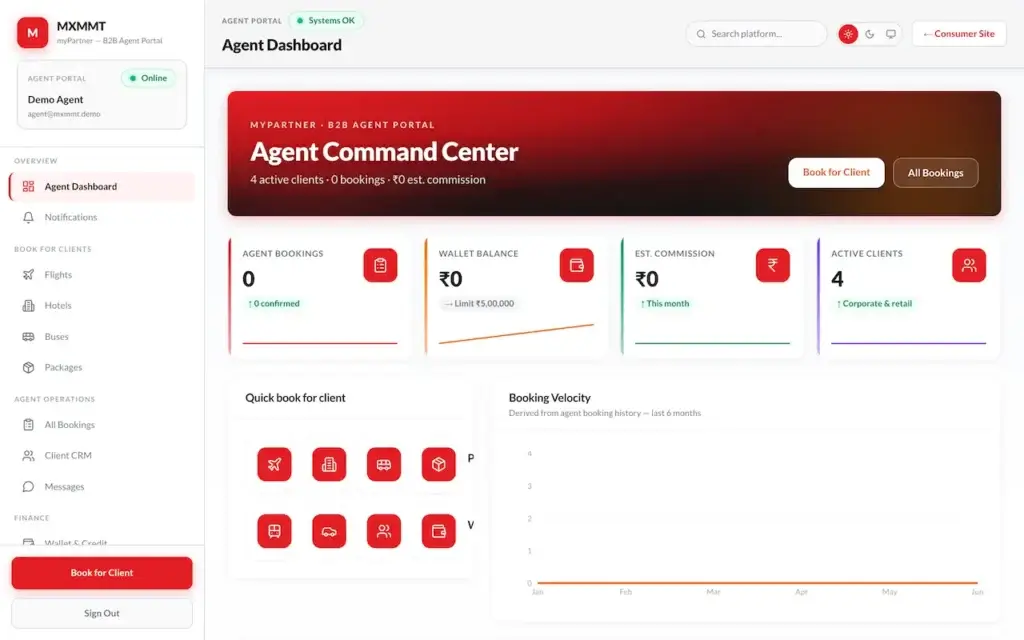
Agent Workspace - Customers, Reservations & Earnings
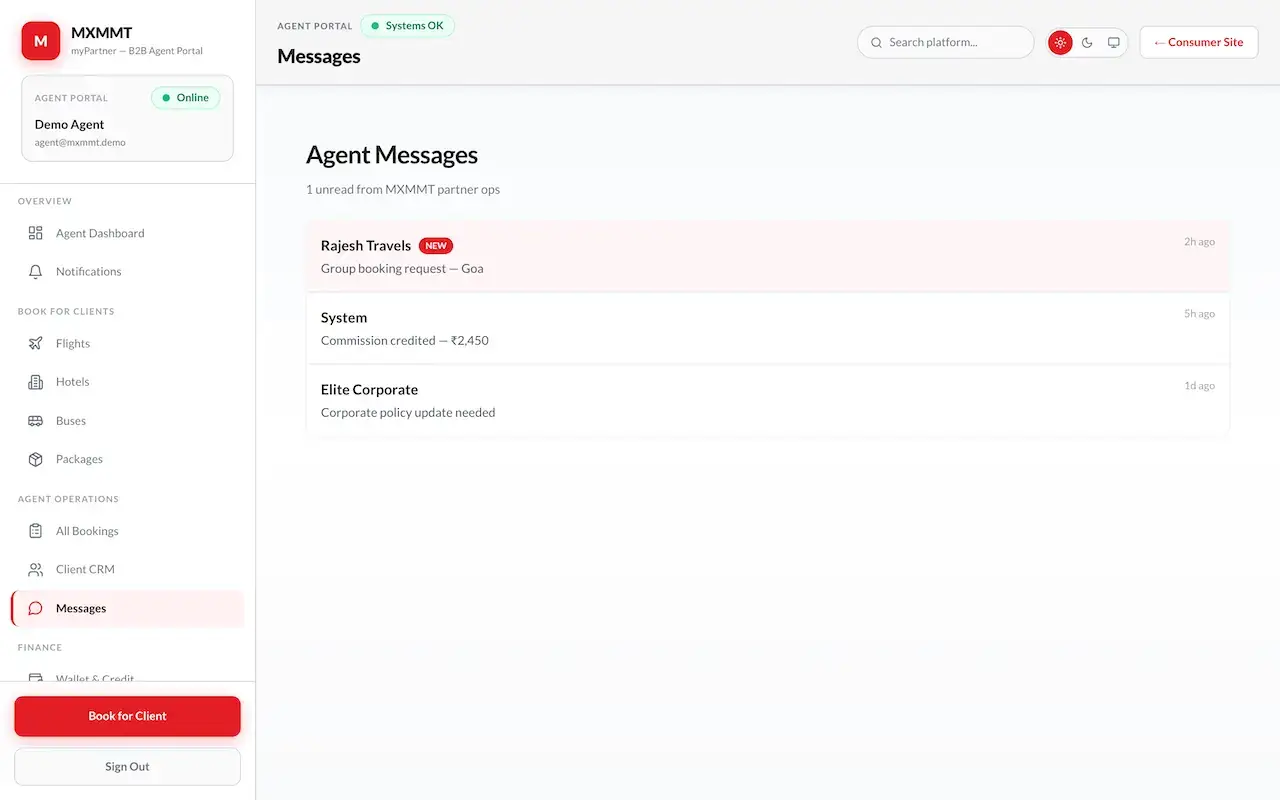
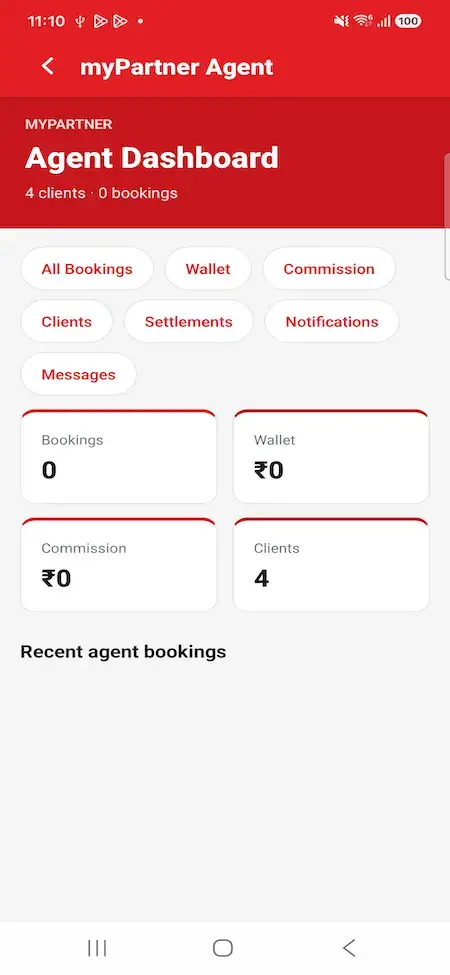
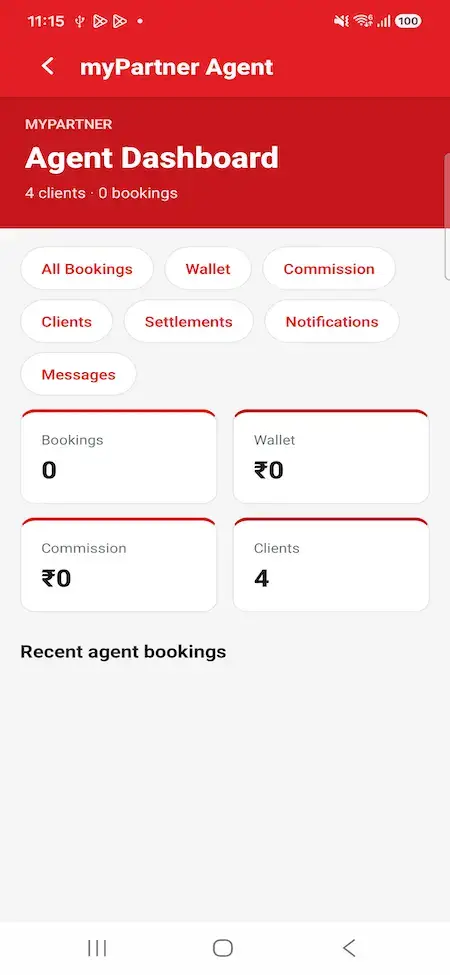
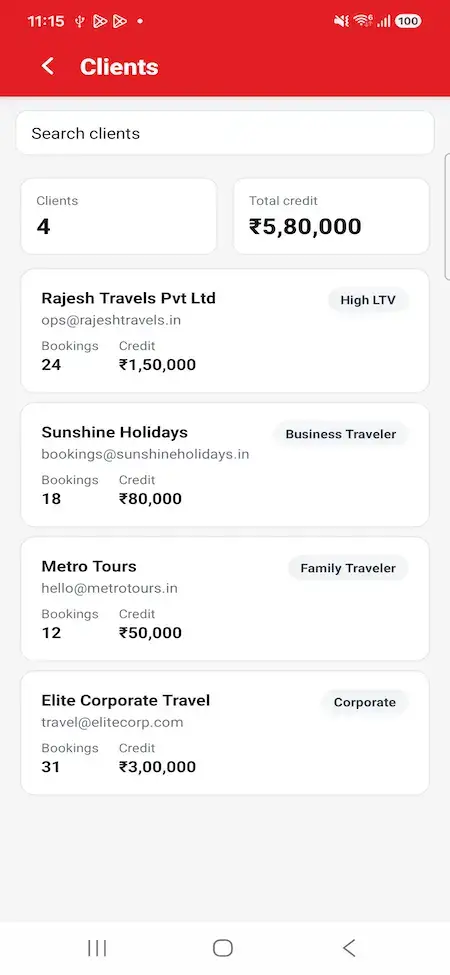
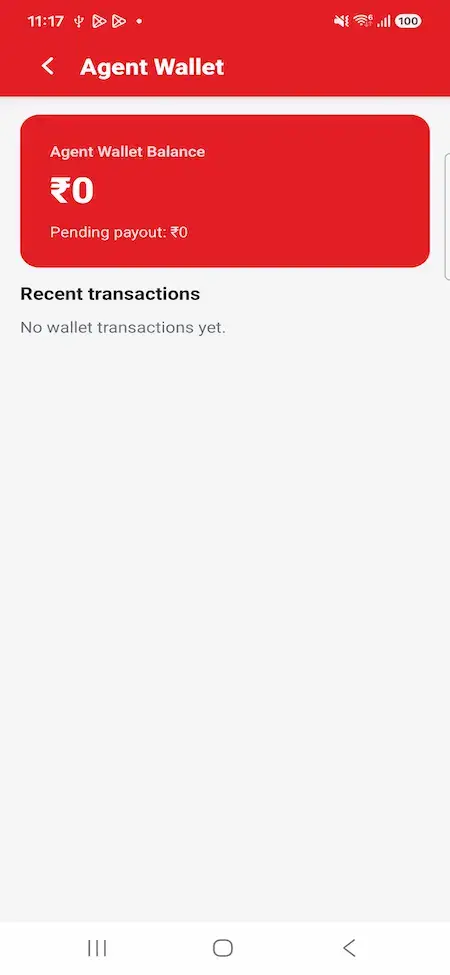
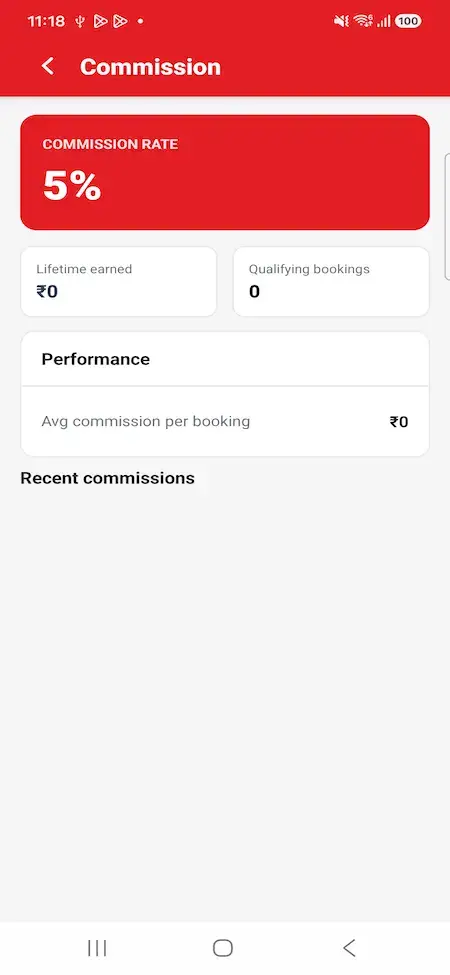
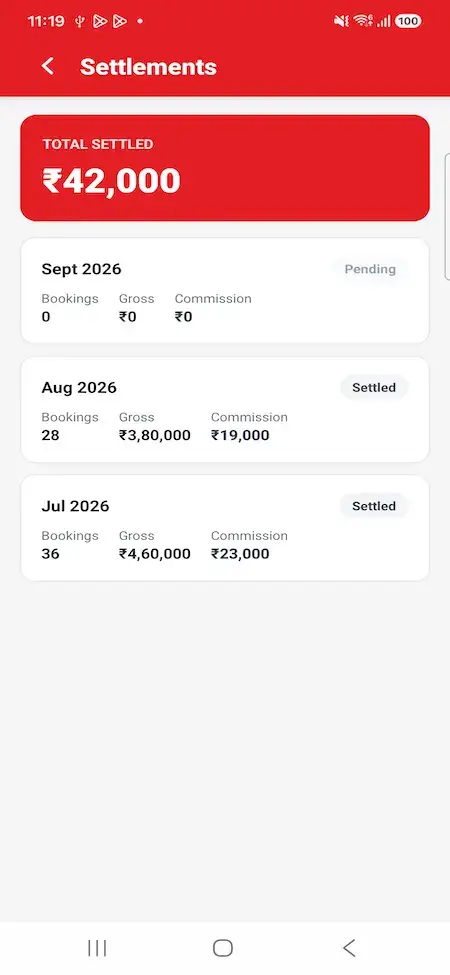
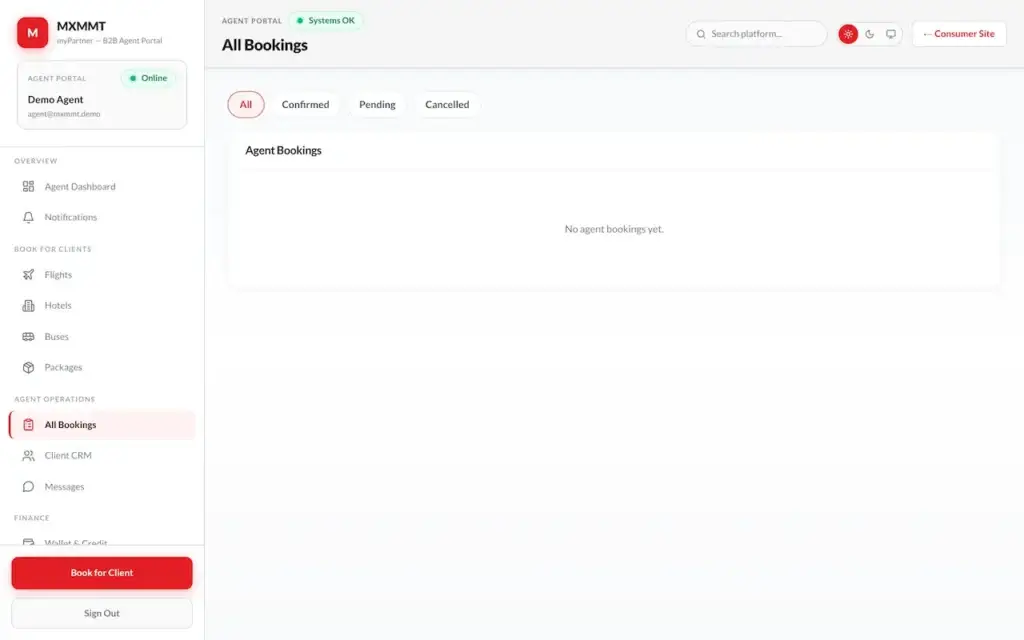
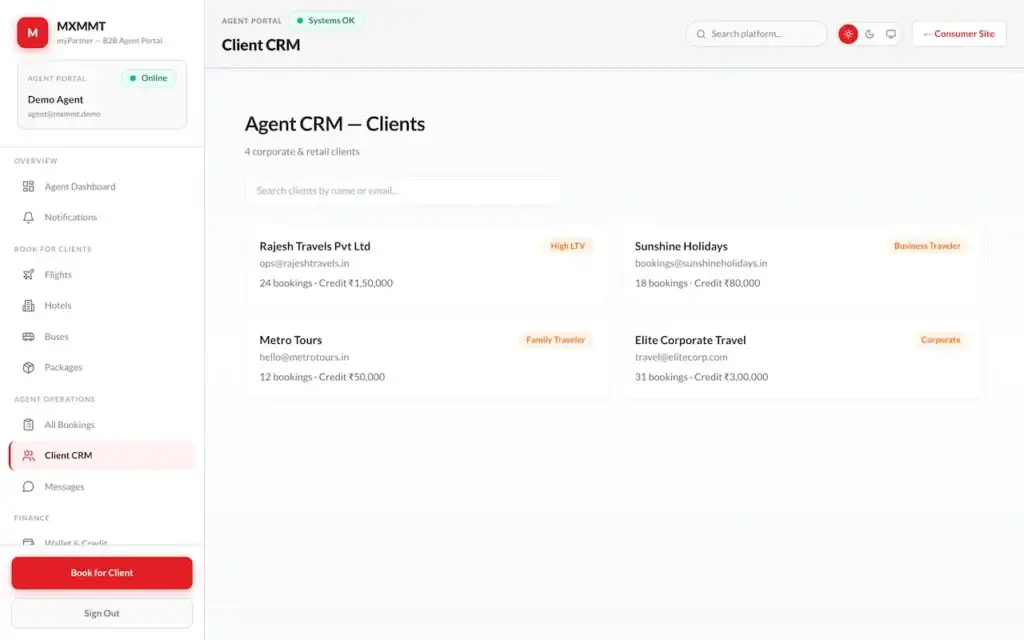
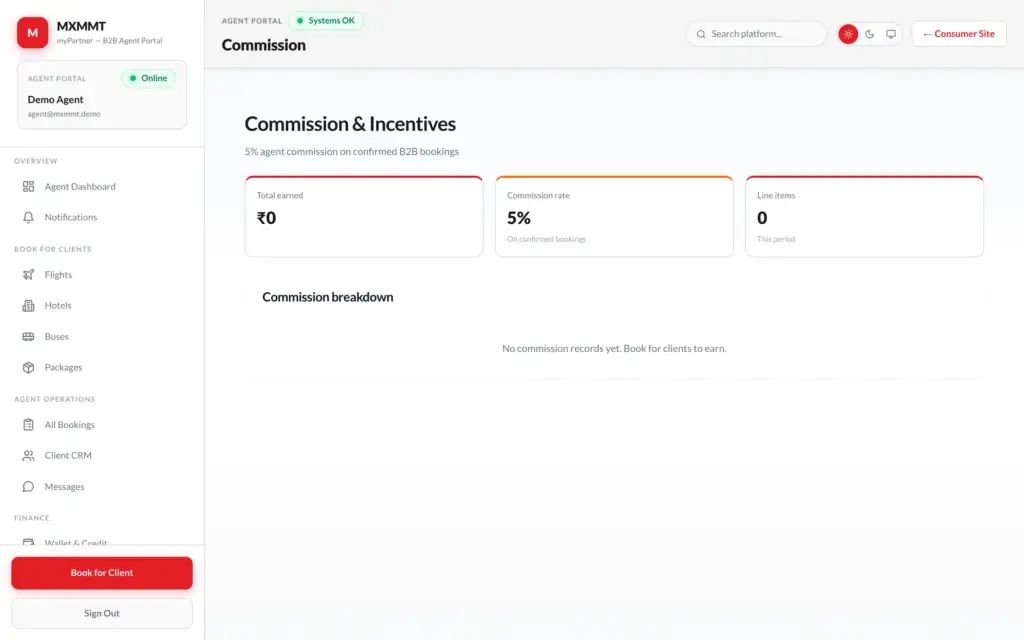
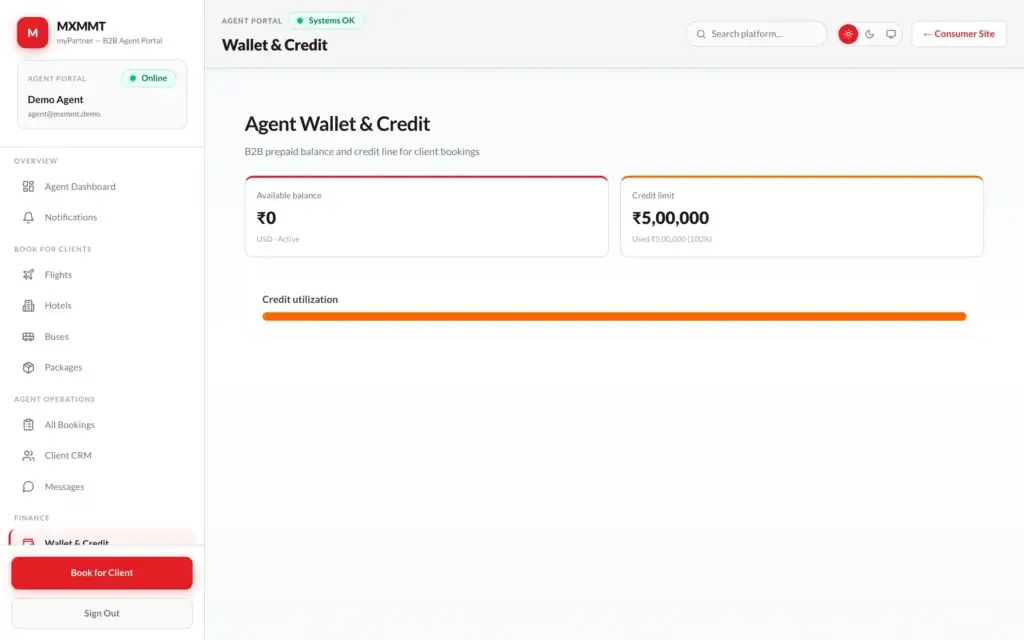
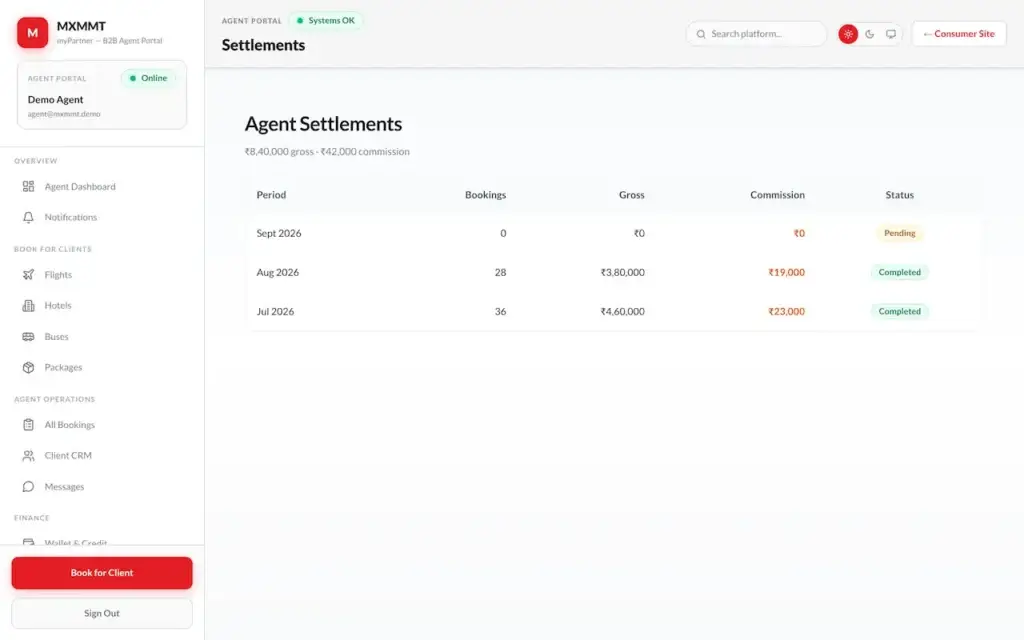
Where the trade books. Every agent has their own client records and can book for a client, sees the commission calculated on each booking, and uses an agent wallet whose credit limit you set; monthly settlements are followed without a spreadsheet.
- 1Log in with the travel agent account shown below
- 2Explore: Clients, Bookings, Commission, Wallet
agent@mxmmt.demo | AgentPass123!
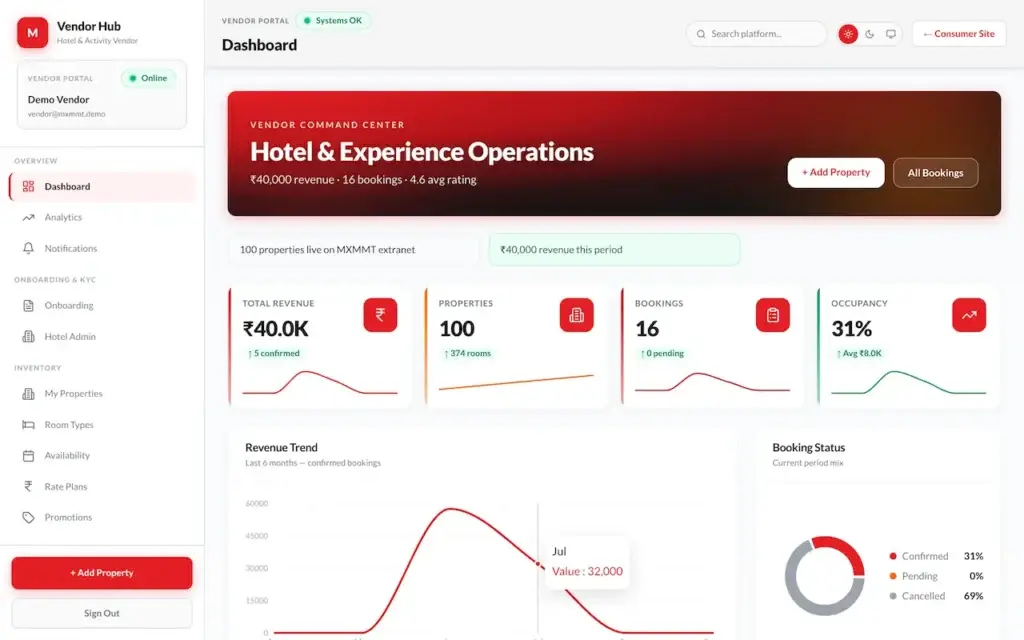
Supplier Hub - Listings, Pricing & Settlements
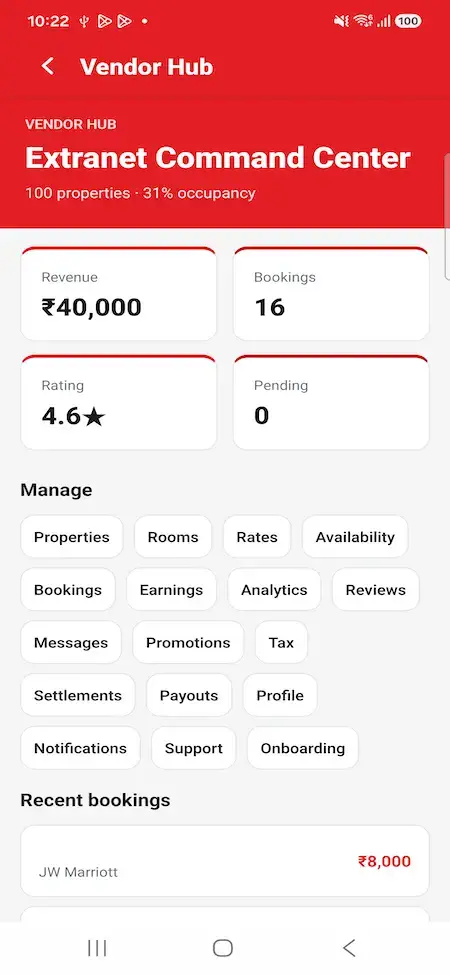
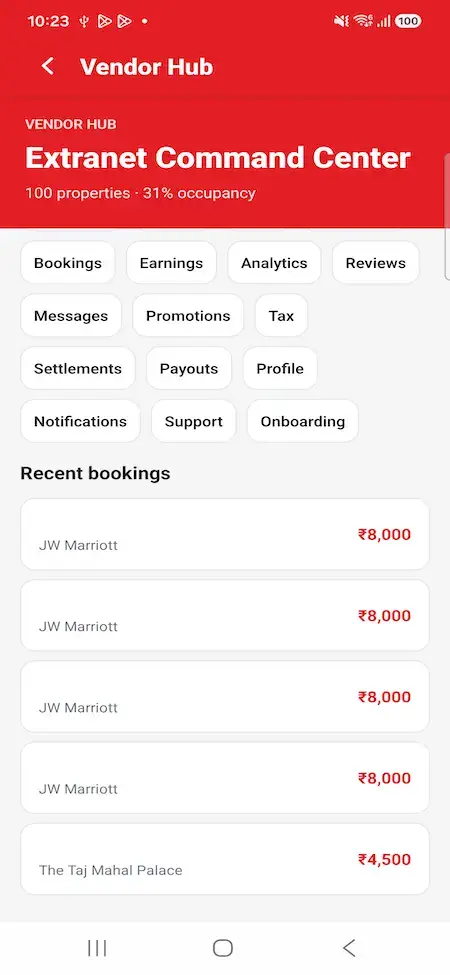
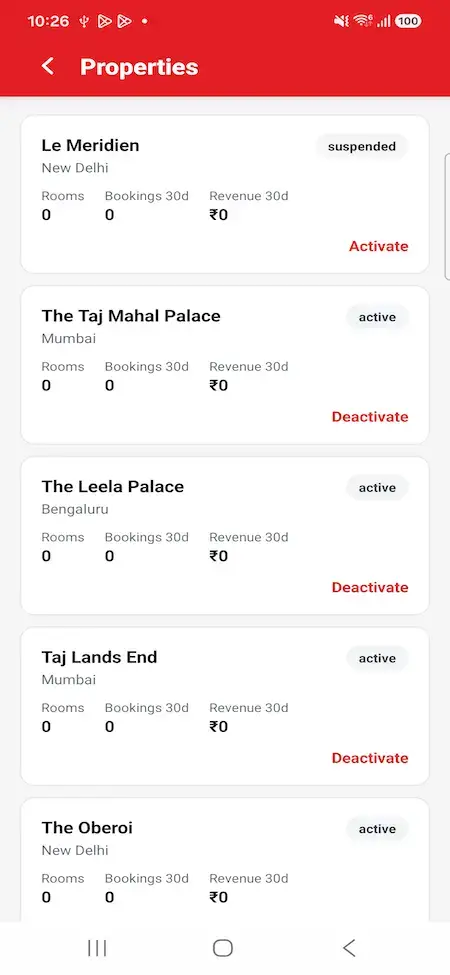
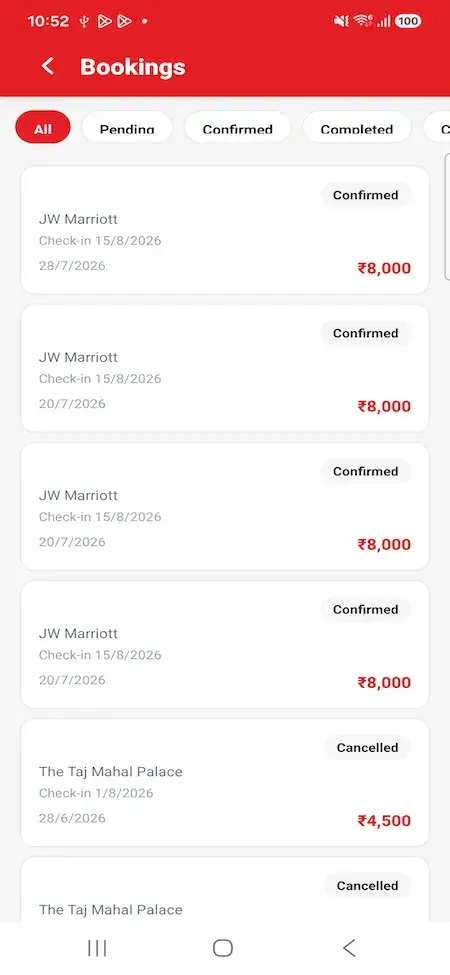
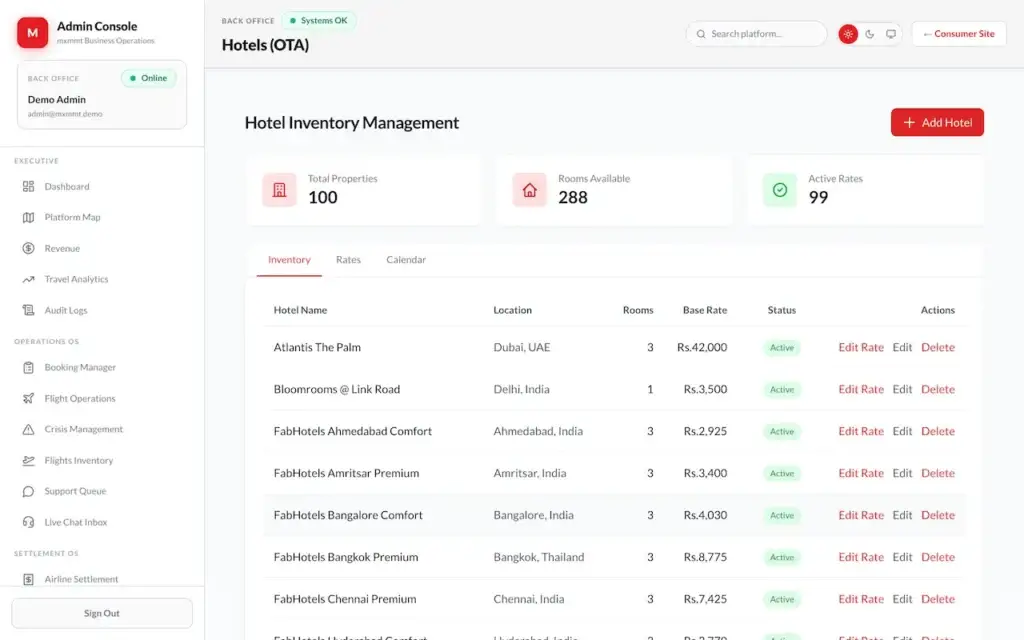
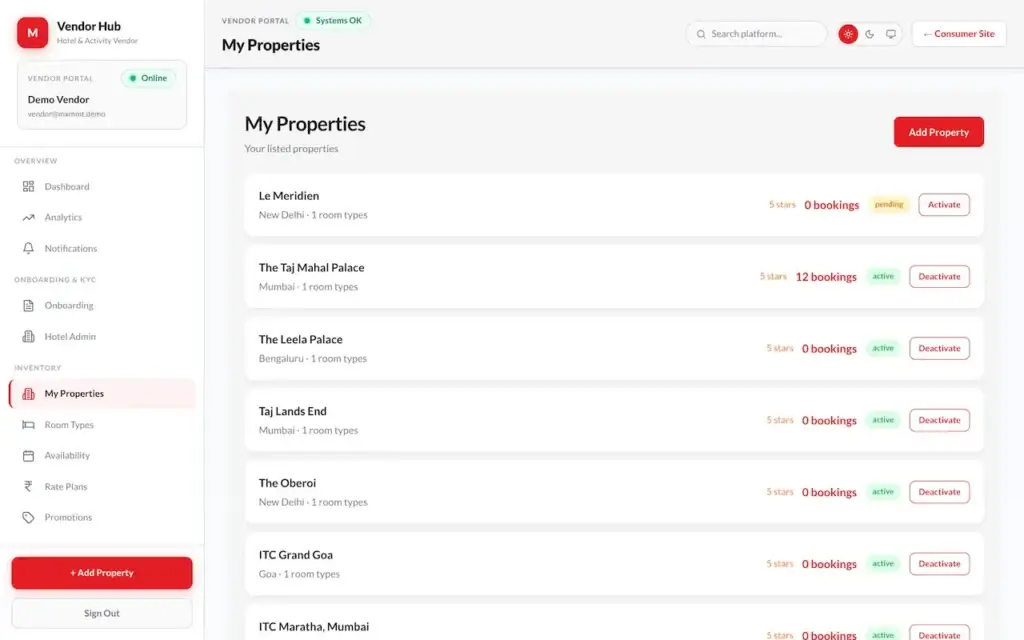
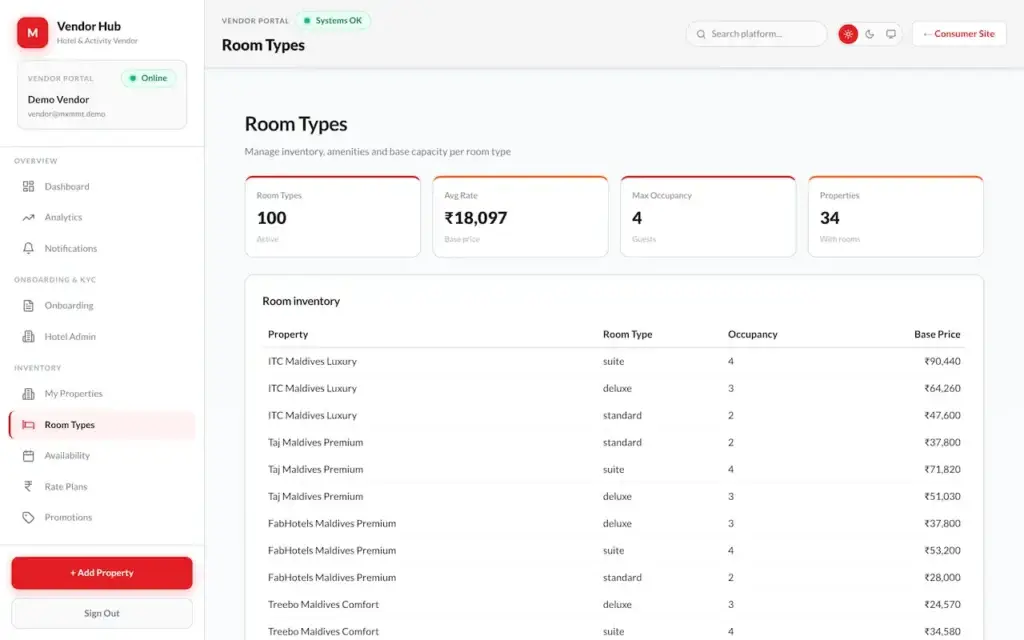
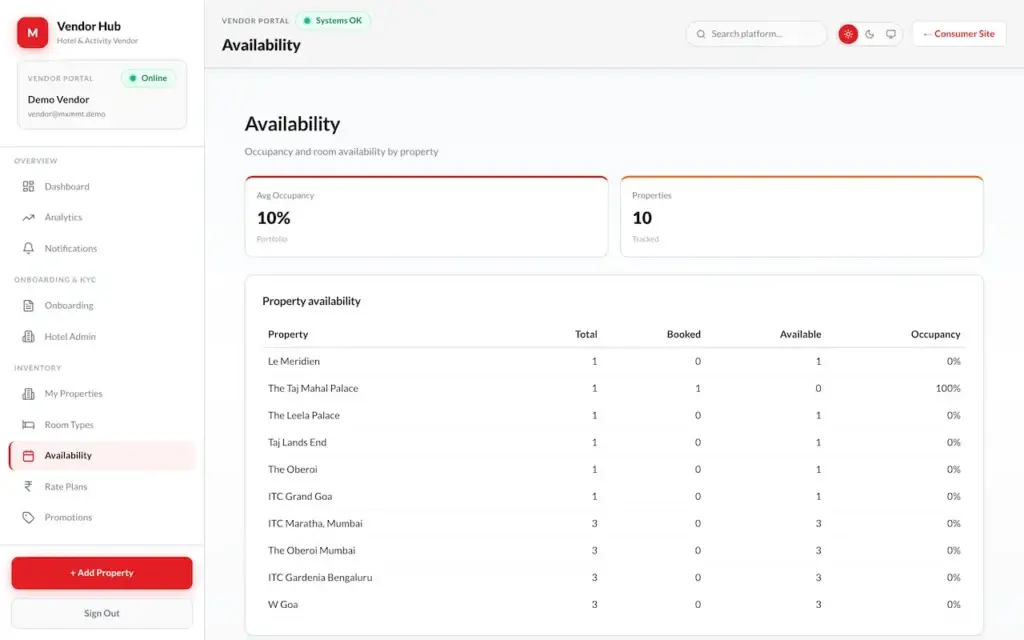
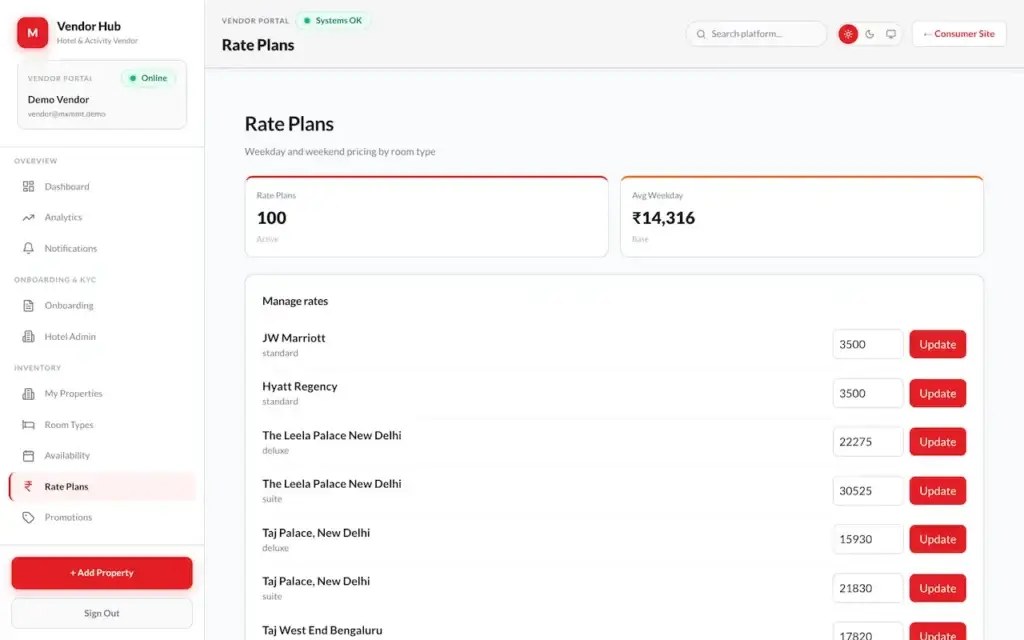
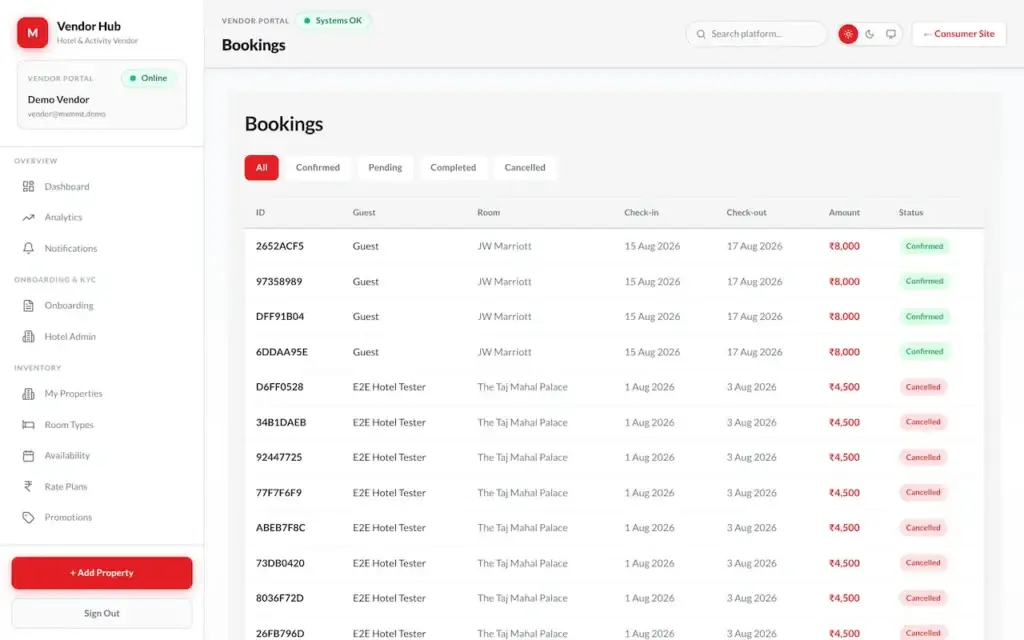
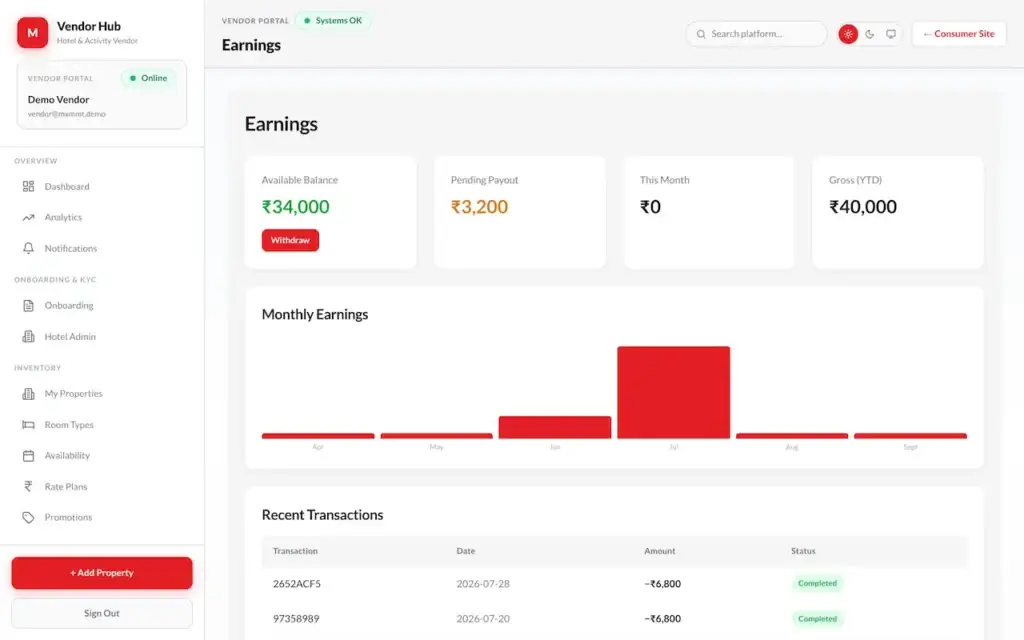
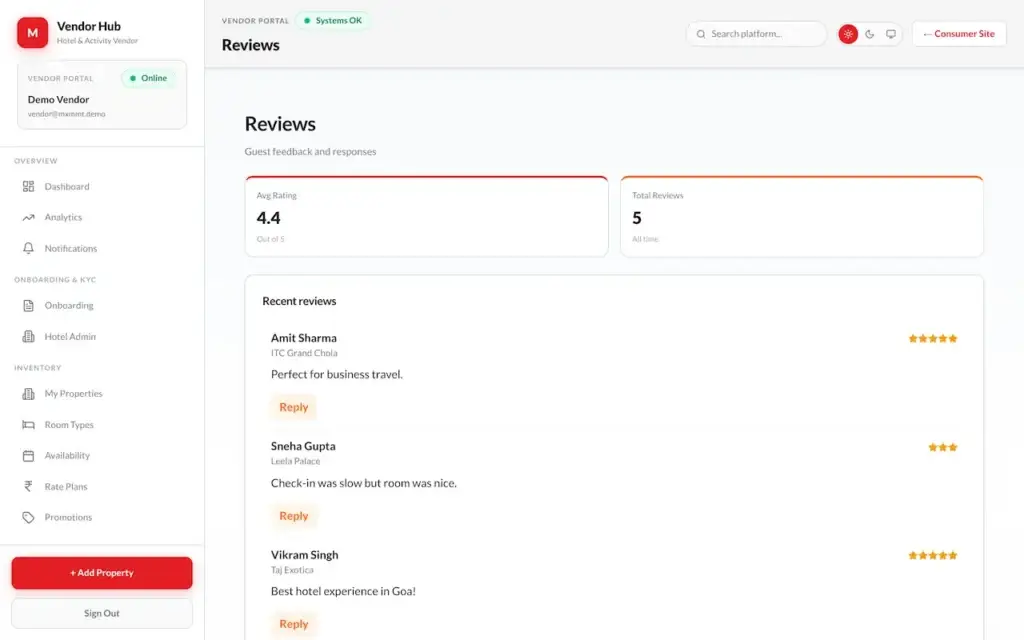
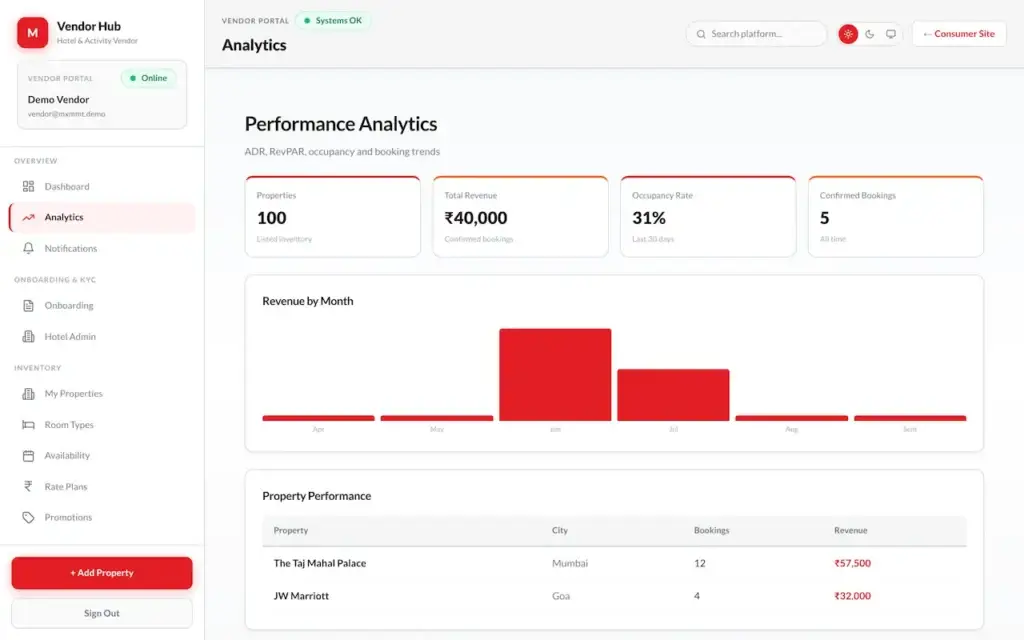
Where your own suppliers work. Hotels, homestay hosts and activity operators onboard with their business documents, list properties and rooms, set seasonal rates, open and close dates on a calendar, answer reviews and track payouts.
- 1The vendor login below is the one to sign in with
- 2Explore: Properties, Rates, Bookings, Payouts
vendor@mxmmt.demo | VendorPass123!
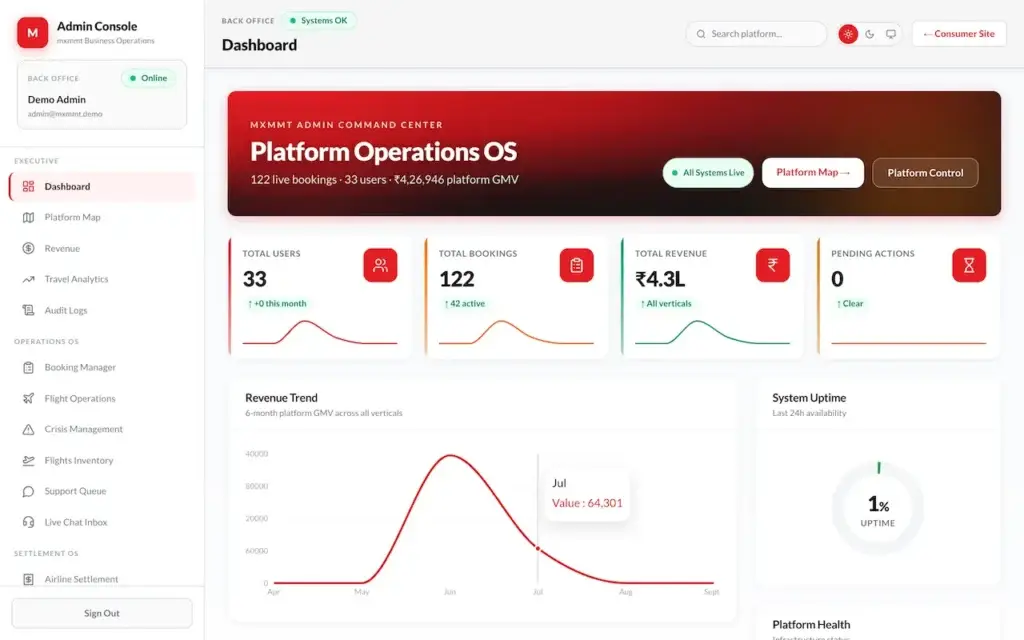
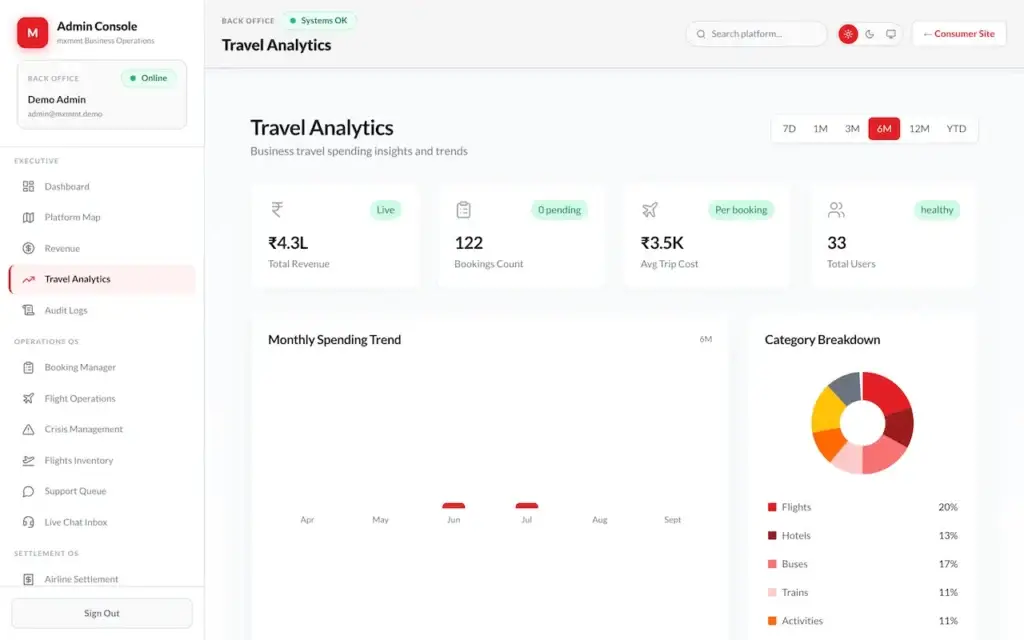
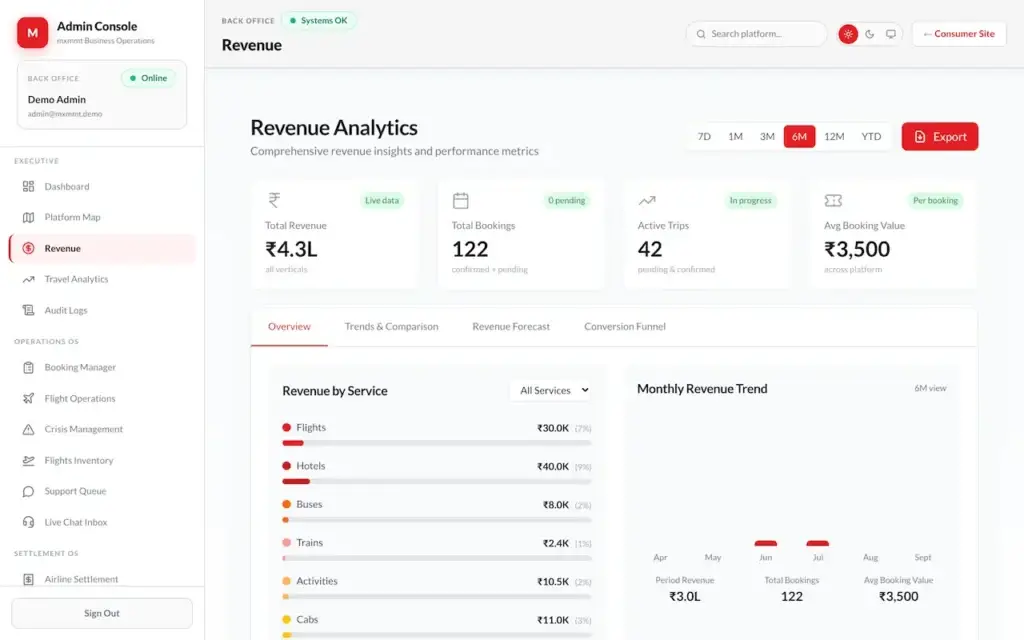
Command Center for Admins: Revenue, Users & Inventory
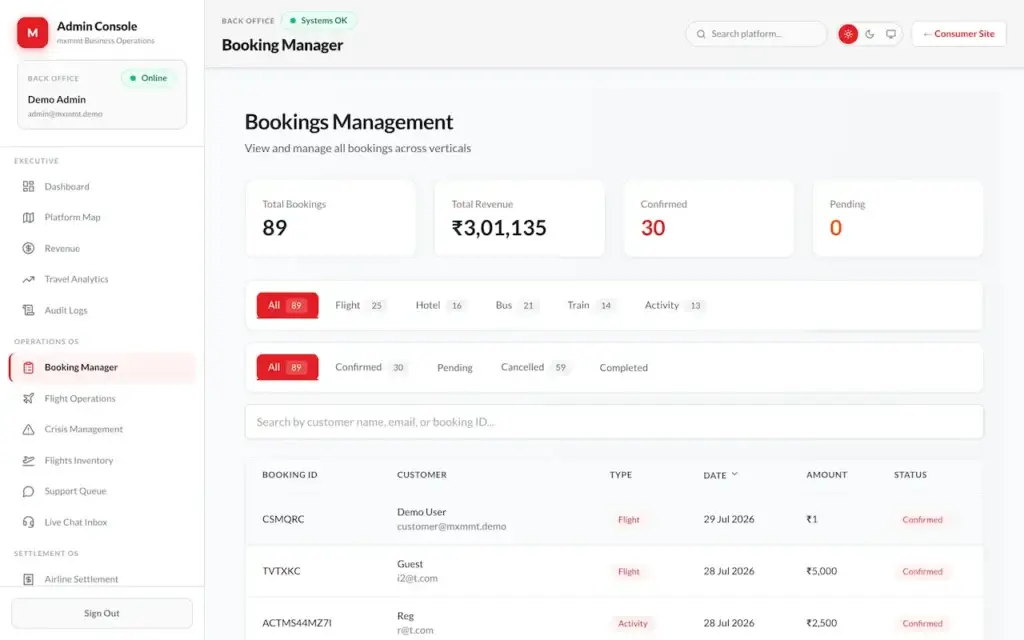
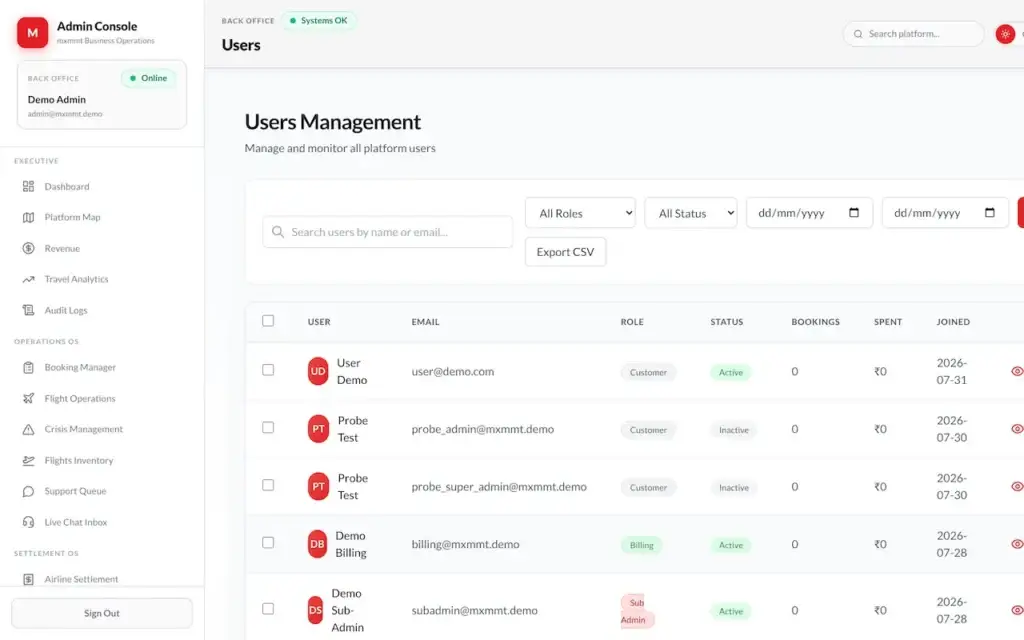
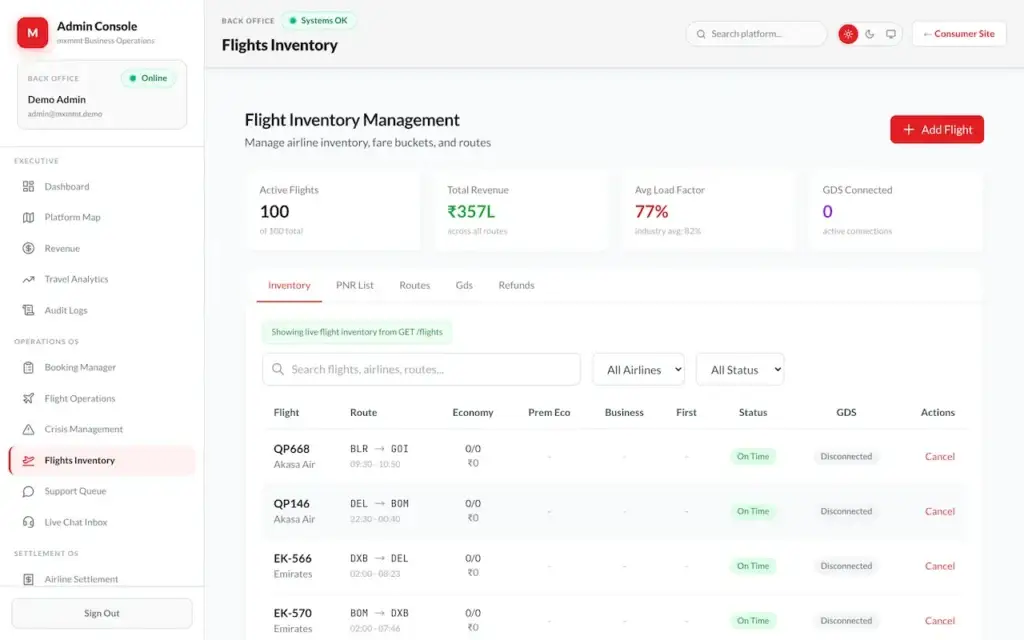
Where your team runs the portal each day. Inventory in every category, every booking and user, promo codes and banners, the refund queue, supplier approvals, tickets, reviews and revenue reports, with every change written to an audit log. A scoped sub-admin login shows what an operations user can and cannot open: subadmin@mxmmt.demo | SubAdmin123!
- 1Sign in using the admin account listed underneath
- 2Explore: Inventory, Bookings, Offers, Revenue
admin@mxmmt.demo | AdminPass123!
Owner Controls - Branding, Markups & Sources
The owner’s view, every permission switched on. On top of the console it controls the business model itself: the brand, which categories and features are live, the margin on each one, which payment methods appear, supplier connections and team permissions.
- 1Enter the CEO account shown below to sign in
- 2Explore: Platform Control, Margins, Team
superadmin@mxmmt.demo | SuperPass123!
Money Desk - Returns, Clearing & Remittances
The finance desk. Review and process refunds, approve agent and vendor settlements, adjust wallet balances, and read revenue, margin and audit reports, without the inventory and content controls a finance role has no reason to open.
- 1Use the billing credentials below to log in
- 2Explore: Refunds, Settlements, Revenue
billing@mxmmt.demo | Billing123!Preview It Live
White Label OTA Video Walkthrough - One Booking, Seen From Both Sides
One real booking followed from both sides instead of a feature reel. It starts on the homepage, searches a flight, narrows to non-stop morning departures, fills in passenger details from a saved traveler, picks seats, then covers part of the fare with the wallet balance after applying a promo code. Next it moves to the console, where the same booking shows its payment, margin and loyalty points, and it finishes with an agent who books a hotel for a client and the commission landing.
Schedule a live walkthrough callAll Screens
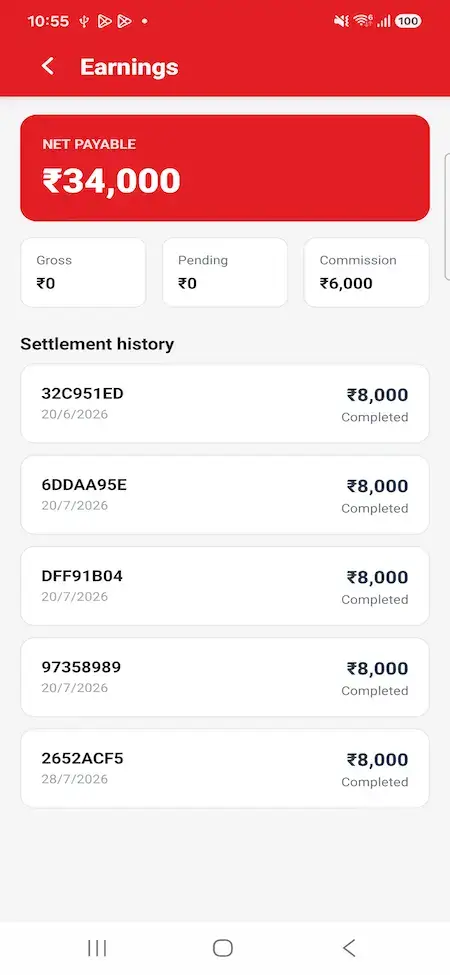
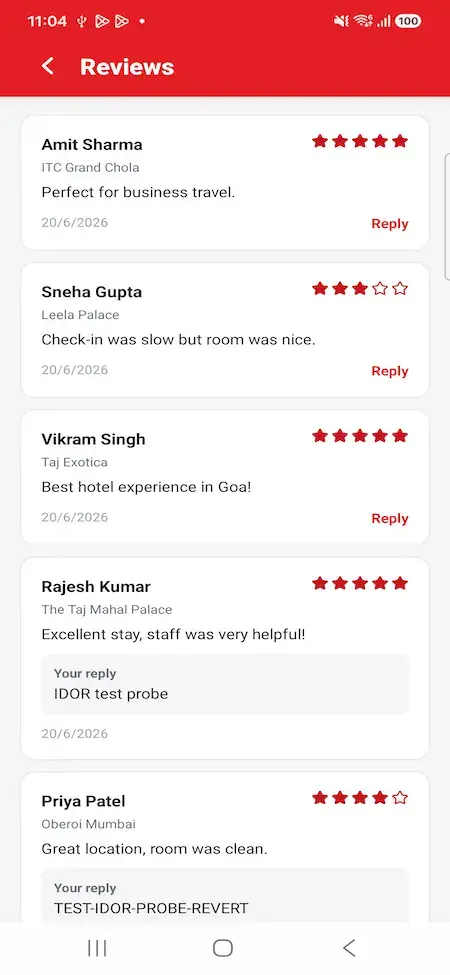
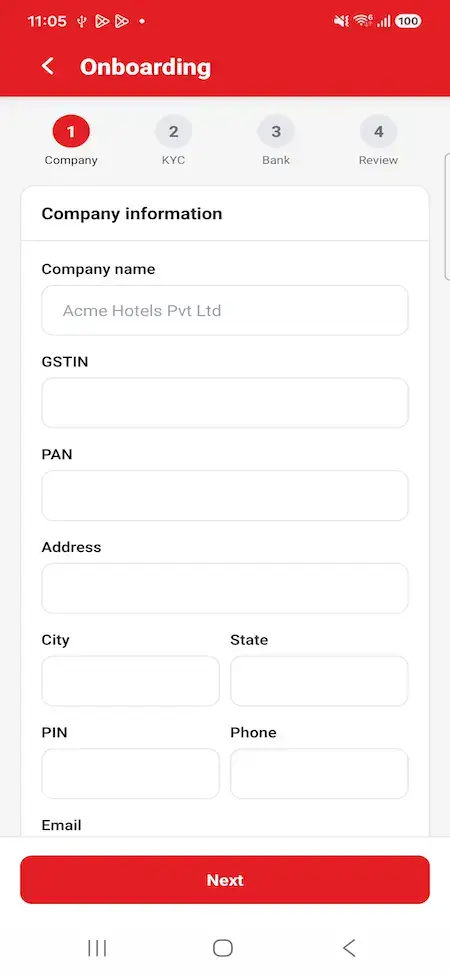
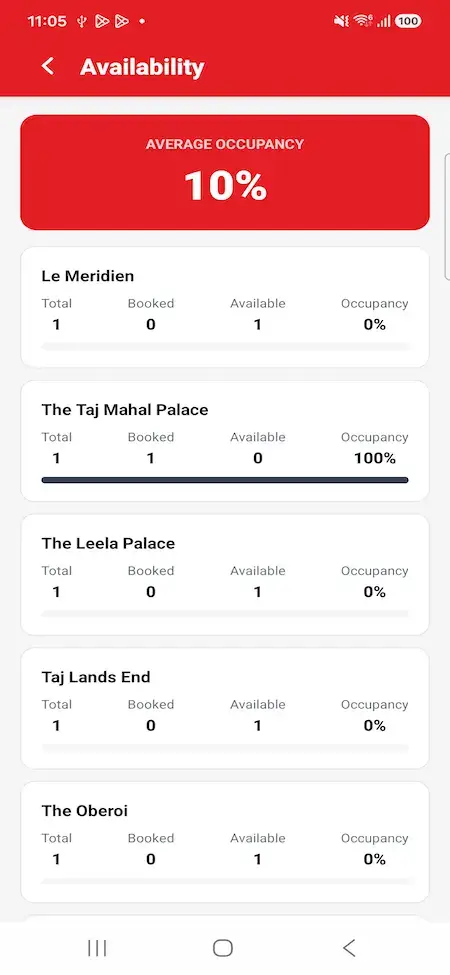
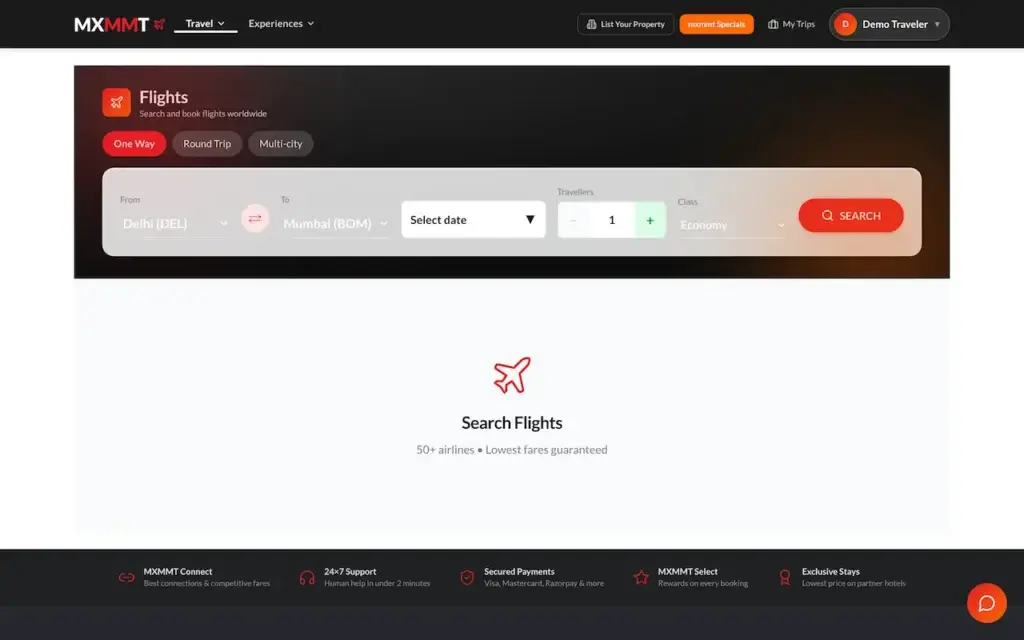
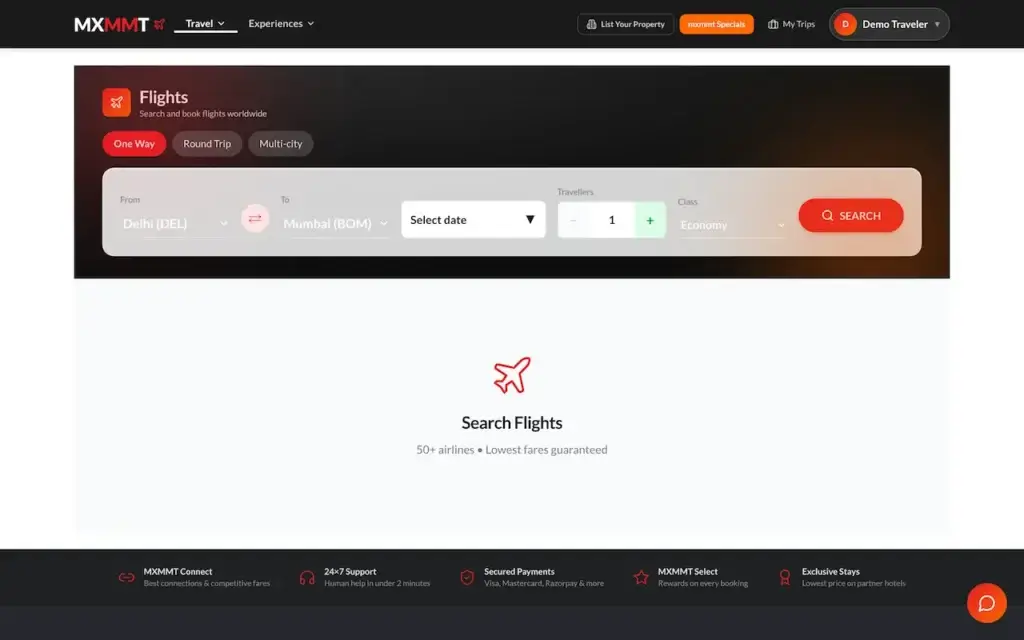
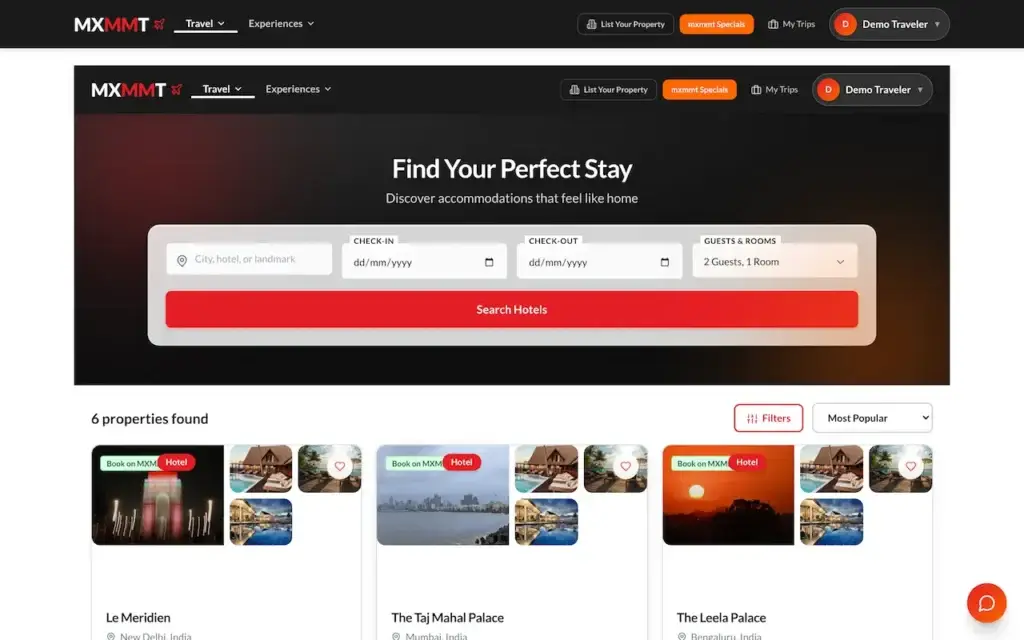
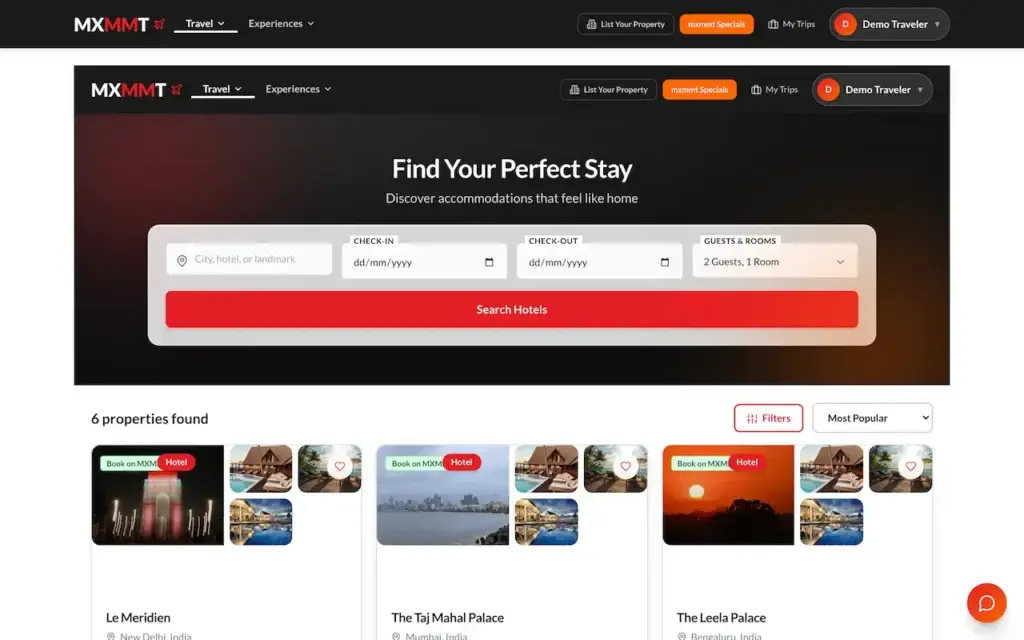
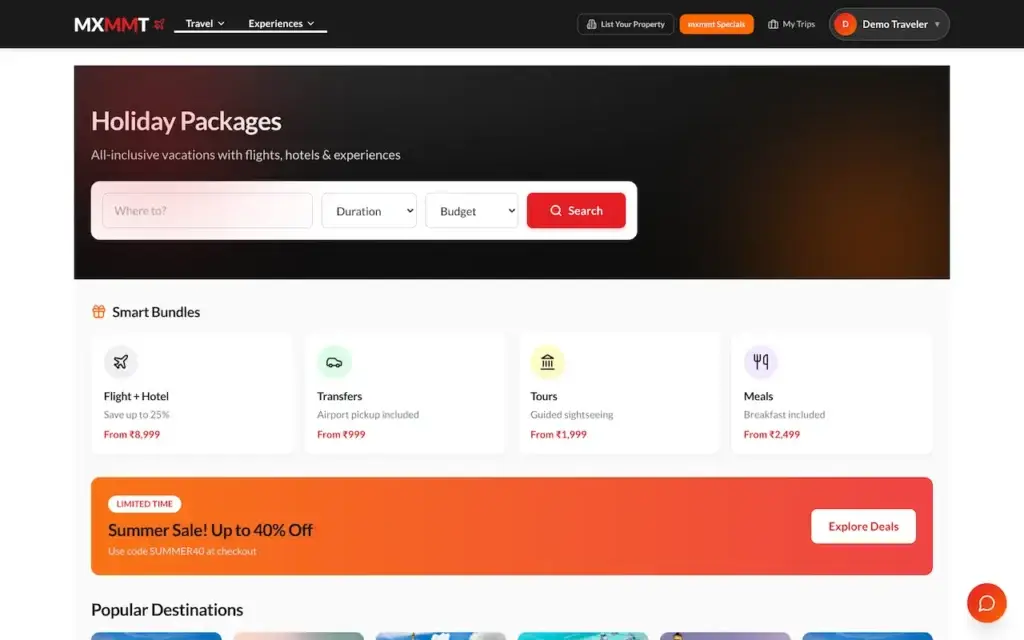
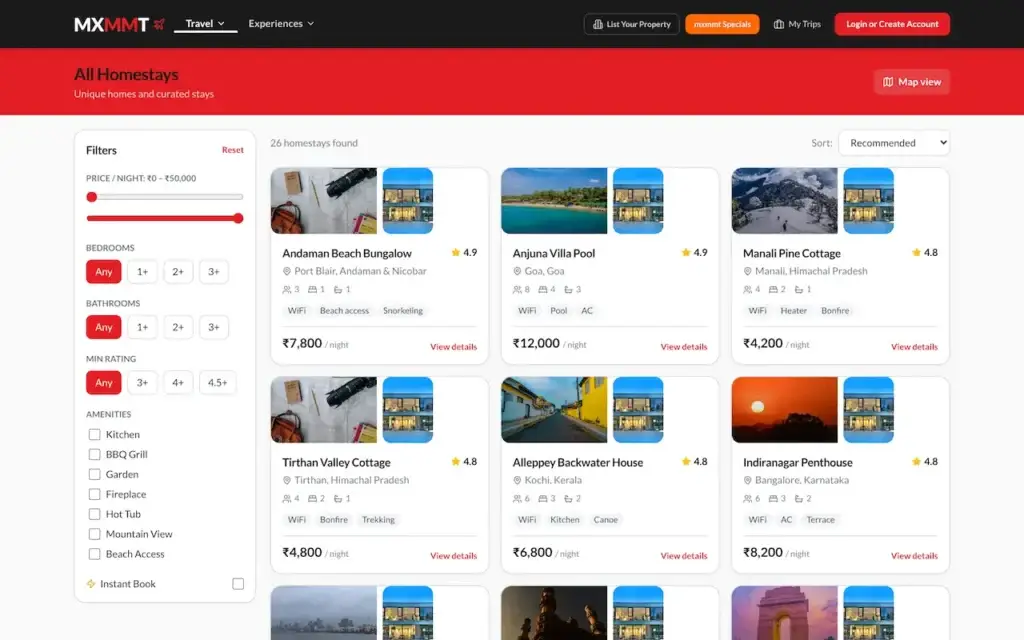
B2B and B2C Travel Portal Screens - Traveler, Agent, Vendor & Operator
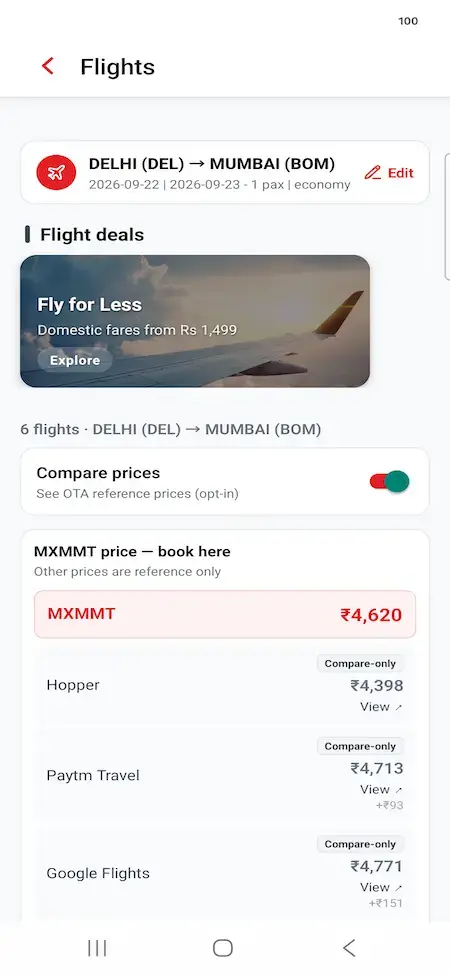
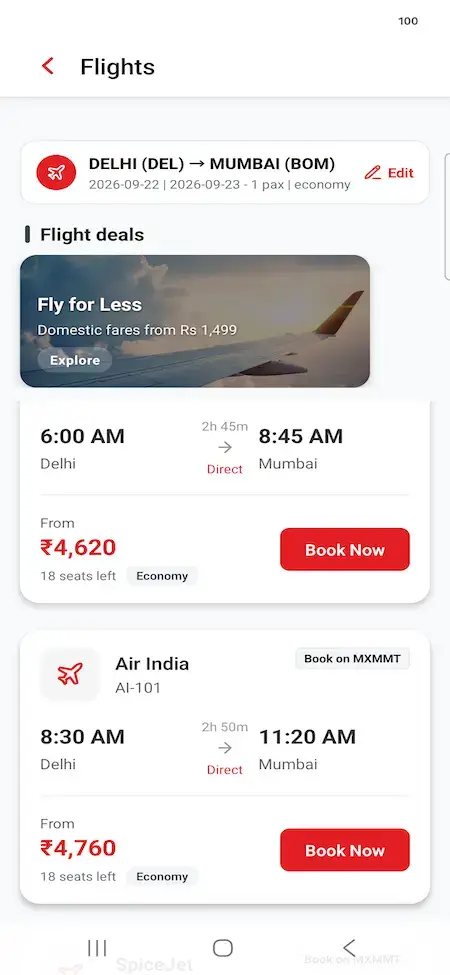
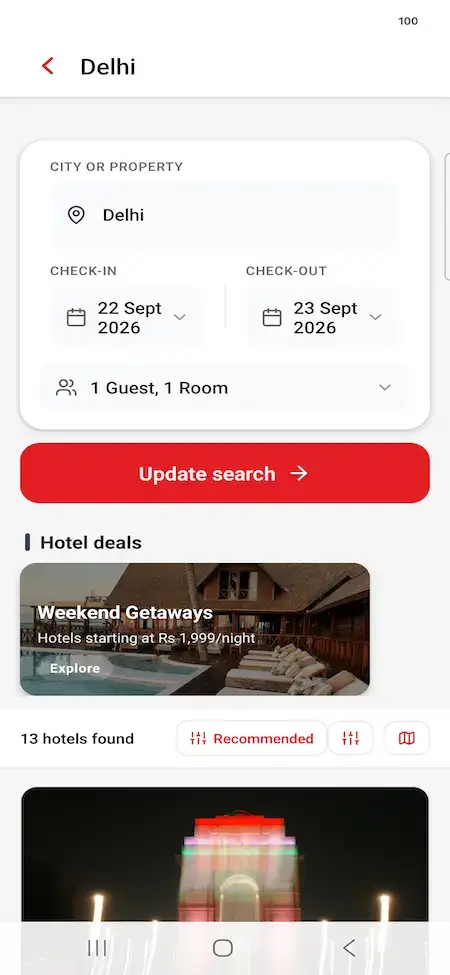
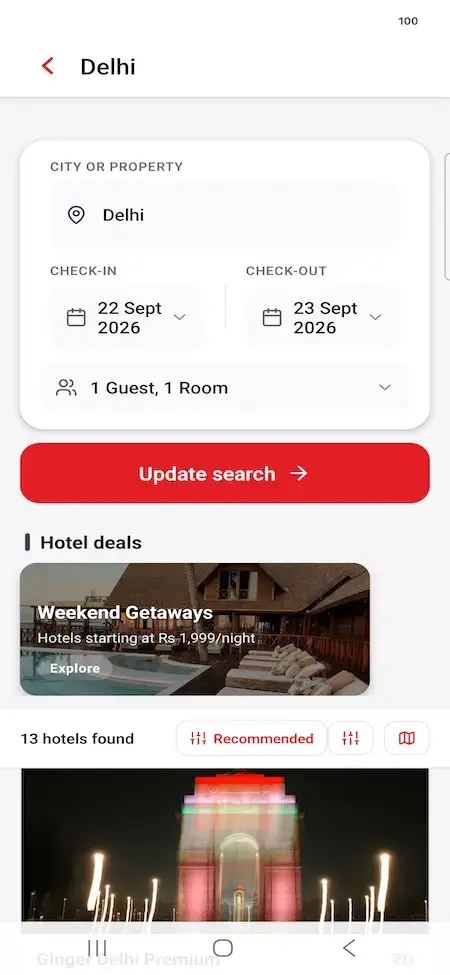
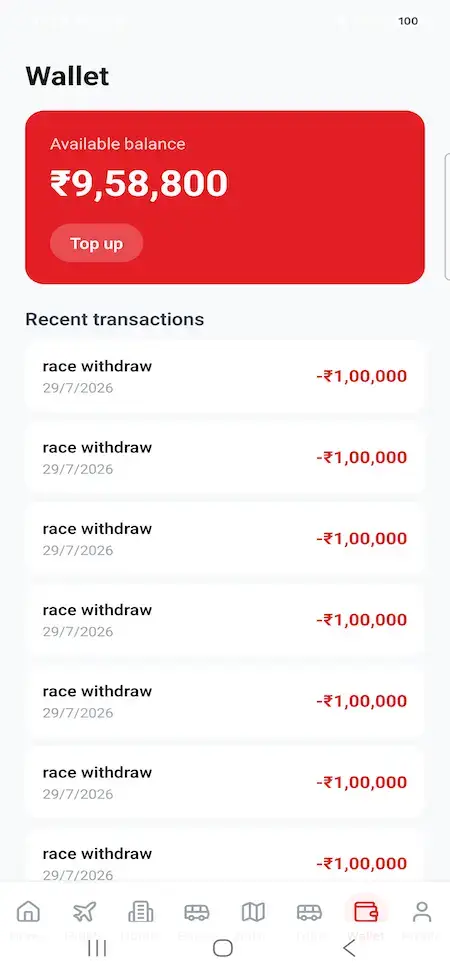
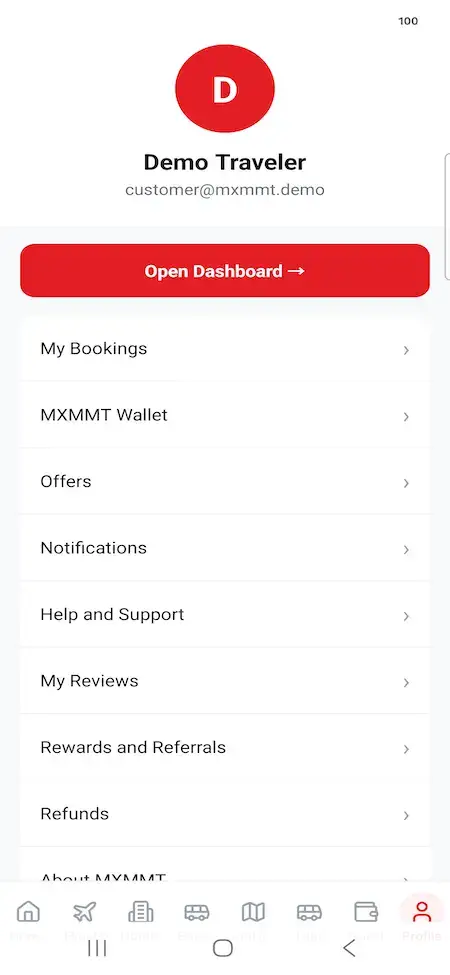
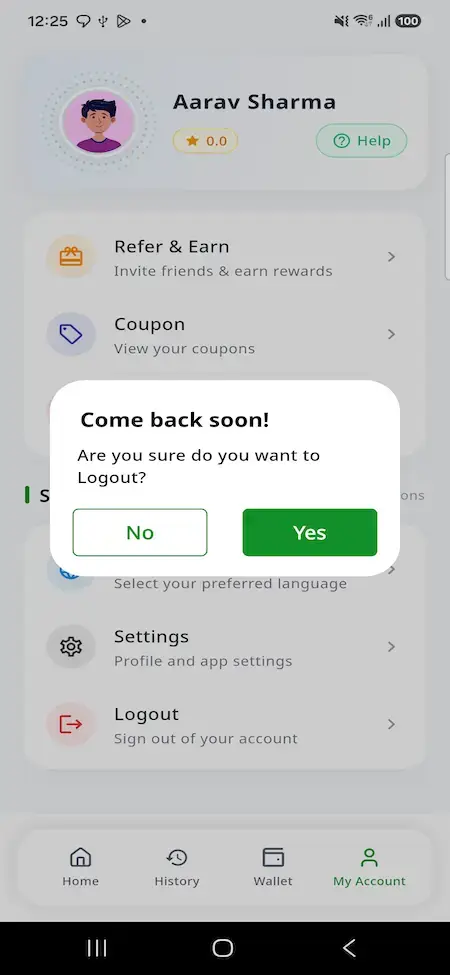
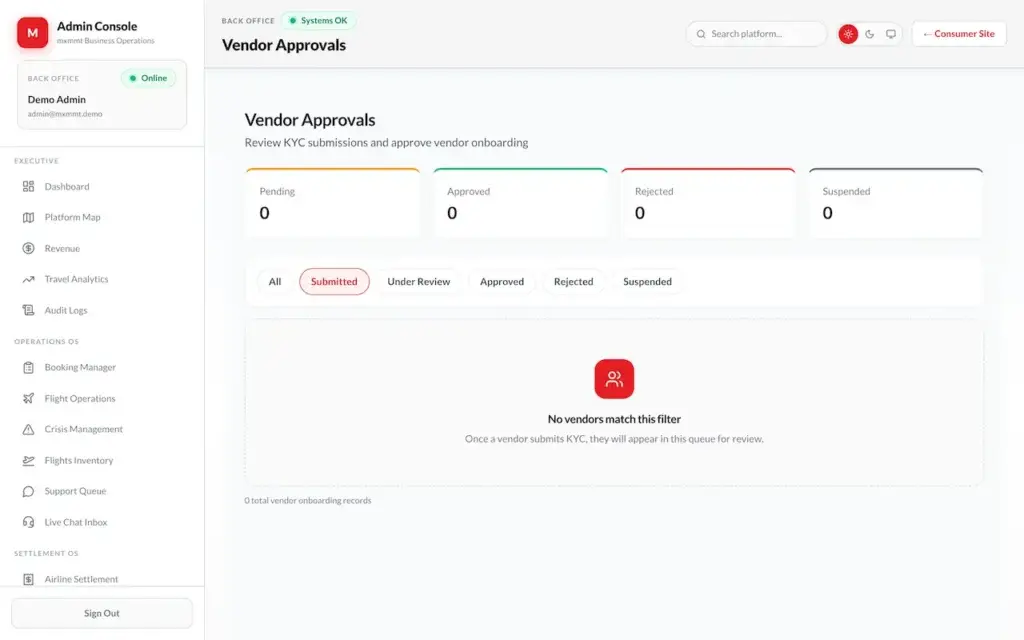
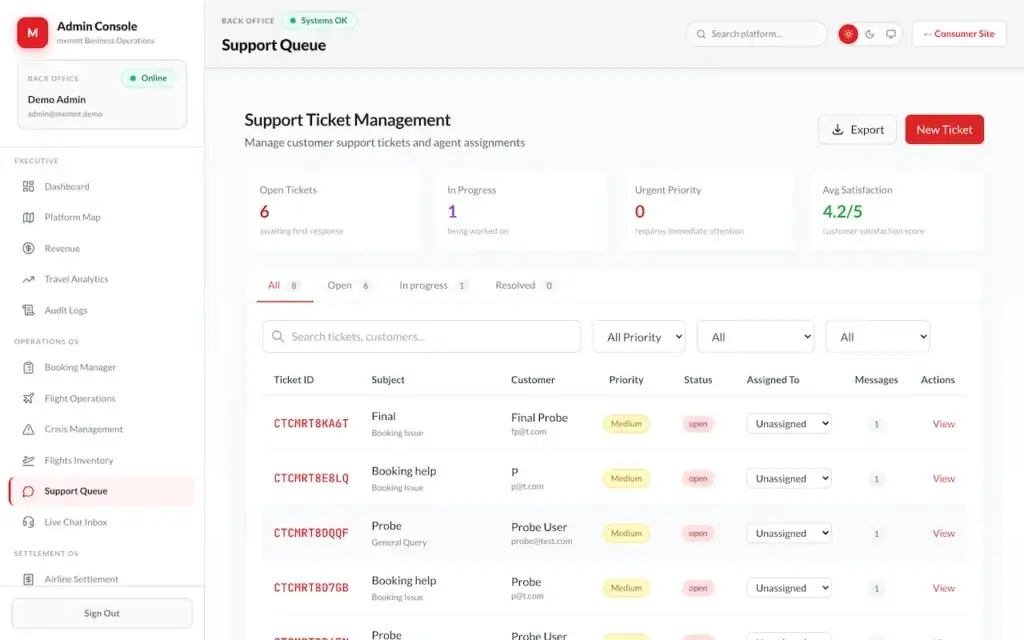
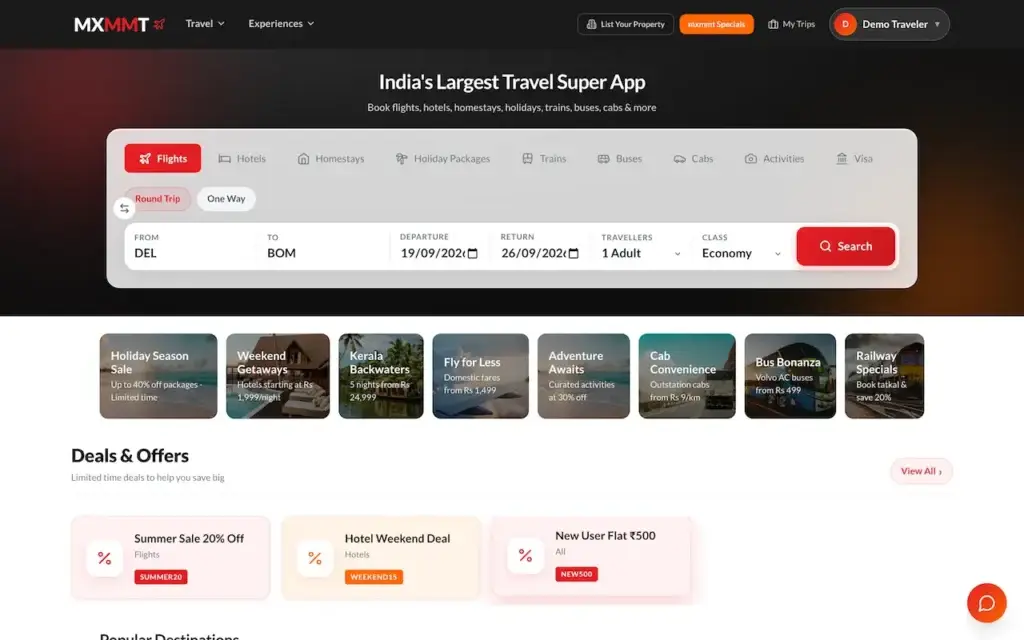
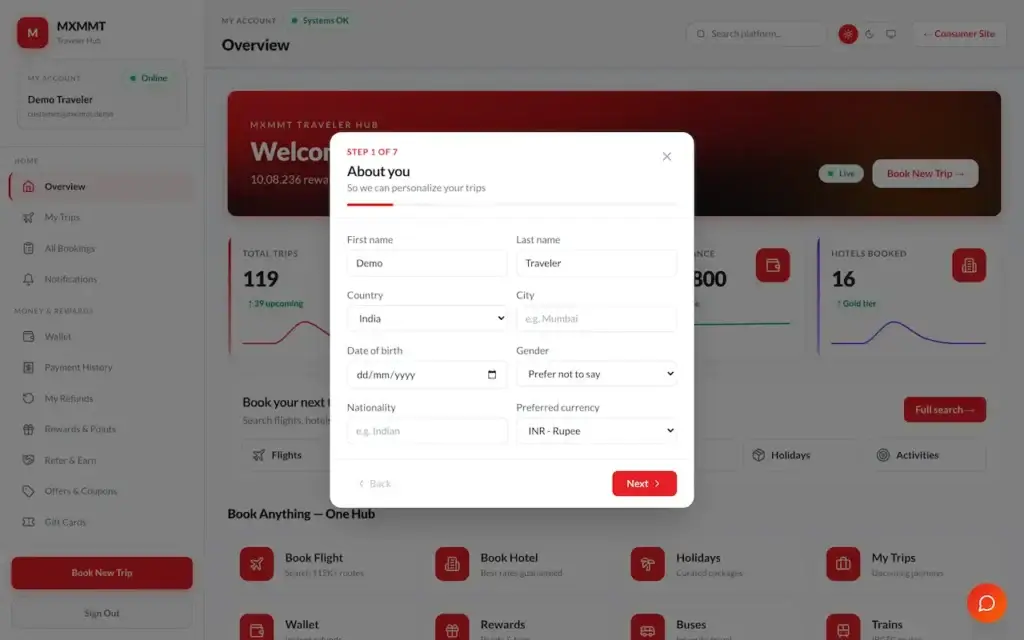
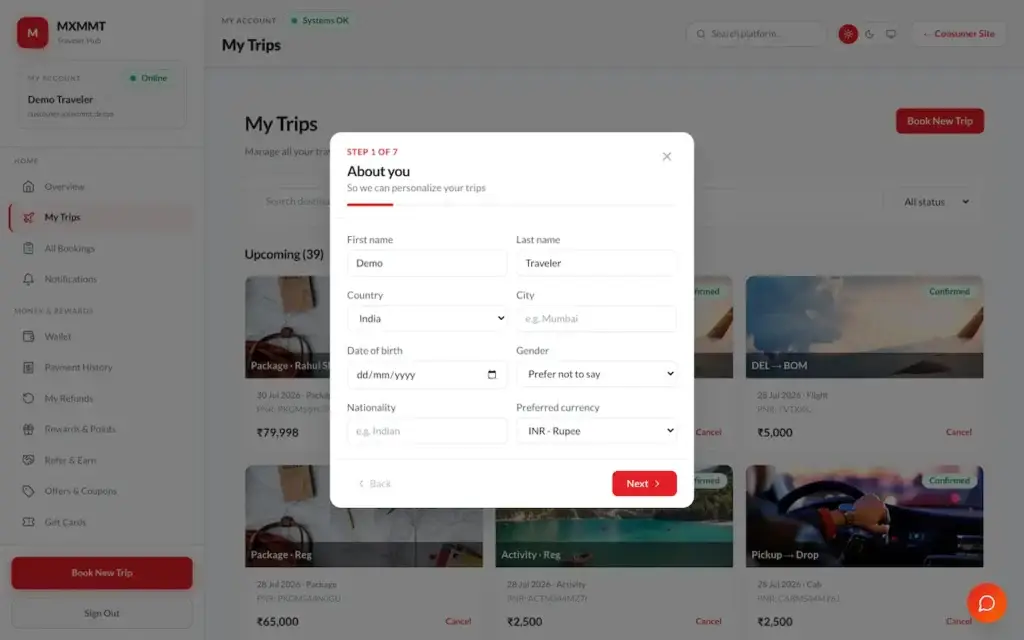
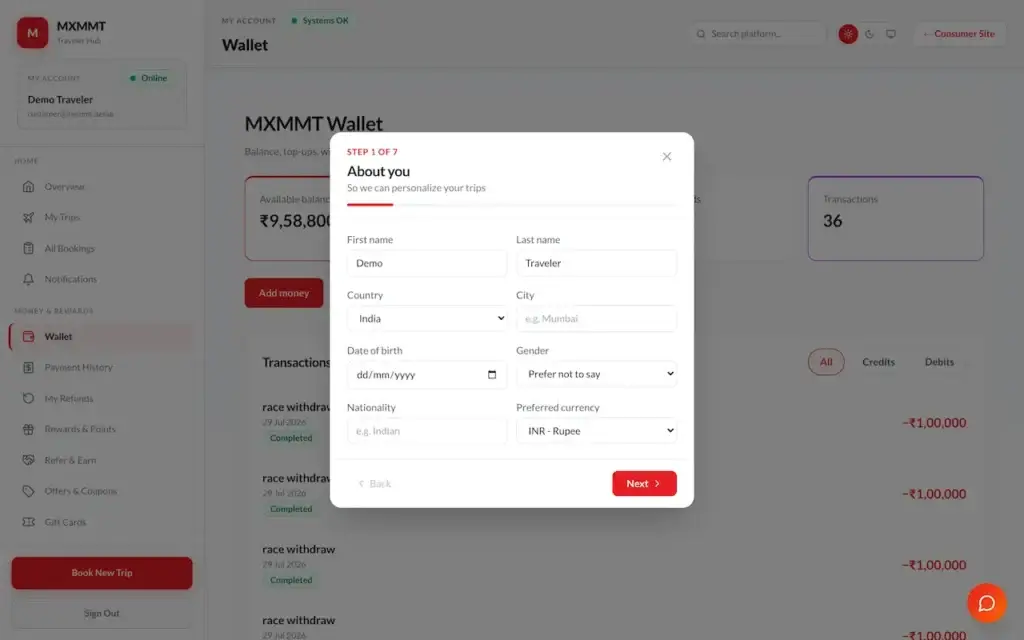
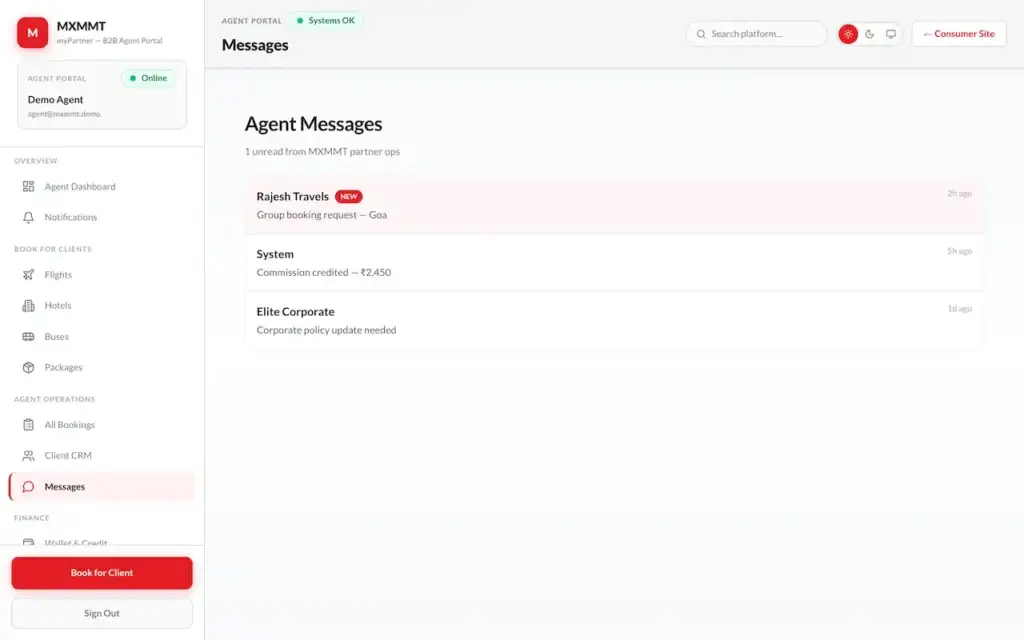
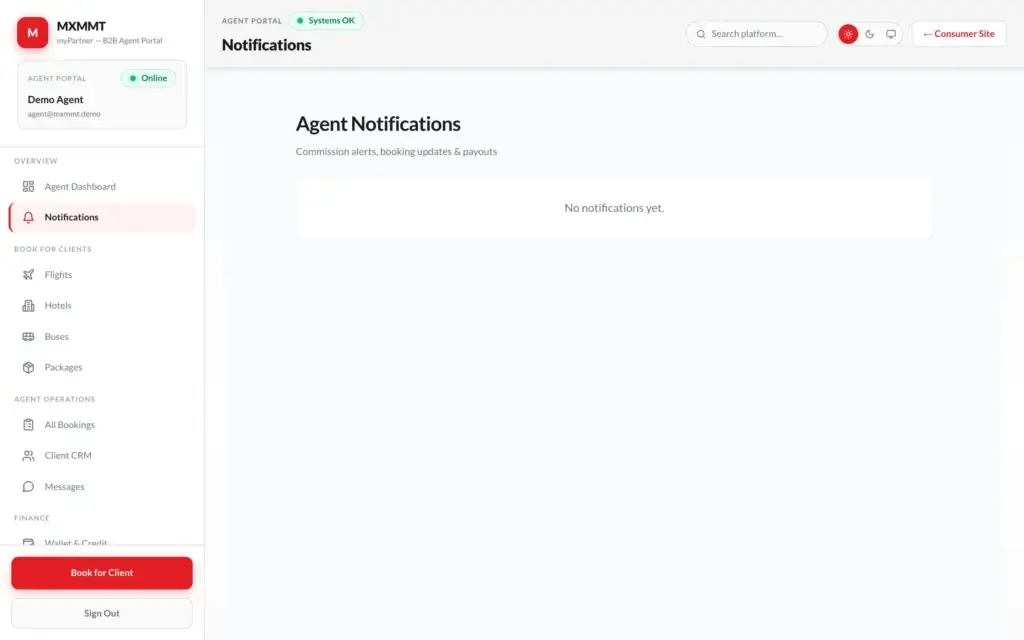
Screens from every side of the portal: the homepage with offers and category tabs, flight results with filters and seat maps, hotel results showing a map and room types, seat selection for bus and train, the checkout with wallet, gift card and promo, the traveler dashboard covering trips, refunds and loyalty, the agent portal for clients and commission, the vendor extranet for rates and availability, and the console with inventory, bookings and revenue.


02Proof
Client Reviews
Client Reviews of Miracuves: Genuine Platforms, Honest Outcomes
Feedback with names attached, from the founders and operators who started travel and booking companies on a Miracuves foundation appears here, covering a multi-service super-app, charter bookings, hotel booking and short-stay rentals. Every engagement is listed in our portfolio together with its particulars.
“We were running charters off a paper calendar and losing bookings to the OTAs. Calendar, booking flow and payments came off the shelf; they added boat listings with availability windows, crew management and a multilingual guest portal. The ops team finally has a live view of the fleet.”
“Ride-hailing, food, courier and a marketplace, and we were chasing a holiday window. Their Gojek base had the rider and driver apps, dispatch and the merchant console already. We added local payment partners and our regional marketplace layer, and were taking live orders inside a month.”
“Hosts, listings, calendars and payments were solved. Our work was the local payment methods, the languages our guests use and the property types we actually list. It replaced a phone-and-email process inside a month.”
“We were running a few dozen properties off a static site, email and a phone. Calendar, booking flow and the property manager came off the shelf. They added a channel manager for our OTAs, a guest portal and a multilingual interface. The operations team no longer lives in the inbox.”
Illustrative Scenario
Modeled Reference - A Regional Portal With Agents and Corporate Travel
A modeled reference showing how the platform is configured for a regional travel brand that sells direct, works through local agents and serves company travel accounts from one deployment. It is not a client engagement, and the figures describe the software rather than results a customer reported.
How the platform is configured for a regional travel brand that sells direct, works through local agents and serves company travel accounts from one deployment, on its own supplier contracts.

- Bookings flowing through a rented portal that owns the customer and caps the margin
- Agents booking by phone and reconciling commission in spreadsheets
- Business customers who need spending caps and sign-off ahead of any booking
- One owned portal for flights, hotels, buses, trains and holidays
- Agents booking for their own clients, commission calculated on every booking
- Accounts for companies, covering travel policy, approval flows and expense claims
- A checkout that takes payment before booking, with wallet, promo code and gift card options
- A portal for agents holding client records, an agent wallet and monthly settlements
- Company-facing portal covering policies and approvals that run in several stages
- Extranet for vendors: supplier onboarding plus management of rates and availability
- Per-category margins and five loyalty tiers set in the operator console
Treat this as a modeled reference setup rather than any client engagement. Everything listed above ships in the base build and works in the seven live demo logins; live inventory comes on once your own supplier accounts are connected. The figures describe the platform itself and are not results any customer reported.
03The product
The Basics
What Is a White Label Travel Portal?
A white label travel portal from Miracuves is a finished online travel business you publish under your own name. Travelers search and book flights, hotels, trains, buses, homestays, cabs, activities and holiday packages in one place, pay once, and manage every trip afterwards from a single dashboard. Behind that sit the parts that make it a business: an operator console, a vendor extranet, a portal for corporate travel, a portal for travel agents, refunds and cancellations, a margin engine and supplier connections. What separates this from a rented portal is ownership: the source code is yours, the database is yours, and the supplier contracts are in your name.
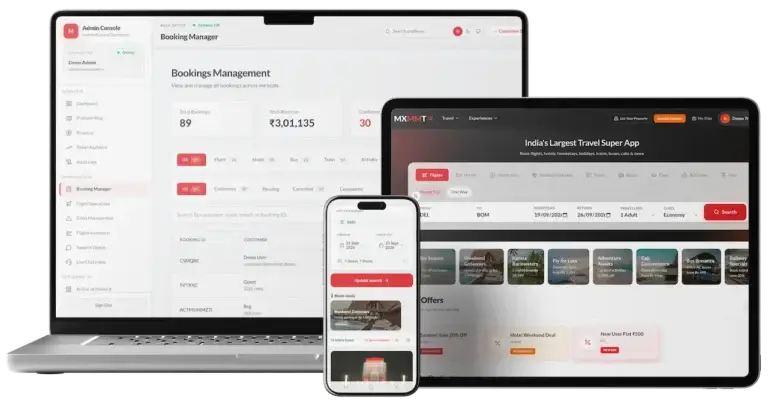
Android, iOS and Web
One portal serves travelers both on the web and inside native mobile apps, with identical trips, wallet and loyalty on every surface.
Yours, Not Leased
Your name, logo, colors, domain and margins. No Miracuves branding anywhere a traveler, an agent or a supplier can see it.
Eight Categories From Day One
Hotels, flights, activities, holidays, homestays, cabs, buses and trains all ship together, and each can be enabled or disabled per market from the console.
The Engine
What Runs Underneath It
Underneath sits the source code you receive: the booking engine covering every category, the partner portals, the operator console, the pay-then-book checkout, the loyalty and wallet system, and connectors to suppliers of flights, hotels, buses, rail, activities and payments. Renting a portal gives you a branded window onto somebody else’s platform; owning this one means the engine, the data and the roadmap are yours.
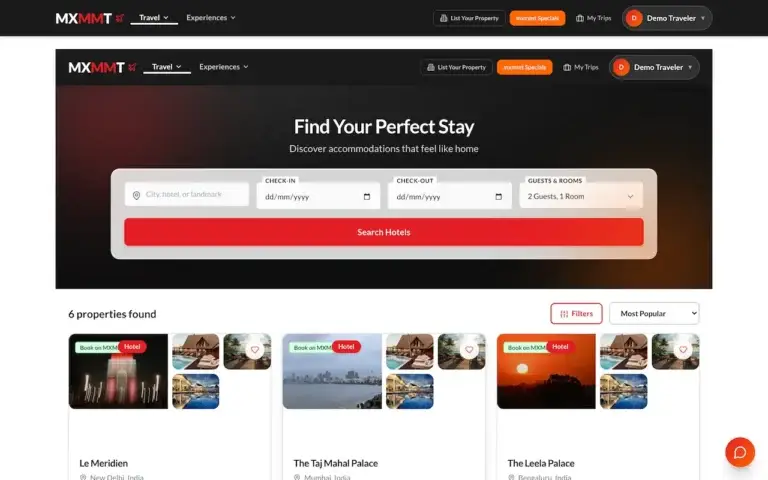
With the Miracuves white label travel portal, you:
- 01The complete source code is yours (100%)
- 02Go live within 6 days, not after months of waiting
- 03No lasting vendor lock-in and no revenue share to give up
- 04Grow by adding more suppliers, categories and workflows over time
In short: this is a complete travel business – consumer apps, an agent channel, corporate travel and a supplier extranet – that you brand, control and own, instead of paying a platform a share of every trip your customers take.
Features
White Label Travel Portal Features - Flights, Hotels, Holidays, Wallet & Loyalty
Miracuves' portal arrives with all that travelers expect of a modern booking app, plus all an operator needs to sell, take payment and bring customers back. Every category, payment method and retention tool below is in the platform at the fixed price. Trains show PNR status including RAC and waitlist, buses mark ladies seats, and cab supply covers India only.
Airfare Search & Reservation
Search one-way, round-trip and multi-city, with the filters travelers expect; pick seats from a seat map, see a fare breakdown that adds up, and get a PNR the moment payment clears.
- Search by one-way, round-trip or multi-city itinerary
- Filters for airline, stops, time, price and duration
- Seat map with seat pricing
- PNR shown at confirmation and in the dashboard
Stay Search & Reservation
Hotels can be compared by guest rating, amenities, price and stars, on a list or on a map; pick a room type and a meal plan, then book with the cancellation terms displayed before payment.
- Filters for stars, price, amenities and guest rating
- Results as a list or on a map
- Choice of room type and meal plan, with cancellation terms shown
- Guest reviews and photo galleries
Coach & Rail Tickets
Bus seats go on sale with boarding points and a live seat map, and train tickets with PNR status, berth preference, quotas and classes - the short, frequent trips that bring travelers back every month.
- Bus seat layouts that flag ladies seats
- Boarding and dropping points
- Pick a train class, quota and preferred berth
- PNR status with RAC and waitlist tracking
Ride Hire & Airport Shuttles
Cabs come in one-way, round-trip and hourly versions, with airport pickup and drop, and the vehicle type and fare are shown before the traveler confirms, so the journey does not end at the terminal.
- One-way, round-trip and hourly hire
- Airport pickup and drop
- Hatchback, sedan, SUV and luxury classes
- Fare shown up front, before booking
Packages, Excursions & Guesthouses
Holiday packages come with day-by-day itineraries, activities are priced by age group, and homestays carry a wishlist - the most valuable orders a travel business takes.
- Holiday packages with day-by-day itineraries
- Meal plans and group pricing
- Separate adult, child and infant pricing for activities
- Wishlists and host reviews for homestays
Single Cart for All Trips
Any category is paid in one go, with cash, pay later, net banking, UPI or card. Promo codes, gift cards and wallet balance apply in the same step, and an automatic refund follows when a supplier fails to confirm.
- Pay-then-book checkout that cannot double-charge
- Wallet, promo codes and gift cards in one step
- Pay by card, UPI, net banking, cash or pay later
- Automatic refund when a supplier fails to confirm
Stored Balance & Vouchers
Give travelers a wallet that holds a balance: cashback and refunds land in it, and they can buy gift cards for other people. That cuts what you pay in gateway fees and gives them every reason to book with you again.
- Wallet top-up, balance and transaction history
- Cashback credited straight to the wallet
- Gift cards can be purchased, redeemed or used in part
- Refunds returned to the wallet
Rewards Scheme
Five tiers running Bronze through Diamond thank travelers who come back, whatever category they book: points up to 2.5x, discounts for members of up to 20%, and plus room upgrades, lounge access and free cancellation for the highest tier.
- Five tiers, Bronze through Diamond
- Every booking, in any category, earns points
- Point multipliers reach 2.5x, and member discounts reach 20%
- Codes for referrals that give a reward to each party
Visa, Currency & Travel Cover
Let travelers buy travel insurance, order foreign currency and check visa requirements and apply, all without leaving your portal, each one adding revenue to a trip already booked.
- Visa requirements, applications and status
- Forex rates and currency orders
- Travel insurance plans and policies
- Sold inside the same checkout
Smart Journey Planner
A traveler describes a trip and receives an itinerary laid out day by day, with suggestions for hotels, activities and restaurants, each acceptable and bookable in a tap, so browsing turns into bookings.
- Choose a destination, dates and travel style
- A day-by-day plan generated for them
- Hotel, activity and restaurant suggestions
- Booked straight from the itinerary
Traveler Trip Board
Travelers see all their bookings together with live status, a refund preview on any cancellation before they agree to it, support tickets linked to each trip and a review prompt after they get back.
- Every booking, every category, one list
- Cancellation with the refund calculated first
- Support tickets and disputes tied to the trip
- Travelers review once the stay or trip ends
Prompt Notices
Travelers hear from you by email, SMS, push and in-app message about confirmations, payments, refunds and reminders, and you win them back with offers that honor their channel preferences.
- Email, SMS, push and in-app messages
- Booking, payment and refund confirmations
- Trip reminders and offer campaigns
- Channel preferences held per traveler
every feature here is white-label, and each can be turned on or off for any market from the console. Launch with the categories your supplier contracts already cover, and turn on the rest when those accounts are approved, with no new release.
How Revenue Flows
Revenue Models - Margins, Commissions, Add-Ons & Enterprise Subscriptions
A travel portal earns on every booking only when the margins, commissions and add-ons belong to the operator rather than to a vendor. The Miracuves platform offers six ways to earn, each of them set in the console.
- 01
Category-Level Booking Markups
Add your margin on top of the rate your supplier gives you, for each category, as a flat fee, a percentage or both, plus a minimum on every booking. Fares are compared line by line, so flights often carry only a small flat amount, while holiday packages, activities and directly listed properties leave more room.
- 02
Commission on Agent Sales
Grow through agents who sell what you have contracted, earning commission that is calculated on every booking and settled monthly. Commission defaults to 5% and can differ from agent to agent; treat each credit limit as money outstanding until the monthly statement clears.
- 03
Commission on Vendor Sales
Earn commission from the hotels, homestay hosts and activity operators who list directly on your portal through the vendor extranet.
- 04
Charges on Visa, Forex & Insurance
Add service fees to visa, forex and insurance sold in one checkout, raising the value of trips that travelers have already booked.
- 05
Business Travel Subscriptions
Offer Starter, Business and Enterprise plans for sale to companies that manage employee travel, on top of the margin on every trip they book.
- 06
Gateway Charges & Wallet Balances
Recover payment costs with a fee on each method, and keep wallet balances that are prepaid, plus unused gift card value, on your own platform.
| Revenue stream | How it is charged | Take rateTypical range | What sets the ceiling |
|---|---|---|---|
| Category-Level Booking Markups | A markup on supplier cost, fixed or proportional or mixed, never below a set floor per booking. | Expedia Group: 12.3% of gross bookings. Yatra air: 7.1%. MakeMyTrip bus: 10.2%. | Category mix. Published figures span roughly 7% to 18% depending on product, so a portal weighted to air will earn less per booking than one weighted to stays. |
| Commission on Vendor Sales | Hotels, homestay hosts and activity operators listing through the extranet pay a commission on bookings. | Hotel OTAs: 15%-30%+ (Cloudbeds). Vrbo homestay hosts: 5% plus 3% processing. | What vendors accept elsewhere. Cloudbeds reports the range shifts with market, property type and volume, so offer a published tier ladder rather than a single percentage. |
| Charges on Visa Help | A service fee for visa support, attached to the booking at payment. | VFS Global India charges one flat INR 1,026 per application, whatever the visa costs. | Flat, not proportional. The same charge sits on a INR 9,504 Schengen visa and a INR 21,120 national visa, about 10.8% and 4.9%, so a percentage markup would look steep next to it. |
| Business Travel Subscriptions | Starter, Business and Enterprise plans for companies managing staff trips, alongside the margin on each trip. | Navan: first five expensing users free, then $15 per user per month; enterprise by quote. | Where the free line sits. Navan lists no per-user travel fee at 300 or fewer employees, so paid plans must lean on approvals, policy enforcement and negotiated rates. |
How to read this. The margin percentages come from three disclosures: Expedia Group's 10-K (revenue margin), Yatra's quarterly release and MakeMyTrip's Form 6-K, where we divided segment adjusted margin by gross bookings. Hotel commission bands are quoted by Cloudbeds, Vrbo's by its host page. Visa figures and the 10.8% and 4.9% ratios use the VFS Global India page, and plan terms are on Navan's pricing page. They describe named companies, not a market average, and imply nothing about an affiliation. Use them to stress-test your own pricing, remembering that nobody is promising income here.
White Label Travel Portal Revenue Model, Stage by Stage
On a rented portal the provider caps your margin; on the white label travel portal Miracuves hands over, all six earning methods sit in your console and you choose when each goes live.
Launch
Set category markups first, a small flat amount on flights and more room on holiday packages and activities, and attach visa, forex and insurance charges to the same checkout.
Traction
Bring agents in at a commission that defaults to 5% and can differ per agent, with monthly statements clearing their credit, and let hotels and homestay hosts list through the extranet.
Scale
Business travel subscriptions then add recurring income from companies, and gateway charges plus prepaid wallet balances keep more value inside your own portal.
None of it is shared with Miracuves, because the portal carries no license fee or per-booking charge.
Control Center
OTA Software Operator Console - Inventory, Margins, Sourcing & Earnings
Miracuves made this operator console because a travel portal turns into a business only once it is easy to run. The operator console puts inventory, bookings, pricing, suppliers, partners and money in one browser for your team, with roles deciding exactly who can touch what.


Scope of the Console
- 01
Stock Across All Verticals
From a single inventory manager you add and change homestays, holiday packages, activities, cabs, train and bus routes, hotels with their rooms, and flights.
- 02
Reservations & Reimbursements
Search every booking across categories, cancel or amend for a traveler, and work the refund queue, with approval required before any money moves. Agents get refunds back into their own balance and top it up through Razorpay; sub-agent tiers, agent-set markups and agent-branded sites are quoted as custom work.
- 03
Accounts, Staff & Access Rights
Look up and manage any traveler, suspend accounts, export lists of users, and give each staff member exactly the permissions their job needs.
- 04
Supplier Vetting Queue
Check each supplier application along with its business documents, accept or decline it, and track the properties and performance of every vendor.
- 05
Deals, Coupons & Ad Banners
Set up promo codes that carry usage caps and expiry dates, and time homepage banners by category, placement and audience.
- 06
Income & Insights
Follow bookings, margin, revenue and gross booking value per category and across time, with reports finance can export.
- 07
CRM & Audience Groups
Full customer history is on hand; you can group travelers by category, tier or spend, and push segments out for retention and campaign use.
- 08
Helpdesk, Messaging & Ratings
Supervise support tickets and escalations, keep an eye on both AI and human chat, and screen reviews before they go live on your site.
Owner Settings
The owner’s control plane covers supplier routing, payment methods, margins, features, categories and brand, all changed without a release.
- Set your own brand name, logo and color scheme
- Each travel category switched on or off
- A margin, flat fee and minimum amount for each category
- Which payment methods appear at checkout
Agent & Business Supervision
Handle corporate accounts together with their policies, approvals and expense claims, alongside agent accounts, commissions and settlements. Each company account has two roles, an admin and employees: bookings inside policy go straight through, and anything over the limit waits for manager and then finance approval.
- Nine roles, from traveler to owner
- Twenty-four permissions can be assigned to each individual
- Staff invited and changed in a click
- Every action written to the audit log
04Deliverables and pricing
Deliverables
What’s Included With the Travel Portal - Source Code, Apps, Portals & Deployment
Miracuves does not hand you one app. At one fixed price you receive the consumer apps, each partner portal, the operator console and the booking engine behind them, plus the help to launch. Nothing recurring is paid to Miracuves afterward, with no license fee, revenue share or per-booking charge; your ongoing costs are hosting, gateway fees, SMS, email and your suppliers' terms, which are raised at kickoff because they usually take longest.
Android App
An Android app in your branding where travelers search, book and pay in any category and handle their trips, wallet and loyalty.
- Branded Android app for travelers
- Every category, plus wallet and loyalty
- Trips, refunds and support inside the app
- Released through your own developer account

iOS App
iPhone users get the same booking experience from one codebase shared with Android, so the two apps never drift apart.
- iOS app matching Android feature for feature
- One codebase behind both
- Your own icon, name and launch splash screen
- Store submission support


Traveler-Facing Site
The full white-label travel booking website for travelers who plan at a desk, with the account, trips and wallet carried over from the app.
- Consumer website covering every category
- Traveler dashboard with every booking
- Search-friendly destination and offer pages
- Served from your own domain

Agency, Business & Supplier Portals
Travel agents, corporate travel managers and suppliers each get a dedicated portal with separate sign-in, tooling and reporting.
- Portal for agents to manage clients and commission
- Company portal covering policies and approval flows
- Supplier-side extranet for hotels and vendors
- Support, CRM and settlement desks
Back-Office Command Hub
Central control over platform settings, revenue, partners, suppliers, refunds, offers, users, bookings and inventory.
- Operator console for your team
- Controls for the platform's brand and margins
- Nine roles share out twenty-four permissions
- An audit log of every action
Source & Gateway Integrations
Ready-made connectors reach suppliers of flights, hotels, buses, rail and activities, plus payments, SMS, email and maps, switched on with your own accounts.
- Supplier connectors for flights, hotels, buses, rail and activities
- Payment gateway, text message, email and map connectors
- Primary and fallback supplier routing
- An open API for your own integrations
$ deploy --to your-cloud Rollout & Go-Live Help
Together with your team we handle cloud setup, configuring suppliers and gateways, branding, and help with submitting to app stores.
- Cloud deployment on the provider you choose
- Hooked up to your own supplier and payment accounts
- Branding, categories and margins configured
- Handover to your operations team
Aftercare Support
- Product, API and security documentation
Pricing
What Does a White Label Travel Portal Cost in 2026?
There are three ways to put a travel portal online, and they cost very differently. Renting a white-label portal runs from about 20,000 to 60,000 rupees, roughly $230 to $690, but it runs on the provider’s inventory, the margin is capped by them and nothing is yours once you stop paying. Commissioning a custom portal is quoted at $8,000 to $40,000 and takes months. This platform costs a single $3,999 for the consumer apps and website, every partner portal, the operator console, the booking engine and the full source code, with customizations quoted separately on top.
Professional
ReadyMade Out-of-Box PackageWorks for: Agencies going direct, tour operators, consolidators & regional travel brands
The solution arrives as shown in our demo, carrying your branding and hosted on your own infrastructure.
Get StartedEnterprise
Bespoke, Regulated & Heavy-VolumeFits well with: Enterprises, hotel groups, agent networks & corporate travel companies
Have it shaped to fit your circumstances, demand and business requirements.
Request a QuoteWhite Label Travel Portal Development Cost in 2026
A single $3,999 payment buys this travel portal outright: eight bookable verticals, traveler apps on Android and iOS, the agent, corporate and vendor logins, and every line of the TypeScript codebase. Flights, hotels and homestays sell from your own domain within six working days, and nothing recurring flows back to Miracuves after that.
Running costs that stay with you
- Hosting on the provider you choose
- Payment gateway fees
- SMS and email providers
- Supplier terms held in your own name
- Custom modules such as a mid-office, a sub-agent tier or agent-branded sub-sites
Mid-office, sub-agent and agent-branded sub-site builds each get a written scope and usually land in 2-8 weeks, while hotel groups, agent networks and corporate travel companies with heavier volume can request an Enterprise quote.
Compare Your Options
Ready-Made White Label Travel Portal vs Custom Development vs SaaS
A travel portal can be owned outright through Miracuves, commissioned from an agency or rented on a provider's feed, and the choice settles who controls inventory, margins and the code after launch.
| Criteria | MiracuvesReady-Made White Label Travel Portal | Custom Development | SaaS |
|---|---|---|---|
| Launch time | 6 days to go live, plus store review | Quoted in writing, typically 2-8 weeks | Sign up and start the same day |
| Upfront cost | A fixed $3,999, once | Quoted in writing for your scope | Low entry, then a recurring subscription |
| Source code ownership | Full source code, yours after handover | Yours if the contract assigns it | Stays with the SaaS vendor |
| Customization | Rebrand and change the code you own | Unlimited, billed as extra build time | Settings, themes and plan limits only |
| Ongoing fees | No license, revenue share or booking fee | Maintenance billed by the agency | Monthly fees that rise with usage |
| Branding & app-store listing | Your brand on apps, website and portals | Your brand, built from a blank screen | Vendor branding or a shared listing |
| Best for | Agencies and tour operators with supplier accounts | Products no existing model can serve | Testing demand before you invest |
Same product, other editions: Expedia Clone · MakeMyTrip Clone · Travel Booking Platform · Yatra Clone · Browse all Travel solutions
Ownership
How We Define White Label Using This Platform
Plenty of white label online travel agency (OTA) software is a monthly rental that sits on another company's inventory, while Miracuves sells you the platform itself. This is precisely where this platform draws the line.
The portal name, logo, colors and domain, the iOS and Android app names, icons, splash screens and store listings under your own developer accounts, and the wording of every email, SMS and push message. Which categories are live, the margin on each and the payment methods at checkout are console settings, so a rebrand is configuration rather than a release.
The TypeScript codebase end to end: the React web apps, the React Native mobile apps, the NestJS booking engine, the PostgreSQL schema, the partner portals and the operator console, plus product, API and security documentation. There is no license fee, revenue share or per-booking charge, and no condition on changing, extending or redeploying it.
It is not a rented portal running on our inventory. No flight, hotel, bus, rail or activity inventory is supplied: supplier agreements are always in your own name, and we connect the accounts you hold. A mid-office or accounting module, agent-set markups, a sub-agent tier and agent-branded sub-sites are available as custom work, each quoted in writing. Your gateway, SMS, email, maps and developer accounts stay yours.
Typical Deployments
Travel Portal Use Cases - Direct Seller, Agent Network, Corporate Travel & Holidays
Miracuves' travel portal answers what travelers want: one app that covers the whole journey, plus a reason to rebook for their next one. A portal that holds booking, payment, loyalty and after-trip support together is how an operator keeps both the customer and the margin.
Swipe · 6
Sell direct under your own name and let travelers book cabs, activities, holidays, trains, buses, hotels and flights in one place. Promo codes, loyalty tiers and the wallet bring them back, and per-category margins plus services such as visa, forex and insurance raise the value of every trip.

Bring a network of agents onto one platform. Each agent keeps client records, books on a client’s behalf, sees commission calculated automatically, and draws on an agent wallet with the credit limit you set, and monthly settlements take the place of spreadsheets and phone calls.

Offer business travel as a managed service. Policies define spend limits and class rules, any booking over the limit goes to manager and finance for approval, expense claims are produced once each trip ends, and company admins view spend by department. A recurring fee comes from the Starter, Business and Enterprise plans.

List your packages online, complete with meal plans, group pricing and day-by-day itineraries, and sell the transfers, activities, hotels and flights around them in the same checkout. With the AI planner, travelers can assemble a trip and book it without calling your team.

Serve a state, region or language that national portals leave underserved. Promote local packages, activities, homestays and bus operators, set margins that suit local prices, and let location rules in the console decide where each service is offered.

Run a supply-led portal on which hotels, homestay hosts and activity operators onboard with their documents, set rates and availability of their own, and receive transparent payouts; you earn commission on every booking they take.

White Label Travel Portal Business Model: Three Ways to Run It
An owned portal from Miracuves can trade under your name in three ways, depending on who holds the customer.
Direct seller
An agency going direct sells cabs, trains, buses, hotels, flights and holidays to travelers itself, keeping full markups and the customer data.
Distribution hub
A consolidator gives agents client records, automatic commission and a credit limit it controls, earning on volume it could never reach alone.
Supply exchange
A lodging-led portal onboards hotels, guesthouses and homestay hosts with their documents and earns commission on every booking they take.
Travelers, agents, hotels and four operator roles all sign in to the same deployment, so a direct seller can open an agent network or a hotel extranet later without buying a second platform.
If your model mixes several of these, so does the platform: one deployment serves travelers, agents, companies and suppliers at the same time.
Book a Free Strategy CallThe Timing
Why Own Your Travel Portal in 2026?
Travelers book from their phones and expect a single app to carry the entire journey, and with a Miracuves portal that app is yours: the hotel, the flight, the activity, the transfer and the refund when plans change. The operators who win own that relationship, and every booking sent through a rented portal hands it to somebody else.
01Own the Traveler, Beyond a Single Booking
Own the customer data, the offers, the follow-up and the loyalty program, rather than renting access to travelers from a platform that also sells to your competitors.
02Make Money Across All Categories, Not Just One
A traveler booking a flight needs a transfer, a hotel and an activity too. When all of these sell through one checkout, each carrying your margin, one trip yields more revenue.
03Go Live Sooner on a Platform Already Proven
No need to spend a long stretch building partner portals, refunds, a checkout and a booking engine. Go live within days, and put the budget into supplier deals and marketing instead of engineering.
04Digitize Agents and Corporate Clients
Plenty of travel still sells via local agents and company travel desks. A portal with an agent channel and a corporate channel captures that alongside direct bookings.
05Capture Local and Specialty Segments
National portals are designed around the busiest routes and the broadest audience. A platform that focuses on one region, language, holiday type or community can serve it better and keep its loyalty.
06Keep Travelers Coming Back Through Wallet and Loyalty
Five loyalty tiers, cashback, gift cards and refunds paid into the wallet give travelers a reason to come back to you for the next trip, which lowers what you pay to win the same customer twice.
Portal Key Figures
Trip Verticals
Rewards Levels
User Categories
Days Before Go-Live
Travel is among the few categories where the same customer books multiple times a year, and across several products. A portal that holds them within one wallet and one loyalty program converts a one-off booking into a customer for the long term.
Industries
Industries We Serve
Travel businesses of all shapes can run on this platform. For the broader sector, read about travel and hospitality platform development, and when you need bespoke work outside this product, look at our travel app development services.
one platformYour portal
- 01OtWeb-Based Travel Agencies
- 02TaTrip Agencies
- 03ToTour Companies & DMCs
- 04CtBusiness Travel
- 05AnResale Partner Groups
- 06HhLodges & Guesthouses
- 07BrCoach & Train Ticketing
- 08CtTaxis & Shuttles
- 09AeExcursions & Attractions
- 10RsLocal & Provincial Tourism
- 11FvCurrency, Visa & Cover
- 12SgSchool & Party Trips
This is a complete travel commerce platform built for travel agencies moving online, tour operators, destination management companies, corporate travel companies, agent networks, consolidators, hotel groups, supply aggregators, tourism platforms at regional and state level, and travel-adjacent financial services selling insurance, forex and visa. Each takes a different mix from the same platform: a supply business starts with the vendor extranet, a corporate travel company with its policies and approvals, an agency with the agent portal, and a direct seller with the consumer app and loyalty. In every case the operator keeps the customer, the margin and the code.
06Under the hood
From Search to Return
How a White Label Travel Portal Works - Search, Book, Pay, Travel & Return
A travel portal looks simple to the traveler, yet every booking involves search and supplier confirmation, then payment, notifications and after-trip care. Below, you can follow the traveler’s path and see what the platform does at each step.
The Traveler Journey: First Search Through to the Next Trip
Swipe · 6
- 1Sign In and See Featured Deals
The moment a traveler opens your app or website, offers from every category are on show, even before any search.
- Offers, banners and popular destinations on the homepage are all managed from your admin panel
- Google sign-in, email or a one-time code all work for travelers signing up
- Stored traveler profiles and documents speed up each booking afterward
- Returning travelers can continue from where they stopped because recent searches are kept
- 2Look Up Flights, Hotels and Packages
The traveler opens the category they need and trims the list with filters in a few taps.
- Every one of homestays, holidays, activities, cabs, trains, buses, hotels and flights comes with a dedicated search
- Ratings, amenities, star class, stops, time and price all work as filter and sort options
- Listings merge what your connected suppliers send with the inventory you list yourself
- Where useful, maps place hotels by location and display routes to support the choice
- 3Select a Fare or Room and See the Price
With the choice made, the exact price is displayed before the traveler commits to anything.
- Flights and buses offer seat maps, trains offer berth preference, and hotels offer room types and meal plans
- Taxes and fees shown in an itemized fare before the traveler pays
- The booking can be paired with forex, visa help and travel insurance offers
- Saved traveler profiles autofill passenger details
- 4Check Out and Get the Booking Confirmed
Payment and the booking go through as one action, so a trip that fails to confirm is never charged.
- Pay with cash, pay later, net banking, UPI or cards, with gift cards, promo codes and wallet balance applied too
- When an order is created, the server fixes the amount, and the payment gateway then confirms that same figure
- Tapping pay more than once cannot produce a second charge, and if the supplier fails to confirm, the money goes back automatically
- Email, SMS and the app all deliver the PNR or voucher right away
- 5Get Help During the Trip
The trip stays on the traveler's dashboard from the booking until they are home again.
- One screen lists each booking: current status, PNR, voucher and reminders
- Before confirming a cancellation, the traveler sees the refund amount that your cancellation policy produces
- Questions go to support tickets, AI chat or human agents, each with the booking already linked
- Every dispute and refund is followed until it is closed
- 6Collect Rewards and Plan the Next Trip
After the traveler returns, ratings, rewards and offers work to secure their next booking.
- Back home, travelers can rate the hotels, activities and trips they took
- Each completed booking earns loyalty points, which carry travelers through the five tiers
- The wallet holds cashback and refunds until the traveler books again
- Travelers who invite friends with a referral code earn a reward
Behind The Scenes
Travel Booking Engine Architecture & Reservation Path
- 01Layer 01
Inventory Source Coordination
Each category has one booking primary, ranked fallbacks and compare-only sources, routed per country. Searches run in parallel, a booking is placed with a single supplier, and a fallback steps in the moment the primary fails.
- 02Layer 02
Charge-First Reservation Flow
On the server, the payment order is created with the amount fixed, and the gateway signature is checked. Only after the supplier confirms does the booking get issued, and a failed confirmation triggers an automatic refund.
- 03Layer 03
Markup & Rate Controls
Each category has its own margin, set as a flat fee, a percentage and a minimum, and supplier rates pass through it, so the price a traveler sees always includes the margin you chose.
- 04Layer 04
Single Reservation Ledger, Every Category
All categories flow into a single booking hub, the source for the traveler dashboard, support desk, refund handling, loyalty program and revenue reports.
- 05Layer 05
Team Permission Tiers
Nine roles and twenty-four permissions limit access, and every request is checked against them: agents, vendors, corporate users, support, finance and operators see only their own part of the portal.
- 06Layer 06
Alerts, Logs & Health Checks
Booking events send email, SMS, push and in-app messages via a queue, and audit logs record operator actions, supplier credential changes and location decisions.
The Supply Behind It
Travel Portal Integrations - 61 Pre-Wired Suppliers & Services
The platform underneath a travel portal is mostly supply, and Miracuves delivers it connected through API integration: 61 providers span flights, hotels, buses, trains, cabs and activities, each with a set role, plus payments, messaging and maps. The portal sells from all of them the day it launches, and your own supplier accounts are linked during delivery.
| Category | Reserves the journeyPrimary | Fallback | Compare and Enrichment |
|---|---|---|---|
| Flights | Amadeus Self-Service | Sabre, Travelport, Duffel, Via.com | Kiwi.com, Skyscanner, Google Flights, Hopper, Trip.com, Expedia Partner Solutions |
| Hotels | Hotelbeds | RateHawk, TBO Holidays, Expedia EPS | Priceline, Agoda, Hotels.com, Via.com, Airbnb, Booking.com, Trip.com |
| Buses | redBus | FlixBus, Omio | AbhiBus, Busbud |
| Trains | IRCTC authorized partner | Trainline, Omio | RailYatri, ConfirmTkt |
| Cabs | Ola | Seeded local fleet | Uber, Bolt, Lyft, Rapido, Grab |
| Activities | Viator | Seeded local inventory | Klook, GetYourGuide |
| Multimodal | - | - | Rome2Rio route options |
| Payments | Razorpay for INR | Stripe for international | - |
| Messaging | SendGrid email, MSG91 SMS | Twilio SMS | - |
| Maps | Google Maps Platform | - | - |
- A single booking primary per category, so no reservation is placed twice
- Automatic fallback when the primary cannot confirm
- Display-only compare sources that never issue tickets
- Rupee payments through Razorpay, all other currencies through Stripe
- A primary and fallback order you set separately for each country
Credentials live in an integrations console, where they are masked, can be rotated and can be tested live; every change is logged with who made it and when.
Technology
Travel Portal Tech Stack - React, NestJS, PostgreSQL Data & React Native
Underneath, a travel portal needs fast search across categories, a checkout that cannot charge twice, supplier connections that can be depended on and strict control over who sees what. Miracuves built the platform on a modern, widely used TypeScript stack, so any competent team can run and extend it.
Browser Front Ends
- A single web app covers the consumer website, the traveler dashboard and all partner portals
- Areas gated by role for agents, corporate travel, vendors, support and operations
- Pages are rendered server-side, which keeps them fast and search-friendly
- Maps, seat pickers and live chat built in
Phone & Tablet Apps
- One codebase behind the iOS and Android apps
- Home, flights, hotels, transport, trips and wallet tabs
- Tokens stored securely on the device
- Deep links take users from push notifications straight into a trip or an offer
API & Reservation Core
- Modular backend with a module per category and business function
- A REST API, with chat running in real time over WebSockets
- Idempotent payments inside a pay-then-book checkout
- Routing across suppliers in primary, fallback and compare modes
Storage & Fast Lookups
- Relational model for bookings, payments, partners and loyalty
- Versioned database migrations
- Background queues, caching and rate limiting run on Redis
- Audit trails for operator actions, supplier credentials and location rules
Inventory Sources & Gateways
- 61 pre-wired providers for activities, hotels, trains, flights, buses and cabs
- Razorpay for India and Stripe for international payments
- SendGrid email, MSG91 and Twilio SMS, Google Maps
- An integrations console masks credentials, lets you rotate them and tests them live
Hosting & Delivery Pipeline
- Containerized deployment with health checks
- nginx reverse proxy with TLS
- Stateless API servers scale out horizontally
- Images and documents are served from object storage and a CDN
the platform is written in TypeScript throughout, so one set of engineers can handle the API as well as the web and mobile apps. Your team can extend it with new categories, suppliers and workflows and never needs to depend on us.
Build to Scale
Made to Scale Through Peak Seasons, Supplier Load & Growth Across Regions
Demand in travel comes in sharp peaks. A holiday weekend, a festival season or a flash sale can multiply search traffic within hours, and each search queries several suppliers simultaneously through their API integrations. A portal that lags at those times loses the booking to a competitor. Miracuves designed the platform so your busiest days perform best rather than worst.
Ready for Holiday Surges
The API servers hold no session state, so capacity is added by adding servers behind a load balancer.
- Capacity grows to meet flash sales, festival seasons and holiday weekends
- Scale back when traffic settles
Simultaneous Source Queries
Each search asks all of your connected suppliers at once, and anything you list yourself is served from your own database alongside them.
- A sluggish supplier cannot hold back the rest of the results
- Demo inventory keeps the portal usable while your supplier accounts are approved
- Indian and worldwide supplier stacks operate in parallel
Self-Switching Backup Suppliers
When a category's primary supplier fails, the booking passes to the next one in line, so the category stays bookable and no errors are shown.
- Your team can monitor supplier health
- Supplier switching from the console, with no release
- As you grow, your own developers extend the same TypeScript codebase instead of rebuilding what works
No Duplicate Card Charges
Peak traffic is precisely when supplier timeouts, gateway retries and duplicate taps occur.
- Every payment order has its amount locked on the server
- Gateway signature checks
- Idempotent payment processing on retries
- If the supplier does not confirm, a refund is issued automatically
Cache, Queue & Throttle Layers
Redis runs caching, notification queues and rate limits on every server, shielding sign-in and search from traffic spikes and abuse.
- PostgreSQL scales with connection pooling
- Dashboards and reports are served by read replicas
Ready for Many Regions & Brands
Launching in a new country or adding a second brand is a matter of configuration, not a rebuild.
- Every deployment has its own location rules, supplier stack, payment methods, currencies, categories and brand
- INR by default, international currencies through Stripe
- No two travel businesses sell the same mix of categories to the same mix of customers, so portals, loyalty rules, payment methods, margins, suppliers and categories are all configuration
- Start with the categories your contracts cover and switch on the rest later; lead with the agent portal if the trade is your channel, or with policies and approvals if companies are
For founders and CTOs: starting small on one server does not leave you exposed in peak season. The first deployment is sized with you, and the traffic level that should trigger each scaling step is documented.
07Security and compliance
Security
Travel Portal Security - Payments, Traveler Data & Permission-Scoped Logins
A Miracuves travel portal deals with passports, payment references, supplier credentials and money that moves between travelers, agents and vendors. Security is built into every layer, covering sign-in, permissions, payment verification and audit logs, and the build includes a VAPT and security compliance reference for your technical team.
- 01 · SuppliersProtecting Supplier Keys
Supplier API keys for payments, cabs, buses, rail, hotels and airlines are kept encrypted with AES-256. The admin panel shows only masked values, and each change is written to a dedicated audit log along with who made it and when.
- 02 · AccessSafe Login & Permission Scopes
Before a request can touch the booking engine, it is rate limited and checked for a valid token, role and permission. Access tokens last only minutes, refresh tokens are rotated and revoked when a user logs out, and suspended accounts lose access at once.
- Protected Logins & Tokens: Short-lived access tokens with rotating refresh tokens, bcrypt password hashing, one-time codes, Google sign-in, and two-factor sign-in for operator and finance roles.
- Least-Privilege Permissions: Access is governed on every request by twenty-four fine-grained permissions spread across nine roles, which limits each person to the data and actions that fit their role.
- 03 · AuditActivity Logs & Geo Restrictions
Separate audit logs record location-based access decisions, supplier credential changes and admin actions, so your team can always see who changed what. Rules by location can permit or deny access for a country, state or city.
- Spam & Scraper Defense: Rate limits cover every endpoint, with stricter ones on sign-in, plus security headers, strict input validation and location rules that block traffic from regions you choose.
- 04 · TestingSecurity Papers & VAPT Preparedness
The handbook for developers and security, plus a VAPT compliance reference aligned with the OWASP Top 10, comes with the platform. Outside testers or your security team can use both to measure the platform against a written baseline prior to launch.
- Aligned With Security Standards: Our build practice mirrors the controls that ISO 27001 or SOC 2 assessments examine: documented security configuration, encrypted secrets, audit logging and role-based access. It is not a certification, and none is claimed.
- 05 · PaymentsSound Charges & Reversals
Payment orders originate on the server with the amount locked, are checked against the gateway signature, and are handled a single time, even if the gateway retries or the traveler taps twice. No refund can be larger than the original payment, no wallet balance can drop below zero, and approving a refund or payout takes finance permissions.
- Safe Card Handling: Card details stay with the payment gateway and are never stored. The server locks amounts, and every gateway payment and webhook is checked by signature.
- 06 · DataGuest Information Safeguards
Payment references, addresses, travel documents and passport numbers can be seen by the traveler and by staff with a role that allows it, and no one else. Passwords and tokens are kept as hashes, the API leaves sensitive fields out of every response, uploads are checked against allowed file types, and each traveler can download or erase their own data.
- GDPR-Aligned Personal Data Care: Consent flags at signup, notification preferences for each channel, export of traveler data, account deletion, and sensitive fields that the API never returns.
A word to serious operators: a travel business, from traveler passports through supplier payouts, can be trusted only as far as its platform can. Bring us your compliance requirements, penetration testing plans and security review before going live.
Discuss Security & Compliance With UsCompliance Explainer
White Label Travel Portal Compliance - Software Scope, Supplier Contracts and Agency Licensing
In essence, a white label travel portal is software. It is not a travel license, and it is not a supplier contract. Miracuves delivers the platform layer: one booking engine for all categories, payment captured at checkout before the booking is made, supplier connectors routed to a primary plus a fallback, cancellation policies configured for each category, operator controls, audit logs, the refund queue, and portals serving agents, corporate users and vendors. The rest of operating as a travel seller remains yours: selling airline seats, hotel rooms, rail and bus tickets and holiday packages, issuing tickets through a supplier account, and taking money as a travel seller. Those are commercial activities, regulated in many markets, and they fall on your business, along with the contracts it enters.
“Ready” means you can try the booking connectors, routing, refund handling and audit trails on the seeded demo inventory, with your own supplier and payment accounts joining at delivery. Agency registration and supplier agreements come through your own business, and live inventory follows the contracts you sign.
Supplied in the Code
Eight travel categories with search and booking, a pay-then-book checkout that refunds automatically if a supplier cannot confirm, margins and cancellation policies per category, and separate portals for agents, corporate users and vendors. Also included: an encrypted, audited console for supplier credentials, role-based access, location rules, and export and deletion of traveler data. The full source code is handed over to you outright.
Remains the Operator's Job
Supplier agreements, with their commercial terms, held in your own name: activity suppliers, bus and rail partners, a hotel wholesaler, and a flight GDS or consolidator. Also your payment gateway account and its merchant terms. Plus any IATA accreditation, or registration as a travel agent or tour operator, that your market demands, along with the tax and invoicing rules that apply to what you sell.
Money-Back Cases, Cancels and Disputes
For each category, the platform enforces the cancellation policy you define, shows the traveler the refund before they confirm, returns money automatically when a booking does not confirm, and sends refunds through finance approval. What remains with you is your refund policy, how it matches the terms each supplier sets, and handling chargebacks with your gateway.
Local Law Sets the Path
Requirements differ by market. Airline tickets are normally sold via a consolidator or by way of IATA accreditation, while rail tickets are sold via an authorized partner, which in India means IRCTC’s. Packages you assemble yourself can bring package travel and consumer protection rules into play, in the EU and UK for instance, and data-protection law covers traveler documents. Confirm the correct path with a travel trade body, legal counsel, or the suppliers you use. Legal, licensing and regulatory advice is outside what Miracuves provides.
08Grow the platform
- Eight bookable verticals
- Charge-first reservations
- Reseller, enterprise & vendor consoles
- Markups & back-office oversight
How add-ons work
- 1Mix and match add-ons
Take modules on day one or down the road, and the core is never rebuilt.
- 2Priced individually per add-on
Every module is quoted with a written scope and its own price.
- 3Delivered inside your repository
Like the core, it comes as source code that belongs to you.
Advanced Add-Ons
White Label OTA Add-Ons - Channel Manager, Dynamic Pricing & Multiple Brands
As delivered, the portal is already a complete travel business. Add-ons extend it around your market for the cases that go further - a new line of business, a particular supplier or a custom corporate workflow - and are quoted separately.
Explore by dragging · hover to pause
- 01Inventory & distribution
Bidirectional Distribution Sync
Rates and availability for the hotels you list are synced both ways with outside booking channels, so a vendor manages inventory once and sells everywhere.
Properties · Wholesale Exchanges - 02Rates & promotion
Rule-Driven Fare Adjustments
Margins shift on their own according to booking window, route, demand or season, so you need not fix a single margin for each category manually.
Online Agencies · Yield Teams - 03B2B & enterprise
Business Travel Approval Flows
For large corporate clients: tailored approval chains, expense integrations with HR and ERP systems, billing by cost center and single sign-on.
TMCs · Large Accounts - 04Storefronts & regions
Several Storefronts, Isolated Tenants
Operate several travel brands from one shared core, each having its own domain, categories, branding and margins.
Resellers · Rebranded Partners
- 05Storefronts & regions
Many Currencies & Languages
Further currencies, translated interfaces and local payment methods for when you launch outside your home market.
Worldwide · Cross-Border - 06Rates & promotion
Automated Promotions
Reminders for abandoned searches and carts, fare alerts, and campaigns segmented by loyalty tier along with traveler history.
Acquisition · Campaign Teams - 07B2B & enterprise
B2B Tour Bundle Composer
Tour operators and agents can build tailored packages out of flights, hotels, transfers and activities, adding their own markup.
DMCs · Group Tour Firms - 08Inventory & distribution
Extra Supplier Connections
Beyond the 61 pre-wired providers, you can connect the exact airline, hotel wholesaler, bus operator, rail partner or activity supplier your market depends on, routed alongside the rest.
Operators · Bespoke Suppliers
Other Travel Products
Building in Travel? Four Travel and Rental Products.
This portal is one part of a broader suite for travel and rentals. If your roadmap goes beyond booking trips, these fit in naturally.
01B2B travel platform with an agent portal, credit limits, commission and corporate travel desks.
Explore Solution
02Travel booking engine with AI trip planning, locked-price checkout and automatic refunds.
Explore Solution
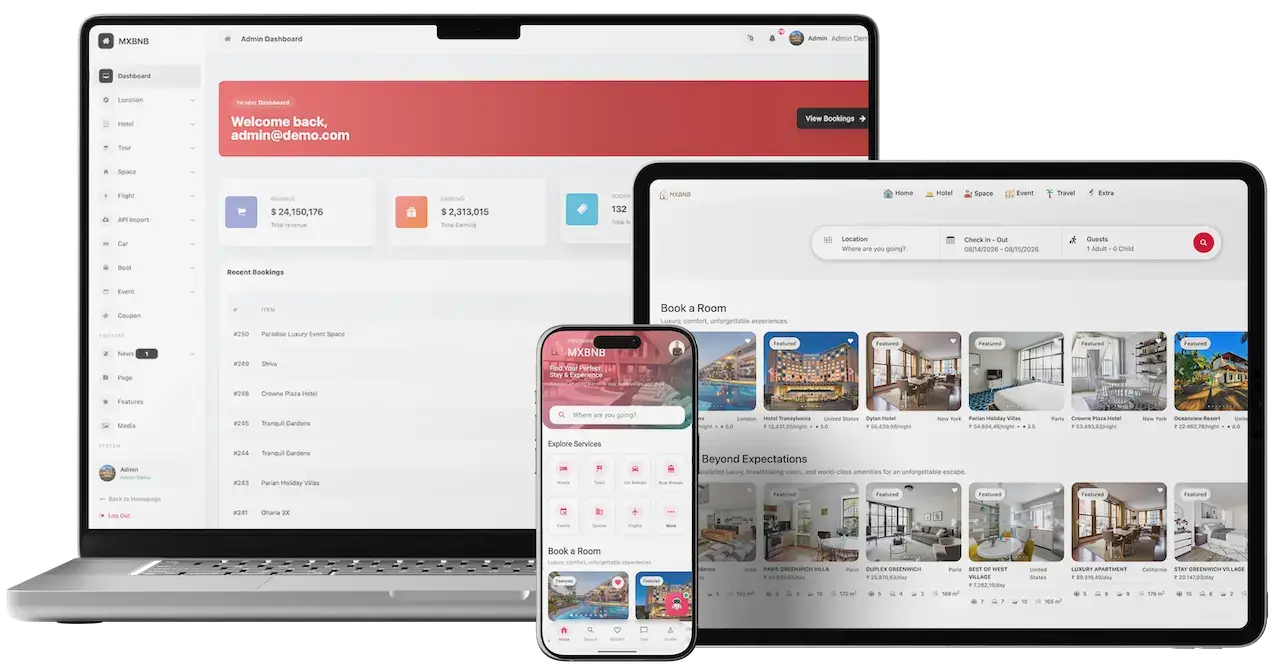
03A vacation rental marketplace covering host listings, calendars, the booking flow and payouts to hosts.
Explore Solution
04A peer-to-peer car rental marketplace covering host fleets, availability, bookings and payouts.
Explore Solution09The business case
Market Benchmarks
Independent Benchmarks for the Online Travel Market - 2025-2026 Data
Our own work is the revenue models above; those below were produced by others. They are UN Tourism data plus the latest yearly filings of Expedia Group, MakeMyTrip and Booking Holdings, quoted as they were released. An operator should focus on how much revenue the listed incumbents retain from each booking's worth, and on where demand is going.
1.52bn Tourist Arrivals Across Borders in 2025
UN Tourism puts the worldwide count of international tourists in 2025 at 1.52 billion. That is a 4 percent increase and nearly 60 million above 2024, and receipts from international tourism are estimated at USD 1.9 trillion. In its September 2026 update, the figure for January-June 2026 is 690 million arrivals, up 0.4 percent, and an increase of 1 to 2 percent is now forecast for 2026.
Booking Holdings Turns 14.5% of Bookings Into Revenue
In its 2025 Form 10-K, Booking Holdings reports US$186.1 billion in total gross bookings, a 12.4 percent rise, and US$26.9 billion in total revenues, equal, by its own statement, to 14.5 percent of those bookings, while the 2024 figure was 14.3 percent. Merchant bookings (those where payment is collected from travelers by the company itself) accounted for 70 percent of everything booked, rising from 63 percent.
Expedia's B2B Bookings in Travel Grow 20% to $35.7bn
In the 2025 Form 10-K from Expedia Group, B2B gross bookings stand at US$35.7 billion, a 20 percent increase, compared with US$83.9 billion in B2C, which rose 3 percent. The B2C margin was 11.3 percent and the B2B margin 13.6 percent, with gross bookings overall at US$119.6 billion. Its B2B segment supplies financial institutions, retailers, travel agents and airlines.
MakeMyTrip: 17.9% on Hotels, 7.0% on Air
According to the Form 20-F for the fiscal year ended 31 March 2026, MakeMyTrip earned an Adjusted Margin of 7.0 percent on air ticketing and 17.9 percent of the gross bookings on hotels and packages, versus 17.8 percent and 6.4 percent respectively the year before. Hotel-room nights grew by 17.6 percent. The company itself defines Adjusted Margin, and it is a non-IFRS measure.
UN Tourism, International tourist arrivals up 4% in 2025 reflecting strong travel demand around the world, 20 January 2026 - untourism.int
UN Tourism, International tourism holds steady with 0.4% growth in first half of 2026, 17 September 2026 - untourism.int
Booking Holdings Inc., Form 10-K for the year ended 31 December 2025, filed 18 February 2026 - sec.gov
Expedia Group, Inc., Form 10-K for the year ended 31 December 2025, filed 13 February 2026 - sec.gov
MakeMyTrip Limited, Form 20-F for the fiscal year ended 31 March 2026, filed 27 July 2026 - sec.gov
Every figure is an estimate or reported result from the publisher itself, shown as published. Each company calculates its revenue ratio its own way, and revenue is recognized differently across them, so the ratios cannot be compared like-for-like. The numbers describe the market. They say nothing about how a platform built by Miracuves will perform, and none of them projects revenue for your business.
Portal Earnings Picture
Marketability, Revenue Potential & Demand Landscape
A travel portal goes well beyond booking. It is a commerce business earning on each trip, a channel for distributing to agents and suppliers, and a customer relationship measured in years. Operators who do well choose the travelers, categories and channels that they are able to serve better than a national portal, then rely on margins, loyalty and add-ons to build the value of each customer.
- 01
Phone-Led Travelers
Travelers plan and book from their phones and expect a single app for the flight and the stay, and everything in between.
- 02
Returning Cross-Category Buyers
A single traveler makes several trips each year in several categories, so loyalty and wallet balances carry unusual value.
- 03
Multiple Routes to Customers
Bookings come from consumers, agents, companies and suppliers, which means paid ads are not the only source of growth. Properties you list directly need no outside supplier, so local inventory can grow without a wholesale contract.
- 04
Premium Extras
Each trip is worth much more than the base booking once forex, visa, insurance, activities and holiday packages are added.
- Booking margins per category
- Travel agent commission
- Vendor commission
- Service fees on visa, forex and insurance
- Corporate plan fees
- Payment method fees
- Wallet float
- Gift card breakage
A well-run portal becomes a regional travel brand, a corporate travel business, an agent distribution network and a supply marketplace all at once, with travelers who come back each year because the wallet and the loyalty tier sit with you rather than with a platform you rent.
- 01A local trip brand
- 02A reseller sales network
- 03A corporate travel business and a supply marketplace
- 04Travelers who come back each year because the wallet and the loyalty tier sit with you
These are patterns travel operators follow, not promises. Real results depend on your execution, your market, your marketing and your supplier rates. Each scenario below relies on capabilities included in the base platform.
A regional operator selling holiday packages, flights, hotels, buses and trains under its own name on its own supplier contracts, setting a margin for each category, with wallet cashback and loyalty tiers bringing travelers back, while visa, forex and insurance add a service fee to international trips.
Picture a consolidator that signs up local agents to book on your portal for their own clients. Every booking earns calculated commission, agents spend from a wallet bounded by a credit limit. Monthly settlements take the place of manual reconciliation, which lets the network expand without extra back-office staff.
A travel management company that puts business clients on Starter, Business or Enterprise plans, sets travel policies with approval steps for managers and finance plus automatic expense claims, and earns the plan fee as well as the margin on each employee booking.
10Why Miracuves
Why Miracuves
Rent a Portal, Buy a Script, or Own the Platform
There are three ways to get a travel portal: rent one on somebody else’s inventory, buy a cheap script, or own the platform outright with Miracuves. Here is how they compare. A small agent with no supplier contracts and no route to them is better served by a rented portal on its provider's feed; ownership pays off for agencies going direct, tour operators, consolidators and corporate travel firms.
Why Operators Back Miracuves
- 01
Eight Verticals, Not Just One
Eight categories ship together, where a cheap script usually covers flights and hotels only and a rented portal gives you whatever its provider carries.
- 02
Reseller & Business Panels Bundled
Sell through agents and to companies from the first day, without paying for separate B2B tools later.
- 03
Markups You Set
Set the margin, flat fee and minimum for each category in the console, without asking a developer or a provider for every price change.
- 04
A Payment Flow That Cannot Charge Twice
Verified payments, amounts that stay locked and refunds issued automatically, all in a pay-then-book flow, made to handle live money instead of a demo.
- 05
Ownership of All Code
Keep the complete TypeScript codebase, free of license fees and revenue share, and have any competent team extend it. Supplier keys stay yours, encrypted and masked in the console with every edit logged, and Razorpay or Stripe holds card details, so Miracuves keeps nothing after setup.
- 06
Commercial + Engineering Help
Provided by a team with earlier experience of travel and booking platforms, this covers launch guidance, bug fixes with priority for 6 months and 12 months of updates.
How to Choose a White Label Travel Portal Development Company
White label should mean you own the portal, so test vendors on ownership first.
What to look for Miracuves
- Your brand everywhere Name, logo, domain and store listings under your developer accounts
- Code with no conditions The full TypeScript codebase, free to change or redeploy
- Supply in your name Supplier agreements stay yours; Miracuves connects them
- Breadth Eight verticals, from flights and hotels to cabs and homestays
- Keys and cards Supplier keys encrypted and masked, cards held by Razorpay or Stripe
- Aftercare Platform guidance for 60 days, half-year priority bug handling and a year of product updates
Walk away from any vendor who
- Rents you a window onto its inventory
- Caps your margin or takes a per-booking charge
- Keeps supplier contracts in its own name
- Switches the portal off when payments stop
- Treats a logo swap as white label
Comparison: Why Clients Choose Us for a Ready-Made Travel Portal
| Criteria | MiracuvesMiracuves White Label Portal | Rented White-Label Portal | Custom Portal Build |
|---|---|---|---|
| Time to Launch | 6 days (Production) | Days, on their inventory | 6-9+ months |
| Source-Code Ownership | ✔ Full | None - the platform stays theirs | Usually yes |
| Feature Depth | High (8 categories, agents, corporate) | Whatever their API carries | Depends on budget |
| Security & Compliance | Strong: GDPR-ready, and built to the controls | Opaque - not your stack | Varies widely |
| Scalability & Performance | Cloud & CDN-optimized | Shared tenancy, shared limits | Depends on architecture |
| Monetization Options | Multiple (margins, commissions, plans) | Margin capped by the provider | Custom (more time & cost) |
| Admin & Analytics | Full-fledged dashboard | Their console, not yours | Custom build (extra cost) |
| Cost vs Speed vs Quality | $3,999 one-time, owned | Rs 20,000-60,000, then recurring | $8,000-$40,000, months |
| Ongoing Support & Updates | Available with clear plans | Ends when you stop paying | Depends on contract |
Changelog
White Label Travel Portal Release Log
| Version | Date | What’s New |
|---|---|---|
| v2026.1 | Jul 2026 | At first release: an AI trip planner, loyalty tiers, a wallet, a vendor extranet, agent and corporate portals, and 8 travel categories. |
Let’s build together
Your idea can become a running product.
A free consultation, a clear timeline and honest replies are what you get. We would rather earn your trust than rush a sale.
- Reply in 24 hrs
- Free consultation
- No lock-in contracts
- Full source code ownership
11Learn more
Blog & Resources
Travel Portal Guides & Handbooks
Guides, business models and launch strategies for travel portals, agent networks and corporate travel platforms.
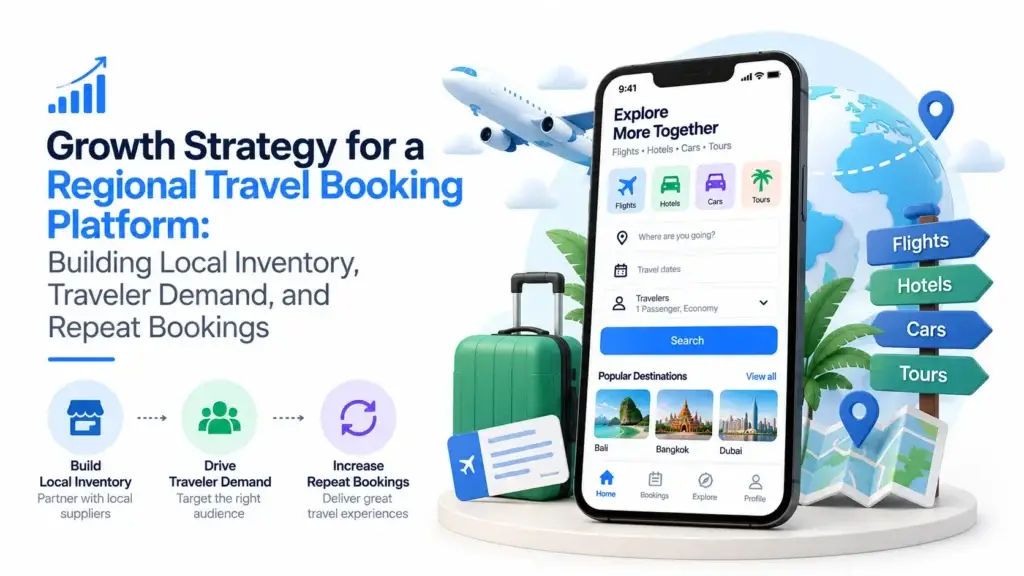

Product5 questions
01What is a white label travel portal?
A complete online travel business you publish under your own name. Travelers search for and book hotels, homestays, flights, cabs, trains, buses, activities and holiday packages in one place, pay once using a wallet, promo codes or gift cards, and manage every trip from one dashboard. Alongside the consumer apps come separate portals for travel agents and for corporate travel customers, an extranet for hotel and supplier vendors, visa, forex and insurance, five loyalty tiers, an AI trip planner and an operator console where you set every margin. The difference from a rented portal is ownership: the source code, the database and the supplier contracts are yours.
02Which parts show your brand?
Everything anyone sees. The portal name, logo, colors and domain, the iOS and Android app names, icons, splash screens and store listings published from your own Apple and Google developer accounts, the wording of every email, SMS and push message, which categories are live, the margin on each, which payment methods appear, loyalty tiers and promo codes. All of it is set in the operator console rather than in code, and no Miracuves name appears anywhere a traveler, agent or supplier can see. Deeper changes, such as a redesigned booking flow or new screens, are code and we quote them as customization.
03Does it include native iOS and Android apps?
Yes. A single React Native codebase produces the native iOS and Android apps, so both always carry the same features: the tabs are home, flights, hotels, transport, trips and wallet, and the app handles search, booking, payment, loyalty and support. The agent, vendor, corporate and operator surfaces are available on mobile as well. You publish the apps using your own Apple and Google developer accounts, carrying your name, icon and splash screen. You can install the Android build from the demo section above and sign in with the traveler login; iOS builds are shared on request.
04Can travel agents and companies book on it?
Yes, and that is among the biggest differences from a basic booking site. Agents keep client records, make bookings for a client, see the commission calculated on each booking, draw from an agent wallet that has a credit limit and follow monthly settlements. Companies set travel policies with spend limits and class rules, route bookings above the limit through manager and finance approval, generate expense claims and see spend by department. Both work on the same platform, with the same inventory as your consumer app. Agent-set markups on top of your price, a sub-agent tier and agent-branded sub-sites are available as custom work.
05Is there a mid-office or accounting module?
No. Back-office accounting, a double-entry ledger and invoicing stay with the accounting system you already run. What you do get is the operational money trail: every booking with its payment, margin, refund and cancellation, agent and vendor settlements with monthly statements, wallet and gift card balances, and revenue and margin reports your finance team can export into whatever accounting system you already use. An integration with that system is custom work, scoped and quoted separately.
Cost & Ownership4 questions
06How much does it cost, and what is ongoing?
The platform is $3,999 as one fixed price: the Android and iOS apps, the consumer website, the agent, corporate and vendor portals, the operator console, the full source code and deployment support, plus 60 days of guidance, 6 months of bug fixes with priority handling and 12 months of updates. You pay no license fee and no revenue share on your bookings. Ongoing costs are your hosting and the accounts you hold: payment gateway, SMS and email providers, and your travel supplier agreements. For context, renting a white-label portal typically runs 20,000 to 60,000 rupees, about $230 to $690, and then keeps charging, while a custom portal build is usually quoted between $8,000 and $40,000.
07How is this different from renting a white label portal?
A rented portal gives you a branded window onto the provider’s inventory. Your margin is capped by their rate, your traveler data sits on their servers, the fee recurs, and everything stops the day you stop paying. Here you own the source code and the database, your supplier contracts are in your own name, there is no per-booking charge, and you can change the margin, the categories or the whole workflow without asking anyone. The trade is that you need supplier accounts of your own, which is why this suits operators who already hold them or can get them.
08Can margins, commissions and prices be set by me?
Yes, and without a developer. Set a margin for each category in the form of a percentage, a flat fee on each booking and a minimum amount, so activities, cabs, trains, buses, hotels, flights and packages each carry the margin that suits your market and your supplier rate. You also set the default commission for vendors and agents, a fee for each payment method, and which methods show at checkout. Promo codes with usage limits, cashback and loyalty tier discounts are managed in the console. Every change applies without a release, so you can answer a season, a competitor or a supplier rate change the same day.
09Can I rebrand and customize the code I own?
The whole source code is yours: web apps, mobile apps and API, with no license fees, revenue share or usage limits attached. Branding, features, margins, payment methods and categories are set from the console without coding. TypeScript runs through the entire stack, so an in-house developer or an outside team can later extend it with extra suppliers, workflows, screens and categories. Miracuves will also build that custom work if you would like us to.
Inventory Sources & Gateways4 questions
10Do flights, hotels, buses and trains arrive with live supply?
No, and that is deliberate. The platform ships connectors for flight, hotel, bus, rail, cab and activity suppliers, plus payment, SMS, email and maps providers, and a demo inventory so every category works from day one. Live inventory is turned on using supplier accounts that you hold yourself, for example a hotel wholesaler, bus or rail partners and a flight GDS or consolidator, since those agreements, with their commercial terms, belong to your business and remain in your name. We connect the accounts you hold as part of deployment. You can also list hotels, homestays, activities and holiday packages of your own through the console and the vendor extranet, with no outside supplier needed at all.
11Which suppliers does the travel portal integrate with?
The 61 providers are wired in ahead of time. For flights, Amadeus is the primary booking source; Via.com, Duffel, Travelport and Sabre are the fallbacks, and Google Flights, Kiwi.com and Skyscanner supply compare results. In hotels, Hotelbeds is the lead, supported by Expedia EPS, TBO Holidays and RateHawk. Buses go through redBus, Indian rail through an IRCTC authorized partner (Trainline and Omio cover Europe), cabs through Ola and activities through Viator. Razorpay and Stripe handle payments, SendGrid, MSG91 and Twilio handle messaging, and Google Maps Platform handles location. Connecting your own supplier accounts is part of delivery.
12Can I add a supplier the portal does not already include?
Yes. The 61 pre-wired providers cover the major GDS, bedbank, bus, rail, cab and activity networks, and any additional airline, consolidator or local operator is connected as its own adapter, given a role and routed alongside the rest, so it becomes a primary, fallback or compare source without changing how travelers book.
13What happens with payments, cancellations and refunds?
Checkout charges the payment and confirms the booking in a single step. Travelers pay by UPI, card, net banking, pay later or cash, via Razorpay in India and Stripe elsewhere in the world, and wallet balance, promo codes and gift cards are applied within that same step. The server locks the amount, each payment is verified and processed only once, and when a supplier cannot confirm, the payment is refunded automatically. Cancellations follow the policy you set per category, so a traveler sees the refund before confirming, and refunds return to the original method or the wallet once your finance team approves them.
Launch & Miracuves5 questions
14How soon can the portal go live?
The standard platform takes six working days from kickoff, covering your payment setup, margins, categories and branding. Custom features and integrations are scoped on their own, usually two to eight weeks. What usually decides the real date is on your side: app store developer accounts and review, payment gateway approval, SMS sender registration, and the approval of your travel supplier accounts. We list all of it at kickoff so you can start in parallel, and the demo inventory lets you test the whole portal while supplier accounts are pending.
15Why should a white label travel portal come from Miracuves?
What you receive is an entire online travel business, not merely a booking front end. It includes eight travel categories, portals for agents, corporate users and vendors, a checkout that takes payment before booking and cannot double-charge, 61 pre-wired suppliers, plus an operator console in which you set your own margins. You pay one fixed amount, $3,999, and no revenue share is taken, while the full source code is yours. Across 6,000+ clients, 9,000+ projects have been completed by Miracuves, and the catalog it maintains holds 90+ ready-made solutions. Standard platforms go live within 6 working days. Launch support runs 60 days for platform guidance, 6 months for priority bug fixes and 12 months for product updates.
16Is a ready-made white label travel portal better than custom development?
For an agency or tour operator with supplier accounts, usually yes. The portal arrives with consumer apps and a website, agent, corporate and vendor portals, an operator console, the booking engine and every line of source code, all for one $3,999 payment and live in 6 days. A custom portal is quoted in writing and takes months before the first booking. Owning the base and paying only for custom pieces is the quicker route to revenue.
17What is the business model of a white label travel portal?
The operator earns at six points, each set in the console: a markup on every category above the supplier rate, commission on agent sales settled monthly, commission from hotels, hosts and activity operators listing through the vendor extranet, service fees on visa, forex and insurance, Starter, Business and Enterprise plans sold to companies, and payment-method fees plus prepaid wallet and gift card balances.
18What is the step-by-step process to launch my white label travel portal?
You walk through the seven demo logins, then send a brief with your markets, categories, markups, your brand assets and the accounts you hold or are arranging with suppliers, payment providers and messaging services. Miracuves brands the apps, website and portals, deploys the platform on your hosting, plugs in your accounts and supports the app store submission. You are live in 6 days, with app store review by Apple and Google handled on their side afterward.
Disclaimer
Miracuves is an independent software development company. We are not affiliated with, connected to, sponsored by, or endorsed by MakeMyTrip, or any other travel booking, online travel agency or travel portal service.
Read our full Legal Notice & Disclaimer →“White label travel portal” describes a category of product, not any one company. Brand names appear elsewhere on this site only to describe the kind of platform being built and the terms buyers search for.
The entire design and codebase is built by our own team. The product contains no code, design, graphics, or content originating from any third-party travel booking website or application.
No airline, hotel, bus, rail or activity inventory is supplied with the platform. Supplier agreements and their commercial terms, travel agency licensing and registrations, the accuracy of the fares and availability your suppliers return, and the consumer-protection, refund and tax rules of every market you sell in are your responsibility. All third-party names and marks are the property of their respective owners.