Key Takeaways
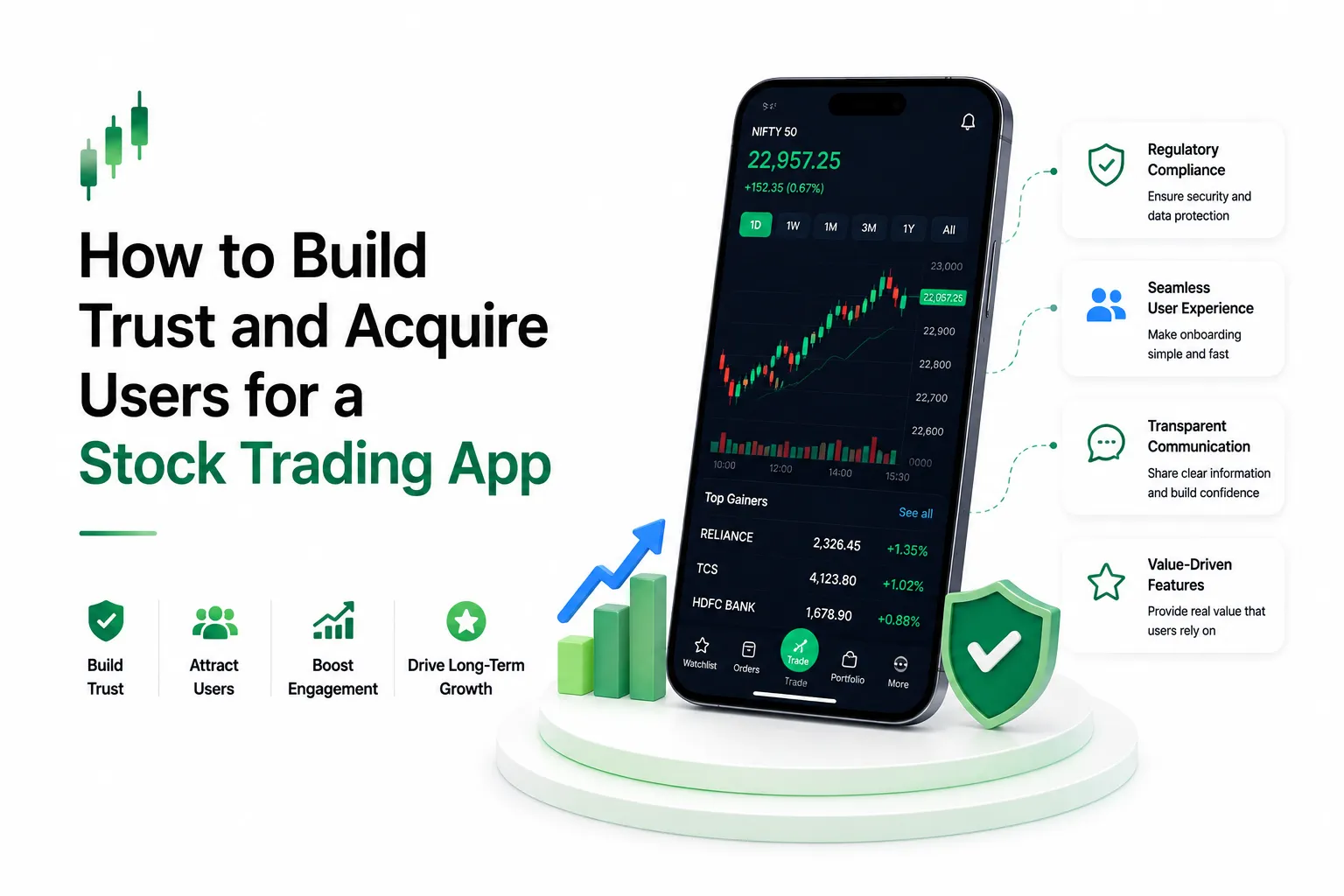
- A stock trading app must establish trust before acquisition by clearly communicating security, KYC requirements, pricing, order execution, withdrawals, and customer support.
- Core trust signals include secure onboarding, transparent brokerage charges, reliable market data, accurate portfolio information, risk controls, and responsive support.
- User acquisition becomes stronger when educational content, referrals, performance marketing, app store visibility, and onboarding optimization work alongside a trustworthy trading experience.
Trust & Acquisition Signals
- Clear KYC steps, security information, fee disclosures, withdrawal policies, privacy controls, and support access can reduce hesitation during trading account onboarding.
- SEO, educational content, social media, referral programs, paid campaigns, partnerships, and app store optimization can attract potential investors and active traders.
- Signup completion, KYC conversion, funded accounts, first trades, acquisition cost, referral activity, and user retention help measure the quality of a trading app growth strategy.
Growth Insights
- Acquiring registrations alone is not enough; the stronger growth funnel moves users from signup to KYC completion, account funding, first trade, and repeat platform usage.
- Fast onboarding, stable order execution, transparent pricing, useful market tools, personalized notifications, and reliable support can improve both trust and long-term retention.
- Miracuves develops customizable stock trading platforms with KYC, market data, order management, portfolio tools, security, payments, analytics, referral workflows, notifications, and admin controls.
Launching a stock trading app is not only a product challenge. It is a trust challenge.
Users are not downloading a casual app where a bad experience only wastes a few minutes. They are connecting identity documents, bank accounts, investment decisions, trading activity, and long-term financial goals to your platform. That changes how acquisition works.
A trading app cannot grow only through discounts, influencer campaigns, or aggressive paid ads. Those tactics may create traffic, but they do not always create confident users. In fintech, trust is the real conversion layer.
For founders building an online brokerage platform, investment app, or multi-broker trading experience, the strongest marketing strategy starts before the first campaign. It starts with product clarity, onboarding confidence, transparent communication, and a retention system that helps users keep coming back.
Miracuves helps founders build launch-ready fintech platforms with branded design, admin control, source-code ownership, and custom workflows. But after the platform foundation is ready, growth depends on how well the business earns user confidence and turns that confidence into active trading behaviour.
Why Trust Comes Before User Acquisition in Trading Apps
Most consumer apps can attract users by showing convenience, entertainment, or savings. A stock trading app needs to prove something deeper: reliability.
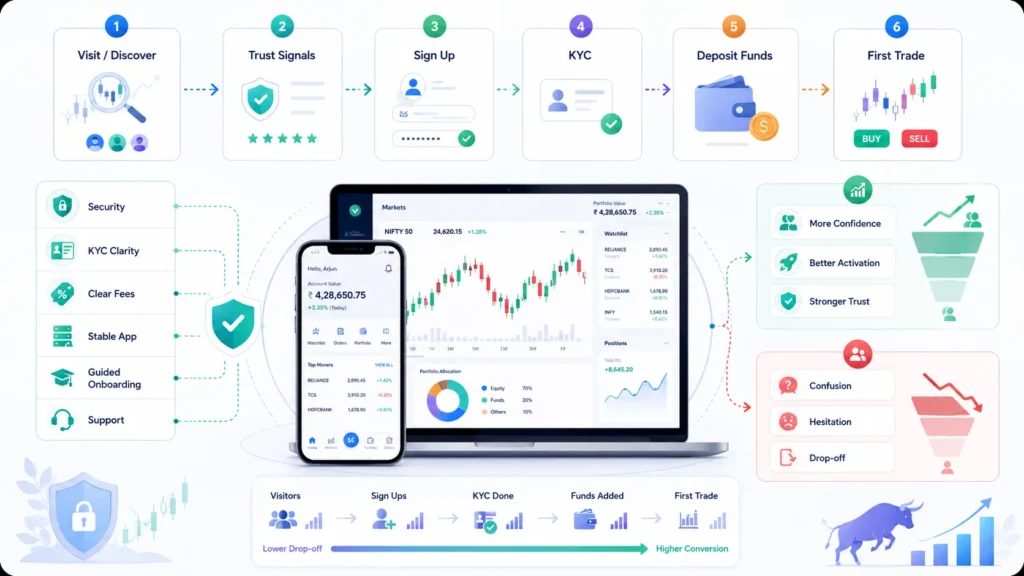
Before users sign up, they want to know whether the platform is safe. Before they complete KYC, they want to know why their documents are required. Before they deposit money, they want confidence that pricing, order flow, withdrawals, and support are clear. Before they place the first trade, they want the app to feel stable and understandable.
That is why trust is not only a brand message. It is part of the acquisition funnel.
A founder may spend heavily on ads, but if the landing page does not explain safety, pricing, onboarding, support, and trading experience clearly, users may drop off before account activation. In fintech, confusion creates hesitation.
A strong trading app growth strategy should answer these questions early:
- Is the platform secure enough for financial activity?
- What does the user need to complete onboarding?
- How are charges, fees, or subscriptions explained?
- What happens after signup?
- How does the app help beginners avoid confusion?
- What support options are available if something goes wrong?
When these answers are visible, users move through the funnel with more confidence.
Understand the Real Trading App Funnel
A stock trading app does not grow by measuring installs alone. Installs are only the top of the funnel.
The real funnel looks like this:
| Funnel Stage | What the User Does | Growth Risk | What Founders Should Improve |
|---|---|---|---|
| Awareness | Discovers the app through SEO, ads, referrals, or social content | User does not understand why this platform is different | Clear positioning and trust-led messaging |
| Signup | Creates an account | Form friction or weak value proposition | Simple signup flow and benefit clarity |
| KYC | Submits identity and verification details | Drop-off due to privacy or process concerns | Explain why documents are needed and what happens next |
| First Deposit | Adds funds or connects required accounts | Fear of money movement | Transparent payment and withdrawal communication |
| First Trade | Places the first order or starts investing | Product confusion | Guided walkthroughs, watchlists, educational prompts |
| Repeat Usage | Returns to track portfolio or trade again | No habit formation | Alerts, portfolio insights, learning content, and lifecycle campaigns |
| Referral | Recommends the app to others | No clear reason to share | Referral rewards, community trust, and social proof |
This funnel matters because every stage has a different marketing job. The message that gets someone to install the app is not the same message that helps them complete verification or place their first trade.
Build a Trust-Led Landing Page Before Running Ads
Many founders run campaigns too early. They send traffic to a page that talks about features but does not reduce user anxiety.
A trading app landing page should not only say “fast trading” or “simple investing.” It should explain why users can trust the platform, what they can do inside it, and how the onboarding process works.
The landing page should include:
- Clear platform positioning
- Supported trading or investment categories
- Onboarding steps
- Security and verification explanation
- Pricing or fee transparency
- App screenshots or product previews
- Support and grievance handling details
- Frequently asked questions
- A simple call to action
If the platform is built on a ready-made foundation, the page can also explain how the product supports branded workflows, admin control, reporting, and user management. This helps connect marketing claims with product reality.
For founders still finalizing the product foundation, Miracuves offers a white-label multi-broker trading platform that can be customized around branding, user journeys, and business requirements.
Use Educational Content to Reduce User Hesitation
Trading users search for answers before they trust a platform. Before users choose a new investing product, many first want to understand how online discount brokerage platforms work, including account opening, order placement, pricing, watchlists, and back-office workflows.
They may search for how account opening works, what brokerage charges mean, how watchlists help, how margin works, how to read charts, or how to avoid beginner mistakes. This gives founders a major SEO opportunity.
Instead of creating only promotional pages, build educational content that supports user confidence.
Useful content topics include:
- How to open a trading account online
- What beginners should check before choosing a trading app
- How brokerage charges work
- How watchlists help new investors track opportunities
- How to understand order types before placing a trade
- What KYC means in a trading app
- How to manage risk as a new trader
- How portfolio tracking helps long-term investors
For example, founders can study how modern investing apps simplify stock and mutual fund access through this guide on how Groww works and then use similar educational thinking for their own user onboarding content.
This content should not push users aggressively. Its job is to make the user feel informed. In fintech, informed users are more likely to become active users.
Position Your App Around a Clear User Segment
A generic trading app is harder to market.
Founders often try to target every type of user at once: beginners, intraday traders, long-term investors, algo traders, wealth managers, and regional investors. That creates unclear messaging.
A better approach is to choose a clear entry segment.
For example:
| Target Segment | Messaging Angle | Content Angle | Product Focus |
|---|---|---|---|
| Beginner investors | Simple investing without confusion | Beginner guides, glossary content, onboarding explainers | Easy signup, watchlists, portfolio view |
| Active traders | Speed, alerts, order control | Order types, charting, market movement guides | Fast execution, alerts, advanced dashboard |
| Regional users | Local trust and accessible investing | Language-specific education, regional market examples | Localized UI, simple support |
| Trading educators | Community-led investing | Learning journeys, webinars, model portfolios | Content tools, user cohorts, admin segmentation |
| Multi-broker users | One place to manage trading workflows | Portfolio consolidation, broker comparison, workflow guides | Multi-broker access, reporting, unified dashboard |
This segmentation makes acquisition cheaper and content more focused. A founder does not need to win every user segment from day one. The goal is to win the right first segment and expand from there.
Once the first user segment is clear, the next step is to connect acquisition channels with the right trading platform business model so revenue, retention, and product workflows move in the same direction.
Improve KYC Completion With Clear Communication
KYC is one of the most important conversion points in a trading app funnel.
A user may be willing to explore the app but still hesitate when asked to submit identity details. This is normal. The platform is asking for sensitive information, so the user needs clarity.
Founders should explain:
- Why KYC is required
- What documents may be needed
- How long verification may take
- What happens after submission
- How user data is handled
- What users should do if verification fails
This explanation should appear inside the app, on the landing page, in email reminders, and in help content.
Do not treat KYC as only a compliance step. Treat it as a trust moment.
Use Lifecycle Marketing to Move Users From Signup to First Trade
A signup does not mean the user is activated.
Many trading app users create an account and then pause. They may be unsure what to do next. They may not understand the dashboard. They may not be ready to deposit money. They may need reminders, education, or reassurance.
Lifecycle marketing helps move users forward.
A simple lifecycle sequence can include:
- Welcome message after signup
- KYC guidance message
- Verification status update
- First watchlist creation prompt
- Beginner education email
- First deposit explanation
- First trade walkthrough
- Portfolio tracking reminder
- Risk awareness content
- Dormant user reactivation message
These messages should be helpful, not pushy. In fintech, aggressive trading prompts can damage trust. The goal is to guide users responsibly.
Build SEO Around Problems, Not Only Platform Features
Many fintech founders make the mistake of writing content only around app features.
Features matter, but users often search for problems and questions. A stronger SEO strategy should cover the full decision journey.
Instead of only writing about “trading app features,” create content around questions like:
- How do I choose a trading app?
- What makes a trading platform reliable?
- How do trading apps make money?
- Why do users abandon trading apps after signup?
- How can beginners start investing safely?
- What should founders know before launching an online brokerage platform?
This type of content supports commercial pages without competing with them. It brings problem-aware users into the funnel and naturally guides them toward the platform page when they are ready.
Make Referral Marketing Trust-Based
Referral campaigns can work well for fintech, but only when users are comfortable recommending the platform.
A trading app referral program should not feel like a random discount campaign. It should be built around confidence.
Users are more likely to refer when:
- The app experience is stable
- Pricing is transparent
- Withdrawals and support work smoothly
- Educational content is useful
- The referral benefit is easy to understand
- The referred user gets a clear onboarding path
Referral rewards can help, but trust drives the recommendation. If the platform experience is weak, referral incentives may bring short-term traffic but poor retention.
Use Social Proof Carefully
Social proof matters in financial products, but it should be used responsibly.
Do not create fake testimonials, fake user counts, or exaggerated claims. Users in fintech are sensitive to credibility. Unsupported numbers can harm trust.
Better social proof includes:
- Product screenshots
- Transparent feature explanations
- Founder-led walkthroughs
- Educational webinars
- Real user feedback where permission exists
- Support process clarity
- Public documentation
- App demo videos
- Clear company background
For early-stage platforms, honest product clarity is better than inflated credibility.
Retention Depends on Habit, Not Just Features
A trading app grows when users return regularly.
Retention does not happen only because the app has many features. It happens because users develop habits around tracking, learning, reviewing, and acting.
Useful retention drivers include:
- Price alerts
- Watchlist reminders
- Portfolio summaries
- Weekly market education
- Risk awareness prompts
- Personalized learning journeys
- Order history clarity
- Performance tracking
- Re-engagement campaigns for inactive users
The strongest retention systems combine product experience and communication. The app gives users a reason to return, and lifecycle marketing reminds them at the right moment.
Founders can also review the Robinhood revenue model to understand how repeat usage, subscriptions, trading activity, and financial product engagement can influence long-term platform monetization.
Founder Decision Signals
Trust
If users hesitate during signup, KYC, or deposit, the issue may not be traffic. It may be unclear communication, weak onboarding, or low platform confidence.
Acquisition
Paid campaigns work better when landing pages explain the platform, user benefits, security logic, pricing, and onboarding steps clearly.
Activation
The most important growth milestone is not installation. It is moving users from signup to KYC completion, first deposit, first watchlist, or first trade.
Retention
Repeat usage grows when users receive alerts, portfolio visibility, educational content, and lifecycle journeys that match their experience level.
Product Features That Support Marketing Growth
Marketing cannot fix a product that users do not trust or understand.
For a stock trading app, growth depends on features that directly support confidence, activation, and repeat usage.
Founders can also review the trading app features that support onboarding and retention before deciding which growth workflows should be included from day one.
| Feature Layer | Why It Matters for Growth |
|---|---|
| Simple onboarding | Reduces signup and KYC drop-off |
| Secure login | Builds confidence around financial access |
| Watchlists | Helps users return and track market movement |
| Portfolio dashboard | Gives users a reason to check the app regularly |
| Transparent fee display | Reduces hesitation before deposits and trades |
| Alerts and notifications | Supports repeat engagement |
| Help center and FAQs | Reduces support load and user confusion |
| Admin dashboard | Helps the operator track users, verification, activity, and issues |
| Risk controls | Supports responsible platform management |
| Analytics | Helps founders identify drop-off points and improve campaigns |
This is why founders should align marketing strategy with product architecture. If campaigns promise speed, clarity, or reliability, the platform must support those expectations.
Founders planning a broader investment product can also explore Miracuves’ finance and investment platform solutions to understand how portfolio tools, trading workflows, secure transactions, and analytics can support long-term user growth.
Miracuves helps founders create stock trading app foundations with branded user journeys, admin control, and customization support so marketing and product execution can work together.
Mistakes Founders Should Avoid While Marketing a Trading App
Running Ads Before Fixing the Funnel
Traffic is expensive when onboarding is unclear. Before scaling paid acquisition, founders should review landing pages, signup forms, KYC messaging, support flows, and first-user journeys.
Using Overpromising Financial Messaging
Avoid claims that suggest guaranteed returns, risk-free trading, or assured profits. Trust grows when the platform communicates responsibly.
Ignoring Beginner Education
Many users need help before they act. Without learning content, users may install the app but never complete the first meaningful action.
Treating Compliance as a Back-End Issue Only
Compliance-related workflows affect marketing because they shape user trust. KYC, risk disclosures, support records, and grievance communication should be explained clearly.
Measuring Only Installs
Installs do not prove growth. Track KYC completion, deposit conversion, first trade, repeat sessions, referral quality, and dormant user recovery.
A Practical 30-Day Growth Plan for a Stock Trading App
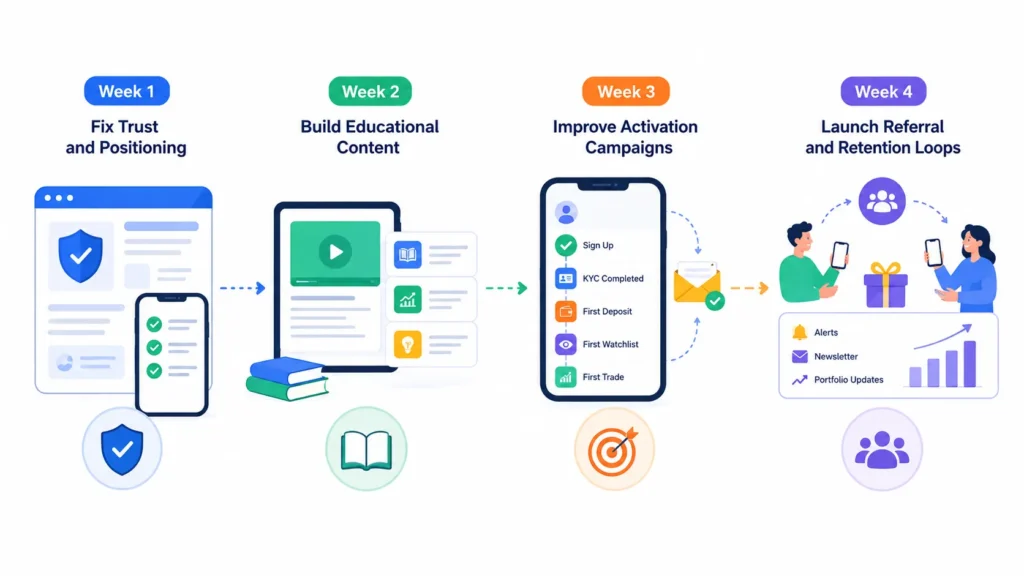
Week 1: Fix Trust and Positioning
Start by reviewing your landing page, onboarding copy, pricing explanation, KYC messaging, app screenshots, and FAQs. Make sure users understand what the platform does and why they can trust it.
Week 2: Build Educational Content
Publish beginner-friendly content around account opening, order types, watchlists, pricing, portfolio tracking, and risk awareness. Use this content for SEO, email onboarding, and social distribution.
Week 3: Improve Activation Campaigns
Create lifecycle messages for signup, KYC completion, first deposit, first watchlist, and first trade. Track where users stop and adjust copy or product guidance.
Week 4: Launch Referral and Retention Loops
Introduce referral campaigns only after the core experience is stable. Add portfolio reminders, alerts, educational newsletters, and reactivation campaigns for inactive users.
How Miracuves Supports Faster Launch and Growth Readiness
A trading app needs more than attractive screens. It needs a product foundation that can support onboarding, user verification, portfolio access, admin monitoring, secure workflows, and continuous growth experiments. If these layers are weak, even strong marketing campaigns may struggle because users can lose confidence before they complete signup, verification, deposit, or first trade.
Founders who are still shaping the product roadmap can first study how to build a modern stock trading app before finalizing the platform foundation, growth funnel, onboarding journey, and launch plan. This helps connect product planning with real acquisition goals instead of treating marketing as a separate activity after development.
Miracuves helps founders launch white-label fintech platforms with source-code ownership, branded design, admin control, and faster deployment. Founders comparing different launch paths can also explore Miracuves’ ready-made app solutions before choosing the right product foundation for their market, audience segment, and long-term business model.
For founders planning an online brokerage or trading platform, the smarter path is to align product, trust, onboarding, and acquisition from the beginning. When the app experience supports the marketing promise, users are more likely to understand the platform, complete key actions, and return with confidence.
Final Thoughts
The strongest way to grow a stock trading app is not to chase installs blindly. It is to build trust at every stage of the user journey.
Users need to understand the platform before they sign up. They need confidence before they complete KYC. They need clarity before they deposit money. They need guidance before they place the first trade. They need value before they return.
That is why marketing and product strategy must work together.
If you are still comparing platform direction, this guide on modern trading app vs traditional brokerage software can help clarify which model gives better control over user experience, scalability, integrations, and growth experiments.
A founder who builds trust, explains onboarding, supports education, and tracks activation will usually create a stronger growth engine than a founder who only spends on ads. In fintech, trust is not a soft brand layer. It is the foundation of acquisition, conversion, and retention.
FAQs
How do you market a stock trading app?
Start with trust-led positioning, educational content, clear onboarding, transparent pricing, lifecycle emails, referral campaigns, and retention features such as alerts, watchlists, and portfolio summaries. Paid ads can help, but they work better when the product and landing page already explain why users should trust the platform.
What is the best user acquisition strategy for a trading app?
The best strategy combines SEO, beginner education, referral marketing, paid search, onboarding optimization, and lifecycle campaigns. For trading apps, acquisition should focus on quality users who complete KYC, deposit funds, and return to the platform.
Why do users abandon trading apps after signup?
Users often drop off because onboarding feels complex, KYC is not explained clearly, pricing is confusing, or the app does not guide them toward the first meaningful action. Better communication and guided product flows can reduce abandonment.
How can a trading platform build trust with new users?
A trading platform can build trust through transparent fees, clear KYC instructions, secure login, visible support options, educational content, responsible risk communication, and a stable product experience.
What content should a stock trading app publish for SEO?
Useful SEO topics include beginner investing guides, trading account setup, KYC explainers, order type guides, fee comparison content, risk awareness articles, portfolio tracking guides, and platform selection checklists.
How important is retention for a trading app?
Retention is extremely important because trading platforms grow when users return to monitor markets, track portfolios, place orders, and learn. Alerts, watchlists, portfolio summaries, learning journeys, and reactivation campaigns can improve repeat usage.
Should founders run paid ads before launching the full platform?
Founders should avoid scaling paid ads before fixing landing pages, onboarding, KYC communication, product walkthroughs, and support flows. Paid traffic works better when the conversion journey is clear.
How can Miracuves help founders launch a trading platform faster?
Miracuves helps founders build white-label fintech platforms with branded design, source-code ownership, admin control, and customization support. This gives founders a stronger product foundation before scaling acquisition campaigns.
Miracuves is an independent software development company. We are not affiliated with, connected to, sponsored by, or endorsed by any company or product named in this article.
Terms such as “X Clone” are used descriptively. It is how the software industry refers to building a platform with functionality comparable to a known service, and how clients search for it.
The entire design and codebase of our products is built by our own team. Our products contain no code, design, graphics, or content originating from any third-party website or applications.
All third-party names and marks referenced in this article are the property of their respective owners, referenced solely to identify the services discussed.