Key Takeaways
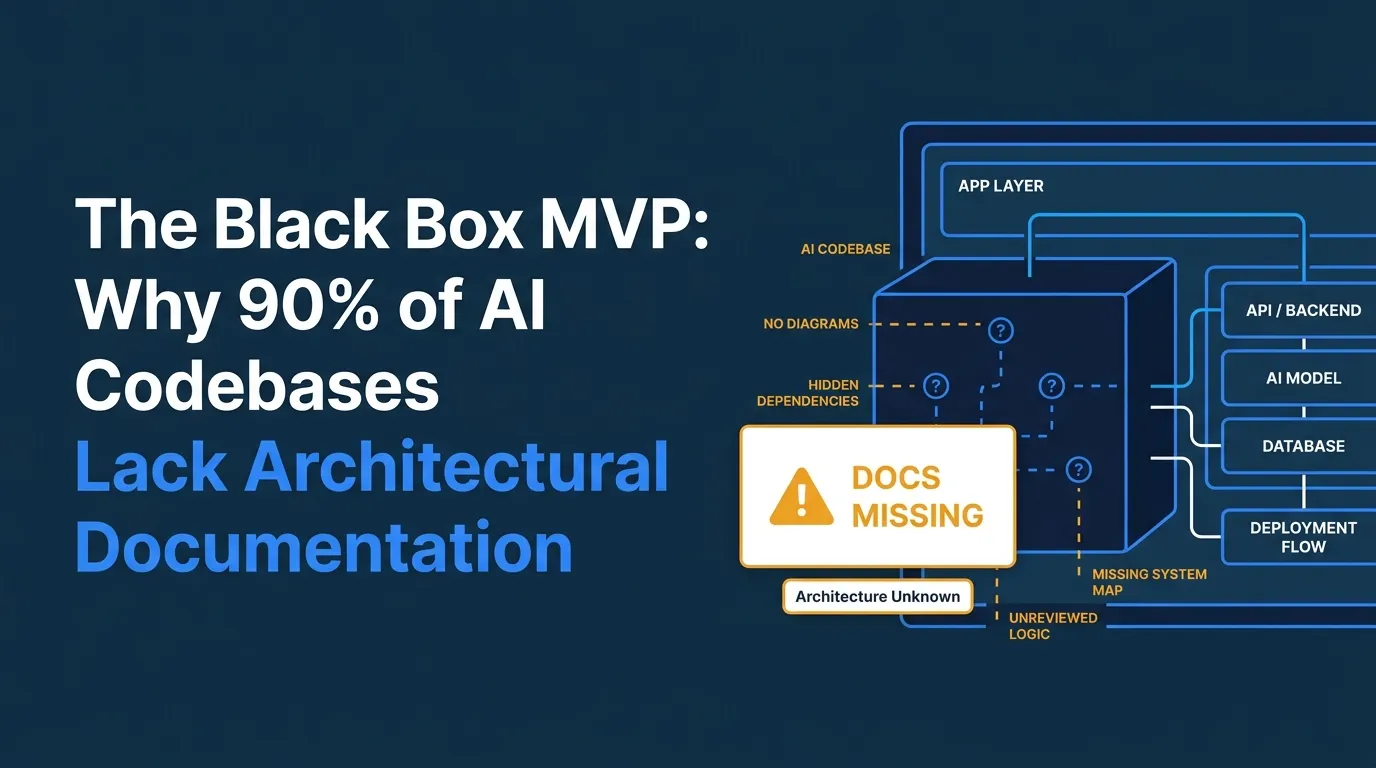
- An AI-generated MVP can become a black box when the codebase lacks architecture documentation.
- Founders, developers, CTOs, investors, and future engineering teams need clear technical handoff materials.
- Architecture maps, API documentation, database schemas, prompt logic, and deployment notes are core documentation layers.
- Documentation risk depends on code quality, AI-generated logic, system complexity, and team visibility.
- A documented AI codebase helps reduce technical debt, investor concern, and scaling friction after launch.
Documentation Signals
- Founders need visibility into product logic, AI workflows, API dependencies, database structure, and deployment steps.
- Developers need clean repositories, readable code, environment setup guides, integration notes, and module-level explanations.
- Admins need control over prompts, model settings, user roles, logs, system alerts, and operational documentation.
- Prompt logic and model configuration should be documented because they directly affect product behavior.
- Technical records help future teams debug issues, onboard faster, review architecture, and plan safe improvements.
Real Insights
- A working demo is not the same as a maintainable product when nobody can explain how the system works.
- Undocumented AI logic can make bugs harder to trace, prompts harder to improve, and integrations harder to replace.
- CTOs and investors may lose confidence when the MVP has no architecture notes, API map, or deployment runbook.
- Founders should document decisions before scaling, hiring engineers, raising funds, or moving into enterprise sales.
- Miracuves builds AI MVPs with documented architecture, prompt workflows, API guides, database structure, deployment notes, and admin control.
AI has made it easier than ever to build a product demo, a working prototype, or a first version of an app. A non-technical founder can now describe a feature, generate screens, connect APIs, and ship something that appears functional in weeks instead of months.
That speed is real.
The problem begins after the demo works.
A CTO joins. A seed round closes. Customers request enterprise features. Security reviews begin. The founder asks the engineering team to “just scale what we already have.” Then the team opens the codebase and discovers the real product is not an MVP. It is a black box.
There are routes, services, prompts, database calls, environment variables, model integrations, fallback handlers, and business rules scattered across the system. Some logic is duplicated. Some logic is hidden inside prompt chains. Some logic only works because one AI-generated function happens to call another AI-generated function in the right order. Nobody knows why the structure exists. Nobody knows which assumptions are intentional. Nobody knows what will break if a core module changes.
This is what Miracuves calls orphaned logic.
Orphaned logic is code that may run today but has no architectural parent. It has no decision record, no system map, no ownership trail, no module boundary, and no explanation of why it exists. For a CTO inheriting a non-technical founder’s AI MVP, orphaned logic is one of the most expensive forms of technical debt because it hides inside working software.
A 2026 empirical study of AI-authored commits found that AI-generated code can introduce long-term maintenance costs into real repositories. The study analyzed 304,362 verified AI-authored commits across 6,275 GitHub repositories and identified 484,606 distinct AI-introduced issues. Code smells represented 89.1% of those issues, and 24.2% of tracked AI-introduced issues were still present in the latest repository revision.
That does not mean AI-generated code is useless. It means AI-generated code without architecture, review, documentation, and ownership discipline can become dangerous faster than founders expect, especially when early software development decisions are made without a clear system design.
For CTOs, the question is no longer, “Can AI build an MVP?”
The better question is, “Can the next engineering team understand, extend, secure, and scale what AI produced?”
The Illusion of Speed: Sacrificing System Documentation
The first trap in AI-assisted MVP development is that speed feels like progress.
A founder asks an AI tool to generate a login flow. Then a dashboard. Then a payment workflow. Then an admin panel. Then a chatbot. Then a recommendation feature. Each feature appears quickly, and every quick win creates the impression that the product is moving forward.
But software does not scale by feature count alone.
It scales through architecture.
Architecture answers questions like:
- Which services own which responsibilities?
- Where does business logic live?
- How does data move between modules?
- Which decisions are hard-coded?
- Which logic is configurable through admin control?
- Where are the model prompts stored?
- How are API failures handled?
- What should happen when traffic increases?
- Which parts of the system are safe to modify?
- What security assumptions were made during development?
In many AI-generated MVPs, these answers are not documented because they were never consciously decided. The AI generated what was requested in the moment. The founder accepted what worked. The system grew through prompts, patches, and short-term fixes instead of a deliberate architecture.
That is why the problem is deeper than missing comments.
A code comment may explain what a function does. Architectural documentation explains why the system exists in that shape.
Without architectural documentation, the CTO is forced to reverse-engineer intent from output. That is slow, risky, and expensive.
The illusion of speed appears when the founder says:
“We already built the MVP. We just need to scale it.”
The CTO sees something different:
“We have a working interface, but we do not yet know whether we have a scalable product foundation.”
That gap is where AI MVPs become black boxes.
Read More: Stripe Payments Not Reconciling? Fix the Webhook Desync Breaking Your AI App Revenue
What Makes an AI MVP a Black Box?
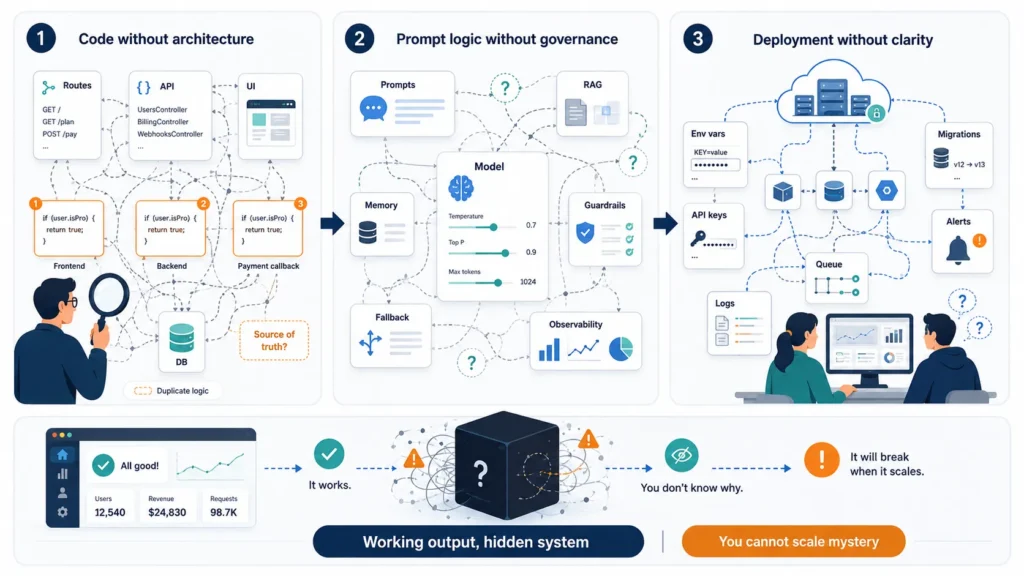
An AI MVP becomes a black box when it can produce outputs but cannot explain its internal logic in a way that engineers can trust.
This often happens in three layers.
1. Code Exists Without Architecture
The app may have controllers, routes, database tables, API calls, and UI components, but no system diagram shows how they connect. The CTO has to inspect files manually to understand relationships that should have been documented from the beginning.
This becomes especially painful when the same business logic appears in multiple places. For example, subscription access may be checked in the frontend, backend middleware, and payment callback handler, each with slightly different rules. The app works until one rule changes. Then nobody knows which part is the source of truth.
2. Prompt Logic Exists Without Product Governance
AI products are not only codebases. They also contain prompt templates, retrieval rules, model settings, chunking strategies, embeddings, memory logic, fallback behavior, and guardrails.
If those decisions are hidden inside scattered files or hard-coded service functions, the system becomes hard to improve. A CTO cannot confidently tune answer quality, reduce hallucination risk, or change model providers if the prompt architecture is undocumented.
Miracuves’ generative AI development approach emphasizes production LLM applications with RAG knowledge assistants, AI agents, guardrails, observability, and source-code ownership, which reflects the level of delivery discipline AI products need beyond simple prompt wrappers.
3. Deployment Works Without Operational Clarity
A black box MVP may run on a cloud server, a no-code backend, a serverless function, or a collection of connected third-party tools. The deployment may work today, but the team may not know:
- Which environment variables are required
- Which API keys are used
- Which services must restart after deployment
- Which logs matter
- Which queue handles background tasks
- Which database migrations are safe
- Which alerts should trigger action
This is not a documentation inconvenience. It is an operational risk.
When customers arrive, the CTO cannot scale mystery.
Read More: What 70%+ of AI-Built Apps Get Wrong About Security — And Why Users Can See Each Other’s Data
Statistical Reality: The Impossibility of Scaling Orphaned Logic
The phrase “90% of AI codebases lack architectural documentation” should be used carefully unless supported by Miracuves’ own internal audit data. But the direction of the problem is strongly supported by broader software engineering research.
A study on non-functional requirements documentation found that maintainability, reliability, usability, and performance were considered important but were not documented by more than 22% of respondents. That matters because these are the exact qualities a CTO must evaluate before scaling an MVP.
A separate review of technical debt and maintainability measurement found that tools often define and measure technical debt differently, making maintainability difficult to judge through automated scores alone.
This creates a dangerous reality for AI MVPs.
If the documentation is missing and the tools cannot fully explain maintainability, the CTO is left with manual discovery. That discovery usually starts with uncomfortable questions:
- Why is this service connected directly to the database?
- Why are prompts mixed with business logic?
- Why are credentials handled this way?
- Why is the same validation rule repeated in three files?
- Why is there no API contract?
- Why is the admin panel unable to control key logic?
- Why does one model response change downstream behavior?
- Why are there no architecture decision records?
- Why does nobody know what this function does?
Orphaned logic makes scaling impossible because scaling requires confidence.
You cannot confidently add enterprise features when role-based access logic is undocumented.
You cannot confidently add new payment flows when transaction rules are scattered.
You cannot confidently add AI agents when tool permissions are unclear.
You cannot confidently onboard engineers when the system has no architecture map.
You cannot confidently refactor when nobody knows which behavior customers depend on.
This is why AI MVPs often face a painful decision after early traction:
| CTO Finding | Business Meaning | Likely Outcome |
|---|---|---|
| No architecture diagram | The system structure is not explainable | Slow onboarding and high refactor risk |
| No API documentation | Integrations are hard to extend | Enterprise deals slow down |
| No prompt governance | AI behavior is difficult to control | Quality and safety issues increase |
| No database schema notes | Data assumptions are unclear | Reporting and scaling become fragile |
| No deployment runbook | Operations depend on guesswork | Downtime risk increases |
| No decision records | Tradeoffs are invisible | Rebuild decisions become political |
| No admin control map | Business logic is developer-dependent | Founder cannot adjust operations quickly |
The MVP may still work.
But it is no longer cheap.
The cost has moved from development into comprehension.
Read More: How an AI-Built MVP Leaked PII and Why the White-Label Rescue Worked
The Orphaned Logic Variable: Why Working Code Can Still Be Unscalable
Orphaned logic is dangerous because it hides behind successful demos.
A login works. A dashboard loads. An AI answer appears. A payment is processed. A user record is saved. From the founder’s view, the product is alive.
From the CTO’s view, the product may be structurally fragile.
Orphaned logic usually appears in five forms.
1. Undocumented Business Rules
Business rules decide how the product behaves. In an AI MVP, these rules may be buried inside generated functions, frontend conditions, prompt instructions, webhook handlers, or admin shortcuts.
For example, a SaaS AI product may limit usage based on subscription tier. If that rule exists partly in the frontend and partly inside a backend check, the CTO must determine which rule is authoritative. If neither is documented, scaling subscriptions becomes risky.
2. Undocumented Model Behavior
AI apps depend on model settings, prompts, retrieval strategies, memory rules, and fallback logic. If those decisions are not documented, every future improvement becomes guesswork.
A founder may say, “The chatbot gives good answers.”
The CTO needs to know:
- Which model is used?
- What temperature setting is used?
- Is retrieval enabled?
- What sources can the model access?
- Are answers grounded in source content?
- What happens when retrieval fails?
- Are user conversations stored?
- Are sensitive fields filtered?
- Are outputs logged for review?
If those answers are missing, the AI layer is not production-ready.
3. Undocumented Data Flows
AI MVPs often connect multiple services quickly: authentication, payments, analytics, LLM APIs, vector databases, storage, emails, notifications, and admin dashboards.
Without a data-flow map, the CTO cannot evaluate privacy, performance, cost, or security. This becomes a serious issue when the product handles customer data, financial data, healthcare information, location data, or proprietary documents.
4. Undocumented Failure Handling
A scalable product is not defined by what happens when everything works. It is defined by what happens when something fails.
What happens when the LLM API times out?
What happens when payment succeeds but account activation fails?
What happens when a background job is delayed?
What happens when a vector search returns irrelevant content?
What happens when a user uploads a corrupted document?
What happens when a webhook is received twice?
If these flows are not documented, the team learns through production incidents.
5. Undocumented Ownership
Every system needs ownership. Someone must know which module controls which behavior. In AI-generated MVPs, ownership is often unclear because features were generated across sessions, prompts, freelancers, plugins, or founder-led experiments.
The result is a codebase where everything exists, but nothing has an owner.
That is orphaned logic.
Founder Decision Signals
Speed
AI can accelerate the first build, but undocumented speed becomes expensive when the next engineering team must reverse-engineer core logic before making changes.
Cost
The visible cost of an AI MVP may be low, but the hidden cost appears during refactoring, onboarding, QA, security review, and architecture cleanup.
Scalability
A product cannot scale safely if data flows, prompt behavior, admin rules, integrations, and deployment assumptions are not documented.
Market Fit
Early traction is valuable only if the product foundation can evolve. A black box MVP can validate demand but still fail as a scalable business platform.
The CTO Handover Problem: When a Non-Technical Founder Ships First
The most painful AI MVP failures often happen during handover.
A non-technical founder may successfully build a product that attracts users, investors, or early pilots. That is a real achievement. The issue is not that the founder used AI. The issue is that the founder often made product and architecture decisions without realizing those decisions needed to be captured.
By the time a CTO enters, the MVP may already contain months of hidden decisions.
The founder says:
- “We used AI to move fast.”
- “The product already works.”
- “We just need a technical leader to scale it.”
- “Investors want us to move quickly.”
- “Customers are waiting for enterprise features.”
The CTO silently sees:
- No architecture map
- No domain model
- No API contract
- No prompt registry
- No error-handling policy
- No test coverage strategy
- No deployment runbook
- No documentation of tradeoffs
- No clean separation between demo logic and production logic
This creates tension between business urgency and engineering reality.
The founder wants velocity.
The CTO needs clarity.
The codebase offers neither.
A smart CTO does not immediately rewrite everything. The first move is to classify the MVP.
The CTO’s Three-Part Classification
| Classification | What It Means | Recommended Action |
| Documentable | The code is messy but understandable | Add documentation, tests, and architecture maps before scaling |
| Refactorable | The logic works but boundaries are weak | Refactor core modules and document decisions |
| Disposable | The MVP proves demand but cannot support scale | Rebuild using a clean architecture and preserve only validated product learnings |
The worst mistake is treating all AI MVPs as production foundations.
Some are. Many are not.
The CTO’s job is to find out before the business builds growth on top of uncertainty.
Read More: The Authentication Loop: Analyzing Session Failures in AI-Generated MVPs
What Architectural Documentation Should Exist Before Scaling an AI MVP
Architectural documentation does not need to become a 200-page enterprise manual. It needs to explain the system well enough that future engineers can make safe decisions.
For an AI MVP, the minimum useful documentation should include the following.
1. System Architecture Diagram
This should show major modules, services, databases, APIs, queues, storage, frontend apps, admin panels, third-party integrations, and AI layers.
The purpose is not decoration. The purpose is shared understanding.
A CTO should be able to look at the diagram and explain how the product works at a system level.
2. Module Responsibility Map
Every major module should have a clear responsibility.
For example:
| Module | Responsibility | Owner Logic |
| Auth service | Login, sessions, user identity | Controls user access |
| Billing service | Subscription, payments, invoices | Controls monetization |
| AI orchestration layer | Prompt routing, model calls, retrieval | Controls AI behavior |
| Admin panel | User, content, pricing, reports | Controls operations |
| Notification service | Email, push, alerts | Controls communication |
| Analytics layer | Events, usage, reporting | Controls product intelligence |
Without this map, developers make assumptions. Assumptions create defects.
3. Data Flow Documentation
Data-flow documentation should show how user data, payment data, AI input, files, logs, and admin changes move through the system.
This matters for performance, privacy, debugging, compliance workflows, and future integrations.
For AI products, data-flow clarity is especially important because prompts and retrieved context may contain sensitive business information.
4. Prompt and Model Governance
An AI product should document:
- Prompt templates
- Prompt versions
- Model providers
- Model settings
- Retrieval sources
- Vector database logic
- Chunking rules
- Fallback responses
- Guardrail logic
- Evaluation criteria
- Human review workflows where needed
If prompts are treated casually, the AI layer becomes unpredictable.
5. API Documentation
Every internal and external API should have documented endpoints, request structures, response structures, authentication rules, error states, and rate-limit considerations.
This becomes essential when integrating enterprise customers, mobile apps, admin dashboards, analytics tools, or third-party services.
6. Database Schema and Entity Relationships
The CTO should know which tables or collections represent users, transactions, subscriptions, documents, messages, prompts, usage limits, permissions, and audit logs.
If the schema is not documented, reporting and feature development become slow.
7. Deployment and Environment Runbook
A deployment runbook should explain:
- Environments
- Build steps
- Environment variables
- Secrets management
- Deployment commands
- Rollback steps
- Logging
- Monitoring
- Backup strategy
- Incident response basics
Without this, deployment becomes tribal knowledge.
8. Architecture Decision Records
Architecture decision records, often called ADRs, explain why key choices were made.
For example:
- Why this database?
- Why this LLM provider?
- Why this vector store?
- Why this auth model?
- Why this deployment architecture?
- Why this admin control structure?
- Why this payment flow?
ADRs prevent future teams from repeating old debates or undoing decisions blindly.
Read More: AI MVP Security Audit: The 14-Point Checklist for Founder Survival
Enterprise Grade: The Miracuves Standard of Deep Documentation
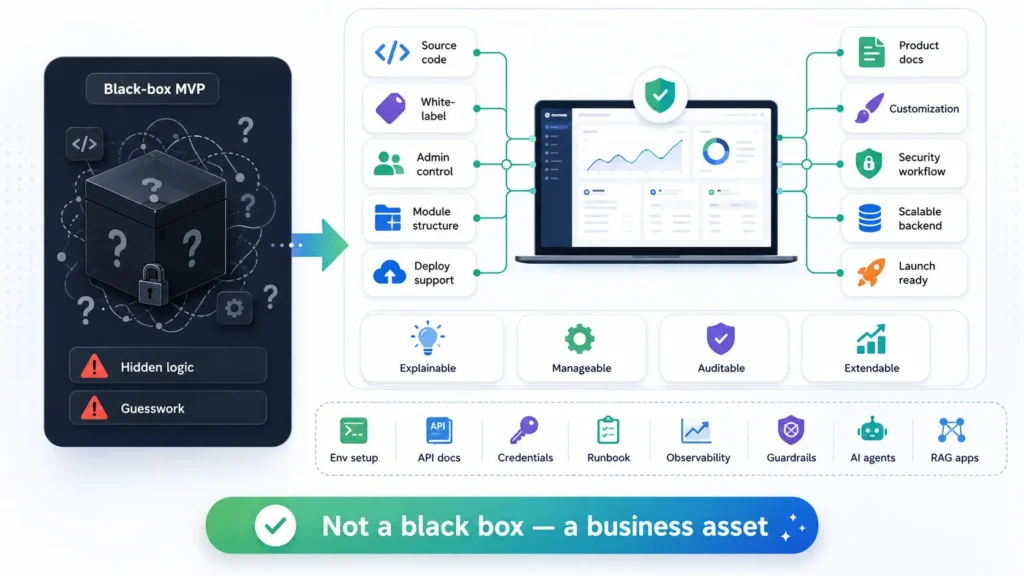
At Miracuves, the goal is not to build software that only works in a demo. The goal is to give founders a launch-ready product foundation that can be understood, customized, operated, and improved.
That difference matters.
A white-label solution without documentation is only a faster black box. A source-code-owned solution without documentation still leaves the founder dependent on guesswork. A launch-ready app without admin clarity can still become rigid after launch.
Miracuves’ approach is built around a stronger handoff standard:
- Source-code ownership
- White-label branding
- Admin dashboard control
- Clear module structure
- Practical deployment support
- Product-specific documentation
- Customisation support
- Security-conscious workflows
- Scalable backend thinking
- Founder-focused launch execution
Miracuves’ full-stack development page describes handoff materials including source code, documentation, environment setup guide, API documentation, deployment credentials, store credentials, and a post-launch runbook.
That is the level of detail CTOs need when inheriting or scaling a product.
For AI products, Miracuves’ generative AI development work includes production LLM applications such as RAG knowledge assistants, AI agents, content generators, and ChatGPT-style products with guardrails, observability, and complete source-code ownership.
This is what separates an enterprise-grade AI build from a prompt-generated MVP.
The product should not only answer users.
It should be explainable to engineers.
It should be manageable by operators.
It should be auditable by leadership.
It should be extendable by future teams.
That is the difference between a black box and a business asset.
AI MVP vs Enterprise-Grade AI Product Foundation
| Area | Black Box AI MVP | Enterprise-Grade Product Foundation |
|---|---|---|
| Architecture | Generated feature by feature without a complete system map. | Designed with clear modules, responsibilities, and system boundaries. |
| Documentation | Minimal notes, scattered comments, or no architectural explanation. | Includes architecture, API, setup, deployment, and operational documentation. |
| AI Logic | Prompts and model settings hidden in code or connected tools. | Prompt behavior, retrieval logic, guardrails, and model choices are documented. |
| Admin Control | Key business logic may require developer changes. | Admin dashboard supports operational control over users, content, settings, and workflows. |
| Scalability | Scaling requires reverse-engineering and refactoring. | Scaling starts from a cleaner, documented foundation. |
| Ownership | Founder may own code but not understand it. | Founder receives source code plus documentation and handoff clarity. |
| Risk | High risk of hidden technical debt and delayed enterprise readiness. | Lower handover risk because engineering decisions are visible. |
Why Source-Code Ownership Alone Is Not Enough
Source-code ownership is important. Founders should not build serious products on platforms where they cannot access, control, or extend the codebase.
But source code alone does not solve the black box problem.
A CTO can own a codebase and still not understand it.
Ownership answers the legal and operational question: “Do we control the asset?”
Documentation answers the engineering question: “Can we safely change the asset?”
Architecture answers the scaling question: “Can this asset grow without collapsing?”
A founder needs all three.
This is especially important in AI products because the product logic may not live only in traditional code. It may live across prompts, chains, model settings, retrieval indexes, vector databases, moderation rules, agent permissions, memory policies, and evaluation workflows.
A source-code handoff that excludes those layers is incomplete.
For AI app development, a proper handoff should include:
- Application source code
- Prompt templates
- Model configuration notes
- API keys and environment setup process
- Retrieval pipeline explanation
- Vector database setup
- Guardrail and fallback logic
- Admin panel documentation
- Deployment guide
- Monitoring and logging overview
- Known limitations
- Future improvement recommendations
This is why CTOs should inspect not only whether source code is delivered, but whether the product can be operated without dependency on the original builder.
The Hidden Business Cost of Undocumented AI Code
The cost of undocumented AI code rarely appears in the first build invoice. It appears later, when the company tries to grow.
Engineering Onboarding Gets Slower
New developers cannot contribute quickly because they must first understand the system manually. They read files, trace function calls, inspect logs, test assumptions, and ask questions nobody can answer.
Every undocumented module adds onboarding drag.
Product Roadmap Becomes Fragile
A roadmap depends on predictable development. If every new feature requires discovery work, sprint planning becomes unreliable.
The product team may promise a feature in two weeks. Engineering may need three weeks just to understand what the feature will affect.
Enterprise Sales Gets Harder
Enterprise customers often ask about security, integrations, uptime, data handling, access controls, audit logs, and deployment architecture.
If the team cannot answer confidently, sales momentum slows.
Refactoring Becomes Politically Difficult
When nobody knows why the system was built a certain way, refactoring becomes emotional. Founders fear delays. CTOs fear instability. Developers fear breaking hidden dependencies.
Documentation reduces this tension because decisions become visible.
AI Quality Becomes Hard to Improve
AI products need continuous tuning. If prompts, retrieval rules, context handling, and evaluation criteria are undocumented, improving quality becomes inconsistent.
The team may improve one answer while breaking another.
Read More: Why Agencies Charge 3x More to Touch AI-Generated Code
How CTOs Should Audit an Inherited AI MVP
Before scaling an inherited AI MVP, CTOs should run a structured documentation and architecture audit.
Step 1: Map the System Before Changing It
Do not start by refactoring. Start by mapping.
Identify:
- Frontend apps
- Backend services
- Databases
- AI model providers
- Vector stores
- Storage services
- Payment gateways
- Authentication providers
- Admin panels
- Third-party APIs
- Background jobs
- Analytics tools
- Deployment environments
The first goal is visibility.
Step 2: Identify Orphaned Logic
Look for logic that exists without a clear owner.
Common signs include:
- Duplicate validation rules
- Hard-coded business rules
- Prompts mixed inside controller files
- Database queries inside UI logic
- Multiple sources of truth
- Unnamed background jobs
- Unclear webhook handling
- No API contracts
- No module boundaries
- Functions nobody wants to touch
Step 3: Separate Demo Logic From Product Logic
Many AI MVPs include shortcuts that were acceptable for validation but unsafe for scale.
Examples include:
- Manual admin workarounds
- Hard-coded pricing
- Static user roles
- No retry logic
- No rate limits
- No audit logs
- No real permission model
- No data retention policy
- No fallback workflow for AI failures
The CTO should classify which shortcuts can remain temporarily and which must be removed before growth.
Step 4: Document Before Refactoring
Documentation should not wait until the system is perfect. It should begin during discovery.
Create:
- Current-state architecture map
- Known risk register
- Module responsibility notes
- Data-flow diagram
- AI logic inventory
- Integration list
- Deployment runbook draft
- Refactor priority list
This gives the team a shared view before making structural changes.
Step 5: Decide Whether to Refactor or Rebuild
Not every AI MVP deserves a rebuild. But not every AI MVP deserves more investment either.
Use this decision logic:
| Signal | Refactor | Rebuild |
| Core product flow works and is understandable | Yes | Not necessary |
| Business logic is duplicated everywhere | Maybe | Often |
| Data model is fundamentally wrong | Hard | Often |
| AI prompt layer is undocumented but recoverable | Yes | Maybe |
| Security model is missing | Maybe | Often |
| No tests, no docs, no module boundaries | Maybe | Strongly consider |
| Customers validated the workflow, not the implementation | Maybe | Often |
The goal is not to protect old code. The goal is to protect the business.
Mistakes Founders Should Avoid With AI-Generated MVPs
Assuming Working Software Is Scalable Software
A product can work for early users and still be structurally weak. Scaling requires architecture, testing, documentation, monitoring, and operational control.
Treating AI Output as Final Engineering
AI can accelerate development, but production software still needs human review, architectural decisions, security checks, and maintainability standards.
Ignoring Prompt and Model Documentation
In AI products, prompts and model settings are part of the product logic. If they are undocumented, the system becomes difficult to improve or govern.
Delaying Documentation Until After Funding
By the time a CTO, investor, or enterprise buyer asks for clarity, missing documentation can slow product development, technical due diligence, and sales conversations.
Where Miracuves Fits: From Black Box MVP to Documented Product Foundation
Founders do not need to reject AI. They need to stop confusing generated speed with product readiness.
A stronger path is to combine speed with engineering discipline.
Miracuves helps founders and product teams build AI, SaaS, marketplace, fintech, delivery, and white-label app solutions with source-code ownership, branded design, admin control, and structured delivery. For teams exploring AI products, Miracuves’ generative AI development services can support production-grade LLM apps, RAG workflows, AI agents, and ChatGPT-style products.
For founders who need a faster launch path, Miracuves also offers white-label ChatGPT clone solutions and broader software development services designed around source-code ownership and delivery clarity.
The key difference is not only how fast the first version launches.
The key difference is whether the product can be understood after launch.
That is what CTOs care about.
That is what investors eventually inspect.
That is what enterprise buyers ask about.
That is what determines whether an MVP becomes a scalable business asset.
Final Thoughts: The Future Belongs to Explainable Codebases
AI will continue to accelerate software development. That is not the debate.
The real question is whether founders will use AI to create scalable product foundations or black box MVPs that collapse under their own hidden logic.
For CTOs inheriting AI-generated MVPs, the first responsibility is not to move fast. It is to make the system explainable. Once the architecture is visible, the team can decide what to document, what to refactor, what to rebuild, and what to scale.
A working MVP can validate demand.
A documented product foundation can support a business.
That is the difference founders need to understand before they mistake speed for readiness.
Miracuves helps founders move from idea to launch faster with ready-made, white-label, and custom AI product solutions built around source-code ownership, admin control, and clearer engineering handoff. If your MVP has become a black box, the next step is not more patching. The next step is architectural clarity.
FAQs
What is AI codebase documentation?
AI codebase documentation explains how an AI-powered product is structured, how its modules connect, how prompts and model settings work, how data flows through the system, and how engineers should deploy, maintain, and scale it. For AI products, documentation should cover both traditional software architecture and AI-specific logic such as prompts, retrieval, guardrails, and model behavior.
Why do AI-generated MVPs often lack architectural documentation?
AI-generated MVPs often grow through fast prompts, feature-by-feature generation, and short-term fixes. Because the founder is focused on making the product work, architectural decisions may happen implicitly instead of being documented. The result is a system that functions but lacks clear explanation of its structure and tradeoffs.
What is orphaned logic in an AI codebase?
Orphaned logic is working code or product behavior that has no clear architectural ownership, documentation, or decision record. It may exist in generated functions, prompts, API handlers, admin shortcuts, or database logic. Orphaned logic is risky because engineers cannot safely change or scale what they cannot explain.
Is AI-generated code bad for MVP development?
No. AI-generated code can be useful for speed, prototyping, scaffolding, and early validation. The problem begins when AI output is treated as production-ready without engineering review, documentation, testing, security checks, and architectural structure.
What should a CTO check before scaling an AI MVP?
A CTO should review system architecture, module boundaries, API documentation, database schema, prompt logic, model settings, third-party integrations, deployment process, security assumptions, admin controls, and test coverage. The goal is to determine whether the MVP is documentable, refactorable, or disposable.
Is source-code ownership enough for an AI product?
Source-code ownership is important, but it is not enough by itself. A founder also needs documentation, deployment instructions, API clarity, architecture diagrams, prompt governance, and admin control. Owning code that nobody understands still creates operational risk.
When should an AI MVP be rebuilt instead of refactored?
An AI MVP may need a rebuild if the data model is wrong, business logic is duplicated across the system, security controls are missing, architecture is unclear, and the product cannot support future features without major risk. If the MVP validated demand but the implementation is fragile, a rebuild can be a smarter business decision.
How can Miracuves help with AI MVP documentation and rebuilds?
Miracuves can help founders assess AI MVP architecture, identify orphaned logic, rebuild unstable product foundations, or launch white-label and custom AI solutions with source-code ownership, admin control, and stronger handoff documentation. The goal is to help founders move faster without sacrificing long-term scalability.
Miracuves is an independent software development company. We are not affiliated with, connected to, sponsored by, or endorsed by any company or product named in this article.
Terms such as “X Clone” are used descriptively. It is how the software industry refers to building a platform with functionality comparable to a known service, and how clients search for it.
The entire design and codebase of our products is built by our own team. Our products contain no code, design, graphics, or content originating from any third-party website or applications.
All third-party names and marks referenced in this article are the property of their respective owners, referenced solely to identify the services discussed.