
Key Takeaways
- AI MVP rebuild cost can rise quickly when the first version has poor architecture, weak documentation, or fragile backend logic.
- Founders, developers, CTOs, agencies, and investors need clarity before deciding whether to fix or rebuild the product.
- Code audits, architecture reviews, database checks, security testing, and documentation are core rebuild decision layers.
- Rebuild risk depends on code quality, modularity, integrations, AI workflows, database structure, and deployment setup.
- A cleaner app foundation can reduce long-term cost, improve developer handoff, and protect startup momentum.
Cost Signals
- Founders need to compare patching cost, rebuild cost, launch delay, technical debt, and future maintenance effort.
- Developers need readable code, clear modules, stable APIs, database structure, environment notes, and deployment documentation.
- Admins need control over users, roles, logs, payments, prompts, AI settings, reports, and operational workflows.
- A rebuild may be safer when the MVP has scattered logic, broken permissions, weak testing, or unreliable integrations.
- Audit reports help identify whether the codebase needs refactoring, partial rebuild, or full replacement.
Real Insights
- A working AI-generated demo can become expensive when every new feature requires developers to untangle hidden logic.
- Patching weak architecture can cost more over time than rebuilding from a clean, scalable foundation.
- Missing documentation, duplicated logic, exposed keys, poor database design, and weak access control increase rebuild pressure.
- Founders should evaluate rebuild cost before hiring agencies, scaling traffic, raising funds, or adding enterprise features.
- Miracuves builds AI MVPs and clone apps with modular architecture, documented codebases, secure workflows, deployment support, and admin control.
Many founders do not realize their AI MVP is broken on day one.
At first, the product feels alive. The chatbot responds. The dashboard loads. The demo looks impressive. A few investor calls go well. A few users say the idea is interesting. The founder thinks the hard part is over.
Then real usage begins.
The responses become inconsistent. The app breaks when multiple users log in. The AI output cannot be controlled. The backend has no clean structure. The admin panel is too limited to manage real operations. The developer who built the first version starts charging hourly for every fix. Every small change creates three new bugs.
That is when the real cost appears.
This is the Rebuild Tax.
The Rebuild Tax is the hidden cost founders pay when they try to rescue a fragile AI MVP instead of replacing it with a cleaner, production-ready foundation. In many startup scenarios, the founder may end up spending 3–5x more on debugging, refactoring, reworking, and relaunching than they would have spent by starting with a strong white-label AI app architecture from day one.
The painful part is not just the money. It is the lost time, lost confidence, lost user momentum, and delayed market validation.
Miracuves helps founders avoid this trap by offering ready-made and white-label AI app solutions, including ChatGPT-style platforms, AI automation systems, and source-code-owned product foundations that can be customized for real business models.
The Sunk Cost Fallacy of the AI-Prompted Startup
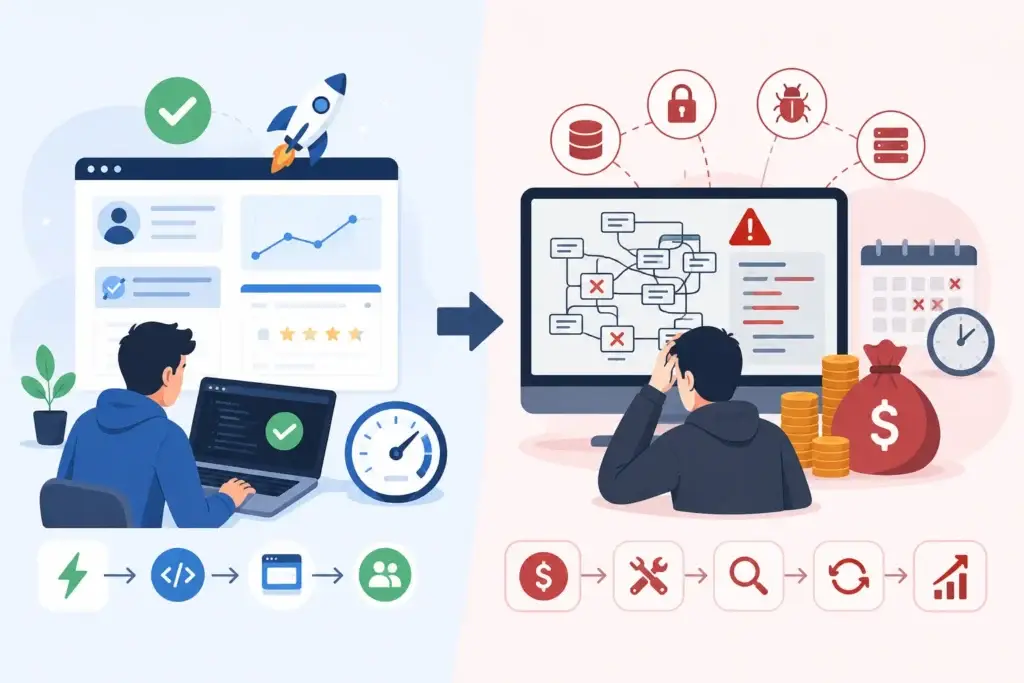
A broken AI MVP rarely looks broken at the beginning.
It usually starts as a fast experiment. The founder uses AI coding tools, freelancers, no-code workflows, open-source templates, or a low-cost team to build the first version. The goal is reasonable: prove demand before committing serious capital.
The problem begins when the first version is treated like a production product.
An AI MVP built for a demo is usually optimized for speed, not durability. It may have hardcoded prompts, fragile API calls, poor role management, weak data storage, no structured admin controls, and little visibility into what happens when the AI fails.
That is manageable during a pitch deck demo. It becomes dangerous when real users, payments, usage limits, support requests, and business workflows enter the system.
This is where founders fall into the sunk cost fallacy.
They think:
“We already spent money on this. Let’s just fix it.”
That sounds practical. But in software, especially AI software, fixing a weak foundation can become more expensive than replacing it.
Why?
Because developers are not just building new features. They are first trying to understand what already exists. They must inspect the codebase, identify broken logic, map the data flow, review API calls, understand prompt behavior, test model responses, trace bugs, and decide whether each module should be repaired or rewritten.
The founder pays for all of that discovery.
Then the founder pays again for actual development.
Then the founder pays again for testing.
Then the founder pays again when the old architecture breaks under the new changes.
That repeating cycle is the Rebuild Tax.
Read More: Stripe Payments Not Reconciling? Fix the Webhook Desync Breaking Your AI App Revenue
What the Rebuild Tax Really Means for AI Founders
The Rebuild Tax is not normal maintenance.
Maintenance keeps a healthy product stable. The Rebuild Tax is what happens when a product needs structural rescue before it can grow.
For AI startups, the Rebuild Tax usually appears in five layers:
- Code understanding cost
Developers spend hours reading, interpreting, and questioning the old codebase. - Architecture correction cost
The app needs restructuring because the original product was not designed for real users, scale, security, or integrations. - AI behavior correction cost
Prompts, model calls, RAG flows, embeddings, hallucination controls, and fallback logic need to be rebuilt. - Operational control cost
Founders realize they lack a useful admin dashboard for users, plans, prompts, usage, subscriptions, support, and content control. - Opportunity cost
The product remains stuck in repair mode while competitors keep launching, testing, selling, and learning.
This is why the cheapest first build often becomes the most expensive second build.
A founder may think they are saving money by fixing what they already have. But if the app has no clean architecture, every repair becomes a negotiation with hidden complexity.
Read More: What 70%+ of AI-Built Apps Get Wrong About Security — And Why Users Can See Each Other’s Data
The Mathematics of the Rebuild Tax: Hourly Debugging vs. Licensing
Let’s turn the Rebuild Tax into a simple founder cost model.
This is not a universal price quote. It is a practical way to compare two paths:
- Path A: Keep repairing a broken AI MVP with hourly development
- Path B: Replace the fragile foundation with a ready-made or white-label AI app architecture
Scenario: Founder with a broken AI assistant app
The app already has:
- User login
- Chat interface
- OpenAI or LLM API connection
- Basic prompt workflows
- A simple dashboard
- Payment idea, but not fully stable
- No strong admin control
- No clear error monitoring
- No reliable usage tracking
- No scalable backend design
The founder wants to turn it into a real product.
Path A: Hourly repair model
| Cost Layer | Example Work | Why It Becomes Expensive |
|---|---|---|
| Code audit | Review old frontend, backend, database, API calls, prompt logic | Developers must understand the mess before fixing it |
| Bug fixing | Resolve crashes, broken flows, inconsistent responses | Fixes often reveal deeper architecture issues |
| Refactoring | Rewrite weak modules without breaking the full app | Refactoring takes longer when documentation is poor |
| AI workflow cleanup | Rebuild prompts, memory, retrieval, fallback logic | AI behavior is hard to stabilize if it was patched together |
| Admin dashboard fixes | Add controls for users, prompts, usage, plans, payments | Admin logic touches multiple backend systems |
| Testing | Regression testing after each change | Old code creates unpredictable breakpoints |
| Delay cost | Product cannot scale during repair | Founder loses market learning time |
Now imagine a developer team charging hourly.
Even if the hourly rate looks reasonable, the founder is not only paying for development. They are paying for investigation, cleanup, rework, retesting, and uncertainty.
A rough Rebuild Tax model may look like this:
| Repair Phase | Estimated Hours | Cost Exposure |
| Technical audit and code discovery | 40–80 hours | Paid before visible progress |
| Backend cleanup and refactoring | 100–250 hours | Depends on code quality |
| AI prompt and workflow stabilization | 60–160 hours | Requires repeated testing |
| Admin and payment correction | 80–180 hours | Touches critical business logic |
| QA, deployment, bug cycles | 80–200 hours | Expands with product fragility |
| Founder management time | High | Not shown on invoices, but very real |
The founder may begin with a “small fix” but end up funding a partial rebuild.
That is how the total cost can become 3–5x higher than expected.
Not because developers are always overcharging. Often, they are dealing with a codebase that was never structured for production.
Path B: White-label AI app foundation
A white-label AI app foundation changes the economics.
Instead of paying developers to untangle a fragile system, the founder starts from a cleaner product base that already includes the core app logic. The budget goes toward branding, configuration, feature customization, integrations, and launch preparation.
For example, a founder considering an AI assistant, chatbot, automation, or ChatGPT-style platform can evaluate a source-code-owned foundation such as a ChatGPT clone app or a broader generative AI development service from Miracuves.
The difference is strategic:
| Decision Factor | Repairing Broken AI MVP | Licensing White-Label AI Architecture |
| First spend | Audit and debugging | Product foundation and customization |
| Developer focus | Understanding old mistakes | Adapting a working base |
| Timeline risk | High because every fix may reveal new issues | Lower because core flows already exist |
| Admin control | Often needs to be built later | Can be included from the foundation |
| Source ownership | Depends on previous developer terms | Can be clarified before launch |
| Scalability | Uncertain until rebuilt | Planned into the architecture |
| Founder energy | Spent managing repair cycles | Spent validating market and monetization |
The Rebuild Tax is not only a financial issue. It is a focus issue.
Founders should not spend their most important early months managing technical cleanup. They should spend them testing positioning, onboarding users, improving retention, building partnerships, and learning what customers will pay for.
Read More: How an AI-Built MVP Leaked PII and Why the White-Label Rescue Worked
Why AI MVPs Become Expensive to Rescue
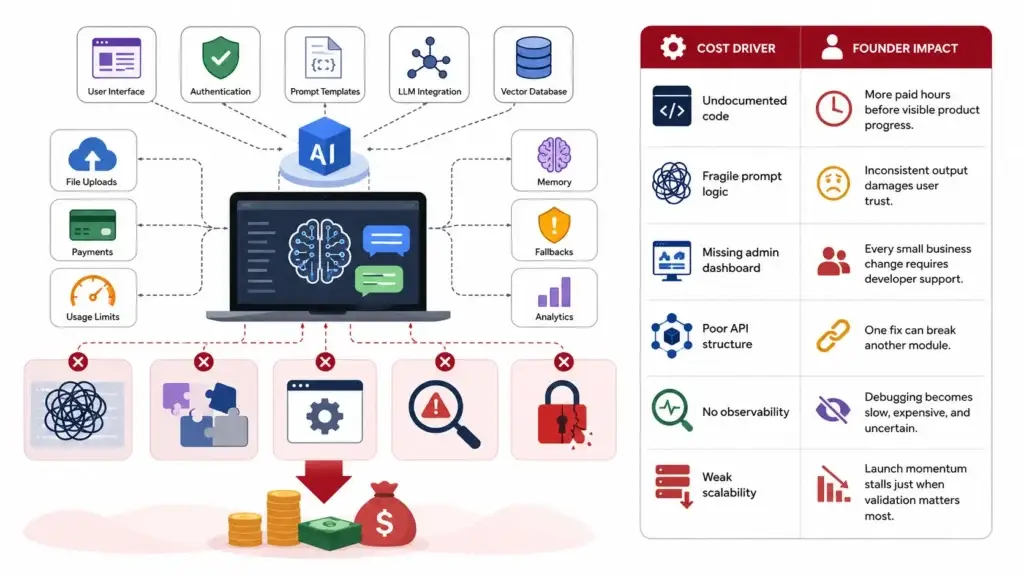
AI apps are not normal CRUD apps with a chat box attached.
A serious AI product has multiple moving parts:
- User interface
- Authentication
- Prompt templates
- LLM API integration
- Model selection
- Usage limits
- Conversation memory
- Retrieval workflows
- Vector database logic
- File uploads
- Payment plans
- Admin dashboard
- Analytics
- Abuse prevention
- Fallback responses
- Error handling
- Data privacy controls
When an AI MVP is built too quickly, these layers often become tangled.
Prompt spaghetti creates unpredictable behavior
Many early AI apps rely on prompts scattered across frontend files, backend routes, environment variables, or third-party workflow tools.
That creates a problem.
When the AI response fails, the developer cannot easily tell whether the issue came from the prompt, the model, the user input, the retrieval layer, the API wrapper, or the fallback logic.
A production-ready AI app needs clearer prompt management, testing flows, and business rules.
API chaos increases operating risk
An AI app may depend on several APIs:
- LLM provider
- Payment gateway
- Authentication
- Email or notification service
- Vector database
- Analytics
- CRM
- Storage provider
- Moderation or safety layer
If these integrations were added quickly without clean separation, one broken API can affect the whole product.
This is where hourly debugging becomes expensive. Developers must trace the issue across multiple systems.
Weak admin panels slow down the founder
Many AI MVPs are built for users, not operators.
That means the founder may not have control over:
- User roles
- Subscription plans
- Prompt versions
- Token usage
- Failed requests
- Refunds
- Support tickets
- Abuse reports
- Content filters
- Model settings
- API keys
- Feature access
Without admin control, the founder depends on developers for basic business changes.
That dependency becomes part of the Rebuild Tax.
No observability means no one knows what failed
A real AI app should help the operator understand what is happening inside the system.
At minimum, founders need visibility into:
- Failed AI responses
- Slow requests
- Token usage
- User activity
- Payment status
- Prompt performance
- API errors
- High-cost usage patterns
- Repeated support issues
Without logs, monitoring, and analytics, every issue becomes a guessing game.
Security and privacy are often added too late
AI apps may handle user conversations, uploaded files, business data, payment information, or sensitive workflows.
Security should not be treated as an afterthought.
A stronger AI app foundation should consider encrypted data transfer, secure API integration, role-based access control, admin access controls, activity logs, and privacy-conscious data handling.
Final compliance depends on the target market, legal review, integrations, and operating model. But founders should still start with a compliance-ready foundation rather than trying to retrofit basic controls after users arrive.
AI Rebuild Tax: Cost Driver vs Founder Impact
| Cost Driver | What It Means | Founder Impact |
|---|---|---|
| Undocumented code | Developers must reverse-engineer logic before making changes. | More paid hours before visible product progress. |
| Fragile prompt logic | AI behavior depends on scattered or untested prompts. | Inconsistent output damages user trust. |
| Missing admin dashboard | The founder cannot manage users, plans, usage, or workflows easily. | Every small business change requires developer support. |
| Poor API structure | LLM, payment, storage, and analytics systems are tightly coupled. | One fix can break another module. |
| No observability | Failures are hard to trace because logs and monitoring are weak. | Debugging becomes slow, expensive, and uncertain. |
| Weak scalability | The app works for demos but struggles with real users. | Launch momentum stalls just when validation matters most. |
The Clean Slate: Deploying a White-Label Engine for Immediate ROI
A clean-slate approach does not mean abandoning the business idea.
It means abandoning the fragile technical base.
For many founders, the better question is not:
“How do I save this old AI MVP?”
The better question is:
“What is the fastest controlled path to relaunch this product on a stronger foundation?”
That is where a white-label AI app solution becomes useful.
A white-label AI app gives founders a product base that can be customized around the business model. Instead of building everything from zero, the founder can focus on the parts that create differentiation:
- Brand identity
- Target audience
- AI use case
- Prompt strategy
- Pricing model
- User onboarding
- Business workflows
- Integrations
- Monetization
- Market positioning
Miracuves supports founders with generative AI app development services designed for startups that need a stronger product foundation instead of another fragile prototype. For products built around advanced language models, LLM app development can help structure model workflows, integrations, backend logic, and user-facing AI experiences around real business use cases.
If the product needs autonomous workflows, task execution, or business automation, AI agent development can support more advanced AI product experiences. Founders planning a conversational AI platform can also explore white-label ChatGPT clone app solutions for a faster, source-code-owned launch path.
The commercial benefit is not just faster development. It is clearer control. A founder can enter the market with a stronger backend, admin dashboard, source-code ownership, configurable workflows, and a more stable path for future customization. That is what reduces rebuild risk.
Founder Decision Signals
Speed
If your AI MVP needs weeks of debugging before users can test it properly, the repair path may already be slowing market validation.
Cost
If developer invoices are going toward audits, bug tracing, and rework instead of product improvements, you are likely paying the Rebuild Tax.
Scalability
If the app cannot support usage growth, admin control, payments, logs, or stable AI behavior, the foundation may need replacement.
Market Fit
If users like the concept but complain about reliability, the idea may be valid even if the current codebase is not.
Patch, Rebuild, or Replace: How Founders Should Decide
Not every imperfect AI MVP should be discarded.
Sometimes a patch is enough. Sometimes a rebuild is necessary. Sometimes replacement is the smarter financial decision.
Use this decision framework.
| Situation | Best Move | Reason |
| The app has small UI bugs but the backend is stable | Patch | The core foundation is still usable |
| The AI responses are inconsistent but the architecture is clean | Refactor AI workflows | Prompt, retrieval, and model logic may be fixable |
| The backend, database, API calls, and admin panel are poorly structured | Rebuild or replace | The issue is architectural, not cosmetic |
| The original developer cannot document how the product works | Replace foundation | Knowledge risk will keep increasing |
| Every fix breaks another feature | Replace foundation | The system is too fragile for efficient repair |
| Users want the concept but cannot rely on the product | Relaunch on stronger base | Market signal exists, but execution needs correction |
| The founder needs to launch quickly for validation | White-label foundation | Speed and control matter more than rescuing messy code |
The main decision is simple:
If the current AI MVP only needs improvement, patch it.
If it needs continuous rescue, stop paying the Rebuild Tax.
Read More: The Authentication Loop: Analyzing Session Failures in AI-Generated MVPs
Why Licensing a White-Label AI Architecture Can Be More Cost-Efficient
A white-label AI architecture is not a shortcut around strategy.
It is a shortcut around avoidable technical waste.
Founders still need to decide:
- What problem the AI product solves
- Who the user is
- What workflow the app improves
- How the product makes money
- Which integrations are required
- What data needs to be protected
- What admin controls are needed
- How the app should scale
But they do not need to reinvent every common product layer from zero.
A strong AI app foundation can already include:
- Login and user management
- Chat or assistant interface
- LLM API integration
- Admin dashboard
- Usage management
- Conversation history
- Subscription-ready logic
- Content or prompt control
- Analytics-ready structure
- Secure API workflows
- Deployment support
- Source code handoff
For founders planning a ChatGPT-style product, automation tool, business assistant, or AI workflow app, this can create a faster path from broken MVP to market-ready product.
Miracuves’ white-label approach is especially useful when the founder wants source-code ownership and control rather than depending permanently on a third-party builder or undocumented freelance codebase.
Mistakes Founders Should Avoid
Paying for endless debugging without a rebuild decision
Debugging is useful only when the foundation is worth saving. If every fix exposes a deeper issue, the founder should pause and compare repair cost against replacement cost.
Confusing a working demo with a scalable product
An AI demo can impress users while still lacking admin control, monitoring, payment logic, security, and reliable backend workflows.
Ignoring source-code ownership
If the founder does not clearly own the code, prompts, deployment assets, and product logic, future customization becomes risky and expensive.
Adding AI features before fixing the product foundation
More AI features will not save a weak architecture. The product first needs stable user flows, backend logic, admin control, and clear data handling.
The Real ROI Is Not Just Lower Cost. It Is Faster Learning.
Founders often calculate software cost too narrowly.
They compare one invoice against another invoice.
But AI product cost should include learning speed.
A broken MVP slows learning because the founder cannot trust user behavior. If users drop off, is the idea bad? Is the onboarding broken? Is the AI response poor? Is the app too slow? Is the payment flow confusing? Is the backend failing?
When the foundation is unstable, every business signal becomes noisy.
A cleaner AI app foundation helps the founder learn faster because the basic product experience is more reliable. That means user feedback becomes more useful.
Instead of asking, “Why is the app breaking?” the founder can ask better questions:
- Which user segment is converting?
- Which AI workflow creates the most value?
- Which pricing model works?
- Which onboarding step causes friction?
- Which feature should be customized next?
- Which integration will increase retention?
- Which admin controls are needed before scaling?
That is why replacing a fragile AI MVP can be a growth decision, not just a technical decision.
When Miracuves Makes Sense for AI MVP Rebuilds
Miracuves is a strong fit when the founder has already validated the idea but does not trust the current codebase.
Common situations include:
- The prototype works but cannot scale
- The first developer disappeared or cannot document the system
- The AI output is inconsistent
- The app lacks admin control
- Payment, subscription, or user role logic is unstable
- The founder wants source-code ownership
- The business needs a branded white-label product
- The startup wants to relaunch faster instead of waiting through months of custom rebuilding
A ready-made solution from Miracuves can help founders move faster because the product foundation already includes core app flows, admin control, and customizable architecture.
For AI-focused products, founders can explore:
- ChatGPT clone app
- Generative AI development
- LLM app development
- AI agent development
- AI and automation solutions
The goal is not to copy another product blindly. The goal is to start with a stronger foundation, customize it for the business model, and reduce the risk of paying the Rebuild Tax again.
Final Thoughts: Do Not Confuse Persistence With Discipline
Founders are often told to keep going.
That advice is useful when the problem is market resistance, weak positioning, or incomplete execution. But it becomes dangerous when “keep going” means pouring more money into a product foundation that cannot support the business.
A broken AI MVP creates emotional pressure. You already spent money. You already showed people the demo. You already imagined the launch. Walking away from the code feels like failure.
But sometimes the disciplined decision is to protect the idea by replacing the foundation.
The real loss is not abandoning messy code. The real loss is allowing messy code to delay a valid business opportunity.
The Rebuild Tax exists because founders keep trying to rescue products that were never built for production. If your AI MVP is fragile, undocumented, hard to modify, and expensive to debug, it may be time to stop asking how to fix it and start asking what foundation will help you launch correctly.
Miracuves helps founders make that shift with white-label, source-code-owned AI app solutions designed for faster relaunch, better admin control, and practical market validation.
FAQs
What is the AI MVP Rebuild Tax?
The AI MVP Rebuild Tax is the hidden cost founders pay when they keep repairing a fragile AI product instead of replacing the weak foundation. It includes debugging, refactoring, AI workflow cleanup, missing admin control, testing delays, and lost market validation time.
Why does fixing an AI MVP cost so much?
Fixing an AI MVP can become expensive because developers must first understand the old codebase, trace unstable AI behavior, review API integrations, clean up backend logic, and test every change. If the original architecture is weak, each fix may reveal deeper problems.
Should I rebuild my AI MVP or keep patching it?
Patch the MVP if the foundation is stable and the issues are limited. Rebuild or replace it if the backend is messy, documentation is missing, AI outputs are unreliable, the admin panel is weak, or every fix breaks another part of the product.
Is a white-label AI app better than custom AI development?
A white-label AI app can be better for founders who need faster launch, source-code ownership, admin control, and a tested product base. Custom AI development is better when the business requires deeply unique workflows, proprietary models, or complex enterprise integrations from the beginning.
How can a ChatGPT clone app reduce rebuild cost?
A ChatGPT clone app can reduce rebuild cost by giving founders a ready-made foundation for chat workflows, user management, AI integration, admin control, and branding. This helps the team focus on customization instead of rebuilding basic product layers from zero.
What are signs my AI MVP is not salvageable?
Common signs include unstable AI responses, no documentation, weak backend structure, missing admin dashboard, unclear source-code ownership, repeated bugs, poor API organization, and developers needing excessive time just to understand the product.
Does Miracuves provide source code for AI app solutions?
Miracuves positions its ready-made and white-label app solutions around source-code ownership, branded customization, admin control, and faster deployment. Final scope, support, and delivery details should be confirmed based on the selected AI product and customization requirements.
How do I avoid paying the Rebuild Tax again?
Start with a cleaner architecture, document product logic, secure source-code ownership, use admin controls from the beginning, monitor AI usage, test prompts systematically, and avoid building production products from undocumented prototypes.
Miracuves is an independent software development company. We are not affiliated with, connected to, sponsored by, or endorsed by any company or product named in this article.
Terms such as “X Clone” are used descriptively. It is how the software industry refers to building a platform with functionality comparable to a known service, and how clients search for it.
The entire design and codebase of our products is built by our own team. Our products contain no code, design, graphics, or content originating from any third-party website or applications.
All third-party names and marks referenced in this article are the property of their respective owners, referenced solely to identify the services discussed.