
Key Takeaways
- alternative credit scoring fintech lenders evaluate borrowers beyond traditional credit scores. Relevant financial information can provide additional insight when conventional credit histories are missing, incomplete, or insufficient.
- Alternative credit data should support underwriting, not replace it. A risk score is only one input alongside affordability, eligibility, loan terms, fraud controls, and established lending policies.
- Cash-flow information can reveal current repayment capacity. Verified income, bank transactions, recurring expenses, payment commitments, and financial stability can help lenders understand borrowers with limited credit histories.
- Alternative scoring can help assess thin-file and credit-invisible borrowers. Young adults, self-employed professionals, new residents, responsible cash users, and small business operators may benefit from a broader assessment when the underlying information is reliable and permitted.
- More financial data does not automatically produce better lending decisions. Lenders should use information that has a defensible relationship to repayment capacity and validate whether it actually improves predictive performance.
- Affordability must remain separate from risk prediction. A borrower may have a favorable predicted default risk but still be unable to comfortably manage a particular loan amount or repayment schedule.
- Responsible alternative credit scoring requires strong privacy and fairness controls. Financial data should be collected for defined purposes, protected appropriately, and evaluated for potentially unfair correlations or disparate outcomes.
- Model validation should cover the actual borrower population. A scoring model designed for salaried applicants may not perform reliably for seasonal workers, self-employed borrowers, new residents, or small business owners without additional validation.
- Explainability and human review remain important. Lenders should be able to understand decision factors, communicate meaningful reasons, correct inaccurate information, and review cases that automated systems cannot assess reliably.
- Alternative credit scoring is most valuable when it improves decision quality rather than simply increasing approvals. The goal for FinTech lenders is to identify genuine creditworthiness where conventional records fall short while maintaining responsible lending, borrower protection, and sustainable portfolio performance.
Millions of people manage their finances responsibly but still struggle to qualify for credit because their financial history does not fit the information used by conventional credit scoring models. A self-employed professional may earn consistently without having a long borrowing history. A young applicant may pay rent, utilities, and other obligations on time but have never used a credit card. Someone entering a new financial market may have sufficient income but no locally established credit score.
For FinTech lenders, these situations create an important challenge: how do you evaluate repayment capacity when a traditional FICO score is missing, incomplete, or unable to represent a borrower’s current financial position?
Alternative credit scoring offers one possible answer. By analyzing relevant information such as verified income, banking transactions, recurring financial obligations, and payment behavior, lenders can develop a broader picture of an applicant’s ability to repay. For businesses operating Fintech App Development Company, understanding these assessment methods is an important step toward designing responsible lending experiences that serve customers with different financial backgrounds.
The objective is not to approve every applicant who lacks a conventional score. It is to avoid confusing insufficient credit history with evidence of poor creditworthiness, while maintaining appropriate underwriting standards.
This article explains how alternative credit scoring works, what information lenders evaluate, how borrowers without traditional FICO scores can be assessed, and what risks financial institutions must manage before using alternative data in lending decisions.
Why Traditional Credit Scores Can Leave Creditworthy Borrowers Underserved
Traditional credit scoring models generally evaluate information associated with a person’s credit accounts, including repayment history, outstanding balances, the length of established credit relationships, and other relevant borrowing characteristics.
For consumers with substantial credit histories, these records can provide useful evidence of how they have managed previous debt. However, a conventional scoring approach becomes less informative when an applicant has limited or no reportable borrowing activity.
Someone who has never borrowed money may not have enough information for a conventional score, even if they consistently earn income and meet their financial commitments. Similarly, a person who has recently moved to another country may have an established financial history elsewhere but little locally recognized credit activity.
These gaps create opportunities for responsible alternative underwriting, particularly when lenders can access reliable, relevant financial information that better reflects the applicant’s current circumstances.
What Are Credit-Invisible and Thin-File Borrowers?
A credit-invisible borrower generally lacks a conventional credit record sufficient to appear in the relevant credit reporting system. A thin-file borrower has some recorded credit activity, but not enough depth or history for certain scoring models or lender requirements.
These categories are not identical to borrowers who have established histories of missed payments or defaults. A lack of recorded information creates uncertainty; it does not, on its own, establish that the applicant will fail to repay.
According to the Federal Reserve’s October 2025 research on alternative data, tens of millions of American adults were estimated to be unscoreable, including people with no credit file and people with thin files. The research also discusses borrowers whose limited traditional credit history may not fully represent their repayment risk.
For lenders, this distinction matters because automatic rejection based only on score availability may exclude applicants who could potentially satisfy appropriate affordability and risk requirements.
Which Borrowers May Benefit From Alternative Assessment?
- Young adults: Applicants beginning their financial lives without extensive borrowing records.
- Self-employed professionals: Individuals whose income may be consistent over time but arrives irregularly rather than through fixed monthly salaries.
- New residents: People with limited credit histories in their current market despite financial activity elsewhere.
- Responsible cash users: Individuals who have historically avoided formal credit products but maintain verifiable financial commitments.
- Small business operators: Applicants whose financial capacity may be better understood through business revenue, expenses, and cash-flow cycles.
- Previously underserved borrowers: People whose existing credit reports omit relevant evidence of financial stability.
Alternative scoring can make these applicants more assessable, but loan approval must still depend on verified financial capacity, legal eligibility, and the lender’s established credit-risk standards.
What Is Alternative Credit Scoring in FinTech Lending?
Alternative credit scoring is the process of using nontraditional financial information, statistical models, or additional assessment methods to estimate an applicant’s credit risk beyond what a conventional credit score alone can reveal.
Rather than depending exclusively on historical credit account records, a lender may analyze relevant evidence of current income, regular expenses, account balance patterns, recurring payment commitments, and other permitted indicators of financial behavior.
The resulting assessment may take the form of a numerical score, risk category, probability-of-default estimate, or structured set of underwriting indicators.
It is useful to distinguish three connected concepts:
- Alternative credit data: Additional information that may help describe a borrower’s financial circumstances.
- Alternative credit scoring: A model or method that transforms relevant information into a credit-risk assessment.
- Credit underwriting: The broader decision process that evaluates risk, affordability, eligibility, loan terms, and whether an application should be approved, declined, or reviewed further.
A score is therefore one input into a lending decision, not the entire decision. A borrower might appear relatively low-risk under a statistical model but still be unable to afford a particular repayment amount. Conversely, an applicant with limited credit history may qualify for a smaller or differently structured loan after an appropriate review.
Traditional FICO Scores vs. Alternative Credit Scoring: What Changes?
The main difference is the information used to evaluate borrowers and how the results are applied. Conventional credit scores focus on established credit history. Alternative assessments can incorporate additional evidence of financial activity, especially when conventional records are limited.
| Assessment Factor | Traditional Credit Scoring | Alternative Credit Scoring |
|---|---|---|
| Primary information | Reported credit accounts and repayment history | Additional permitted financial and payment information |
| Limited credit histories | May produce insufficient scoring information | May provide additional indicators of creditworthiness |
| Current income | Generally not a direct component of conventional FICO scores | Can be evaluated through verified deposits and income records |
| Recurring household payments | Coverage varies across reports and models | May include relevant rent, utility, or similar payment records |
| Data access | Established credit reporting channels | May require consent-based connections or additional data providers |
| Key limitations | Limited visibility into people without sufficient credit history | Data quality, fairness, privacy, model validation, and coverage risks |
| Decision use | Established credit-risk signal | Supplementary or separately validated risk assessment |
Alternative scoring should not be presented as inherently more accurate. Its usefulness depends on whether the additional data meaningfully predicts repayment outcomes for the specific borrowers, products, and markets being served.
It is also important to recognize that some modern conventional scoring products already incorporate broader financial information. The distinction between traditional and alternative methods is becoming less rigid as credit assessment evolves.
Which Alternative Data Sources Help Lenders Evaluate Borrowers Without FICO Scores?
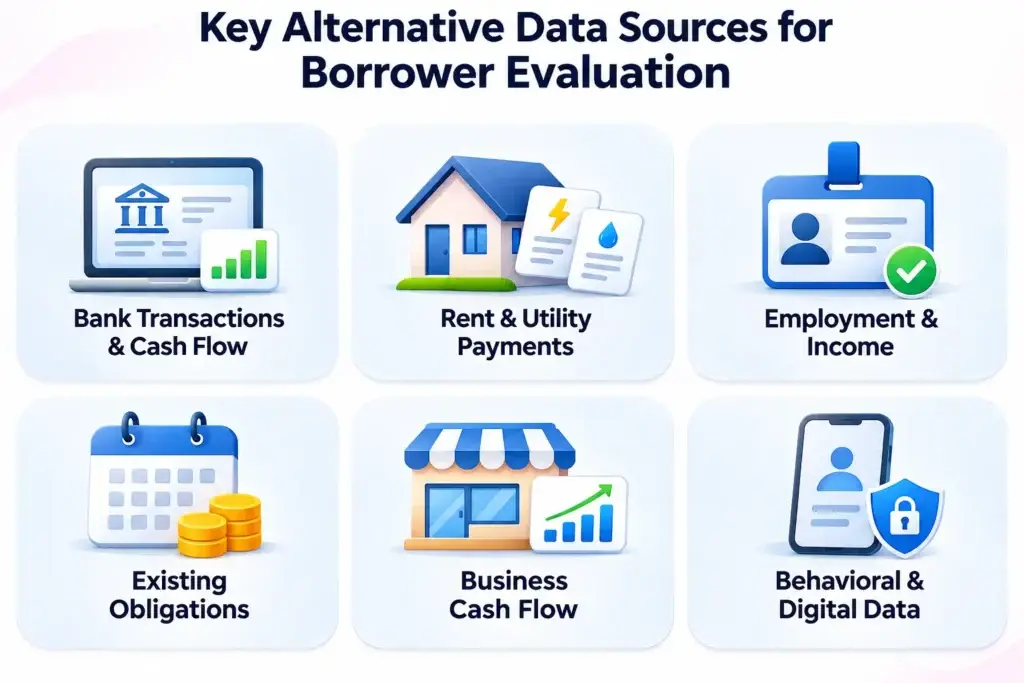
The quality of alternative scoring depends heavily on the information being analyzed. A lender should prefer data that is reliable, relevant to repayment capacity, legally obtainable, and understandable to both credit-risk teams and applicants.
1. Bank Account Transactions and Cash-Flow Patterns
Bank account activity can provide insight into money entering and leaving an applicant’s account over time. Instead of relying solely on previously reported borrowing behavior, lenders may examine recurring deposits, essential expenses, savings patterns, balance stability, and existing payment commitments.
For example, a borrower might receive income from several clients rather than one employer. A basic employment-based review could make that income look inconsistent. A properly designed cash-flow assessment may recognize that aggregate earnings remain sufficiently stable across multiple periods.
However, account activity needs careful interpretation. Transfers between a borrower’s own accounts are not necessarily income. A large one-time deposit may not represent recurring earnings. Seasonal businesses can have substantial fluctuations without being financially unsustainable.
FinTech lenders using permission-based financial information can explore how bank account connectivity and transaction data analysis support income verification and other financial assessment workflows.
2. Rent and Utility Payment Histories
Regular rent, electricity, water, or telecommunications payments may provide useful information about how a person manages recurring financial obligations. These histories can be particularly relevant for applicants with limited conventional borrowing activity.
For example, someone may have paid rent consistently for several years without establishing a traditional credit score. If reliable payment information is available and permitted for underwriting, it may support a more complete assessment.
Still, payment reporting can be incomplete. The absence of a recorded rent payment may reflect the limitations of the reporting system rather than a missed obligation. Lenders must distinguish missing data from actual negative behavior.
3. Employment and Income Stability
Income assessment examines whether applicants have sufficient, reasonably predictable resources to manage proposed repayments. This can involve verified salary records, business revenue, contract payments, recurring deposits, or appropriately documented self-employment earnings.
Financial stability should not be confused with employment type. A self-employed borrower may have multiple reliable income sources, while a salaried applicant may face significant existing debt obligations.
Strong underwriting therefore considers income in relation to essential spending, existing commitments, volatility, and the repayment schedule of the proposed loan.
4. Existing Financial Obligations and Payment Commitments
Borrowers may have financial responsibilities that are not fully visible in conventional credit records. Relevant recurring payments, permitted alternative finance obligations, and verified debt commitments can help the lender estimate how much income remains available after existing expenses.
The objective is not to penalize people simply because they spend money. It is to avoid extending a loan whose repayment structure would be unrealistic given the applicant’s existing obligations.
5. Business Cash Flow for Small Business Borrowers
For small business financing, lenders may review customer receipts, revenue consistency, supplier payments, cash reserves, business expenses, and seasonal fluctuations.
These signals are especially useful when a business owner’s personal credit file provides limited information about the company’s operating capacity.
Business cash flow must still be assessed against outstanding liabilities, operational requirements, and the business’s ability to sustain repayments during weaker periods.
6. Other Behavioral and Digital Information: A Higher-Risk Category
Some alternative scoring discussions include device information, digital activity, or behavioral indicators. These sources deserve greater scrutiny because they may create privacy concerns, unreliable correlations, unequal access, and potential discrimination risks.
A person should not be assumed to have poor repayment capacity simply because they use an older phone, have limited digital activity, or access financial services differently from other applicants.
For most responsible lending assessments, verified financial behavior is a more defensible starting point than intrusive signals with unclear relationships to repayment ability.
How Alternative Credit Scoring Works: From Borrower Application to Loan Decision
The practical value of alternative credit scoring becomes clearer when examined as a sequence of lending decisions rather than as a standalone numerical score.
Consider an illustrative borrower who has never used a traditional credit card but receives regular freelance income and maintains active bank accounts. The lender cannot obtain a usable conventional score, but the applicant may still have sufficient financial information for another form of assessment.
Step 1: Establish Identity and Initial Eligibility
The lender first confirms the applicant’s identity and checks the basic requirements of the requested product. These may include age eligibility, location, identity verification, applicable sanctions or fraud controls, and product-specific conditions.
Identity verification and creditworthiness evaluation are separate functions. A genuine identity does not establish affordability, and a limited credit history does not prove identity fraud.
For founders examining operational safeguards, a related Miracuves guide explains how to plan KYC, AML, risk, and compliance workflows before introducing regulated financial products.
Step 2: Explain the Alternative Data Request
If conventional information is insufficient, the lender can explain that additional financial information may help assess the application. The applicant should understand which data is requested, why it is needed, which parties will process it, and what choices are available.
Where consent is the appropriate lawful basis, permission should be specific and meaningful. Lenders should not assume that accepting a general privacy policy authorizes unrestricted collection or indefinite use of financial data.
Step 3: Collect and Validate Relevant Financial Information
The lender retrieves or receives permitted financial data and checks whether it is complete, current, authentic, and relevant. It may reconcile account ownership, remove duplicate transactions, distinguish income from transfers, and identify recurring obligations.
Data validation matters because a scoring model can produce misleading results when the underlying records are incomplete or incorrectly categorized.
Step 4: Analyze Repayment Capacity and Financial Stability
The lender examines what the applicant typically earns, how variable that income is, what recurring expenses must be paid, and how much financial flexibility remains.
A borrower with several small but consistent income streams may demonstrate sufficient resources for an appropriately sized loan. Another applicant might receive a high monthly salary but have so many existing financial obligations that additional borrowing would be difficult to sustain.
The analysis should account for repayment frequency, loan duration, income volatility, and reasonably foreseeable affordability pressures rather than relying on a single monthly snapshot.
Step 5: Generate a Risk Assessment
Validated information can be evaluated using transparent decision rules, statistical methods, or appropriately governed machine learning models. The output may estimate default risk, identify affordability concerns, or assign the application to a defined risk category.
A risk estimate is a prediction with uncertainty. It should not be interpreted as a definitive statement about a person’s financial character or future behavior.
Step 6: Apply Underwriting Policies and Determine the Next Action
The lender combines the risk assessment with eligibility, affordability, exposure limits, product rules, and other relevant requirements. The application might qualify for approval, be referred for further review, require additional information, or be declined.
Alternative scoring becomes particularly valuable when its results are evaluated alongside eligibility requirements, borrower documentation, and established lending policies. In practice, digital lending and automated underwriting workflows can help organize these assessments, ensuring that risk estimates contribute to structured credit decisions rather than functioning as automatic approval guarantees.
Where appropriate, a lender might offer a smaller loan amount or different repayment arrangement rather than making a binary decision based on missing credit history alone. Any such offer must remain consistent with affordability, fair-lending requirements, and applicable laws.
Step 7: Record the Decision and Monitor Subsequent Outcomes
Once a decision is made, the lender should retain the information necessary to understand which policies, model versions, and reviewed evidence contributed to the outcome.
After lending, repayment performance helps risk teams evaluate whether the approach is working. This feedback should inform controlled model monitoring and governance—not unrestricted changes to borrower decisions without review.
How Cash-Flow Underwriting Helps Reveal Repayment Capacity
Cash-flow underwriting is among the most practical applications of alternative financial data because it examines the resources a borrower may actually have available to meet repayment obligations.
Imagine two applicants seeking the same small personal loan.
Applicant A has no conventional credit score but earns income from several recurring freelance contracts. Bank records show relatively stable incoming payments, manageable expenses, and a pattern of maintaining funds after major obligations are paid.
Applicant B has a long traditional credit history but has recently experienced a substantial reduction in income while continuing to carry significant monthly financial commitments.
A conventional credit score alone may reveal little about Applicant A’s current repayment capacity. Cash-flow information may help the lender understand whether this person can reasonably manage the proposed loan.
For Applicant B, current cash-flow analysis may identify affordability concerns that are not yet reflected in historical credit records.
Neither applicant should automatically be approved or rejected based on this simple description. The example illustrates why a lender can benefit from assessing both past repayment experience and present financial conditions.
An Illustrative Affordability Calculation
Suppose a borrower has an average verified monthly income of $3,000, recurring essential expenses of $1,700, and existing debt payments of $500. The remaining amount is $800 before other variable costs, reserves, and the proposed repayment.
A proposed loan repayment of $650 would leave considerably less flexibility than a repayment of $200. The lender should examine income variability, unrecorded expenses, emergency needs, and its own validated affordability policy before deciding whether either arrangement is suitable.
These figures are purely illustrative, not approval criteria or recommended lending thresholds. Real underwriting requires appropriately validated policies, additional information, and jurisdiction-specific obligations.
How Alternative Credit Models Turn Financial Signals Into Risk Decisions
Alternative scoring can use different analytical approaches depending on data availability, risk appetite, explainability requirements, and the lending product.
Rule-Based Credit Assessment
Rule-based systems evaluate applicants against predefined conditions. These might include minimum verified income, an acceptable repayment-to-income relationship, sufficient data coverage, and the absence of specified high-risk conditions.
The advantage is transparency: credit teams can identify the exact conditions behind a decision. However, simple rules may miss interactions between financial indicators or treat applicants with different circumstances too uniformly.
Statistical Credit Models
Statistical models estimate relationships between observed financial characteristics and historical repayment outcomes. They can evaluate how combinations of relevant factors correspond to different levels of default risk.
The accuracy of these models depends on representative training data, appropriate outcome definitions, sound validation, and ongoing monitoring. Historical correlations can change as economic conditions, borrower populations, or lending products evolve.
Machine Learning and AI-Assisted Scoring
Machine learning can evaluate complex relationships across multiple financial indicators. It may help risk teams recognize patterns that simpler methods overlook, provided sufficient reliable data and appropriate governance are available.
More complex models introduce additional challenges. Lenders must understand whether a model is stable, explainable, fair, and suitable for the applicants it evaluates.
A model should not gain authority merely because it uses advanced technology. Its value depends on validated decision quality and whether the financial institution can explain, review, and govern its outputs.
For readers interested in the operational relationship between scoring models and financial controls, Miracuves also covers AI-assisted credit-risk and financial decision workflows as a separate implementation subject.
Why Alternative Credit Scoring Does Not Mean Automatic Loan Approval
A common misunderstanding is that alternative scoring allows lenders to approve applicants who would otherwise fail established credit requirements. In reality, the purpose of additional data is to improve the quality of assessment, not to eliminate underwriting standards.
A missing conventional score may justify a different assessment route. It does not mean that financial obligations, fraud risks, affordability limits, or regulatory restrictions should be ignored.
Alternative scoring may produce one of several legitimate outcomes:
- Approval: Verified information supports eligibility, affordability, and acceptable risk under the lender’s policy.
- Conditional assessment: The lender requires additional documentation or clarification before deciding.
- Modified offer: A different loan amount or repayment arrangement may better reflect the applicant’s financial capacity.
- Manual review: The applicant’s circumstances require interpretation beyond an automated decision.
- Decline: Available information does not support responsible lending under the applicable criteria.
The most important distinction is that an applicant without sufficient traditional credit information receives an appropriate opportunity for assessment rather than being automatically treated as financially unreliable.
Benefits of Alternative Credit Scoring for FinTech Lenders and Borrowers
Better Visibility Into Financially Responsible Applicants
Alternative information can reveal evidence of financial stability that conventional credit records may not capture. This can help lenders evaluate people who have historically remained outside mainstream credit scoring systems.
More Informed Affordability Decisions
Current financial information can help lenders understand income patterns and existing obligations. When carefully validated, it may support loan decisions that better reflect a borrower’s present capacity rather than depending entirely on historical records.
Additional Opportunities for Financial Inclusion
Borrowers with limited conventional credit records may gain access to a more complete eligibility assessment. This is particularly relevant for new-to-credit consumers, certain self-employed applicants, and people whose financial commitments are not comprehensively reported.
More Efficient Assessment of Complex Income Profiles
Structured analysis of financial information can reduce repetitive administrative tasks, especially when applicants receive income from multiple sources. However, automation should be applied only where data quality and decision controls are sufficient.
Potentially Better Segmentation of Borrower Risk
Additional financial variables may help differentiate borrowers with similar traditional credit histories but substantially different cash-flow conditions. Whether this improves risk prediction must be established through model validation and observed portfolio performance.
These opportunities can support a more inclusive financial ecosystem, but they do not automatically deliver lower defaults, higher approval rates, or better profitability. Responsible lenders must demonstrate those outcomes through evidence.
The Biggest Risks of Alternative Credit Scoring: Bias, Privacy, and Model Accuracy
Alternative data creates new opportunities for credit assessment, but it can also introduce problems that are less visible in conventional underwriting processes.
Data Quality and Incomplete Financial Records
A transaction dataset may be incomplete because a borrower uses multiple accounts, receives some income outside the connected institution, or has missing historical records. Categorization errors may also cause a scoring model to misinterpret transfers, reimbursements, or irregular deposits.
Lenders should define minimum data quality standards and provide a reasonable route for applicants to correct inaccurate information.
Unfair Correlations and Disparate Outcomes
Certain seemingly neutral financial or behavioral variables may correlate with characteristics protected by applicable anti-discrimination laws. A model that appears accurate overall may still produce unjustified differences across borrower groups.
Responsible model governance therefore includes documented feature selection, fairness testing, outcome monitoring, and review of potentially harmful proxies.
Privacy and Excessive Data Collection
Access to bank transaction information can expose highly sensitive details about an individual’s financial and personal life. Lenders should collect only data needed for a defined purpose, restrict access, establish retention rules, and provide meaningful information about how the data is used.
Financial information should be protected through appropriate encryption, controlled permissions, secure integrations, and documented incident response procedures.
Model Drift and Changing Economic Conditions
A model trained on historical repayment patterns may become less reliable when interest rates, employment conditions, consumer spending, or borrower characteristics change.
Monitoring should therefore examine whether the relationship between model predictions and actual repayment outcomes remains stable, especially for new borrower segments or products.
Lack of Explainability
A lender must be able to understand why an application received a particular result. A complex model that generates unexplained rejections can create customer complaints, operational uncertainty, and regulatory exposure.
In the United States, applicable adverse-action requirements under the Equal Credit Opportunity Act and Regulation B require specific explanations of credit decisions, including decisions involving complex algorithms. Compliance duties depend on the jurisdiction and lending context.
Explainability should be built into the operating process through meaningful decision reasons, documented model versions, review procedures, and accurate applicant communications.
How Responsible Lenders Validate an Alternative Credit Scoring Model
Before deploying a new scoring approach, a lender needs evidence that the selected data and models are appropriate for the intended lending population.
A useful validation process begins by defining the outcome the lender wants to predict. For example, a risk model might estimate the probability that a borrower will become seriously delinquent within a specified period.
Next, the institution should test the approach against representative historical information, examine performance across different borrower groups, and evaluate whether the model’s predicted probabilities correspond reasonably with observed outcomes.
Validation should also determine whether additional financial information provides meaningful predictive value over existing underwriting methods. If a complicated model offers little measurable improvement, the operational and compliance burden may not be justified.
Key Metrics for Credit Model Evaluation
| Metric | What It Measures | Why It Matters |
|---|---|---|
| Approval rate | Share of applications approved | Shows access, but not whether the decisions are sustainable |
| Default or delinquency rate | Repayment problems over a defined period | Helps assess portfolio outcomes |
| Discrimination and calibration | Risk ranking and agreement between predictions and outcomes | Tests predictive usefulness |
| Data coverage | Applicants with sufficient usable information | Identifies exclusion caused by incomplete records |
| Fairness outcomes | Relevant performance and approval differences across groups | Supports fair-lending review |
| Manual review rate | Applications needing human intervention | Indicates operational complexity and exceptions |
| Data-consent abandonment | Applicants leaving during additional data collection | Reveals potential friction or privacy concerns |
These metrics should be assessed together. A higher approval rate is not necessarily positive if repayments become unaffordable. A low default rate may be achieved through overly restrictive rules that exclude creditworthy applicants.
For new borrowers whose repayment performance is not yet observable, lenders should also account for selection bias and the limitations of historical approval data. Only applicants who previously received loans have observed outcomes, which can make evaluation of previously excluded groups difficult.
When Should Lenders Use Alternative Scoring Instead of Traditional Credit Scores?
The answer depends on the applicant, available financial information, regulatory environment, and the lending product.
For borrowers with substantial traditional credit records, additional cash-flow information may supplement an established risk assessment. For thin-file applicants, alternative data may provide useful information where the conventional score has limited predictive value.
For completely credit-invisible consumers, the lender may need a separately validated assessment approach that does not depend on a traditional score being available.
In other situations, the available alternative information may be insufficient or unreliable, and the lender may need to request additional evidence or decline the application.
Founder Decision Signals
Borrower Coverage
How many eligible applicants lack sufficient traditional credit data, and can alternative information meaningfully improve their assessment?
Data Reliability
Are the proposed income, payment, or transaction records accurate, sufficiently complete, and lawfully accessible?
Risk and Fairness
Can the institution validate predictions, review exceptions, explain outcomes, and detect unintended disparities?
Operating Readiness
Can credit staff maintain policies, investigate data errors, monitor model changes, and respond to borrower complaints?
The most appropriate approach is often a controlled second assessment rather than an immediate replacement of established credit information. This allows a lender to evaluate whether additional data genuinely improves decisions for applicants who would otherwise receive inconclusive assessments.
Alternative Credit Scoring and Financial Inclusion: What Founders Should Understand
Financial inclusion is more than increasing the number of approved applications. It involves making suitable financial products accessible to people who can use them responsibly and understand their obligations.
Alternative credit assessment can support this objective by recognizing financial behavior that has not historically been represented in conventional scoring systems.
However, inclusion should not become an excuse for unaffordable lending. A product may expand credit access while still causing harm if repayments are poorly matched to income patterns or if applicants cannot understand the terms.
Founders should consider whether the intended customers benefit from transparent pricing, manageable repayment schedules, reliable application decisions, and accessible dispute procedures.
These questions also connect to broader financial technology risk-management and digital finance operations, where customer experience, financial controls, and operational governance must work together.
Practical Use Cases for Alternative Credit Scoring in Digital Lending
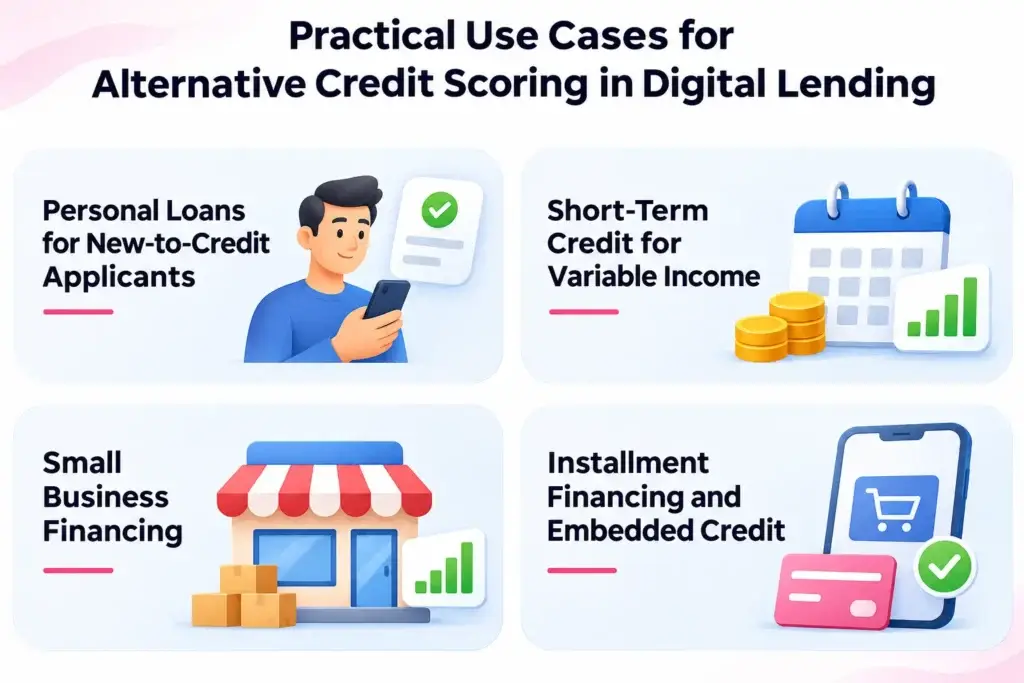
Personal Loans for New-to-Credit Applicants
A consumer seeking a first formal loan may have no score despite a history of income and regular household payments. Alternative financial records can help the lender evaluate whether an appropriately structured loan is affordable.
Short-Term Credit for People With Variable Income
Workers with irregular earnings may not fit simple salary-based eligibility rules. Cash-flow analysis over a suitable period can help distinguish temporary fluctuations from persistent financial shortfalls.
Small Business Financing
Business transaction patterns, customer receipts, operating expenses, and cash reserves can provide information about a company’s ability to manage repayment obligations, especially where the owner’s personal credit history is not sufficiently informative.
Installment Financing and Embedded Credit
Some digital commerce financing models require quick decisions about whether a customer can reasonably manage a sequence of payments. Alternative information may help assess applicants with thin credit files, provided affordability checks, consumer disclosures, and applicable regulatory requirements remain central to the process.
Installment financing also demonstrates why alternative risk information must be interpreted alongside purchase value, repayment frequency, and existing customer obligations. In these environments, installment lending models and credit-risk management provide useful context for understanding how financing decisions, repayment schedules, and merchant relationships influence the broader lending experience.
For an adjacent explanation of loan applications, borrower profiles, and repayment-related workflows, see Miracuves’ guide to digital lending platform operations and borrower assessment. The operational technology discussion is separate from this article’s focus on alternative scoring methodology.
Mistakes FinTech Lenders Should Avoid When Introducing Alternative Credit Scoring
Assuming More Data Always Means Better Decisions
Collecting additional variables can create noise, privacy risk, and unstable model behavior. Each data source should have a defensible relationship to repayment capacity and demonstrate measurable value under appropriate testing.
Using Unexplained Automated Rejections
Borrowers need accurate communications about decisions and appropriate opportunities to correct erroneous information. Decision systems should preserve meaningful reasons, not merely produce an unexplained risk score.
Ignoring Affordability Because a Risk Score Looks Favorable
A low predicted probability of default does not automatically mean every loan amount is affordable. Repayment capacity, essential expenses, and product terms still require independent consideration.
Confusing Fraud Detection With Credit Risk
Fraud controls assess whether an application or identity may be deceptive. Credit assessment evaluates the likelihood and capacity of repayment. Both are important, but a clean identity check is not evidence that a borrower can afford a loan.
Applying a Model to a Different Borrower Population Without Validation
A scoring model developed for salaried applicants may behave poorly when applied to seasonal workers, new residents, or small business owners. Institutions need to test whether the approach remains reliable for its intended use.
Treating Privacy and Fair Lending as Post-Launch Tasks
Data permissions, model governance, customer corrections, access controls, and compliance review should be part of the operating process from the beginning. Adding them only after decisions are being made can create significant financial and reputational risks.
How Alternative Scoring Fits Into a Responsible FinTech Lending Ecosystem
Credit scoring is only one part of digital lending. The surrounding process must handle borrower identity, application records, data permission, eligibility evaluation, credit decisions, disclosures, repayments, and ongoing account servicing.
A reliable lending operation also needs to distinguish the responsibilities of technology providers, licensed lenders, financial data partners, credit-risk teams, and compliance personnel.
For founders assessing adjacent financial products, Miracuves provides an overview of digital finance and investment platform foundations. The broader product ecosystem can help explain where credit assessment connects to onboarding and financial operations without assuming that a generic finance foundation already includes a validated lending model.
More importantly, a credit decision process should preserve clear ownership of model policies and the final lending decision. Technology can provide useful information, but the financial institution remains responsible for meeting its legal, operational, and consumer-protection obligations.
How Miracuves Can Support Responsible FinTech Product Workflows
When a founder moves from understanding alternative scoring to planning a financial product, the next challenge is ensuring the surrounding borrower experience and administrative controls can support the intended underwriting policies.
Miracuves provides ready-made and customizable FinTech foundations for eligible financial product categories. These can offer a starting point for onboarding, user experiences, financial workflows, and administrative operations, depending on the selected solution.
For applicable ready-made foundations, Miracuves promotes six-working-day delivery. However, alternative credit scoring, proprietary risk models, bank-data integrations, lending policy configuration, model validation, and jurisdiction-specific compliance require separately assessed scope. A ready-made application foundation should not be represented as an automatically approved or production-validated lending decision system.
The practical starting point is to define which financial information is necessary, how underwriting decisions will be reviewed, what regulatory responsibilities apply, and which processes require specialized integrations or human oversight.
Final Thoughts: Alternative Credit Scoring Can Expand Access Without Replacing Responsible Lending
A missing FICO score should not automatically define a borrower as financially unreliable. Many applicants maintain stable income, meet recurring financial commitments, and manage their expenses responsibly without building an extensive history of traditional credit products.
Alternative credit scoring creates opportunities to evaluate these applicants using additional, relevant financial information. Cash-flow analysis, verified income, payment behavior, and appropriate risk models can help lenders understand repayment capacity beyond conventional score availability.
However, responsible adoption requires much more than adding alternative data to an algorithm. Lenders must evaluate affordability, verify information, explain decisions, protect privacy, monitor fairness, and continually validate how their underwriting policies perform.
For FinTech founders considering how these workflows connect to a broader financial product, Miracuves’ Fintech App Development Company provide a relevant starting point for discussing operational requirements, integrations, and platform controls while keeping credit-model validation and regulatory approval as separate responsibilities.
Ultimately, alternative credit scoring is most valuable when it helps lenders make better-informed decisions—not simply faster approvals. The goal is to recognize genuine creditworthiness where conventional records fall short while protecting borrowers and the long-term health of the lending business.
Frequently Asked Questions
What is alternative credit scoring in FinTech lending?
Alternative credit scoring uses additional financial information and assessment methods to evaluate credit risk beyond conventional credit scores. It may consider verified income, cash-flow patterns, payment commitments, and other relevant data, subject to appropriate legal and risk controls.
Can someone get approved for a loan without a FICO score?
Yes, some lenders can evaluate applicants without a conventional FICO score using separately validated underwriting methods and alternative financial information. Approval still depends on affordability, eligibility, applicable regulations, and the lender’s risk policy.
What alternative data can lenders use to assess creditworthiness?
Relevant sources may include permission-based bank transactions, verified income, rent and utility payment histories, existing financial commitments, and business cash-flow records. Availability and permissible use depend on the lender, product, and jurisdiction.
How does cash-flow underwriting work without traditional credit history?
Cash-flow underwriting evaluates income, recurring expenses, account balances, financial obligations, and other relevant transaction patterns to estimate whether an applicant can manage a proposed loan repayment.
Is alternative credit scoring more accurate than a traditional FICO score?
Not necessarily. Alternative information may improve assessment for certain borrowers, especially those with limited credit records, but accuracy depends on data quality, model validation, borrower populations, and the lending product.
Does alternative credit scoring use artificial intelligence?
It can, but AI is not required. Alternative credit assessment may use transparent rules, statistical models, machine learning, or combinations of these methods. Any approach should support appropriate validation, governance, and decision explanations.
What are the risks of alternative credit scoring?
Important risks include inaccurate or incomplete data, privacy concerns, unfair outcomes, model drift, fraud, weak affordability assessment, and insufficient explanation of lending decisions. Responsible lenders use appropriate controls and ongoing monitoring.
How can FinTech lenders prevent bias in alternative credit models?
Lenders can review data sources, test for inappropriate proxies, monitor outcomes across relevant borrower groups, validate model performance, preserve decision explanations, and provide suitable review or correction processes.
Should alternative credit scoring replace traditional credit scoring?
Not in every situation. Alternative data can supplement conventional credit information or support a separately validated assessment when a traditional score is unavailable. The appropriate method depends on the borrower, product, available data, and applicable requirements.
Miracuves is an independent software development company. We are not affiliated with, connected to, sponsored by, or endorsed by any company or product named in this article.
Terms such as “X Clone” are used descriptively. It is how the software industry refers to building a platform with functionality comparable to a known service, and how clients search for it.
The entire design and codebase of our products is built by our own team. Our products contain no code, design, graphics, or content originating from any third-party website or applications.
All third-party names and marks referenced in this article are the property of their respective owners, referenced solely to identify the services discussed.