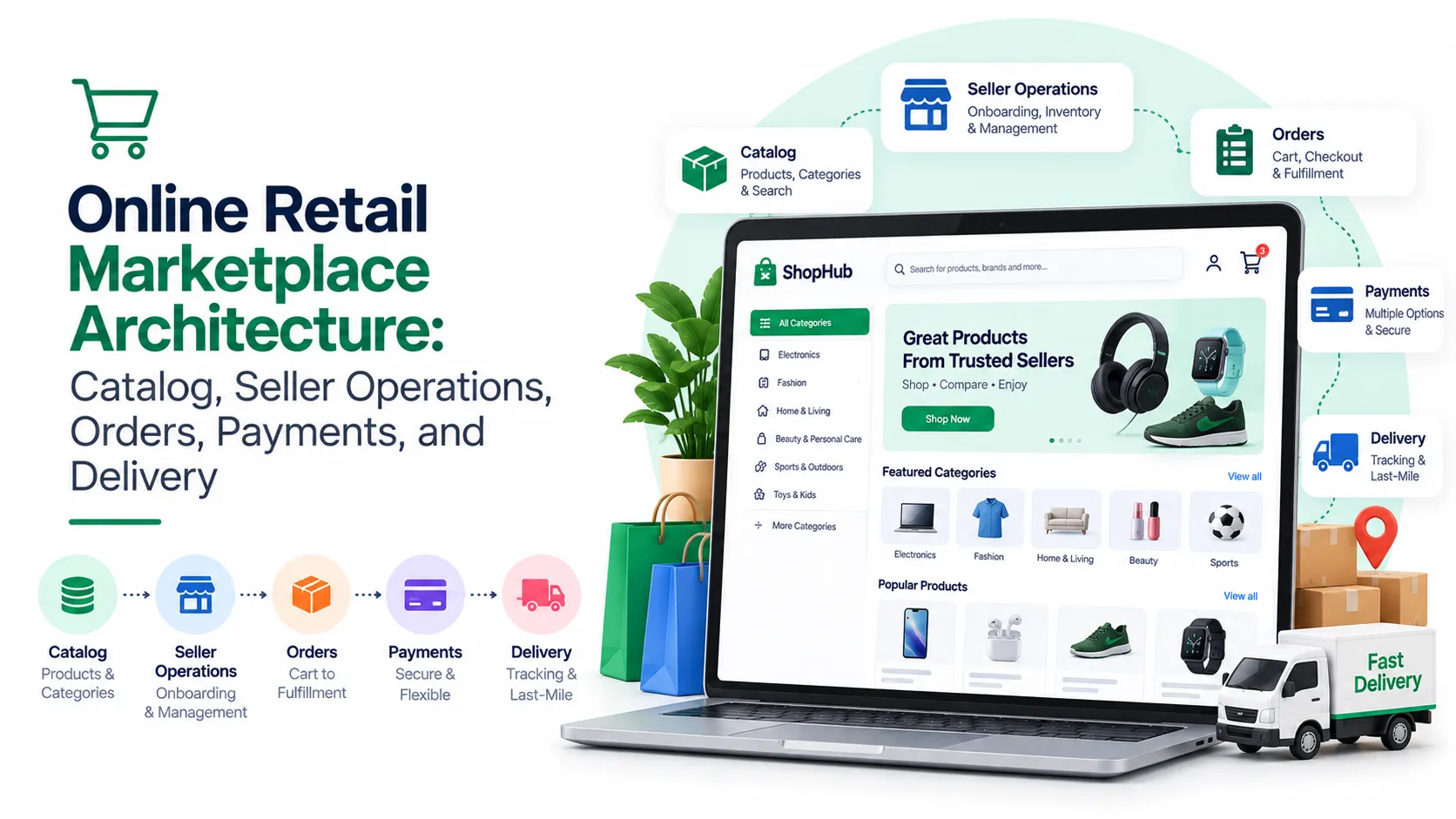
Key Takeaways
- An online retail marketplace architecture should connect product catalog, seller operations, inventory, orders, payments, commissions, delivery, returns, and admin management through coordinated backend services.
- Core components can include catalog services, seller dashboards, inventory management, cart and checkout, order processing, payment orchestration, logistics integrations, notifications, and analytics.
- A modular architecture allows catalog, seller, order, payment, and delivery services to scale independently while keeping pricing, stock, transaction status, and fulfillment data synchronized.
Marketplace Architecture Signals
- Catalog architecture should manage products, categories, variants, attributes, images, pricing, seller offers, inventory availability, search indexing, and product moderation.
- Seller services can support onboarding, store profiles, product uploads, pricing, stock updates, promotions, order acceptance, fulfillment status, commissions, payouts, and performance analytics.
- Order services should coordinate carts, checkout, inventory reservation, discounts, taxes, payment confirmation, seller routing, cancellations, returns, refunds, and customer notifications.
Order & Delivery Operations Insights
- Payment and settlement systems should manage customer charges, marketplace commissions, seller earnings, refunds, payment failures, payout schedules, reconciliation, and transaction records.
- Delivery architecture can connect warehouses, sellers, courier partners, shipment creation, tracking events, estimated delivery dates, failed deliveries, returns, and proof of delivery.
- Miracuves develops customizable online retail marketplaces with catalog management, seller operations, inventory, orders, payments, commissions, delivery integrations, analytics, and admin controls.
An online retail marketplace looks simple from the buyer’s side. A customer searches for a product, adds it to the cart, pays, tracks delivery, and receives the order. But behind that smooth journey is a complex architecture connecting catalog data, seller operations, inventory, commissions, refunds, logistics, admin controls, and customer support.
This is where many retail marketplace projects fail. Founders often start by planning screens: homepage, product page, cart, checkout, seller dashboard, and admin panel. Those screens matter, but they are not the real architecture. The real marketplace architecture sits underneath the interface. It decides how products are structured, how sellers are controlled, how stock is reserved, how payments are settled, how delivery promises are calculated, and how the platform handles disputes when something goes wrong.
For founders, this is not only a technical decision. It is a business decision. A weak architecture creates overselling, delayed refunds, seller confusion, payment disputes, poor delivery visibility, and high support costs. A strong architecture gives the platform operator control over marketplace quality, monetization, fulfillment, and long-term scalability.
For founders exploring broader retail and ecommerce platform development, the first step is understanding how marketplace architecture connects product discovery, seller control, checkout, fulfillment, payment operations, and admin decision-making.
Why Online Retail Marketplace Architecture Matters More Than the Frontend
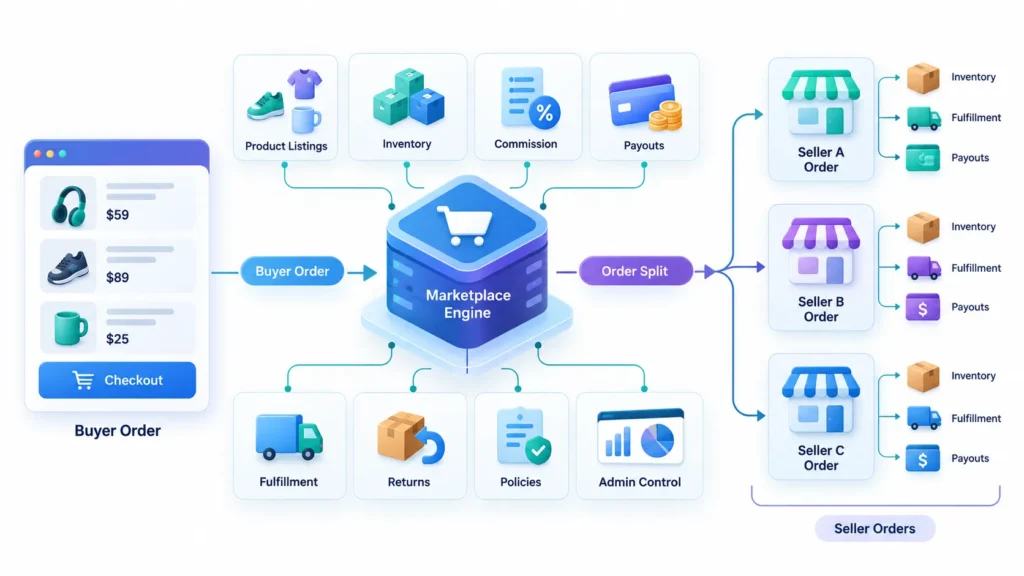
A clean interface can attract users, but architecture decides whether the marketplace can operate reliably after launch.
A single online store usually has one business owner, one catalog, one payment account, one inventory source, and one fulfillment flow. A retail marketplace has many sellers, many catalogs, many stock records, multiple commission rules, seller-level payouts, buyer-level orders, platform-level policies, and a wider support surface.
That difference changes the entire backend.
For example, when one buyer purchases products from three sellers in the same checkout, the platform must treat it as one customer order on the frontend but multiple seller-level orders in the backend. Each seller may have a different dispatch time, shipping method, return policy, commission rate, tax rule, and payout schedule. If the architecture does not separate these records properly, the platform will struggle with fulfillment, reconciliation, refunds, and seller reporting.
A scalable marketplace should answer practical questions clearly:
- Who owns the product listing?
- Who controls the selling price?
- When is stock reserved?
- How are seller orders separated?
- How does the platform calculate commission?
- When does the seller receive payout?
- What happens if one item in a multi-seller order is cancelled?
- Who approves refunds and returns?
- How does the admin team detect seller abuse or delayed fulfillment?
These are not small backend details. They decide whether the marketplace can grow without creating operational chaos.
The Core Layers of an Online Retail Marketplace System
A retail marketplace works best when each system layer has a clear responsibility. The buyer experience may look unified, but the backend should separate marketplace functions carefully.
Core Marketplace Architecture Layers
| Architecture Layer | What It Controls | Why It Matters for Founders |
|---|---|---|
| Catalog Layer | Products, variants, attributes, media, categories, search data, listing approval | Improves product discovery, listing quality, filtering, merchandising, and buyer trust. |
| Seller Operations Layer | Seller onboarding, verification, dashboards, product uploads, pricing, inventory, seller rules | Gives the operator control over seller quality, service standards, and marketplace growth. |
| Order Management Layer | Cart, checkout, parent orders, seller-level orders, cancellation, returns, refund states | Prevents confusion when one buyer order involves multiple sellers and delivery paths. |
| Payment and Commission Layer | Payment gateway, platform commission, seller settlement, refunds, payout ledgers | Protects marketplace revenue and keeps seller earnings traceable. |
| Delivery and Fulfillment Layer | Shipping rules, delivery zones, serviceability, tracking, proof of delivery, reverse logistics | Reduces post-purchase support pressure and improves buyer confidence. |
| Admin Control Layer | Approvals, disputes, policies, analytics, user control, seller control, promotions | Allows the platform operator to manage the business without depending on developers for every change. |
If you are comparing different ecommerce marketplace solutions, focus less on surface-level screens and more on whether the platform supports catalog governance, seller operations, order splitting, payment logic, delivery workflows, and admin control.
Catalog Architecture: The Foundation of Product Discovery
The catalog is not just a list of products. It is the marketplace’s discovery engine, merchandising layer, search foundation, and seller quality filter.
A weak catalog structure creates messy categories, poor filters, duplicate listings, irrelevant search results, and low buyer confidence. A strong catalog structure helps users find products faster and helps the admin team maintain consistency across sellers.
Product Families, Variants, and Attributes
Retail marketplaces need a variant-aware catalog. A product may have multiple sizes, colors, storage options, weights, materials, or package types. Treating every variant as a separate unrelated product creates a poor shopping experience and makes inventory harder to manage.
A better structure separates:
- Parent product
- Variant options
- SKU-level stock
- Attribute groups
- Category-specific specifications
- Product media
- Seller-specific price and availability
For example, apparel needs size, color, fabric, fit, and return logic. Electronics need warranty, model, storage, color, specifications, and seller authenticity controls. Grocery needs weight, pack size, expiry sensitivity, and substitution rules. The architecture should support category differences instead of forcing every product into the same template.
Category and Attribute Governance
Founders often underestimate category governance. If every seller can create their own category names and attributes freely, the platform quickly becomes messy. One seller may list “mobile phone,” another may list “smartphone,” and another may place the same item under “electronics accessories.”
The admin panel should allow the platform operator to define controlled categories, attribute sets, mandatory fields, and approval workflows. Seller flexibility is useful, but marketplace consistency matters more.
Search and Filtering Depend on Catalog Quality
Search quality does not begin with the search bar. It begins with structured product data.
If the product catalog does not capture the right attributes, filters will be weak. If product titles are inconsistent, search results will feel random. If sellers upload low-quality images or incomplete descriptions, conversion will suffer.
A marketplace-ready catalog should support:
- Structured product titles
- Category-specific attributes
- Mandatory product fields
- Product image validation
- Listing approval workflows
- Search indexing
- Filters and sorting
- Featured listings
- Product status control
- Duplicate listing detection
The goal is not only to let sellers upload products. The goal is to help buyers discover trustworthy products quickly.
Seller Operations Architecture: Controlling Marketplace Quality at Scale
A retail marketplace grows through sellers, but seller growth without control creates risk. Every seller adds products, prices, inventory, fulfillment promises, customer expectations, and potential disputes.
That is why seller operations need a dedicated architecture layer.
Seller Onboarding and Verification
Seller onboarding should collect the information needed to approve, categorize, and manage sellers properly. Depending on the marketplace model, this may include business details, identity documents, tax information, bank details, service locations, product categories, and fulfilment capabilities.
The admin team should be able to approve, reject, suspend, or restrict sellers based on platform rules. In regulated or sensitive categories, additional controls may be required before a seller can publish products.
Seller Dashboard and Product Control
Sellers need a dashboard that lets them manage daily operations without contacting support for every update. A practical seller dashboard should include:
- Product listing management
- Bulk upload options
- Price updates
- Stock updates
- Order acceptance and processing
- Return requests
- Payout reports
- Commission visibility
- Seller analytics
- Support and dispute communication
For founders, the seller dashboard reduces operational dependency. If sellers can manage routine work themselves, the marketplace team can focus on growth, quality control, and buyer experience.
For a broader module-level breakdown, this guide to buyer and seller marketplace features explains how customer-side, seller-side, and admin-side workflows support daily marketplace operations.
Seller-Level Rules and Marketplace Policy
Not every seller should operate under the same rules. A new seller may need stricter listing approvals. A trusted seller may receive faster publishing permissions. A high-return seller may need additional review. A seller in a sensitive category may need controlled catalog access.
The architecture should support seller-level rules such as:
- Commission percentage
- Listing approval requirement
- Product category access
- Delivery serviceability
- Return policy
- Payout cycle
- Subscription plan
- Promotional access
- Penalty rules
- Seller rating visibility
This gives the platform operator more control over marketplace quality without hardcoding every rule.
Order Management Architecture: Where Marketplace Complexity Becomes Real
Order management is where the difference between a store and a marketplace becomes obvious.
From the buyer’s perspective, checkout should feel simple. But from the backend perspective, the platform may need to split a single cart into multiple seller orders, calculate separate commissions, trigger different delivery workflows, and manage partial cancellations or returns.
Parent Order and Seller-Level Orders
A strong marketplace order model usually separates the buyer-facing order from seller-facing order records.
The parent order represents the buyer’s full checkout. Seller-level orders represent the fulfillment responsibility of each seller. This separation helps the platform manage:
- Multi-seller checkout
- Seller-specific dispatch
- Item-level cancellation
- Partial shipment
- Partial refund
- Seller commission
- Payout eligibility
- Delivery tracking
- Return approval
- Dispute resolution
Without this separation, a simple issue such as cancelling one item can become difficult. The platform may not know how to adjust payment, commission, stock, delivery, and seller payout correctly.
Order Status Should Work Like a State Machine
Order status should not be a random text field. It should work as a controlled state machine where each stage has rules.
A practical order lifecycle may include:
- Order placed
- Payment pending
- Payment confirmed
- Seller accepted
- Packed
- Shipped
- Out for delivery
- Delivered
- Return requested
- Return approved
- Item received
- Refund initiated
- Refund completed
- Dispute opened
- Dispute resolved
Each transition should be traceable. The admin team should know who changed the status, when it changed, and what triggered it. This improves support, seller accountability, and buyer trust.
Cancellations, Returns, and Refunds Need Separate Logic
Many ecommerce systems treat refunds as a negative order adjustment. That may work for simple stores, but marketplaces need more precise logic.
A refund may be connected to one item, one seller order, one payment method, one return reason, one inspection result, or one dispute. The platform must know whether the item was cancelled before dispatch, returned after delivery, rejected during inspection, or refunded due to seller failure.
A proper refund architecture should track:
- Refund request reason
- Approval status
- Item condition
- Refund amount
- Payment method
- Commission reversal
- Seller payout impact
- Delivery fee handling
- Admin notes
- Buyer communication
This protects the marketplace from financial confusion as order volume increases.
Payment Architecture: Gateway, Commission, Settlement, and Refund Control
Payments are not just about accepting money. In a marketplace, payments must connect buyer checkout, platform commission, seller earnings, refunds, payout timing, and financial reconciliation.
Payment Gateway Integration
The payment layer should support the methods buyers expect in the target market. Depending on the business model, this may include cards, wallets, bank transfers, local payment methods, or cash-based workflows.
The key decision is not only which gateway to integrate. It is how the marketplace handles payment status, failed transactions, retries, refund requests, and settlement timing.
Commission and Marketplace Revenue Logic
The platform should be able to define commission rules clearly. Some marketplaces use category-based commission. Some use seller-level commission. Some charge subscriptions, listing fees, featured placement fees, delivery fees, or promotional fees.
Common revenue controls include:
- Percentage commission
- Fixed transaction fee
- Seller subscription
- Featured listing fee
- Promotional placement
- Delivery margin
- Payment handling fee
- Category-based commission
- Seller-tier commission
These rules should be configurable in the admin panel instead of hardcoded into the platform. As the marketplace grows, the founder may need to test different monetization models.
Seller Settlement and Payout Ledgers
Seller payout should not be calculated casually. The platform should track seller earnings, platform commission, refunds, penalties, delivery deductions, payout holds, and settlement status.
A payout ledger helps answer important questions:
- How much has the seller earned?
- How much commission has the platform retained?
- Which orders are eligible for payout?
- Which payouts are held due to refund windows?
- Which refunds reduced the seller balance?
- What amount has already been settled?
This matters because seller trust depends on transparent earnings and predictable payout cycles.
Payment and Compliance Caveat
Payment architecture may also need KYC workflows, tax logic, invoicing, transaction monitoring, audit logs, and local compliance review depending on the target market. Final payment, tax, and compliance requirements depend on jurisdiction, operating model, payment provider, and legal review.
Delivery Architecture: From Checkout Promise to Real Fulfillment
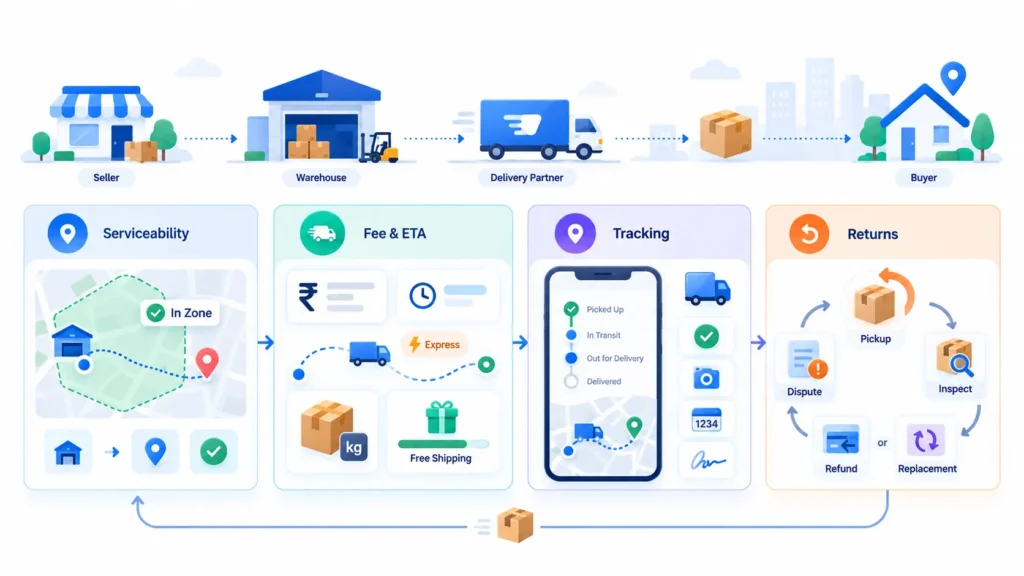
Delivery is where the marketplace promise becomes visible to the customer. A platform can have a strong catalog and smooth checkout, but if delivery fails, the buyer remembers the failure.
Delivery architecture should connect serviceability, stock location, seller readiness, shipping partner availability, delivery fees, tracking, proof of delivery, and reverse logistics.
Serviceability and Delivery Zones
Before accepting an order, the platform should know whether the product can actually be delivered to the buyer’s location. Serviceability logic may depend on seller location, warehouse location, delivery partner coverage, product category, weight, delivery speed, and local restrictions.
Without serviceability checks, the platform may accept orders that cannot be fulfilled reliably.
Delivery Fee and ETA Logic
Delivery cost and estimated delivery time should be calculated based on real operational rules. These may include:
- Seller location
- Buyer location
- Warehouse location
- Product weight
- Order value
- Delivery partner rate
- Delivery distance
- Express delivery availability
- Free shipping threshold
- Category-specific handling
A simple flat delivery promise may work in early testing, but it becomes risky as categories, sellers, and regions expand.
Tracking and Proof of Delivery
Tracking updates reduce buyer anxiety and support tickets. The platform should allow buyers, sellers, delivery partners, and admins to see relevant delivery status.
For high-value or sensitive orders, proof of delivery can include OTP confirmation, delivery photo, customer signature, or delivery partner verification. The exact proof model depends on the product category and target market.
Reverse Logistics
Returns are part of retail marketplace architecture, not an afterthought.
A return workflow should define:
- Return eligibility
- Return request window
- Seller approval rules
- Pickup process
- Item inspection
- Refund timing
- Restocking decision
- Replacement option
- Dispute handling
- Delivery cost responsibility
A marketplace that ignores reverse logistics may face high support costs and seller-buyer conflict after launch.
Admin Dashboard Architecture: The Marketplace Control Center
The admin dashboard is the operating system of the marketplace. It should give the platform operator control over users, sellers, products, orders, payments, commissions, delivery, disputes, promotions, and analytics.
A weak admin panel forces the team to depend on developers for everyday changes. A strong admin panel helps the business operate independently.
What the Admin Dashboard Should Control
A marketplace admin dashboard should include:
- Buyer management
- Seller management
- Seller approvals
- Product approvals
- Category management
- Attribute management
- Order monitoring
- Payment status
- Commission settings
- Payout tracking
- Refund and return management
- Delivery partner control
- Promotions and coupons
- Featured listings
- Reviews and ratings
- Dispute management
- Reports and analytics
- Role-based admin permissions
The admin dashboard should also support role-based access. A support executive may need order access but not payout settings. A finance manager may need settlement reports but not category editing permissions. A marketplace owner may need full access.
Founders who want to understand the module-level structure can also review the key retail marketplace app features that connect buyer journeys, seller dashboards, product management, payments, delivery tracking, and admin control.
Marketplace Analytics
Analytics should help the operator understand marketplace health. Useful dashboards may track:
- Gross order value
- Total orders
- Active buyers
- Active sellers
- Top categories
- Failed payments
- Cancelled orders
- Return rate
- Seller fulfillment delay
- Delivery success rate
- Average order value
- Commission earned
- Payout pending
- Disputes by category
These metrics help founders move from guessing to decision-making.
Security and Trust Layers in Retail Marketplace Architecture
Security should not be treated as a final checklist. It should be part of the product foundation.
A retail marketplace handles buyer data, seller data, payment flows, invoices, addresses, documents, and order history. The system should be designed with practical trust controls from the start.
Important security and trust layers include:
- Encrypted data transfer
- Secure payment gateway integration
- Role-based access control
- Admin activity logs
- Seller verification
- Buyer account protection
- Fraud monitoring signals
- Refund and dispute records
- Secure API integration
- Permission-based dashboards
- Audit logs
- Abuse reporting
- Review moderation
For some markets or product categories, additional compliance workflows may be required. A marketplace platform can be built with compliance-ready workflows, but final compliance depends on jurisdiction, legal review, integrations, and operating model. For a deeper breakdown of fraud prevention, payment safety, seller verification, role-based access, and admin controls, read this guide on online retail marketplace security.
Founder Decision Signals: What to Plan Before Development
Catalog Complexity
If your marketplace has many categories, variants, seller-specific prices, or detailed filters, catalog architecture should be planned before UI design.
Seller Control
If many sellers will manage products and orders independently, you need onboarding, approval, payout, and policy controls from day one.
Order Splitting
If buyers can purchase from multiple sellers in one checkout, your backend must separate parent orders, seller orders, commissions, and fulfillment states.
Delivery Reliability
If delivery speed and serviceability affect repeat purchases, your platform needs clear delivery zones, tracking, ETA logic, and return workflows.
Ready-Made Marketplace Foundation vs Custom Architecture
Not every founder needs to build every marketplace module from zero. The better question is whether the business model requires unique architecture or whether it can start from a proven marketplace foundation and customize the differentiating parts.
A ready-made marketplace foundation can be useful when the core workflows are familiar: buyer app, seller dashboard, catalog, cart, checkout, orders, payments, delivery, admin control, and commission management.
Custom development may be better when the marketplace depends on unusual workflows, proprietary algorithms, enterprise integrations, complex warehouse systems, or a business model that does not fit standard commerce flows. In those cases, dedicated ecommerce app development services may be more suitable than a standard launch-ready foundation.
| Build Path | Best For | Architecture Advantage | Business Tradeoff |
|---|---|---|---|
| Ready-made marketplace foundation | Founders who need standard marketplace flows with customization | Faster access to buyer, seller, admin, catalog, order, payment, and delivery modules | Must validate whether the ready-made base fits the operating model |
| Custom marketplace architecture | Businesses with complex or proprietary workflows | Full control over every workflow and integration | Higher time, cost, QA, and maintenance responsibility |
| Hybrid approach | Founders who need speed plus selected custom modules | Start with proven commerce foundation and customize unique business logic | Requires clear scoping to avoid unnecessary rebuilds |
For founders who want a faster path, Miracuves offers a marketplace-ready retail commerce foundation that can be adapted around catalog structure, seller workflows, order management, payment logic, delivery operations, and admin control. Where the selected scope fits the ready-made product, Miracuves’ 6-day solution delivery can help businesses move from planning to launch faster without rebuilding the entire marketplace from scratch.
If budgeting is part of the decision, review the main retail marketplace development cost factors before finalizing the feature scope, integrations, payment gateway, delivery model, seller workflows, and customization depth.
Common Architecture Mistakes Founders Should Avoid
Starting With a Single-Store System for a Multi-Seller Marketplace
A single-store ecommerce setup may not support seller isolation, split orders, seller payouts, commission rules, and seller-level inventory without heavy customization.
Treating Inventory as a Simple Product Count
Marketplace inventory must account for seller stock, reserved stock, cancelled orders, returns, damaged items, and stock updates across locations.
Ignoring Refund and Return States
Returns affect payment, commission, seller payout, inventory, buyer trust, and support workload. They need a structured workflow from the beginning.
Hardcoding Commission and Seller Rules
Marketplace monetization changes as the business grows. Commission, subscription, featured listing, and payout rules should be configurable where possible.
How Miracuves Helps Founders Plan Retail Marketplace Architecture
Miracuves helps founders build launch-ready marketplace platforms with buyer, seller, delivery, and admin workflows aligned around real business operations. Instead of treating ecommerce as only a storefront, the focus is on the complete operating layer: product structure, seller control, order flow, payment logic, commission rules, delivery tracking, and admin visibility.
This matters because marketplace success depends on more than launching an app. The platform must help the operator manage seller quality, buyer expectations, payment accuracy, delivery reliability, and long-term customization.
A launch-ready retail marketplace system can be useful when founders want to validate faster while keeping room for branding, feature customization, source-code ownership, and operational control. The key is not to copy an existing marketplace blindly. The stronger approach is to use a proven marketplace architecture and adapt it to a specific category, geography, seller strategy, and monetization model.
Final Thoughts: Architecture Decides Marketplace Control
An online retail marketplace is not only a buyer app, seller dashboard, and checkout page. It is a connected operating system where catalog quality, seller control, order logic, payment settlement, delivery tracking, returns, disputes, and admin decisions all depend on the architecture underneath.
Founders should avoid starting with surface-level screens alone. The smarter path is to define how the marketplace will actually operate: who can sell, how products are approved, when stock is reserved, how orders are split, how payments are settled, how returns are handled, and how the admin team keeps control as the platform grows.
A strong architecture gives the business room to scale. A weak architecture creates hidden operational debt. For founders planning to launch faster, Miracuves can help turn marketplace architecture into a practical, launch-ready product foundation with source-code ownership, white-label branding, and the control needed to operate confidently.
FAQs
What is online retail marketplace architecture?
Online retail marketplace architecture is the backend and operational structure that connects buyers, sellers, products, orders, payments, delivery, refunds, commissions, and admin controls inside one marketplace platform. It ensures that many sellers can operate independently while the platform owner maintains control.
How is a retail marketplace different from a normal ecommerce store?
A normal ecommerce store is usually managed by one business. A retail marketplace allows multiple sellers to list products, manage inventory, receive orders, and earn payouts. This requires seller isolation, product approval, split orders, commission rules, payout ledgers, and stronger admin controls.
Why is catalog architecture important in an ecommerce marketplace?
Catalog architecture controls how products, variants, attributes, categories, images, and filters are structured. A strong catalog improves product discovery, search accuracy, seller consistency, and buyer confidence.
What is split order logic in a marketplace?
Split order logic allows one buyer checkout to be separated into multiple seller-level orders in the backend. This helps each seller manage fulfillment, shipping, commission, cancellation, refund, and payout separately.
What payment features should a retail marketplace include?
A retail marketplace should include payment gateway integration, payment status tracking, platform commission, seller settlement, payout ledgers, refund handling, transaction history, and admin visibility. The final payment flow depends on the business model and target market.
Why does delivery architecture matter for online retail marketplaces?
Delivery architecture connects serviceability, shipping fees, ETA calculation, delivery partner integration, tracking, proof of delivery, failed delivery handling, and reverse logistics. It directly affects buyer trust and support workload.
Should founders build a marketplace from scratch or use a ready-made foundation?
A custom build makes sense when the marketplace has unusual workflows or proprietary logic. A ready-made foundation is often more practical when the core requirement is buyer, seller, catalog, order, payment, delivery, and admin workflows with customization.
How can Miracuves help with retail marketplace development?
Miracuves helps founders launch ready-made and white-label retail marketplace platforms with source-code ownership, branded design, admin dashboards, catalog workflows, seller operations, payment logic, and delivery modules that can be customized around the business model.
Miracuves is an independent software development company. We are not affiliated with, connected to, sponsored by, or endorsed by any company or product named in this article.
Terms such as “X Clone” are used descriptively. It is how the software industry refers to building a platform with functionality comparable to a known service, and how clients search for it.
The entire design and codebase of our products is built by our own team. Our products contain no code, design, graphics, or content originating from any third-party website or applications.
All third-party names and marks referenced in this article are the property of their respective owners, referenced solely to identify the services discussed.