


Key Takeaways
- A food delivery marketplace architecture should connect ordering, restaurant operations, rider dispatch, live tracking, payments, commissions, payouts, and settlement through coordinated backend services.
- Core components can include customer and restaurant APIs, order management, dispatch logic, location services, payment orchestration, notifications, databases, caching, and admin controls.
- A modular architecture allows ordering, logistics, payments, and settlement services to scale independently while keeping order status, pricing, rider activity, and financial records synchronized.
Architecture & Fulfillment Signals
- The ordering layer should manage restaurant discovery, menus, carts, pricing, coupons, checkout, order validation, availability, and status updates across customer and restaurant applications.
- Dispatch services can use rider availability, restaurant preparation time, distance, delivery zones, current workloads, batching rules, and route conditions to assign orders efficiently.
- Tracking architecture can combine GPS updates, geofencing, event streams, ETA calculations, push notifications, and real-time order states so customers, restaurants, riders, and operators share the same delivery view.
Payment & Settlement Insights
- Payment orchestration should coordinate customer charges, taxes, delivery fees, discounts, restaurant commissions, refunds, rider earnings, payment failures, and transaction status.
- Settlement services should maintain restaurant payouts, rider payouts, platform revenue, adjustments, reconciliation records, payout schedules, transaction references, and exception handling.
- Miracuves develops customizable food delivery marketplaces with ordering, dispatch, live tracking, payment orchestration, commissions, payouts, settlement, analytics, integrations, and admin controls.
A food delivery marketplace is not just a customer app with restaurant listings. The real product lives behind the screen: order routing, restaurant confirmation, courier assignment, delivery tracking, payment capture, refund handling, commission calculation, and settlement.
That is why food delivery marketplace architecture matters.
A founder may see the app as a simple flow: browse, order, pay, track, receive. But the platform operator has to manage many moving parts at once. Restaurants need accurate menus and order visibility. Delivery partners need assignment logic and route updates. Customers need real-time status. Admin teams need control over commissions, zones, refunds, disputes, and payouts.
When these systems are poorly planned, problems appear quickly. Orders get stuck. Restaurants miss preparation alerts. Delivery partners receive inefficient assignments. Customers lose trust because tracking is unclear. Settlement becomes messy because commissions, refunds, cash payments, and delivery fees are not recorded cleanly.
This guide explains the architecture behind a scalable food delivery marketplace, focusing on ordering, dispatch, tracking, payments, and settlement. It is written for founders, startups, agencies, and product teams that want to understand what must be built before launching or customising a delivery platform.
What Food Delivery Marketplace Architecture Actually Means
Food delivery marketplace architecture is the technical and operational structure that allows customers, restaurants, delivery partners, and platform admins to work inside one connected system.
It includes the apps, panels, APIs, database models, business rules, payment logic, dispatch workflows, notification systems, and reporting tools that keep the marketplace running.
A strong architecture usually includes four major user layers:
| Platform Layer | Main Users | Core Responsibility |
|---|---|---|
| Customer app or web app | Customers | Browse restaurants, add items, place orders, pay, track delivery, review experience |
| Restaurant panel | Restaurant owners and staff | Manage menus, receive orders, update preparation status, view earnings |
| Delivery partner app | Riders or couriers | Accept orders, navigate to pickup, update status, complete delivery |
| Admin dashboard | Platform operator | Manage users, restaurants, zones, commissions, payments, refunds, disputes, and reports |
The architecture becomes valuable when these layers are not treated as separate products. They need to communicate through a shared backend so every status update, payment event, menu change, and delivery movement is visible to the right party at the right time.
For example, when a customer places an order, the system should not only store the order. It should check restaurant availability, calculate pricing, apply delivery rules, trigger payment, notify the restaurant, prepare dispatch conditions, update the admin dashboard, and start customer-facing status visibility.
That is the difference between a basic ordering system and a real delivery marketplace.
Why Architecture Matters Before Features
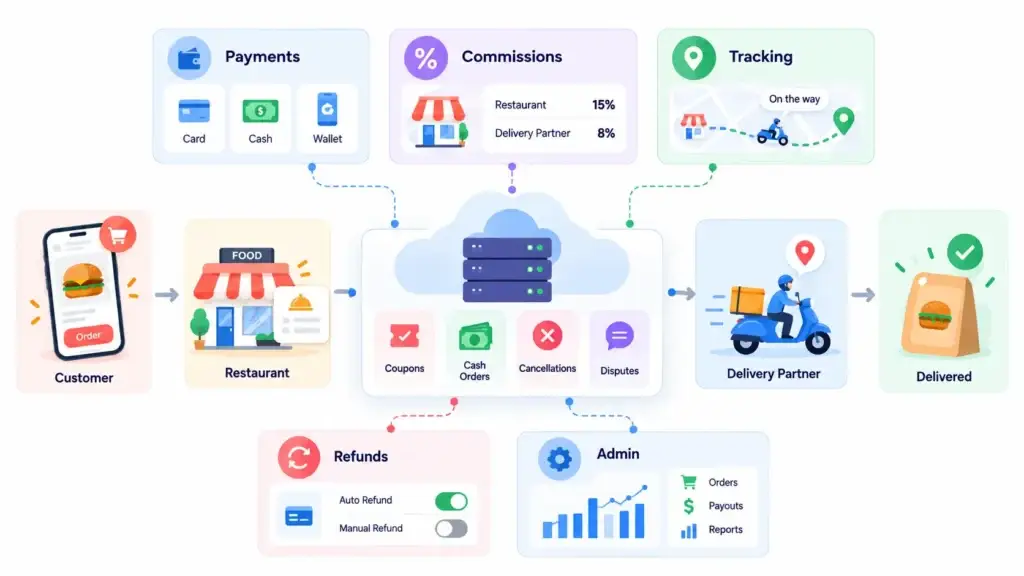
Many founders start by listing features: restaurant search, cart, coupons, live tracking, payment gateway, ratings, and admin panel. Features are important, but they do not guarantee that the platform can operate under real marketplace pressure.
Architecture decides whether those features work together.
A coupon feature is simple until it affects tax calculation, restaurant commission, platform margin, and refund value. Live tracking looks simple until the delivery partner loses connectivity or changes route. Payment looks complete until cash orders, failed payments, wallet credits, partial refunds, and settlement reports enter the picture.
Good architecture answers practical questions before they become operational issues:
- How is an order created, accepted, prepared, picked up, and completed?
- Who can cancel the order at each stage?
- When is payment captured?
- How is commission calculated?
- What happens when the customer pays in cash?
- How are restaurant and delivery partner earnings separated?
- How does the admin resolve disputes?
- How does the system prevent duplicate payout runs?
These decisions should be part of the product foundation, not last-minute fixes after launch.
Core Modules in a Food Delivery Marketplace
A delivery marketplace needs several connected modules. Each module has a visible user function and a backend business function.
| Module | What Users See | What the Backend Must Handle |
|---|---|---|
| Restaurant discovery | Restaurant list, cuisine filters, ratings | Zone visibility, availability, menu status, distance logic |
| Menu and catalogue | Food items, add-ons, prices | Item variants, stock status, tax, packaging fees, modifier rules |
| Cart and checkout | Cart review, delivery fee, offers | Price validation, coupon rules, delivery charge, minimum order logic |
| Order management | Order confirmation and status | State machine, restaurant acceptance, cancellation rules |
| Dispatch | Assigned delivery partner | Availability, proximity, zone, workload, reassignment |
| Tracking | Live map and status updates | Location pings, event logs, ETA updates, fallback logic |
| Payments | Card, wallet, cash, gateway | Payment intent, capture, failure handling, refunds |
| Settlement | Restaurant and rider earnings | Commission, delivery fee split, payout status, reconciliation |
| Admin control | Dashboard and reports | Permissions, overrides, disputes, analytics, audit logs |
Each module should be designed with future changes in mind. A founder may launch with food delivery first, then add grocery, pharmacy, cloud kitchens, corporate meals, or multi-location restaurant chains later. If the architecture is too rigid, every expansion becomes expensive.
Founders who want to compare customer ordering, restaurant management, delivery partner workflows, payment gateways, tracking, and admin controls in more detail can review the complete delivery marketplace feature set before finalising their launch scope.
Ordering Architecture: From Cart to Confirmed Order
The ordering flow is the heart of the marketplace. It connects restaurant discovery, menu selection, pricing, checkout, payment, and restaurant confirmation.
A clean ordering flow usually moves through these stages:
- Customer selects a restaurant.
- Customer adds menu items, variants, add-ons, and instructions.
- The cart validates restaurant availability, item availability, minimum order value, delivery zone, taxes, fees, and coupon eligibility.
- The customer selects payment method.
- The backend creates an order record with a pending or placed status.
- The restaurant receives the order.
- The restaurant accepts, rejects, or marks it for preparation.
- The customer receives real-time updates.
This may sound simple, but order architecture can break if the platform does not validate data at the right time.
For example, menu prices should be validated again at checkout. A customer may keep a cart open for twenty minutes while the restaurant changes an item price or marks the item unavailable. If the backend does not re-check availability, the order may be placed with outdated information.
The same applies to delivery fees, coupons, surge pricing, tax rules, packaging fees, and restaurant working hours. A strong ordering system does not trust the cart blindly. It recalculates before final order creation.
Restaurant Workflow: Acceptance, Preparation, and Readiness
Restaurant operations need a dedicated workflow because fulfilment starts before the delivery partner arrives. A restaurant panel should help staff manage incoming orders without depending on phone calls or manual coordination.
Important restaurant-side controls include:
- Order acceptance or rejection.
- Preparation time update.
- Item availability control.
- Temporary store pause.
- Menu and price updates.
- Order history.
- Earnings view.
Refund or complaint visibility where needed.
The architecture should support different restaurant models. Some restaurants want auto-accept for speed. Others want manual confirmation to avoid accepting orders during rush hours. Cloud kitchens may handle multiple virtual brands from one kitchen. Multi-location chains may need centralised menu control but local preparation visibility.
That is why restaurant workflow should not be treated as a simple vendor login. It should behave like an operating panel that helps restaurants fulfil orders accurately.
Dispatch Architecture: Matching Orders With Delivery Partners
Dispatch is one of the most important parts of food delivery marketplace architecture. It decides which delivery partner receives which order, when, and why.
Poor dispatch logic creates late deliveries, rider frustration, restaurant delays, and customer complaints. Strong dispatch logic considers operational signals.
A practical dispatch system may evaluate:
- Delivery zone.
- Restaurant location.
- Customer location.
- Delivery partner availability.
- Current delivery partner workload.
- Distance from pickup point.
- Mode of transport.
- Order priority.
- Expected preparation time.
- Acceptance timeout.
- Reassignment rules.
The simplest assignment method is nearest-available delivery partner. But this is not always enough. If the nearest delivery partner is already handling another order, moving away from the restaurant, or close to going offline, the system needs smarter filtering.
Zone-based dispatch helps keep operations controlled. Instead of searching every available rider across the entire city, the system first checks the relevant delivery zone. This reduces unnecessary matching noise and gives the admin better control over coverage, service radius, and peak-hour availability.
For early-stage founders, the goal is not always to build the most complex algorithm from day one. The goal is to have dispatch rules that are clear, adjustable, and reliable enough for real orders.
As order volume grows, founders can also explore AI dispatch and automation trends to understand how smarter routing, order allocation, demand forecasting, and operational visibility can improve marketplace performance.
Live Tracking Architecture: Status Events Matter More Than the Map
Customers expect live tracking, but live tracking is not only about showing a moving marker on a map. The system also needs accurate status events.
A reliable order-tracking flow may include:
- Order placed.
- Restaurant accepted.
- Food is being prepared.
- Delivery partner assigned.
- Delivery partner reached restaurant.
- Order picked up.
- Delivery partner is on the way.
- Order delivered.
- Order completed.
These statuses give customers confidence and help support teams understand what happened if there is a delay.
The architecture should combine location updates and event logs. Location tells the customer where the delivery partner is. Events explain what stage the order is in. Without event logs, the admin team may struggle to diagnose whether a delay came from restaurant preparation, rider assignment, route issues, customer unavailability, or payment problems.
Tracking should also handle imperfect real-world conditions. Delivery partners may lose GPS access. Mobile networks may be unstable. Battery-saving settings may reduce background updates. The system should avoid showing misleading information when the latest location ping is outdated.
A practical approach is to show recent activity, last updated time, order stage, and support options instead of relying only on continuous movement.
Payment Architecture: Capture, Cash, Refunds, and Failure States
Payment architecture in a delivery marketplace is more complex than accepting online payments.
A platform may need to support online payments, wallets, cash on delivery, discounts, refunds, failed transactions, payment retries, restaurant earnings, delivery partner earnings, platform commission, tax records, and settlement reports.
The payment system should clearly separate:
- Customer payment amount.
- Food item value.
- Taxes and packaging charges.
- Delivery fee.
- Platform service fee.
- Restaurant commission.
- Delivery partner payout.
- Discount or coupon amount.
- Refund amount.
- Payment gateway charges where applicable.
This separation matters because settlement depends on it.
For example, if a customer pays online and later receives a partial refund for a missing item, the system should know whether that refund affects the restaurant earning, platform commission, delivery partner payout, or only the customer’s final charge.
For cash orders, the architecture needs cash reconciliation. If the delivery partner collects money from the customer, the platform needs to track how much is owed back to the platform or restaurant depending on the business model.
Without clear payment records, marketplace finance becomes manual and error-prone.
Settlement Architecture: Turning Orders Into Earnings
Settlement is where marketplace architecture becomes a business system.
After an order is completed, the platform must calculate who earned what. The restaurant may receive the item value minus platform commission. The delivery partner may receive a delivery fee, incentive, or distance-based payout. The platform may retain commission, service fees, advertising fees, or delivery margin. This is why the platform’s marketplace revenue and settlement logic should be planned before launch, not added later as a manual finance process.
A settlement record should usually include:
- Order ID.
- Restaurant earning.
- Platform commission.
- Delivery partner earning.
- Delivery fee split.
- Tax components.
- Discount impact.
- Refund adjustment.
- Payout status.
- Settlement date.
- Payment method.
- Reconciliation status.
Settlement should be traceable. Admin teams need to understand why a restaurant received a certain amount and why a delivery partner payout changed. This is especially important when there are cancellations, refunds, disputes, or failed deliveries.
Strong settlement architecture also prevents duplicate payouts. If a payout job runs twice by mistake, it can create financial loss and operational confusion. That is why payout workflows should include payout statuses, transaction references, locking logic, audit trails, and admin visibility.
Admin Dashboard Architecture: The Control Layer Founders Actually Need
The admin dashboard is not just a backend screen. It is the control room of the delivery marketplace.
A strong admin dashboard should let the platform operator manage:
- Customers.
- Restaurants.
- Delivery partners.
- Delivery zones.
- Menus and categories.
- Orders.
- Payments.
- Commissions.
- Delivery fees.
- Coupons and promotions.
- Refunds and disputes.
- Notifications.
- Reports and analytics.
- Roles and permissions.
The most important part is control. A founder should not need a developer every time they want to pause a restaurant, change a delivery fee, approve a refund, update commission, or review a payout.
Role-based access is also important. Finance teams may need settlement access. Support teams may need order and dispute access. Operations managers may need delivery zone and rider controls. Marketing teams may need promotion management. Not every admin user should have permission to change payout or commission settings.
That is why permission-based dashboards, audit logs, and admin access controls are part of serious marketplace architecture.
Founder Decision Signals
Speed
If your launch depends on signing restaurants quickly, a ready-made architecture can reduce the time spent building standard ordering, dispatch, and admin workflows from zero.
Cost
Cost is not only development cost. Poor architecture creates rework, delayed launches, manual operations, support pressure, and payment disputes.
Scalability
A scalable delivery marketplace should handle more restaurants, more zones, more orders, and more payout records without forcing a full backend rebuild.
Market Fit
The right architecture lets founders test local delivery behaviour, restaurant supply, payment preferences, and operational rules before over-customising the platform.
Database Design for Food Delivery Marketplace Operations
The database should reflect the way the business works. In food delivery, that means the schema must support users, restaurants, delivery partners, menus, orders, payments, locations, commissions, settlements, and disputes.
Common database entities include:
- Users.
- Customer profiles.
- Restaurant profiles.
- Delivery partner profiles.
- Restaurant branches.
- Menus.
- Menu items.
- Item variants.
- Add-ons.
- Carts.
- Orders.
- Order items.
- Order statuses.
- Delivery assignments.
- Location logs.
- Payment transactions.
- Refunds.
- Commission records.
- Settlement records.
- Coupons.
- Ratings and reviews.
- Support tickets.
- Admin users.
- Permissions.
A relational database is often practical for marketplace operations because many records need consistency and traceability. Orders connect to customers, restaurants, delivery partners, payments, settlements, and refunds. These relationships should be clear.
However, some parts of the platform may benefit from event logs, caching, search indexes, or real-time data stores. For example, restaurant discovery should be fast. Live tracking may need frequent location updates. Notifications may require queues. Reports may need aggregated tables for performance.
The important decision is not only which database to use. The important decision is how cleanly the business relationships are modelled.
API Architecture: Connecting Apps, Panels, and Admin Workflows
A food delivery marketplace usually needs APIs for customer apps, restaurant panels, delivery partner apps, and admin dashboards.
These APIs should be designed around workflows, not only database records.
Customer APIs may include restaurant discovery, menu details, cart, checkout, order status, payment, ratings, and support.
Restaurant APIs may include order acceptance, preparation updates, menu management, availability, earnings, and store status.
Delivery partner APIs may include assignment requests, acceptance, navigation details, pickup status, delivery status, earnings, and availability.
Admin APIs may include user management, restaurant management, delivery partner management, zone control, commission settings, order review, payment reports, settlement management, and dispute handling.
API architecture should also include authentication, authorization, rate limits, error handling, logging, and versioning. This protects the platform as more apps, panels, and integrations are added.
For founders, API quality matters because it affects future flexibility. A clean backend can support mobile apps, web ordering, restaurant tablets, call-centre dashboards, loyalty integrations, and analytics tools without starting again.
Notification Architecture: Keeping Every Party Updated
Food delivery is time-sensitive. Notifications reduce uncertainty and prevent operational delays.
A delivery marketplace may send notifications for:
- Order placed.
- Restaurant accepted order.
- Restaurant rejected order.
- Delivery partner assigned.
- Delivery partner reached pickup.
- Order picked up.
- Order delayed.
- Order delivered.
- Payment failed.
- Refund processed.
- Promotion applied.
- Support update.
Notifications may happen through push notifications, SMS, email, WhatsApp integrations, in-app alerts, or dashboard alerts depending on market and scope.
The system should avoid notification overload. Customers need useful updates, not noise. Restaurants need urgent order alerts, not marketing messages. Delivery partners need assignment and navigation-related updates. Admins need exception alerts for failed payments, late preparation, unassigned orders, and disputed transactions.
Good notification architecture is event-driven. When an order status changes, the correct user receives the correct message automatically.
Delivery Zone Architecture: The Hidden Layer Behind Availability
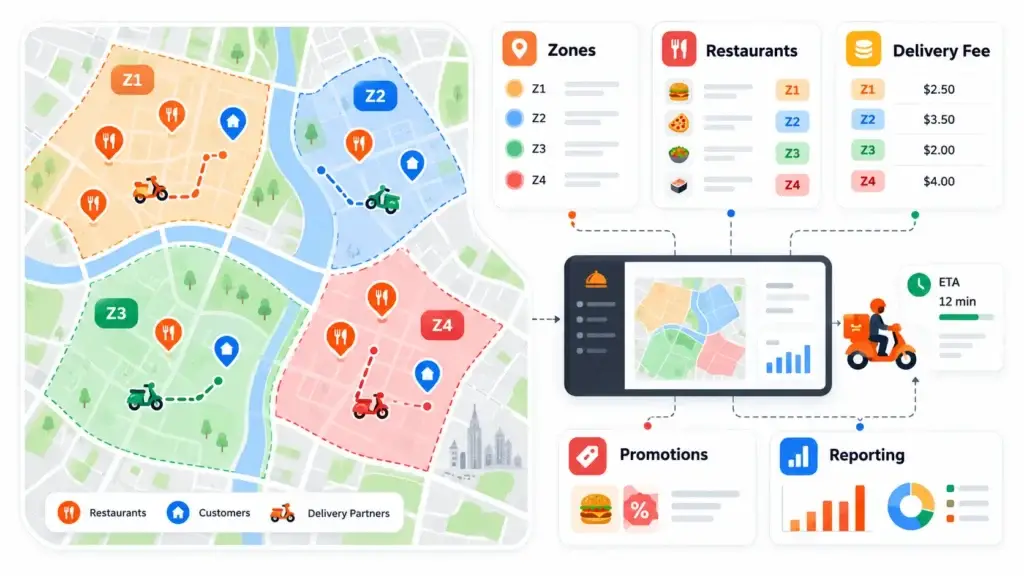
Food delivery marketplaces are local by nature. A restaurant may serve only specific areas. Delivery partners may work inside specific zones. Delivery fees may change by distance or zone. Promotions may apply only to selected locations.
That is why delivery zones are a core architecture layer.
Zone logic may control:
- Restaurant visibility.
- Service availability.
- Delivery partner assignment.
- Delivery fee calculation.
- Minimum order value.
- Surge pricing.
- Promotional campaigns.
- Estimated delivery time.
- Admin reporting.
Without zone control, the platform may show restaurants that cannot fulfil an order, assign delivery partners inefficiently, or calculate delivery charges incorrectly.
For launch-stage founders, zones also help with market validation. Instead of launching everywhere at once, the platform can start with a limited operating area, monitor order density, and expand zone by zone.
This zone-first approach is especially useful for founders exploring closed-loop delivery operations, where menu control, preparation timing, delivery radius, and fleet efficiency directly affect margins.
Security and Trust in Food Delivery Marketplace Architecture
Marketplace trust depends on identity, payments, records, and admin control.
A food delivery platform should use secure login, encrypted data transfer, role-based access control, secure payment gateway integration, activity logs, and permission-based dashboards. For restaurants and delivery partners, verification workflows can help reduce fraud and improve operational accountability.
Security also matters in admin workflows. The admin panel may control refunds, commissions, payouts, restaurant approvals, and delivery partner records. These controls should not be open to every internal user.
Important trust layers include:
- Customer account security.
- Restaurant verification.
- Delivery partner verification.
- Secure payment handling.
- Admin role permissions.
- Refund approval workflows.
- Dispute records.
- Order history.
- Payout audit logs.
- Activity logs.
For a deeper breakdown of login protection, payment safety, rider verification, payout protection, audit logs, fraud signals, and admin permissions, read this guide on food delivery marketplace security controls.
Security should be built into the operating model instead of added only after growth creates risk.
Ready-Made vs Custom Architecture: What Founders Should Understand
A fully custom build gives product teams maximum control, but it also requires more planning, engineering time, testing, and operational validation. Every module must be designed, built, tested, connected, and improved before the platform can handle real marketplace activity.
Before choosing between a custom build and a ready-made foundation, founders should review the main delivery marketplace development cost factors, including customer apps, restaurant panels, courier workflows, payment gateways, dispatch logic, tracking, admin controls, and settlement requirements.
A ready-made food delivery marketplace foundation gives founders a faster starting point because the major workflows already exist. The value is not that every business should launch the exact same platform. The value is that ordering, restaurant management, delivery partner workflows, admin control, payment logic, and settlement foundations do not need to be invented from zero.
| Build Path | What It Means | Best For | Risk to Watch |
|---|---|---|---|
| Fully custom architecture | Every workflow is designed and built from scratch | Highly unique operating models with enough time and budget | Longer launch cycle, more testing, higher planning dependency |
| Ready-made foundation | Core delivery workflows already exist and are configured for launch | Founders who want faster validation and standard marketplace operations | Scope must be clear so custom requests do not delay launch |
| Hybrid approach | Start with a ready-made foundation and customise selected workflows | Startups that need speed now and flexibility later | Requires careful prioritisation of what to customise first |
Miracuves supports founders who want to move faster with a ready-made, white-label delivery marketplace foundation. For defined ready-made scopes, Miracuves can help prepare the platform for launch in 6 working days with branding, configuration, admin control, and source-code ownership. If you are evaluating implementation support, choosing the right food delivery software development partner matters because the platform must connect ordering, dispatch, tracking, payments, settlement, and admin control cleanly.
How This Architecture Supports a Commercial Delivery Solution Page
This blog should not try to sell the product directly in every section. Its job is to educate the reader on what a serious food delivery marketplace needs under the surface.
That makes it a support asset for the main solution page.
A reader who searches for architecture, dispatch, tracking, payments, or settlement may not be ready to request a demo immediately. But after understanding the complexity of the platform, they may want to explore a launch-ready solution instead of building every workflow from scratch.
This keeps the blog helpful while passing qualified commercial intent to the money page.
Mistakes Founders Should Avoid
Building only the customer app first
The customer app is important, but it is only one side of the marketplace. If the restaurant panel, delivery partner app, and admin dashboard are weak, the customer experience will fail during real orders.
Treating dispatch as a simple rider notification
Dispatch is a matching system. It should consider zone, availability, pickup distance, workload, acceptance time, reassignment, and order priority.
Ignoring settlement until after launch
Settlement should be designed early. Restaurant earnings, delivery partner payouts, platform commission, refunds, and cash reconciliation must be traceable from the beginning.
Over-customising before market validation
A founder may not know which restaurant model, delivery fee, offer strategy, or operating zone will work until real users start ordering. Build enough flexibility to learn before spending heavily on unusual custom logic.
Giving every admin user full access
Admin access should be permission-based. Finance, operations, support, and marketing users do not need the same controls.
Practical Launch Checklist for Food Delivery Marketplace Architecture
Before launch, founders should confirm these items:
- The customer ordering flow works from restaurant discovery to checkout.
- Restaurant availability and menu status are controlled correctly.
- The restaurant panel receives and updates orders clearly.
- Delivery partners can accept, pick up, track, and complete orders.
- Admin users can manage orders, users, restaurants, drivers, and zones.
- Payment methods are configured and tested.
- Refund workflows are defined.
- Commission rules are clear.
- Settlement records are generated cleanly.
- Delivery zones are mapped.
- Notifications are triggered at the right order stages.
- Support and dispute workflows are available.
- Reports show order, payment, commission, and payout visibility.
- Source-code ownership and handover expectations are clear.
This checklist helps founders avoid a common mistake: launching a visually complete app that is operationally incomplete.
Final Thoughts
Food delivery marketplace architecture is what turns a food ordering idea into a working business system. The visible app screens matter, but the real strength of the platform comes from how ordering, restaurant workflows, dispatch, tracking, payments, settlement, and admin control work together.
For founders, the key decision is not only which features to include. The stronger question is whether the platform can handle real marketplace operations once customers, restaurants, and delivery partners start interacting at the same time.
Once the architecture is stable, the next challenge is demand generation. Founders can study food delivery growth strategy to connect retention, promotions, restaurant visibility, customer loyalty, and repeat orders.
A ready-made foundation can help reduce avoidable development work, especially when the goal is to launch faster, test the market, and keep enough flexibility for future customisation. Miracuves helps founders move in that direction with white-label delivery marketplace solutions built for faster launch, admin control, monetization readiness, and source-code ownership.
FAQs
What is food delivery marketplace architecture?
Food delivery marketplace architecture is the technical structure that connects customers, restaurants, delivery partners, payments, order tracking, admin controls, and settlement workflows inside one platform.
Why is dispatch architecture important in a food delivery platform?
Dispatch architecture decides how orders are assigned to delivery partners. It affects delivery speed, rider efficiency, restaurant coordination, customer satisfaction, and operational cost.
What modules should a food delivery marketplace include?
A food delivery marketplace should include customer ordering, restaurant management, delivery partner workflows, admin dashboard, payment processing, delivery tracking, commission management, settlement records, notifications, and dispute handling.
How does payment settlement work in a food delivery marketplace?
Payment settlement calculates how the order value is split between the restaurant, delivery partner, and platform. It may include commission, delivery fees, refunds, taxes, cash reconciliation, and payout status.
Is live tracking only about showing a map?
No. Live tracking should include both location updates and order status events. Customers need to know where the delivery partner is and what stage the order is in.
Should founders build a food delivery platform from scratch?
A custom build may make sense for highly unique business models. But for founders who want faster validation, a ready-made delivery marketplace foundation can reduce development time by starting with existing ordering, dispatch, tracking, payment, and admin workflows.
Why does the admin dashboard matter so much?
The admin dashboard controls the marketplace. It helps the operator manage users, restaurants, delivery partners, orders, payments, commissions, disputes, delivery zones, and reports without depending on developers for every operational change.
Can a food delivery marketplace later expand into grocery or pharmacy delivery?
Yes, if the architecture is modular. Shared modules such as users, carts, delivery zones, dispatch, payments, and settlement can support future expansion when designed carefully.
Miracuves is an independent software development company. We are not affiliated with, connected to, sponsored by, or endorsed by any company or product named in this article.
Terms such as “X Clone” are used descriptively. It is how the software industry refers to building a platform with functionality comparable to a known service, and how clients search for it.
The entire design and codebase of our products is built by our own team. Our products contain no code, design, graphics, or content originating from any third-party website or applications.
All third-party names and marks referenced in this article are the property of their respective owners, referenced solely to identify the services discussed.



