
Key Takeaways
- An AI app builder go-to-market strategy should connect user acquisition, fast product activation, clear use cases, templates, onboarding, and ongoing product education.
- Growth depends on helping users move quickly from their first prompt to a working application, successful preview, useful customization, and repeat project creation.
- Organic demand becomes stronger when users can share projects, publish templates, showcase outcomes, invite collaborators, and discover practical ways to use the AI app builder.
Acquisition & Activation Signals
- SEO, developer communities, product-led content, social demonstrations, template libraries, partnerships, referrals, and targeted campaigns can attract potential AI app builder users.
- Prompt suggestions, starter templates, guided onboarding, instant previews, sample applications, and simple integrations can reduce friction during the first product session.
- Track signup completion, first prompt, first generated app, preview success, project completion, deployment, repeat sessions, and time-to-value to understand activation quality.
Organic Growth Insights
- Public templates, community projects, tutorials, use-case pages, user showcases, and shareable app outputs can create search visibility and product-led discovery.
- Referral loops, collaboration invitations, remixable projects, creator communities, and educational content can turn active users into recurring acquisition channels.
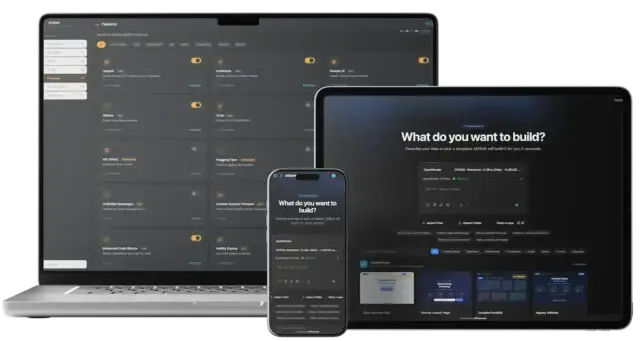
- Miracuves develops customizable AI app builder platforms with prompt-based generation, templates, visual previews, integrations, deployment workflows, collaboration, analytics, and admin controls.
AI app builders are becoming one of the most practical ways for founders, agencies, creators, and internal teams to turn ideas into working software faster. A user can describe an app, generate screens, edit workflows, preview the result, and move closer to deployment without starting every feature from zero.
But launching an AI app builder is not the same as growing one.
Many AI products attract early curiosity because the category is trending. Users sign up, test a few prompts, generate something once, and then disappear. For founders, that creates a dangerous gap between attention and real demand.
A strong AI app builder go-to-market strategy should not only bring users to the platform. It should help the right users understand the product, reach a useful first build, trust the output, return for more projects, and eventually upgrade.
That is the difference between launching an AI tool and building an AI app builder business.
Miracuves helps founders launch a white-label AI app builder platform faster with ready-made, source-code-owned product foundations. But after launch, the founder still needs the right go-to-market system: positioning, activation, organic content, community, pricing logic, and retention loops.
Why an AI App Builder Needs a Go-to-Market System, Not Just Marketing
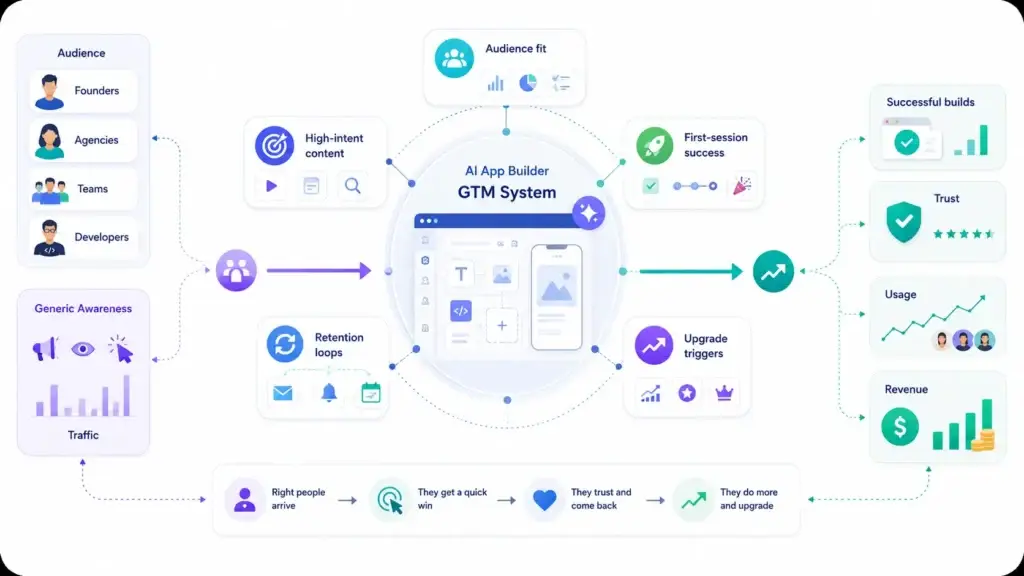
A normal marketing plan asks, “How do we get more people to see the product?”
A go-to-market strategy asks a deeper question: “How do we connect the right product promise with the right users, through the right channels, in a way that creates usage, trust, and revenue?”
For AI app builders, this distinction matters because the product category is still new for many users. Some people understand the value immediately. Others are curious but unsure whether they can trust AI-generated apps. Some users want prototypes. Others want source code. Agencies may want branded client demos. Business teams may want internal tools. Developers may care about code quality, integrations, and deployment control.
If the platform speaks to all of them in the same way, the message becomes weak.
A strong GTM system should define:
- Who the platform is for first
- What outcome the user should achieve in the first session
- What content will attract high-intent users
- What proof will make users trust the platform
- What pricing model protects AI usage costs
- What retention loops bring users back
- What upgrade triggers convert free users into paid users
The goal is not just more signups. The goal is more successful builds.
Start With One Clear First User Segment
Many founders make the mistake of marketing an AI app builder as a tool for everyone.
“Build any app with AI” sounds attractive, but it is too broad. Broad messaging creates curiosity, but specific messaging creates action.
A better approach is to choose one first user segment and build the GTM message around that group.
Segment 1: Startup Founders
Startup founders want speed, validation, investor demos, landing pages, app prototypes, and early product direction.
A strong message for them could be:
“Turn your product idea into a working app prototype faster, with editable workflows, templates, and deployment-ready foundations.”
Segment 2: Agencies and Freelancers
Agencies want to create client demos faster, reduce repetitive development work, and show polished concepts before full production.
A strong message for them could be:
“Create client-ready app prototypes and branded demos faster without rebuilding every project from zero.”
Segment 3: Internal Business Teams
Operations, HR, sales, support, and finance teams often need small workflow apps, dashboards, approval tools, and reporting systems.
A strong message for them could be:
“Build internal workflow apps faster using AI-assisted app generation, templates, and controlled deployment.”
Segment 4: Educators and Learners
Educators and learners may use AI app builders to understand product thinking, workflows, software logic, and entrepreneurship.
A strong message for them could be:
“Learn product building by turning ideas into working app examples without starting from complex code.”
The first GTM decision is not the channel. It is the audience.
What Makes an AI App Builder Marketable?
Before spending on traffic, founders should understand what makes the product easy to explain and promote.
An AI app builder becomes more marketable when it offers a clear path from idea to visible output. Users should be able to understand the promise quickly and experience value without needing a long explanation.
Key marketable benefits include:
| Product Capability | Why It Matters for GTM | User Impact |
|---|---|---|
| Prompt-based app generation | Easy to explain in demos and content | Users see fast output from simple input |
| Template library | Creates use-case clarity | Users do not start from a blank screen |
| Live preview | Builds confidence quickly | Users can see what the AI generated |
| Editable output | Reduces fear of losing control | Users can refine the generated app |
| Source-code export or ownership | Builds serious buyer trust | Founders and agencies feel safer using it |
| Deployment support | Connects generation to launch | Users move closer to real product use |
| Admin dashboard | Supports platform operators | Owners can manage users, credits, billing, and usage |
| Credit-based AI usage | Protects operating margins | Pricing can reflect real model and infrastructure costs |
A product is easier to grow when its core promise can be demonstrated visually.
For founders evaluating the product layer, strong AI app builder features should not only look impressive. They should improve activation, support user control, manage credit usage, and help the platform owner monetize without adding operational complexity.
That is why AI app builder marketing should rely heavily on demos, examples, templates, prompt libraries, and before-after workflows.
Activation Should Come Before Aggressive Acquisition
Traffic is useful only when users can activate.
For an AI app builder, activation does not mean “signup completed.” It means the user has created something useful enough to understand the product’s value.
A practical activation event could be:
“The user generates, previews, edits, and saves their first useful app project.”
This is much stronger than simply tracking visits or registrations.
First-Session Activation Flow
A strong first session should help the user move through these steps:
- Choose a clear use case or template
- Enter a guided prompt
- Generate an app screen, workflow, or project
- Preview the result
- Edit one meaningful element
- Save the project
- Understand the next action, such as export, deploy, invite, or upgrade
If users fail before step four, the platform has an activation problem.
More ads will not fix that. More SEO traffic will not fix that. More social posts will not fix that.
The product must help users reach the first useful output quickly.
Founder Decision Signal
Speed
If new users cannot create a useful first app project within the first session, improve onboarding, templates, guided prompts, and preview flows before increasing acquisition spend.
Clarity
If users feel lost after signup, add template categories, prompt examples, use-case paths, and clearer next-step instructions instead of leaving them with a blank prompt box.
Trust
If users ask what happens to their code, data, API keys, or generated projects, strengthen ownership messaging, privacy notes, export rules, and security explanations.
Margin
If AI usage costs rise faster than revenue, review credits, plan limits, model access, generation rules, and admin controls before offering more free usage.
Build Organic Demand With Template SEO
Organic demand is not only about writing broad blogs such as “What is an AI app builder?”
Those blogs are useful, but users often search for the specific thing they want to build.
That is why template SEO is one of the strongest organic strategies for AI app builders.
Instead of targeting only broad keywords, create pages around specific use cases:
- AI CRM app builder
- AI booking app builder
- AI marketplace app builder
- AI SaaS dashboard builder
- AI admin panel generator
- AI ecommerce app builder
- AI landing page builder
- AI internal tool builder
- AI invoice app builder
- AI project management app builder
- AI chatbot app builder
- AI portfolio app builder
Each page should help users understand what they can build, who the template is for, what features it includes, and what prompt they can start with.
Template Page Structure
A strong template page should include:
- Clear H1 with the template keyword
- Short explanation of the use case
- Who should use this template
- Features the AI can generate
- Example prompts
- Screenshots or preview examples
- Customization options
- CTA to start building
- Related templates
- FAQs
For example, an “AI CRM App Builder” page can show users how to generate lead dashboards, contact records, sales pipeline views, task reminders, user roles, and admin reports.
This creates high-intent organic traffic because the visitor already knows what they want to build.
Create a Prompt Library to Reduce User Friction
Many users fail with AI app builders because they do not know how to write a good prompt. Before they can create useful outputs, they need to understand the prompt-to-app AI builder workflow and how clear instructions turn into usable screens, logic, dashboards, and project structure.
The platform may be powerful, but the user still needs guidance.
A prompt library solves this problem by giving users ready examples they can modify. This improves activation and also creates SEO content.
Prompt library categories can include:
- Startup app prompts
- Marketplace app prompts
- SaaS dashboard prompts
- Booking app prompts
- Ecommerce app prompts
- Internal tool prompts
- Admin dashboard prompts
- AI chatbot prompts
- Landing page prompts
- CRM and sales app prompts
Each prompt should include:
- The user goal
- The full prompt
- Expected output
- Suggested edits
- Related templates
- CTA to generate the app
This turns content into product usage.
Instead of only educating users, the prompt library becomes a bridge between organic discovery and product activation.
Use Product-Led Growth as the Core GTM Engine
AI app builders are naturally suited for product-led growth because users want to experience the output before they commit.
A founder will not fully trust the product after reading a landing page. An agency will not adopt it for client work without testing the quality. A developer will not take it seriously unless they can inspect the generated structure, export options, and deployment flow.
The product itself must sell the value.
AI App Builder GTM Funnel
| Funnel Stage | User Question | GTM Strategy |
|---|---|---|
| Awareness | What is this and why should I care? | SEO, demos, social proof, examples, comparison content |
| Signup | Can I try it safely? | Free credits, guided onboarding, low-friction account creation |
| Activation | Can I build something useful? | Templates, prompt examples, live preview, onboarding checklist |
| Retention | Why should I come back? | Saved projects, build history, suggested next templates, email reminders |
| Conversion | Why should I pay? | More credits, exports, deployment, teams, branding, advanced models |
| Expansion | How can my team or clients use this? | Agency plans, team seats, white-label options, enterprise controls |
The most important part of this funnel is activation.
If the product cannot move users from curiosity to first useful output, every other GTM activity becomes harder.
Build Organic Demand Through Use-Case Content
Use-case content helps users connect the AI app builder to their own work.
A generic article about AI app builders may attract broad traffic. A specific use-case article attracts users with intent.
Useful use-case article ideas include:
- How to build a booking app with an AI app builder
- How agencies can create client demos using AI app builders
- How founders can validate SaaS ideas with AI-generated app prototypes
- How internal teams can build workflow apps without waiting for engineering
- How to turn a prompt into an admin dashboard
- How to create marketplace app prototypes using AI
- How to use AI app builders for product discovery
- How to evaluate AI-generated code before launch
Each use-case page should answer a practical question and include a next step into the product or solution page.
This is how organic content becomes a demand engine rather than a passive blog archive.
For readers who are still learning the category, Miracuves already explains how an AI app builder turns prompts into working applications. This GTM article should sit one step later in the journey: after the founder understands the product, but before they start scaling demand.
Add Comparison Content for High-Intent Buyers
Comparison content works well because serious users compare options before adopting a platform. Founders who are closer to purchase often compare AI app builder vs custom development before deciding whether to build from scratch or start with a ready-made foundation.
AI app builder comparison pages can target questions such as:
- AI app builder vs no-code builder
- AI app builder vs traditional development
- AI app builder vs custom software development
- SaaS AI app builder vs self-hosted AI app builder
- Open-source AI app builder vs white-label AI app builder
- AI app builder for agencies vs AI app builder for founders
- Bolt.new SaaS vs owning an AI app builder platform
Comparison pages should not attack competitors. They should clarify decision logic.
A strong comparison page should explain:
- Who each option is best for
- What control the user gets
- What happens to source code
- How pricing works
- What deployment options exist
- What scaling risks to consider
- When a ready-made foundation is better
- When custom development is better
This helps founders make decisions with less confusion.
Build Trust Before Asking Users to Upgrade
AI app builders ask users to trust generated software. That is a serious ask.
A user may wonder:
- Is my prompt data private?
- Can I export the generated code?
- Who owns the project?
- What happens to my API keys?
- Can the generated app be deployed?
- Is the code editable?
- Can I connect databases and third-party APIs?
- What happens if the AI output is wrong?
- Can my team collaborate safely?
- Can the platform operator control credits and costs?
For serious buyers, owning an AI app builder platform can become part of the trust decision because source code, deployment control, project privacy, provider access, and export clarity directly affect long-term confidence.
Trust signals should be visible across the landing page, onboarding flow, pricing page, documentation, and FAQs.
Important trust-building elements include:
- Source-code access or export clarity
- Project privacy explanation
- Secure API handling
- Role-based access controls
- Admin usage controls
- Credit transparency
- Deployment documentation
- Model/provider selection clarity
- Activity logs
- Support and update policy
- Clear refund or trial rules where applicable
Trust is not only a legal detail. It is a conversion lever.
Use Pricing and Credit Logic to Protect Margins
AI app builders have a different cost structure from normal SaaS products.
Every generation, prompt, preview, deployment, model request, image asset, or code refinement may create usage cost. If pricing is not connected to usage, growth can hurt margins.
A practical pricing model may include:
- Free credits for activation
- Starter plan for individuals
- Pro plan for serious builders
- Agency plan for client work
- Team plan for collaboration
- Enterprise plan for security, support, and custom deployment
- Credit top-ups for heavy usage
- Model-based credit differences
- Export or deployment as upgrade triggers
The goal is to let users experience value without creating uncontrolled AI usage costs.
The goal is to let users experience value without creating uncontrolled AI usage costs. A strong AI app builder business model should connect credit usage, model access, subscriptions, team plans, exports, deployment options, and upgrade triggers to the real cost of AI generation.
Founders should track credit usage by user segment. Agencies, students, solo founders, and internal business teams may use the platform differently. Pricing should reflect those usage patterns.
A good rule is simple: free usage should create activation, not unlimited cost exposure.
Build Community Around Outcomes, Not Hype
AI communities are noisy. Many users are tired of vague claims.
An AI app builder community should focus on outcomes:
- What did users build?
- What prompt worked?
- What template helped?
- What app idea became a working prototype?
- What agency demo closed a client conversation?
- What internal tool saved a team time?
- What workflow was improved?
Community content can include:
- Weekly build challenges
- Prompt showcases
- Template contests
- Founder demo days
- Agency workflow sessions
- Product teardown videos
- Live build workshops
- User-generated template libraries
Community is powerful when it creates proof.
Instead of saying “our AI builder is powerful,” show users building useful apps with it.
Use Agencies as a Distribution Channel
Agencies can become a strong GTM channel for AI app builder platforms.
Why?
Because agencies repeatedly need demos, landing pages, prototypes, internal tools, app concepts, and client-ready examples. If the platform helps them move faster, they can become long-term users or reseller partners.
Agency-focused features may include:
- White-label branding
- Client workspaces
- Team seats
- Export options
- Reusable templates
- Project duplication
- Role-based access
- Billing control
- Custom domains
- Collaboration workflows
Agency messaging should not only say “build faster.” It should say:
“Create better client demos, reduce repetitive setup work, and move from concept to presentable product direction faster.”
That is a business outcome agencies understand.
Use Paid Ads Only After Activation Is Working
Paid ads can help, but they should not be the first fix.
Before scaling paid campaigns, founders should answer:
- What percentage of users reach first useful build?
- Which templates activate fastest?
- Which user segment returns most often?
- Which upgrade trigger converts best?
- Which landing page message creates qualified signups?
- Which prompt examples reduce user failure?
- What is the average credit cost per activated user?
If these answers are unclear, paid ads may bring traffic but not growth.
Paid campaigns work better when they amplify a proven activation path.
Start with small campaigns around specific use cases:
- AI CRM builder
- AI booking app builder
- AI dashboard generator
- AI app builder for agencies
- AI prototype builder for startup founders
Specific campaigns usually outperform broad “build apps with AI” campaigns because they match clearer user intent.
Metrics Every AI App Builder Founder Should Track
A founder should not measure growth only by total users.
For AI app builders, the best metrics show whether users are reaching value and returning.
Track:
| Metric | Why It Matters |
|---|---|
| Visitor-to-signup rate | Shows whether messaging creates enough interest |
| Signup-to-first-generation rate | Shows whether onboarding starts well |
| First useful build rate | Shows real activation |
| Time to first useful output | Shows how fast users reach value |
| Template usage rate | Shows whether users need guided starts |
| Prompt failure rate | Shows where users get stuck |
| Project save rate | Shows whether the output is worth keeping |
| Export or deployment rate | Shows deeper product intent |
| Credit usage per activated user | Helps protect margins |
| Free-to-paid conversion | Shows pricing and value alignment |
| Repeat project creation | Shows retention |
| Team invite rate | Shows collaboration potential |
| Agency plan conversion | Shows B2B growth opportunity |
| Churn reasons | Shows product and pricing friction |
The most important early metric is not traffic.
It is successful first build rate.
If users build something useful, the founder has a foundation for retention, referrals, upgrades, and organic proof.
Common GTM Mistakes Founders Should Avoid
Mistake 1: Marketing Too Broadly
“Build anything with AI” sounds exciting, but it does not help a specific user decide.
Better messaging focuses on a clear use case, such as AI app builder for startup prototypes, AI builder for agencies, or AI internal tool builder for business teams.
Mistake 2: Scaling Traffic Before Fixing Activation
If users cannot create a useful output quickly, increasing traffic only increases wasted acquisition cost.
Improve templates, onboarding, prompt examples, preview quality, and save/export flows before scaling paid acquisition.
Mistake 3: Ignoring Trust Signals
Users may not pay for an AI app builder if ownership, export, deployment, privacy, and data handling are unclear.
Trust should be built into the product experience and content.
Mistake 4: Publishing Generic AI Content
Generic AI articles rarely build strong organic demand.
Specific content around templates, prompts, comparisons, examples, pricing, deployment, and use cases is more useful.
Mistake 5: Offering Unlimited Free Usage
Unlimited free AI usage can create infrastructure and model costs without revenue.
A better approach is free credits designed to help users experience value.
Mistake 6: Forgetting the Admin Layer
The platform operator needs control over users, subscriptions, credits, models, billing, usage, plans, and feature access.
Without strong admin control, growth becomes harder to manage.
A Practical 90-Day GTM Roadmap for AI App Builders
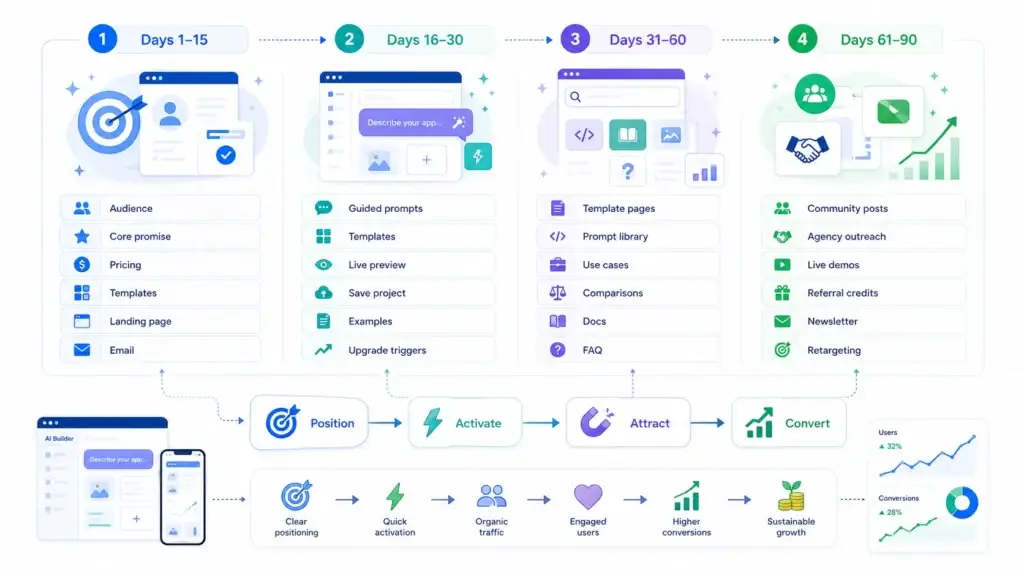
Days 1–15: Positioning and Audience Clarity
Choose one first user segment. Define the core promise, activation event, pricing logic, and first set of templates.
Create messaging for:
- Landing page
- Signup page
- Onboarding
- Pricing page
- Demo video
- Email sequence
- First five organic pages
Days 16–30: Activation Foundation
Improve the first-session experience.
Focus on:
- Guided prompt flow
- Template selection
- Live preview
- Save project flow
- Example outputs
- Help prompts
- Credit explanation
- Upgrade triggers
The goal is to help users create one useful app project quickly.
Days 31–60: Organic Demand Assets
Publish content that connects search intent to product usage.
Create:
- Template pages
- Prompt library pages
- Use-case articles
- Comparison articles
- Demo videos
- FAQ content
- Documentation pages
Each asset should lead users toward trying the builder or exploring the product foundation.
Days 61–90: Community, Partnerships, and Conversion
Once activation improves, expand distribution.
Start:
- Founder community posts
- Agency outreach
- Live build sessions
- Partner webinars
- Referral credits
- Case-style product demos
- Newsletter workflows
- Retargeting campaigns
At this stage, marketing is no longer guessing. It is scaling what already works.
How Miracuves Helps Founders Launch AI App Builder Platforms Faster
Building an AI app builder requires more than a prompt box. A serious platform needs user accounts, prompt workflows, templates, model integration, credit usage logic, generated project management, preview workflows, deployment support, billing, analytics, and admin controls.
For founders who want a faster route to market, Miracuves offers AI app builder platform solutions that can support prompt-to-app workflows, white-label branding, admin control, and source-code ownership. If you are comparing vendors, working with an experienced AI app builder development company can help you evaluate architecture, credit logic, deployment control, admin workflows, and long-term scalability before launch.
Founders exploring the broader AI ecosystem can also review Miracuves’ AI and automation solutions or AI and data product development services depending on whether they need a ready-made platform or a custom AI product build.
The key advantage is focus.
When the product foundation is already launch-ready, the founder can spend more time on positioning, onboarding, acquisition, activation, pricing, content, and retention.
Final Thoughts: Growth Comes From Useful First Builds
An AI app builder does not grow because users are curious. It grows because users create something useful, trust the result, return to build more, and see a reason to upgrade.
That means the go-to-market strategy must connect product, content, pricing, onboarding, trust, and retention.
Founders should start narrow, improve activation, build organic demand through templates and prompt libraries, use comparison content for serious buyers, and track successful first builds as the core early metric.
The strongest AI app builder GTM strategy is not the loudest launch campaign. It is the system that turns the right users into active builders.
FAQs
What is an AI app builder go-to-market strategy?
An AI app builder go-to-market strategy is a plan for attracting the right users, helping them experience the product quickly, building trust, converting active users into paid customers, and creating long-term demand through content, templates, communities, and partnerships.
How do you attract users for an AI app builder?
You can attract users through template SEO, prompt libraries, product demos, founder communities, agency partnerships, comparison content, use-case articles, social proof, referral programs, and targeted paid campaigns after activation is working.
What is the most important activation metric for an AI app builder?
The most important activation metric is successful first build rate. This measures how many users generate, preview, edit, and save a useful first app project.
Why is organic demand important for AI app builders?
Organic demand helps AI app builders attract users who already have specific intent. Template pages, prompt examples, use-case content, and comparison articles can bring users who are actively searching for ways to build apps faster.
Should AI app builders offer a free plan?
A free plan can help users experience value, but it should usually be controlled through credits, usage limits, model access, and upgrade triggers. Unlimited free usage can increase AI costs without creating revenue.
What content works best for AI app builder SEO?
Template pages, prompt libraries, use-case guides, comparison pages, demo articles, pricing explainers, and deployment guides work well because they match practical user intent.
How can agencies help grow an AI app builder?
Agencies can use AI app builders to create client demos, prototypes, landing pages, internal tools, and branded project examples. If the platform supports white-label branding, team seats, and export options, agencies can become strong distribution partners.
How does Miracuves support AI app builder founders?
Miracuves helps founders launch AI app builder platforms faster with ready-made, white-label, and source-code-owned solutions that include branded deployment, admin control, and product foundations designed for faster market validation.
Miracuves is an independent software development company. We are not affiliated with, connected to, sponsored by, or endorsed by any company or product named in this article.
Terms such as “X Clone” are used descriptively. It is how the software industry refers to building a platform with functionality comparable to a known service, and how clients search for it.
The entire design and codebase of our products is built by our own team. Our products contain no code, design, graphics, or content originating from any third-party website or applications.
All third-party names and marks referenced in this article are the property of their respective owners, referenced solely to identify the services discussed.