

Key Takeaways
- AI App Builder for Startups can help founders launch, validate demand, test pricing, and collect real user feedback without rebuilding every standard platform module from scratch.
- Ready-made development is useful when speed, market validation, predictable scope, and faster product testing are the main priorities.
- Custom development is better suited to startups that require proprietary AI workflows, advanced integrations, specialized infrastructure, or complex enterprise permissions.
- A hybrid approach combines a launch-ready foundation with custom AI logic, pricing, templates, workflows, branding, and integrations.
- Source-code ownership, AI usage control, admin capabilities, security, scalability, and future customization should be evaluated before choosing a development path.
Decision Signals
- Choose ready-made when delayed market entry is a bigger risk than technical differentiation.
- Choose custom when proprietary AI architecture or unique technical workflows form the core competitive advantage.
- Choose hybrid when the product category is proven but the startup still needs niche-specific differentiation.
- AI usage tracking, credits, subscriptions, model costs, and plan limits should be considered early because they directly affect margins.
- Admin dashboards should provide control over users, plans, templates, AI usage, pricing, access rules, payments, and platform activity.
Real Insights
- A working AI demo is not automatically a launch-ready business; billing, usage limits, project management, security, admin control, and support workflows also matter.
- Building fully custom before validating demand can consume startup runway on features users may not actually need.
- Ready-made should not mean inflexible when founders have source-code ownership and the ability to customize important workflows.
- Differentiation can come from the target niche, templates, AI workflows, pricing, integrations, and user experience rather than rebuilding every backend module.
- The strongest path is: define the target market → validate the product pattern → choose ready-made, custom, or hybrid → launch → measure usage → customize what creates real differentiation.
AI startups are under pressure to move faster than traditional software teams. Founders are no longer asking only, “Can we build this?” They are asking, “Can we launch, validate, monetize, and improve this before the market moves again?”
That is why the decision between a ready-made AI App Builder and custom AI App Builder for Startups development matters.
An AI App Builder can help users turn prompts into applications, websites, workflows, dashboards, internal tools, and digital products with less technical friction. But for founders building a business around this model, the real question is not whether AI-powered development is useful. The real question is which launch path gives the startup the right balance of speed, control, scalability, and ownership.
Some startups should begin with a ready-made foundation. Others need custom development from day one. Many will benefit from a hybrid approach: launch faster with a proven product base, then customize the business logic, AI workflows, pricing model, and user experience around a sharper market niche.
Miracuves helps founders make that decision with ready-made, white-label, source-code-owned app solutions and custom development support designed around faster market validation.
What Is an AI App Builder?
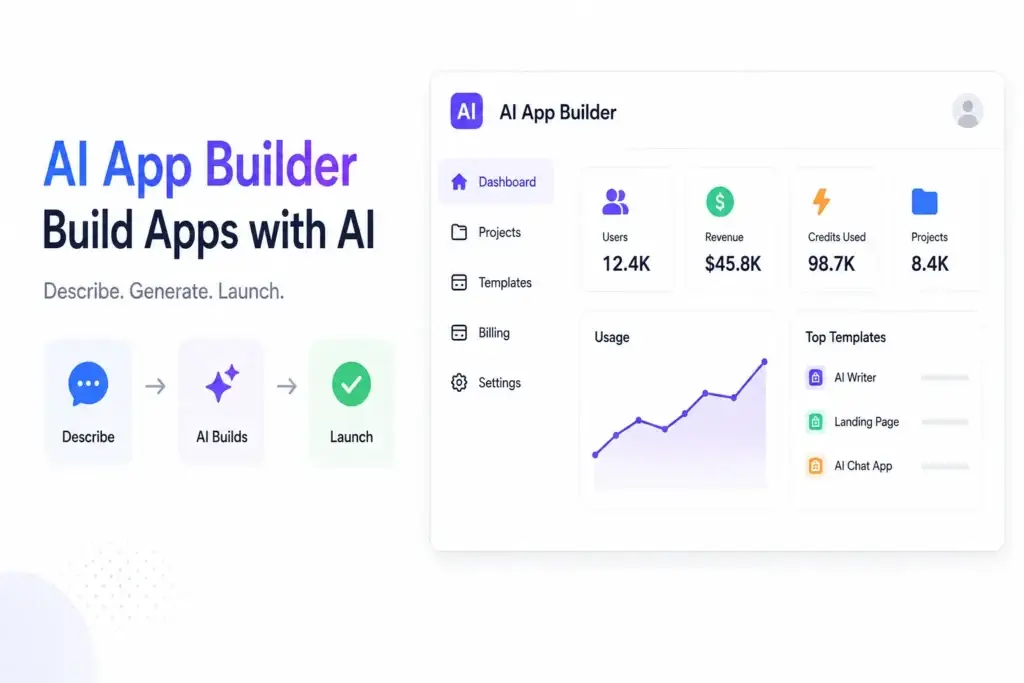
An AI App Builder is a software platform that uses artificial intelligence to help users create applications faster. Instead of manually writing every screen, component, API, workflow, and deployment configuration, users describe what they want to build. The platform then helps generate the app structure, interface, code, logic, or workflow.
Depending on the product, an AI app builder may include:
- Prompt-based app generation
- AI code generation
- Visual editing
- Project workspaces
- Live preview
- Template libraries
- Authentication
- API integration
- Database setup
- Subscription billing
- Credit-based usage control
- Deployment support
- Admin dashboards
- Model or provider management
For users, the value is speed. For founders, the value is bigger than speed. A commercial AI app builder must also manage users, projects, pricing plans, AI usage, model costs, access control, system reliability, and post-launch growth.
That is where the build decision becomes important.
Why AI Startups Compare Ready-Made and Custom Development
Most founders do not compare ready-made and custom development out of curiosity. They compare them because they are trying to protect runway.
An AI startup may be dealing with investor pressure, fast-moving competitors, changing model costs, uncertain user demand, and limited technical resources. Building every module from zero may feel attractive because it promises full flexibility, but it can also delay market learning.
A ready-made AI app builder foundation can help when the startup already understands the broad product pattern. The founder does not need to reinvent user registration, workspaces, prompt input, generated project previews, billing logic, dashboards, or admin controls from scratch. Instead, the team can focus on positioning, niche use cases, pricing, customer acquisition, onboarding, and differentiation.
Custom development makes more sense when the startup’s core advantage depends on unique technical architecture. For example, a founder building a deeply specialized AI engineering platform, regulated enterprise automation tool, proprietary model workflow, or unusual developer infrastructure may need custom development from the beginning.
The right decision depends on the startup stage.
Ready-Made AI App Builder Development: What It Means for Founders
A ready-made AI app builder is a launch-ready product foundation that already includes the core platform logic needed to enter the market faster. It is not meant to remove strategy. It is meant to reduce the time spent rebuilding standard product layers.
For founders, this approach is useful when the goal is to validate demand quickly without starting from a blank codebase.
A ready-made foundation may include the essential app-building journey: user signs up, creates a project, enters a prompt, receives generated output, previews the result, edits the project, manages usage, upgrades a plan, and continues building inside a controlled workspace.
The business value is simple: the founder starts closer to launch.
Instead of spending months deciding how basic workflows should work, the startup can invest energy into better questions:
- Which user segment should we target first?
- Should we serve agencies, SaaS founders, creators, developers, ecommerce sellers, or internal teams?
- What templates should be included?
- How should credits or subscriptions be priced?
- Which AI models or providers should be supported?
- What should the admin team control?
- How should usage costs be monitored?
- Which integrations matter for the first market version?
A ready-made AI app builder is strongest when the startup needs speed, product structure, admin control, and market validation before committing to a deeper custom roadmap.
Custom AI App Builder Development: When It Makes Sense
Custom AI app builder development means building the product from the ground up around the startup’s exact requirements. The team defines the architecture, user experience, AI workflow, backend systems, deployment flow, database logic, admin controls, and integrations from the beginning.
This gives the highest level of flexibility.
Custom development may be the better choice when the startup needs:
- Proprietary AI orchestration
- Unusual project generation workflows
- Advanced developer tooling
- Custom model routing logic
- Complex enterprise permissions
- Deep integration with existing systems
- Sensitive data handling
- Specialized compliance workflows
- Advanced collaboration features
- Long-term technical moat
- Custom infrastructure and deployment logic
The trade-off is time, planning, and cost control.
A fully custom AI app builder usually requires deeper discovery, architecture design, engineering, testing, security review, infrastructure planning, and iteration. That can be valuable for mature teams, but risky for founders who still have not validated the audience, pricing, onboarding flow, or core use case.
Custom development is powerful when the product direction is clear. It can become expensive when the business assumptions are still uncertain.
Ready-Made vs Custom AI App Builder Development: Core Comparison
Ready-Made vs Custom AI App Builder Development
| Decision Factor | Ready-Made AI App Builder | Custom AI App Builder Development | Founder Impact |
|---|---|---|---|
| Launch Speed | Faster because core workflows are already available. | Slower because architecture and modules are built from zero. | Ready-made is stronger for fast validation and early market entry. |
| Customization | Good when the solution includes source-code ownership and modular changes. | Highest flexibility across product logic, infrastructure, and UX. | Choose based on whether differentiation comes from positioning or deep technology. |
| Cost Control | More predictable because the foundation is already defined. | More variable because scope, architecture, and integrations can change. | Ready-made can protect runway during early validation. |
| Source-Code Ownership | Strong if the provider gives full source code and customization rights. | Strong if ownership is clearly included in the contract. | Ownership matters when the platform becomes a long-term business asset. |
| AI Workflow Depth | Useful for standard prompt-to-app, project, preview, billing, and admin flows. | Better for proprietary AI logic, advanced model workflows, or unusual generation pipelines. | The deeper the AI differentiation, the more custom planning is needed. |
| Scalability | Depends on architecture quality, hosting, database, and usage control. | Can be designed specifically for scale from day one. | Founders should review backend, model cost, and admin control before launch. |
| Best Fit | Startups validating a proven AI product pattern. | Startups building highly unique or enterprise-grade AI platforms. | The build path should match product maturity, not founder excitement alone. |
Founder Decision Signals: Which Path Fits Your Startup?
Speed
Choose a ready-made AI app builder foundation when your biggest risk is delayed market entry. If you need users, feedback, demos, or revenue conversations quickly, speed has strategic value.
Cost
Choose ready-made when the startup must control early spending and avoid rebuilding standard modules. Choose custom when the product has already proven demand and justifies deeper engineering investment.
Scalability
Choose custom when scale, infrastructure, or proprietary architecture is the main differentiator. Choose ready-made when the first goal is to test positioning and product-market response.
Market Fit
Choose a hybrid path when your product category is clear but your niche is still evolving. Start with a foundation, then customize templates, workflows, pricing, and AI logic based on user behavior.
Where a Ready-Made AI App Builder Helps Startups Move Faster
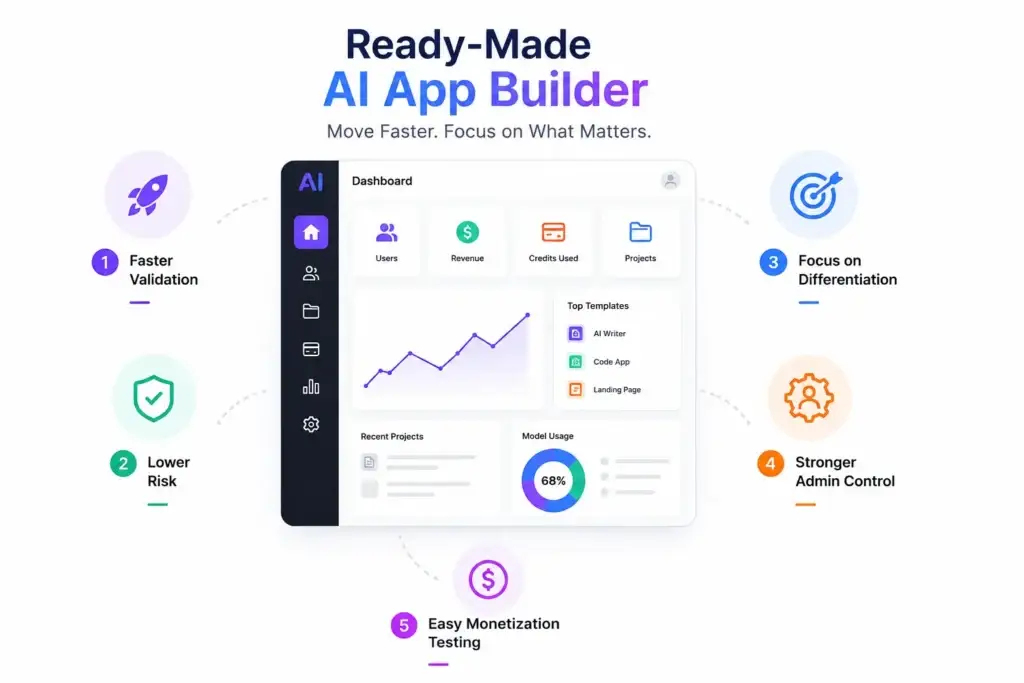
A ready-made AI app builder is not only about launching quickly. It helps founders reduce uncertainty across the common parts of the business.
1. Faster Market Validation
In AI markets, waiting too long can be costly. User expectations, model options, pricing patterns, and competitor positioning change quickly. A launch-ready foundation allows founders to test demand before over-investing in assumptions.
This is especially useful when the startup is targeting a known audience such as agencies, SaaS founders, small businesses, creators, internal teams, ecommerce brands, or non-technical entrepreneurs.
2. Lower Product Foundation Risk
Every AI app builder needs more than a prompt box. It needs account management, project storage, generated output handling, preview logic, billing, usage limits, admin control, and support workflows.
A ready-made foundation reduces the risk of missing these core layers during the first build.
3. Better Focus on Differentiation
Many founders spend too much time rebuilding the same backend workflows every AI platform needs. But differentiation usually comes from the market angle.
A startup may differentiate by building an AI app builder for restaurants, ecommerce sellers, agencies, education businesses, internal operations, landing pages, dashboards, or workflow automation.
The foundation helps launch the category. The customization defines the niche.
4. Stronger Admin Control From Day One
Admin control is not a small feature. It decides how the platform operator manages users, plans, credits, templates, access rules, content, payments, support, and abuse.
Without a strong admin layer, the founder may depend on developers for every small operational change. A serious AI app builder business should give the operator visibility into users, usage, revenue signals, model costs, and platform activity.
5. Easier Monetization Testing
AI app builders often need flexible monetization because model usage creates ongoing operating cost. Founders may test:
- Free plans with limited credits
- Monthly subscriptions
- Usage-based credits
- Team workspaces
- Premium templates
- Agency plans
- Enterprise access
- Custom implementation services
- White-label licensing
If you are planning subscriptions, usage credits, team plans, or white-label licensing, this AI app builder business model guide explains how monetization can be structured around real AI usage costs.
A ready-made foundation can help founders test pricing logic faster, while custom development can refine monetization once the startup knows which plan structure works.
When Custom AI App Builder Development Is the Better Choice
Custom development is the stronger path when the startup is not only launching an AI app builder, but building a deeply differentiated technology product.
For startups building proprietary AI workflows, model-driven automation, NLP features, recommendation engines, or generative AI layers, Miracuves’ custom AI development support can help define the right architecture before development begins.
Choose custom development when:
- Your AI workflow cannot fit a standard prompt-to-project model.
- Your product depends on proprietary algorithms or internal datasets.
- Your customers need advanced permissions, audit logs, or governance.
- Your platform must integrate deeply with enterprise systems.
- Your app requires unusual deployment, sandboxing, or infrastructure logic.
- Your business model depends on technical uniqueness, not only speed.
- You already have traction and need a long-term engineering moat.
If your AI app builder requires native mobile experiences, complex mobile workflows, or a product that cannot fit a ready-made foundation, working with a custom mobile app development team can help you scope the product from scratch with clearer ownership and delivery milestones.
Custom development should not be avoided. It should be timed correctly.
For early-stage startups, custom development before validation can slow learning. For validated startups, custom development can create defensibility.
The Hybrid Path: Faster Launch With Custom Differentiation
For many AI startups, the best answer is not ready-made versus custom. The best answer is ready-made plus focused customization.
This hybrid approach gives founders the speed of a launch-ready foundation while still allowing the business to create a distinct product.
A founder can start with standard modules such as registration, workspaces, app generation, preview, billing, admin control, and project management. Then the team can customize:
- User onboarding
- Niche-specific templates
- Prompt enhancement logic
- Model selection
- Credit rules
- Pricing plans
- Deployment options
- Agency or team workflows
- Branding
- Analytics
- Security settings
- Support operations
This prevents the startup from spending months on undifferentiated infrastructure while still leaving room to build a unique market position.
For founders exploring a launch-ready AI code generation platform, Miracuves’ AI app builder platform solution can be used as the commercial next step without making this blog compete for the same keyword intent.
Core Features an AI App Builder Startup Should Prioritize
A strong AI app builder needs more than a good demo. It needs a product system that can support real users, recurring usage, support issues, and monetization.
For a deeper view of modules such as model selection, browser-based previews, credit metering, admin controls, and deployment options, explore this AI app builder feature breakdown.
AI App Builder Features and Business Value
| Feature | Business Value | Founder Impact |
|---|---|---|
| Prompt-Based Generation | Allows users to describe what they want to build in natural language. | Creates the core product experience users expect from an AI app builder. |
| Project Workspace | Stores generated apps, edits, files, settings, and user activity. | Improves retention because users can return and continue building. |
| Live Preview | Lets users see generated output quickly. | Reduces friction between idea, output, and iteration. |
| Template Library | Helps users start faster with predefined app types. | Supports niche positioning and faster onboarding. |
| Model and Provider Settings | Controls which AI models power generation workflows. | Helps manage quality, cost, availability, and future flexibility. |
| Credit and Usage Control | Tracks AI usage and connects it to subscriptions or credits. | Protects margins as token or model costs increase. |
| Admin Dashboard | Controls users, plans, pricing, features, templates, and system activity. | Gives the founder operational control without depending on developers for every change. |
| Deployment Workflow | Helps users export, publish, or prepare generated apps for launch. | Turns the product from a generator into a practical building platform. |
Cost Logic: Why the Cheapest First Step Is Not Always the Most Cost-Efficient
Founders often compare development options only by upfront cost. That is risky.
A low-cost tool can become expensive if it creates vendor lock-in, weak code quality, limited export options, poor scalability, or high maintenance needs. A custom build can also become expensive if the team spends months building features before validating demand.
Founders comparing ready-made and custom development can review the AI app builder development cost breakdown to understand how platform pricing, token usage, provider setup, and deployment scope affect total cost.
The better question is: which approach creates the lowest total risk for the current stage?
For an early AI startup, a ready-made foundation can be cost-efficient because it reduces time spent on common modules. For a mature AI startup, custom development can be cost-efficient because it supports deeper technical differentiation.
The cost decision should include:
- Development scope
- Customization needs
- AI model or API usage
- Hosting and infrastructure
- Payment and billing logic
- Security requirements
- Admin dashboard depth
- Maintenance
- Future feature expansion
- Source-code ownership
- Technical review and QA
Miracuves’ ready-made approach can reduce development time because the foundation already includes core app flows, admin control, and essential modules. Final pricing should always be confirmed based on selected features, integrations, branding, and customization scope.
Security and Ownership Questions Founders Should Ask
AI app builder startups should treat security and ownership as product foundations, not optional extras.
Before choosing ready-made or custom development, founders should ask:
- Do we own the source code?
- Can we customize the product after launch?
- Can we change AI providers or model settings?
- Can we control user access and permissions?
- Is user data handled with privacy-conscious workflows?
- Are payments integrated securely?
- Are admin actions tracked?
- Can we monitor unusual activity or abuse?
- Can we manage usage limits and billing rules?
- Can the architecture support future scale?
Security-sensitive products may need encrypted data transfer, secure API integrations, role-based access control, activity logs, admin access controls, and audit-friendly workflows.
A working demo is not the same as a launch-ready AI business. The platform must be manageable, measurable, and maintainable.
Mistakes Founders Should Avoid
Choosing Only Based on Speed
A fast product demo is useful, but it does not automatically create a scalable business. Founders should check admin control, billing logic, ownership, integrations, security, and maintainability before launch.
Building Custom Before Validating Demand
Custom development can be powerful, but building too much before understanding user demand can waste runway. Early-stage founders should validate the audience, pricing, and workflow before committing to deep architecture.
Ignoring AI Usage Costs
AI app builders may look simple from the outside, but model usage can affect margins. Founders need credit controls, plan limits, usage tracking, and admin visibility to protect the business model.
Overlooking Source-Code Ownership
If the platform succeeds, the startup needs freedom to extend, migrate, optimize, and customize the product. Limited ownership can create long-term dependency.
How Miracuves Helps AI Startups Choose the Right Build Path
Miracuves helps founders choose between ready-made app solutions, white-label customization, AI-assisted development, and custom software development based on the business model.
If you want help deciding between a ready-made foundation, custom development, or a hybrid approach, Miracuves can act as your AI app builder development partner and guide the platform scope before launch.
For an AI App Builder startup, the decision usually depends on the founder’s stage:
- If the goal is fast validation, a ready-made foundation can reduce launch time.
- If the goal is a deeply unique AI workflow, custom development may be better.
- If the goal is speed plus control, a hybrid approach can balance both.
- If the business needs long-term flexibility, source-code ownership should be a priority.
Founders can also explore Miracuves’ AI app builder vs traditional development guide for a broader comparison of launch paths, and the AI app builder unit economics guide to understand how token usage, credits, and admin controls affect margins.
Final Thoughts: Choose the Build Path That Matches Your Startup Stage
The decision between ready-made and custom AI app builder development is not about which option sounds more advanced. It is about what your startup needs right now.
If your main goal is to enter the market, validate demand, test pricing, and learn from real users, a ready-made AI app builder foundation can be the smarter first move. It helps reduce avoidable development work and gives your team more time to focus on positioning, onboarding, monetization, and growth.
If your product depends on proprietary AI architecture, enterprise-grade workflows, advanced governance, or deeply specialized infrastructure, custom development may be worth the investment.
For many founders, the strongest path is hybrid: launch faster with a proven foundation, customize what creates differentiation, and invest deeper once the market proves what matters.
Miracuves helps founders move from idea to launch faster with ready-made, white-label, source-code-owned app solutions built for branding, admin control, monetization, and long-term product ownership.
FAQs
What is an AI App Builder?
An AI App Builder is a platform that uses artificial intelligence, prompts, templates, or automation to help users create applications faster. It can generate screens, workflows, code, project structures, previews, and deployment-ready outputs depending on the platform.
Is a ready-made AI app builder good for startups?
Yes, a ready-made AI app builder can be useful for startups that want faster market validation. It works best when the founder is entering a known product category and wants to customize branding, pricing, templates, workflows, and admin controls instead of building every module from zero.
When should a startup choose custom AI app development?
A startup should choose custom AI app development when the product needs proprietary AI workflows, advanced integrations, sensitive data handling, custom infrastructure, complex permissions, or a technical architecture that cannot fit a ready-made foundation.
What is the main difference between ready-made and custom AI app builder development?
Ready-made development starts with an existing product foundation that can be branded and customized. Custom development starts from zero and gives deeper flexibility, but usually requires more planning, engineering, testing, and budget commitment.
Can a ready-made AI app builder be customized?
Yes, if the solution includes source-code ownership and modular architecture. Founders can customize branding, templates, pricing plans, AI provider settings, admin workflows, user roles, integrations, and launch-specific features.
Why does source-code ownership matter for AI startups?
Source-code ownership matters because the startup may need to modify, scale, migrate, optimize, or extend the platform after launch. Without ownership, the founder may face vendor dependency or limits on future customization.
How do AI app builders make money?
AI app builders can make money through subscriptions, usage-based credits, team plans, agency workspaces, premium templates, custom implementation services, enterprise access, and white-label licensing.
What is the safest launch path for an AI app builder startup?
The safest launch path depends on the startup stage. Early-stage founders often benefit from a ready-made or hybrid approach because it supports faster validation. Startups with proven demand and unique technical requirements may benefit from deeper custom development.
Miracuves is an independent software development company. We are not affiliated with, connected to, sponsored by, or endorsed by any company or product named in this article.
Terms such as “X Clone” are used descriptively. It is how the software industry refers to building a platform with functionality comparable to a known service, and how clients search for it.
The entire design and codebase of our products is built by our own team. Our products contain no code, design, graphics, or content originating from any third-party website or applications.
All third-party names and marks referenced in this article are the property of their respective owners, referenced solely to identify the services discussed.