Key Takeaways
- The cost to build an Uber-like ride-hailing app depends on the complete mobility system. Rider and driver apps are only part of the budget; dispatch, payments, administration, testing, security, and backend infrastructure also require engineering effort.
- Custom development costs vary significantly by scope. Focused single-city platforms may require tens of thousands of dollars, while multi-city systems with advanced dispatch, vehicle categories, and complex settlement workflows can require substantially more.
- The dispatch engine is one of the major technical cost centers. Driver discovery, timed offers, concurrency control, duplicate-assignment prevention, cancellations, and recovery workflows require more than basic booking functionality.
- Driver-side architecture can be more operationally demanding than it appears. Background location, connectivity, ride offers, driver verification, earnings, and device reliability all affect development and testing requirements.
- Recurring operating costs must be included in the business plan. Maps, routing, cloud infrastructure, notifications, identity verification, payment processing, monitoring, maintenance, and customer support can continue generating costs after development is complete.
- Technology cost should be measured against completed rides. Cost per completed ride provides more useful operational insight than looking at the cloud bill alone because low utilization can make otherwise reasonable infrastructure costs expensive on a per-trip basis.
- Architecture should match the first market. A modular and reliable system can be more appropriate for a first-city launch than an unnecessarily complex microservices or advanced dispatch architecture.
- Security and compliance add legitimate engineering requirements. Ride-hailing platforms handle location information, personal data, driver documents, and financial records, requiring appropriate access controls, secure integrations, auditability, and data protection.
- A ready-made foundation can reduce duplicated development work. When existing booking, driver, dispatch, and administrative workflows closely match the business model, reusable software can shorten the path to initial deployment while still requiring customization and validation.
- The best budget is the one that supports reliable operations. Founders should prioritize accurate booking, dependable dispatch, payment clarity, failure recovery, monitoring, and maintainability before adding advanced features that the first market may not need.
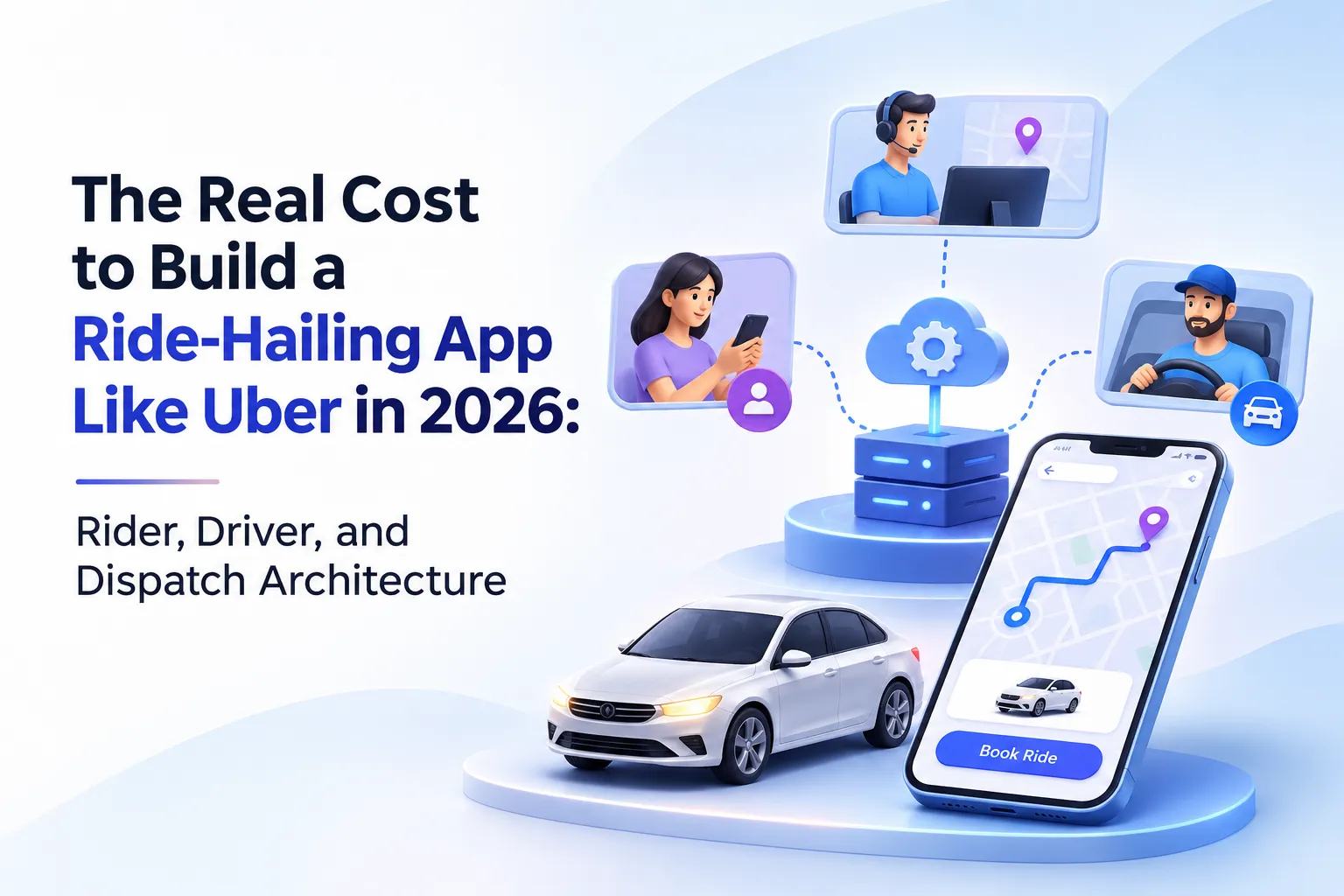
What does it really cost to build a ride-hailing platform in 2026? The answer depends on far more than designing a passenger booking screen. A working mobility business needs a rider application, a driver application, a reliable dispatch engine, administrative controls, payment processing, and backend infrastructure capable of coordinating trips in real time.
Founders comparing development quotes often discover that similar-looking applications have very different technical foundations. One estimate may cover mobile interfaces and basic booking functionality, while another includes location synchronization, automated driver allocation, payment reconciliation, monitoring, and operational recovery. Before comparing quotes, it helps to know which core components a ready-made Uber-like platform already covers, because those are the parts you should not pay to rebuild.
This guide examines the real cost to build a ride-hailing app like Uber in 2026 through its underlying technical architecture. We will explore what each application requires, where engineering budgets are consumed, how dispatch decisions influence infrastructure spending, and which recurring expenses founders must account for before entering the market.
How Much Does It Cost to Build a Ride-Hailing App in 2026?
For founders assessing custom development, published 2026 estimates for a focused, single-city ride-hailing platform often fall in the tens of thousands of dollars. A lean MVP typically needs about 2,100 to 2,600 engineering hours. At blended offshore-team rates of $20 to $40 an hour that is roughly $42,000 to $105,000, while the same hours at US wage levels come to about $135,000 to $170,000 before benefits, overhead or margin (the breakdown below shows the math). More sophisticated multi-city platforms can require substantially higher investment, particularly when they introduce specialized dispatch algorithms, several vehicle categories, complex settlement workflows, and advanced operational tools.
These figures should be treated as market planning references rather than fixed quotations. There is no universal development price because different estimates include different engineering responsibilities, technology choices, testing standards, and operational requirements.
The important question is not simply how much an application costs. It is what the quoted price includes and whether the delivered architecture can support real trips reliably.
Budget time and upkeep as well. A custom single-city MVP typically needs about 12 to 20 weeks from discovery to store launch (see the timeline below), and a common planning rule is to reserve 15 to 20 percent of the original build cost each year for maintenance, mobile OS updates and provider API changes. Treat both as planning ranges to test against written quotes, not as benchmarks.
The Four Major Cost Categories
| Architecture component | What must be engineered | Main budget pressure |
|---|---|---|
| Rider application | Account creation, booking, pickup selection, fare estimates, tracking, payments | Mobile development, maps, UI, integration testing |
| Driver application | Availability, GPS reporting, ride offers, navigation, trip status, earnings | Background location, reliability, device testing |
| Dispatch and backend | Driver discovery, trip matching, request queues, timeouts, live event delivery | Backend engineering, geospatial logic, concurrency |
| Operations and supporting systems | Admin controls, verification, disputes, payouts, reporting, security | Workflow complexity, integrations, auditability |
Although the four categories share data and business logic, each creates independent development and testing requirements. A low initial estimate can become expensive if essential workflows were omitted from the original scope.
Cost by Feature Module: An Illustrative MVP Estimate
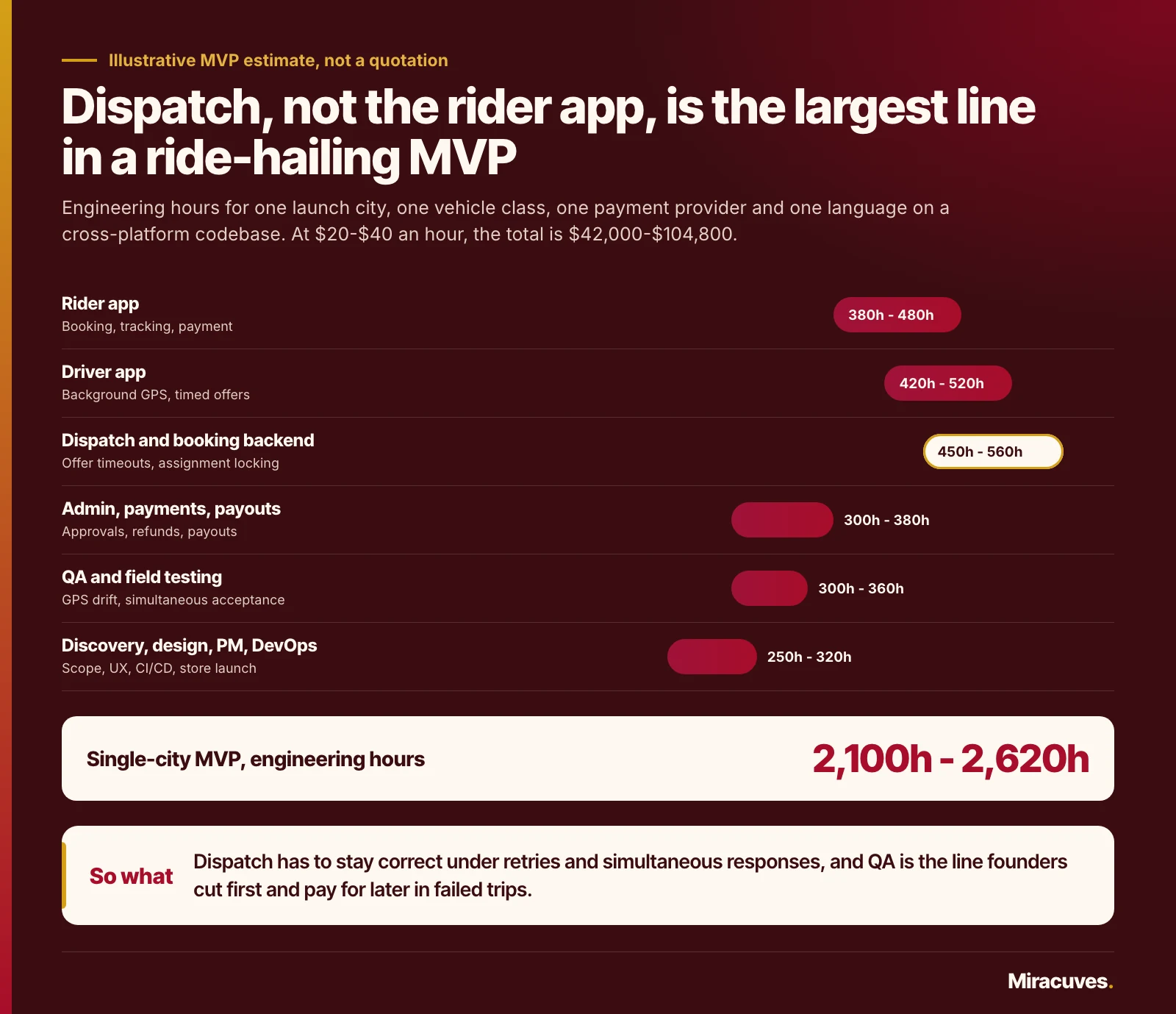
The table below turns the four categories into feature modules with engineering hours, then prices those hours at two blended rates. It is an illustrative estimate, not a quotation: it assumes a cross-platform mobile codebase, one launch city, one vehicle class, one payment provider and one language. The hourly rates are planning assumptions for a mixed offshore team, not a market average.
| Module | Typical MVP features | Hours (illustrative) | At $20/hr | At $40/hr |
|---|---|---|---|---|
| Rider app | Sign-up with phone OTP, pickup and drop-off search, fare estimate, booking, live tracking, card or cash payment, ratings | 380-480 | $7,600-$9,600 | $15,200-$19,200 |
| Driver app | Onboarding and documents, online/offline toggle, background GPS, timed ride offers, trip status, navigation hand-off, earnings | 420-520 | $8,400-$10,400 | $16,800-$20,800 |
| Dispatch and booking backend | Geospatial driver search, offer queue and timeouts, assignment locking, trip state machine, fare rules, real-time events | 450-560 | $9,000-$11,200 | $18,000-$22,400 |
| Admin panel, payments and payouts | Driver approval, zones and fares, trip monitoring, refunds, commission and payout records, reports | 300-380 | $6,000-$7,600 | $12,000-$15,200 |
| QA and field testing | Device matrix, poor-network and GPS-drift tests, simultaneous-acceptance tests, payment failure cases | 300-360 | $6,000-$7,200 | $12,000-$14,400 |
| Discovery, design, PM and DevOps | Scope document, UX flows, architecture, CI/CD, hosting setup, store submission | 250-320 | $5,000-$6,400 | $10,000-$12,800 |
| Total | 2,100-2,620 | $42,000-$52,400 | $84,000-$104,800 |
Two things move this total more than anything else: the dispatch backend, which is the largest single module because it has to stay correct under retries and simultaneous responses, and QA, which founders most often cut and later pay for in failed trips. Recurring costs, legal work, driver acquisition and marketing are not included.
MVP vs Full Platform vs Multi-City: Cost Tiers
Scope tiers scale the hours, and the hourly rate scales the dollars. The last column prices the same hours at the US median wage for software developers, QA analysts and testers, which the US Bureau of Labor Statistics puts at $64.44 an hour (May 2025). That is wages only; a contractor or agency bill rate adds benefits, overhead and margin on top.
| Tier | Typical scope | Team and duration (typical) | Engineering hours | At $20-$40/hr blended | US wages only at $64.44/hr |
|---|---|---|---|---|---|
| Single-city MVP | One city, one vehicle class, sequential dispatch, card and cash, basic admin | 4-5 people for 12-16 weeks | 2,100-2,620 | $42,000-$104,800 | $135,000-$169,000 |
| Full single-market platform | Several vehicle classes, scheduled rides, scored dispatch, wallet, promo codes, surge rules, support tooling | 6-7 people for 22-26 weeks | About 6,000 | About $120,000-$240,000 | About $387,000 |
| Multi-city or multi-service | City-level configuration, fleet accounts, several currencies, analytics, delivery or other job types | 8-10 people for 36-44 weeks | About 14,000 | About $280,000-$560,000 | About $902,000 |
All figures are illustrative estimates built from the stated hours and rates, rounded. Use them to sanity-check a quote: if a proposal for a full single-market platform implies far fewer than a few thousand hours, ask what has been left out or reused.
Why Quotes for the Same App Differ So Much by Region
Much of the gap between a $50,000 quote and a $250,000 quote for the same feature list usually comes from the hourly rate, not the scope. Pay for the same role varies several-fold between countries: the 2025 Stack Overflow Developer Survey reports a median back-end developer salary of $175,000 in the US, about $87,000 in Germany and about $22,000 in India. When you compare regions, compare estimated hours and scope line by line, check who owns the source code and third-party accounts, and ask who carries the cost if the hours run over.
Why Rider, Driver, and Dispatch Architecture Determines the Development Budget
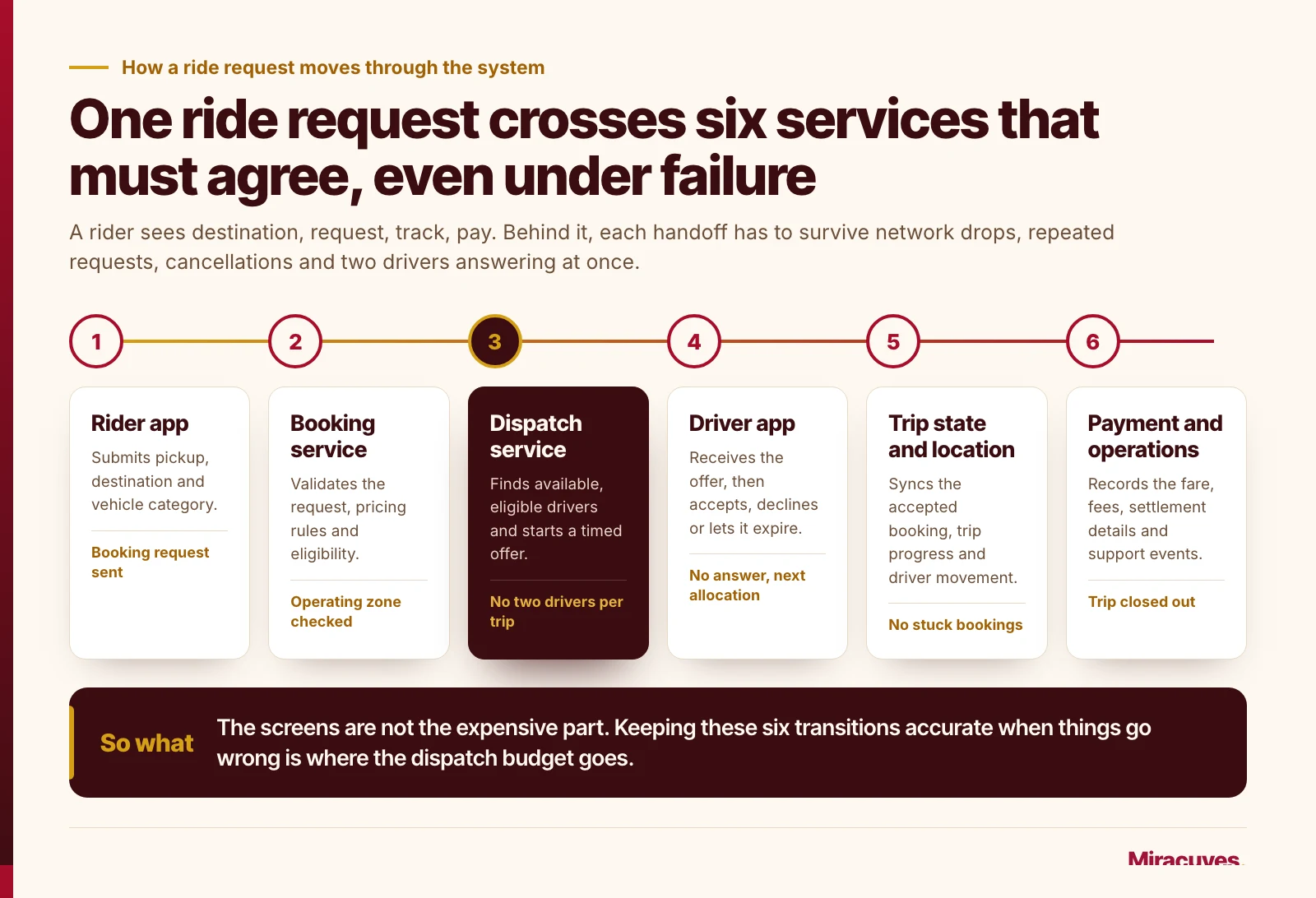
A passenger might see a simple process: select a destination, request a vehicle, follow its movement, and pay. Behind that experience, multiple services exchange information under time-sensitive conditions.
When a booking is submitted, the system validates the request, checks the operating zone, identifies eligible drivers, calculates estimated arrival times, sends an offer, records the driver’s response, and updates the passenger’s trip status. If a driver declines or fails to respond, another allocation decision may be required.
These operations must be coordinated without allowing two drivers to claim the same trip or leaving a booking permanently stuck in an uncertain state.
A Simplified Ride Request Architecture
How a Ride Request Moves Through the System
1. Rider application: Submits pickup, destination, vehicle category, and booking request.
↓
2. Booking service: Validates the request, pricing rules, and booking eligibility.
↓
3. Dispatch service: Searches for available, eligible drivers and starts a timed allocation process.
↓
4. Driver application: Receives an offer and accepts, declines, or allows it to expire.
↓
5. Trip state and location services: Synchronize the accepted booking, trip progress, driver movement, and arrival information.
↓
6. Payment and operations systems: Record the completed fare, applicable fees, settlement information, and support events.
The expensive part is ensuring these transitions remain accurate during network failures, repeated requests, canceled trips, or simultaneous driver responses. A visually polished interface cannot compensate for unreliable allocation and trip management.
Rider App Architecture: What Are You Actually Paying For?
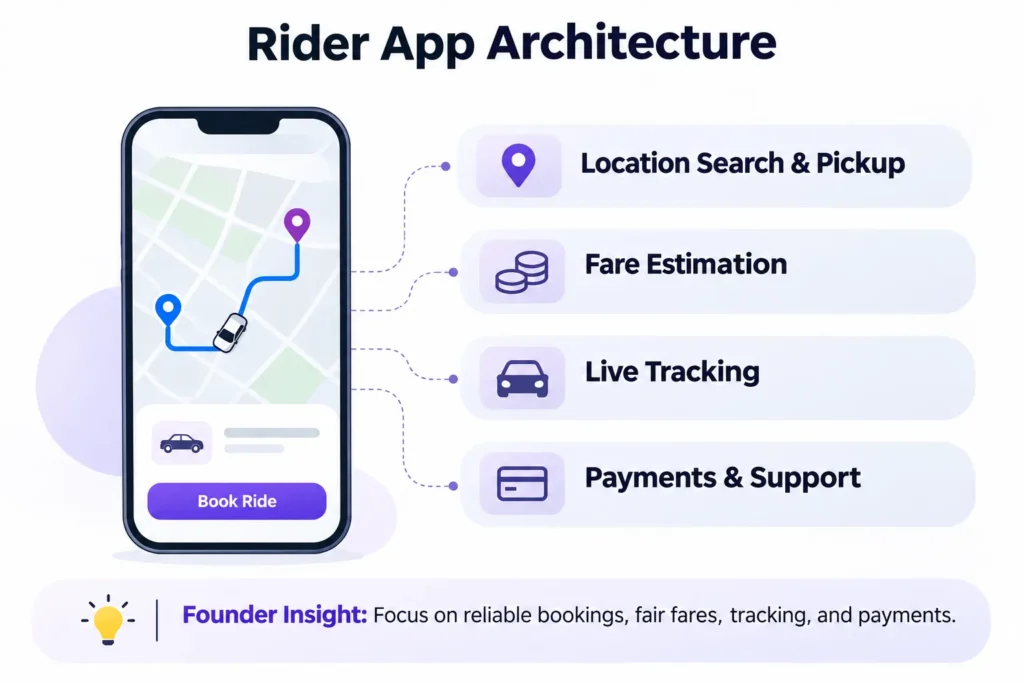
The rider application is the primary customer-facing interface. Its job is to make booking straightforward while providing reliable information about fares, drivers, routes, and payment status.
From a development perspective, the main cost does not come from displaying buttons and maps. It comes from connecting those interfaces to services that continuously change.
Location Search and Pickup Validation
A passenger may select a pickup point using a live map, saved address, or location search. The application then needs to validate whether the requested pickup is supported and whether nearby drivers can reasonably access it.
This introduces map provider integrations, geocoding, geographic restrictions, and location-permission handling. If the product supports multiple cities or unusual service boundaries, the underlying rules become more complicated.
Fare Estimation Before Booking
Passengers generally expect an estimated fare before confirming a trip. Producing that estimate may require journey distance, expected travel duration, vehicle category, local pricing rules, toll assumptions, and demand-related adjustments.
A simple pricing formula is relatively inexpensive to implement. A configurable pricing engine that supports different zones, time windows, fees, and exceptions requires additional engineering and administrative controls.
Live Tracking and Booking Status
Once a driver accepts a request, the rider application must reflect the journey’s changing state. Typical updates include driver assigned, driver approaching, driver arrived, trip started, and trip completed.
These updates can use a combination of real-time communication and ordinary API requests. The architecture needs reconnection handling because passengers may switch networks, lock their devices, or reopen the application during an active trip.
Payments, Receipts, and Customer Support
Payment integration adds another layer of complexity. The system must distinguish between payment authorization, successful collection, failure, refund, and final settlement. It should also maintain a reliable record of the booking’s financial events.
Payment information should be handled through appropriate gateway integrations rather than unnecessarily storing sensitive card data in the platform.
Founder insight: An initial rider application should prioritize accurate bookings, understandable fares, dependable tracking, and payment clarity. Advanced loyalty programs and elaborate promotional experiences can be evaluated after the core trip workflow has been validated.
Driver App Architecture: Why Operational Reliability Increases Cost
The driver application serves a very different purpose. Passengers interact with an app during individual bookings, but drivers may keep their app active throughout a working shift. This changes how location updates, connectivity, battery consumption, and notifications must be handled.
Driver Registration and Verification
Driver onboarding typically involves identity information, vehicle details, required documents, and an approval process. Depending on the jurisdiction and operating model, the business may also need workflows for document expiration, vehicle eligibility, and account suspension.
These are not simply form fields. The backend needs reliable approval states and access controls so unapproved or suspended accounts cannot receive trips.
Continuous Driver Location Updates
The platform needs reasonably fresh driver locations to estimate pickup times and allocate journeys. However, transmitting GPS coordinates too frequently increases network traffic, processing work, device battery consumption, and infrastructure usage.
Good architecture balances accuracy with efficiency. For example, an application might report location differently when a driver is idle, moving toward a pickup, or carrying a passenger. The appropriate update strategy must be tested against actual operating conditions.
Ride Offers and Acceptance Logic
A driver must receive a booking offer quickly and understand the available response options. The system also needs to determine what happens if the driver is offline, the message arrives late, or the acceptance request is submitted after another assignment has already been made.
This is where mobile reliability intersects with backend correctness. The interface can display an acceptance button, but the server must be responsible for deciding whether the assignment remains valid.
Driver Earnings and Settlement Records
Drivers need visibility into completed rides, gross fares, platform deductions, adjustments, and available earnings. Operators may also require different payout cycles for independent drivers and fleet-managed vehicles.
Financial records should be designed as auditable transactions rather than relying on a displayed wallet balance alone. When payment disputes arise, the business needs to reconstruct what happened.
Founder insight: Driver-side stability directly influences fulfillment quality. Spending more on decorative features while neglecting location reliability or offer handling can increase cancellations, manual support, and lost completed trips.
Dispatch Engine Architecture: The Hidden Cost Center of a Ride-Hailing Platform
The dispatch engine connects available drivers with incoming ride requests. It is responsible for deciding who should receive an offer, how long that offer remains available, and what happens when no suitable driver accepts.
This layer is particularly important because matching quality influences passenger waiting time, driver utilization, cancellations, and customer support workload.
Geospatial Driver Discovery
At the start of an allocation process, the system searches for drivers who are available and meet the request’s requirements. These requirements may include operating zone, vehicle category, service permissions, account approval, and location freshness.
Geospatial indexing makes nearby-driver searches more efficient than scanning every driver record. Technologies such as PostgreSQL with PostGIS or suitable in-memory location indexes can support different query and freshness requirements.
Finding a geographically nearby driver is not always enough. Road access, actual travel time, driver eligibility, and pickup restrictions can matter more than straight-line distance.
Sequential Versus Scored Matching
A first-city platform might use a straightforward method: identify eligible nearby drivers, send an offer to one, wait for a response, and move to the next eligible candidate if necessary.
A more sophisticated dispatch engine may rank candidates using expected pickup time, historical acceptance behavior, vehicle suitability, operational policies, and supply conditions.
The second approach can offer additional control, but it also introduces more data requirements, tuning, testing, and monitoring. Founders should not assume that a complicated algorithm is necessary for the first operating market.
Concurrency and Duplicate Assignment Prevention
Consider a booking that is offered to multiple drivers under a parallel allocation strategy. Two drivers may respond almost simultaneously. Without appropriate transaction controls, both could appear to have accepted the same request.
The backend therefore needs authoritative assignment logic, suitable database constraints or atomic operations, and predictable responses to repeated requests.
Engineering this correctly requires more care than a basic database update, especially when mobile clients reconnect or retry requests after a timeout.
Dispatch Failures, Cancellations, and Manual Recovery
Real operating conditions are rarely perfect. Drivers cancel, passengers change pickup points, smartphones lose connectivity, and vehicles become unavailable after accepting a trip.
Dispatch architecture should specify how the system handles each exception. Possible responses include retrying allocation, canceling a stale offer, escalating to a dispatcher, notifying the passenger, or applying an operator-defined cancellation rule.
A manual dispatch capability can be especially useful for fleet operators and businesses that accept telephone bookings. More broadly, these workflows are part of the operational requirements of transportation and mobility platforms, where software decisions must account for real vehicles, drivers, service areas, and human intervention.
A Practical 2026 Cost Breakdown by Engineering Workstream
Instead of assigning an arbitrary price to every individual feature, founders can build a more useful estimate by separating the development budget into engineering workstreams.
The following allocation is a hypothetical planning model, not a supplier quotation or a verified industry average. It assumes a $60,000 custom-development budget for a focused first-city platform. The percentages are illustrative and should be adjusted after technical discovery.
| Workstream | Illustrative allocation | Example budget |
|---|---|---|
| Rider application | 18% | $10,800 |
| Driver application | 20% | $12,000 |
| Dispatch and booking backend | 25% | $15,000 |
| Admin operations and payments | 15% | $9,000 |
| Testing, security, and deployment | 12% | $7,200 |
| Discovery and architecture design | 10% | $6,000 |
| Total | 100% | $60,000 |
This model demonstrates why budgeting only for two mobile applications can produce an incomplete estimate. In the example, dispatch, administrative operations, testing, security, deployment, and architecture design account for more than half of the total development budget.
The $60,000 figure does not include every recurring operating expense, customer acquisition, driver incentives, legal work, or a dedicated contingency reserve. Those should be modeled separately.
How to Adapt the Example to Your Own Scope
Start by recording the number of launch cities, vehicle categories, payment methods, user roles, and third-party integrations. Then identify which workflows are required from day one and which can be introduced after the first operating period.
Next, request estimates using the same documented scope. Ask each supplier to separate reusable components, new development, integrations, quality assurance, deployment, and post-launch support. Comparable scope is essential for comparable pricing.
How Long Does It Take to Build an App Like Uber?
A custom single-city MVP typically takes about 12 to 20 weeks from the first discovery workshop to a limited public launch. Phases overlap, so the total is shorter than the sum of the rows. The ranges below are typical, not commitments.
| Phase | What happens | Typical duration |
|---|---|---|
| Discovery and architecture | Operating model, scope document, integration choices, data model, dispatch rules | 2-3 weeks |
| UX and UI design | Rider, driver and admin flows, clickable prototype, design system | 2-4 weeks (overlaps discovery) |
| Core development | Rider app, driver app, dispatch and booking backend, admin panel, payments | 8-14 weeks |
| QA and field testing | Device testing, test rides in the launch city, failure and load tests | 3-4 weeks (partly overlaps development) |
| Store submission and soft launch | App Store and Google Play review, driver onboarding, limited launch | 1-2 weeks |
| Custom single-city MVP | About 12-20 weeks |
A full single-market platform commonly runs about five to six months, and multi-city or multi-service systems longer. Driver recruitment, local licensing and payment-provider approval often take as long as the software, so start them in parallel. A ready-made foundation shortens the development phase, not the business setup.
Which Technology Choices Have the Biggest Impact on Cost?
A technology stack affects development speed, maintenance effort, infrastructure complexity, and the availability of engineering talent. There is no single required stack for mobility platforms, but certain architectural decisions influence the budget more than others.
| Technology layer | Common approach | Cost consideration |
|---|---|---|
| Mobile applications | Cross-platform or native iOS/Android | Shared code can reduce duplication; device-specific testing remains necessary |
| Backend APIs | Node.js, Laravel, Java, or similar | Existing expertise, maintainability, and real-time integration matter |
| Transactional data | Relational database | Reliable trip records, payments, and consistency |
| Location discovery | Geospatial database or indexed location store | Search efficiency and location freshness |
| Live communication | WebSockets and event notifications | Connection handling, reconnection, message delivery |
| Background processing | Queues and workers | Retries, delayed tasks, and reliable asynchronous workflows |
| Maps and routing | Third-party mapping APIs or suitable map infrastructure | Usage-based fees, provider coverage, and integration effort |
| Cloud infrastructure | Managed compute, database, storage, monitoring | Operational complexity, availability, and usage |
Founders should resist choosing technologies only because they sound modern. The relevant questions are whether the architecture fits expected demand, whether the team can maintain it, and how its operating costs change as trip volume grows.
Monolithic Architecture Versus Microservices
A carefully structured modular monolith can be an effective starting point for a first-city platform. It keeps deployment and development coordination relatively straightforward while allowing boundaries between booking, dispatch, user management, and payments.
Microservices may become valuable when the product requires independently scaled workloads, multiple engineering teams, or more complex operational separation. However, they also introduce communication, deployment, tracing, and data consistency overhead.
Architecture should follow demonstrated requirements rather than assuming that greater distribution automatically means better scalability.
For scale context, Uber reported 13.6 billion trips across all its services in 2025. A first-city launch is measured in thousands of trips a month, so it does not need an architecture designed for that volume on day one. For a closer look at how a PHP backend handles growth, see this note on Uber-style app scalability with PHP, Laravel and Flutter.
The Hidden Monthly Costs of Operating a Ride-Hailing Platform
The original development budget is only one part of the financial commitment. Once the platform is live, its operating costs are influenced by traffic, active drivers, completed trips, geographic coverage, integrations, and customer support requirements.
Maps, Routing, and Geocoding Usage
Map integrations may charge for search requests, route calculations, geocoding, or other billable usage depending on the provider and selected services.
A fare estimate may trigger route calculations before the user books anything. If the app recalculates routes unnecessarily or repeatedly requests the same data, API expenses can increase without a corresponding increase in completed rides.
Founders should review provider billing units, permitted caching, route refresh frequency, and expected requests per booking attempt before choosing an integration.
Cloud Hosting and Real-Time Connectivity
Backend hosting expenses depend on more than registered users. Active drivers may maintain persistent connections and send location updates even when no trip is being completed.
That means the ratio between drivers online and completed journeys can influence resource consumption. A platform with a large idle driver pool may incur substantial location-processing work without generating equivalent trip revenue.
Messages, Calls, and Identity Verification
Phone verification, booking alerts, masked calling, and driver verification may involve external services with separate billing arrangements. The final expense depends on message volume, geographic coverage, provider terms, and the selected identity workflows.
Payment Processing and Financial Reconciliation
Payment processing can introduce percentage-based fees, fixed charges, refund expenses, or payout-related costs. Businesses should distinguish payment costs from the platform’s commission income rather than assuming every collected fare is retained revenue.
Reconciliation also requires operational work. A passenger payment may succeed while a driver payout is pending, and a refunded trip may require several accounting adjustments.
Monitoring, Maintenance, and Support
Real-world operation requires infrastructure monitoring, security updates, app-store compatibility work, incident response, database backups, and periodic integration updates.
Customer support and driver support should be treated as separate budget considerations. Reliable dispatch architecture can reduce avoidable incidents, but it cannot eliminate operational support requirements.
Illustrative Monthly Running Costs at 6,000 Trips
Usage-based fees are easier to judge with real list prices. The table applies published 2026 prices to one hypothetical month of a single-city platform.
| Line item | Published price (checked November 2026) | Illustrative monthly cost |
|---|---|---|
| Map display (Dynamic Maps) | Google Maps Platform: $7.00 per 1,000 loads after 10,000 free each month | 36,000 loads: about $182 |
| Address autocomplete | $2.83 per 1,000 requests after 10,000 free | 36,000 requests: about $74 |
| Route and fare estimates (Compute Routes Essentials) | $5.00 per 1,000 after 10,000 free (Pro tier: $10.00 after 5,000 free) | 18,000 requests: about $40 |
| Geocoding | $5.00 per 1,000 after 10,000 free | 9,000 requests: $0 (within free usage) |
| Card payments | Stripe US: 2.9% plus 30 cents per successful domestic card charge, plus 1.5% for international cards | 6,000 fares at $15: about $4,410 |
| SMS one-time passwords | Twilio US: $0.0083 per segment plus carrier fees of $0.0025-$0.005 | 1,500 sign-ups: about $16-$20 |
Assumptions: 6,000 completed trips from 9,000 booking attempts, four autocomplete requests and two route calls per attempt, two rider map loads per attempt plus three driver map loads per trip, a $15 average fare paid by card, and 1,500 new phone sign-ups. Hosting, push notifications, identity checks and support are excluded. This is an illustrative estimate, not a quote, and provider prices change, so check the pricing pages before you budget.
Two points stand out. Map spend stays modest at this volume because each map SKU carries free monthly usage, but it grows in a straight line once you pass it, which is why caching and fewer route refreshes matter. Payment processing, at about 74 cents on a $15 fare, is the largest per-trip technology cost; it comes out of the fare before your commission, so model it in unit economics, not in the cloud bill.
Why Cost per Completed Ride Matters More Than Server Cost Alone
A founder might believe that a low cloud bill means the platform is operating efficiently. But infrastructure costs only make sense when compared with actual fulfilled demand.
Consider two hypothetical situations. Both platforms spend the same amount on technology each month, but one completes significantly fewer rides because its drivers are spread across low-demand neighborhoods and its dispatch process produces repeated booking failures.
The second platform has a higher technology cost per completed trip, even though its hosting bill is identical.
Illustrative Cost-per-Ride Calculation
Monthly technology and integration spending: $2,400
Completed trips in the month: 6,000
Technology cost per completed ride: $2,400 ÷ 6,000 = $0.40
If completed trips fall to 3,000 with the same monthly spending, technology cost becomes $0.80 per completed ride.
This is an explanatory scenario, not a forecast or industry benchmark. It excludes driver compensation, incentives, support, and other operating costs.
The example illustrates why technical planning should consider driver utilization, booking conversion, dispatch success rate, and completed trips, not only infrastructure capacity.
Model Unit Economics Alongside Architecture
A useful operating model considers average booking value, platform commission, payment costs, driver incentives, trip-related support, and technology expenditure. These variables determine whether transaction volume is translating into sustainable contribution margins.
For a deeper understanding of how the marketplace operates, review the business model behind app-based taxi marketplaces. For an additional view of commission and income mechanisms, the ride-booking platform revenue model breakdown provides complementary context.
How Dispatch Design Can Reduce Long-Term Infrastructure Spending
Not every cost reduction comes from using less expensive servers. Some of the most meaningful savings come from eliminating unnecessary processing, improving matching decisions, and reducing operational exceptions.
Control Location Update Frequency
Sending location updates at a fixed high frequency for every connected driver can create unnecessary traffic. A more thoughtful implementation can consider movement, trip state, battery impact, acceptable location freshness, and operational requirements.
Avoid Repeated Expensive Route Calculations
Routing requests should be made when they improve a booking or operational decision. Calculating routes for every nearby vehicle continuously may add cost without delivering proportional value.
Separate Live Location Data From Historical Trip Records
Current driver locations and completed trip records have different access patterns. Live locations require frequent updates and quick retrieval, while completed trips require durable storage and appropriate retention policies.
Designing for those differences helps avoid excessive database work and supports clearer data governance.
Measure Dispatch Effectiveness
Useful operational measurements include request-to-assignment time, driver offer acceptance rate, bookings with no available drivers, cancellation rate, and percentage of trips requiring manual intervention.
These measurements help identify whether the next engineering investment should improve infrastructure performance, driver coverage, matching rules, or operational processes.
Ready-Made Foundation or Custom Architecture: Which Has Better Cost Economics?
The choice between custom engineering and an existing software foundation affects more than the initial invoice. It changes how much engineering work must be completed before testing the business in a live market.
A custom architecture allows teams to design workflows around unusual operating requirements from the beginning. However, the business must finance the implementation, integration, and validation of foundational components.
A ready-made platform may already contain standard booking, driver, administration, and dispatch functionality. This can reduce duplicate development work when the existing architecture closely matches the required operating model. It still requires careful evaluation of code quality, integrations, scalability, customization, and ongoing support.
| Decision factor | Custom development | Ready-made foundation |
|---|---|---|
| Initial engineering | Core workflows built for the project | Existing workflows evaluated and adapted |
| Upfront cost structure | Design, development, testing, and integration effort | Product license or purchase, customization, integration, and validation |
| Time to initial launch | Depends on scope and development capacity | Potentially shorter for supported configurations |
| Architecture flexibility | Designed around specific requirements | Depends on source-code access and product structure |
| Operational risk | New implementation must be validated | Existing implementation must be reviewed against the new use case |
| Best fit | Highly differentiated or unusual workflows | Familiar mobility workflows with manageable customization |
Starting from ready-made mobility software can help founders avoid rebuilding common workflows and shorten the path to a first deployment for standard configurations; the pricing section further down shows one example. Custom requirements, integrations, testing, and market-specific configuration must still be assessed individually.
Founders evaluating reusable components may also review the white-label taxi software approach. For a separate comparison focused on packaged software capabilities and commercial terms, see the guide to taxi platform scripts, features, and pricing.
How Different Mobility Business Models Change Architecture Costs
Two platforms may both provide ride booking while requiring different technical investments. The underlying business model determines which workflows need to be designed, tested, and maintained.
Fixed-Fare Ride Booking
In a conventional fixed-fare workflow, the platform calculates an estimated price and allocates a suitable driver. The core technical challenges involve pricing accuracy, driver discovery, assignment reliability, and trip tracking.
Negotiated-Fare Ride Booking
A negotiated-fare model introduces proposals, acceptance rules, potential counteroffers, offer expiration, and additional booking-state transitions.
The resulting architecture can require more complex interactions between passengers, drivers, and dispatch services. Founders considering this model can explore the fare-negotiation mobility platform as a separate product direction rather than assuming conventional fixed-fare dispatch will support every requirement automatically.
Fleet-Managed Taxi Operations
Fleet operations may require vehicle ownership records, assigned drivers, organization-level permissions, dispatcher overrides, and fleet-specific settlement rules.
Multi-Service Mobility and On-Demand Operations
A business combining passenger journeys with deliveries or other local services needs to manage different job lifecycles, pricing policies, provider eligibility rules, and fulfillment workflows.
For founders planning beyond passenger transportation, a multi-service on-demand platform illustrates a different architectural direction. The decision should be driven by validated service demand rather than an assumption that additional categories automatically improve profitability.
What Security and Compliance Requirements Add to the Budget
Mobility platforms handle personal information, location histories, driver documents, and financial transaction records. Their architecture should therefore include practical security and access controls from the beginning.
Key requirements may include encrypted communication, protected data storage, role-based administrative access, audit logs, secure payment integrations, driver verification, fraud monitoring, and appropriate personal-data retention policies.
Location information deserves particular attention. It may reveal sensitive travel patterns and should be accessible only to authorized users and systems for legitimate operational purposes.
Compliance obligations also depend on the operating market. Local transportation licensing, passenger safety, employment classifications, privacy requirements, insurance obligations, and payment regulations may affect both product workflows and business operations.
A software architecture can support compliance workflows, but using a particular technology or ready-made product does not guarantee regulatory compliance. Legal and operational requirements should be validated in the intended market.
How to Plan a Cost-Efficient First-City Launch Without Overengineering
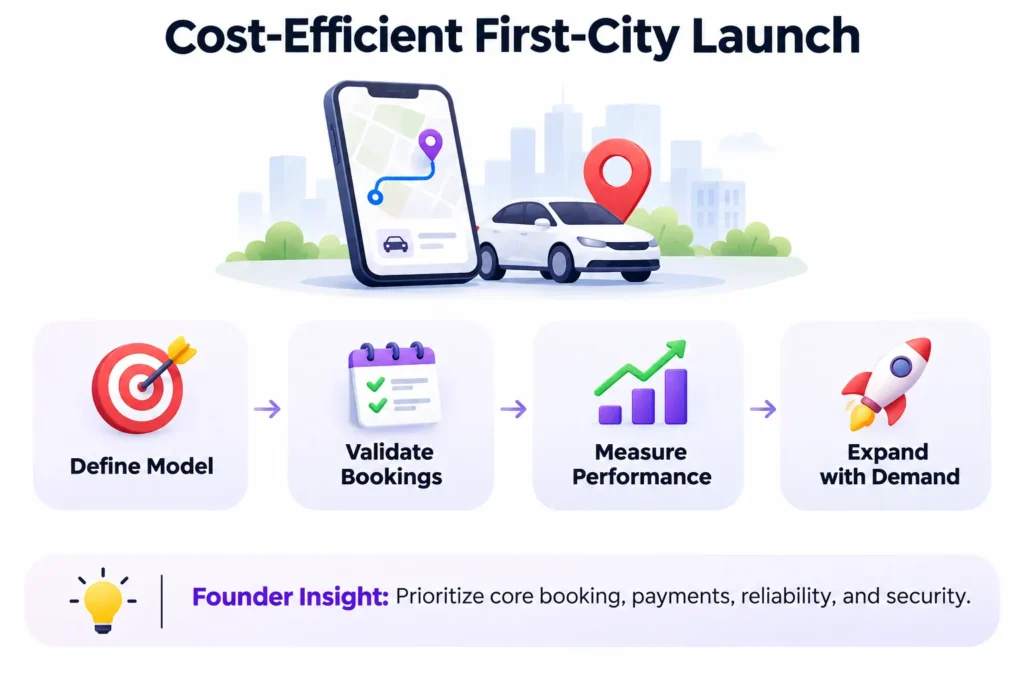
Founders frequently face a difficult trade-off: build enough technology to deliver a reliable service without committing to advanced capabilities that the first market may not need.
A practical approach is to establish the smallest operational scope that can handle real bookings, cancellations, driver availability, payments, and support.
Stage One: Define the Operating Model
Specify where the service will operate, which vehicle categories are supported, how drivers will join, how fares will be calculated, and which payment methods the business will accept.
These decisions should come before extensive feature development because they determine the core booking and financial logic.
Stage Two: Validate the Core Booking Lifecycle
Test the complete journey from passenger request to driver acceptance, pickup, journey completion, payment record, and customer support access.
Run tests involving rejected requests, unavailable drivers, expired offers, payment errors, and disconnected devices. A successful demonstration under ideal conditions is not sufficient evidence of operational readiness.
Stage Three: Introduce Operational Measurement
Measure booking conversion, assignment latency, rider cancellations, driver acceptance, successful payments, and support incidents. These metrics reveal the areas where engineering improvements can have the greatest business value.
Stage Four: Expand Only When Demand Justifies It
Advanced features such as multi-city management, sophisticated demand forecasting, complex incentives, or specialized fleet workflows can be added when operating data supports the investment.
This does not mean postponing essential security, data integrity, or reliability. It means distinguishing foundational engineering from optional sophistication.
Founder Decision Signals: Where Should the Budget Go First?
01. Software or Driver Availability?
If supply is insufficient, spending on a more advanced matching algorithm may provide less value than improving driver coverage and operating zones.
02. Are Integrations Consuming Too Much Margin?
Examine routing frequency, verification messages, payment fees, and unnecessary location processing before increasing infrastructure capacity.
03. Does the Business Need a Unique Workflow?
Highly specialized dispatch or settlement requirements may justify custom engineering. Standard workflows may be candidates for reuse.
04. Can the Team Maintain the Architecture?
A technically sophisticated system is not necessarily a good investment if the business cannot monitor, support, and update it effectively.
Common Budgeting Mistakes That Increase Ride-Hailing Software Costs
Estimating Only Mobile Application Screens
Passenger and driver interfaces are visible, but booking state, dispatch coordination, payment records, and administrative operations require their own engineering effort. Ignoring these components creates an incomplete budget.
Underestimating Real-World Testing
GPS inaccuracies, poor network conditions, simultaneous acceptance attempts, and payment interruptions can expose weaknesses that do not appear during routine development testing.
Selecting Every Advanced Feature Before Launch
Complex pricing algorithms, elaborate loyalty systems, and broad multi-service support increase scope. Their business value should be established before they become mandatory engineering requirements.
Ignoring Source Code, Documentation, and Operational Access
The initial purchase or development fee should not be evaluated independently of long-term control. Confirm source-code rights, deployment access, database ownership, third-party accounts, documentation, and procedures for future maintenance.
Confusing Deployment With Business Readiness
An application may be technically deployable before the business has completed driver onboarding, location-specific configuration, regulatory preparation, payment activation, and real-world operational validation.
That distinction is important when comparing delivery timelines and planning the first commercial launch.
Miracuves Uber-Like App Solution Cost and Tech Stack
Miracuves Pricing for an Uber-Like Ride-Hailing App developed in PHP For $3,099 USD (One-Time Price) in just 6 days
Get a fully developed, deployment-ready ride-hailing platform modeled after Uber. Built on a stable PHP foundation, this complete package includes everything you need to launch and scale:
Core Workflows: Rider registration, driver onboarding, ride booking, pickup and drop-off selection, fare estimation, driver matching, live ride tracking, trip management, and customer notifications.
Built-in Revenue Logic: Ride commissions, dynamic pricing, booking fees, cancellation charges, driver subscription plans, promotional campaigns, referral programs, wallet payments, and driver payout management.
Management Hub: Centralized admin dashboard, rider management, driver verification, trip monitoring, dispatch controls, fare management, payment records, refund handling, dispute resolution, and ride analytics.
Launch-Ready: Fully prepared for your custom branding, configuration, payment gateway setup, map integration, driver onboarding, service area configuration, and immediate market entry.
Why Is Uber-Like App Development More Affordable?
Most ride-hailing platforms become expensive when businesses choose fully custom development from scratch. Building separate workflows for riders, drivers, dispatchers, admins, real-time location tracking, fare calculation, payments, trip management, notifications, and analytics can increase cost, timeline, and technical complexity.
We took a smarter, more practical approach:
You Aren’t Paying for Ground-Up Development: Our ride-hailing engine is already developed, tested, and ready to deploy. You skip the inflated cost and long waiting period usually required for building an Uber-style mobility platform from scratch.
The Power of PHP: We built this solution on a reliable and cost-effective PHP architecture. This keeps the upfront price affordable while supporting essential ride booking, driver matching, dispatch management, fare calculation, payment workflows, real-time tracking integrations, and admin operations.
You get a launch-ready Uber-like ride-hailing platform with practical rider, driver, dispatch, monetization, and management features, source code access, and faster deployment without the high custom development price tag.
Note: This cost is for the solution, re-branding, deployment, and source code only.
How to Evaluate a Development Partner’s Architecture Estimate
Before approving a budget, founders should request an architecture discussion that goes beyond application screenshots and feature checklists.
Ask how the platform handles simultaneous driver responses, stale GPS positions, failed payments, interrupted bookings, and manual reassignment. Request clarity about who controls third-party accounts, how logs are accessed, and how future changes will be delivered.
Miracuves’ Aone mobility implementation offers a documented example of a platform built on an earlier reusable ride-hailing foundation. When evaluating any such reference, the useful questions are which components were reused, what required customization, and how the final system matched the operator’s requirements.
If a proposed operating model requires substantial architecture changes, it may also be useful to discuss custom mobility engineering requirements instead of assuming that every workflow can be solved through configuration.
What a Complete Estimate Should Explain
- Included passenger, driver, dispatch, and administrator workflows.
- Existing components versus newly engineered modules.
- Mapping, communications, identity, and payment dependencies.
- Expected testing, security review, and deployment responsibilities.
- Source-code, data, hosting, and account ownership arrangements.
- Recurring provider costs and maintenance assumptions.
- What is specifically excluded from the quoted scope.
- Conditions that would trigger additional development charges.
An estimate that clearly answers these questions is more useful than one that provides a single attractive number without explaining how the platform will work.
Final Thoughts: Budget for a Working Mobility System, Not Just an App
The real cost to build a ride-hailing app in 2026 is determined by the reliability and complexity of the complete system. Rider interfaces, driver operations, real-time dispatch, trip records, payments, and administration must work together consistently for the business to deliver a dependable service.
For founders, the strongest investment decision is not necessarily the architecture with the most features. It is the architecture that supports the intended operating model, handles essential failures, provides financial visibility, and allows the business to learn from real demand before scaling.
Where a reusable foundation matches those requirements, Miracuves’ Ride Hailing App Development provides a relevant starting point to evaluate. The right next step is to compare its included workflows against your own dispatch requirements, integration needs, and expected operating costs before committing to a launch plan.
Frequently Asked Questions
How much does it cost to build an app like Uber in 2026?
A lean single-city MVP typically needs about 2,100 to 2,600 engineering hours. At blended offshore-team rates of $20 to $40 an hour that is roughly $42,000 to $105,000, while the same hours at US wage levels exceed $135,000 before overhead. Full single-market platforms and multi-city systems need several times more hours. Treat these as illustrative estimates and compare quotes on hours and scope, not just the headline number.
How long does it take to build an app like Uber?
A custom single-city MVP typically takes about 12 to 20 weeks: two to three weeks of discovery, two to four weeks of design, eight to fourteen weeks of development, three to four weeks of testing and one to two weeks for store review and a soft launch, with phases overlapping. Full single-market platforms commonly take about five to six months, and multi-city systems longer.
How much does it cost to maintain a ride-hailing app each year?
A common planning rule is to reserve 15 to 20 percent of the original build cost each year for maintenance, mobile OS updates, security patches and provider API changes. Usage-based costs come on top: maps, SMS, hosting and payment processing grow with trips. Payment fees are usually the largest of these, for example 2.9 percent plus 30 cents per US domestic card charge on Stripe.
Why do ride-hailing app quotes differ so much between countries?
Largely because of the hourly rate behind the hours. Pay for the same engineering role varies several-fold between countries; the 2025 Stack Overflow survey puts the median back-end developer salary at $175,000 in the US, about $87,000 in Germany and about $22,000 in India. Compare quotes on estimated hours, scope, source-code ownership and who pays if the work runs over.
Why is the dispatch engine expensive to develop?
A dispatch engine must locate eligible drivers, send timed offers, handle timeouts, prevent two drivers from claiming the same trip and recover from cancellations or lost connections. Keeping trip state consistent while mobile clients retry and reconnect takes careful backend work and testing, which is why dispatch is usually the largest single module in a ride-hailing budget.
Is the driver app more complex than the rider app?
Often, yes. A rider app focuses on booking, fare estimates, tracking and payment. A driver app stays active for whole shifts, so it needs reliable background location, battery-aware GPS updates, timed ride offers, document onboarding and earnings records, and it must be tested across many devices and network conditions. The exact cost depends on the workflow scope.
What are the recurring expenses of a ride-hailing platform?
Common recurring expenses include cloud hosting, map display, autocomplete and routing requests, SMS verification, push notifications, identity checks, payment processing, monitoring, maintenance and customer support. Map platforms such as Google Maps Platform include free monthly usage per service and then charge per 1,000 requests, so costs scale with booking attempts as well as completed trips.
Can a ready-made platform reduce development costs?
A ready-made foundation can remove the need to rebuild standard booking, driver, dispatch and admin workflows, which are most of the hours in a custom MVP. The saving depends on how closely those workflows match your operating model and on the customization, integrations, testing and maintenance that are still required. Check source-code access and documentation before you buy.
How can founders calculate technology cost per ride?
Divide the monthly technology and integration spend by the number of completed trips in the same month. For example, $2,400 across 6,000 completed trips is $0.40 per ride. Track payment processing separately, because it comes out of each fare, and remember that broader unit economics must also include driver incentives, support and other operating costs.
Can a complete ride-hailing platform launch in six days?
A ready-made platform may be deployed in a short period when its standard workflows fit the requirements. Miracuves offers a six-working-day delivery approach for eligible ready-made configurations. A commercial launch still depends on custom changes, app store approval, payment and map account setup, driver recruitment and local licensing, which usually take longer than the software deployment itself.
Miracuves is an independent software development company. We are not affiliated with, connected to, sponsored by, or endorsed by any company or product named in this article.
Terms such as “X Clone” are used descriptively. It is how the software industry refers to building a platform with functionality comparable to a known service, and how clients search for it.
The entire design and codebase of our products is built by our own team. Our products contain no code, design, graphics, or content originating from any third-party website or applications.
All third-party names and marks referenced in this article are the property of their respective owners, referenced solely to identify the services discussed.