Key Takeaways
- A niche vacation rental marketplace can launch faster by starting with proven booking, property listing, host management, payments, reviews, and admin modules instead of developing every feature from zero.
- The real differentiation should come from the target audience, property category, booking experience, trust model, pricing strategy, and specialized marketplace workflows.
- Using a modular platform foundation can reduce development complexity while still allowing founders to customize branding, features, integrations, and business rules around a specific rental niche.
Launch & Module Signals
- Core modules should cover guest registration, host onboarding, property listings, availability calendars, search filters, booking, payments, messaging, reviews, and cancellations.
- Niche-specific features can then be layered on top, such as pet-friendly filters, luxury verification, long-stay pricing, outdoor property types, local experiences, or specialized host requirements.
- APIs, payment gateways, maps, notifications, identity verification, analytics, and third-party integrations help extend the marketplace without rebuilding common infrastructure internally.
Founder Insights
- Founders should validate the niche, supply strategy, guest demand, commission model, trust requirements, and must-have workflows before deciding which modules require deep customization.
- A phased launch can prioritize listing, discovery, booking, payments, and host operations first, then expand into loyalty, dynamic pricing, advanced analytics, automation, and additional revenue features.
- Miracuves develops customizable vacation rental marketplace platforms with modular booking, host management, property listings, payments, search, reviews, analytics, integrations, and admin controls.
Launching a vacation rental marketplace is not just about adding property listings and a booking button. The real challenge is choosing the right niche, attracting quality hosts, building trust with guests, managing availability, handling payments, and creating enough operational control to scale without chaos.
Many founders start with a broad idea: “I want to build a rental booking platform.” But broad platforms are difficult to validate because they need strong supply, strong demand, trust systems, payment flows, and local operating rules from day one.
A niche vacation rental marketplace gives founders a smarter starting point. Instead of trying to serve every traveler and every property type, you focus on a sharper segment such as luxury villas, pet-friendly stays, serviced apartments, homestays, corporate rentals, religious tourism stays, eco-retreats, student housing, or regional short-term rentals.
This approach helps you launch with clearer positioning, better host targeting, and a stronger reason for guests to choose your platform.
Miracuves helps founders turn this kind of idea into a launch-ready rental marketplace foundation with custom branding, admin control, source-code ownership, and business-specific workflows. For founders who want a branded booking marketplace foundation instead of starting from zero, Miracuves offers a ready-made vacation rental marketplace solution that can be customized around niche, region, and operating model. The goal is not to copy an existing travel platform. The goal is to build a focused marketplace that solves a real booking problem for a specific audience.
Why a Niche Rental Marketplace Is Easier to Validate
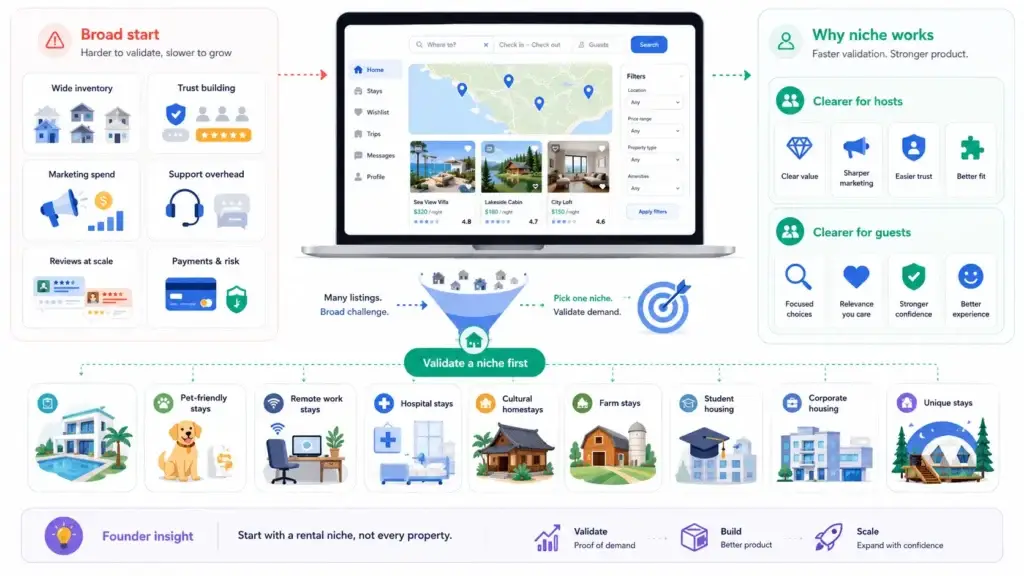
A broad rental platform needs wide inventory, strong brand trust, guest demand, payment reliability, review systems, customer support, and marketing spend. That is a heavy starting point for most founders.
A niche marketplace reduces that pressure by narrowing the business around a specific use case.
For example, a founder may build around:
- Luxury villas in one tourist region
- Pet-friendly stays for domestic travelers
- Monthly furnished apartments for remote workers
- Short-term rentals near hospitals
- Homestays for cultural tourism
- Farm stays and eco-retreats
- Student accommodation near universities
- Corporate housing for relocation teams
- Boat stays, cabins, or unique travel experiences
The advantage is clarity. Hosts understand why they should join. Guests understand why the platform exists. Marketing becomes sharper because you are not competing for every travel search. You are solving a focused rental problem.
This is where many founders make the wrong first move. They start by asking, “What features should we build?” The better question is, “Which rental niche can we own first?”
Choosing the Right Niche Before Development Starts
The niche decides your product logic. A villa marketplace does not need the same workflows as corporate housing. A student rental platform does not need the same pricing model as weekend retreats.
Because rental marketplaces depend heavily on search, filters, listings, reviews, and secure transactions, founders can also explore Miracuves’ listings marketplace solutions to understand how different listing-led platforms are structured across rentals, travel, ecommerce, jobs, and other marketplace categories.
A boat rental marketplace needs duration tiers, deposits, crew options, and safety details. A serviced apartment platform may need monthly pricing, recurring billing, and document verification.
Before development starts, define the business around four questions.
Who is the guest?
Your guest could be a tourist, business traveler, remote worker, student, family, event attendee, patient caregiver, digital nomad, or local weekend traveler.
Each group searches differently and evaluates trust differently. A family may care about safety, kitchen access, cancellation rules, and reviews. A business traveler may care about invoices, Wi-Fi, monthly pricing, and location near commercial districts.
Who is the host?
Your host may be an individual property owner, property manager, hotel operator, villa owner, serviced apartment brand, local tour operator, boat owner, or agency.
The host type affects onboarding, verification, payout rules, calendar control, and dashboard design.
What makes the inventory different?
A niche marketplace needs a reason to exist. That reason may be location, property type, stay duration, price range, guest segment, service quality, local support, or bundled travel services.
For example, a platform focused on wellness retreats may need amenity filters for yoga spaces, meal plans, wellness packages, and retreat schedules. A platform for business housing may need invoices, monthly rates, corporate approval, and longer booking windows.
What trust problem are you solving?
Guests do not book only because a listing exists. They book because they trust the photos, pricing, host, payment flow, cancellation terms, and support process.
Your niche should define what trust means in that category. For pet-friendly stays, trust may mean clear pet rules and cleaning fees. For luxury villas, trust may mean verified property photos, concierge options, deposits, and premium support.
Core Modules Every Niche Rental Marketplace Needs
A focused marketplace can start lean, but it cannot ignore the core booking engine. The platform still needs to manage discovery, availability, payments, communication, reviews, and operations.
| Module | What It Does | Why It Matters for Founders |
|---|---|---|
| Property Listings | Lets hosts add spaces, photos, amenities, pricing, rules, and availability | Creates the supply foundation of the marketplace |
| Guest Search | Allows users to filter by location, dates, guests, price, amenities, and property type | Helps guests find relevant options faster |
| Availability Calendar | Shows bookable dates and prevents booking conflicts | Reduces operational errors and guest dissatisfaction |
| Booking Workflow | Handles instant booking, enquiry-based booking, approvals, and confirmations | Defines how transactions actually happen |
| Payment Flow | Supports booking payments, platform fees, refunds, and host payouts | Connects monetization with operational trust |
| Host Dashboard | Gives hosts control over listings, bookings, pricing, calendar, and earnings | Makes supply management easier |
| Guest Dashboard | Helps guests manage trips, messages, payments, and reviews | Improves retention and post-booking clarity |
| Admin Panel | Lets the operator manage users, listings, bookings, commissions, disputes, and reports | Gives the founder business control |
| Review System | Collects guest and host feedback | Builds marketplace trust over time |
| Messaging | Supports guest-host communication before and after booking | Reduces uncertainty and improves conversion |
The goal is not to add every advanced feature at launch. The goal is to include enough core logic so that real bookings can happen safely and repeatedly.
Before locking the first launch scope, founders should review the essential vacation rental marketplace features needed across guest search, host dashboards, booking workflows, secure payments, reviews, messaging, and admin control.
Build Around a Booking Engine, Not Just Listings
A listing website is not the same as a rental marketplace. A listing website shows inventory. A marketplace manages transactions.
For a vacation rental platform, the booking engine is the center of the product. It controls dates, guest count, pricing, deposits, fees, cancellation rules, host approval, and payment status.
If this layer is weak, the marketplace becomes hard to operate. Double bookings, unclear prices, refund disputes, and calendar errors can damage trust quickly.
Because booking reliability depends heavily on availability logic, founders should also understand calendar sync and double-booking prevention before scaling host inventory across multiple properties or regions.
A strong booking engine should support:
- Date-based availability
- Minimum and maximum stay rules
- Seasonal pricing
- Cleaning fees and service fees
- Extra guest charges
- Coupon or discount logic
- Booking status updates
- Refund and cancellation workflows
- Host approval where needed
- Admin override for support cases
This is one of the biggest reasons founders look for a ready-made foundation instead of building every module from scratch. The visible screens may look simple, but the backend rules decide whether the platform can handle real bookings.
Host Onboarding Is the First Growth Engine
Many rental marketplace founders focus too much on guest acquisition at the start. But without quality hosts, guest marketing becomes expensive and ineffective.
Your first growth engine is host onboarding.
A niche marketplace should make it easy for hosts to join, but strict enough to protect quality. The host onboarding flow may include profile setup, property details, photo uploads, pricing rules, calendar setup, payout details, identity checks, property verification, and approval by the admin team.
The founder should decide whether listings go live instantly or require manual approval. For higher-value categories like villas, corporate stays, or premium retreats, approval workflows usually help protect trust.
A strong host dashboard should help hosts:
- Add and edit listings
- Manage calendars
- Set pricing and discounts
- Accept or reject bookings
- View earnings
- Respond to guest messages
- Track reviews
- Update policies and rules
When hosts feel in control, they are more likely to keep inventory updated. That improves guest experience and reduces support workload.
Guest Trust Decides Booking Conversion
Guests compare more than price. They look for signals that reduce risk.
A niche vacation rental marketplace should make these signals visible throughout the booking journey. This includes verified listings, clear photos, house rules, transparent pricing, cancellation terms, host response indicators, reviews, secure checkout, and accessible support.
Trust is especially important for niche categories because guests may not already know the platform. Large platforms have brand recognition. New marketplaces need product-level trust signals to compensate.
Important guest trust features include:
- Verified host badges
- Clear cancellation policy
- Transparent total price before payment
- Secure payment gateway
- Booking confirmation
- Guest-host messaging
- Review and rating history
- Support or dispute reporting
- Refund visibility
- Property rules and safety information
For platforms handling guest data, booking records, payments, host profiles, and dispute workflows, white-label marketplace security practices should be planned early instead of being treated as a post-launch fix.
For founders, this is not only a UX issue. It is a revenue issue. More trust usually means fewer abandoned bookings and fewer support problems.
Founders who want to go deeper into verification, pricing confidence, guest safety, and marketplace control can read this guide on short-term rental trust and safety systems before scaling host inventory.
Monetization Models for a Niche Rental Marketplace
A rental marketplace can monetize in more than one way. The right model depends on the niche, host type, booking frequency, and level of platform involvement.
| Revenue Model | How It Works | Best Fit |
| Booking Commission | Platform takes a percentage from each confirmed booking | Most rental marketplaces |
| Host Subscription | Hosts pay a monthly or annual fee to list inventory | Professional hosts, agencies, property managers |
| Guest Service Fee | Guests pay a platform fee during checkout | Platforms with strong guest demand |
| Featured Listings | Hosts pay for higher visibility | Competitive property categories |
| Verification Fee | Hosts pay for property or profile verification | Premium or trust-sensitive niches |
| Add-on Services | Platform sells cleaning, concierge, insurance, transport, or local services | Travel and hospitality marketplaces |
| Corporate Plans | Businesses pay for access, booking control, or managed housing workflows | Corporate rental platforms |
Founders should avoid overcomplicating monetization at launch. A simple commission model is usually easier to validate. Once the platform has supply and demand, additional revenue lines can be added.
A focused vacation rental marketplace business model helps founders choose the right mix of booking commissions, guest service fees, host subscriptions, featured listings, and add-on revenue streams.
When a Ready-Made Foundation Makes More Sense
Building from scratch can make sense when the business model is highly unique, deeply regulated, or requires unusual workflows that existing foundations cannot support.
But many niche rental marketplace ideas share common core modules: listings, search, calendars, bookings, payments, host dashboards, guest dashboards, reviews, notifications, and admin controls.
If those core modules already exist in a ready-made foundation, the founder can focus more energy on the parts that make the business different: niche positioning, host acquisition, branding, payment setup, launch region, content quality, and customer support.
Before choosing a build path, founders should review rental marketplace development cost factors such as feature scope, integrations, custom branding, booking rules, admin workflows, payment setup, and launch region.
A ready-made foundation can be especially useful when:
- You want to validate a market faster
- You need guest, host, and admin workflows already connected
- You want source-code ownership instead of platform dependency
- You need white-label branding for your own marketplace
- You want to customize around a specific rental niche
- You need a faster route to launch before investing in deeper custom features
For founders who want a branded rental booking marketplace without starting every module from zero, Miracuves offers a ready-made vacation rental marketplace solution that can be customized around your niche, brand, and operating model: explore the rental marketplace solution.
Founder Decision Signals
Speed
If the niche is still being validated, spending months on basic booking modules can delay market learning. A ready-made foundation helps founders test demand sooner.
Cost
Final cost depends on features, integrations, branding, and customization scope. The key decision is whether to spend budget on core modules or on market differentiation.
Scalability
The platform should support more hosts, listings, bookings, payments, and admin workflows as the niche grows beyond the first launch region.
Market Fit
A niche marketplace wins when the audience, inventory, pricing, and trust signals are specific enough to create a reason to book outside generic platforms.
Custom Build vs Ready-Made Foundation
The right development path depends on how much uncertainty exists in the business.
| Build Path | What It Means | Best For | Founder Risk |
| Fully Custom Build | Every workflow is designed and developed from scratch | Complex or highly unique rental models | Higher upfront time and cost before market validation |
| Ready-Made Foundation | Core marketplace modules already exist and are customized for the brand | Founders who want faster launch and proven booking workflows | Requires careful customization to avoid looking generic |
| Hybrid Approach | Start with a ready-made base, then customize deeper after validation | Niche marketplaces with clear launch goals and future expansion plans | Needs a clear roadmap to avoid unnecessary features |
For most niche rental marketplace ideas, the hybrid approach is practical. Start with the essential workflows, customize for the niche, launch in a focused market, learn from real users, and then expand the product based on actual behavior.
If the decision depends on vendor capability, technical ownership, launch support, and customization depth, this guide on choosing a vacation rental app development company can help founders compare the right partner criteria.
What to Customize for Your Niche
A ready-made foundation should not mean a generic marketplace. The customization layer is where your positioning becomes visible.
Important customization areas include:
Branding and User Experience
Your visual identity, onboarding flow, homepage structure, listing layout, and search experience should reflect the niche. A luxury villa platform should feel different from a student housing platform. A wellness retreat marketplace should not look like a generic property directory.
Listing Fields
Different niches need different listing details. Villas may need private pool, chef, security, and staff options. Corporate rentals may need workspace, invoices, monthly pricing, and transport access. Pet-friendly stays may need pet size limits, cleaning rules, nearby parks, and pet fees.
Booking Rules
The booking logic should match the category. Some rentals work with instant booking. Others need approval, deposits, contracts, or enquiry-based workflows.
Pricing Rules
Short weekend stays, monthly rentals, seasonal pricing, discounts, cleaning fees, deposits, and extra guest charges should be configurable from the admin side.
Host Verification
Verification can be light or strict depending on the niche. Premium properties, corporate rentals, and regulated local markets usually need more control before listings go live.
Admin Controls
The platform operator should be able to manage users, listings, commissions, bookings, refunds, disputes, content, payouts, and reports without depending on developers for every small update.
Mistakes Founders Should Avoid
Starting Too Broad
Trying to serve every rental category from day one makes positioning weak. Start with a niche where supply and demand can be reached clearly.
Copying Features Without Understanding Operations
A feature list is not a business model. Founders should understand how bookings, cancellations, disputes, payouts, and host support will work in real life.
Ignoring Host Quality
Low-quality listings damage guest trust. Host onboarding, listing approval, and review systems matter from the beginning.
Treating Payments as a Simple Checkout Page
Rental payments may involve deposits, service fees, refunds, host payouts, cancellation charges, and payment gateway rules. The financial flow needs planning before launch.
Delaying Admin Panel Decisions
The admin panel is where the business is controlled. If the operator cannot manage commissions, listings, users, disputes, and reports, daily operations become difficult.
Launch Roadmap for a Niche Vacation Rental Marketplace
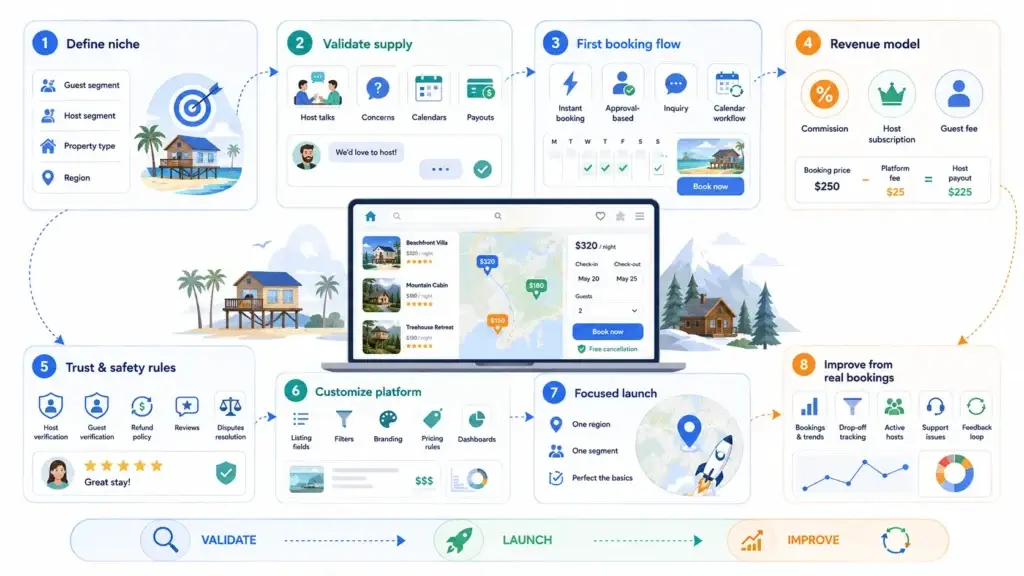
A practical launch does not begin with development. It begins with validation and operating clarity.
Step 1: Define the Niche
Choose the guest segment, host segment, rental category, and launch region. Avoid vague positioning such as “rental platform for everyone.”
Step 2: Validate Supply
Speak to hosts before building. Understand their pain points, current channels, commission concerns, calendar habits, and payout expectations.
Step 3: Define the First Booking Flow
Decide whether bookings are instant, approval-based, enquiry-based, or a mix. This decision affects calendar logic, notifications, payments, and host workload.
Step 4: Choose the Revenue Model
Start simple. Commission, host subscription, or guest service fee should be clear before launch.
Step 5: Set Trust and Safety Rules
Define host verification, guest verification, cancellation rules, review policies, refund logic, and dispute handling.
Step 6: Customize the Platform Foundation
Adapt listing fields, filters, branding, pricing rules, dashboards, and admin workflows for the niche.
Step 7: Launch in One Focused Market
Do not spread supply too thin. Launch in one city, region, traveler segment, or property category first.
Step 8: Improve Based on Real Bookings
Track where users drop off, which listings convert, which hosts stay active, and which support issues repeat.
After the first version is ready, a focused rental app marketing strategy can help attract hosts, build guest trust, improve local visibility, and generate early bookings in the selected niche.
How Miracuves Supports Niche Rental Marketplace Launches
Miracuves helps founders build rental marketplace platforms with ready-made foundations, white-label branding, admin control, and source-code ownership. This gives founders a faster path to market without giving up customization.
For a niche vacation rental marketplace, Miracuves can help structure the core product around guest search, host listings, availability calendars, booking flows, secure payment integration, review systems, admin dashboards, and marketplace monetization logic.
The stronger decision is not always “build everything from scratch.” For many founders, the stronger decision is to launch a focused rental platform, validate the niche, and then invest in deeper customization once the market proves demand.
Final Thoughts
A niche vacation rental marketplace succeeds when the founder makes clear decisions before development begins. The niche decides the listings. The listings decide the filters. The booking flow decides the payment logic. The host workflow decides supply quality. The admin panel decides how manageable the business becomes after launch.
Building every module from scratch is not always the best first move. If the core marketplace logic already exists, founders can spend more time on positioning, host acquisition, guest trust, and revenue strategy.
The real opportunity is not to create another generic rental platform. It is to build a focused marketplace that serves a specific guest segment better, helps hosts earn more efficiently, and gives the operator enough control to grow with confidence.
FAQs
What is a niche vacation rental marketplace?
A niche vacation rental marketplace is a booking platform focused on a specific guest group, property type, location, or rental use case. Examples include luxury villas, pet-friendly stays, serviced apartments, eco-retreats, student housing, or corporate rentals.
Why should founders start with a niche instead of a broad rental platform?
A niche helps founders validate demand faster because the audience, inventory, messaging, and host acquisition strategy are more focused. Broad platforms usually need more supply, stronger brand trust, and higher marketing spend from the beginning.
What features are needed for a vacation rental marketplace?
Core features include property listings, guest search, availability calendars, booking workflows, secure payments, host dashboards, guest dashboards, reviews, messaging, notifications, and admin controls.
How does a rental marketplace make money?
Common revenue models include booking commissions, host subscriptions, guest service fees, featured listings, verification fees, add-on services, and corporate plans. The best model depends on the niche and booking behavior.
Is it better to build from scratch or use a ready-made foundation?
Building from scratch gives full flexibility but usually requires more time and budget. A ready-made foundation is useful when the core workflows are standard and the founder wants to launch faster, customize the brand, and validate the market before deeper development.
What should be customized for a niche rental platform?
Important customization areas include listing fields, search filters, booking rules, pricing logic, host verification, payment setup, dashboard design, cancellation policies, and admin controls.
How important is the admin panel in a rental marketplace?
The admin panel is critical because it lets the platform operator manage users, listings, bookings, payments, commissions, disputes, reports, and content. Without strong admin control, daily operations become harder as the marketplace grows.
How can Miracuves help launch a rental marketplace?
Miracuves helps founders create ready-made and white-label rental marketplace platforms with source code, custom branding, admin dashboards, booking workflows, payment integration, and customization support based on the selected niche.
Miracuves is an independent software development company. We are not affiliated with, connected to, sponsored by, or endorsed by any company or product named in this article.
Terms such as “X Clone” are used descriptively. It is how the software industry refers to building a platform with functionality comparable to a known service, and how clients search for it.
The entire design and codebase of our products is built by our own team. Our products contain no code, design, graphics, or content originating from any third-party website or applications.
All third-party names and marks referenced in this article are the property of their respective owners, referenced solely to identify the services discussed.