
Key Takeaways
- A vacation rental marketplace needs strong security across guest accounts, host onboarding, bookings, payments, and admin workflows.
- Guests, hosts, property managers, payment partners, support teams, and admins need protected platform interactions.
- Identity checks, secure payments, listing review, booking controls, dispute handling, and audit logs are core safety features.
- Security planning helps reduce fake listings, payment fraud, account takeovers, refund abuse, and payout manipulation.
- A secure rental marketplace can build user trust faster when safety controls are planned before launch.
Security Signals
- Guests need secure signup, protected profiles, verified listings, safe checkout, booking history, and refund visibility.
- Hosts need identity verification, listing approval, calendar protection, payout security, review control, and dispute support.
- Admins need control over users, hosts, listings, bookings, payments, reports, disputes, roles, and suspicious activity.
- Payment security should include encrypted transactions, payout checks, refund rules, fraud monitoring, and provider-level compliance.
- Alerts help detect fake listings, unusual login activity, double-booking attempts, refund abuse, and high-risk payment behavior.
Real Insights
- Trust is the foundation of a rental marketplace because both guests and hosts depend on accurate information and secure transactions.
- Weak verification can lead to fake listings, poor guest experiences, payout disputes, and reputation damage.
- Role-based access, audit logs, secure messaging, and moderation tools help operators manage platform risk.
- Founders should review guest safety, host verification, payment controls, compliance readiness, and admin access before launch.
- Miracuves builds secure vacation rental marketplace platforms with booking workflows, host tools, payment protection, verification, dispute handling, and admin control.
A vacation rental marketplace is built on trust. Guests need to trust that listings are real, payments are protected, and their personal details are handled carefully. Hosts need to trust that bookings, payouts, reviews, and guest behavior are managed fairly. The platform operator needs enough admin visibility to investigate disputes, detect abuse, and protect the business without creating unnecessary data or access risk.
That is why security should not be treated as one technical feature near the end of development. For rental marketplaces, security touches the entire operating model: account creation, listing approval, booking flow, payment processing, refunds, identity checks, messaging, admin permissions, analytics, and post-launch support.
This checklist helps founders review the most important security controls before launching or choosing a white-label vacation rental marketplace foundation. It does not replace legal, compliance, or payment-provider review. Instead, it gives you a practical decision framework so you can ask better questions, reduce avoidable risk, and build a marketplace users can trust.
Why Security Matters More in Vacation Rental Marketplaces
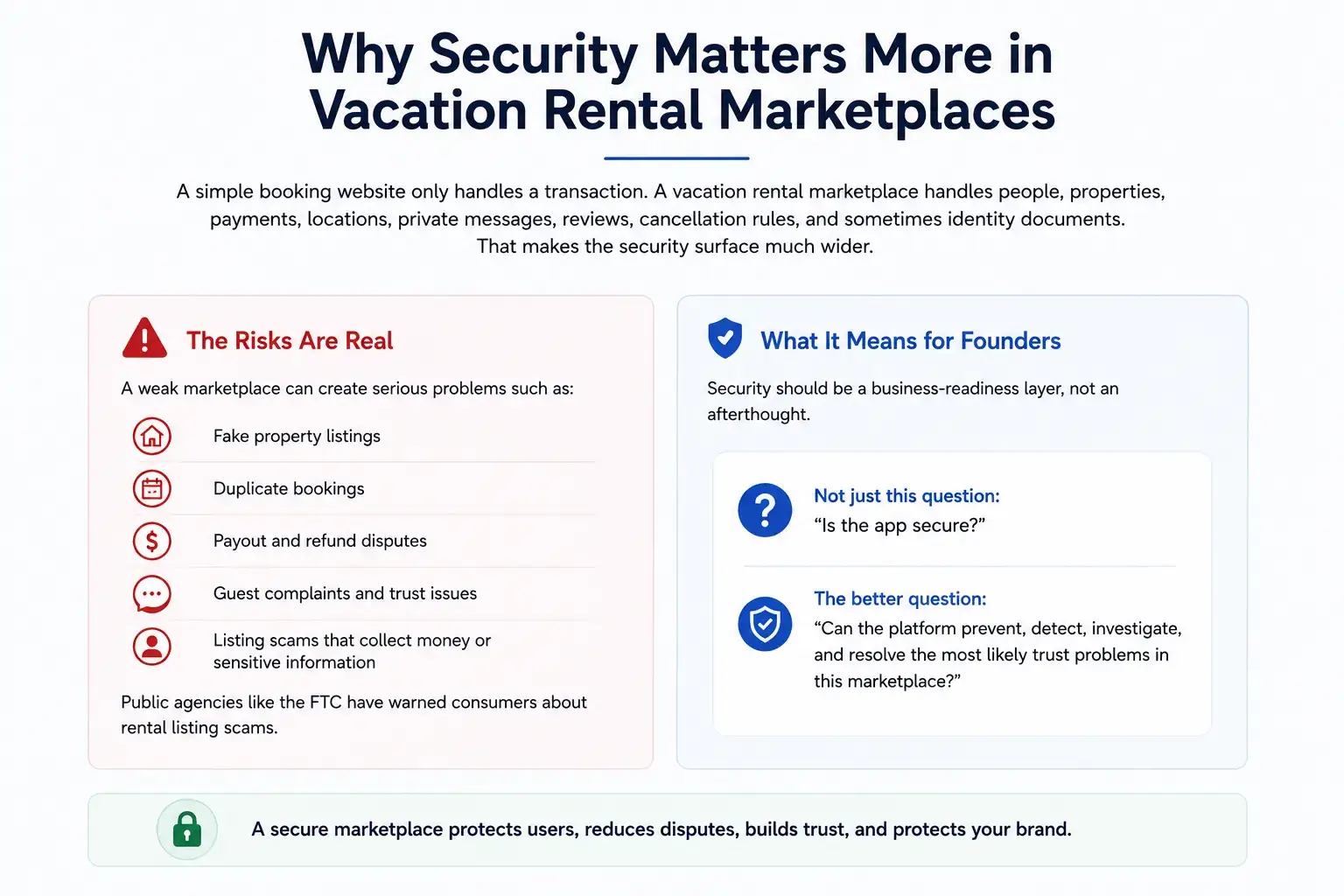
A simple booking website only handles a transaction. A vacation rental marketplace handles people, properties, payments, locations, private messages, reviews, cancellation rules, and sometimes identity documents. That makes the security surface much wider.
The risk is not only technical. A weak marketplace can create operational problems such as fake property listings, duplicate bookings, payout disputes, guest complaints, refund manipulation, and reputation damage. Public agencies such as the FTC have warned consumers about rental listing scams where fake or copied listings are used to collect money or sensitive information from users.
For founders, this means security should be reviewed as a business-readiness layer. The question is not only, “Is the app secure?” The better question is, “Can the platform prevent, detect, investigate, and resolve the most likely trust problems in this marketplace?”
Founder Security Checklist at a Glance
| Security Area | What to Review | Why It Matters |
|---|---|---|
| Guest accounts | Login protection, password reset, session security, booking privacy | Protects personal data, trip details, and account access |
| Host onboarding | Host verification, document checks, payout review, listing approval | Reduces fake listings and payout abuse |
| Listing controls | Property approval, image moderation, address privacy, duplicate detection | Protects marketplace quality and guest trust |
| Payments | Gateway setup, tokenized payments, refund permissions, payout controls | Reduces payment fraud and financial disputes |
| Admin access | Role-based access, audit logs, approval workflows, staff permissions | Prevents internal misuse and improves accountability |
| Messaging | Abuse reporting, message visibility rules, attachment controls | Protects users from scams and harassment |
| Compliance readiness | Privacy workflows, data retention, consent, payment responsibilities | Helps the operator prepare for market-specific obligations |
| Post-launch monitoring | Alerts, logs, backups, incident response, suspicious activity review | Keeps security active after launch |
Guest Security: Protect Accounts, Bookings, and Personal Data
Guests share personal details when they browse, book, pay, message hosts, and manage trip information. Depending on the platform configuration, this may include names, email addresses, telephone numbers, booking history, saved preferences, identity checks, payment references, travel dates, and private messages.
A secure guest workflow should include:
- Strong authentication and secure password reset
- Protection against account takeover attempts
- Limited exposure of sensitive trip and contact details
- Secure storage and transfer of personal information
- Clear privacy settings and communication boundaries
- Abuse reporting for suspicious host behavior
- Booking confirmations that are difficult to manipulate
- Session timeout and device/session management where needed
Founders should pay special attention to password reset and login flows. OWASP lists identification and authentication failures as one of the major web application risk categories, which makes account security an important review area for any marketplace handling private user activity.
Guest Data Minimization Questions
Before launch, founders should ask:
- What guest data do we collect?
- Why do we collect each field?
- Who can access it?
- How long do we keep it?
- Can guests request updates or deletion where applicable?
- Is sensitive booking information visible only when needed?
- Are identity documents stored, processed by a third party, or avoided completely?
Collecting less unnecessary data can reduce operational risk. A marketplace should not collect sensitive documents simply because the feature exists. The data should serve a defined verification, safety, payment, or legal purpose.
Host Security: Verify the People Behind the Listings
Host trust is one of the strongest signals in a rental marketplace. Guests are not only buying a stay; they are trusting the host, the property, the listing details, and the platform’s ability to intervene when something goes wrong.
Host-side controls should cover:
- Host profile verification
- Email and phone verification
- Optional identity verification for high-risk categories
- Property ownership or authorization checks where relevant
- Payout method review
- Listing approval workflows
- Rules for changing bank or payout information
- Activity history for listing and payout edits
A host account takeover can be especially damaging. An attacker may change payout details, edit a listing, communicate with guests, or attempt to redirect transactions. That is why host account changes should be traceable and, for sensitive actions, protected by additional verification or admin review.
Listing Security: Stop Fake Properties Before They Damage Trust
Fake listings are one of the clearest risks in rental marketplaces. A scammer may copy property photos, create an attractive listing, collect payments or personal information, and disappear. The FTC has described rental listing scams where fake or copied ads are used to take money before consumers realize the property is not available.
A rental marketplace should not rely only on users reporting bad listings after the damage is done. It should build checks into the listing lifecycle.
Listing Review Checklist
| Listing Control | Founder Question | Risk Reduced |
| Manual approval | Are new listings reviewed before going live? | Fake or low-quality listings |
| Image checks | Can suspicious or copied images be flagged? | Misleading property representation |
| Address privacy | Is exact location hidden until booking rules allow disclosure? | Guest and host privacy risk |
| Duplicate detection | Can similar listings be detected across accounts? | Reposted scam listings |
| Category validation | Are property type, amenities, rules, and pricing reviewed? | Guest disputes |
| Change logs | Can admins see listing edits over time? | Abuse after approval |
The strongest platforms treat listing approval as a trust workflow, not just a content upload. For founders, this matters because early marketplace quality shapes conversion, review quality, and repeat usage.
Payment Security: Protect Transactions, Refunds, and Payouts
Payment security in a rental marketplace is more than accepting card payments. Founders must think through authorization, payment capture, refunds, cancellation rules, host payouts, chargebacks, deposits, commissions, and admin approval workflows.
The PCI Security Standards Council maintains PCI DSS for protecting payment account data, and payment responsibilities depend on the final architecture, gateway, and validation requirements.
A security-conscious payment setup should include:
- Secure payment gateway integration
- Tokenized payment handling where supported
- Protection of gateway keys and webhook secrets
- Validation of payment notifications
- Restricted refund permissions
- Payout-change review
- Booking-to-payment traceability
- Chargeback documentation
- Clear cancellation and refund rules
- Separation of financial duties inside the admin panel
Where practical, sensitive card data should be handled by the payment provider rather than passing through the marketplace’s own servers. Founders should confirm the exact payment flow with their gateway and technical team.
Read more: Vacation Rental Marketplace Features and Pricing: What Founders Should Evaluate Before Launch
Admin Controls: The Hidden Layer That Decides Platform Safety
Many founders focus on the guest app and host dashboard because those are visible in the demo. But the admin panel is where marketplace safety is actually managed.
A strong admin control layer helps the operator review suspicious users, approve listings, manage disputes, track payments, restrict staff access, review reports, and document decisions.
OWASP identifies broken access control as a leading web application risk category, which makes role-based permissions and authorization checks especially important for marketplace admin dashboards.
Admin Control Checklist
| Admin Area | Required Control | Founder Impact |
| Staff roles | Role-based access control | Prevents every team member from seeing or changing everything |
| Financial actions | Approval rules for refunds, payouts, and adjustments | Reduces payment abuse |
| User management | Review, suspend, reinstate, and verify accounts | Improves marketplace governance |
| Listing management | Approve, reject, edit, or remove listings | Protects listing quality |
| Activity logs | Records of admin actions and sensitive changes | Supports investigation and accountability |
| Disputes | Booking, payment, message, and evidence review | Helps resolve guest-host conflicts |
| Reporting | Suspicious activity, failed payments, flagged listings | Improves operational visibility |
Admin access should follow the principle of least privilege. A support agent may need to view a booking status, but not modify payout information. A finance manager may need refund tools, but not unrestricted user-data access. A marketplace operator may need executive reporting without direct access to private identity files.
Secure Messaging and Abuse Reporting
In rental marketplaces, users often message before and after booking. This creates trust, but also creates risk. Scammers may try to move conversations outside the platform, request direct payments, send suspicious links, or pressure users into unsafe behavior.
A secure messaging workflow should include:
- In-app communication records
- Abuse reporting
- Link or attachment rules where needed
- Admin review for reported conversations
- User blocking or restriction tools
- Alerts for suspicious payment-related language
- Clear community and booking policies
The platform does not need to read every message manually. But it should provide enough moderation and reporting workflows to act when users report fraud, harassment, payment diversion, or policy violations.
API and Third-Party Integration Security
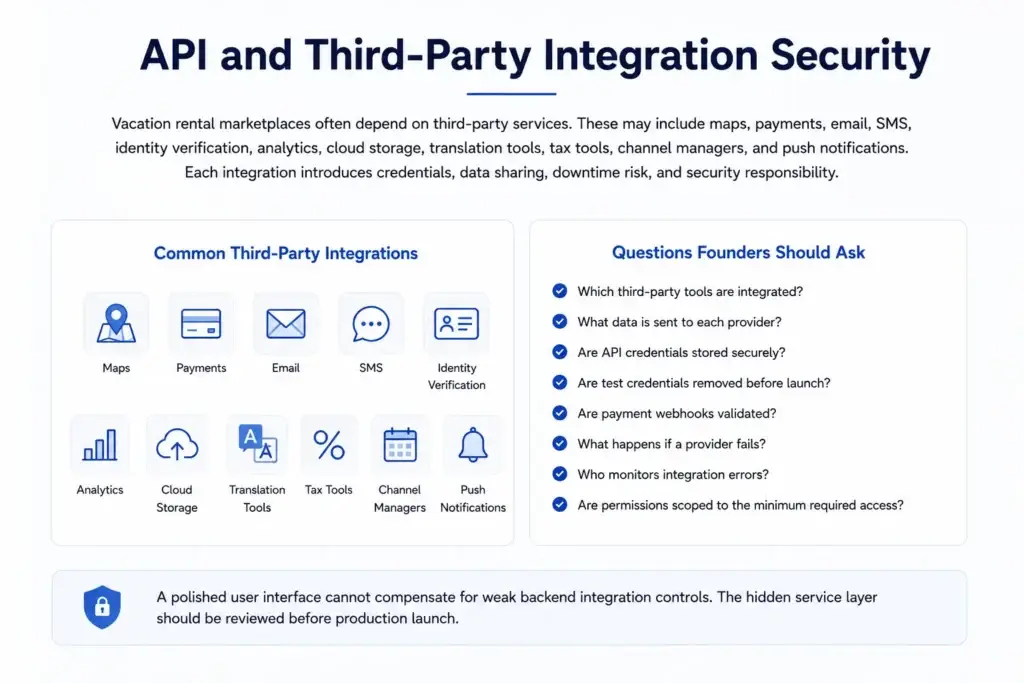
Vacation rental marketplaces often depend on third-party services. These may include maps, payments, email, SMS, identity verification, analytics, cloud storage, translation tools, tax tools, channel managers, and push notifications.
Each integration introduces credentials, data sharing, downtime risk, and security responsibility. The platform should protect API keys, validate callbacks, restrict permissions, and avoid exposing more data than necessary.
Founders should ask:
- Which third-party tools are integrated?
- What data is sent to each provider?
- Are API credentials stored securely?
- Are test credentials removed before launch?
- Are payment webhooks validated?
- What happens if a provider fails?
- Who monitors integration errors?
- Are permissions scoped to the minimum required access?
A polished user interface cannot compensate for weak backend integration controls. The hidden service layer should be reviewed before production launch.
Read more: Inventory-Led Rentals vs Marketplace-Led Stays: A Founder’s Guide to Choosing the Right Rental Model
Compliance-Ready Workflows Founders Should Review
Security and compliance are related, but they are not the same. A platform can include security controls, but final compliance depends on the operating country, user location, data collected, payment flow, contracts, legal policies, third-party providers, and business processes.
Use careful language here: a platform may provide a compliance-ready foundation, but it should not be described as automatically compliant in every market.
Important compliance-readiness areas include:
- Privacy policy alignment
- Consent collection where required
- Data access and deletion workflows where applicable
- Payment responsibility review
- Record retention rules
- Terms for guests and hosts
- Listing accuracy policies
- Cancellation and refund rules
- Dispute-handling procedure
- Local rental, tax, and safety obligations
- Legal review before launch
For founders, this is not just paperwork. Clear policies help reduce confusion when refunds, property damage, cancellations, account suspensions, or listing disputes occur.
Founder Decision Signals
Speed
A ready-made foundation can help launch faster, but security workflows still need configuration before going live.
Cost
Security cost depends on verification tools, payment architecture, hosting, monitoring, admin permissions, and compliance needs.
Scalability
As listings, users, and transactions grow, manual review alone becomes difficult. Admin workflows and automated alerts become more important.
Market Fit
Different rental categories need different trust controls. Luxury stays, shared spaces, events, and local rentals may require different verification and dispute rules.
White-Label vs Custom Development: Security Review Difference
Security is not automatically better or worse because a platform is white-label or custom-built. The real difference is how the product is reviewed, configured, tested, maintained, and operated.
| Build Route | Security Advantage | Security Risk to Review |
| White-label platform | Faster foundation with existing guest, host, booking, payment, and admin flows | Requires vendor transparency, configuration review, update policy, and secure deployment |
| Custom development | Full control over architecture and business logic | Longer build time, higher testing burden, and more risk if security is added late |
| Hybrid customization | Faster base with selected custom workflows | Requires careful review of custom modules and integration points |
For founders, the strongest decision is not simply “ready-made or custom.” The stronger decision is choosing a platform path where security responsibilities are clear before launch.
Mistakes Founders Should Avoid
Treating security as a final QA task
Security should be mapped during workflow planning. Guest data, host verification, payments, refunds, listings, and admin access all affect the operating model.
Giving every admin full access
Unrestricted admin access creates avoidable risk. Staff permissions should match the role, and sensitive actions should be logged.
Assuming a payment gateway removes all payment risk
A gateway helps, but the platform still needs secure credentials, webhook validation, refund rules, payout controls, and transaction records.
Approving listings without a trust workflow
Fake or misleading listings can damage early marketplace trust. Listing review, duplicate checks, host verification, and reporting tools should be in place.
How Miracuves Supports a Security-Conscious Rental Marketplace Launch
Miracuves helps founders build white-label rental marketplace platforms with branded design, source-code ownership, admin control, and configurable workflows for guest, host, listing, booking, payment, and platform management.
For founders who want to move faster, a ready-made foundation can reduce the effort required to build standard rental marketplace workflows from zero. The important step is making sure the launch configuration fits the actual business model: property categories, host approval rules, payment gateway, payout flow, cancellation policies, admin roles, dispute handling, and regional requirements.
You can connect this blog naturally to the main rental marketplace money page using an anchor such as white-label rental marketplace platform. Keep the anchor supportive and contextual rather than keyword-heavy.
Final Thoughts: Security Is a Marketplace Growth Decision
A vacation rental marketplace grows when guests trust the booking process, hosts trust the payout process, and the operator can resolve problems quickly. That requires more than a login screen and a payment gateway.
Founders should review guest protection, host verification, listing approval, payment controls, admin permissions, audit logs, dispute workflows, API security, privacy settings, and post-launch monitoring before going live.
A secure foundation does not guarantee business success or legal compliance in every region. But it does give founders a stronger base for trust, safer operations, and long-term marketplace growth.
FAQs
What is a vacation rental marketplace security checklist?
A vacation rental marketplace security checklist is a structured review of the controls needed to protect guests, hosts, listings, payments, admin access, data, integrations, and post-launch operations.
Why is host verification important in a rental marketplace?
Host verification helps reduce fake listings, payout abuse, misleading property details, and guest trust issues. It can include email verification, phone verification, identity checks, property review, and payout-change monitoring.
How should a rental marketplace protect guest accounts?
A rental marketplace should use secure authentication, safe password reset, session protection, privacy controls, limited data exposure, abuse reporting, and careful access rules for booking and personal information.
What payment controls should founders review before launch?
Founders should review payment gateway setup, tokenized payment handling, webhook validation, refund permissions, payout controls, cancellation logic, transaction records, and chargeback documentation.
Why is the admin panel important for marketplace security?
The admin panel controls user review, listing approval, payment actions, refunds, disputes, reports, staff permissions, and suspicious activity investigation. Weak admin controls can create serious business and data risks.
Can a white-label rental marketplace support compliance-ready workflows?
Yes. A white-label rental marketplace can support privacy controls, user verification, payment workflows, audit logs, staff permissions, and data-handling processes. Final compliance depends on the jurisdiction, integrations, policies, legal review, and operating model.
What are the most common security mistakes in rental booking platforms?
Common mistakes include approving listings without review, giving all staff unrestricted admin access, collecting unnecessary sensitive data, ignoring payment webhook security, weak password reset flows, and having no post-launch monitoring process.
How can Miracuves help founders launch a rental marketplace faster?
Miracuves helps founders launch white-label rental marketplace platforms with branded design, source-code ownership, admin dashboards, payment workflows, listing management, booking flows, and customization support.
Miracuves is an independent software development company. We are not affiliated with, connected to, sponsored by, or endorsed by any company or product named in this article.
Terms such as “X Clone” are used descriptively. It is how the software industry refers to building a platform with functionality comparable to a known service, and how clients search for it.
The entire design and codebase of our products is built by our own team. Our products contain no code, design, graphics, or content originating from any third-party website or applications.
All third-party names and marks referenced in this article are the property of their respective owners, referenced solely to identify the services discussed.