Key Takeaways
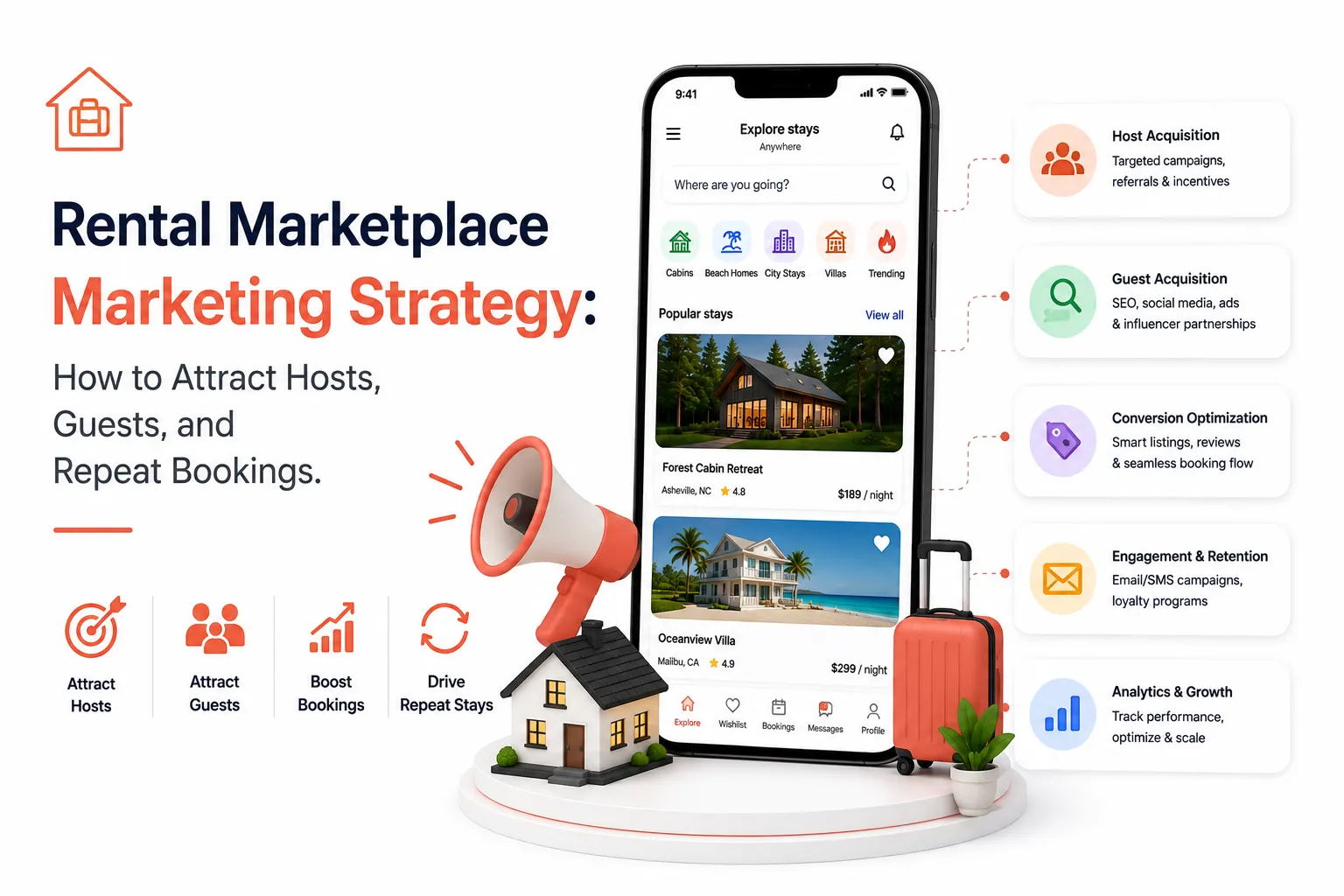
- A rental marketplace marketing strategy must attract both hosts and guests because marketplace growth depends on balancing property supply with consistent booking demand.
- Host acquisition can rely on local outreach, referral programs, onboarding incentives, property manager partnerships, SEO, and clear earning opportunities.
- Guest growth depends on search visibility, paid campaigns, social proof, relevant property inventory, transparent pricing, smooth booking, and strong repeat-booking experiences.
Host & Guest Acquisition Signals
- Hosts are more likely to join when the marketplace offers simple listing creation, booking visibility, pricing controls, secure payouts, calendar management, and responsive support.
- Guests can be acquired through destination SEO, content marketing, social media, referral campaigns, paid search, partnerships, email marketing, and targeted promotions.
- Track host activation, active listings, guest registrations, booking conversion, acquisition cost, property occupancy, and completed reservations to measure marketplace growth quality.
Retention Insights
- Repeat bookings improve when guests receive relevant recommendations, saved searches, wishlists, loyalty benefits, personalized offers, and timely booking reminders.
- Reliable host communication, accurate listings, transparent fees, secure payments, positive reviews, and responsive support help strengthen trust and long-term retention.
- Miracuves develops customizable rental marketplaces with host onboarding, property listings, booking workflows, payments, referrals, promotions, reviews, analytics, notifications, and admin controls.
A rental marketplace does not grow only because the app is live. It grows when property owners trust the platform enough to list inventory, guests trust it enough to book, and both sides see enough value to return.
That is why a rental marketplace marketing strategy must do more than drive downloads or website visits. It has to build supply, create demand, improve booking confidence, and support repeat usage.
For founders, this creates a different kind of marketing challenge. You are not promoting a single product. You are growing a two-sided marketplace where one side depends on the other. If there are too few listings, guests leave. If there are too few guests, hosts lose interest. If trust signals are weak, bookings do not happen even when traffic is strong.
This guide explains how to attract hosts, bring in guests, increase bookings, and build a rental marketplace that people remember.
What Is a Rental Marketplace Marketing Strategy?
A rental marketplace marketing strategy is a plan for attracting property owners, rental operators, travel businesses, and guests to one booking ecosystem. It covers host onboarding, guest acquisition, search visibility, app store visibility, trust-building, referral campaigns, paid ads, partnerships, retention, and booking conversion.
Unlike normal app marketing, rental marketplace marketing has a supply-and-demand problem.
Guests need enough quality listings before they book. Hosts need enough booking potential before they join. The platform owner needs enough trust, pricing control, and operational clarity to keep both sides active.
A strong strategy should answer four questions:
- Who will list inventory first?
- Who will book first?
- Why should both sides trust the platform?
- What will make users return after the first transaction?
When those answers are clear, marketing becomes easier to execute because every campaign supports a real marketplace gap.
Why Rental Marketplace Marketing Is Different From Normal App Promotion
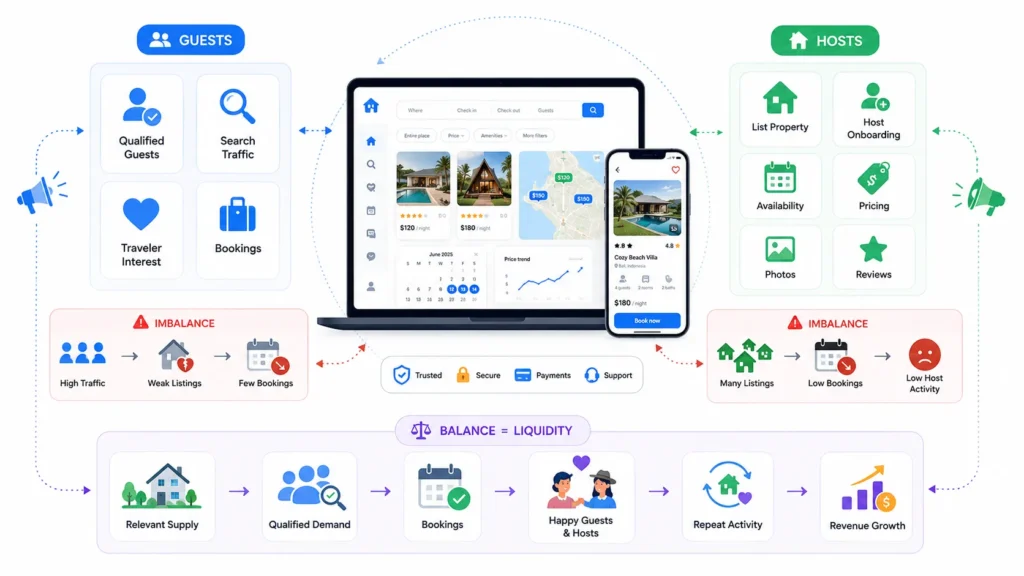
Most apps can grow by focusing on one audience. A rental marketplace cannot.
A food ordering app needs customers and restaurants. A ride platform needs riders and drivers. A rental booking marketplace needs guests and hosts. If one side grows faster than the other, the experience breaks.
For example, a founder may spend heavily on ads to attract guests. But if the platform has limited listings, poor photos, weak availability data, unclear pricing, or no reviews, those guests will not book. The campaign may generate traffic, but the marketplace will not create revenue.
The same issue happens on the host side. A founder may onboard property owners quickly, but if bookings do not arrive, hosts may stop updating calendars, responding to requests, or promoting the platform.
Marketing must therefore be built around marketplace balance.
That means the early goal is not only traffic. The early goal is liquidity: enough relevant supply and enough qualified demand in a focused market.
Start With a Clear Rental Niche Before Scaling
Many rental marketplace founders try to launch too broadly. They want apartments, villas, homestays, workspaces, cars, boats, tours, and events from day one. The problem is that broad positioning creates broad marketing.
A focused niche is easier to explain, rank, promote, and trust.
For example, the first version of the marketplace could focus on:
- Family vacation homes in one region
- Monthly furnished rentals for remote workers
- Pet-friendly stays near tourist destinations
- Premium villas for group travel
- Short-stay apartments for business travelers
- Local experience stays connected to tours
- Student-friendly temporary housing
- Boat and marine rentals in coastal cities
The sharper the niche, the easier it becomes to write landing pages, recruit hosts, run paid campaigns, build partnerships, and create social content.
Founders exploring broader rental, travel, ecommerce, real estate, or booking marketplace models can also review Miracuves’ rental and listings marketplace solutions to understand how different listing-based businesses are structured.
A focused rental platform also helps users understand why they should choose you instead of a generic listing site.
Build Host Supply Before Heavy Guest Acquisition
Hosts are the inventory engine of a rental marketplace. Without quality listings, guest marketing becomes expensive and inefficient.
Before spending heavily on guest campaigns, founders should build a clear host acquisition plan.
The first step is to define the ideal host profile. This may include independent property owners, property managers, boutique stay operators, serviced apartment businesses, travel agencies, tour operators, or local rental companies.
Then the outreach should focus on practical host benefits:
- More booking visibility
- Branded digital listing presence
- Calendar and availability control
- Secure booking and payment workflows
- Review and trust-building systems
- Easier communication with guests
- Admin support and listing approval
- Commission-based growth instead of fixed advertising spend
Hosts need to see that the platform is not just another place to upload property details. They need to understand how it can help them manage demand, improve visibility, and earn from their inventory.
Create a Host Onboarding Funnel
Host acquisition should not depend on random outreach. It should work like a funnel.
At the top of the funnel, hosts discover the platform through local SEO pages, partnerships, social proof, community groups, paid campaigns, and direct outreach.
In the middle, they need proof. This can include demo videos, listing examples, screenshots, commission explanations, host FAQs, onboarding support, and examples of how the booking process works.
At the bottom, they need a simple action. The platform should make it easy to create a profile, submit listings, upload photos, set pricing, define availability, and understand payout rules.
A weak host onboarding process slows supply growth. If hosts need too many manual steps, unclear approvals, or repeated support calls, they may drop off before their listings go live.
Host Onboarding Checklist
A strong host onboarding journey should include:
- Clear host signup page
- Simple listing creation flow
- Photo and description guidance
- Pricing and availability setup
- House rules or rental policy fields
- Verification or approval workflow
- Commission and payout explanation
- Host dashboard access
- Booking notification setup
- Support contact or onboarding guide
This is also where product and marketing connect. If the platform does not make host onboarding easy, marketing will keep losing qualified supply.
Use Local SEO to Capture High-Intent Guest Searches
Rental bookings are location-driven. Guests usually search by destination, stay type, date, property type, budget, or travel purpose.
That makes local SEO one of the most important long-term channels for a rental marketplace.
Instead of building only one generic homepage, founders should create search-friendly pages for specific locations and use cases.
Examples include:
- Vacation homes in [city]
- Pet-friendly rentals in [destination]
- Monthly furnished apartments in [area]
- Beach villas near [location]
- Weekend stays for families in [region]
- Short-term rentals near business districts
- Workation stays in [destination]
- Boat rentals in [coastal city]
Each page should be useful, not thin. It should include relevant listings, location context, travel use cases, trust signals, FAQs, and clear booking actions.
For marketplaces where guests search by area, landmark, distance, or map view, rental marketplace map search optimization can directly influence discovery and booking conversion.
The goal is to help guests find the right inventory faster while giving search engines clearer pages to understand.
Improve Listing Quality Before Scaling Ads
Paid ads can bring traffic quickly, but they cannot fix weak listings.
If photos are poor, pricing is unclear, location details are missing, cancellation rules are vague, or availability is inaccurate, guests will hesitate. In rental marketplaces, trust is part of conversion.
Every listing should answer the questions guests ask before booking:
- Where exactly is the property or rental item located?
- What is included?
- What dates are available?
- What is the total price?
- What rules apply?
- What happens if plans change?
- Who is the host or provider?
- What do previous users say?
- How does support work if something goes wrong?
The better the listing quality, the more efficiently marketing spend can convert.
Before scaling campaigns, founders should review whether their listing, booking, and host workflow features are strong enough to convert visitors into real bookings.
Build Trust Signals Into Every Guest Journey
Trust is not a separate marketing section. It is part of the entire booking journey.
Guests are often booking something they have not seen in person from someone they do not know. Hosts are accepting bookings from people they may never meet before arrival. The platform has to reduce uncertainty on both sides.
Important trust signals include:
- Verified host profiles
- Verified guest profiles where relevant
- Clear property or inventory details
- Transparent pricing
- Real photos
- Reviews and ratings
- Secure payment gateway integration
- Cancellation and refund policies
- Dispute management
- Admin approval for listings
- Support and reporting options
Founders should define rental marketplace security guidelines early, especially around user verification, secure payments, admin access, dispute handling, and abuse reporting.
Trust also affects repeat bookings. A guest may book once because of price or availability, but they return when the experience feels safe, predictable, and well-managed.
Use Content Marketing to Educate Both Sides of the Marketplace
A rental marketplace should not create content only for guests. It should also create content for hosts.
Guest content helps attract demand. Host content helps attract supply.
Guest-focused content can include destination guides, travel planning tips, property comparison guides, seasonal stay ideas, family travel guides, local experience guides, and booking checklists.
Host-focused content can include pricing tips, listing photo guides, guest communication templates, seasonal demand planning, property preparation advice, payout explanations, and trust-building tips.
This creates two SEO advantages.
First, the platform can rank for more long-tail queries. Second, the marketplace becomes useful before the user is ready to book or list.
That is how a blog can support the commercial page without competing with it. The blog should educate users around marketing, growth, trust, and booking behavior, while the commercial page remains the destination for users ready to explore the platform foundation.
Use Social Proof to Reduce Booking Hesitation
Social proof is one of the most powerful marketing assets for rental platforms.
For guests, social proof can include reviews, ratings, verified stays, guest photos, repeat booking badges, host response rates, and testimonials.
For hosts, social proof can include active listing examples, booking success signals, platform screenshots, host onboarding support, and visible demand in target locations.
The goal is not to create fake urgency or exaggerated claims. The goal is to show that real people use and trust the platform.
If the marketplace is new, founders can start with softer trust assets:
- Verified host badges
- Professional listing photos
- Clear support policies
- Founder-led local partnerships
- Manual listing review
- Transparent booking rules
- Early user feedback
- Pre-launch host stories with permission
Trust grows through consistency. Marketing should highlight the systems that make the platform safer and easier to use.
Run Paid Campaigns Only After the Marketplace Is Ready to Convert
Paid campaigns can help a rental marketplace grow faster, but only when the platform is ready.
Before running ads, founders should check whether the booking journey is strong enough to handle traffic.
Important checks include:
- Are there enough listings in the target location?
- Do listings have strong photos and complete details?
- Is pricing clear before checkout?
- Does search work smoothly?
- Are filters useful?
- Does the platform load quickly on mobile?
- Are payment and booking flows tested?
- Are cancellation and refund rules visible?
- Is there a support path for guests and hosts?
- Is conversion tracking installed?
Once these basics are ready, paid campaigns can be used for destination-specific traffic, retargeting, seasonal promotions, host acquisition, and lookalike audiences.
A practical vacation rental app feature checklist can help founders identify whether the platform is ready before paid traffic is scaled.
The best early campaigns are usually narrow. Promote one destination, one rental category, or one guest segment instead of advertising the entire marketplace at once.
Use Referral Programs to Grow Both Hosts and Guests
Referral marketing works well for rental marketplaces because trust often moves through networks.
Guests refer friends after a good stay. Hosts refer other property owners when the platform is easy to use. Local partners refer customers when the marketplace supports their business.
A good referral program should be simple and relevant.
For guests, rewards can include booking credits, discount codes, loyalty points, or early access to selected listings.
For hosts, rewards can include reduced commission for a period, listing promotion credits, premium visibility, or onboarding support for referred hosts.
The reward should support platform growth without damaging unit economics.
A referral program should also be timed correctly. Asking for referrals before a user has experienced value feels premature. Asking after a successful booking, completed stay, or positive review feels natural.
Use App Store Optimization for Mobile Growth
If the rental marketplace has mobile apps, app store optimization can support discovery and conversion.
The app title, subtitle, description, screenshots, and preview content should explain the marketplace clearly. Screenshots should not only look attractive. They should show the actual user journey.
Useful screenshot themes include:
- Search by location
- Explore listings
- Check availability
- Book securely
- Message host
- Manage trips
- List property
- Track host earnings
Reviews also matter. A strong post-booking review flow can help improve app credibility over time.
App store content should avoid overpromising. It should clearly explain what the platform helps users do and why the experience is easier than scattered manual booking.
Retain Guests With Post-Stay Communication
Many rental platforms spend too much on acquiring first-time guests and too little on bringing them back.
Retention starts after the booking is complete.
Post-stay communication can include:
- Thank-you messages
- Review requests
- Personalized recommendations
- Seasonal offers
- Destination reminders
- Referral prompts
- Loyalty rewards
- Early access to new listings
- Win-back campaigns
Repeat guests are valuable because they already understand the platform. They need less education and may convert faster if the first experience was good.
The strongest retention strategies connect guest behavior with future suggestions. A family that booked a weekend villa may want similar listings during school holidays. A business traveler who booked a serviced apartment may need monthly stay options. A couple that booked a coastal stay may respond to seasonal destination offers.
Retain Hosts With Better Control and Clear Communication
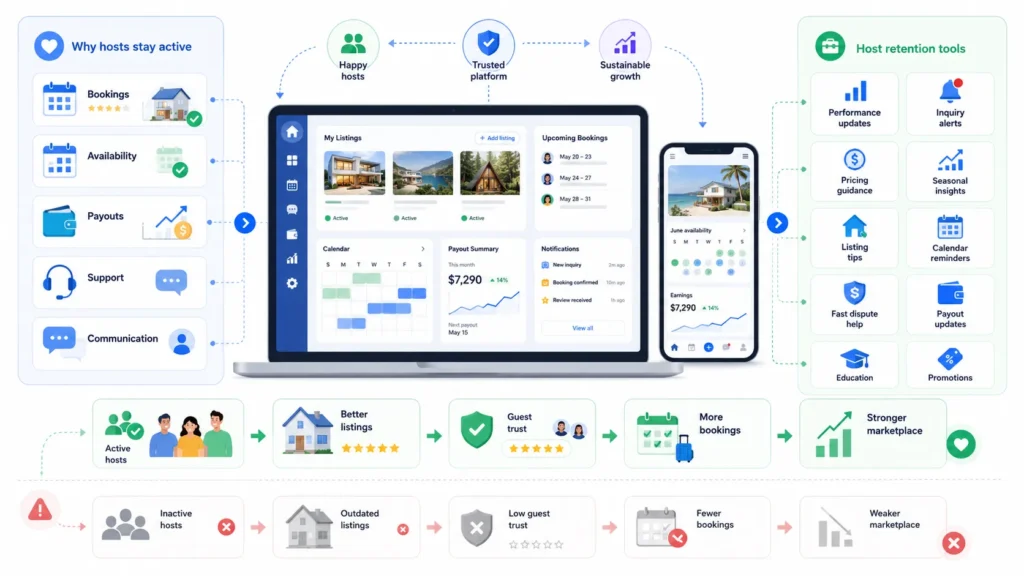
Host retention is just as important as guest retention.
Hosts stay active when they receive bookings, understand payouts, control availability, and trust the platform’s support process.
For hosts managing inventory across multiple channels, calendar sync and double-booking prevention can improve availability accuracy and reduce operational friction.
A host retention strategy should include:
- Regular performance updates
- Booking and inquiry notifications
- Pricing guidance
- Seasonal demand insights
- Listing improvement suggestions
- Calendar reminders
- Fast dispute resolution
- Clear payout communication
- Host education content
- Promotional opportunities for strong listings
Inactive hosts weaken the marketplace. If listings are outdated, unavailable, or poorly maintained, guest trust drops.
This is why platform operations and marketing must work together. A strong host dashboard, admin controls, and communication workflows help marketing perform better because the supply side remains active.
Track the Right Rental Marketplace Marketing Metrics
Founders should not measure rental marketplace marketing only by traffic or downloads. Those numbers matter, but they do not show whether the marketplace is becoming healthier.
Better metrics include:
- Host signup rate
- Listing completion rate
- Approved listings by location
- Guest search-to-listing-view rate
- Listing-view-to-booking rate
- Booking completion rate
- Cost per booking
- Repeat booking rate
- Host response rate
- Cancellation rate
- Review submission rate
- Referral conversion rate
- Average booking value
- Revenue by location or category
Marketing performance should also connect to the rental marketplace revenue model, because commissions, booking fees, subscriptions, featured listings, and host payouts affect how much a founder can spend to acquire users.
These metrics help founders see where growth is blocked.
If traffic is high but bookings are low, the issue may be listing quality, pricing, trust, or checkout friction. If host signups are high but listings are incomplete, onboarding may be too difficult. If bookings happen once but repeat usage is low, retention and post-stay engagement may need work.
Founder Decision Signals
Supply Readiness
If guests are arriving before enough quality listings are available, slow down paid demand campaigns and focus on host acquisition first.
Trust Strength
If users browse but do not book, review pricing clarity, photos, reviews, policies, verification, and payment confidence.
Channel Focus
If marketing feels scattered, choose one location, one audience, and one booking use case before scaling wider.
Retention Potential
If every booking requires a new paid campaign, build referral, email, loyalty, and repeat-stay workflows earlier.
Rental Marketplace Marketing Channels and Their Business Value
| Marketing Channel | Best For | Founder Benefit |
|---|---|---|
| Local SEO | Destination-based guest demand | Builds long-term organic traffic for high-intent searches |
| Host outreach | Early supply acquisition | Helps create enough inventory before demand campaigns scale |
| Paid search | High-intent booking traffic | Captures users already looking for rental options |
| Paid social | Awareness and retargeting | Helps promote destinations, listing categories, and offers |
| Content marketing | Guest and host education | Builds authority and supports long-tail discovery |
| Influencer partnerships | Trust and lifestyle demand | Shows real use cases through relatable content |
| Referral programs | Lower-cost growth | Turns happy guests and hosts into acquisition channels |
| Email marketing | Retention and repeat bookings | Keeps past users engaged without depending only on paid ads |
| Local partnerships | Community-level trust | Connects the platform with tourism, events, and property networks |
| App store optimization | Mobile discovery | Improves visibility and trust for app-first users |
Common Marketing Mistakes Rental Marketplace Founders Should Avoid
Marketing Before Supply Is Ready
If the platform has weak inventory, paid traffic can expose the gap faster. Build enough quality listings in your first target market before scaling guest acquisition.
Targeting Everyone Too Early
A broad audience makes messaging weaker. Start with a clear niche, location, and user type before expanding.
Treating Hosts as One-Time Signups
Hosts need onboarding, communication, performance visibility, and support. If hosts become inactive, the marketplace loses value.
Ignoring Trust Until Complaints Start
Trust should be designed before launch. Verification, reviews, policies, support, and dispute workflows are growth assets, not afterthoughts.
Tracking Downloads Instead of Bookings
Downloads do not prove marketplace health. Track listing quality, booking conversion, repeat usage, host response rates, and revenue by category.
How Product Readiness Supports Marketing Performance
Marketing works better when the platform itself supports conversion.
A rental marketplace needs more than traffic. It needs search, filters, listing management, booking flows, payment logic, host dashboards, guest profiles, reviews, admin controls, and communication workflows.
This is where a ready-made rental marketplace foundation can help founders move faster. Instead of building every guest, host, booking, payment, and admin module from zero, founders can start with a platform structure and focus more energy on positioning, supply, demand, and market validation.
For founders who want a product foundation built for rental bookings, host workflows, secure payments, and admin control, Miracuves offers a ready-made rental marketplace solution that can support both launch execution and growth campaigns.
How Miracuves Helps Rental Marketplace Founders Launch and Grow
Miracuves helps founders build rental marketplace platforms with branded user journeys, listing workflows, host dashboards, booking flows, secure payment integration, reviews, admin controls, and source-code ownership.
For marketing, this matters because campaigns perform better when the platform can support real user behavior. Host acquisition needs smooth listing management. Guest acquisition needs trustworthy booking flows. Retention needs communication, reviews, and repeat-use systems. Admin teams need control over listings, users, bookings, commissions, payouts, and disputes.
A strong product foundation does not replace marketing. It makes marketing more effective.
Related reading: truck rental platform features and pricing guide.
Final Thoughts
A rental marketplace marketing strategy is not only about getting attention. It is about creating enough trust, supply, demand, and repeat behavior for the platform to grow sustainably.
Founders should start with a focused niche, recruit quality hosts, build location-based guest demand, improve listing quality, and strengthen trust signals before scaling paid campaigns. Once bookings begin, the next growth layer is retention: referrals, repeat stays, personalized recommendations, and stronger host relationships.
The strongest rental marketplaces are not remembered because they ran more ads. They are remembered because they solved a real booking problem for a specific audience and made both sides of the marketplace feel confident enough to come back. For founders who want to turn that strategy into a launch-ready platform, Miracuves helps build rental marketplace solutions with branded booking flows, host workflows, admin control, and source-code ownership.
FAQs
What is a rental marketplace marketing strategy?
A rental marketplace marketing strategy is a growth plan for attracting hosts, guests, and repeat bookings. It includes host onboarding, guest acquisition, local SEO, paid campaigns, referral programs, content marketing, trust signals, app store optimization, and retention workflows.
How do you attract hosts to a rental marketplace?
To attract hosts, explain the earning opportunity, booking process, payout rules, listing control, and platform support clearly. Use host landing pages, direct outreach, local partnerships, demo videos, onboarding guides, and early promotional offers to reduce signup friction.
How do you attract guests to a rental booking platform?
Guests can be attracted through local SEO, destination pages, paid search, social media, influencer partnerships, referral programs, retargeting, app store optimization, and trust-focused listing content. The platform should also provide clear pricing, strong photos, reviews, and easy booking flows.
Why is local SEO important for rental marketplaces?
Local SEO is important because rental searches are usually destination-based. Guests often search by city, property type, travel purpose, nearby attraction, or stay duration. Location-specific pages help the marketplace capture high-intent traffic.
What should founders market first: hosts or guests?
Most founders should build enough host supply first, especially in the first target location. Guest marketing performs better when the platform already has relevant listings, accurate availability, strong photos, clear pricing, and trust signals.
How can a rental marketplace increase repeat bookings?
A rental marketplace can increase repeat bookings through post-stay emails, loyalty rewards, personalized recommendations, referral offers, seasonal campaigns, saved preferences, and a smooth guest experience that encourages users to return.
What metrics should a rental marketplace track?
Important metrics include host signup rate, listing completion rate, approved listings, guest search-to-booking rate, booking completion rate, cost per booking, repeat booking rate, host response rate, cancellation rate, review rate, and revenue by location.
How does platform design affect rental marketplace marketing?
Platform design affects marketing because users must trust and complete the booking journey. Strong search, filters, listing pages, booking flows, payment integration, reviews, host dashboards, and admin controls help marketing traffic convert into real bookings.
Miracuves is an independent software development company. We are not affiliated with, connected to, sponsored by, or endorsed by any company or product named in this article.
Terms such as “X Clone” are used descriptively. It is how the software industry refers to building a platform with functionality comparable to a known service, and how clients search for it.
The entire design and codebase of our products is built by our own team. Our products contain no code, design, graphics, or content originating from any third-party website or applications.
All third-party names and marks referenced in this article are the property of their respective owners, referenced solely to identify the services discussed.