
Key Takeaways
- vacation rental startup development calendar sync is a core trust layer that keeps property availability accurate across guest searches, host calendars, checkout, payments, and external booking channels.
- Double-bookings can occur when multiple guests attempt overlapping reservations, external updates arrive late, payment retries create duplicates, or timezone handling changes date boundaries.
- Real-time availability checks should happen during search and again before payment because inventory can change while a guest moves through checkout.
- Temporary booking holds and reservation locks help ensure that only one checkout process can control the same property-date range at a time.
- Reliable double-booking prevention combines availability validation, reservation locks, payment-state handling, timezone normalization, external sync, and audit logs.
Calendar Sync Signals
- A reliable flow follows: availability check → checkout revalidation → temporary hold → payment → reservation confirmation → calendar update → external sync.
- Booking holds should expire automatically when checkout is abandoned or payment fails so unavailable inventory is not blocked unnecessarily.
- Timezone normalization helps prevent shifted blocked dates, incorrect check-in boundaries, pricing errors, and overlapping reservations across regions.
- iCal and channel integrations should support internal availability management rather than acting as the platform’s only double-booking protection.
- Idempotency helps prevent duplicate reservations when guests retry payments or payment gateways send the same confirmation more than once.
Real Insights
- A visual calendar alone cannot prevent booking conflicts; the critical protection must happen inside the server-side booking workflow.
- Race conditions occur when two booking attempts read the same dates as available before the first transaction has fully updated inventory.
- Confirmed internal reservations should remain a protected source of truth unless an authorized cancellation, refund, or admin action changes availability.
- Admin teams need visibility into pending holds, expired holds, sync failures, blocked dates, payment attempts, conflicts, cancellations, and manual overrides.
- The strongest booking protection flow is: search → revalidate → lock dates → process payment → confirm once → update availability → sync channels → record the event.
In vacation rental platform development, the calendar is not just a date picker. It is the trust layer between guests, hosts, payment systems, external booking channels, and the marketplace operator.
When a guest selects dates, the platform must answer one question with absolute clarity:
Is this property available for this exact date range right now?
That answer becomes complicated when multiple guests are searching at the same time, hosts are updating availability, external channels are importing calendar changes, payments are pending, cancellations are being processed, and time zones are shifting date boundaries.
This is why real-time calendar sync matters.
A rental marketplace may look polished on the front end, but if its availability engine is weak, double-bookings can damage host trust, guest confidence, support operations, and platform reputation. For founders building a short-term rental marketplace, vacation booking app, villa rental platform, homestay marketplace, or property booking system, calendar reliability should be treated as core infrastructure.
For founders still exploring the broader rental marketplace space, Miracuves offers multiple rental and property platform options across short-stay booking, property listings, car rentals, boat rentals, and other rental marketplace models. This helps founders compare the wider category before deciding which booking platform direction fits their market.
This guide explains how rental marketplaces prevent double-bookings using real-time calendar sync, booking locks, timezone normalization, external channel updates, retry-safe booking flows, and admin visibility.
Why Double-Bookings Are a Business Problem, Not Just a Calendar Problem
A double-booking may look like a simple scheduling mistake, but for a rental marketplace it creates a chain reaction.
The guest may have already paid. The host may have confirmed the stay. The same room, villa, apartment, vehicle, or property may still appear available on another channel. The admin team may need to process refunds, contact users, adjust payout records, and protect marketplace trust.
For founders who want to understand the wider operating model behind booking platforms, this host-guest rental marketplace model explains how guests search, hosts manage listings, bookings are confirmed, payments are processed, reviews build trust, and admins control marketplace operations.
In early-stage vacation rental platform development, founders often focus on visible features: listing pages, search filters, property photos, reviews, and checkout design. Those features matter, but they depend on a deeper layer: the availability engine.
If the availability engine is not reliable, even a well-designed marketplace can fail during peak demand.
Double-bookings can happen when:
- Two guests attempt to reserve the same listing-date range at almost the same time.
- A host blocks dates manually while a guest is already in checkout.
- An external calendar update arrives late.
- A cancellation releases dates incorrectly.
- Timezone differences shift check-in or check-out boundaries.
- A payment succeeds after the platform has already released the hold.
- A retry creates a duplicate reservation instead of continuing the original booking attempt.
For founders, this is why calendar sync is not a small technical detail. It is part of the marketplace’s trust infrastructure.
How Real-Time Calendar Sync Works in Rental Marketplaces
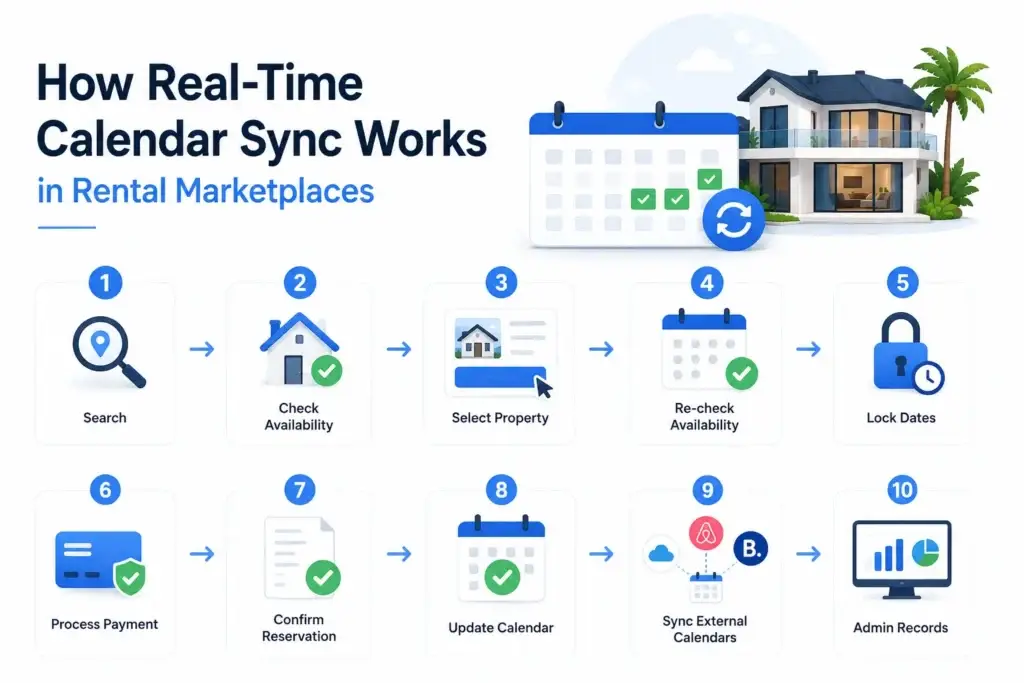
Real-time calendar sync keeps listing availability consistent across guest searches, host calendars, booking flows, payment events, and external channels.
A basic calendar only displays available and unavailable dates. A stronger rental marketplace calendar does more. It checks availability at the moment of search, validates it again before checkout, protects the selected date range during payment, confirms the booking only once, and updates every connected calendar after the reservation is completed.
In simple terms, a reliable booking platform follows this sequence:
- Guest searches for a location, date range, and stay type.
- Platform checks available listings based on confirmed bookings, blocked dates, host rules, and pending holds.
- Guest selects a property and begins checkout.
- Platform re-checks the same date range before payment.
- Booking engine locks the listing-date range temporarily.
- Payment is processed.
- Reservation is confirmed if the lock, payment, and availability check all pass.
- Calendar is updated internally.
- External calendars or channel tools receive the updated availability.
- Admin records the event for reporting, dispute handling, and support.
This flow is important because availability can change between search and payment. Without a real-time confirmation layer, the platform may show available dates that are no longer safe to book.
Core Calendar Sync Layers in Vacation Rental Platform Development
| Calendar Layer | What It Does | Why It Matters for Founders |
|---|---|---|
| Search-Level Availability | Filters listings based on date range, host rules, blocked dates, and confirmed reservations. | Prevents users from wasting time on listings that cannot be booked. |
| Checkout Revalidation | Checks availability again before payment or booking confirmation. | Protects the platform when availability changes after the initial search. |
| Temporary Booking Holds | Reserves a date range for a short window while the guest completes payment. | Reduces conflict when multiple guests try to book the same property. |
| Reservation Locks | Allows only one booking process to control a listing-date range at a time. | Prevents duplicate confirmations during high-demand checkout activity. |
| Timezone Normalization | Converts check-in and check-out boundaries into a consistent time reference. | Reduces calendar errors across countries, cities, guests, hosts, and channels. |
| External Calendar Sync | Imports and exports availability updates between the platform and external booking sources. | Helps hosts manage inventory across multiple sales channels. |
| Audit Logs | Records booking changes, calendar updates, sync jobs, conflicts, and admin actions. | Gives operators visibility when support issues or disputes occur. |
Founders who want to understand the deeper product layer can review this rental marketplace features including booking flows, host tools, payment handling, admin controls, availability logic, and marketplace modules that support a reliable booking experience.
Why Race Conditions Create Booking Conflicts
One of the biggest technical risks in rental marketplace development is a race condition.
A race condition happens when two or more actions try to access and update the same data at the same time. In a booking platform, this usually means two guests try to reserve the same property for the same dates before the system has completed the first confirmation.
For example:
- Guest A opens checkout for a villa from March 10 to March 14.
- Guest B opens checkout for the same villa and dates seconds later.
- Both requests read the listing as available.
- Guest A completes payment.
- Guest B also completes payment before the first reservation fully updates availability.
- The platform now has two confirmed bookings for one property-date range.
This is not a front-end issue. It is a concurrency issue.
A strong booking engine should not rely only on what the user saw on the calendar screen. It should validate availability inside the server-side booking flow, lock the selected date range, and confirm only one reservation.
That is why double-booking prevention requires backend discipline, not just better calendar UI.
How Reservation Locks Protect the Booking Window
A reservation lock is a temporary control mechanism that protects a listing-date range during checkout.
When a guest moves toward final booking confirmation, the system attempts to lock the selected listing and date window. If the lock is successful, the booking flow continues. If another guest is already processing the same dates, the second request should wait, retry, or return a clear availability response.
A simple conceptual lock may look like this:
booking_lock:{listing_id}:{checkin_utc}:{checkout_utc}The exact implementation depends on the platform architecture, database, framework, queue system, and caching layer. The principle is the same: only one booking process should control a protected date range at a time.
In vacation rental platform development, this lock should be paired with:
- Server-side availability checks
- Database transactions
- Row-level booking protection where needed
- Payment status validation
- Expiry rules for abandoned checkouts
- Clear user messaging when dates are no longer available
- Admin visibility into failed or interrupted booking attempts
Locks should not hold dates forever. If the user abandons checkout or payment fails, the hold must expire safely so the property can return to availability.
Why Timezone Normalization Matters for Rental Calendars
Timezone handling is one of the most underestimated parts of short-term rental platform development.
A guest may search from one country, the host may manage the property in another region, and the server may operate in a different timezone. External calendar feeds may also interpret dates differently depending on the source.
For hotel-style stays, vacation homes, villas, cars, boats, tours, and experience-based rentals, check-in and check-out boundaries must be handled consistently.
Without timezone normalization, problems can appear:
- A blocked date may shift by one day.
- A checkout date may overlap with the next guest’s check-in.
- External calendar imports may mark the wrong date unavailable.
- Admin reports may show booking events in the wrong sequence.
- Cancellation or refund windows may be calculated incorrectly.
- Seasonal pricing may apply to the wrong night.
A strong rental marketplace should store and compare booking windows consistently, while still displaying dates in the user’s local context where appropriate.
For founders, this matters because calendar accuracy affects more than bookings. It affects pricing, payouts, support, reporting, and trust.
External Calendar Sync: iCal, Channel Managers, and Delayed Updates
Many rental marketplace founders assume that iCal sync alone will prevent double-bookings. It helps, but it should not be treated as the only protection layer.
External calendar feeds can update at different speeds. Some are pulled on a schedule. Some are delayed. Some do not provide enough context about the booking source, payment status, cancellation state, or blocked-date reason.
That means a rental marketplace should use external calendar sync as part of a wider availability strategy, not as the entire strategy.
A practical platform may need to support:
- iCal import and export
- Channel manager integrations
- Host-side calendar blocking
- Admin-created booking blocks
- OTA availability updates
- Manual inventory adjustments
- Retry jobs when sync fails
- Conflict detection when imported dates overlap existing bookings
The platform should also avoid overwriting confirmed reservations with external data. A confirmed internal booking should be treated as a protected source of truth unless an authorized cancellation, refund, or admin action changes it.
Booking Holds, Payment Windows, and Failed Checkout Recovery
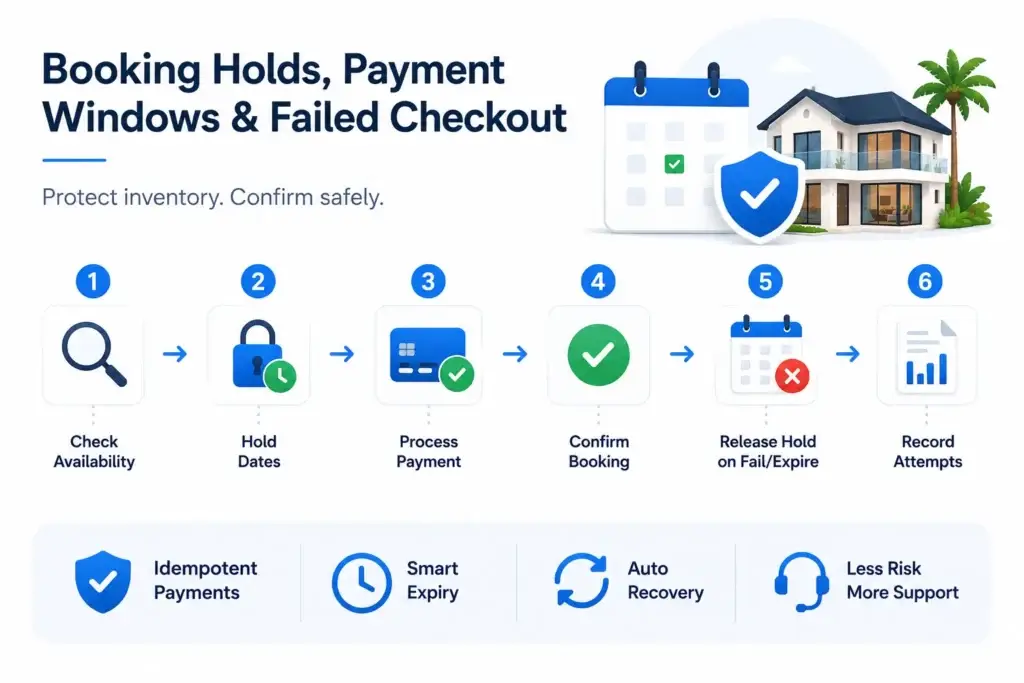
The most sensitive booking moment happens between checkout and payment confirmation.
If dates are not protected during payment, another guest may complete a competing booking first. But if dates are held for too long, the platform may unnecessarily block inventory and reduce host revenue.
A balanced rental marketplace needs a clear payment window.
For example:
- Hold selected dates only after the final availability check.
- Set an expiry time for unpaid bookings.
- Release the hold if payment fails or the user abandons checkout.
- Confirm the booking only after payment status is verified.
- Prevent duplicate booking creation if the user refreshes or retries payment.
- Record failed, expired, and completed booking attempts for support review.
This is where idempotency becomes useful. If a guest retries payment or the payment gateway sends the same callback twice, the system should not create two reservations. It should recognize the booking attempt and continue or update the existing transaction safely.
Once the platform can protect availability and prevent booking conflicts, founders should also decide how the marketplace will earn. A clear rental marketplace revenue model can include booking commissions, host subscriptions, guest service fees, featured listings, payout logic, and other monetization layers.
For founders, this reduces both technical risk and support pressure.
Admin Visibility: The Layer Founders Often Forget
Double-booking prevention is not complete unless the admin team can see what happened.
A booking conflict may involve a guest, host, payment gateway, channel update, blocked date, refund event, or failed sync job. Without clear admin records, the support team is forced to guess.
A strong admin dashboard should help operators view:
- Confirmed bookings
- Pending booking holds
- Expired holds
- Failed payment attempts
- Host-blocked dates
- External calendar imports
- Sync job status
- Conflict warnings
- Cancellation and refund actions
- Manual admin overrides
- Activity logs by user, host, listing, and date range
This is especially important as the platform grows across regions, property types, and booking channels.
Calendar reliability becomes even more important when a startup focuses on a specific rental niche, such as pet-friendly stays, villas, student housing, eco-retreats, or destination-based rentals. This niche vacation rental marketplace strategy explains how focused inventory, local supply density, host fit, and high-intent travelers can create a stronger starting point before scaling the platform.
In vacation rental platform development, admin visibility gives the founder operational control. It helps the team understand whether issues come from product logic, host behavior, external sync delays, payment failures, or guest retries.
Founder Decision Signals
Booking Trust
If guests can pay for unavailable dates, the platform has a trust problem. Real-time calendar sync should be part of the first serious launch version.
Host Retention
Hosts are less likely to stay active if the platform creates calendar conflicts, payout confusion, or support-heavy booking errors.
Operational Control
Admin teams need visibility into booking holds, sync failures, blocked dates, refunds, and manual changes to resolve issues quickly.
Scalability
As listings, channels, and checkouts increase, the platform needs locking, retry, and audit logic that can handle higher booking pressure.
Real-Time Calendar Sync Checklist for Rental Marketplace Founders
Before launching a rental marketplace, founders should check whether the booking foundation can handle the realities of live inventory.
Use this checklist during product planning, vendor evaluation, or platform review:
- Does the platform re-check availability before checkout?
- Are listing-date ranges locked during payment?
- Are abandoned booking holds released automatically?
- Can the platform prevent duplicate reservations after payment retries?
- Are check-in and check-out windows normalized across time zones?
- Can hosts manually block unavailable dates?
- Can admins override or adjust calendar blocks safely?
- Does the platform import and export external calendar updates?
- Are sync failures visible to the admin team?
- Can the platform detect conflicts between internal and external bookings?
- Are cancellation and refund events reflected in availability correctly?
- Are all booking changes recorded in activity logs?
- Does the platform support future channel manager integration?
- Can the system scale when multiple guests book high-demand listings at once?
If the answer is unclear, the founder should treat calendar reliability as a launch risk.
Mistakes Founders Should Avoid
Relying Only on the Calendar UI
A visual calendar can show dates, but double-booking prevention needs server-side validation, booking locks, transaction handling, and payment-state control.
Treating iCal as the Entire Sync Strategy
External calendar feeds can be delayed or incomplete. They should support availability management, not replace real-time internal booking control.
Ignoring Timezone Boundaries
Timezone mistakes can shift blocked dates, booking windows, pricing rules, and cancellation periods. Consistent date handling is essential for multi-region rental platforms.
Missing Admin Logs
When a booking conflict happens, the admin team needs to know which user, host, payment event, sync job, or manual action changed the calendar.
Where Miracuves Fits Into Reliable Rental Marketplace Launches
Miracuves helps founders launch rental marketplace platforms faster with ready-made, white-label, source-code-owned foundations that can be customized for different rental and booking models.
For founders working on vacation rental platform development, the value is not just speed. It is starting with core marketplace workflows such as listings, booking flows, host dashboards, guest journeys, payment handling, admin control, and calendar logic already considered at the platform level.
A founder should not have to discover calendar conflict problems only after the first users start booking. The booking engine should be planned around real marketplace behavior from the beginning.
If you are comparing build paths, Miracuves’ launch-ready rental marketplace platform can be used as the next-step solution page after this technical guide. Keep this blog focused on calendar sync and double-booking prevention, while the solution page handles direct product, demo, pricing, and purchase-intent details.
Final Thoughts: Calendar Reliability Is Marketplace Trust
Double-booking prevention is not only a development task. It is a trust decision.
Guests need confidence that the dates they book are truly available. Hosts need confidence that the platform will not sell the same inventory twice. Operators need enough admin visibility to resolve issues before they become reputation problems.
That is why calendar sync deserves serious attention in vacation rental platform development.
A strong rental marketplace should not rely on a static calendar screen. It should combine real-time availability checks, booking locks, database-safe confirmation logic, timezone normalization, external sync workflows, payment-state handling, and audit logs.
Reliable calendar sync also supports growth because marketing will only work if guests can book confidently and hosts trust the platform’s availability controls. This rental app marketing strategy explains how host outreach, guest acquisition, local SEO, trust signals, launch campaigns, and retention workflows work together for a rental marketplace.
For founders, the lesson is simple: launch faster, but do not launch blind. A ready-made booking foundation can reduce development time, but the platform still needs reliable calendar architecture to support real users, real hosts, and real transactions.
Before choosing a build partner, founders should evaluate more than design screens. The right rental marketplace development partner should understand calendar reliability, booking conflict prevention, payment handling, source-code ownership, admin control, and post-launch support.
FAQs
What is real-time calendar sync in rental marketplaces?
Real-time calendar sync is the process of keeping property availability updated across guest searches, host dashboards, booking flows, payment events, external channels, and admin systems. It helps ensure that a listing-date range is not sold twice.
Why do double-bookings happen in vacation rental platforms?
Double-bookings happen when two booking actions overlap before the platform has safely confirmed and blocked the first reservation. They can also happen because of delayed external calendar updates, timezone errors, failed payment recovery, or weak checkout validation.
How can vacation rental platform development reduce booking conflicts?
Vacation rental platform development can reduce booking conflicts by using server-side availability checks, checkout revalidation, reservation locks, database transactions, payment-state validation, sync monitoring, and admin audit logs.
Is iCal synchronization enough to prevent double-bookings?
iCal synchronization can help share availability between platforms, but it may not be enough on its own. A stronger rental marketplace combines external calendar sync with real-time internal booking control, reservation locks, and conflict detection.
Why are booking locks important?
Booking locks help ensure that only one checkout process can control a specific listing-date range at a time. This reduces the risk of two guests confirming the same property for the same dates.
Why does timezone handling matter in booking platforms?
Timezone handling matters because check-in and check-out dates can shift when guests, hosts, properties, servers, and external channels operate in different regions. Poor timezone logic can cause wrong blocked dates, incorrect pricing, and booking overlap.
What should founders check before launching a rental marketplace?
Founders should check whether the platform supports real-time availability, host calendar control, booking locks, abandoned checkout recovery, external sync, admin logs, cancellation handling, and payment-state validation.
How does Miracuves support rental marketplace founders?
Miracuves helps founders launch ready-made and white-label rental marketplace platforms with source-code ownership, admin control, booking workflows, host and guest modules, and customization support for faster market entry.
Miracuves is an independent software development company. We are not affiliated with, connected to, sponsored by, or endorsed by any company or product named in this article.
Terms such as “X Clone” are used descriptively. It is how the software industry refers to building a platform with functionality comparable to a known service, and how clients search for it.
The entire design and codebase of our products is built by our own team. Our products contain no code, design, graphics, or content originating from any third-party website or applications.
All third-party names and marks referenced in this article are the property of their respective owners, referenced solely to identify the services discussed.