Key Takeaways
- Building an on-demand food delivery platform requires more than customer ordering and courier tracking. The platform must coordinate restaurants, couriers, customers, dispatch decisions, payments, and fulfillment operations.
- Smart order batching can improve delivery efficiency by grouping compatible orders into coordinated routes, but only when preparation times, destinations, delivery promises, courier capacity, and food-handling requirements remain within acceptable limits.
- Batching should optimize productive work rather than maximize order volume. Adding more orders to a courier route can reduce efficiency when it creates excessive waiting, detours, late deliveries, or additional support costs.
- Courier economics must remain part of the dispatch strategy. Platforms should evaluate earnings per online hour, waiting time, travel distance, compensation, and relevant operating expenses rather than assuming more deliveries automatically mean higher earnings.
- Contribution margin per order provides a more useful financial measure than gross order value. Courier compensation, payment processing, promotions, refunds, customer support, and other relevant variable fulfillment costs should be considered.
- A reliable batching engine needs real-time order states, restaurant preparation estimates, courier availability, road-network travel times, customer delivery windows, vehicle capacity, and route information.
- Dynamic batching adds complexity. When new orders are inserted into active routes, the platform needs controlled re-optimization rules so couriers are not constantly reassigned and existing customer commitments are not unnecessarily disrupted.
- Customer experience remains a critical guardrail. On-time delivery, food quality, refunds, complaints, and delivery exceptions should be monitored alongside cost and courier-utilization metrics.
- Batching should sometimes be restricted or disabled. Low-density demand, unreliable restaurant readiness, severe traffic, special-handling orders, and routes already close to their delivery deadlines may make single-order dispatch more appropriate.
- Founders should begin with a baseline and controlled batching tests, then expand toward dynamic routing and zone-specific optimization only after reliable operational data is available.
- A ready-made food delivery platform can provide the core ordering, restaurant, courier, and administrative foundation, while advanced batching algorithms, predictive preparation models, and specialized route optimization should be evaluated as separate requirements.
Food delivery businesses face a difficult operational challenge: customers expect convenient, timely deliveries, couriers want consistent earnings, and platform operators need enough contribution margin to keep the marketplace sustainable. These priorities are closely connected, yet improving one does not automatically improve the others. A delivery system that assigns every order to a separate courier may be simple to operate, but it can also create unnecessary travel, inefficient pickup schedules, and underused delivery capacity.
Smart order batching offers a more coordinated approach. Instead of treating every order as an independent delivery trip, the dispatch system evaluates whether one courier can collect and deliver multiple compatible orders without violating service expectations. For founders examining On-demand food delivery platform, understanding this operational logic is important before deciding how dispatch rules should evolve as order volumes increase.
Consider a busy lunch period when two customers order from restaurants on the same street and live within a short distance of one another. Assigning two separate couriers could create overlapping journeys. A carefully planned batch might allow one courier to complete both deliveries with less combined travel and a more productive route. However, the batch only creates value if preparation times align, customer promises remain realistic, and the courier is fairly compensated for the additional work.
That last condition matters. Batching is not simply a way to make drivers carry more orders. It is an operational strategy for increasing useful delivery output while managing waiting time, travel distance, food quality, payout economics, and customer satisfaction.
This guide explains how intelligent batching works, what influences its profitability, how it can improve courier earnings, and what founders should measure before introducing automated order grouping into their delivery operations.
What Is Smart Order Batching in Food Delivery?
Smart order batching is the process of grouping two or more compatible food deliveries into a coordinated pickup-and-drop-off route for a single courier. The objective is to use courier capacity more effectively while keeping every order within acceptable delivery conditions.
Unlike simple order grouping, intelligent batching evaluates multiple changing factors. These may include restaurant locations, food preparation estimates, customer destinations, road conditions, courier availability, vehicle capacity, and promised delivery windows.
A batch may involve collecting two orders from the same restaurant, collecting orders from nearby restaurants, or delivering several orders to customers located along a compatible route. The best combination is not necessarily the group with the shortest geographic distance. It is the group that offers a feasible balance of travel efficiency, pickup readiness, service quality, and economic value.
Single-Order Dispatch vs. Batched Dispatch
In single-order dispatch, a courier typically accepts one delivery assignment, travels to the restaurant, collects the meal, completes the drop-off, and becomes available for another job. This model is straightforward and can work particularly well when demand is low or destinations are widely separated.
In batched dispatch, the courier receives a coordinated sequence of eligible tasks. For example, the route may require collecting two prepared orders before delivering them to separate customers. Alternatively, it may be faster to collect the first order, complete a nearby drop-off, and then collect the second.
The dispatch engine must choose the sequence rather than assuming that collecting every order first is always optimal. Food preparation timing, traffic, and delivery deadlines can make one sequence significantly better than another.
Static Batching vs. Dynamic Batching
Static batching groups orders at a predefined point, often before a courier departs. It can be simpler to manage when restaurants have predictable preparation schedules and demand is relatively stable.
Dynamic batching continuously evaluates whether newly arriving orders can be inserted into active or pending routes. It allows more responsive decisions when demand changes quickly, but it also introduces complexity because routes may already be underway and customer expectations have already been established.
Research on crowdsourced delivery batching and assignment examines rolling-horizon policies that repeatedly reassess assignments under uncertain demand and courier supply. The broader lesson is that real-time coordination can improve operational decisions, but it requires reliable information and careful service constraints.
Why Traditional One-Order-Per-Trip Dispatch Creates Operational Inefficiency
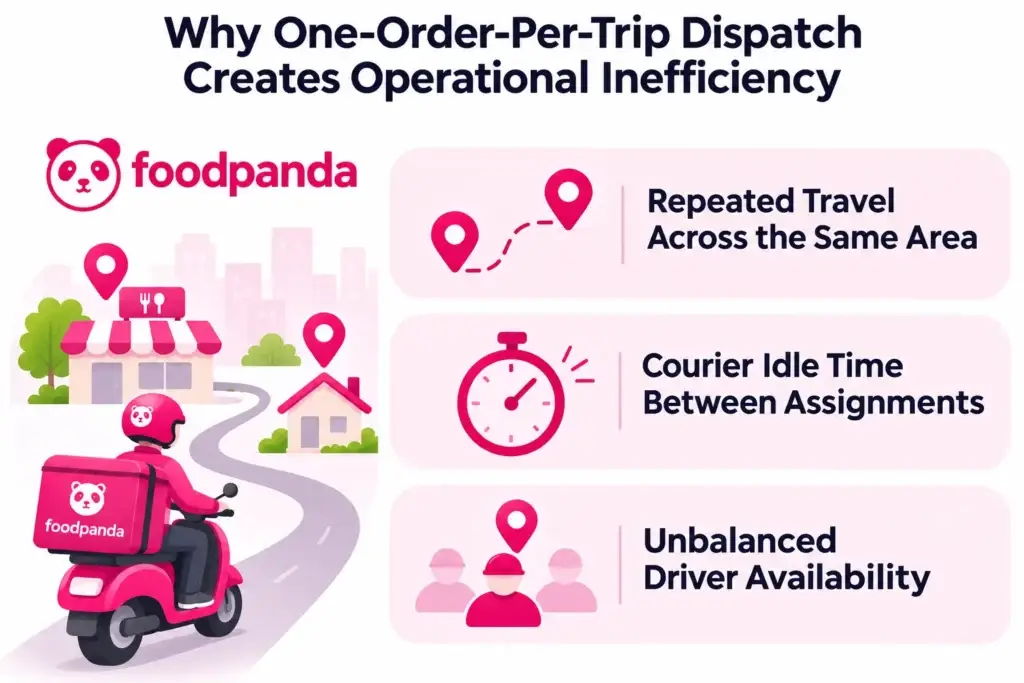
Single-order delivery is not inherently inefficient. It remains appropriate for urgent orders, long distances, low-density markets, or meals that cannot tolerate additional waiting. Problems arise when a platform uses the same dispatch policy during every demand condition, regardless of available opportunities to consolidate trips.
Repeated Travel Across the Same Area
Imagine two restaurants operating from the same commercial complex and receiving orders from neighboring residential buildings. If both orders are assigned independently, separate couriers may travel along largely overlapping routes.
Some of that duplication can potentially be avoided. A batched route may use a single journey for compatible pickups and destinations, reducing total travel across the delivery network. The important distinction is total network distance rather than the distance shown for one courier alone.
Courier Idle Time Between Assignments
Drivers may spend substantial time waiting between delivery opportunities, moving toward restaurant clusters, or waiting for food preparation. These periods reduce the number of completed deliveries per working hour.
Appropriate batching can make working time more productive by combining compatible tasks. However, grouping an order with another restaurant that is significantly delayed may actually increase waiting time. Efficient utilization requires coordination with restaurant readiness rather than simply allocating more orders to the same person.
Unbalanced Driver Availability
During busy periods, one delivery zone may have many available couriers while another experiences a shortage. Independent dispatch decisions can amplify this imbalance when they fail to account for where couriers are likely to become available after completing an assignment.
A more informed dispatch strategy considers both current availability and the geographic outcome of a route. This can help operators avoid sending too many couriers away from areas that are about to experience high demand.
Founders who want a broader explanation of how customer orders move through restaurants, couriers, and platform operations can explore Miracuves’ guide to the food ordering and delivery workflow. That background provides useful context for understanding where batching fits into the larger fulfillment process.
How a Smart Order Batching Algorithm Works Step by Step
A batching system should not begin by collecting random nearby orders. It must first determine which combinations are operationally feasible and then select assignments that provide measurable value. The exact algorithms can vary, but the core decision process follows a logical sequence.
Step 1: Collect Real-Time Order Information
When a customer places an order, the platform records its restaurant location, destination, order status, estimated preparation time, promised delivery window, and any special handling requirements.
Relevant courier information includes current location, availability, existing assignments, vehicle type, carrying capacity, and accepted work status. Traffic estimates and road-network information help the system predict realistic travel times.
Data freshness matters. A restaurant preparation estimate generated several minutes earlier may no longer be useful after a sudden kitchen delay. Dispatch decisions should respond to updated operational events rather than relying exclusively on the original checkout estimate.
Step 2: Identify Compatible Pickup and Delivery Locations
The system first identifies potentially compatible orders based on geography and timing. Orders from the same restaurant or neighboring pickup points may be strong candidates, particularly when their destination routes overlap.
However, proximity on a map does not guarantee route compatibility. Two destinations may appear close but require travel in opposite directions because of road restrictions, rivers, traffic barriers, or limited access points.
Road-network travel estimates therefore provide a more useful basis for batching than straight-line distance alone.
Step 3: Compare Restaurant Preparation Times
Preparation time is one of the most important constraints in food delivery batching. If one restaurant has a meal ready immediately while another requires another fifteen minutes, collecting both before delivery could expose the first meal to an unacceptable delay.
A practical system estimates when each meal will become ready, how long the courier will take to arrive, and whether waiting for a second pickup makes operational sense.
Research on food processing times and driver-order matching shows why assignment timing matters. Delaying a dispatch decision briefly can sometimes create better matching opportunities, but the benefit must be weighed against additional customer waiting and courier idle time.
Step 4: Generate Feasible Route Sequences
For two pickups and two deliveries, there may be multiple possible sequences. Some are invalid because they attempt to deliver an order before its pickup. Others are technically possible but result in late arrivals or excessive detours.
The system should test valid sequences against pickup readiness, estimated road travel, customer deadlines, and courier capacity. Only routes that satisfy the required constraints should proceed to economic evaluation.
Step 5: Evaluate the Economic Benefit
For every feasible batch, the dispatch engine estimates the expected operational value. This includes potential savings from combining travel, the courier payout required, expected waiting time, and the risk of additional service costs.
A shorter route may not be financially attractive if the courier incentive is disproportionately large. Likewise, a seemingly inexpensive batch can be costly if it causes late delivery, refunds, compensation, or loss of future customer orders.
Step 6: Assign the Batch and Communicate the Route
Once a feasible assignment is selected, the courier should receive clear information about the stops, expected compensation, and any relevant handling requirements. The app should distinguish pickup and drop-off tasks so the courier can complete them in the correct sequence.
Customers also need trustworthy tracking and delivery estimates. If the route changes after assignment, the platform should update relevant status information without revealing another customer’s private order details.
Step 7: Reassess When Conditions Change
Restaurants may experience delays, couriers may decline assignments, and road conditions may deteriorate. An effective dispatch system monitors these changes and reevaluates unfinished work when necessary.
Reassignment should be controlled. Constantly changing courier tasks can create confusion and unnecessary travel. A system needs clear limits on when re-optimization is permitted, especially after pickup or once a courier has made a substantial commitment to a route.
How Smart Order Batching Can Increase Driver Earnings
Driver earnings are central to the economics of food delivery. A dispatch policy that improves margins only by reducing courier compensation is unlikely to create a healthy long-term marketplace. The stronger opportunity is to improve the amount of productive work a courier can complete within a reasonable period.
More Completed Deliveries During Productive Hours
Suppose a courier completes one delivery and must then travel back to a restaurant area to find another assignment. That return journey may not generate additional earnings. When a compatible order is included in the initial route, some otherwise unproductive travel can be avoided.
In a well-matched batch, the courier can potentially complete more paid deliveries during the same working period. The improvement comes from route efficiency, not from asking the courier to travel unrealistically fast or work longer hours.
Lower Unpaid Distance Between Jobs
Courier profitability depends partly on operating expenses such as fuel, vehicle maintenance, parking, and the time required to reach new pickup locations.
Reducing unnecessary repositioning can improve net earnings even when gross payout changes only slightly. For this reason, platforms should examine earnings after relevant work-related costs rather than relying solely on the number of orders completed.
Transparent Compensation for Additional Stops
A courier handling two orders is undertaking additional responsibility. The compensation policy should acknowledge that extra work through appropriate per-stop, per-order, distance, time, or batch incentives.
Transparent compensation helps couriers evaluate assignments fairly. Drivers should understand whether an offered batch includes additional waiting, multiple pickups, and the expected route before accepting it, subject to local working arrangements and regulations.
Why Higher Order Count Does Not Always Mean Higher Earnings
Imagine a courier receiving two orders in a batch but spending twenty extra minutes waiting at the second restaurant. Even if the trip pays more than a single order, the resulting hourly earnings may be lower.
Similarly, an assignment that requires several additional kilometers may increase fuel costs. A responsible batching policy should therefore consider gross earnings, net earnings, active time, total online time, and reasonable workload.
The goal is not maximum orders per courier at any cost. It is a sustainable increase in productive earning opportunities while preserving safety and realistic delivery commitments.
How Order Batching Improves Platform Contribution Margins
For platform operators, the financial value of batching comes from changing the variable economics of fulfillment. Instead of funding two entirely independent journeys, the marketplace may be able to serve compatible orders through a partially shared route.
However, lower travel distance does not automatically translate into higher platform profit. Contribution margin depends on revenue retained by the platform and all relevant variable costs associated with fulfilling an order.
Understanding Contribution Margin Per Order
A practical contribution-margin calculation starts with platform revenue attributable to the order, then subtracts the variable costs required to serve it.
Contribution Margin Formula
Contribution margin per order = Net platform revenue per order – Variable fulfillment costs per order
Variable costs may include courier payments, payment processing, platform-funded promotions, customer support, refunds, and other costs directly attributable to that delivery.
Restaurant sales that belong to merchants should not be counted as platform revenue. Taxes and pass-through amounts should be treated consistently with the business’s accounting model.
Batching can improve contribution margin when the shared route lowers the variable cost of completing a set of orders. Savings may arise from reduced travel requirements, more efficient courier allocation, or fewer unproductive journeys.
These gains must be compared against additional batch payments, longer waiting periods, delivery exceptions, and customer-service expenses.
Illustrative Scenario: Two Independent Deliveries vs. One Batch
The following example is hypothetical and is designed only to explain the arithmetic. The values are not market averages, Miracuves customer results, or guaranteed financial outcomes.
| Metric for Two Orders | Separate Delivery | Batched Delivery |
|---|---|---|
| Combined platform revenue | $14 | $14 |
| Total courier compensation | $9 | $7 |
| Other variable costs | $3 | $3 |
| Total contribution margin | $2 | $4 |
| Contribution margin per order | $1 | $2 |
Under these assumptions, batching improves total contribution margin for the two orders from $2 to $4. The improvement is $2 across the pair, or $1 per order. The apparent gain results from lower total courier compensation and assumes that other variable costs remain unchanged.
But this is only the platform perspective. The separate-delivery scenario pays $9 across two couriers, while the batched scenario pays $7 to one courier. That does not, by itself, demonstrate higher earnings per hour for the batch courier.
For example, if the batched assignment takes 30 minutes, the courier receives a gross equivalent of $14 per active delivery hour for that assignment. If the assignment takes 45 minutes, the equivalent drops to approximately $9.33 per active delivery hour. Neither figure represents earnings over a complete shift, and vehicle expenses are not deducted.
The platform should compare those results with the courier’s realistic alternative work opportunities, time spent waiting, and total online hours. Only then can operators assess whether the batch creates shared economic value.
The Hidden Costs That Can Erase Batching Savings
A batch may initially appear profitable based on distance and payout. But operational exceptions can alter the final result. Food arriving late may produce a refund or discount. An incorrect handover may require additional support. A driver delayed at one restaurant may miss the promised arrival time for another customer.
These expenses are part of the economic evaluation. Platforms should estimate expected exception costs, not assume that every planned route will be completed exactly as predicted.
Research published in the Journal of Operations Management in 2025 found that late deliveries significantly reduced future orders in the studied marketplace, while delivering early provided more limited benefits. This reinforces the importance of protecting service reliability rather than optimizing only the immediate cost of each route.
The Operational Constraints That Determine Whether a Batch Is Worth Creating
Not every nearby pair of orders should be combined. Intelligent batching requires practical eligibility rules that protect customers, restaurants, couriers, and platform economics.
Restaurant Preparation Reliability
Two orders might have compatible destinations but very different kitchen completion times. If the courier must wait for the slower restaurant, the earlier order may sit in a bag longer than intended.
Platforms should incorporate restaurant-specific preparation estimates and update those estimates when kitchens report delays. A reliable preparation-time signal may be more valuable than a minor reduction in geographic distance.
Maximum Acceptable Delivery Detour
Every additional pickup or drop-off can change the arrival time of existing assignments. The system should calculate this incremental delay before accepting another order into the route.
Rather than applying a universal detour allowance, founders should establish service thresholds based on meal type, geography, traffic reliability, customer promises, and their operating model. Batching should be rejected when those thresholds cannot be met with sufficient confidence.
Food Freshness and Handling Requirements
Some foods tolerate a slightly longer delivery journey better than others. Temperature-sensitive meals, frozen products, fragile packaging, and items requiring special handling may need stricter batching rules.
Courier carrying capacity and appropriate food separation are also important. The number of orders a vehicle can physically carry is not necessarily the number it can deliver while preserving quality.
Traffic and Route Predictability
Congestion can change route feasibility very quickly. A sequence that appears efficient under normal traffic may become unsuitable during heavy rainfall, rush hour, or road closures.
The routing system should account for uncertainty rather than relying only on a single optimistic travel-time estimate. For high-risk deliveries, conservative estimates may protect customer experience better than aggressive route consolidation.
Courier Workload and Safety
A batch should never depend on dangerous driving or unrealistic time pressure. Drivers need adequate time for parking, pickup verification, building access, and safe handovers.
Assignment rules should reflect vehicle capacity, realistic travel speeds, local working conditions, and the courier’s existing commitments. A profitable route on a dispatch dashboard may be impractical on the street.
Which Batching Strategy Works Best for Different Delivery Conditions?
The right batching method depends on order density, restaurant distribution, courier supply, and the reliability of preparation estimates. A strategy suitable for a busy city center may deliver little value in a low-density suburban market.
| Strategy | Appropriate Scenario | Main Advantage | Key Risk |
|---|---|---|---|
| Same-restaurant batching | Multiple orders ready at one kitchen | Reduces repeated pickup travel | Incompatible destinations |
| Nearby-restaurant batching | Dense restaurant clusters | Consolidates nearby pickups | Uneven preparation times |
| Destination-based batching | Customers along a shared route | Reduces overlapping delivery travel | Extra stop delays |
| Dynamic route insertion | Frequent incoming orders | Uses available route capacity | Route instability |
| Scheduled-order grouping | Predictable future fulfillment windows | Supports advance capacity planning | Preparation or customer-time conflicts |
These strategies can coexist. A marketplace may use same-restaurant grouping during lunch peaks, dynamic insertion in dense commercial districts, and predominantly single-order assignments during quieter periods.
The objective should not be to maximize the percentage of orders that are batched. It should be to batch the right orders under the right operating conditions.
The Technical and Operational Components Behind Intelligent Batching
Smart dispatch involves more than an assignment button. It depends on consistent information flowing across customer ordering, restaurant preparation, courier availability, mapping, and administrative systems.
Real-Time Order State Management
Every order should have a reliable operational state. The system needs to distinguish an order that has been placed from one that has been accepted, prepared, collected, or completed.
These states matter because batching decisions must avoid assigning an order twice, creating conflicting pickup instructions, or promising delivery through a courier who is no longer available.
Routing and ETA Estimation
Routing services estimate travel time between pickup and delivery points. The batching engine uses these estimates to compare possible task sequences and calculate the incremental delay from additional stops.
ETAs should be updated as operational information changes. A useful system distinguishes estimated restaurant readiness from courier arrival time and customer delivery time, rather than treating them as one prediction.
Batch Feasibility and Scoring Rules
A feasibility layer rejects combinations that violate important restrictions. These include expired delivery promises, insufficient courier capacity, unacceptable food holding times, and prohibited pickup sequences.
After infeasible combinations are excluded, an economic scoring layer can compare candidate routes based on expected cost, delivery reliability, driver compensation, and utilization.
The system should avoid selecting an apparently inexpensive route if it exposes an existing customer to an unacceptable delay. Hard service constraints and economic optimization serve different purposes and should not be confused.
Courier Application and Assignment Visibility
Couriers need understandable task information, including pickup sequence, delivery sequence, route details, and clear payment expectations. Adding batching logic to the backend without adapting courier workflows can create confusion and assignment mistakes.
Operators should also support exceptions such as missing orders, restaurant delays, customer unavailability, or a courier becoming unable to complete a route.
Administrative Monitoring and Intervention
The operations team needs visibility into active assignments, potential late deliveries, restaurant bottlenecks, driver availability, and batch-related complaints.
Manual intervention may remain necessary when predictions fail or a restaurant unexpectedly closes. Administrative access should be role-based and changes should be recorded so operators can investigate delivery disputes and dispatch mistakes.
For founders evaluating the engineering requirements of these workflows, Miracuves’ food delivery software engineering services provide a relevant next step for discussing custom dispatch rules and integrations. Advanced batching functionality should be confirmed and scoped separately rather than assumed to be part of a standard product package.
How to Measure Whether Batching Is Actually Working
A higher batching rate does not necessarily indicate better operations. Operators need a combination of financial, courier, and customer-service metrics to determine whether grouping orders improves the marketplace as a whole.
Batching Rate
Batching rate measures the share of completed orders handled within multi-order routes. It is useful for understanding how frequently the feature is used, but it should not become the sole optimization target.
Batching rate = Orders completed in batches / Total completed orders × 100
Courier Earnings per Online Hour
This metric connects courier compensation to the total time spent available for work, including waiting between assignments. It provides a broader view than active delivery earnings alone.
Gross earnings per online hour = Total courier compensation / Total courier online hours
Where reliable information is available, net earnings after vehicle-related expenses should also be considered. Platform operators should avoid treating gross earnings as equivalent to take-home income.
Contribution Margin per Completed Order
This measures retained platform revenue after the relevant variable costs of fulfilling an order. It helps show whether operational efficiency translates into financial improvement.
Contribution margin per completed order = Total contribution margin / Total completed orders
The calculation should include actual fulfillment costs and appropriately allocated batch compensation, not just predicted courier payouts.
On-Time Delivery Rate
The share of orders arriving within their customer-facing delivery promise is an essential guardrail. A platform that reduces cost while causing more late deliveries may damage repeat ordering and long-term marketplace health.
On-time delivery rate = Orders delivered within their promise / Total completed deliveries × 100
Additional Diagnostic Metrics
Useful supporting measures include courier waiting minutes at restaurants, average kilometers per completed delivery, order reassignment rates, batch acceptance rates, customer complaints, refunds, food quality issues, and completed deliveries per courier hour.
These measures should be segmented by delivery zone, restaurant type, demand period, vehicle category, and batch size. An improvement in one dense district may hide poor results elsewhere.
Why Data Security and Delivery Verification Still Matter in Batched Orders
Combining deliveries increases the number of orders managed within a single courier workflow. This makes reliable order identification, privacy, and delivery confirmation especially important.
Each order should remain separately identifiable even when it belongs to a shared route. Couriers need sufficient information to complete the correct handover, but should not receive unnecessary personal or payment information about customers.
Order verification mechanisms, controlled administrative permissions, audit records, and secure communication between applications can help operators investigate incorrect handovers and disputes. For sensitive payment information, the platform should rely on appropriate payment providers and minimize the data retained internally.
Miracuves’ food delivery platform security guide provides complementary context around user protection, operational controls, payment handling, and platform trust. Those safeguards remain relevant even when the main optimization objective is faster dispatch.
When Smart Order Batching Should Be Disabled or Restricted
A mature batching strategy includes clear rules for when not to consolidate orders. Restricting batching under unsuitable conditions is part of intelligent dispatch, not evidence that the system has failed.
Low-Density Demand
When customers and restaurants are widely dispersed, the detour required to collect another order may exceed any shared-route benefit. A direct single-order assignment may be the most efficient option.
Uncertain Restaurant Readiness
Restaurants with highly unpredictable preparation times can make multi-pickup routes unreliable. Until readiness data improves, the platform may need stricter grouping thresholds or simpler dispatch policies.
Time-Sensitive or Special-Handling Orders
Some orders require tighter handling windows because of food temperature, product fragility, or customer commitments. These orders may be unsuitable for batching with additional stops.
Severe Traffic or Weather Disruptions
During major disruptions, route predictions may become unreliable. Reducing batch sizes or temporarily switching to simpler assignments can preserve operational control and courier safety.
Existing Routes Close to Their Delivery Deadlines
Adding another order to an assignment that is already close to its promised delivery limit creates unnecessary risk. Protecting an existing customer commitment should take priority over a speculative efficiency gain.
A Practical Roadmap for Testing Smart Batching in a Growing Delivery Marketplace
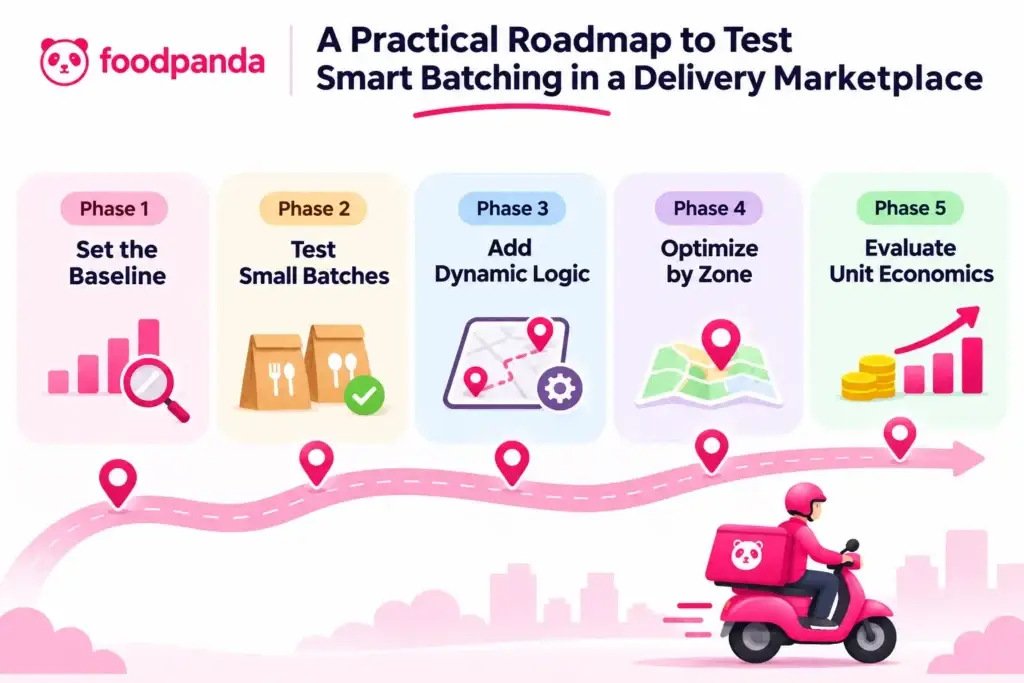
Founders do not need to introduce a sophisticated real-time optimization system before understanding their delivery patterns. The safer approach is to build operational visibility first and expand automation as the marketplace generates reliable data.
Phase 1: Establish the Baseline
Measure current courier working hours, earnings, restaurant waiting time, delivery distance, service reliability, and contribution margin. Identify geographic areas where routes regularly overlap or couriers spend substantial time without assignments.
This establishes the reference point against which any batching improvement should be evaluated. Without a baseline, an increase in order volume can be mistaken for an improvement in dispatch quality.
Phase 2: Test Limited, Low-Risk Batches
Begin with simple combinations, such as two orders from the same restaurant with compatible destinations and preparation times. Set conservative delivery and waiting constraints.
Measure whether these assignments improve courier productivity and cost per completed order without increasing lateness or complaints. The initial objective is learning, not achieving a high batching percentage.
Phase 3: Add Dynamic Decisions
Once the platform has more reliable restaurant and traffic information, it can evaluate dynamic insertion of incoming orders into compatible routes. The added complexity should be justified by improved outcomes.
Operators should introduce clear re-optimization rules and monitor situations where route changes create confusion for couriers or delay existing deliveries.
Phase 4: Optimize by Zone and Demand Period
Different parts of a city may require different batching strategies. Dense restaurant corridors can support more frequent consolidation, while suburban areas may favor single-order routes.
Demand forecasts, preparation patterns, and courier availability can inform these decisions. The goal is to match the dispatch policy to actual operating conditions rather than enforcing a universal batching rule.
Phase 5: Evaluate Long-Term Unit Economics
After operational changes have stabilized, assess whether they are improving contribution margin, courier earning opportunities, and repeat customer satisfaction over time.
Where possible, compare similar delivery zones or controlled test groups. Account for demand shifts, promotional campaigns, restaurant changes, and courier supply differences before attributing improvements solely to batching.
Founder Decision Signals: Is Your Delivery Network Ready for Automated Batching?
Before investing in complex dispatch logic, founders should assess whether their marketplace has the operational characteristics needed to benefit from it. The most important signals are not simply the number of downloads or registered couriers.
Order Density
Are enough orders arriving within compatible restaurant and customer areas to create useful grouping opportunities?
Preparation Accuracy
Can restaurants provide reasonably reliable readiness information before couriers are assigned?
Courier Economics
Can the platform demonstrate fair compensation and productive work opportunities for additional stops?
Service Reliability
Can existing delivery promises remain achievable after adding another pickup or drop-off?
If several of these conditions are weak, improving restaurant coordination and basic dispatch visibility may deliver more immediate value than introducing an elaborate algorithm.
The Bigger Business Opportunity: Building a More Efficient Delivery Ecosystem
Smart batching is one component of a broader operational system. Its effectiveness depends on restaurant participation, courier reliability, realistic delivery promises, and administrative visibility.
For example, improvements in restaurant order readiness may reduce courier waiting time even without changing routing. More accurate delivery estimates can reduce customer complaints. Better courier availability forecasting may prevent overloaded zones during peak hours.
These improvements become more powerful when they reinforce one another. A restaurant that provides accurate preparation updates allows the dispatch engine to select better pickup times. A reliable courier workflow reduces handover mistakes. A platform that understands actual fulfillment costs can make more informed choices about grouping and compensation.
Founders evaluating the wider operational requirements can also review Miracuves’ food and beverage platform capabilities, which provides broader industry context. The operational priority remains the same: technology should address a measurable fulfillment problem rather than introduce complexity without business value.
A ready-made system may provide the foundational ordering, courier, restaurant, and administrative workflows needed to enter the market. Sophisticated batching rules, predictive preparation models, and specialized route optimization should be evaluated as separate requirements according to actual business needs.
How Miracuves Can Support a Faster Delivery Platform Launch
Miracuves helps founders establish ready-made and white-label food delivery businesses with customer, restaurant, courier, and administrative functionality. For businesses exploring a differentiated delivery experience, starting with an existing platform foundation can reduce the time spent developing core ordering workflows from scratch.
Its white-label food delivery solution overview explains the broader software approach available to operators seeking a branded marketplace. The decision to introduce automated batching should be based on actual delivery volumes, route patterns, and the custom functionality required.
Miracuves advertises a six-working-day delivery process for the standard ready-made solution, subject to the published scope and required customer inputs. Custom batching algorithms, additional integrations, and more advanced dispatch workflows require separate technical evaluation and may affect cost and timeline.
Final Thoughts: Smart Batching Is About Better Economics, Not Just More Deliveries
Smart order batching has the potential to improve food delivery operations by reducing unnecessary travel, making courier working time more productive, and lowering the variable cost of fulfilling compatible orders. Its value comes from coordinating restaurant readiness, realistic routes, fair compensation, and customer promises rather than simply placing more orders into every assignment.
For couriers, the meaningful outcome is stronger earning potential over a realistic working period, not merely a higher number of delivery tasks. For platform operators, success means improving contribution margins without shifting excessive cost or risk onto drivers, restaurants, or customers.
The strongest strategy is to establish reliable fulfillment workflows, measure performance, introduce controlled batching where conditions justify it, and refine dispatch decisions as operational data improves. Founders who want to explore a On-demand food delivery platform can evaluate Miracuves’ ready-made solution while separately planning any specialized batching capabilities their business requires.
Ultimately, better delivery economics are created when every participant benefits from a more reliable system. The most successful batching decisions are not the ones that combine the most orders, but the ones that produce sustainable value without compromising service quality.
Frequently Asked Questions
What is smart order batching in food delivery?
Smart order batching combines compatible customer orders into coordinated courier routes. It evaluates pickup locations, restaurant preparation times, delivery destinations, courier capacity, and customer deadlines to determine whether multiple orders can be delivered efficiently without unacceptable delays.
How does order batching increase driver earnings?
Order batching can improve driver earnings by reducing unnecessary travel and enabling more paid deliveries within productive working time. The actual benefit depends on batch compensation, waiting time, route distance, vehicle expenses, and available alternative assignments. Higher order volume alone does not guarantee higher hourly or net earnings.
How does order batching improve platform margins?
Batching may improve contribution margins when shared routes reduce variable delivery costs more than they increase courier incentives, delays, refunds, or support expenses. Operators should measure contribution margin per completed order and preserve customer delivery promises.
What is the difference between static and dynamic order batching?
Static batching groups orders at a predefined decision point, usually before dispatch. Dynamic batching reevaluates incoming orders and available routes as conditions change. Dynamic approaches offer more flexibility but require stronger real-time data, route controls, and reassignment safeguards.
Can batching delay food delivery?
Yes. Batching can increase delivery times when restaurants have different preparation schedules, pickup locations require detours, or customer destinations are poorly aligned. Feasibility checks, conservative delivery windows, and appropriate batch limits help control these risks.
What data does a delivery batching algorithm need?
Useful inputs include restaurant locations, preparation estimates, customer destinations, order deadlines, courier availability, vehicle capacity, current assignments, road-network travel times, and delivery exception information. Data quality is essential for reliable dispatch decisions.
Which metrics should founders monitor when testing order batching?
Important metrics include batching rate, courier earnings per online hour, contribution margin per order, kilometers per delivery, restaurant waiting time, on-time delivery rate, complaints, refunds, and reassignment rates. Results should be compared across similar operating conditions.
Does a ready-made food delivery solution automatically include advanced batching?
Not necessarily. A ready-made product may include core ordering, courier, restaurant, and dispatch workflows without specialized optimization algorithms. Founders should verify the exact product scope and separately assess custom requirements for dynamic batching, route insertion, and predictive preparation times.
Miracuves is an independent software development company. We are not affiliated with, connected to, sponsored by, or endorsed by any company or product named in this article.
Terms such as “X Clone” are used descriptively. It is how the software industry refers to building a platform with functionality comparable to a known service, and how clients search for it.
The entire design and codebase of our products is built by our own team. Our products contain no code, design, graphics, or content originating from any third-party website or applications.
All third-party names and marks referenced in this article are the property of their respective owners, referenced solely to identify the services discussed.