Trip Booking App · Production Ready

White Label Taxi App - Rider, Driver & Dispatch Platform You Own

Built by Miracuves, the ready-made, white-label taxi app for business travel runs under your brand: you own the rider and driver app source, a corporate portal, a browser booking app and an admin console, launched in six working days.

Companies set ride policies, choose auto or strict approvals and pay from one company wallet with daily invoices, while staff switch between personal and business rides in the app. Entertainment, tour-guide and voice-command modules are optional add-ons, priced on their own. A client-specific approval rule, such as two approvers above a spend limit, is custom work: we scope it in writing and deliver it within 2-8 weeks.

Launch in 6 Days with

  • Source Code
  • Rider App
  • Driver App
  • Corporate Portal
  • Admin Console
  • Android + iOS

StackReact Native · Laravel 11 · MySQL · Redis · Reverb · OpenStreetMap

Operator console · OperationsIllustrative
Trips today148
Awaiting dispatch6
Drivers online now214

Live activity feed

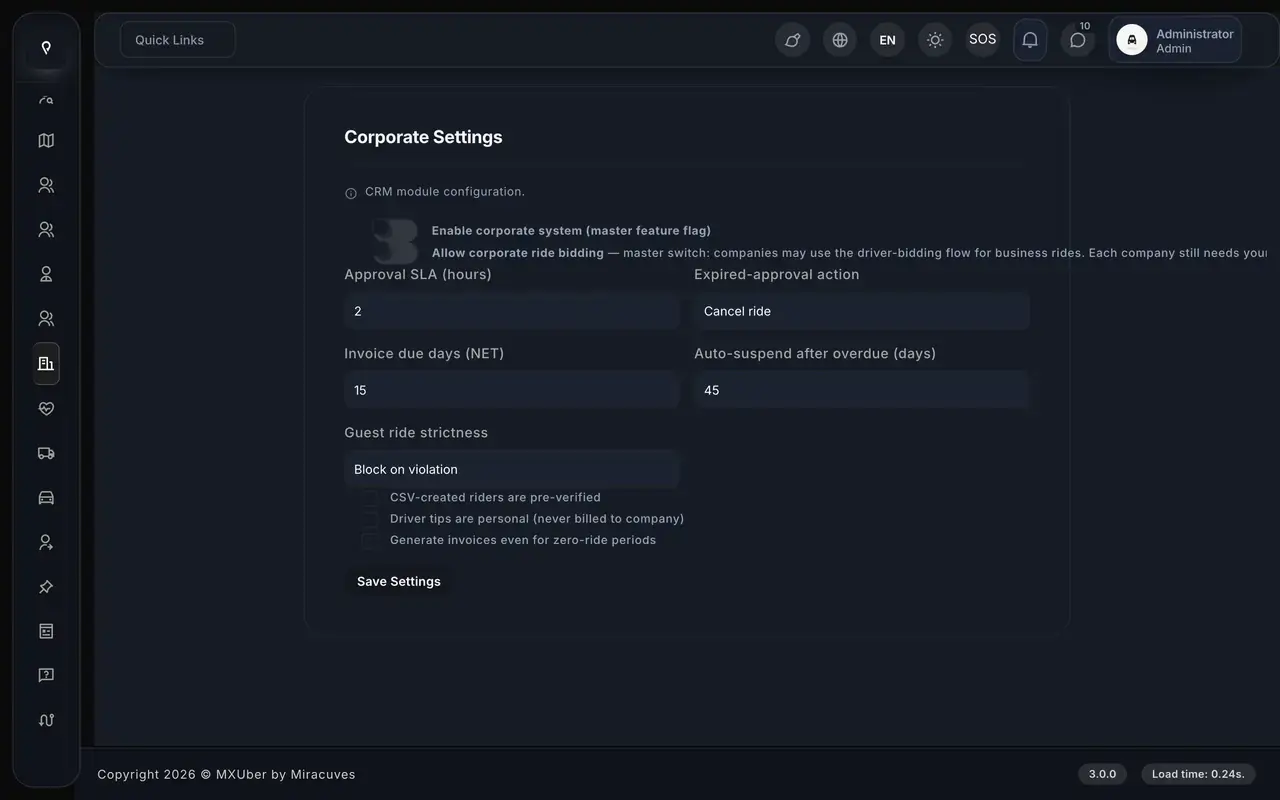
Admin · Corporate SettingsReal screen
White Label Taxi App - Rider, Driver & Dispatch Platform You Own - real admin screen, Corporate Settings
App in action
Drivers see each new requestas it arrives
  • 8Corporate Portal Pagesdashboard, approvals, employees, departments, policies, billing, disputes, reports
  • 2Approval Modesauto for in-policy rides, strict for every business ride
  • 0%Revenue Share With Miracuvesno royalty on any fare or delivery, ever
  • 100%Source Codethe whole codebase, unencrypted
  • 6Days to Launchand if the delay is ours, we keep going free
  • $3,099Paid Once, Not Rentedsource code yours, no per-seat fee, no monthly rental

Live in six working days, or we keep working free until you launch. Every build carries 60 days guidance, 6 months bug fixes and 12 months updates.Verify every figure

Guests Ride on the Company

Staff can book a ride for a client, a visitor or a new hire who has no account, and the guest gets the trip details by SMS.

Aone Went Live on This Product

Twenty of the 25 building blocks were reused unchanged for Aone on an earlier release, and the source code moved to its own account.

The Gateway Keeps the Cards

Card details pass to the gateway you connect and the platform keeps a payment reference, not a card number; business rides bill to the company wallet.

Want your own taxi platform running on the road?Speak With a Product Expert

Trusted by 6,000+ clients worldwide
Miracuves is listed by Expertise.com as a managed IT service provider.Miracuves is an official member of the Forbes Business Council.Miracuves is a verified agency on DesignRush, listed among top design agencies in India.Miracuves is reviewed on Trustpilot as a software development company.Miracuves is listed by The Manifest among top managed software development companies.Miracuves is listed by DesignRush as a top software development company.Miracuves is recognized by GoodFirms as a top software development company.Miracuves is ranked among the top 1000 companies globally by Clutch.Miracuves is a top managed service provider in the United States on Clutch.

01Try it yourself

Working Demo

White Label Taxi App Demo - Rider App, Driver App, Corporate Portal & Operator Panels

Miracuves lets you test its white label taxi app end to end before you pay. The rider, driver, dispatcher, fleet and admin logins below are public, the rider app carries the For Me / Business switch used for company rides, and the corporate portal lives on the same demo host.
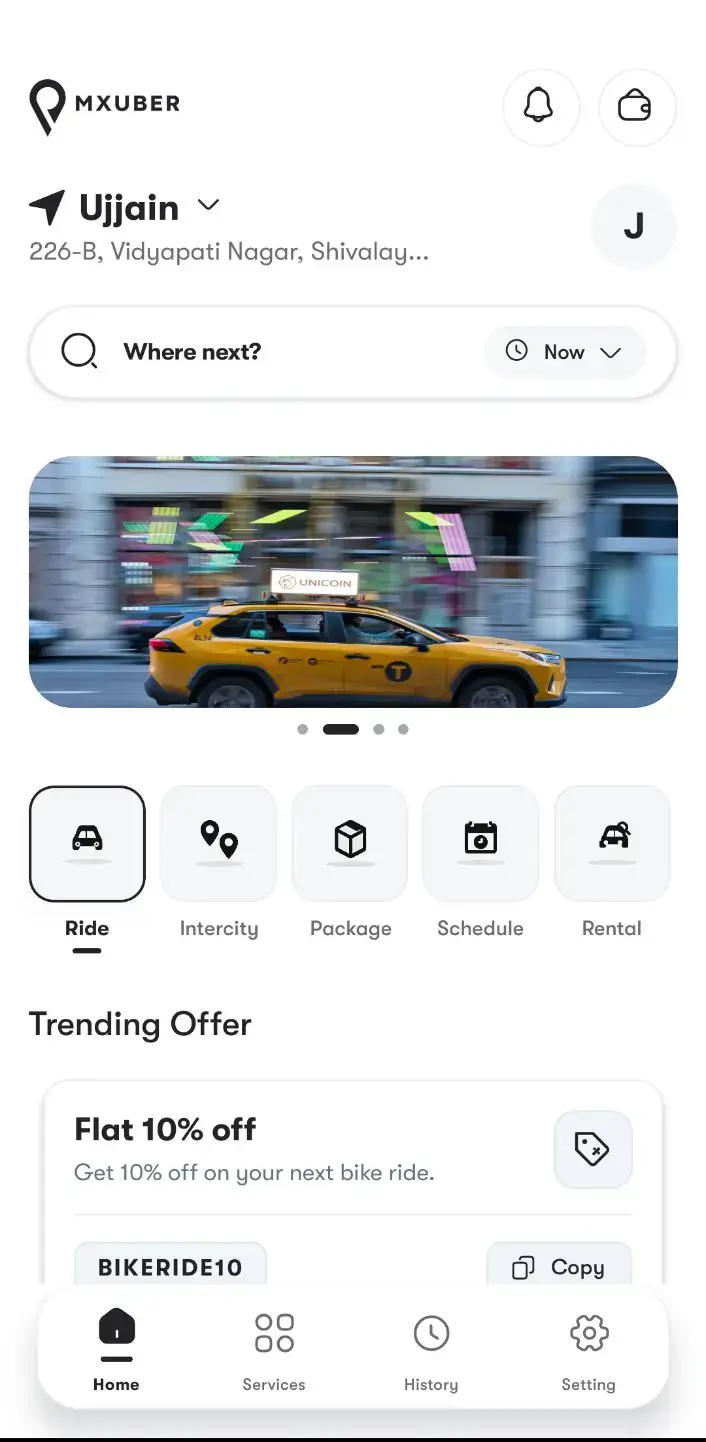
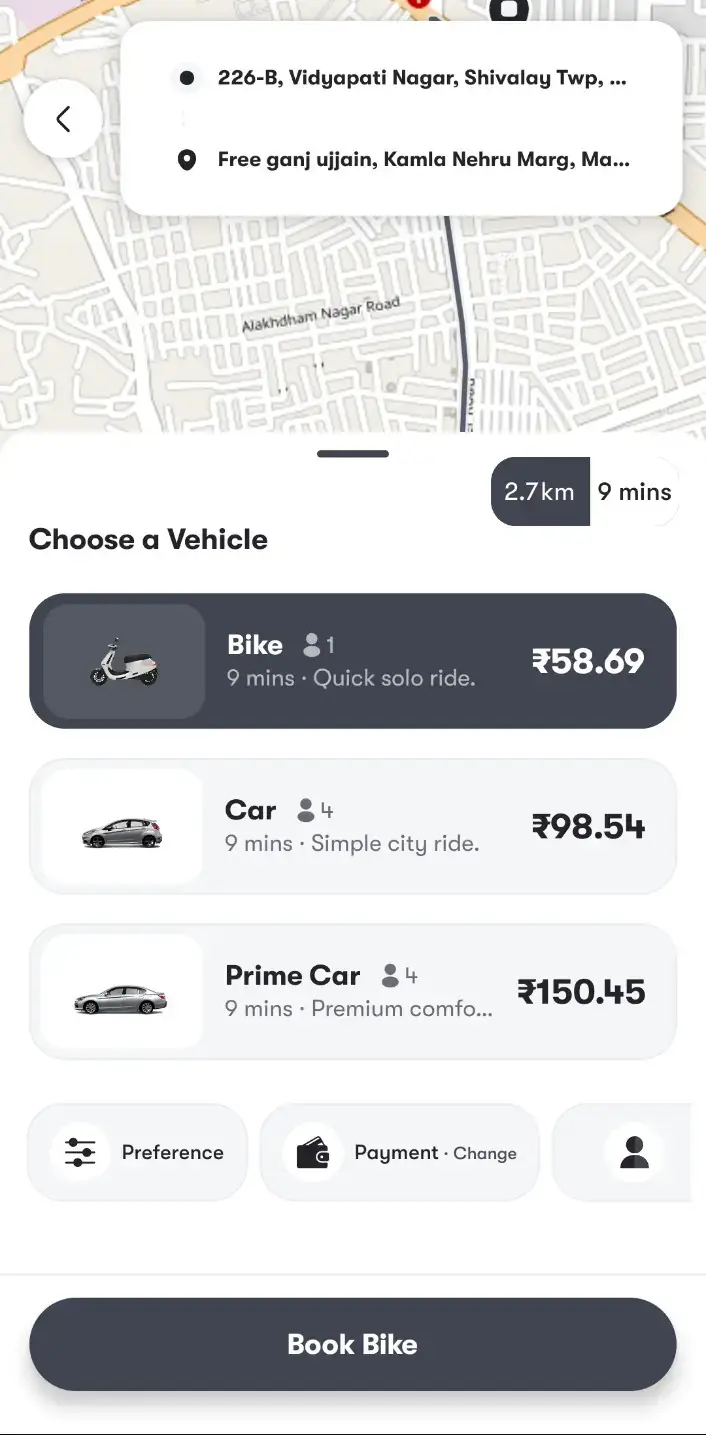
Taxi app rider home with Where next search and Ride, Intercity, Package, Schedule and Rental tilesTaxi app rider choosing Bike, Car or Prime Car with fares and arrival times before booking
Rider app

Rider App - For Me or Business

A rider signs in with a code or a social account, or browses as a guest, picks a tile, sets the route and sees a fare per vehicle. An employee flips the For Me / Business switch, picks the company and a reason, and that company's policy checks the ride.

  1. 1Install the Android app from the demo portal
  2. 2Use the rider login shown below
  3. 3Look around: Home tiles, Choose a vehicle, Business switch, Rebook
Login:+91 9876543210 | User_321
  • Online switch and ride offers
  • Live surge zones on the map
  • Earnings donut and 5-tab history
  • Wallet, withdrawals, subscriptions
Driver app

Driver App - Online, Offers, Earnings

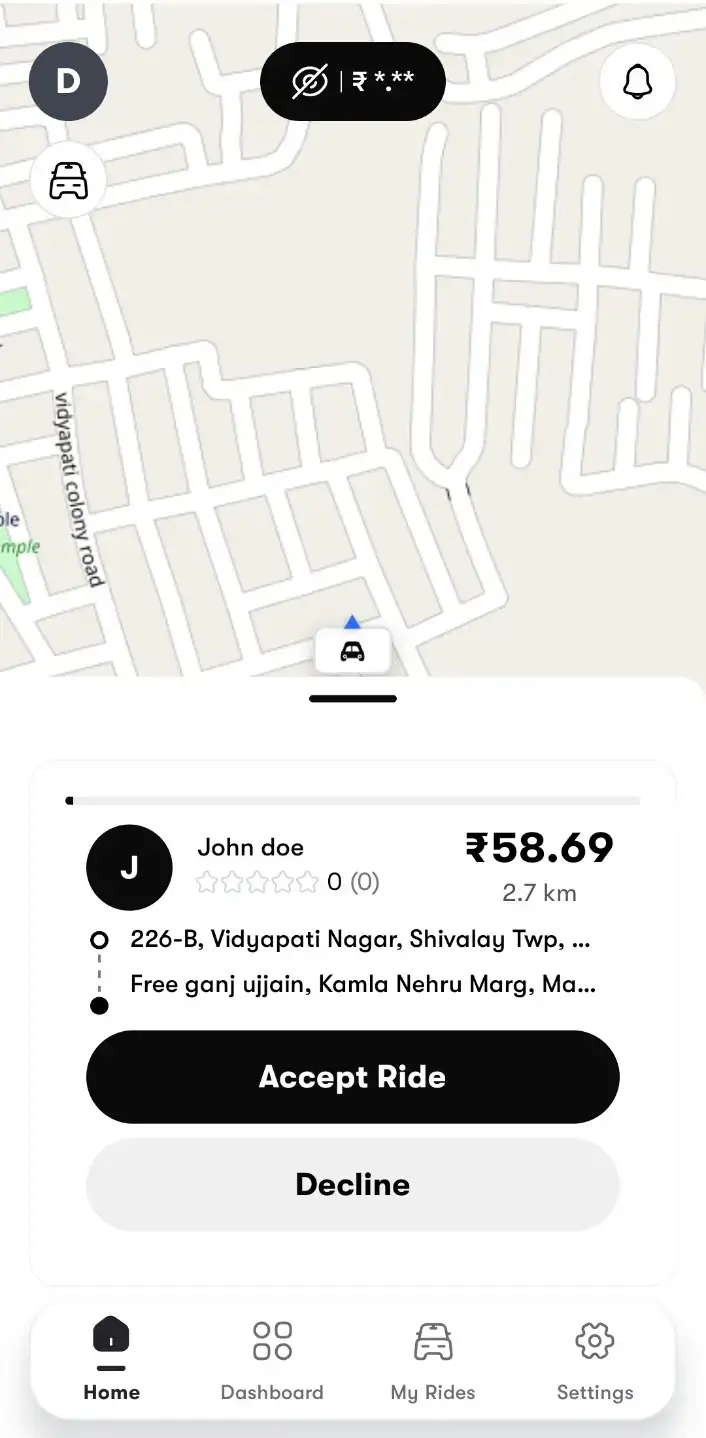
Drivers switch online with the power button, answer timed ride offers, begin a trip by entering the rider's OTP, then track earnings in a donut chart. Fleet managers use this same app.

  1. 1Install the driver app from the demo portal
  2. 2Open the app with the driver credentials below
  3. 3Look around: Online switch, Ride offers, Earnings
Login:driver@demo.com | Driver_321
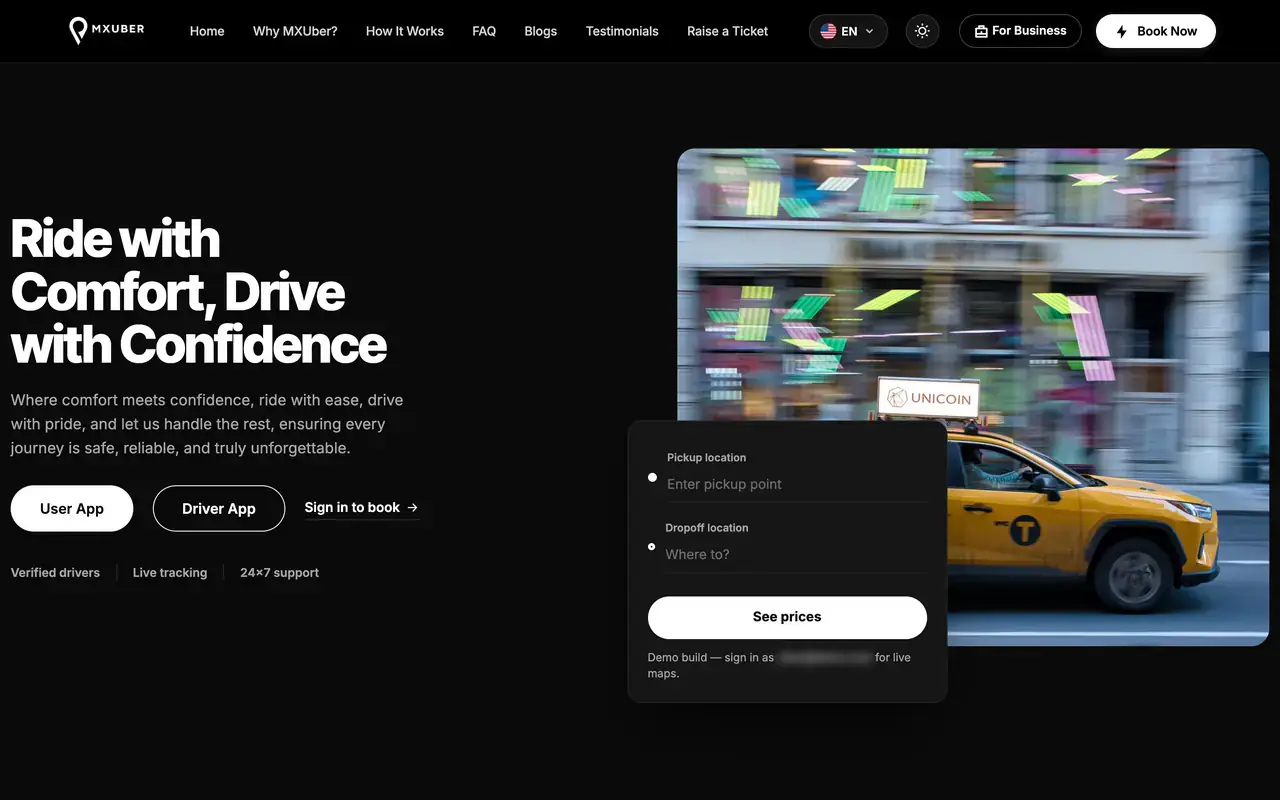
Taxi app rider website hero with pickup and drop-off fields, See prices button and rider and driver app links
Web site

Rider Web App & Public Website

Riders book in a browser on the rider web app, with map pickup, vehicle choice and live tracking. The public website sits beside it, with a for-business page that collects company leads.

  1. 1Open the rider web app in your browser
  2. 2Sign in with the rider login
  3. 3Look around: Booking, Ride history, Wallet
Rider web:+91 9876543210 | User_321
  • Dispatcher: bookings and manual assignment
  • Fleet: its own drivers, vehicles, earnings
  • Admin: zones, surge, staff roles, reports
  • Public logins, no call needed
Operator panels

Admin, Dispatch & Fleet Consoles

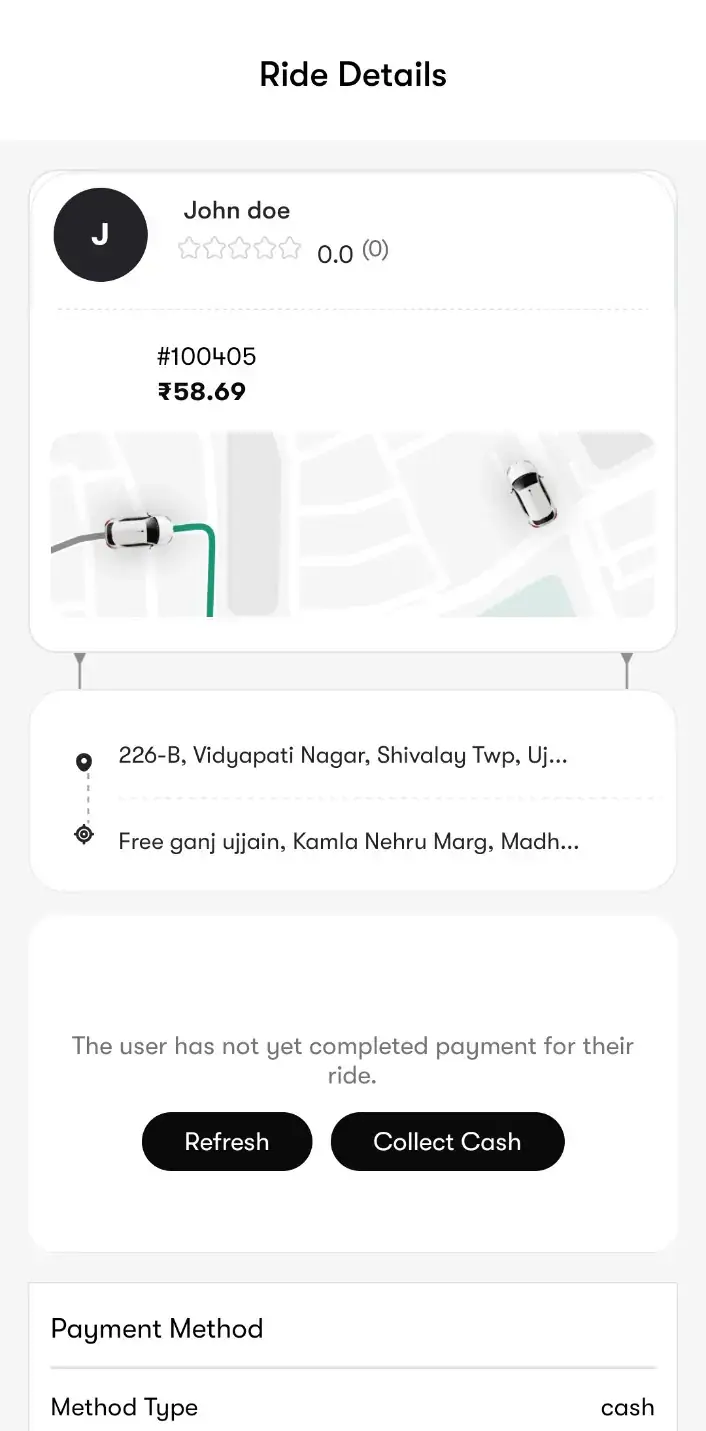
This is the operator's side: one admin console with three logins. Dispatchers book and assign rides by hand, a fleet login is limited to that fleet's drivers, and admin runs zones, surge, coupons, reports and withdrawals.

  1. 1Sign in with the logins below
  2. 2Open the admin console on the demo host
  3. 3Look around: Ride Requests, Peak zones, Fleet earnings
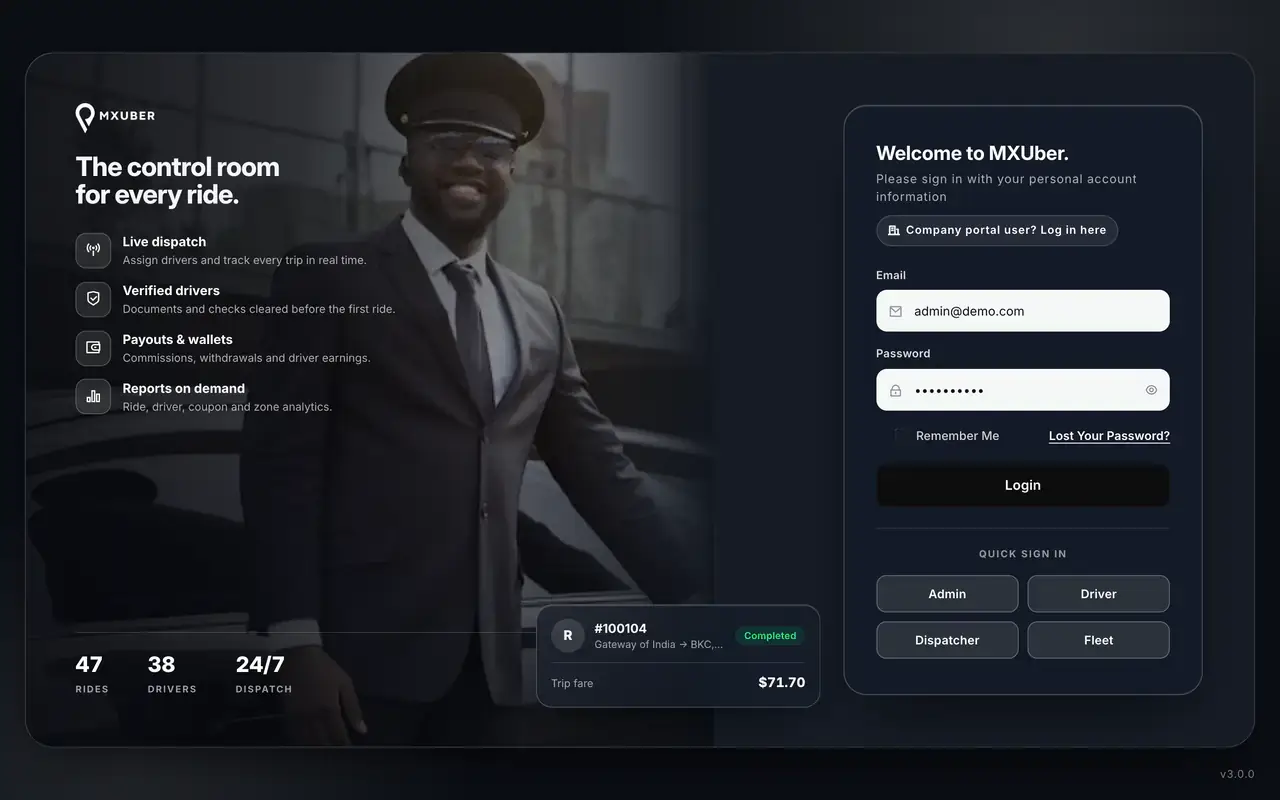
Logins:Admin: admin@demo.com | Admin_$321Dispatcher: dispatcher@demo.com | Dispatcher_321Fleet: fleet@demo.com | Fleet_321
White Label Taxi App on three phones: the rider app menu with wallet, SOS and out-station, the scheduled-ride date picker and the suggested rides and fare listTaxi app rider choosing Bike, Car or Prime Car with fares and arrival times before bookingTaxi app rider home with Where next search and Ride, Intercity, Package, Schedule and Rental tiles

Guided Walkthrough

Live Walkthrough: Rider App, Driver App, Admin Console and Corporate Portal

The demo logins are open any time, and a live call is the fastest way to watch five applications work as one platform. Within 30 minutes we walk a company ride from booking through approval to billing, then tie it to your own plan: the cities you will open, the fares you charge, what commission you take and the date you want to launch.

Book a live walkthrough call.

Each Screen in Sequence

Taxi App Screen Flows - Rider, Driver, Admin & Website

Miracuves shows the real screens of its taxi platform in four groups: the rider app in trip order, the driver app, the admin console and the public website in front of it.

Taxi app rider app splash screen with the logo over a night street
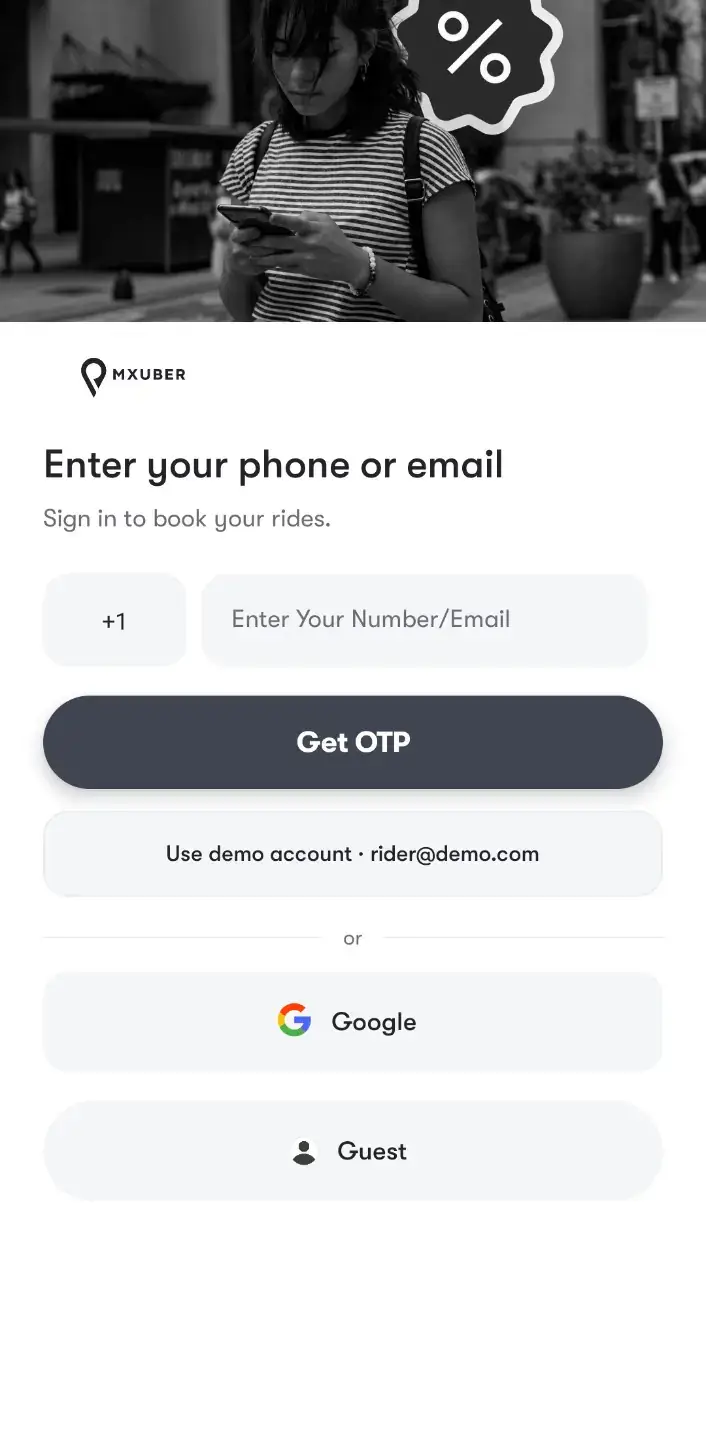
Taxi app rider sign-in with phone or email OTP, Google sign-in and guest entry
Taxi app rider home with Where next search and Ride, Intercity, Package, Schedule and Rental tiles
Taxi app rider choosing Bike, Car or Prime Car with fares and arrival times before booking
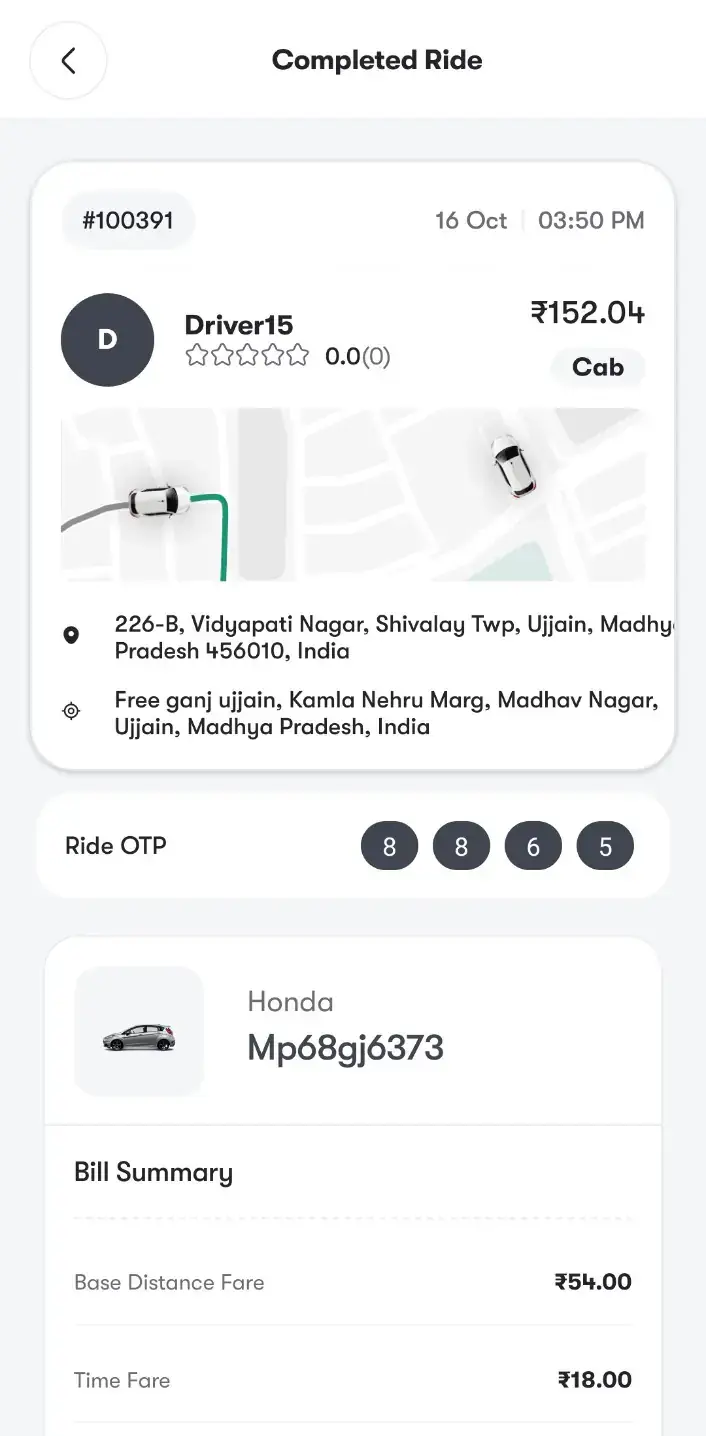
Taxi app completed ride with route, ride OTP, vehicle and bill summary
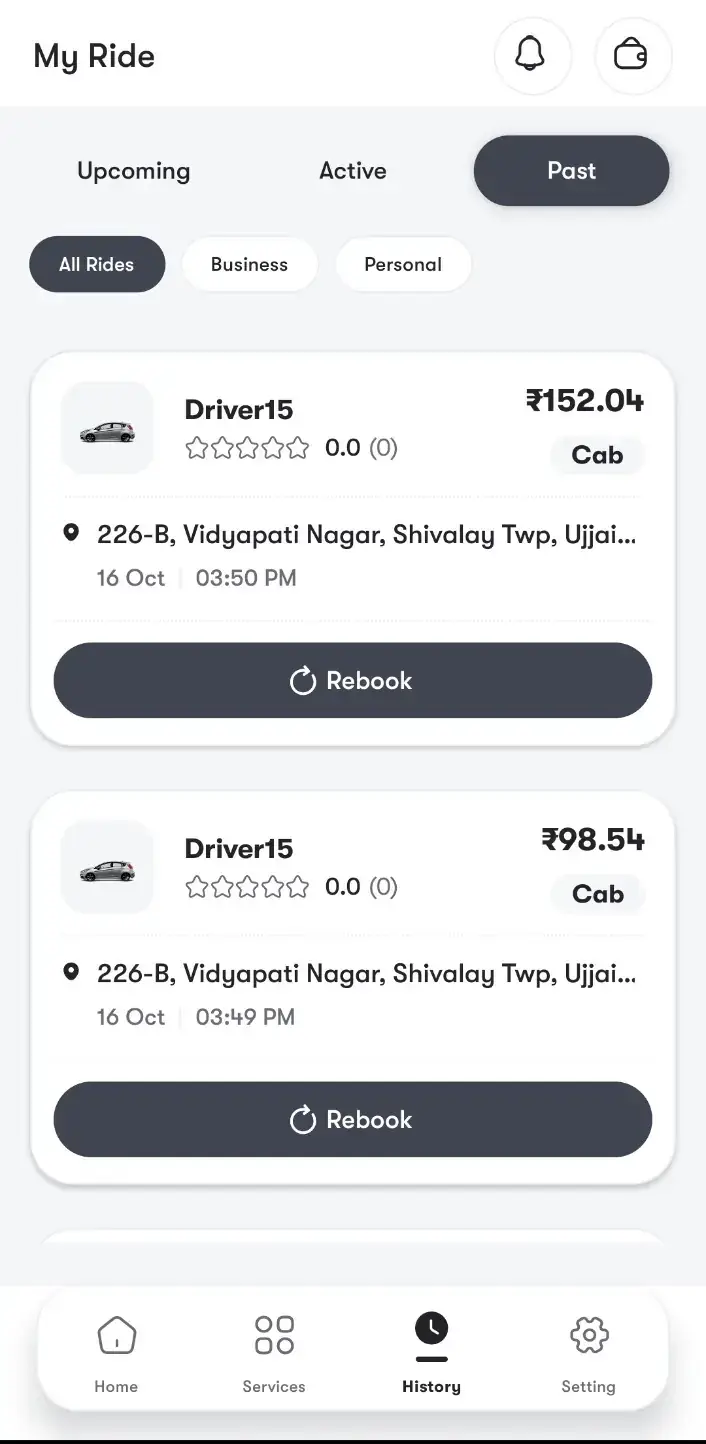
Taxi app ride history with business and personal filters and one-tap Rebook
6 screens · scroll →
Taxi app driver app splash screen
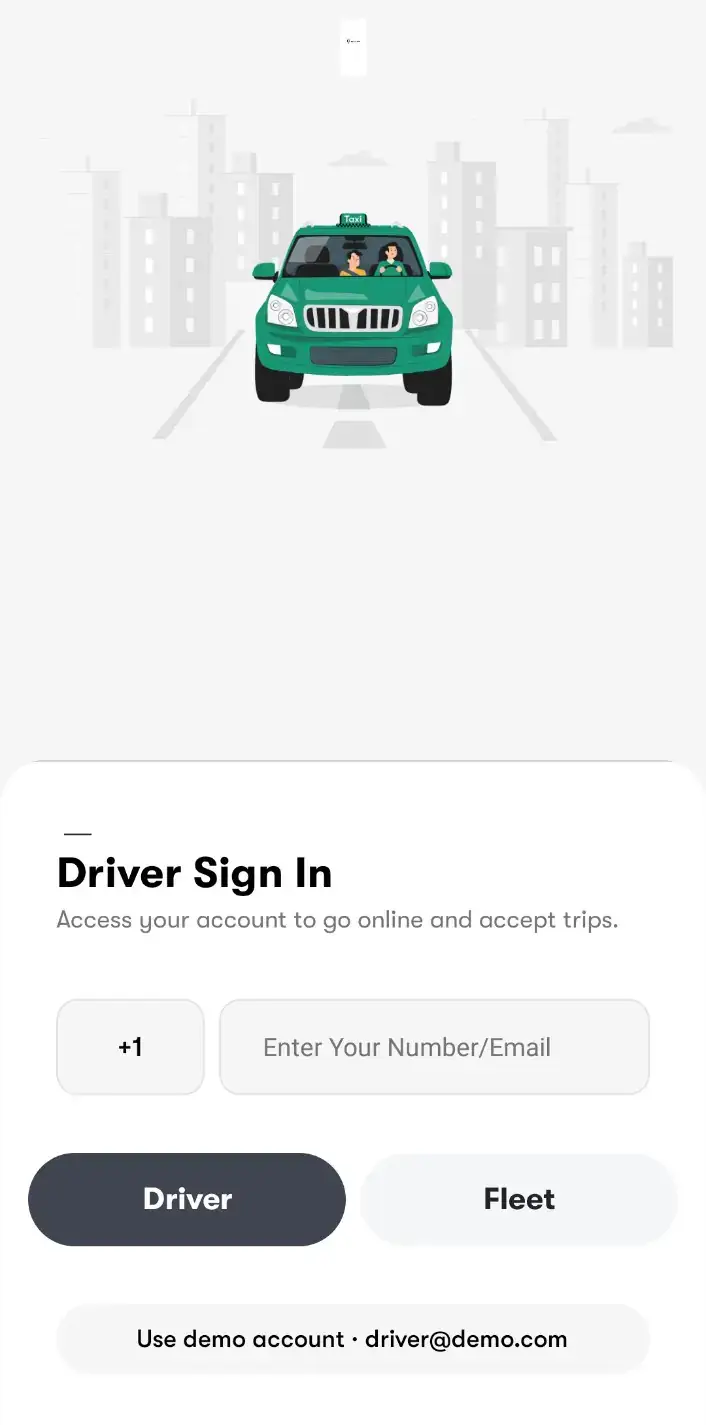
Taxi app driver sign-in with Driver and Fleet options
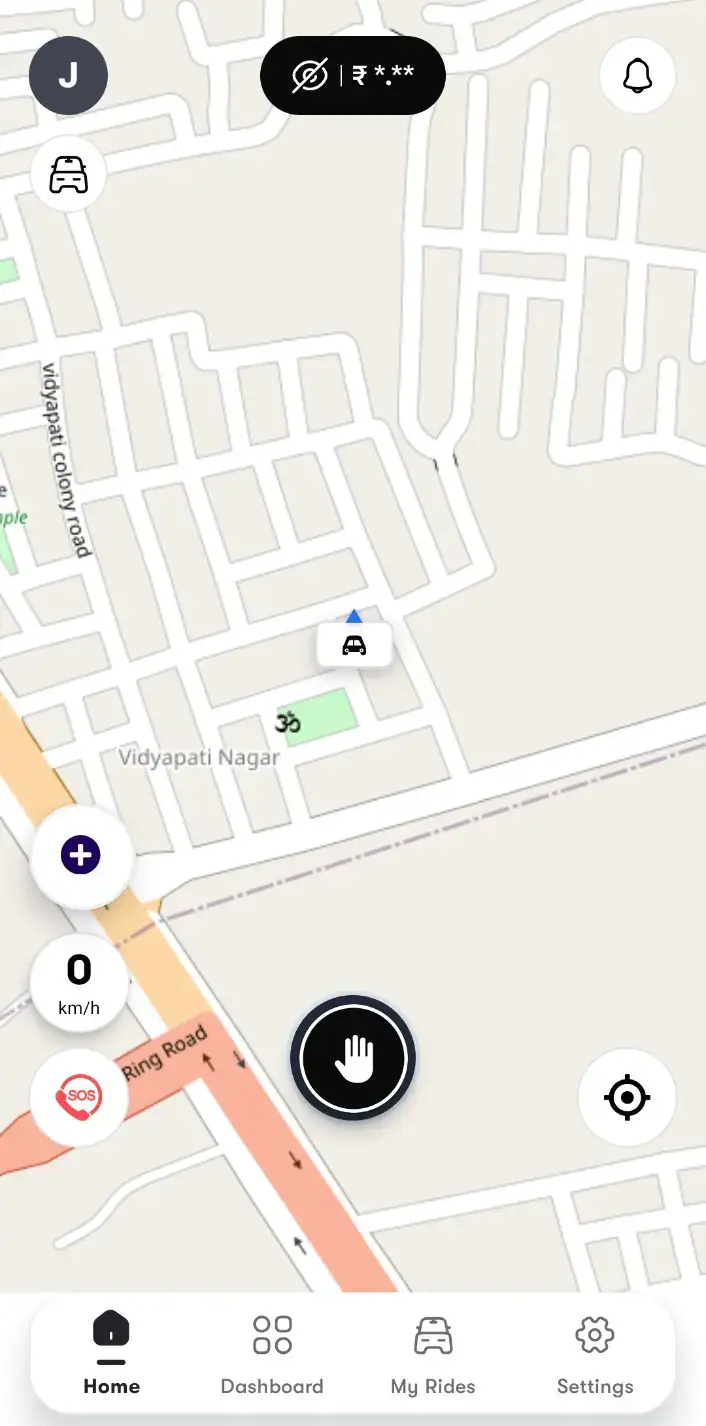
Taxi app driver home map with the online power button and hidden earnings chip
Taxi app driver ride offer with rider, fare, distance, pickup and drop-off and Accept Ride or Decline
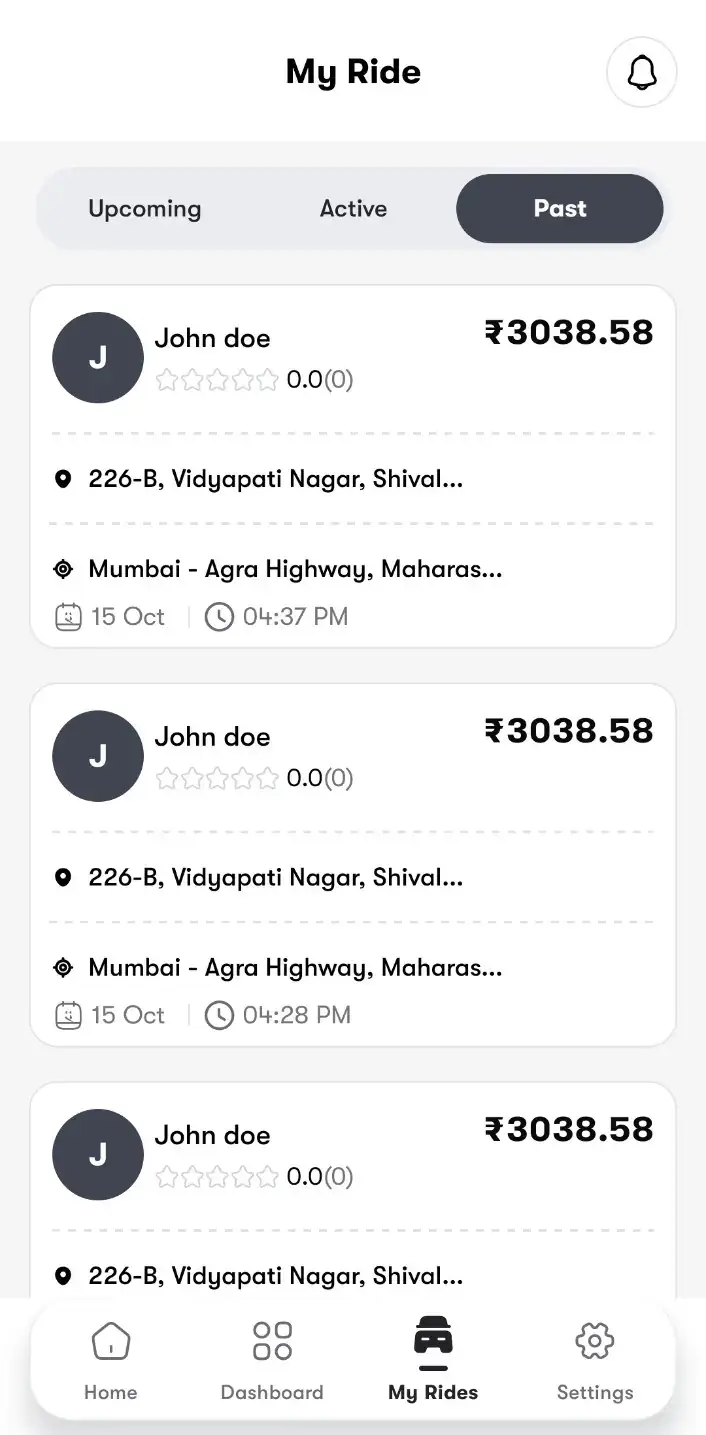
Taxi app driver My Ride list with upcoming, active and past rides and fares
Taxi app driver ride details with route and Collect Cash for an unpaid ride
6 screens · scroll →
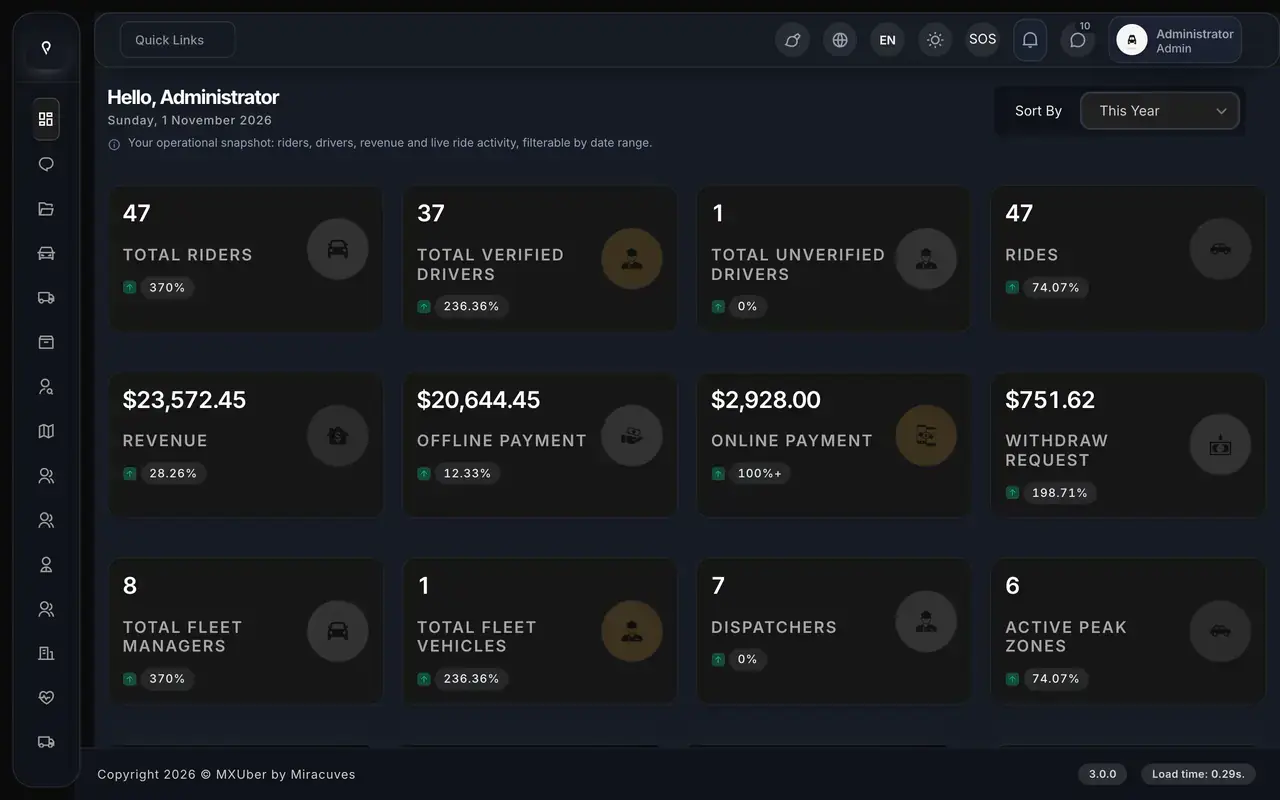
Taxi app admin dashboard showing riders, verified drivers, rides, revenue, payments, withdrawals, fleet managers and peak zones
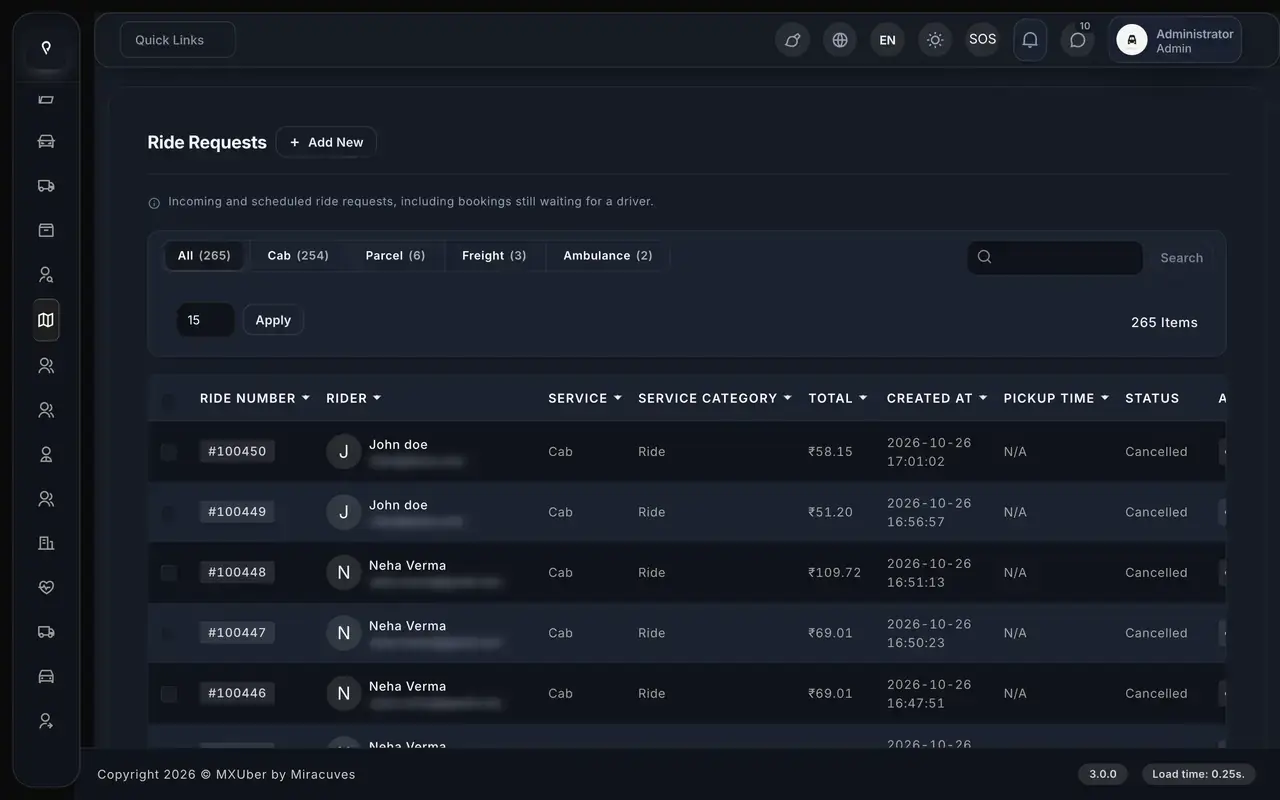
Taxi app ride requests list filtered by cab, parcel, freight and ambulance with rider, service, fare and status
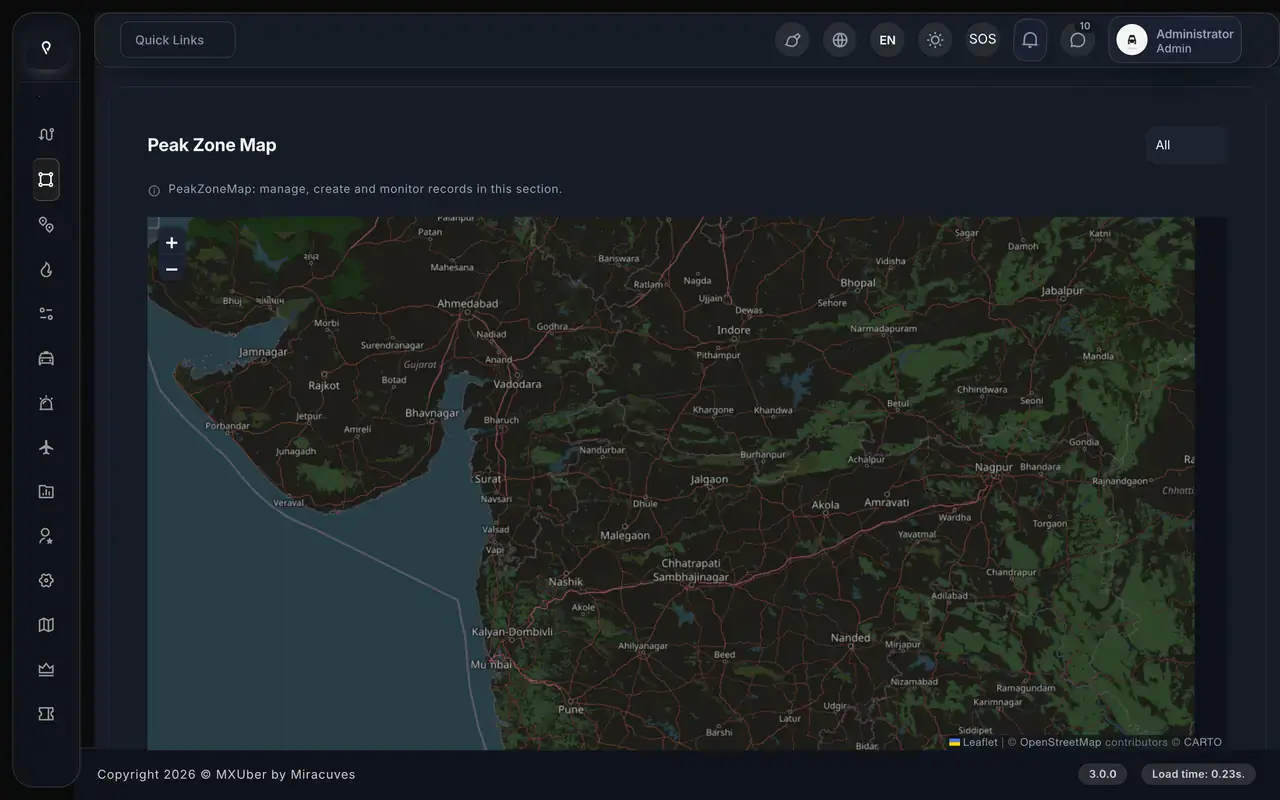
Taxi app admin peak zone map on an OpenStreetMap base layer, where operators draw surge areas
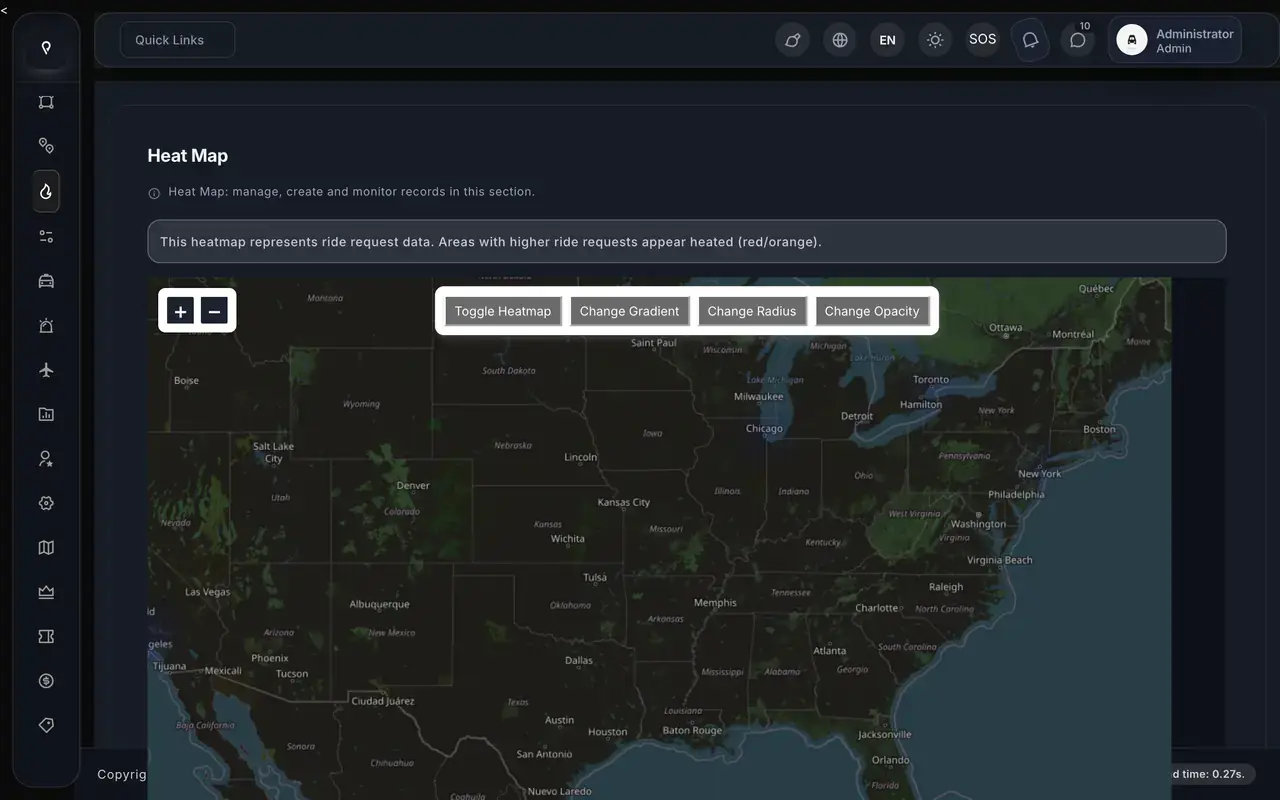
Taxi app admin heat map showing ride request density across the map
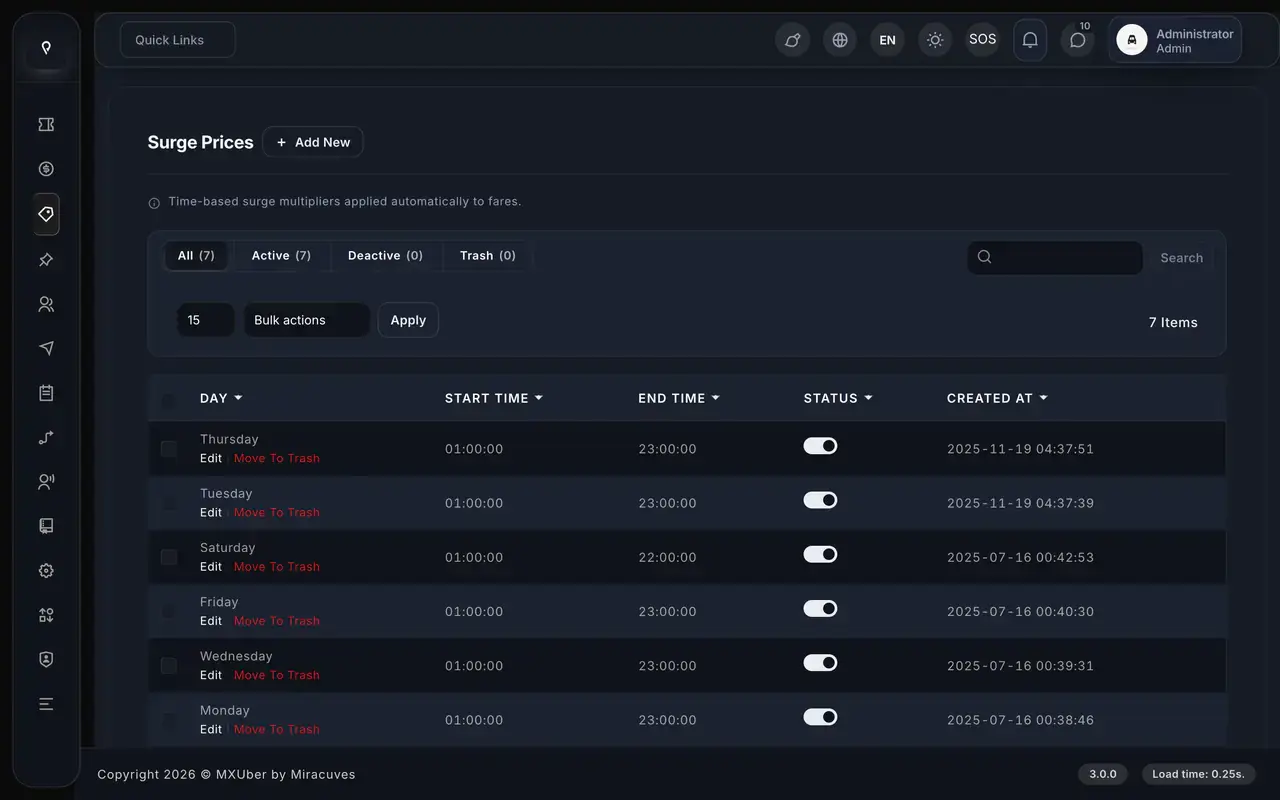
Taxi app surge prices by day with start and end time
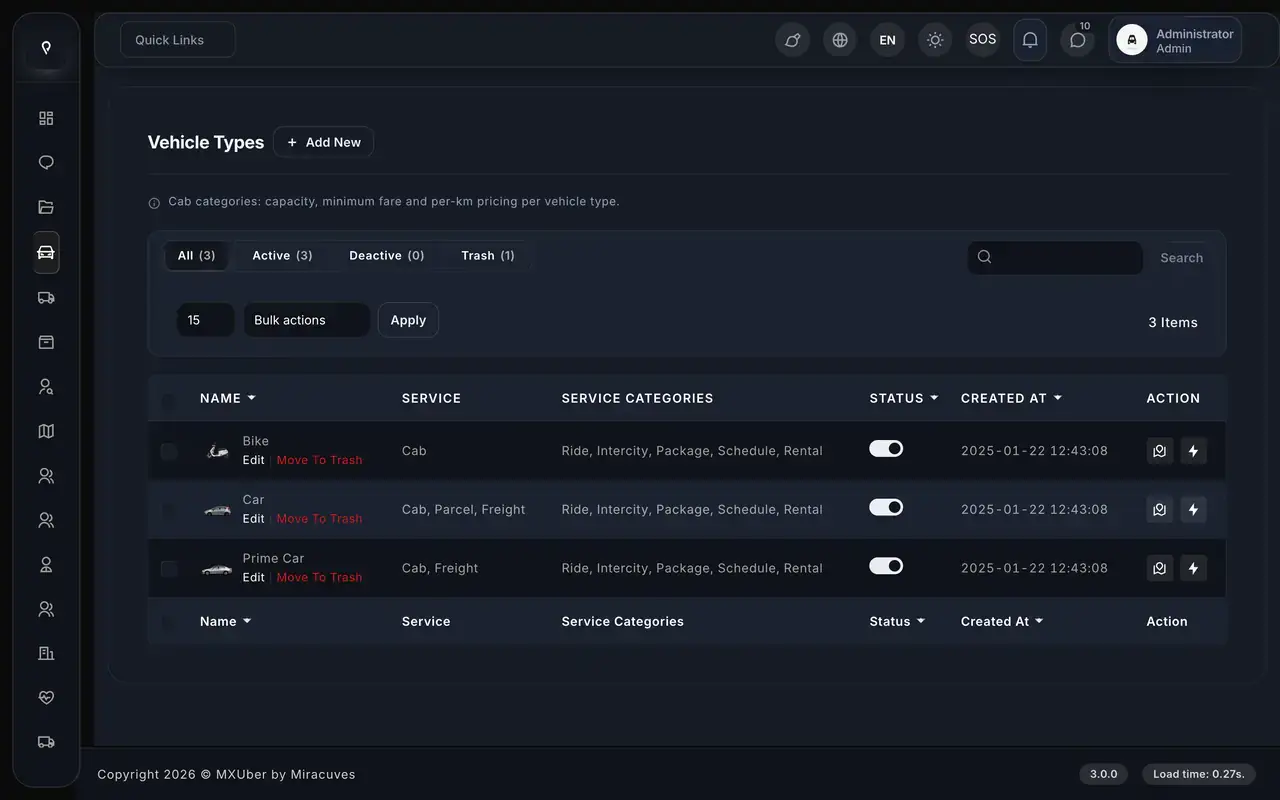
Taxi app vehicle types bike, car and prime car mapped to cab, parcel and freight services and ride categories
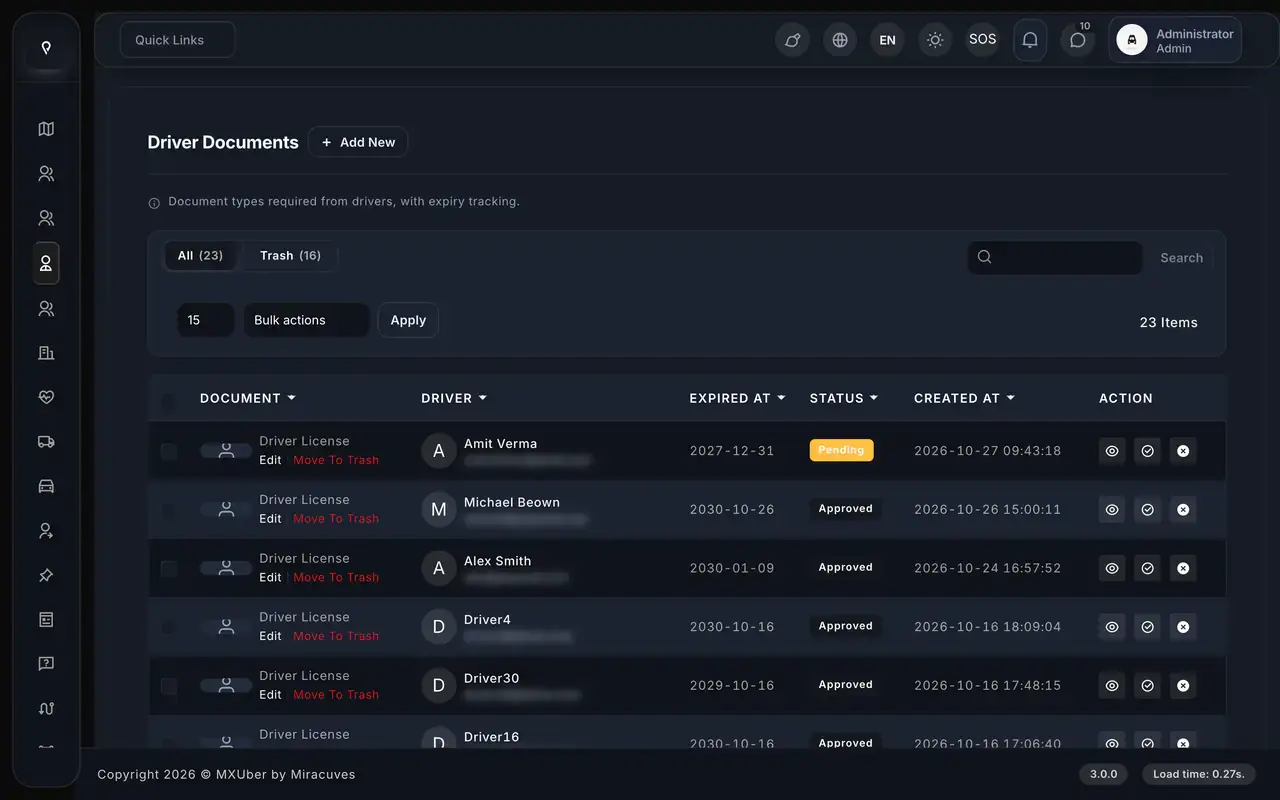
Taxi app driver documents list with expiry dates and pending or approved status
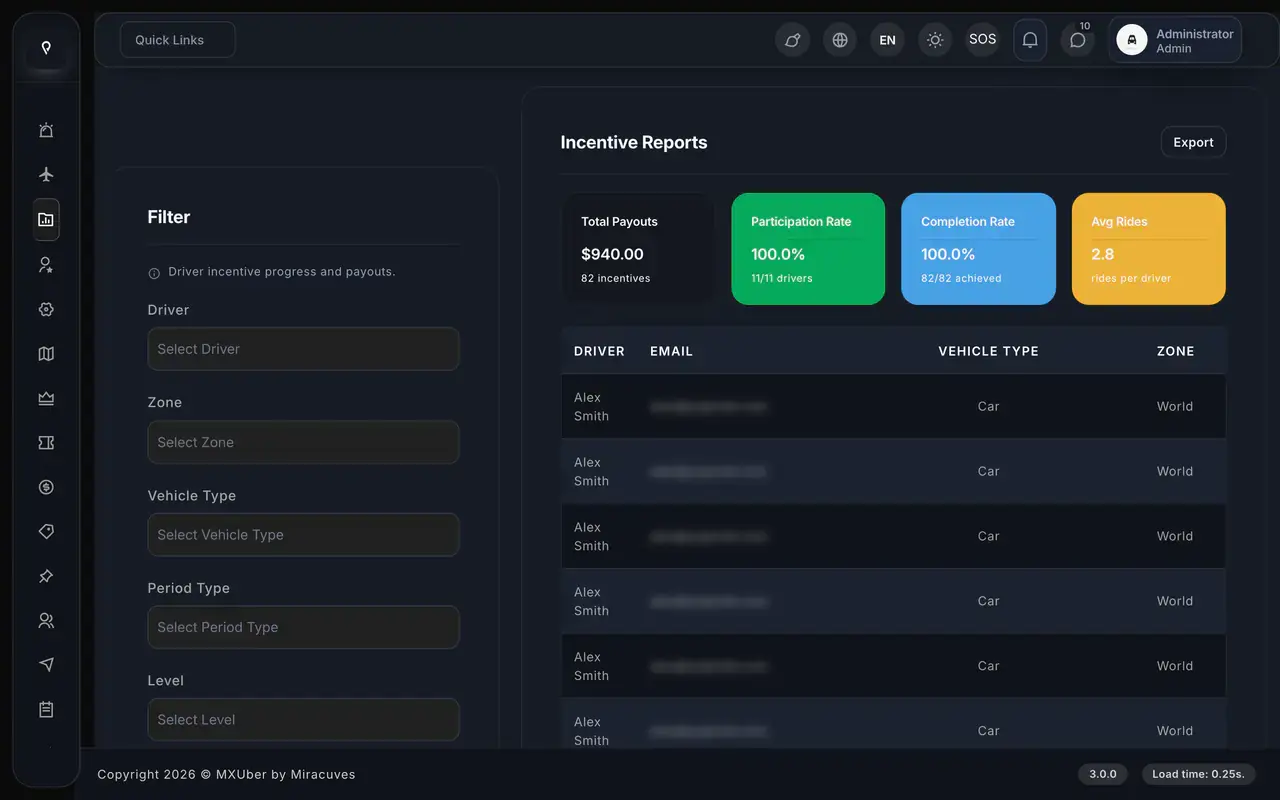
Taxi app incentive report with total payouts, participation rate, completion rate and average rides per driver
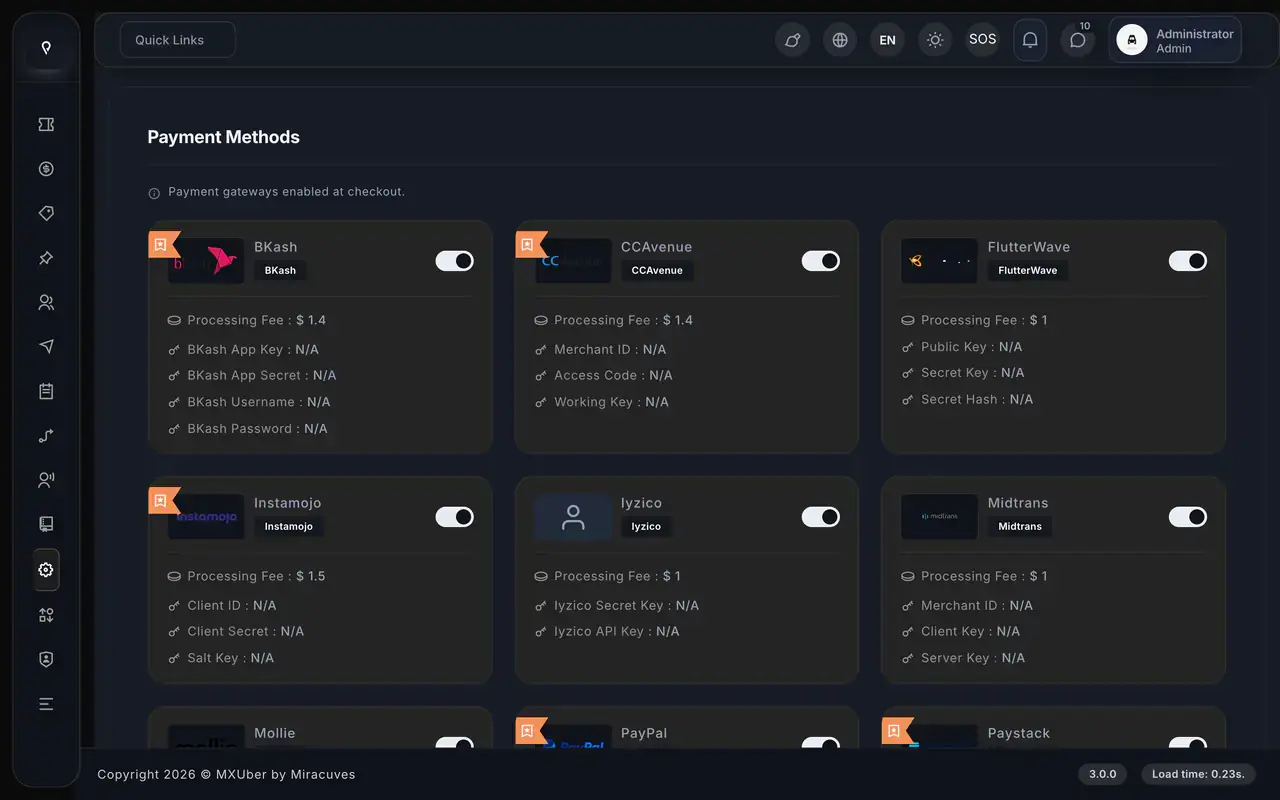
Taxi app payment methods screen with bKash, CCAvenue, Flutterwave, Instamojo, Iyzico, Midtrans, Mollie, PayPal and Paystack toggles
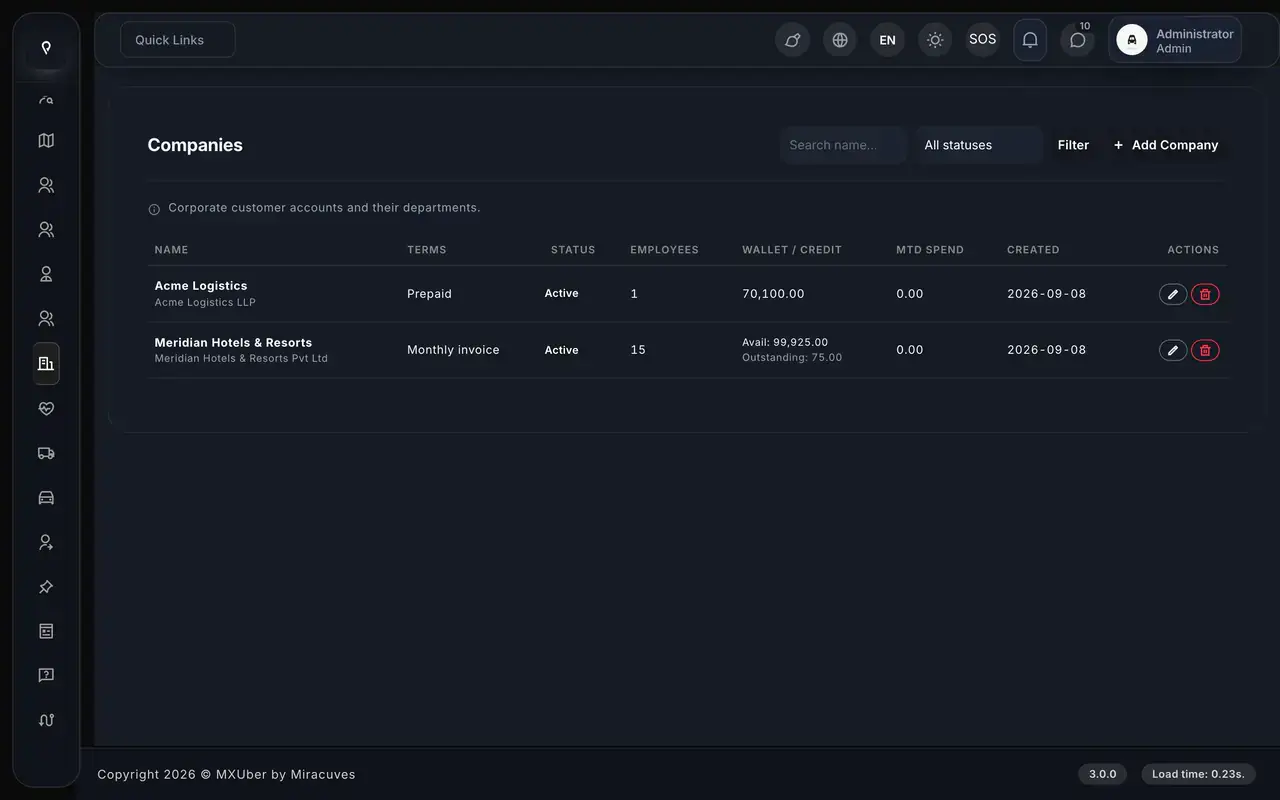
Taxi app companies list with billing terms, employee counts, wallet credit and month-to-date spend
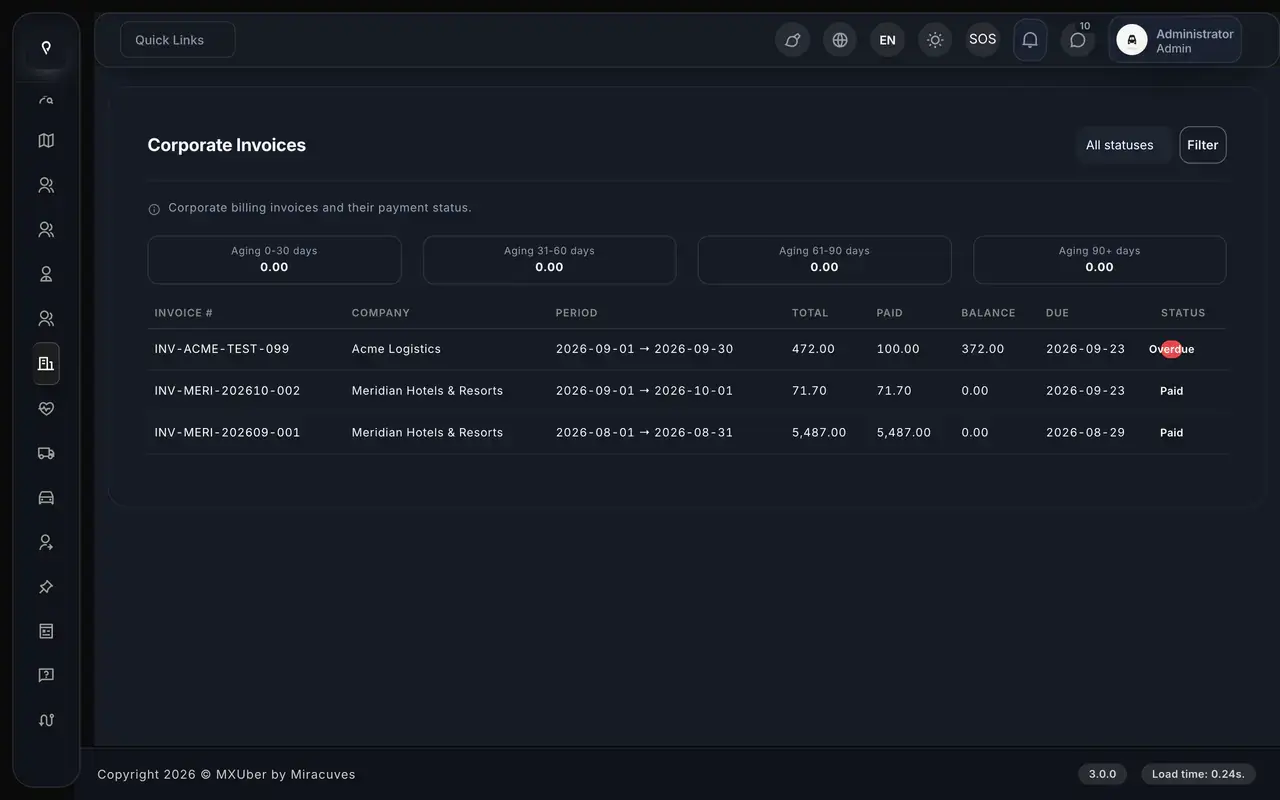
Taxi app corporate invoices with aging buckets, billing periods, totals, balances and paid or overdue status
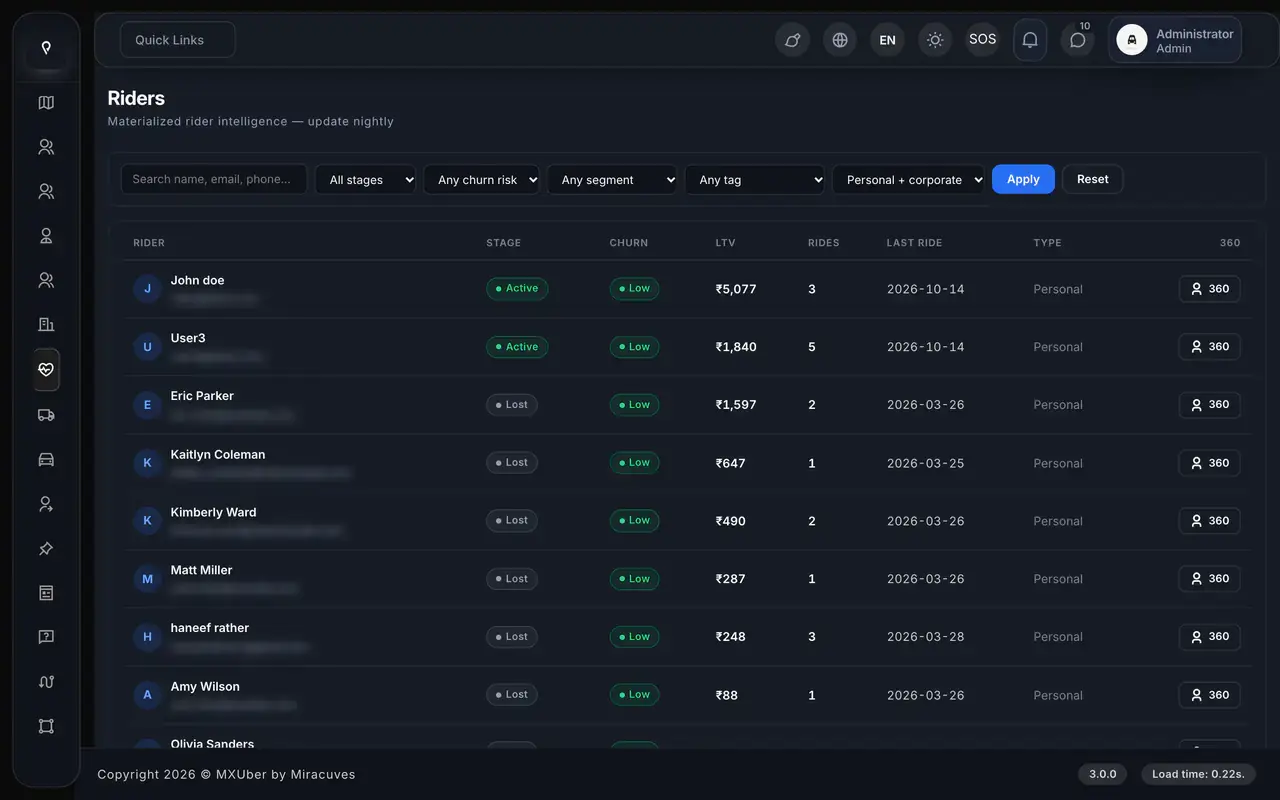
Taxi app Riders 360 list with lifecycle stage, churn risk, lifetime value, rides and last ride date
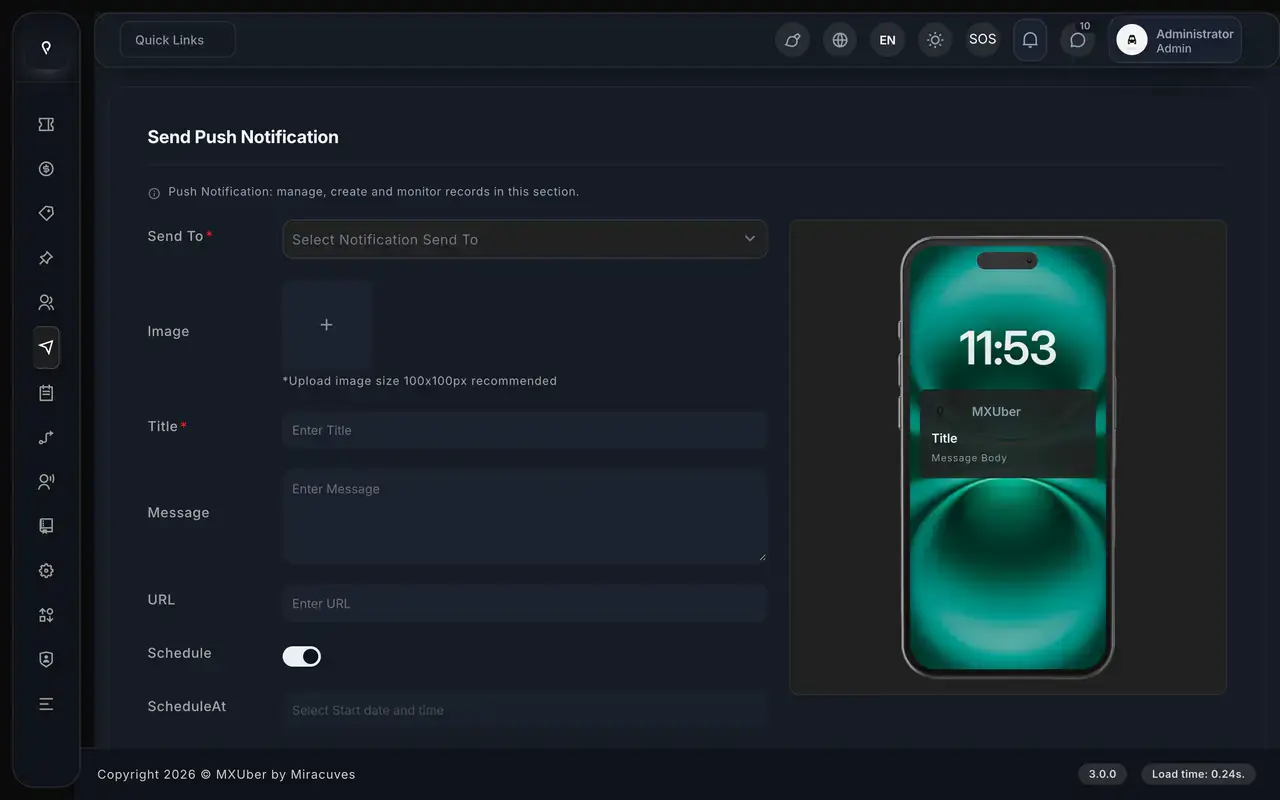
Taxi app send push notification form with audience, image, title, message, URL and schedule options beside a phone preview
13 screens · scroll →
Taxi app rider website hero with pickup and drop-off fields, See prices button and rider and driver app links
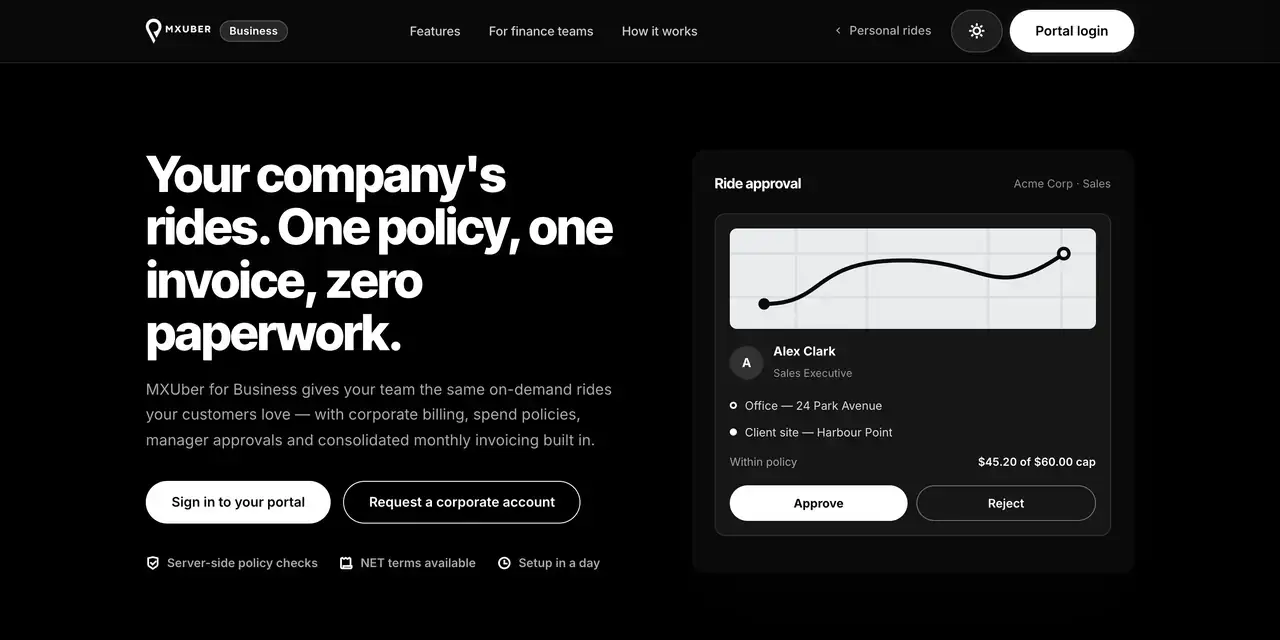
Taxi app for Business page with corporate ride approval card, portal sign-in and corporate account buttons
Taxi app admin sign-in page with demo role buttons for admin, driver, dispatcher and fleet
3 screens · scroll →

Follow a rider from sign-in through the home tiles, the vehicle list and the fare, then switch to the driver app, the admin screens and the website screens that belong to the same platform.

Browse More Solutions

02Proof

Client Voices

Client Reviews - Operators Tell It in Their Own Words

What clients say about building on Miracuves bases. Two describe ride-hailing and dispatch builds; the others come from other industries and are shown exactly as their authors gave them.

MMarsha WilliamsFounder, Bmore
“Live GPS tracking, bookings, driver and customer apps and the admin dashboard were all in place. We reshaped the workflows to our bid-and-ride model and wired in our own payments and notifications. Live inside a month on infrastructure that was already proven.”
TTariq ArbabDirector, Arbab Logistics FZ-LLC
“Our ops team was running last-mile on a whiteboard and a WhatsApp group. The rider app, dispatch console and live tracking came out of the box. They tuned dispatch for our COD-heavy model and added customer tracking. Where-is-my-order calls have all but stopped.”
MMarsha WilliamsFounder, Bmore On Demands LLC
“The team was running it on a dispatcher and a Google Sheet, and we needed a real platform quickly, because we were about to onboard a major retail client. Miracuves’s Delivery Genie base gave us the rider app, the dispatch console, and live tracking. We launched in 6 weeks and cleared 4x the previous order volume in the first month.”
BBrian LatailleVP Logistics Technology, IBC Tanks Canada
“We were juggling spreadsheets, a third-party GPS provider, and a phone. We needed a single operations console. Miracuves’s MXLogistics base covered the trip lifecycle, the driver app, and the customer tracking page. We’ve cut operations admin time by about 40%.”
AAndre GittensCEO, Ride Corporation
“Turo is the obvious reference, but the Caribbean specifics, from different insurance norms to different payment rails, meant we needed a real partner, not just a clone. Miracuves’s MXCar base covered the listing, the trip flow, and the host payouts. We launched in 6 working days and are live in three islands.”
TTiffany DandreaOperations Director, Best Cabo Yacht Rentals
“We were running it on phone calls and a paper calendar, and we were losing bookings to bigger OTAs. Miracuves’s GetmyBoat Clone base gave us the calendar, the booking flow, and the payment engine. Online bookings are up roughly 70% in the first six months, and the ops team finally has a live view of the fleet.”
DDr. Vivek RungtaFounder & Chief Dermatologist, Dermacian
“Every HMS I tried was built for general physicians, with no lesion mapping, no before/after tracking, and no procedure-based billing. Their MXHealth base gave us the patient app, doctor app, EMR and video consult out of the box. Front-desk time on scheduling and follow-ups is down ~70%, and we went fully digital in 9 months, where a fully custom job would have been 18.”
DDr. Carlos A. PalermoCo-founder & CEO, Doctta Health
“Building a compliant telehealth stack from scratch in three markets would have been a year-plus effort. Miracuves’s MXHealth base covered the patient and doctor apps, video consult, e-prescription and the pharmacy integrations. We launched in our first market in 9 weeks and rolled out to two more in the following six months.”
Read More Client TestimonialsOperators and founders in their own words

Proof in Production

Case Study: How Aone Launched a Ride-Hailing Platform

How a ride-hailing business started from the Miracuves base platform. This is a summary of the published Aone case study, which records which parts were reused and which were newly built.

Case Study
Ride-Hailing Platform on the Uber Clone Base

Aone launched a ride-hailing platform on the Miracuves Uber Clone base. Twenty of the 25 building blocks were reused unchanged, five were built for Aone, and the source code was transferred to Aone's own account.
AoneClient
Ride-hailingIndustry
Uber CloneSolution family
6 daysBuild window
20 of 25Blocks reused
5Apps and consoles shipped
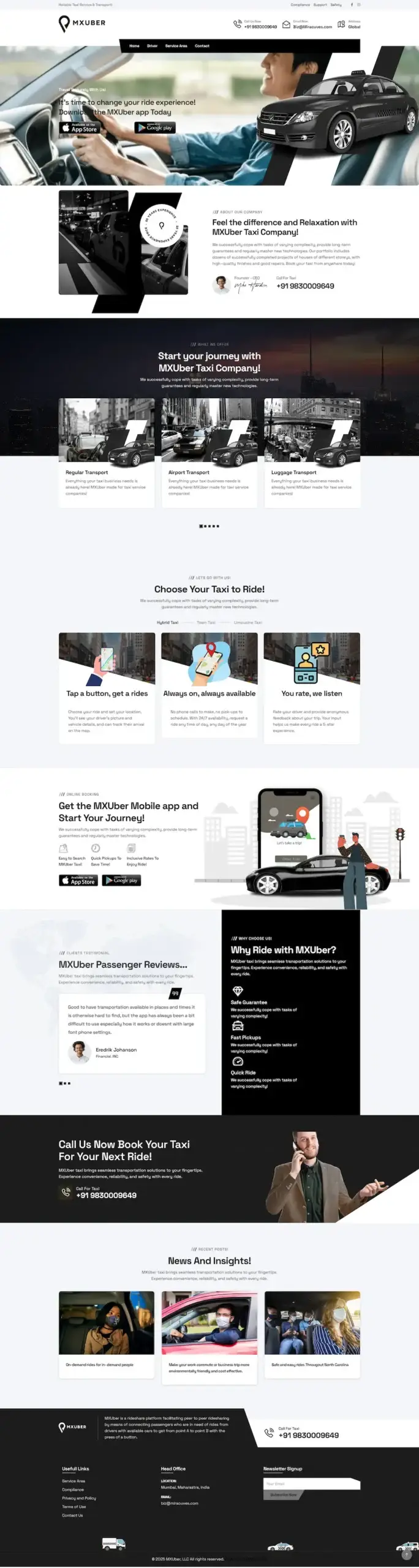
White Label Taxi App public taxi website with a hero banner, service cards and an app download section.
Challenges
  • Matching has to weigh distance, arrival time, driver acceptance and surge all at once
  • A fare has to reconcile after the trip, or it becomes a support cost forever
  • Commission, payouts and incentives decide whether drivers keep showing up
Goal
  • Stand up a ride-hailing platform without rebuilding the parts already proven on the base
  • Put the effort into the five decisions that were Aone's own
  • Hold the source code outright
Solution by Miracuves
  • Rider app, driver app, dispatcher, fleet-owner and admin console, each with its own permissions
  • Cities and zones, vehicle classes, fare and surge rules, payment gateways and brand theming set for Aone
  • Source, schema, deployment configuration and architecture notes handed over
  • Build window of 6 working days on the ready-made base

“Fares, the city and the payment partner were ours to bring. Everything underneath - matching, live tracking, driver payouts, the operations console - came ready. From kickoff to real trips was under a month, which is the only reason we made our window.”Aone Team · Founding team, Aone

Read the full case studySee which 20 of the 25 blocks were reused and which 5 were built.

03What it is

The Basics

What a White Label Taxi App Does for Companies, Employees and Operators

A white label taxi app is a ride-hailing, delivery and corporate mobility platform you rebrand and run as your own service; Miracuves delivers it as rider and driver apps, a browser booking app, an operator console and a portal for business customers. Companies book rides for their staff under your name, with policies, approvals and one invoice from you.

Beyond the Booking Screen

Next to the rider app you get a dispatch desk, a fleet login, pricing rules, driver wallets and withdrawals, so you run a mobility business and not only take bookings.

Open, Not Locked Down

You receive the full source for the apps, the backend and the web consoles, so your developers can adapt screens, pricing and flows over time. There is no per-seat fee.

Clear on What Costs Extra

Anything beyond the shipped feature set is scoped as a separate, quoted module. Licenses, store accounts, payment gateways and hosting stay in your name.

Web, iOS & Android

What Is a Taxi Booking App Script?

A booking screen is the easy part of running rides. The harder work sits around the trip: finding the driver, pricing the fare, checking a business ride against policy, collecting approval and billing the company. All of that arrives already working.

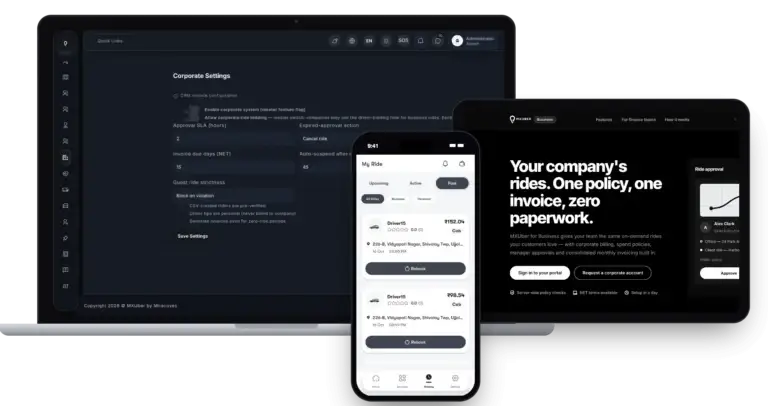
White label taxi app on a laptop, tablet and phone: corporate ride settings, the For Business page and the rider history with business and personal filters
  1. 01Rider app with a For Me / Business switch for company trips
  2. 02Company accounts, policies and approvals in a corporate portal
  3. 03Driver app with ride offers, wallet and a fleet manager role
  4. 04Dispatch desk, fleet login and admin console for operators
  5. 05Daily company invoices, credit notes and Rider-360 profiles

The package has five applications - the corporate portal, the admin console, the driver app, the rider app and the browser app at /cab - plus the public website, the React Native source and the database schema.

What Is in the Box

White Label Taxi App Features - Booking, Scheduled Rides, Multi-Stop Trips, Dispatch, Fleet & Admin Control

Each item below ships in the 2.0 taxi build from Miracuves and can be opened in the demo. The first areas cover company accounts, the rest cover the rider, driver and operator sides. Extra modules are flagged as add-ons further down.

Area 01 / 12

Company Accounts & Departments

A business signs up once and builds its structure: departments, employees, approvers and a spending limit for each employee. Invites go out by email, or you import the roster from a CSV or XLSX file.

  • Departments, employees and approvers per company
  • A spending limit set for each employee
  • Invites sent by email from the portal
  • Roster import from CSV or XLSX
  • Company data kept private to each company
Area 02 / 12

Ride Policies With a Simulator

Each company sets which vehicle types its staff may book, the cost caps and the time windows. A what-if simulator tests a trip against the policy before anyone relies on it.

  • Allowed vehicle types set per policy
  • Cost caps and time windows on business rides
  • What-if simulator to test a trip
  • Policy version saved with every ride
  • Flagged rides wait for an approver
Area 03 / 12

Approvals & Deadlines

Choose auto mode, where in-policy rides go straight to dispatch and flagged ones wait, or strict mode, where every business ride waits for an approver. Each request carries a 2-hour default deadline.

  • Auto mode sends in-policy rides to dispatch
  • Strict mode holds every business ride
  • 2-hour default deadline with escalation
  • Expiry cancels the ride or makes it personal
  • Approvers decide in the portal or the app
Area 04 / 12

Wallet & Invoices

Business rides bill to the company, not to the employee. A company wallet is in place, invoices run on a daily cycle, and a company that stays overdue past a set number of days is suspended automatically.

  • A company wallet for business rides
  • Daily invoice cycle with PDF invoices
  • Credit notes, Excel exports and spend reports
  • Auto-suspend when invoices run overdue
Area 05 / 12

Guest Rides With SMS

Book a ride for a client, a visitor or a new hire who has no account. The guest gets the ride details by SMS and a tracking page, so nobody has to install anything.

  • Guest ride for someone without the app
  • Ride details sent to the guest by SMS
  • Tracking page the guest opens in a browser
  • Book for another person from the rider app
  • Share-trip link follows the car live
Area 06 / 12

The 8-Page Corporate Portal

Company admins work in their own web portal: dashboard, approvals, employees, departments, policies, billing, disputes and reports. Nothing in it is visible to another company.

  • Dashboard and approvals pages for daily control
  • Employees and departments for the roster
  • Policies and billing, invoices included
  • Disputes and reports for review
Area 07 / 12

The For Me / Business Switch

Inside the rider app one switch moves a trip between personal and business. The rider picks the company, a trip category and a reason, and approvers act on the request in the app.

  • For Me / Business switch in the rider app
  • Company picker, then category and reason
  • Approvers approve or reject from the app
  • SOS, share-trip link and chat on business rides
  • Invoice PDFs and ratings after every trip
Area 08 / 12

Cab, Parcel, Freight & Hire a Driver

One app covers more than staff taxis. Cab has Ride, Intercity, hourly Package, Schedule and Rental; Parcel and Freight carry goods; Ambulance has live tracking; Find Driver books a hired driver for your own vehicle.

  • Cab: Ride, Intercity, Package, Schedule, Rental
  • Parcel priced by weight, closed by delivery OTP
  • Freight with cargo photo and weight
  • Ambulance trips with live tracking
  • Find Driver: One Way, Round Trip, Outstation, Daily
Area 09 / 12

Scheduled Rides

Staff can book travel at least 3 hours ahead. Drivers receive each scheduled ride 15 minutes before pickup; if none accepts, it is canceled and the rider hears about it, so nothing slips by silently.

  • Booked at least 3 hours before pickup
  • Released to drivers 15 minutes before
  • Unaccepted rides canceled, rider notified
  • Airports and hourly packages priced in admin
Area 10 / 12

Dispatch Desk

Phone orders and corporate bookings can be keyed in by a dispatcher. The closest eligible driver is asked first through a timed offer, and staff can assign someone by hand.

  • Phone orders keyed in by operators
  • Nearest eligible driver offered first
  • Offline or busy drivers cannot be assigned
  • Search stops after 3 minutes by default
  • Fleet logins see only their own drivers
Area 11 / 12

Admin & Pricing Control

The admin console has 52 sections, from zones and live peak zones to zone, vehicle and time-of-day surge, coupons, commissions, reports and staff roles with per-page permissions.

  • Zones and live peak zones
  • Surge by vehicle, zone and time
  • Coupons and extra charges
  • About 70 switches in settings
  • Reports exported to CSV, Excel or PDF
Area 12 / 12

Rider-360, Loyalty & Complaints

The CRM suite profiles every rider by recency, frequency and spend, awards loyalty points, surveys with NPS and opens a complaint on its own when a rating is low.

  • Rider-360 with lifecycle and churn risk
  • Loyalty points and tiers
  • NPS surveys with public links
  • Complaints with categories and an SLA
  • B2B leads from the for-business page

Read this before buying: The platform is delivered in your branding on hosting that you control. You bring a domain, a payment gateway account with onboarding and KYC finished, verified store developer accounts, your branding assets, your business details and keys for any third-party service. Apple and Google set their own review times, and the 6-day build does not include that wait.

Speak With Our Team

How Your Business Earns

White Label Taxi App Revenue - Company Billing, Fleet Share, Subscriptions, Surge, Commission & Fees

A mobility platform built by Miracuves earns on the ride, from drivers, through fleets, from corporate billing and from ads in the driver app. Every line sits in its own setting, so tuning one leaves the rest untouched.

Two lines usually matter most: commission on each fare, and how drivers pay for access, as a share of earnings or a subscription. Corporate accounts add a third, since business rides are billed to the company.

  1. 01

    Ride Commission

    You keep a share of each completed fare and the driver gets the rest. Commission rates are set in the admin console.

  2. 02

    Fare Settings & Surge

    Surge can follow a time window or combine vehicle type, zone and time. Operators mark peak zones on a map, and drivers see them live once switched on. Airports and hourly packages have their own pricing.

  3. 03

    Driver Subscription Plans

    Subscription plans are built in. A driver pays a recurring fee for access, which gives you income that stays steady whatever each trip earns. Expired plans switch off automatically.

  4. 04

    Fleet Owner Share

    Fleets run from the driver app, see only their own drivers and earnings by day, week or month, and withdraw fleet earnings. Fleet commission is a line you control.

  5. 05

    Cancellation Charges

    A rider who cancels after a driver accepts may be charged a fee, and the fee is shown before the cancel is confirmed.

  6. 06

    Wallets, Company Billing & Card Costs

    Riders top up a wallet and companies fund theirs, with daily invoices for business rides. Every card payment carries a processing fee; passing any of it on is your pricing choice.

What published ride-hailing platforms keep from a trip, how a flat driver pass differs from a percentage, and what card processing costs, with each figure traced to a filing, a fee page or a rule.
Revenue streamHow it is chargedTake rateTypical take rateWhat sets the ceiling
Ride CommissionA percentage of each completed fare, kept before the driver is paid.Uber 3%-35% per trip (25% average, Helsinki); Lyft about 34% of bookings; Grab about 15%; Bolt 15%-30%.What drivers will accept in your market. Bolt's published range alone runs from 15% to 30%, so a commission is judged against the cheapest competitor a driver can switch to.
Surge & Fare RulesRates for distance and time, with a multiplier when demand is high.Uber defines its fee as the gap between what a rider pays and what a driver earns, and says it varies from trip to trip.Rules on driver pay. New York City sets a minimum of $1.283 per mile plus $0.681 per minute for app trips from 1 March 2026, which limits how much of a fare a platform can keep there.
Driver SubscriptionsA flat fee for a time window, instead of a share of each trip.Uber India's Drive Pass: a flat price per pass, no percentage stated. Passes run for periods such as 24 hours or until INR 500 is earned.The cost of the pass relative to a driver's earnings. Sold inside the app, store billing applies: Apple takes 30% in year one and 15% after, and Google Play lists 10% plus a 5% billing fee for auto-renewing subscriptions in the US, UK and EEA.
Wallet Top-Ups & Card CostsA processing fee on each card payment, passed on or absorbed.In its US example, Stripe's Connect help article puts a credit card payment at 2.9% + 30c.What your gateway charges in your country, given the cards your riders use. Cash trips skip that fee, though then there is no payment on the platform to deduct commission from.

How to read this. The Uber, Lyft and Grab figures come from their own filings: Uber's Helsinki fee notice, the Lyft annual report and the Grab results release, with the Lyft and Grab ratios being our own arithmetic. Bolt's commissions come from its support pages, the pay floor from the New York TLC, the flat pass from Uber India's Drive Pass terms, and card and store costs from Stripe, Apple and Google Play. Treat them as modeling inputs for your own settings in the admin panel: this table is neither a quote nor a forecast of what any platform will earn.

Revenue Model

White Label Taxi App Revenue Model, Stage by Stage

Each of the six revenue lines above is its own admin setting, so a new taxi operator can start on fare commission and add fleet share, subscriptions or company billing as drivers and client firms arrive.

Launch

Fare commission pays from the very first completed ride, and a cancellation charge after a driver accepts protects driver time while the rider base is still thin.

Traction

When fleet owners start bringing their own cars, fleet commission and driver subscription plans add a predictable monthly line that does not swing with trip volume.

Scale

Across several cities, the company portal bills corporate trips, surge prices each zone by time slot and the driver app carries Google native ads.

Commission, surge and subscription rates are all set in the admin console, with 0% of any fare going to Miracuves.

Need a revenue model that fits your own city and fleet?Plan My Revenue Model

Daily Operations

Admin Console for Your Taxi Booking App - Zones, Dispatch, Fleets, Pricing & Reports

In the Miracuves taxi build, one console covers a normal operating day: live rides on the heat map, driver and fleet wallets, the zones and surge in force, the coupons running and the withdrawals waiting to be paid.

  1. Rider appBook, rebook, track, pay
  2. Driver appOffers, trips, wallet, fleet role
  3. Rider web appBook in a browser at /cab
  4. Company portalApprovals, policies, billing
  5. Admin consoleZones, surge, staff, reports

Inside the Admin Console

  • 01

    Dashboard & Reports

    Beside a live KPI dashboard, a heat map and driver locations, finance and ops can pull CSV, Excel or PDF exports covering money movement, trips, drivers, coupons, zones and incentives.

  • 02

    Drivers & Documents

    Driver documents carry expiry dates; once one lapses, that driver stops receiving dispatch until it is approved again. Driver and fleet wallets and withdrawals are handled here too.

  • 03

    Zones, Peak Zones & Surge

    Draw zones, switch on peak zones that redraw live on driver maps, and set surge by time, vehicle and zone. Airports and hourly packages too.

  • 04

    Fleets & Vehicles

    Fleet managers sign in to a fleet login and see only their own drivers, while admin adds vehicle types, rental vehicles and fleet wallets.

  • 05

    Dispatch Oversight

    Live ride tracking, ride and request lists by status, manual assignment and operator bookings, all in one place.

  • 06

    Promotions

    Coupons, banners, push notifications with images scheduled ahead, and incentive levels by vehicle type and zone.

  • 07

    Driver Payouts

    Set commission rates, review withdrawals and manage subscription plans, with driver and fleet wallets reported on.

  • 08

    Branding Controls

    Onboarding screens, banners and the landing page are edited here, next to the settings console.

Money Movement

The finance half of the console: everything from the first fare through to the driver withdrawal.

  • Commissions and surge pricing
  • Driver withdrawals and wallets
  • Fleet wallets and commission
  • Reports to CSV or Excel

Control Room

What the operations team uses to keep every trip moving.

  • Live ride tracking and heat map
  • Staff roles with per-page permissions
  • Tickets and a knowledge base
  • Activity log and backups

Need more from the console? Extra reports, another payout rule or a custom approval step are scoped as separate work. Tell us what your operations team needs and you get a written quote.

Contact Our Team

04Contents and cost

Complete Handover

Delivered to You: Source Code, Apps & Deployment for Your Taxi App

What Miracuves hands over is a working platform, not a pile of components: the corporate portal, admin console, rider web app, driver and rider apps, public website, source code and database schema. You own it outright. Nothing is billed per seat or per ride, and keeping it running takes no license.

01

Taxi App Source Code

The Laravel backend, the admin and corporate web code and the React Native app code are all delivered, so your developers can reshape them around how you operate.

  • Laravel 11 backend and web console source
  • React Native 0.82 source for Android and iOS
  • Yours to modify, extend and deploy again
  • Placed in your own repository
02

Schema & Migrations

The MySQL schema, about 180 tables covering drivers, vehicles, rides, fares, companies and wallets, comes with the package, so a blank database can be rebuilt from it.

  • Schema and migrations for the database
  • MySQL and Redis layers
  • Covers rides, fares, drivers, companies
  • Covers wallets, invoices and settings
03

Handover & Support

We apply your branding, deploy to your hosting, supply the handover documents and cover three support periods, all counted from launch day.

  • Your logo, icons and color scheme in every app
  • Deployment onto your hosting
  • Architecture notes and deployment configuration
  • Guidance for 60 days, bug fixes for 6 months, updates for 12
04

Rider App

Riders use a React Native 0.82 app on Android and iOS. It covers OTP, Google, Apple or guest sign-in, a wallet, trip history, support tickets, scheduled bookings and the For Me / Business switch.

  • Cab, Parcel, Freight, Ambulance, Find Driver tiles
  • Fare and ETA per vehicle before booking
  • Scheduled and multi-stop rides
  • Published through your developer accounts
Taxi app rider choosing Bike, Car or Prime Car with fares and arrival times before booking
Taxi app rider website hero with pickup and drop-off fields, See prices button and rider and driver app links
05

Rider Web App & Website

The /cab rider web app books rides in a browser, and the public website carries your brand, app links and a for-business page.

  • Public website with app download links
  • Riders book, track and pay in the browser
  • English, Arabic, French and Spanish
  • Styled to match your brand
06

Driver App

The driver's working app: online switch, ride offers, earnings, wallet, subscription plans and, for managers, the fleet view.

  • Offers that survive a dropped link
  • Accept, decline or counter-bid
  • Earnings donut and 5-tab history
  • Withdrawals and subscription plans
07

Dispatch & Fleet Logins

These two logins in the admin console serve staff who are not riders: a dispatcher who creates bookings and picks drivers manually, and a fleet manager who handles cars and drivers.

  • Assign by hand with guards
  • Operator bookings for phone orders
  • Fleets add drivers and vehicles
  • Fleet earnings by day, week or month
08

Admin Console

The operator's console: 52 sections covering zones, surge, drivers, wallets, coupons, reports and staff permissions.

  • Staff roles with page permissions
  • About 70 settings switches
  • Reports in CSV, Excel or PDF
  • Withdrawals and coupons

Prefer to test it first? Open the demo with the public rider, driver, dispatcher, fleet and admin logins. A live session can step through a company ride, an approval and a daily invoice, each checked against your plan.

Reach Our Team

Clear Pricing

How Much Does a White Label Taxi App Cost in 2026?

Taxi app development cost here is one fixed price: $3,099 for the launch-ready platform. Anything past the base build, such as custom flows, extra integrations or add-ons, is scoped and quoted separately in writing.

Most Popular

Professional

Ready-to-Launch Package
$3,099paid one time
Delivered in 6 days

Built for: Taxi and fleet companies, ride-hailing startups, call-center dispatch teams

What you get matches the demo, carrying your logo, icons and color scheme and set up on hosting of your own.

Get Started

Enterprise

Bespoke Work for Bigger Scope
Customquote
Go-live: depends on final scope

Built for: Mobility groups in many cities, large fleet networks, operators whose dispatch rules are unusual

Need flows the base build does not have? Give us a brief and we will agree scope and price before any work starts.

Ask for a Quote
Development Cost

White Label Taxi App Development Cost in 2026

Miracuves prices the white label taxi app at $3,099, paid once, for the five applications in the demo, from the Android and iOS rider and driver apps to the corporate portal and admin console, with full source and schema, launched in six working days.

$3,099 Paid once
6 working days Rebranded and live
0% Revenue share

Costs that sit outside the taxi software invoice

  • Hosting you control, plus your own domain
  • Your own gateway account, already through KYC
  • Apple and Google developer accounts for your store listings
  • SMS, Firebase and Google Maps keys
  • Any of the three optional modules: entertainment, tour guide or voice control

Approval logic beyond auto and strict modes, for example a second sign-off on pricier trips, is custom work scoped in writing over 2-8 weeks, and mobility groups spanning many cities are quoted on the Enterprise plan.

Compare Your Options

Ready-Made White Label Taxi App vs Custom Development vs SaaS

How an own-brand taxi platform from Miracuves compares with a custom build and a rented SaaS dispatch tool, row by row, for fleets and corporate mobility operators.

CriteriaMiracuvesReady-Made White Label Taxi AppCustom DevelopmentSaaS
Launch timeReady for riders in 6 working days2-8 weeks for custom scope, quoted in writingFast to try, slower to make your own
Upfront cost$3,099 one timeA written quote once scope is agreedSubscription billed monthly
Source code ownershipComplete code and schema, owned by youDepends on the agency contractStays with the SaaS provider
CustomizationYour logo, colors and flows, any timeFully bespoke, at bespoke costConfiguration screens only
Ongoing feesNo per-ride or per-seat chargesHosting plus agreed maintenanceFees continue every month
Branding & app-store listingYour own name in both storesYour name, after the buildTheir brand is often visible
Best forFleets and corporate travel providersRare workflows no base coversShort trials and pilots

Go Deeper

Four Guides on the Taxi Platform, Compared Side by Side

These four Miracuves blog guides cover the cost and contents of the script, how the business model is arranged, where revenue comes from and how the app functions. All four go into more depth than this overview.

Ownership

What White Label Means for Your Taxi App

The phrase gets used loosely, from a rented tenancy to full code ownership. Here it means your name on every app, the source code in your repository and your own store listings, with third-party accounts kept separate.

What carries your brand

Your company name, logo, icons, colors and theme go onto the corporate portal, the admin console, the public website, the browser booking app and both mobile apps. Store listings go under developer accounts that you hold, and the platform runs on your domain and hosting.

What you own for good

Yours outright: the Laravel 11 backend, corporate portal, browser booking app, React Native apps for Android and iOS and the admin console, which carries separate admin, dispatcher and fleet roles, plus the MySQL schema, deployment configuration and architecture notes. No seat charge and no per-trip charge applies, and running it needs no license.

What it does not mean

This is not a rented monthly service that a provider can switch off, because the code is yours. Accounts for payment gateways, SMS, push messaging and Google Maps if you use it, plus your store developer accounts, stay in your name. Apple and Google run app review on their own timelines. Extras beyond the shipped feature set are quoted separately.

Use Cases

Taxi App Use Cases - Company Travel, Guest Rides, Dispatch, Fleets & Rentals

Each type of operator uses a different slice of the one taxi product Miracuves ships. A mobility provider starts with company accounts and approvals, a call center begins with the dispatch desk, and a fleet company focuses on commission and vehicle management. You choose the emphasis through configuration.

CompanyStaffStaff Rides on Accounts

Give a company's people rides on the company account: the employee switches to Business, picks a reason, the ride is checked against policy, and the company is billed on the daily cycle.

01
Taxi app rider choosing Bike, Car or Prime Car with fares and arrival times before booking
ScheduledRidesAirport & Scheduled Transfers

Staff book at least 3 hours ahead of a flight or a meeting; drivers get the job 15 minutes ahead of pickup, and airports are priced in admin.

02
Taxi app rider home with Where next search and Ride, Intercity, Package, Schedule and Rental tiles
DispatchDeskPhone Dispatch Desk

Keep a phone line open next to the app. Operators create bookings from Ride Requests, assign a driver by hand and follow the trip to its end; offline or busy drivers are refused.

03
Taxi app rider choosing Bike, Car or Prime Car with fares and arrival times before booking
FleetOwnersFleet Owner Network

Fleet managers use the same driver app: they add drivers and vehicles, follow earnings by day, week or month, withdraw them, and see only their own drivers.

04
Taxi app ride history with business and personal filters and one-tap Rebook
GuestClientsGuest & Client Rides

Book a ride for a client or visitor who has no account. They get the details by SMS and a tracking page, and the booking stays inside the corporate suite.

05
Taxi app rider home with Where next search and Ride, Intercity, Package, Schedule and Rental tiles
ParcelFreightParcel, Freight & Hire a Driver

One account can send a parcel with weight pricing and a delivery OTP, move freight with a cargo photo, or hire a driver for its own car by the day, all from the same app.

06
Taxi app ride history with business and personal filters and one-tap Rebook
Business Model

White Label Taxi App Business Model: Three Ways to Run It

The same rider app, driver app and corporate portal run three taxi businesses, set apart by whether companies, fleet owners or phone callers come first.

Corporate mobility provider

Sell managed travel to companies: each client gets ride policies, approvals and a company wallet, you bill it on the daily invoice cycle, and a share of every business fare is yours.

Fleet network

Recruit fleet owners who supply cars and drivers, then earn fleet commission and driver subscriptions on top of ride commission, with every fleet limited to its own drivers.

Dispatch-led city service

Keep a call-center desk beside the app, keying phone bookings into Ride Requests and assigning drivers by hand, so a single driver pool serves app and phone customers alike.

In all three, the source code, Rider-360 profiles and company invoices stay yours.

One platform, six ways to use it. Every case runs on the same apps, consoles and codebase. What changes is where you operate, the fares you charge, the policies your companies set and your branding, so only one system needs looking after.

Contact Our Team

Market Timing

Why Launch a White Label Taxi App in 2026?

City travel is local and crowded, and in most places a few large apps plus many independent cabs divide the demand. Put your own name on a Miracuves platform and you earn the riders, drivers and commission those apps now collect.

01

Riders Want Booking, Tracking and Payment in a Single App

Someone who can watch the map, check the fare and follow the car in has little reason to call a dispatcher. Those tools already exist in the product.

02

Upfront Fares Earn Rider Trust

The suggested rides list shows an estimate before the request goes out, which answers the first thing any rider wants to know: the price.

03

Drivers Stay Where Terms Are Clear

Drivers stay with the platform whose withdrawals, commission settings and subscription option are easy to see, so show them openly on yours.

04

Phone Bookings Still Reach Cars Through Dispatch

Many bookings still arrive by phone. Staff enter them on the Ride Requests page and pick a driver by hand, so one desk serves app and call-center customers from a shared pool of drivers.

05

Your Brand, Not a Listing Inside Someone Else's App

When your name is on the platform, riders, drivers and every trip's data belong to your business, not to an intermediary.

06

Buy or Build: A Short Decision

Your brand runs across five applications: the corporate portal, admin console, browser booking app and the rider and driver apps, plus dispatch, tracking, fares and payouts. Our build takes 6 days, then your platform runs on your own hosting.

The Platform in Numbers

5

Surfaces on One Codebase

5

Services in the Rider App

3

Support Periods Running Together

6

Build Time in Days

Behind every taxi business sits the same unglamorous work: an operations console that reconciles driver payouts, cancellations, fares and driver matching. Here, that work is already built.

Industries

Industries It Fits

The platform suits any company that moves people or goods by car, on demand or on a schedule. Corporate mobility providers sell managed travel to businesses. Taxi fleets run city bookings, new ride services open a fresh market and call centers dispatch by phone. Chauffeur and airport-transfer firms live on scheduled rides, while delivery and freight teams run parcel trips. Bike and car fleets share one app.

  1. 01Cab Fleets
  2. 02Ride Startups
  3. 03Car Hire
  4. 04Out-Station Trips
  5. 05Delivery Runs
  6. 06Chauffeur Rides
  7. 07Phone Dispatch
  8. 08Fleet Companies
  9. 09Business Travel
  10. 10Tourist Transfers
  11. 11Motorbike Rides
  12. 12Auto-Rickshaw Rides

Miracuves built this platform to suit many different mobility business models, and your name sits on the apps, dispatch tools and admin panel from the first screen.

06How it runs

End to End

How the White Label Taxi App Works - Sign In, Pick, Route, Compare, Confirm & Ride

A rider needs only a handful of taps to book in the white label taxi app Miracuves builds, while behind the screen a fixed sequence of offer, match, track and settle runs. Follow that sequence below, then the architecture underneath it.

Rider Journey - Sign-In Through to a Finished Ride

  1. Taxi app rider sign-in with phone or email OTP, Google sign-in and guest entry
    1Sign In

    The rider opens the app and signs in with a phone or email code, or a Google or Apple account, or looks around as a guest first. Invited staff do the same.

    • OTP by phone or email
    • Google or Apple sign-in
    • Browse as a guest before signing in
  2. Taxi app rider home with Where next search and Ride, Intercity, Package, Schedule and Rental tiles
    2Choose a Taxi Service

    Home tiles offer Cab, Parcel, Freight, Ambulance and Find Driver. A For Me / Business switch sets whether the trip is personal or goes on a company account.

    • Cab, Parcel, Freight, Ambulance, Find Driver
    • For Me / Business switch
    • Business reason picker
  3. Taxi app rider choosing Bike, Car or Prime Car with fares and arrival times before booking
    3Enter Pickup and Destination

    Riders enter pickup and drop-off by search or a pin on the map, can add stops and use saved places, then confirm to reach the vehicle list.

    • Saved places and recent searches
    • Pin on the map for pickup
    • Multi-stop rides
  4. Taxi app rider choosing Bike, Car or Prime Car with fares and arrival times before booking
    4Compare Taxi Fares by Vehicle

    Before booking, each vehicle lists its fare and arrival time, backed by an itemized estimate, ride preferences and promo codes. A business ride is checked against company policy.

    • Fare and ETA for each vehicle
    • Itemized estimate before booking
    • Promo code and payment method
  5. Taxi app rider home with Where next search and Ride, Intercity, Package, Schedule and Rental tiles
    5Book Now or Plan a Ride

    A rider who needs a car later schedules it at least 3 hours ahead. A business ride that needs approval waits for the approver, up to the 2-hour default deadline.

    • Date and time picker
    • Approver decides
    • Released 15 minutes before
  6. Taxi app ride history with business and personal filters and one-tap Rebook
    6Driver Match, Live Tracking & Payment

    The closest eligible driver is sent a timed offer. The ride starts when the driver keys in the rider's code, and the rider then watches the car on the map, settles by wallet, cash or gateway, leaves a rating and tip, and can tap Rebook to repeat the route.

    • Ride OTP to start the trip
    • Live tracking over websockets
    • Invoice PDF, rating, tip and Rebook
Journey MapSign inPickRouteCompareConfirmRide

Build Overview

Taxi Platform Architecture & Trip Flow

Contact Our Team
  1. Part 01

    Five Applications, Separate Permissions

    Operators sign in under roles, and each role sees only the pages it is allowed. Every company's data is walled off from every other company.

  2. Part 02

    Driver Matching

    Driver positions sit in Redis. A ride goes to the nearest verified driver in the right zone for that service and vehicle, and a timeout or decline sends it to the next in line.

  3. Part 03

    Websockets With a Fallback

    Laravel Reverb websockets stream driver positions and ride status to the live map, and the apps check again every 10 seconds if a connection drops.

  4. Part 04

    Fare Calculation

    One fare is built from trip distance, minutes on the road and waiting time, with surge applied per vehicle class, zone or time slot, so rider and driver both see an identical figure.

  5. Part 05

    Payments & Billing

    Each trip records its cash, wallet or gateway payment. Business rides go to the company wallet and roll into the daily invoice, while drivers and fleets withdraw from their own wallets.

  6. Part 06

    Queued Jobs

    Dispatch and notification jobs run on Redis queues, so a slow message never holds up a ride, and every status change is logged in an append-only history.

Technology Stack

What Powers Your Own-Brand Mobility Platform - Laravel, MySQL, React Native & Maps

Miracuves chose this stack because company accounts, approvals and invoicing need a dependable web tier, a database where every ride and invoice stays consistent, and native-feeling mobile apps. This is the stack your brand ships on.

WEB & PANELS

Web & Admin

Laravel PHP
  • Admin console, corporate portal and public site
  • Admin, dispatcher and fleet logins, per-page roles
  • Laravel 11 backend, PHP 8.2 minimum
  • English, Arabic, French, Spanish
DATABASE

Data Tier

MySQL Redis
  • About 180 tables for rides, companies, invoices
  • Source code ships with the schema and migrations
  • Redis: queues, cache, driver positions
MOBILE

Rider & Driver Apps

React Native iOS Android
  • Rider app with a For Me / Business switch
  • Driver app doubles as the fleet manager app
  • 42 rider screen groups, 13 driver ones
  • Publishing happens from your developer accounts
MAPS

Maps & Routing

OpenStreetMap Google Maps Map cache
  • Switch the map provider in admin
  • Map cache serves tiles, addresses and routes
  • Dark map for dark mode
  • Map cache for tiles and routes
MESSAGING

Realtime & Alerts

Reverb FCM SMS gateways
  • Five SMS gateways to choose from
  • Firebase Cloud Messaging for push alerts
  • Payment gateway APIs run on your own account
  • Reverb websockets carry live ride updates
HANDOVER

Payments & Handover

13 gateways Source Schema
  • 13 payment gateways, with wallet, cash and corporate billing
  • Source for both apps, the console and the portal
  • Deployment configuration is documented
  • Architecture notes handed over
Tech notes for buyers:

Payment gateway, SMS, Firebase and Google Maps accounts and keys are yours, supplied at deployment. All of this is mainstream and easy to hire for.

Contact Our Team

Room to Grow

Corporate Mobility Built to Scale - Separate Apps, Queued Dispatch & Room to Grow

Five applications - rider, driver, rider web, admin and company portal - run separately on shared building blocks. On the build Miracuves delivers, taking on a client company or a city is mostly capacity and settings, not a rewrite.

Five Applications, Separate Access. Each application has its own sign-in and permissions, so staff, drivers, riders and company admins only reach what is theirs.

Redis Finds the Nearest Eligible Driver. Live positions sit in Redis. The engine picks the nearest driver in the right zone with the right service, vehicle type, preferences and wallet balance, then sends a timed offer.

Websockets With a Safety Net. Reverb websockets carry positions and ride status, and the app also checks every 10 seconds as a fallback, so a dropped connection does not leave anyone looking at a stale screen.

History You Can Audit. Every update to a ride's status goes into a log that cannot be edited, so a billing question or dispute is settled from the record, not from memory.

01

Independent Applications

Rider, driver, rider web, admin and corporate applications keep their own sign-in and permissions, and company data inside the portal stays walled off per company.

02
NearestOfferNext

Nearest-Driver Dispatch

The nearest eligible driver gets each ride first, as an offer that times out after 30 seconds by default (set in admin). A decline or a lapse hands it to the next nearest, and the search ends after 3 minutes.

  • Redis GEO driver lookup
  • Timed offer, 30 seconds default
  • Timeout passes it on
  • Staff can assign by hand
03

Token Sign-In, Rate Limits

Apps authenticate with tokens, staff with sessions and per-page permissions, and sign-in is rate limited at 5 per minute.

  • Token sign-in for the apps
  • Rate limits on offer actions
  • A distinct login for each role
  • OTP, Google or Apple sign-in
04
TokensLimitsRoles

Realtime Feed

Reverb websockets carry driver positions and ride status to the rider app, the admin console and the dispatch desk, with push through FCM.

  • Car location updates
  • Status of each trip
  • Route line on both screens
  • Notifications on ride progress
05

Fare & Invoice Records

Rides, fares, company invoices and credit notes are all stored, so you can review cancellations, surge and billing cycles later.

  • Fares itemized before the rider books
  • Records of cancellation fees
  • Records of fleet commission
  • Daily company invoice cycle
06

Handover Documentation

You receive the source for every application, the schema of about 180 tables, deployment settings and architecture notes, so another team could take over without us.

Room for Each Client's Rules. Every company you sign will want its own limits, hours and approvers. Policies and approvals are settings, and anything beyond them is plain development work on source you hold, done by your developers or ours.

Starting with a few companies? Launch with the vehicle classes you can cover and add cities and clients from the same deployment. As volume climbs, capacity becomes a hosting and settings decision; work beyond the base build is scoped and quoted separately.

Speak With Our Team

07Trust and security

Open to Inspection

White Label Taxi App Security - Company Data Walled Off, Gateway-Held Cards & Honest Limits

Every taxi platform Miracuves deploys holds identities, locations, payment references and, for business clients, company spending. Three questions matter: who sees which records, where card data lives, and what is checked before go-live. Here is what the platform handles and what stays your job.

  1. 01 · Roles
    Who Sees What

    Staff sign in with roles (admin, dispatcher, fleet manager, support agent) and per-page permissions, so each person sees only their own pages. Riders and drivers have no route into the console.

    • Fleet Scope: Every fleet is limited to its own drivers, vehicles and earnings; you, the operator, see across all fleets from the admin console.
    • Company Walls: Company data stays private to each company, deny by default, so one client's riders, rides and invoices never show up in another's portal. Which staff hold which role is your policy to set.
    • SOS & Complaints: Riders can raise an SOS that shares emergency contacts and live location, and a low rating opens a complaint automatically. Who responds, and how fast, is a process you build around the app.
  2. 02 · Audit
    Change Records

    Status changes on every ride are kept in an append-only history, while an activity log records what staff do, so a fare dispute or canceled trip can be settled from the record.

    • Driver Paperwork: Drivers upload documents in the app, and an expired one takes them off dispatch until re-approved. You choose which documents are required.
  3. 03 · Sign-in
    Sign-In Protection

    Apps sign in with tokens and staff with sessions. Sign-in is rate limited to 5 tries a minute, and offer actions carry limits as well.

  4. 04 · Secrets
    Key Management

    API keys for maps, SMS and payments belong to your accounts and sit in configuration on your own infrastructure. The go-live checklist covers demo mode, key rotation and secrets outside the web root.

    • Tasks Named Up Front: Miracuves runs that checklist with you before launch, along with a check of gateway and SMS settings. We list the tasks openly instead of presuming they are done.
  5. 05 · Cards
    The Gateway Holds the Card Data

    Card details pass directly to the gateway you connect; what the platform retains is a payment reference, not a card number.

    • Company Billing: Business rides run on a company wallet and daily invoices with credit notes; overdue invoices suspend the company automatically.
  6. 06 · Backups
    Backups and Restores

    Scheduled backups are set up with the deployment, and we rehearse a restore before launch, because an untested backup is just a hope.

The controls follow common practice, and any reviewer you bring in can examine the activity log and ride history. Ahead of launch we agree a go-live checklist with you: switch demo mode off, rotate keys, move secrets outside the web root and run a restore drill.

Review Security Before You Launch

Before You Operate

Operator Readiness - What the Software Covers and What Stays Your Responsibility

A company program puts employees in cars with drivers you vetted. Miracuves supplies booking, dispatch, fare, approval and billing tools. Driver and vehicle eligibility, the insurance behind each trip and the rules of every market you serve are yours to settle as the operator.

Built to run a ride business; it holds no license or approval.

Ready, on this page, covers whatever the demo or admin console lets you operate. Taxi licensing stays with you as operator.

Included in the Software

Rider app, driver app and rider web app, with scheduled rides, multi-stop trips and live tracking. Operators also get fare and surge settings, a dispatch desk, driver wallets and withdrawals, SOS, an admin console with reports, a fleet login and the corporate portal with approvals and company billing.

Your Side of the Line

Writing your terms of service and privacy policy, choosing which drivers, vehicles and client companies to accept, setting the documents you ask for, resolving complaints and disputes, and publishing your fare, commission and cancellation rules.

Insurance & Safety

Whether vehicles are roadworthy, whether drivers are licensed and what insurance backs each trip are for you and your drivers to sort out. The platform offers a place to store driver documents, plus an SOS entry point; it does not verify a license or settle a loss.

Your Local Rules

Each country, and often each city, sets its own rules on cab licensing, what drivers must be paid, how fares are regulated and how passengers are protected. Have qualified local advisers confirm them for every market before your first booking.

08Extend the platform

Base packageMXCore
  • Rider, driver and rider web apps
  • Dispatcher and fleet logins
  • Scheduled rides, multi-stop trips
  • Admin console, corporate portal

Adding modules

  1. 1
    Pick a module

    Choose media, tour details or voice control, added at launch or later.

  2. 2
    Quote before work

    You get the scope and the price in writing before development on a module begins.

  3. 3
    Delivered as source code

    It joins the source code that is already yours.

Ask About Extra Modules

Go Further

Taxi App Add-Ons - Entertainment on Board, a Virtual Tour Guide & Voice Control

The platform as shipped works end to end, and the demo proves it. Miracuves sells the three modules below as separate products, each priced individually because their scope depends on your market.

  • Ride experience

    Entertainment on Board

    Links to entertainment services let passengers watch a film, play music or follow a podcast during the trip.

    Cabin · Media
  • Ride experience

    Tour Guide Module

    A module that gives riders live details about the landmarks and attractions they pass en route, a fit for tourism and airport transfer businesses.

    Tour · Guide
  • Hands-free

    Voice Commands

    Drivers and riders steer navigation, place calls and use other app functions by voice, keeping their hands off the screen while on the move.

    Voice · Commands

More Mobility & On-Demand Platforms

Planning a Ride or On-Demand Business? Related Platforms Worth a Look.

This taxi platform belongs to a larger mobility and on-demand range. Should your plans go beyond taxi rides, these four are the natural next stops.
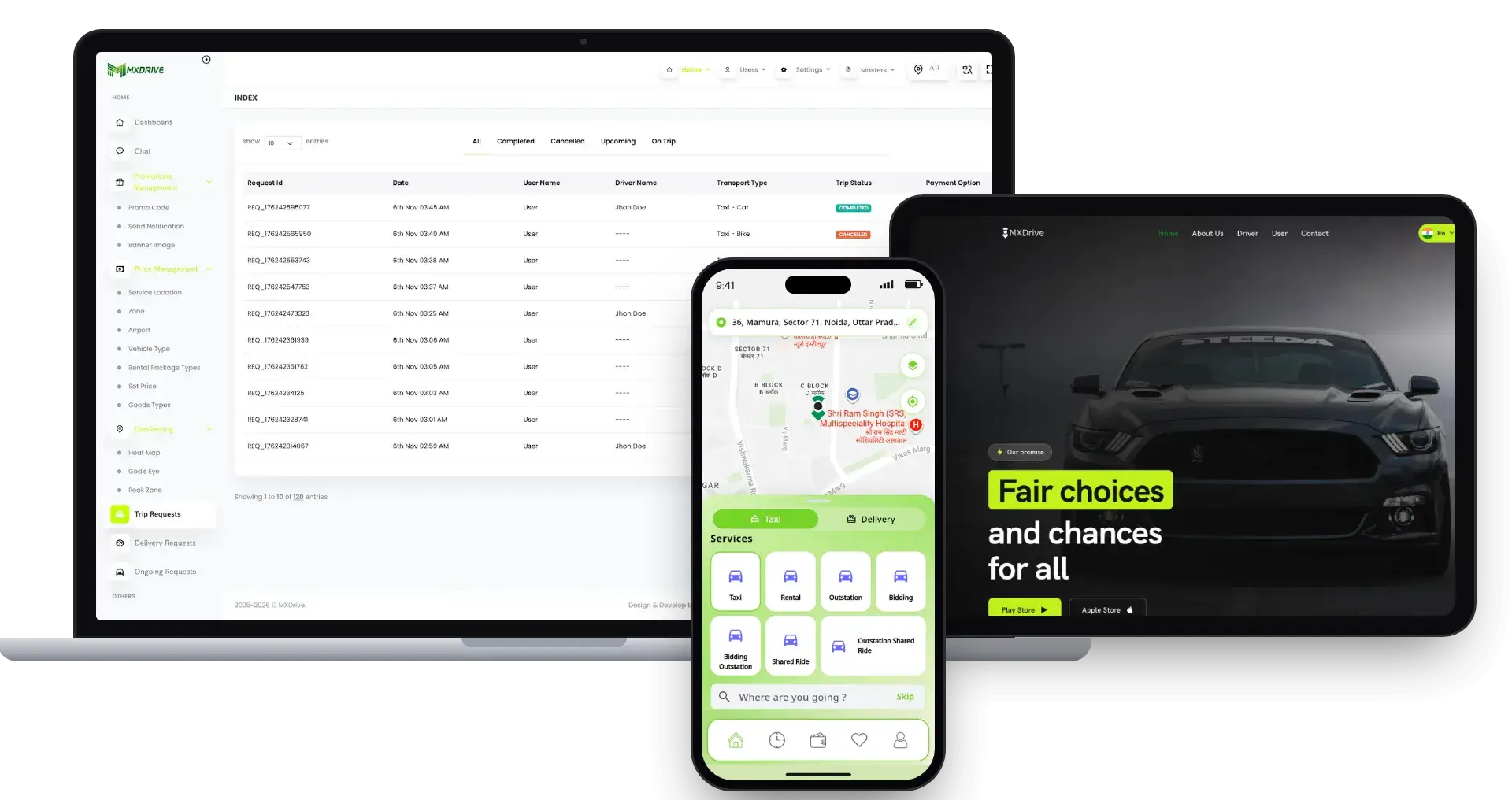
inDrive Clone cross-platform solution: the admin trip requests console, the booking website and the rider app.01
Pick it if: Riders offer their own fareinDrive Clone

Fare bidding sits at the center of this ride-hailing platform, which also offers taxi, rental and outstation services, an admin console for trip requests, a booking website and a rider app.

Explore Solution
Gojek Clone super app screens on three tilted phones.02
Pick it if: One app should cover rides and other servicesGojek Clone

A super app for several services: rides, delivery and other on-demand needs sit together in one app serving a single customer base.

Explore Solution
Turo Clone peer-to-peer car rental app screens.03
Pick it if: Cars are rented out dailyTuro Clone

A car rental marketplace that connects private individuals, with owner onboarding, trust workflows and trip management.

Explore Solution
UberEats Clone cross-platform solution with the admin orders console, the ordering website and the customer app.04
Pick it if: The cargo is meals, not ridersUberEats Clone

Food delivery marketplace: delivery dispatch, a customer app, an ordering website and a restaurant console in one product.

Explore Solution
DirectorySee all 90+ solutions

09The money side

Market Benchmarks

Taxi Market Benchmarks - Independent 2025-2026 Data

The revenue models above are ours. The figures below are not. They come from the Uber and Lyft annual reports on Form 10-K, Grab's full-year 2025 results and the UK Department for Transport, reproduced as published. They show what ride-hailing platforms keep from each trip in the US and Southeast Asia, and how large the licensed driver base is, so you can test your own business case.

Uber 10-K01

$29.7bn in Uber Mobility Revenue in 2025

Uber's annual report on Form 10-K shows Mobility segment revenue of $29.7 billion in 2025, up 18 percent from $25.1 billion in 2024. Across all its businesses Uber completed 13.6 billion trips, up 20 percent, and reported 202 million monthly active platform consumers in the fourth quarter, up 18 percent. Uber states that revenue comes from fees paid by drivers and merchants.

Lyft 10-K02

$18.5bn in Lyft Gross Bookings in 2025

Lyft's annual report on Form 10-K reports Gross Bookings of $18.5 billion in 2025, up 15 percent, on 945.5 million rides, up 14 percent. Revenue was $6.3 billion, up 9 percent. Revenue divided by Gross Bookings is about 34 percent (our arithmetic on reported figures), the share Lyft retains after driver earnings.

Grab03

15% of Grab Mobility GMV Kept as Revenue in 2025

Grab reports that full-year 2025 Mobility revenue grew 16 percent to $1,219 million, on Mobility gross merchandise value that grew 19 percent to $7,901 million, and that Mobility segment adjusted EBITDA was $690 million. Revenue divided by GMV is about 15 percent (our arithmetic on reported figures), a lower share than Lyft retains in the US.

UK DfT04

290,000 Licensed Private Hire Vehicles in England

The UK Department for Transport counted about 290,000 licensed private hire vehicles in England as at 1 April 2026, up 13 percent on 2024, alongside 417,300 taxi and private hire driver licenses, up 9 percent. The statistics were published on 13 August 2026 and include app-based operators, though they cannot separate app drivers.

Where each figure comes from.

Uber Technologies, Inc., Annual Report on Form 10-K for the year ended 31 December 2025, filed 13 February 2026 - sec.gov

Lyft, Inc., Annual Report on Form 10-K for the year ended 31 December 2025, filed 11 February 2026 - sec.gov

Grab Holdings Limited, Grab reports fourth quarter and 2025 results with first full year net profit, press release, 12 February 2026 - grab.com

Department for Transport, Taxi and private hire vehicle statistics, England: 2026, 13 August 2026 - gov.uk

All figures are the publishers’ own, reproduced as published from annual filings, a results release and official statistics. Two ratios (Lyft and Grab revenue divided by bookings or GMV) are our arithmetic on reported figures; each company defines its metrics differently. They describe the companies and country named, not any platform Miracuves builds, and nothing here is a revenue projection for your business.

Commercial Outlook

Taxi Business Marketability, Revenue Potential & Prospects

Revenue on a mobility platform rests on three kinds of confidence: drivers who stay online, riders who book, and companies that put their staff on your rides. The sections below look at winning each decision and keeping the relationship afterward.

  1. 01

    Share of Every Fare

    You keep a share of every completed ride, personal or business, so income climbs with ride volume instead of staff numbers.

  2. 02

    Many Revenue Lines, One Panel

    Surge, driver subscriptions, fleet commission, company billing and in-app ads for drivers each have their own settings in the admin console, so turning one on does not mean redesigning the others.

  3. 03

    Riders and Drivers You Own

    Companies, employees, riders, drivers and every ride sit in a database you host. What the platform builds up over time belongs to your business, not to an outside marketplace.

  4. 04

    Freedom to Move On

    With the whole codebase and the schema in your hands, moving to another host, developer team or strategy later needs nobody's approval.

Key Revenue Levers
  • Ride Commission
  • Fare Settings & Surge
  • Driver Subscription Plans
  • Fleet Owner Share
  • Cancellation Charges
  • Wallets, Company Billing & Card Costs
Lasting Value

What protects a platform is its supply and trust, not its feature list.

  1. 01Drivers who signed up with paperwork and a payout schedule are not quick to leave
  2. 02Companies with employees, policies and invoice history have reasons to stay
  3. 03The build-up begins at launch and stays in your own database
  4. 04Quick dispatch and transparent fares add a second moat
Illustrative Revenue Cases

The three cases below differ in one respect, the count of drivers online, and each one names the lever that counts most at that scale. Use them as input for planning conversations, not as forecasts of what any platform will earn.

Taxi Brand in One City25Drivers Online

Early revenue comes from fare commission.

A modest taxi brand serving one city. Day coverage comes from a few dozen drivers, and commission on completed fares covers running costs. Illustrative size, not a forecast.

Regional Operator Plus Fleets250Drivers Online

Fare commission, a fleet share and driver subscriptions.

A regional business in which fleet owners supply their own cars, which brings fleet commission and driver subscriptions into play next to fare commission. Illustrative size, not a forecast.

Mobility Platform Across Cities2,500Drivers Online

Many cities, surge rules and subscriptions all switched on.

A platform spanning many cities, where driver subscriptions, surge rules and corporate billing all bring in money and the admin reports show which city deserves attention next. Illustrative size, not a forecast.

10Why choose us

Why Miracuves

Miracuves Versus Other White Label Ride Hailing App Builders

A taxi operator has several ways to get software: buy a ready-made script, hire a freelancer or an agency, or start from the finished base Miracuves built with delivered work behind it.

Why Operators Pick Miracuves

  • 01

    Five Applications Included

    Five applications come wired together: rider, driver, rider web, admin and company portal. You are not stitching up five separate projects yourself.

  • 02

    Company Accounts Built In

    Departments, approvers, ride policies, a company wallet and daily invoices come with the base, plus a dispatch desk and fleet login. Generic scripts frequently end at the rider and driver apps.

  • 03

    Approvals and Ride Policies

    Rides are checked against a policy, then approved automatically or by a person before dispatch, and a what-if simulator lets you test rules first.

  • 04

    Taxi App Source Code You Own

    You get the entire codebase unencrypted, plus the database schema and deployment notes, so no one can raise the price or alter the terms afterward.

  • 05

    Proven Foundation

    An earlier release of this base supported Aone, reusing 20 of 25 building blocks unchanged, and the ledger is set out in the published case study.

  • 06

    Clear Readiness Wording

    Gateway accounts, hosting and app store developer accounts are things you supply yourself, and this page keeps them apart from base features and from paid add-ons.

Development Company

How to Choose a White Label Taxi App Development Company

Book one business ride through the demo first: rider app, dispatch desk, driver app, company invoice.

What to look for Miracuves

  • Working logins for every role Rider, driver and three console logins, no call
  • A corporate suite, not only rides Policies, approvals, a company wallet and daily invoices
  • A launch on the same base Aone, on an earlier release, reused 20 of 25 blocks
  • Source ownership Whole codebase unencrypted, plus schema
  • Time to launch Six working days, slips on our side worked free
  • Support after launch Guidance 60 days, fixes 6 months, updates 12 months

Walk away from any vendor who

  • Shows no dispatch desk or fleet login
  • Bills business rides to employees, not the company
  • Stores card numbers itself, not at the gateway
  • Ships encrypted code on a yearly license
  • Charges per seat or per trip

White Label Taxi App Against Scripts and Agencies, Compared Row by Row

CriteriaMiracuvesMiracuves Taxi AppTaxi Booking App ScriptCustom Agency Build
Launch TimelineOur build takes 6 daysOpen-ended or DIYQuoted per project, typically months
Who Owns the CodeFull code, unencryptedOften restricted or lockedUsually yes
Taxi Feature DepthFive apps, many trip types, corporate suiteBasic booking onlyLimited by the budget
Dispatch and Fleet PanelsDispatch desk, fleet login, company portalSeldom includedMade to order
Fares & PayoutsFare and surge rules, payouts, company invoicesDiffers per scriptCustom integration
Admin & ReportsReports, Rider-360 CRM, NPS, campaignsSparse or missingCustom build, priced extra
Security & ReadinessRole permissions, gateway-held card data, stated limitsMinimalVaries widely
Price, Speed & QualitySet price, fast launch, tested baseCheap but riskyCostly and slow
Support and Updates After LaunchGuidance for 60 days, bug fixes for 6 months, updates for 12 monthsSeldom offeredDepends on the contract

Few paths to a taxi platform come through the first busy month untouched. Those are the points where they differ.

Chat With Our Team

Changelog

Release Log for This Taxi Platform - Versions & Updates

This is the change history, newest entry first. Release 2.0 is the latest: apps built in React Native, a backend on Laravel 11, a dispatch engine and a corporate suite. The V1.x rows below stay as history.

VersionChanges
V2.0Apps rebuilt in React Native 0.82 under your own brand
Corporate portal with policies, approvals and company billing
Guest rides booked for people without the app
Rider-360 profiles, loyalty tiers and NPS surveys
Admin console grown to 52 sections
Laravel 11 backend with Redis and Reverb websockets
V1.13The new Places API replaces the earlier Google Places API
The Routes API takes over from the Directions API
Rental rides get a refreshed pickup confirmation screen
Dark theme issues fixed in the OpenStreetMap view
Assorted minor fixes in the mobile apps and in the admin panel
V1.12PHP moved up to 8.2
Flutter moved up to 3.24.4
A dark theme bug in the driver app was fixed
Small server and mobile app fixes
V1.11Flutter moved up to 3.22.3
Support for Android 14 added
Location update problems in the driver app addressed
SMS fixes covering Twilio and one more gateway
An End all stops action added
An option to edit gender added
V1.10Better geocoding and map API calls
Instant ride feature for delivery added
Completion of multiple stops added
Minor fixes
V1.9iOS location problem fixed
Live tracking now shows a route line to both rider and driver apps
Minor fixes
V1.8Gender field introduced for rider and driver sign-up
Interface refinements
A ride preference feature added
Minor fixes for server and mobile apps

Let's get started

Let's turn your taxi business idea into a platform you can run.

Ask for a free consultation and you leave with a fixed timeline and plain answers. Winning your trust counts for more with us than closing a fast sale.

  • We reply in under 2 hours
  • Free consultation
  • No contract lock-in
  • You own the source code

11Learn more

Blog & Resources

Taxi App Blog: Latest Guides & Insights

Read our latest guides on what a taxi app needs, how ride platforms make money and how the technology stack fits together.


The platform9 questions

01What is a white label taxi app?

A white label taxi app is ready-made ride-hailing software that you operate as your own brand. This one is delivered as the rider app, the driver app, a browser version for riders, the admin console and a corporate portal, with a public website on top, all carrying your name.

02How long does launching a white label taxi app take?

Launch takes 6 days of Miracuves build time, covering rebranding, deployment to your hosting and publishing of the apps from your developer accounts. Apple, Google and your payment provider run their own approval steps - store review and gateway onboarding - so those fall outside the 6 days. Anything custom is scoped and quoted on its own.

03Can the platform grow with my fleet?

Yes. The apps run separately, driver positions sit in Redis, dispatch runs as queued jobs and websockets carry live updates. Each added city comes down mostly to hosting and configuration, and any work outside the base build is scoped in writing.

04What support and updates come after launch?

Support comes in three periods that all begin at launch: guidance on the platform covers 60 days, bug fixes get priority for 6 months, and the product keeps receiving updates for 12 months. Replies to a first message come within 2 hours, Mon-Sat, between 10:00 and 19:00 IST.

05Is this the same software as your branded clone pages?

Yes. The branded clone pages on this site describe this same platform as modeled on a well-known app, while this page covers the platform underneath. Miracuves delivers every solution white-label, so your name, logo, icons and color scheme are applied at delivery.

06Is it legal to launch a taxi app in my city?

Software like this is generally lawful to build and sell, but running a taxi service depends on licensing where you operate. The platform builds on ordinary marketplace patterns, and no code, design or content has been copied from an existing taxi brand; it launches under your own brand and rules. Choose your own name and logo, and have local counsel check which licensing, driver pay and passenger rules apply to taxi and private hire in each market. Nothing here is legal advice from Miracuves.

07What must I provide before launch?

You supply what surrounds the software: hosting and a domain, a verified store developer account to list the apps, your branding and business information, a payment gateway already onboarded with KYC done, and keys for services such as Google Maps, an SMS gateway and Firebase. Miracuves does not apply to gateways for you or write your privacy policy and terms.

08Do I get the full source code?

Yes. You get the full source code, unencrypted, spanning the Laravel backend, the staff console, the company portal and both React Native apps, together with the database schema, architecture notes and deployment configuration. No seat fee or per-trip charge applies.

09How much does a white label taxi app cost?

A white label taxi app from Miracuves is priced at a fixed $3,099, live in 6 working days, with five surfaces working on delivery. Support is included and starts at launch: guidance for 60 days, plus priority bug fixes for 6 months, plus product updates for 12 months. The same base already served Aone, which reused 20 of 25 building blocks unchanged. Miracuves has built software since 2010. Its record: 9,000+ projects delivered, with 6,000+ clients served and 90+ ready-made solutions on the shelf.

Booking7 questions

10How does a rider book a ride?

Riders can log in using an OTP, Google or Apple, or look around first as a guest. Business riders flip the For Me / Business switch, then everyone picks a service tile (Cab, Parcel, Freight, Ambulance or Find Driver), sets pickup and drop-off, and chooses a vehicle with the fare and ETA shown. The system matches a driver, and the trip starts when the driver enters the rider's OTP.

11Can riders book scheduled rides in advance?

Yes. A scheduled ride must be booked at least 3 hours before pickup and is released to drivers 15 minutes beforehand. When no driver accepts, the ride is canceled and the rider gets notified.

12How does a rider track a trip live?

Yes. The rider app shows the driver moving on the map over websockets, with push alerts at each stage. Riders can also share a live-tracking link, which opens on the rider web app.

13What payment options does it support?

Riders pay by cash, wallet or any enabled gateway, 13 in all, and business rides can be billed to the company. You supply your own gateway account, onboarded with KYC finished, and the gateway processes the card details.

14Can riders cancel a booking?

Yes. A rider cancels with a reason, and any fee is shown before the cancel is confirmed. Your own cancellation policy decides whether a fee applies after a driver accepts.

15What separates a white label taxi app from a custom build?

A white label taxi app arrives finished and rebranded in 6 days, while a custom build is scoped from scratch per project and usually takes months. Changes to ours are quoted separately.

16How does the app calculate fares?

Before booking, riders see an itemized estimate with fare and ETA for each vehicle type. Surge can vary by vehicle type, zone and time, and ride preferences like a quiet ride or AC are added into the fare.

Drivers, dispatch & fleet owners7 questions

17How do drivers get ride requests?

Dispatch picks the nearest eligible driver and sends a timed offer that rings and vibrates; a decline or timeout hands the ride on.

18How do driver payouts work?

Drivers keep a wallet, can top it up and ask for withdrawals to a payout account. Subscription plans, referrals, incentives and daily goals are built in too, and the admin sets commissions.

19What can the dispatcher do?

A dispatcher keys in phone bookings on the Ride Requests page and picks the driver manually from the ride or ride-request page. Requests are listed by status, so one desk serves phone and app customers from a single driver pool.

20What if a driver cancels a ride?

Dispatch offers it to the next nearest driver, or staff can assign one by hand, so the rider is still looked after.

21Are there limits on manual assignment?

Yes. The system refuses offline drivers and anyone already on a trip, and tells the other drivers who saw the offer that it is gone. Which staff hold the dispatcher role is your call as the operator.

22What does the fleet panel do?

Fleet managers use the driver app or the fleet login. They get a live map of their own drivers, can add or remove drivers and vehicles with their documents, and see fleet earnings by day, week or month.

23Can fleet owners view earnings and withdraw them?

Fleet owners follow earnings by day, week or month and request fleet withdrawals. You set commissions in the admin console, so each fleet's margin stays under your control.

Admin, payouts & revenue6 questions

24What does the admin panel manage?

The admin console has 52 sections: a live KPI dashboard and heat map, zones, surge and airports, coupons, driver documents, commissions, withdrawals, reports, help desk, landing-page editor, staff roles and about 70 switches.

25Can I configure surge pricing?

Yes. Surge prices can follow a plain time window, or be set per zone, vehicle type and time window. Peak zones are marked on a map and show live to drivers once switched on.

26Can I watch every ride live?

Yes. Admins get live ride tracking, driver locations on a map and a heat map, and dispatchers get ride lists by status.

27How are earnings and payouts managed?

You can export transaction, trip, driver, coupon, zone and incentive data to CSV, Excel or PDF. Driver and fleet wallets and withdrawals sit in the console, and company invoices run on a daily cycle.

28Where does the first revenue come from?

Fare commission comes first, since the first completed ride already earns it. Driver subscriptions and fleet commission follow when enough cars are on the road. Corporate billing is built in too, as are Google native ads inside the driver app, though what they earn depends on your own client deals and ad setup.

29How defensible is a taxi platform?

Mostly through supply and trust, not features. Drivers who joined with their documents, vehicle and payout schedule rarely walk away, and riders with past trips and saved addresses have reasons to come back. That build-up begins at launch and stays in your database. Quick dispatch and transparent fares form a second layer, since reliability is hard for others to copy.

Tech stack5 questions

30What technology powers the platform?

The web and admin side runs on Laravel 11 with PHP 8.2 or newer and MySQL; Redis handles queues, cache and driver positions. Rider and driver apps use React Native 0.82 on Android and iOS, and the map provider, OpenStreetMap or Google, is switched in admin.

31Does it run on iOS and Android?

Yes. Both mobile apps are React Native builds for Android and iOS, and riders can also book in a browser on the rider web app. Publishing happens through your own developer accounts, and app store review lies beyond our 6-day build time.

32Is a ready-made white label taxi app better than custom development?

Usually, because the white label taxi app already runs rider and driver apps, dispatch, fleets, company billing and payouts, and launches with your branding at one fixed price within 6 working days. A custom build starts from nothing. Where your operation needs something the base does not do, that change is scoped and quoted in writing and added to the same code.

33What is the business model of a white label taxi app?

A taxi platform earns from several lines at once, and each is a separate setting. You keep a commission on every completed fare, raise fares with surge set per vehicle type, zone and time slot, sell driver subscription plans, take a share from fleet owners, charge cancellation fees and bill company accounts through the corporate portal. Changing one line leaves the others untouched, so you can test pricing per city.

34What is the step-by-step process to launch my white label taxi app?

Open the live demo and try the rider app, driver app, corporate portal and admin console. Then send us your brand, domain, hosting, developer accounts, an onboarded payment gateway and third-party keys. We put your branding on every application, deploy them to your servers and get the app builds ready under your own developer accounts, and the taxi platform is up 6 working days after kickoff. Apple and Google store review and payment gateway approval keep their own calendars.

Disclaimer

Miracuves is an independent software development company. We are not affiliated with, connected to, sponsored by, or endorsed by Uber.

Read our full Legal Notice & Disclaimer →
Why this name

“White label taxi app” describes a category of product, not any one company. Brand names appear elsewhere on this site only to describe the kind of platform being built and the terms buyers search for.

Who built this

The entire design and codebase is built by our own team. The product contains no code, design, graphics, or content originating from the Uber website or applications.

Trademarks

Uber and all other third-party names and marks are the property of their respective owners, referenced here solely to describe the category of software offered.