

Building an app sounds exciting. You imagine users downloading it, investors noticing it, and your startup taking off. But here’s the reality — most apps fail not because they are poorly built, but because no one actually needs them.
That’s why validating your app idea before development is one of the smartest moves you can make as a founder.
At Miracuves, we often work with startups that come in with great ideas but need clarity on whether those ideas will actually work in the real market. Validation helps you avoid wasting time, money, and effort on something that may never succeed.
This guide will walk you through a practical, step-by-step approach to validate your app idea before writing a single line of code.
Why App Idea Validation Is Critical
Most Startups Fail Due to Lack of Demand
Studies consistently show that around 90% of startups fail, and one of the biggest reasons is building something people don’t need. Founders often assume demand instead of testing it.
Development Is Expensive and Time-Consuming
Even a simple app can cost thousands of dollars and months of effort. Without validation, you are essentially gambling with your resources.
Validation Reduces Risk
Validation gives you confidence. It ensures that you are solving a real problem for real users before investing heavily in development.
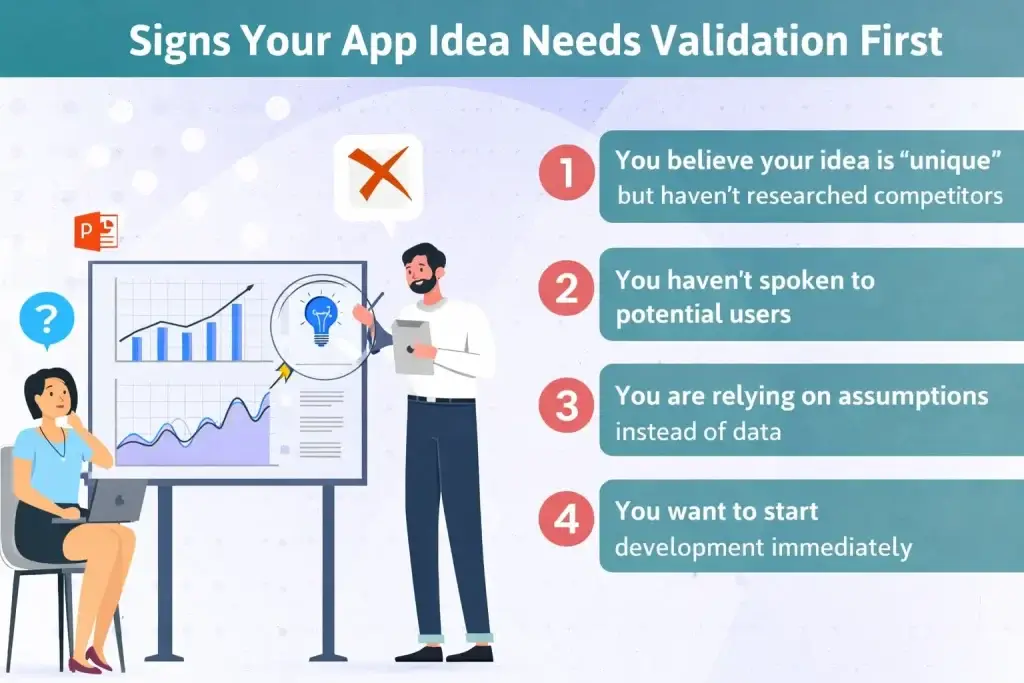
If any of these apply, you should pause and validate first.
Step-by-Step Framework to Validate Your App Idea
Step 1: Clearly Define the Problem
Before thinking about features, focus on the problem your app is solving.
Ask yourself:
- What pain point does this app address?
- Who is experiencing this problem?
- How are they currently solving it?
A strong problem statement is the foundation of validation.
Step 2: Identify Your Target Audience
Who Will Use Your App?
You need to define:
- Age group
- Location
- Profession
- Behavior patterns
The more specific you are, the easier it becomes to validate.
Step 3: Analyze Competitors
Understand What Already Exists
Search for:
- Similar apps in the app store
- SaaS tools solving the same problem
- Indirect competitors
This helps you:
- Validate demand
- Identify gaps
- Improve your idea
Step 4: Validate Market Demand
Use Real Data Sources
Check platforms like:
- Google Trends
- Reddit discussions
- Quora questions
- Product Hunt
If people are actively discussing the problem, there is demand.
Step 5: Create a Simple Landing Page
Test Interest Without Building the App
Create a page that explains:
- What your app does
- Who it is for
- Why it matters
Add a simple call-to-action like:
- “Join waitlist”
- “Get early access”
If people sign up, your idea has potential.
Step 6: Run Small Experiments
Use Ads or Social Media
Run low-budget campaigns on:
- Google Ads
Measure:
- Click-through rate
- Sign-ups
- Engagement
This gives real validation from actual users.
Read more : – Top Features Every Marketplace App Needs
Step 7: Build a Minimum Viable Product (MVP)
Start Small, Learn Fast
An MVP is a simplified version of your app with only core features.
Instead of building everything from scratch, many founders now use ready-made solutions or clone apps to test their idea quickly. This reduces time and cost significantly.
Best Methods to Validate an App Idea
| Method | Cost | Speed | Accuracy |
|---|---|---|---|
| Surveys | Low | Fast | Medium |
| Landing Page | Medium | Fast | High |
| MVP | High | Medium | Very High |
Each method has its place, but combining multiple methods gives the best results.
MVP: The Smartest Way to Validate
An MVP allows you to test your idea in real conditions. Instead of guessing what users want, you observe how they actually behave.
Many startups today are skipping full development and launching faster using ready-made apps or clone platforms. This approach helps you validate your idea without heavy investment.
Common Mistakes to Avoid
Building Too Early
Jumping straight into development without validation is the biggest mistake founders make.
Ignoring User Feedback
Validation is about listening, not proving your idea is right.
Overcomplicating the MVP
Your MVP should be simple. Focus only on the core problem.
Asking the Wrong Questions
Avoid leading questions like:
“Would you use this app?”
Instead ask:
“How are you solving this problem today?”
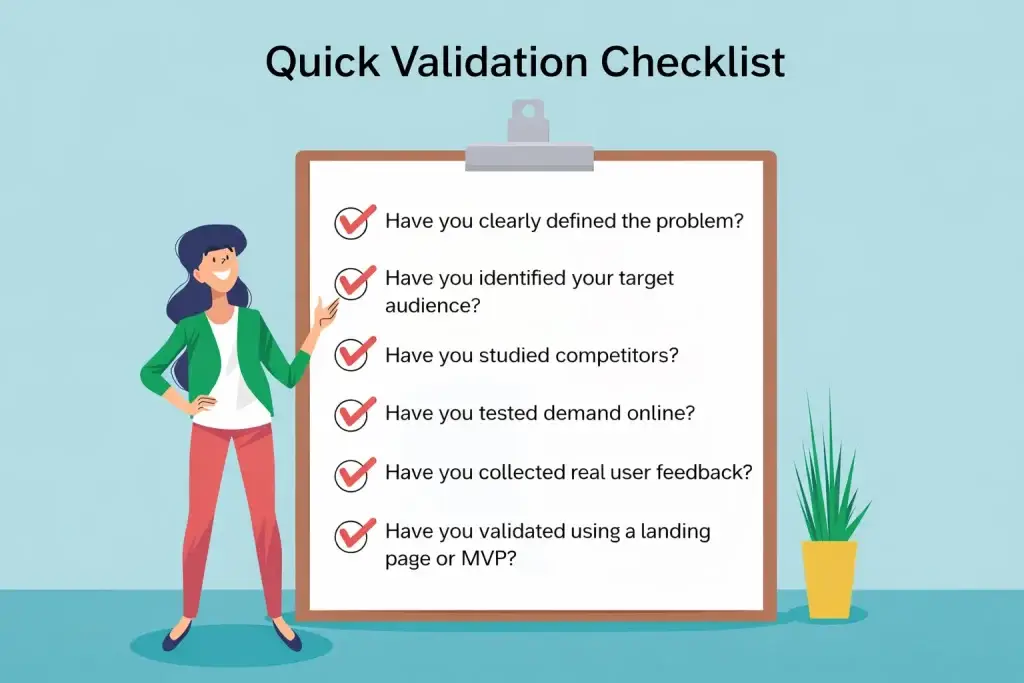
If you can confidently answer yes to these, you are ready to move forward.
How Miracuves Helps You Validate Faster
Validating your app idea doesn’t always require starting from zero.
With solutions like:
- Ready-made apps
- Clone platforms
- SaaS-based systems
- AI-powered automation tools
Miracuves helps founders test their ideas quickly without spending months on development.
This allows you to launch faster, gather feedback, and refine your product before scaling.
Conclusion
Validating your app idea before development is not optional — it is essential. It saves your time, reduces risk, and increases your chances of building something people actually want. Instead of rushing into development, take a step back and test your idea using the methods shared in this guide.
If you validate properly, you are not just building an app — you are building a business with real potential.
If you want to validate your app idea quickly and build a smart clone, contact Miracuves today to get started.
FAQs
1. How long does it take to validate an app idea?
It can take anywhere from a few days to a few weeks depending on the methods you use.
2. Do I need to build an MVP to validate my idea?
Not always. You can start with landing pages or surveys, but an MVP gives stronger validation.
3. What is the cheapest way to validate an app idea?
Using surveys, interviews, and organic social media feedback is the most cost-effective approach.
4. Can I validate an app idea without coding?
Yes, many tools and ready-made platforms allow you to validate ideas without writing code.
5. What if my idea fails validation?
That’s a success in itself because you avoided building something that wouldn’t work. Use the insights to improve or pivot your idea.
Related Articles
Miracuves is an independent software development company. We are not affiliated with, connected to, sponsored by, or endorsed by any company or product named in this article.
Terms such as “X Clone” are used descriptively. It is how the software industry refers to building a platform with functionality comparable to a known service, and how clients search for it.
The entire design and codebase of our products is built by our own team. Our products contain no code, design, graphics, or content originating from any third-party website or applications.
All third-party names and marks referenced in this article are the property of their respective owners, referenced solely to identify the services discussed.