

Key Takeaways
- A digital astrology platform user journey can begin with free Kundli generation, horoscope insights, compatibility tools, or personalized chart summaries before introducing paid astrologer consultations.
- Free tools should provide immediate value while helping users understand which questions may benefit from deeper interpretation through chat, voice, or video consultations.
- The journey should connect discovery, birth-detail entry, personalized insights, astrologer selection, consultation booking, payment, follow-up, and repeat engagement without unnecessary friction.
Free-to-Paid Journey Signals
- Free Kundli tools can capture birth details and generate structured insights around planetary positions, houses, doshas, compatibility, career, relationships, or other relevant astrology categories.
- Contextual prompts can recommend astrologers based on the user’s selected concern, preferred language, expertise, availability, ratings, consultation mode, and pricing.
- Clear profiles, transparent consultation rates, available time slots, introductory offers, wallet balance, and simple checkout can reduce friction between free insight and paid consultation.
Consultation Conversion Insights
- Operators should track Kundli completion, insight views, astrologer profile visits, consultation clicks, booking conversion, payment completion, session duration, repeat consultations, and retention.
- Follow-up recommendations, saved reports, consultation history, reminders, personalized content, and relevant astrologer suggestions can encourage users to return without overusing promotional prompts.
- Miracuves develops customizable digital astrology platforms with Kundli generation, personalized insights, astrologer discovery, chat and call consultations, scheduling, payments, recommendations, analytics, and admin controls.
A digital astrology platform does not usually win because users pay on the first screen. Most users arrive with curiosity. They want to check a birth chart, read a daily horoscope, test compatibility, understand an event timing, or ask a personal question.
That first free interaction is not a throwaway feature. It is the beginning of the business model.
The strongest astrology platforms treat free kundli, horoscope, matching, panchang, and similar tools as trust-building entry points. The paid layer comes later, when the user sees personal relevance and feels ready to go deeper through a report, AI answer, remedy, or human consultation.
For founders, the real challenge is not simply adding free tools and paid calls into the same app. The challenge is designing a journey where every step feels natural, useful, and commercially measurable.
Miracuves helps founders build a ready-made astrology consultation platform and a free-tool astrology app foundation where free discovery, wallet activation, consultation, practitioner management, and admin control can work as one connected product. The key is to design the journey before scaling the traffic.
Why Free Astrology Tools Are the Front Door, Not the Final Product
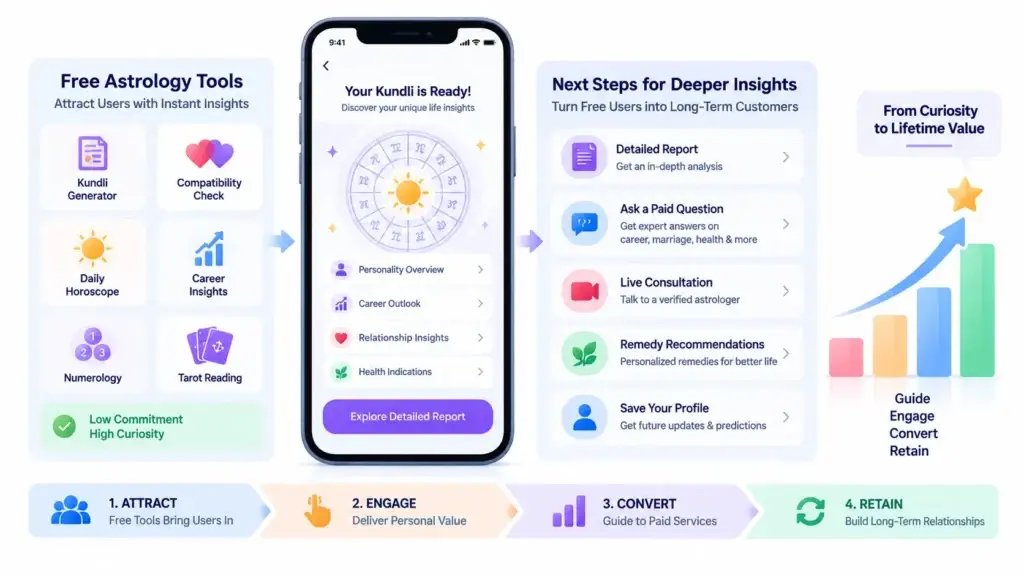
Free astrology tools attract users because they answer high-curiosity questions with low commitment. A visitor may not be ready to pay an astrologer immediately, but they may be willing to enter birth details to generate a kundli or check compatibility.
That creates the first important platform moment: the user gives data because they expect personal value.
A basic app treats this as a completed interaction. A better platform treats it as the start of a guided journey. Once the free result appears, the app can help the user understand what the result means, what areas need attention, and what paid option makes sense next.
For example, after a free kundli report, the platform can guide the user toward:
- A detailed downloadable report
- A paid question about career, marriage, health, or finance
- A live consultation with a relevant expert
- A remedy recommendation
- A saved profile for future horoscope updates
The goal is not to block free value. The goal is to make the next step obvious.
For founders building a kundli-first product, the free experience should be supported by the right astrology app feature flow. Tools such as kundli generation, horoscope, panchang, matching, saved profiles, and paid report previews should not feel disconnected. You can explore how these feature layers are structured in a free-tool-led astrology platform.
The Ideal Free-to-Paid Journey in an Astrology Platform
A well-designed astrology platform journey usually moves through five stages.
| Journey Stage | User Mindset | Platform Goal | Monetization Opportunity |
|---|---|---|---|
| Discovery | “Let me try this.” | Offer free value quickly | None or soft signup |
| Personalization | “This feels relevant to me.” | Capture birth details and preferences | Saved profile |
| Interpretation | “What does this mean?” | Explain insights clearly | Paid report preview |
| Deepening | “I need a personal answer.” | Recommend the right paid path | Wallet recharge, consultation, AI answer |
| Retention | “I want to come back.” | Build habit and repeat trust | Repeat consultation, subscription, reports, remedies |
This journey works because it respects user psychology. Astrology users often need reassurance before payment. They want to know whether the platform understands their situation. If the free layer feels generic, the paid layer feels risky. If the free layer feels personalized and useful, paid guidance becomes easier to accept.
Step 1: Make the Free Kundli Experience Fast and Meaningful
The first step should feel effortless. If users need to fill too many fields, create an account, verify too early, or handle a confusing form before seeing value, the platform may lose them before the journey begins.
A strong free kundli flow should include:
- Simple birth-detail entry
- Clear location selection
- Fast report generation
- Easy-to-read charts and summaries
- Mobile-first layout
- Saved profile option after the result, not before the result
- Clear next steps based on user interest
The free result should not overwhelm the user with dense technical language. It should give enough clarity to create interest while leaving space for deeper interpretation.
For example, instead of only showing planetary positions, the platform can organize insights into practical areas such as personality, career direction, relationship patterns, timing, strengths, concerns, and questions to explore.
This helps the user understand why a paid report or consultation may be useful.
Step 2: Use Personalization to Build Trust Before Payment
Personalization is the bridge between a free feature and a paid action.
A user is more likely to pay when the platform responds to their specific context. That may include birth chart data, selected concern, preferred language, relationship status, location, or consultation category.
For founders, personalization should not be limited to the report screen. It should influence the full journey:
- Which expert profiles appear first
- Which consultation categories are recommended
- Which report upgrades are shown
- Which push notifications are sent
- Which remedy or content suggestions appear
- Which wallet offer is triggered
A user who checked compatibility should not see the same journey as someone checking career timing. A user reading daily horoscope should not receive the same paid prompt as someone reviewing a detailed birth chart.
This is where astrology platform UX becomes a conversion system, not just a design layer.
AI can make this journey even more personalized when it is used carefully. Instead of showing the same paid prompt to every user, an AI-powered astrology flow can guide users based on their birth details, selected concern, report behavior, preferred language, and consultation intent. Founders planning this type of experience can explore a white-label AI astrology platform where AI readings, wallet metering, human consultations, and free astrology tools work inside one connected journey.
Step 3: Place Paid Prompts at Natural Decision Moments
Paid prompts fail when they appear too early or too aggressively. A user who has not yet received value may see payment as a barrier. A user who just received a relevant insight may see payment as the next logical step.
The right paid prompt should appear at moments such as:
- After a free kundli summary reveals an unresolved question
- After a compatibility result highlights a concern
- After a horoscope suggests a timing-related decision
- After a user views multiple expert profiles
- After a user repeats the same category search
- After a free result shows a preview of a deeper paid report
The message should explain value, not pressure the user.
A weak prompt says: “Pay now to continue.”
A stronger prompt says: “Want a deeper explanation of your career timing? Get a detailed report or speak with an expert.”
That small difference matters. It turns the paid step into a helpful continuation instead of a forced checkout.
This is also where the platform’s monetization logic becomes important. Paid prompts should connect naturally with reports, wallet recharge, consultation minutes, expert recommendations, and repeat usage. A clear astrology consultation monetization model helps founders avoid random upsells and design revenue around user intent.
Step 4: Design the Wallet Recharge Flow Around Confidence
Wallet recharge is one of the most sensitive parts of the astrology consultation journey. Users may hesitate if they do not understand how billing works, how much time they need, or what happens if a session ends early.
A good wallet flow should make these details clear before payment:
- Per-minute pricing or fixed report pricing
- Minimum recharge amount
- Estimated consultation duration
- Current wallet balance
- Bonus or offer logic, if applicable
- Refund or unused balance rules
- Session deduction history
- Payment confirmation
- Recharge failure handling
The wallet should not feel like a hidden billing layer. It should feel transparent and predictable.
Payment trust becomes even more important when users are paying per minute or recharging before a live session. Clear deduction history, secure payment handling, refund visibility, and admin-side payment monitoring help create a safer consultation experience. For a deeper view, founders can review this guide on secure wallet and consultation billing flows.
For founders, this is a trust issue as much as a payment issue. If users feel confused after one paid interaction, repeat conversion becomes harder. If users can see recharge history, deductions, refunds, and remaining balance clearly, the platform feels more reliable.
Step 5: Make Expert Discovery Feel Guided, Not Random
Once a user decides to consult, the next challenge is choosing the right expert. Too many astrology platforms show a long list of profiles and expect the user to decide alone.
That creates friction.
A better discovery experience helps users filter and compare experts by:
- Specialization
- Language
- Price per minute
- Availability
- Ratings and reviews
- Experience
- Consultation mode
- Response time
- Category match
- Online status
The platform should also explain why a certain expert is being recommended. For example, a user asking about marriage compatibility should see relevant specialists before general profiles.
The goal is to reduce decision fatigue. When users can quickly identify the right expert, they are more likely to start a paid chat, call, or video session.
This is why expert-side and user-side features should be planned together. Availability status, language filters, pricing visibility, category matching, reviews, and profile depth all influence whether a user feels confident enough to begin a paid session. These flows are usually part of strong expert consultation platform features.
Step 6: Keep the Consultation Flow Smooth After Payment
The user journey does not end when payment is made. The consultation experience decides whether the user returns.
A strong consultation flow should include:
- Clear session start confirmation
- Live wallet balance visibility
- Timer or session duration indicator
- Chat, voice, or video mode clarity
- Mid-session top-up option
- Network failure handling
- Session summary
- Rating and review flow
- Follow-up recommendation
- Support option for disputes or technical issues
For real-time astrology consultation platforms, small friction points can hurt trust. If a session disconnects, wallet deduction is unclear, or the user cannot recharge without leaving the session, the paid experience feels broken.
This is why founders should think about consultation UX and backend billing together. The interface and money logic must stay synchronized.
Live consultation quality also depends on the real-time layer behind the product. Chat continuity, call stability, session timers, wallet balance updates, and mid-session recharge prompts must work without delay. Founders planning chat, call, or video-based astrology sessions can read more about the real-time consultation experience.
Step 7: Add Paid Reports for Users Who Are Not Ready for Live Consultation
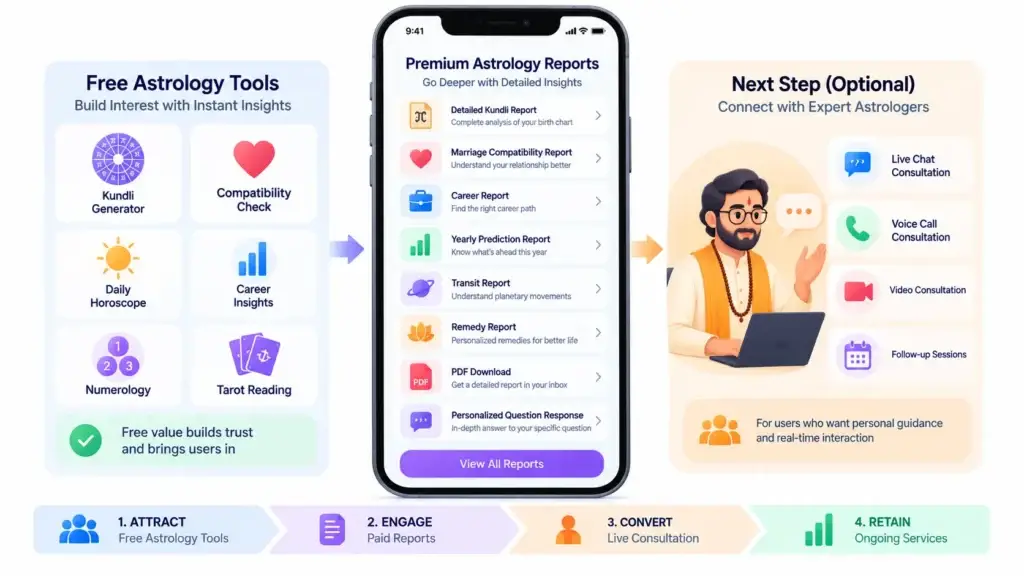
Not every user wants to speak to an expert immediately. Some prefer a written report first. Others may want to explore privately before making a paid call.
Paid reports are useful because they create a lower-pressure monetization path between free tools and live consultation.
Common paid report options include:
- Detailed kundli report
- Marriage compatibility report
- Career report
- Yearly prediction report
- Transit report
- Remedy report
- PDF download
- Personalized question response
A smart platform can show paid reports as an upgrade from free insights. The free version gives the user enough value to trust the system. The paid version goes deeper and offers more detail.
This creates a softer conversion path for users who are interested but not ready for real-time interaction.
Paid reports also create a separate revenue path for users who prefer private, self-paced guidance. A platform can combine free kundli results with downloadable reports, AI-assisted readings, personalized PDFs, and later expert consultation. This makes the paid astrology report business model useful for founders who want more than one monetization route.
Step 8: Use Content to Bring Users Back Before They Need Another Consultation
Astrology is not only a one-time consultation category. Users often return for daily guidance, monthly predictions, festival timing, relationship questions, career decisions, and recurring life events.
That means content can support retention.
Useful content layers include:
- Daily horoscope
- Weekly horoscope
- Monthly horoscope
- Panchang updates
- Muhurta guidance
- Compatibility education
- Festival and ritual explainers
- Expert-authored articles
- Personalized reminders
Content should not sit separately from the product. It should connect back to saved profiles, expert categories, report upgrades, and consultation flows.
For example, a user reading a monthly career prediction can be guided toward a career-focused report or consultation. A user checking a marriage-related article can be guided toward compatibility matching or relationship guidance.
Founder Decision Signals
Speed
If the goal is to test demand quickly, the journey should start with free tools and only add complex monetization layers after the core funnel is clear.
Trust
Users need transparent wallet deductions, visible expert profiles, clear pricing, and useful free insights before they feel comfortable paying.
Scalability
The platform should connect free tools, reports, wallet, expert sessions, content, and admin controls through one backend logic rather than separate disconnected systems.
Market Fit
Track which free entry points lead to wallet recharge, report purchase, consultation, or repeat visits. That data shows where the strongest monetization path exists.
Why Journey Continuity Matters Before Monetization
A digital astrology platform should not push users directly from a free kundli result to payment. The journey needs a smooth bridge where users understand what they discovered, why it matters, and what deeper guidance can help them next. When free tools, paid reports, wallet recharge, and expert consultation feel connected, users are more likely to trust the platform and continue without feeling pressured.
This continuity also helps founders understand which part of the funnel needs improvement. If users generate free kundli reports but do not click paid reports, the issue may be weak interpretation. If they view expert profiles but do not recharge, the issue may be pricing clarity or trust. A connected journey makes these drop-off points easier to identify and optimize.
Mistakes Founders Should Avoid
Asking for Payment Before Showing Value
Users who arrive for free kundli or horoscope tools need to see useful insight first. A payment wall too early can break trust before the platform has earned attention.
Treating Wallet Recharge as a Generic Checkout
Astrology consultation billing needs clarity. Users should know how balance is used, how sessions are charged, and what happens to unused funds.
Showing Too Many Expert Profiles Without Guidance
A long list of experts can create confusion. Category-based recommendations, filters, availability, price, and language matching help users decide faster.
Separating Content, Tools, and Consultation
If free tools, content pages, paid reports, and consultation flows operate separately, users do not receive a natural next step. The platform should feel connected from discovery to payment.
What the Admin Dashboard Should Track
A founder cannot improve the astrology app journey without visibility into user behavior. The admin dashboard should show where users enter, where they drop, and which free interactions convert into revenue. To understand the operational side more clearly, founders can also review key astrology app features for platform operators.
Important metrics include:
| Funnel Metric | Why It Matters |
|---|---|
| Free kundli completions | Shows whether the acquisition tool is usable and attractive |
| Saved birth profiles | Indicates user trust and future personalization potential |
| Paid report clicks | Shows interest in deeper interpretation |
| Wallet recharge rate | Measures payment confidence |
| Consultation start rate | Shows whether expert discovery and pricing are working |
| Session completion rate | Reveals technical and trust quality |
| Repeat consultation rate | Measures long-term retention |
| Refund or dispute rate | Highlights billing, quality, or expectation issues |
| Expert response time | Impacts user satisfaction and conversion |
| Category-wise revenue | Helps identify which life questions monetize best |
Admin analytics should not only report revenue. They should explain the journey behind the revenue.
How Miracuves Helps Founders Build the Journey Faster
Building an astrology platform from scratch can take time because the product is not just one app. It includes free tools, user profiles, expert dashboards, wallet logic, real-time communication, reports, content, admin controls, and monetization settings.
Miracuves helps founders move faster with ready-made and white-label astrology platform foundations that can be customized around business model, branding, consultation categories, and launch priorities. For ready-made solutions, Miracuves positions a 6-day delivery path where relevant to the selected scope.
For founders, this matters because the first market version should test the journey, not just display features. The faster you can observe where users move from free kundli to paid consultation, the faster you can refine pricing, expert categories, content strategy, wallet offers, and retention flows.
Founders who are planning scope, budget, and launch priorities should also understand how feature selection affects the final build. Consultation modes, free tools, wallet logic, paid reports, expert panels, and admin controls can all influence planning. For cost-focused readers, this guide on the development cost of an astrology platform can be a useful next step.
Final Thoughts
The strongest digital astrology platforms do not treat free kundli tools, paid reports, wallet recharge, and expert consultations as separate features. They treat them as one connected user journey.
A user arrives with curiosity. The platform gives value. The result creates trust. The next step offers deeper clarity. Payment happens when the user understands why the paid action matters.
For founders, that is the real product strategy: design the journey before chasing scale. A free tool can bring traffic, but a thoughtful funnel turns that traffic into trust, consultation, repeat usage, and long-term revenue.
FAQs
How can a free kundli tool help generate paid consultations?
A free kundli tool gives users immediate personal value. Once users see insights related to career, marriage, relationships, finance, or timing, the platform can guide them toward a detailed report or expert consultation for deeper interpretation.
What is the best first paid step in an astrology app?
The best first paid step depends on user behavior. Some users prefer a low-pressure paid report, while others are ready for a live consultation. A strong platform should support both paths and let data show which converts better.
When should an astrology app ask users to recharge their wallet?
Wallet recharge should appear when the user has a clear reason to pay, such as starting a consultation, buying a report, asking a personal question, or unlocking deeper analysis. Asking for recharge before showing value can reduce trust.
What features improve paid consultation conversion?
Expert filters, clear pricing, visible availability, ratings, language preference, category matching, wallet transparency, and smooth chat or call flow can improve paid consultation conversion.
Should free astrology tools require login?
Not always. Many platforms perform better when they show initial value first and ask users to save their profile after the result. This reduces friction and makes registration feel useful rather than forced.
How do paid reports fit into the astrology app journey?
Paid reports work as a middle step between free tools and live consultations. They are useful for users who want deeper guidance but are not ready to speak to an expert immediately.
What should founders track in an astrology app funnel?
Founders should track free tool completions, saved profiles, paid report clicks, wallet recharges, consultation starts, session completion, repeat bookings, refund requests, and category-wise revenue.
How can Miracuves support a digital astrology platform launch?
Miracuves can help founders build a white-label astrology platform foundation with free tools, consultation workflows, wallet systems, expert panels, admin controls, and source-code ownership, helping teams move from planning to launch faster.
Miracuves is an independent software development company. We are not affiliated with, connected to, sponsored by, or endorsed by any company or product named in this article.
Terms such as “X Clone” are used descriptively. It is how the software industry refers to building a platform with functionality comparable to a known service, and how clients search for it.
The entire design and codebase of our products is built by our own team. Our products contain no code, design, graphics, or content originating from any third-party website or applications.
All third-party names and marks referenced in this article are the property of their respective owners, referenced solely to identify the services discussed.