Key Takeaways
- An astrology portal platform may process sensitive birth details, personal questions, consultation records, wallet activity, and payment information.
- Account protection, encrypted data handling, role-based access, payment safety, and activity monitoring form the core trust layer.
- Administrators, content editors, support teams, practitioners, finance users, and technical staff should receive different permissions.
- Every wallet recharge, report purchase, consultation payment, refund, and payout should be traceable through reliable transaction records.
- Security should be built across the complete platform instead of being limited to login or checkout screens.
Security Evaluation Signals
- Protect accounts through secure login, OTP or password controls, session management, rate limits, and safe recovery workflows.
- Encrypt sensitive information during transfer and storage while limiting access to reports and consultation histories.
- Restrict each staff member and practitioner to the data, settings, sessions, and financial records required for their role.
- Use secure payment gateways, wallet ledgers, transaction IDs, refund logs, reconciliation tools, and fraud-monitoring signals.
- Maintain audit logs, protected backups, API security, monitoring, incident-response procedures, and privacy-conscious retention rules.
Real Insights
- A content editor does not need access to wallet balances, while a support agent should not control platform-wide payment settings.
- Payment integration alone is insufficient when failed transactions, refunds, wallet adjustments, and disputes cannot be traced.
- Audit logs help operators investigate admin logins, pricing changes, practitioner approvals, refunds, and permission updates.
- Final privacy and compliance requirements depend on the target jurisdiction, hosting setup, integrations, and operating model.
- Miracuves develops white-label, source-code-owned astrology platforms with secure payments, role-based access, admin oversight, privacy-conscious workflows, and six-day delivery where the standard scope applies.
Astrology portal platforms are no longer simple horoscope websites. A modern astrology platform may collect birth details, location-based panchang requests, kundali inputs, relationship matching data, wallet transactions, paid report purchases, AI reading history, practitioner interactions, and support conversations.
That makes trust a product requirement, not a marketing claim.
For founders, the question is not only “Can this platform generate charts or connect users with astrologers?” The better question is: “Can users safely trust this platform with personal details, payment activity, and private spiritual conversations?”
This guide explains the security layers every astrology portal platform should consider before launch, especially when the product includes free astrology tools, paid reports, wallet billing, practitioner access, admin controls, and digital payments.
Why Trust Matters More in Astrology Portals Than Generic Content Websites
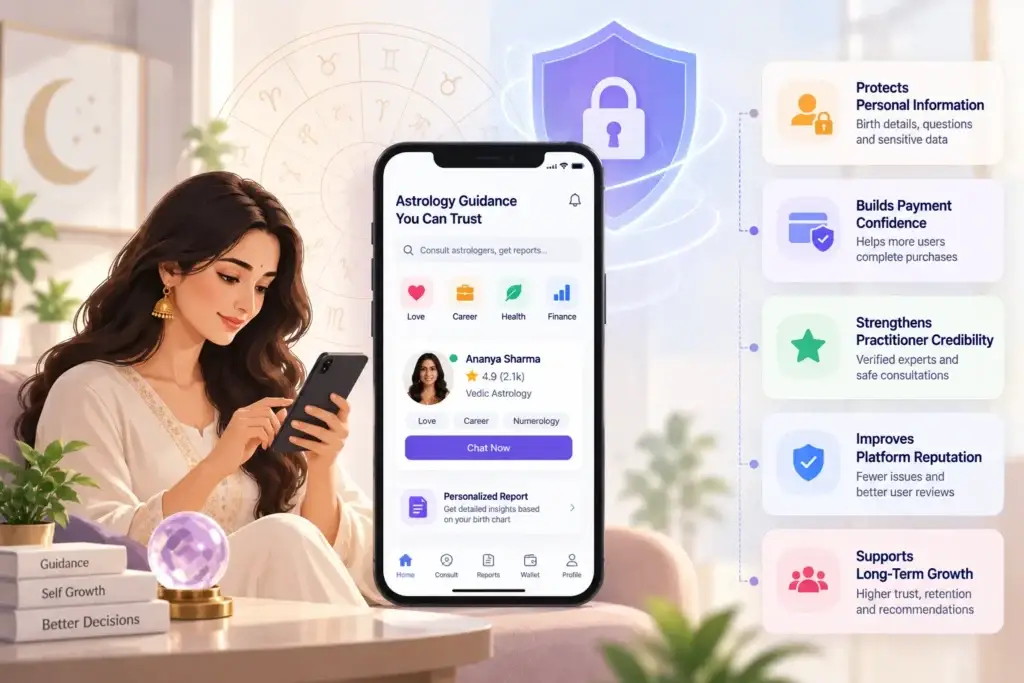
An astrology portal sits at a sensitive intersection of belief, identity, payment, and personal decision-making. Users may enter birth date, birth time, birthplace, relationship details, questions about marriage or career, and sometimes emotionally vulnerable concerns.
That data may look harmless compared with banking or medical records, but for the user, it can feel deeply personal.
A founder should treat this trust layer seriously because weak security can damage:
- user confidence
- payment conversion
- practitioner credibility
- platform reputation
- app-store review outcomes
- long-term retention
- business partnerships
A secure astrology portal does not simply protect databases. It protects the user’s willingness to return, pay, consult, and recommend the platform.
What Data Does an Astrology Portal Platform Usually Handle?
Security planning starts by understanding the types of data moving through the product. A founder cannot protect what the team has not mapped.
| Data Type | Examples | Why It Matters |
|---|---|---|
| User profile data | Name, mobile number, email, login credentials | Needed for accounts, authentication, notifications, and support |
| Astrology input data | Birth date, birth time, birthplace, gender, relationship details | Used for kundali, matching, reports, panchang, muhurta, and personalized readings |
| Consultation data | Chat, call, video session records, questions, practitioner notes where applicable | Sensitive because users may share personal concerns |
| Payment data | Wallet refill records, report purchases, gateway status, invoices, refunds | Needed for revenue tracking, disputes, reconciliation, and payment safety |
| Platform activity data | Login history, report downloads, user actions, admin changes | Useful for security review, abuse detection, and troubleshooting |
| Practitioner data | Availability, profile details, earnings, payout records, ratings | Important for marketplace trust and operational control |
The goal is not to collect everything possible. The stronger approach is to collect what the platform needs, protect it properly, and define how long it should be retained.
Core Security Layers Every Astrology Portal Should Have
Security should be designed across the full platform, not added only to payment screens. A practical astrology portal security model usually includes five layers:
- User account protection
- Data protection
- Admin and practitioner access control
- Payment and wallet safety
- Monitoring, logs, and incident response
Each layer supports a different part of trust.
1. User Account Protection: Keep Access Safe From the First Login
User accounts are the first security boundary. If account protection is weak, attackers may access birth details, purchased reports, wallet balances, or consultation history.
A secure astrology portal should consider:
- OTP or secure password-based login
- session timeout rules
- device/session management
- suspicious login alerts where relevant
- rate limits on login attempts
- secure password reset flows
- protection against credential stuffing
For founders, this matters because astrology platforms often rely on repeat visits. A user may return daily for horoscope content, monthly for reports, or whenever they need a consultation. Account trust directly affects long-term retention.
2. Data Protection: Secure Birth Details, Reports, and Consultation Records
Astrology platforms should treat birth details and consultation records as sensitive data. Even when the platform does not fall into a highly regulated category, users still expect privacy.
Important data protection practices include:
- encrypted data transfer using HTTPS/TLS
- encrypted storage for sensitive records
- secure handling of generated reports
- access limits for consultation records
- privacy-conscious data retention rules
- backup protection
- secure API communication between web, app, and backend systems
The founder’s decision is simple: the platform should not make sensitive user information visible to people who do not need it.
For example, a content editor may need access to horoscope articles and blog drafts. That person does not need access to user wallet balances or consultation records. A support executive may need limited order visibility. That person does not need full admin configuration access.
This is where role-based access control becomes important.
3. Access Control: Restrict What Admins, Editors, Practitioners, and Support Teams Can Do
Many platform risks come from inside the admin panel, not just from outside attackers. A weak admin system gives too many people too much control.
An astrology portal should separate access by role.
| Platform Role | Should Access | Should Not Access |
|---|---|---|
| Super admin | Platform settings, roles, payments, user management, reports | Should be limited to trusted owners only |
| Content editor | Horoscope posts, blog content, spiritual articles, CMS pages | Payment settings, user wallets, practitioner payouts |
| Support team | Ticket details, limited user lookup, order status | Sensitive admin settings, full data exports |
| Practitioner | Own profile, availability, consultation history, earnings | Other practitioners’ data, admin pricing, platform-wide user records |
| Finance/admin operator | Transactions, payout status, refunds, invoices | Content moderation settings unless required |
| Technical team | Logs, diagnostics, deployment tools | User-sensitive records unless explicitly approved |
Good access control supports operational growth. As the platform adds more editors, astrologers, practitioners, support agents, and finance users, permissions prevent everyday mistakes from becoming security problems.
Founder Decision Signals: Is the Platform Trust-Ready?
Data Sensitivity
If the platform collects birth details, relationship inputs, consultation questions, wallet records, or paid reports, it needs stronger privacy controls than a basic content website.
Admin Control
If multiple team members manage content, support, practitioners, pricing, or payouts, role-based access should be available before launch.
Payment Risk
If users buy reports, recharge wallets, book consultations, or purchase remedies, the platform needs secure payment gateway handling and clear transaction records.
Scale Readiness
If the business depends on organic traffic, daily horoscope visits, or free-tool usage, monitoring and logging should be ready before traffic grows.
4. Payment Safety: Protect Wallet Refills, Paid Reports, Refunds, and Checkout Flows
Payment security is not only about integrating a gateway. In astrology portals, payments may appear in several places:
- paid kundali or horoscope reports
- wallet recharge
- AI readings or paid questions
- remedy marketplace orders
- puja or ritual package bookings
- practitioner consultation charges
- subscription or membership access
- profile boosting or practitioner-side fees
Each payment flow should be traceable. A user should know whether a payment succeeded, failed, or is pending. The admin should be able to reconcile gateway status with platform records. Refunds should follow a defined workflow instead of being handled manually without logs.
A secure payment setup should include:
- trusted payment gateway integration
- tokenized card handling where applicable
- no raw card storage inside the application
- transaction IDs and payment status records
- wallet ledger or balance history
- refund and cancellation logs
- fraud or unusual-activity signals
- clear invoice or receipt generation
- admin-level reconciliation tools
For wallet-based astrology platforms, the ledger matters especially. If users recharge before booking consultations or buying readings, the platform should maintain a clear record of credits, debits, refunds, and adjustments.
5. Practitioner and Consultant Safety: Trust Goes Both Ways
If the astrology portal includes human practitioners, trust must protect both users and service providers.
For users, the platform should show clear practitioner information, availability, pricing, ratings, and session terms. For practitioners, the platform should protect earnings records, payout history, profile access, and account security.
Important controls include:
- practitioner verification workflow
- profile approval before public listing
- secure login for practitioner accounts
- session and earnings records
- payout status tracking
- rating and review moderation
- dispute management
- abuse reporting
- admin review of suspicious activity
This matters because consultation marketplaces depend on both sides feeling safe. Users need confidence before sharing personal questions. Practitioners need confidence before depending on the platform for earnings.
6. Audit Logs: Know Who Changed What and When
Audit logs are often ignored until something goes wrong. But for a platform owner, logs are one of the most practical security tools.
Audit logs can help answer:
- Who changed a report price?
- Who approved or suspended a practitioner?
- Who processed a refund?
- Who changed payout settings?
- Who accessed a user record?
- Who updated platform-wide configuration?
- Which admin action happened before a complaint or dispute?
Not every platform needs enterprise-grade logging on day one, but high-risk actions should be traceable. At minimum, platform owners should identify which admin actions need logs before launch.
High-priority logged actions may include:
- admin login
- role and permission changes
- payment setting changes
- refund approvals
- wallet adjustments
- practitioner approval or suspension
- user account blocking
- report price changes
- data export attempts
Auditability becomes more important as the business grows beyond a small founding team.
7. API and Backend Security: Protect the Connective Layer
A modern astrology portal may connect multiple systems: web portal, mobile app, practitioner app, admin panel, chart calculation API, payment gateway, AI model provider, notification provider, and video/chat service.
That makes API security critical.
Important backend controls include:
- secure API authentication
- permission checks on every sensitive request
- input validation
- protection against injection attacks
- rate limiting
- secure file upload handling
- protected webhook processing
- separate production and testing credentials
- environment-variable protection
- regular dependency updates
For founders, the practical question is: can the platform handle integrations without exposing user records, wallet actions, or admin controls through weak API endpoints?
8. Privacy and Consent: Make Data Use Clear to Users
Trust also depends on transparency. Users should understand what data the platform collects, why it is collected, how it is used, and how they can request support or deletion where applicable.
Important privacy areas include:
- privacy policy
- terms of use
- cookie and tracking disclosures
- consent for notifications
- consent for promotional communication
- data deletion or account closure process
- region-specific privacy requirements
- third-party provider disclosure where relevant
This is especially important when the platform uses astrology APIs, AI providers, payment gateways, analytics tools, or communication services.
The correct positioning is not “the app is automatically compliant everywhere.” A better approach is that the platform should support compliance-ready workflows, while final legal compliance depends on target jurisdiction, policies, integrations, hosting, and operating model.
9. Content and Community Safety in Astrology Portals
An astrology portal is often content-heavy. It may include daily horoscopes, blogs, news, spiritual guides, AI-generated readings, comments, reviews, practitioner bios, and user-submitted questions.
This creates another layer of safety.
A founder should plan controls for:
- misleading or harmful content moderation
- practitioner profile review
- spam prevention
- review moderation
- abuse reports
- fake profile detection
- AI output review where applicable
- content approval workflows
- escalation for sensitive user complaints
The more the platform moves from a static content site to an interactive consultation ecosystem, the more important moderation becomes.
Security Checklist for Astrology Portal Founders
Use this checklist before launch or before evaluating a technology provider.
| Security Area | Founder Question |
|---|---|
| User accounts | Are login, OTP, password reset, and session flows protected? |
| Data protection | Are sensitive records encrypted in transfer and storage? |
| Birth data | Is kundali, matching, and report data visible only where needed? |
| Admin access | Can roles restrict what each team member can view or change? |
| Practitioner access | Can practitioners access only their own profile, availability, sessions, and earnings? |
| Payments | Are gateway transactions, wallet refills, refunds, and failed payments logged clearly? |
| Audit logs | Can the owner review important admin actions? |
| APIs | Are web, app, admin, payment, and third-party integrations protected? |
| Backups | Are backups encrypted, tested, and access-controlled? |
| Privacy | Are policies, consent flows, and deletion processes prepared for the target region? |
| Incident response | Does the team know what to do if data, payment, or admin access is compromised? |
Mistakes Founders Should Avoid
Treating astrology data as low-risk data
Birth details, relationship inputs, spiritual questions, and consultation conversations can feel deeply personal to users. Treating them casually can damage platform trust.
Giving every admin full access
Unrestricted admin access creates unnecessary internal risk. Editors, support agents, practitioners, and finance users should have separate permissions.
Ignoring payment reconciliation
Wallet refills, report purchases, refunds, and failed transactions need clear records. Manual handling without logs creates disputes and accounting confusion.
Launching without a privacy review
Privacy policies, data retention, consent flows, deletion requests, and third-party provider disclosures should be reviewed before launch, not after users complain.
Read more : Astrology Portal Platform Business Model: Turning Free Tools and Content Into Paid Services
How Miracuves Helps Founders Build Trust-Ready Astrology Platforms
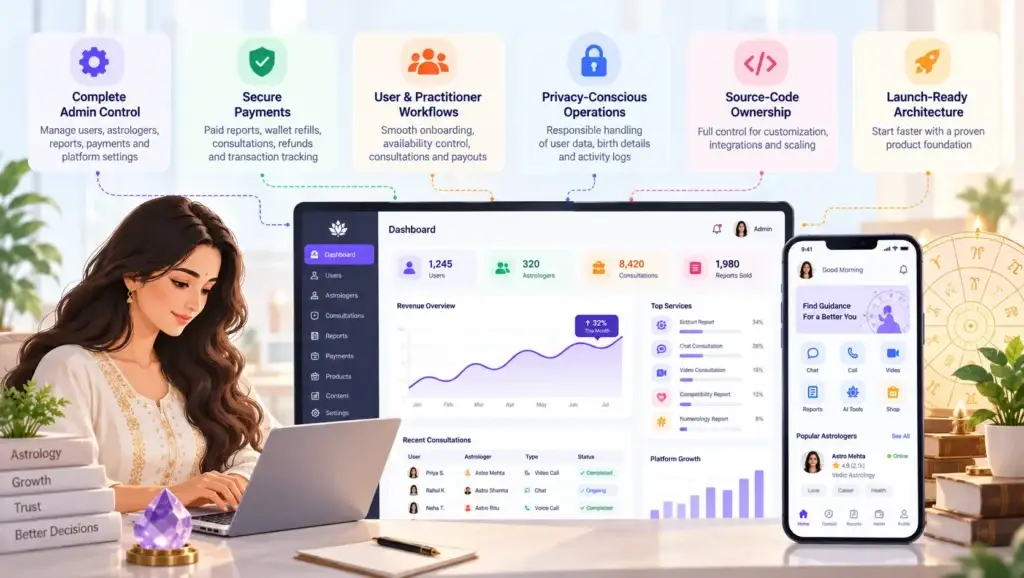
For founders planning a secure astrology portal, the technology foundation matters. The platform should not only include astrology tools and monetization flows; it should also support admin control, secure payment integration, practitioner workflows, and privacy-conscious operations.
Miracuves helps founders launch white-label, source-code-owned astrology platforms with branded design, admin dashboards, user and practitioner workflows, payment integration, and launch-ready product architecture. If you are evaluating a ready-made foundation for an AstroSage-style astrology portal, you can explore the Miracuves astrology portal solution.
Key ways Miracuves supports trust-ready astrology platforms:
- Admin control: Manage users, practitioners, reports, payments, content, and platform settings from a centralized dashboard.
- Secure payment integration: Support paid reports, wallet refills, consultation bookings, refunds, and transaction tracking with safer payment workflows.
- User and practitioner workflows: Enable smooth onboarding, profile management, availability control, consultation handling, ratings, and payout tracking.
- Privacy-conscious operations: Build with responsible handling of birth details, consultation data, wallet records, and user activity logs.
- Source-code ownership: Give founders more control over customization, integrations, scaling, and long-term product direction.
- Launch-ready architecture: Start with a stronger platform foundation instead of building every astrology, admin, and monetization module from zero.
The stronger founder decision is not only about going live quickly. It is about going live with the right trust layer behind the product.
Final Thoughts: Trust Is the Real Product Layer
Astrology users may arrive for a free kundali, horoscope, matching report, panchang, or spiritual guidance. But they stay only when the platform feels reliable, private, and safe.
For founders, trust should be designed into the product from the beginning. That means protecting user data, separating admin permissions, securing payment flows, maintaining audit trails, and preparing privacy workflows before traffic grows.
A strong astrology portal does more than generate reports or connect users with practitioners. It gives users confidence that their personal details, payments, and spiritual conversations are handled responsibly.
FAQs
Why is security important in an astrology portal platform?
Security is important because astrology portals often handle personal birth details, consultation questions, wallet activity, paid reports, and payment records. Users are more likely to trust and return to a platform when their personal and transaction data is handled responsibly.
What user data should an astrology portal protect?
An astrology portal should protect user profiles, birth details, kundali inputs, matching data, report history, consultation records, wallet transactions, payment status, support conversations, and practitioner-related records where applicable.
What is role-based access control in an astrology platform?
Role-based access control limits what different team members can view or change. For example, a content editor may manage horoscope articles, while a finance user may access payment records. This reduces internal risk and prevents unnecessary exposure of sensitive data.
How can astrology apps make payments safer?
Astrology apps can improve payment safety through secure gateway integration, tokenized payment handling where applicable, transaction IDs, wallet ledger records, refund logs, fraud monitoring signals, and admin reconciliation tools.
Should astrology consultation chats be encrypted?
Yes, consultation chats and sensitive communication should be protected with secure transmission and appropriate storage controls. Access should be limited to authorized users based on the platform’s operational and legal requirements.
Do astrology platforms need audit logs?
Audit logs are highly useful because they help platform owners review important actions such as admin login, pricing changes, refund approvals, practitioner approvals, permission changes, and wallet adjustments.
Can a ready-made astrology portal support privacy and compliance workflows?
A ready-made platform can support privacy and compliance workflows if it includes secure data handling, access controls, consent support, payment records, and operational logs. Final compliance depends on the target jurisdiction, legal review, integrations, hosting, and business model.
What should founders check before launching an astrology portal?
Founders should check user login security, data encryption, payment gateway setup, wallet records, admin permissions, practitioner verification, privacy policies, backup processes, API protection, and incident-response readiness before launch.
Miracuves is an independent software development company. We are not affiliated with, connected to, sponsored by, or endorsed by any company or product named in this article.
Terms such as “X Clone” are used descriptively. It is how the software industry refers to building a platform with functionality comparable to a known service, and how clients search for it.
The entire design and codebase of our products is built by our own team. Our products contain no code, design, graphics, or content originating from any third-party website or applications.
All third-party names and marks referenced in this article are the property of their respective owners, referenced solely to identify the services discussed.