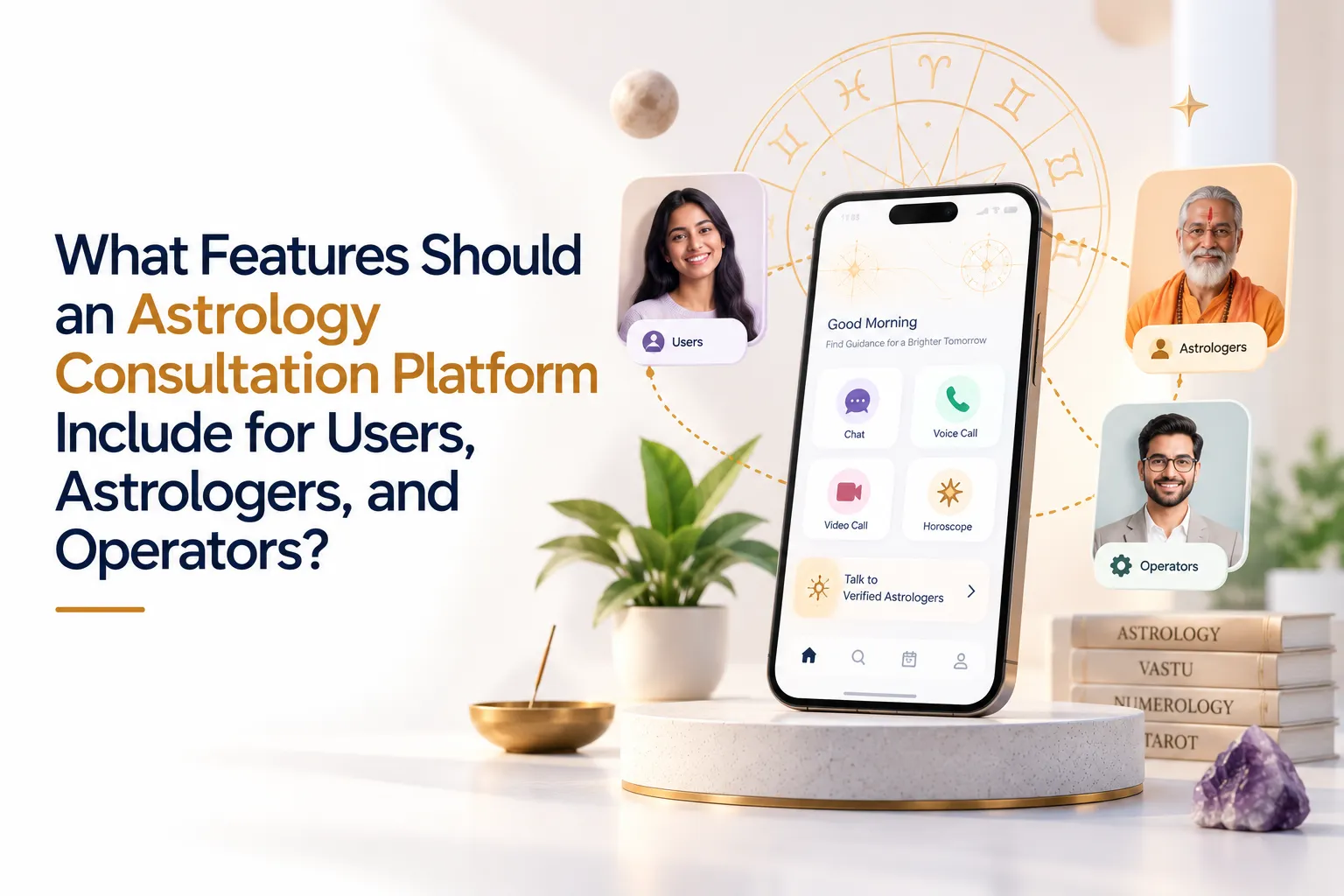
An astrology consultation platform is not just a horoscope app with chat added on top. It is a three-sided marketplace where users want fast, personal guidance, astrologers need a reliable consultation workspace, and operators need complete control over payments, quality, support, reports, and platform growth.
That is why feature planning matters so much. A platform may look polished from the outside, but if wallet deduction is inaccurate, astrologer availability is not updated in real time, payouts are unclear, or the admin team cannot resolve disputes quickly, the business becomes difficult to operate after launch.
For founders studying Astrotalk-style app features, the stronger question is not “How many features can we add?” The better question is: “Which features create trust, enable paid consultations, protect transactions, retain users, and help the operator manage the marketplace without depending on developers for every small change?”
This guide breaks down the essential features an astrology consultation platform should include for users, astrologers, and operators. It also explains how each feature supports product experience, monetization, daily operations, and long-term scalability.
Key Takeaways
- Astrology consultation platform features should be planned around three roles: users, astrologers, and platform operators.
- Users need easy onboarding, astrologer discovery, wallet recharge, live consultation, astrology tools, reports, reviews, and support.
- Astrologers need profile control, verification, availability management, consultation workspaces, earnings visibility, and payout workflows.
- Operators need admin control over users, astrologers, payments, commissions, refunds, content, moderation, analytics, and growth campaigns.
- A strong platform should connect feature planning with business logic, not just copy visible screens.
Why Feature Planning Matters in an Astrology Consultation Platform
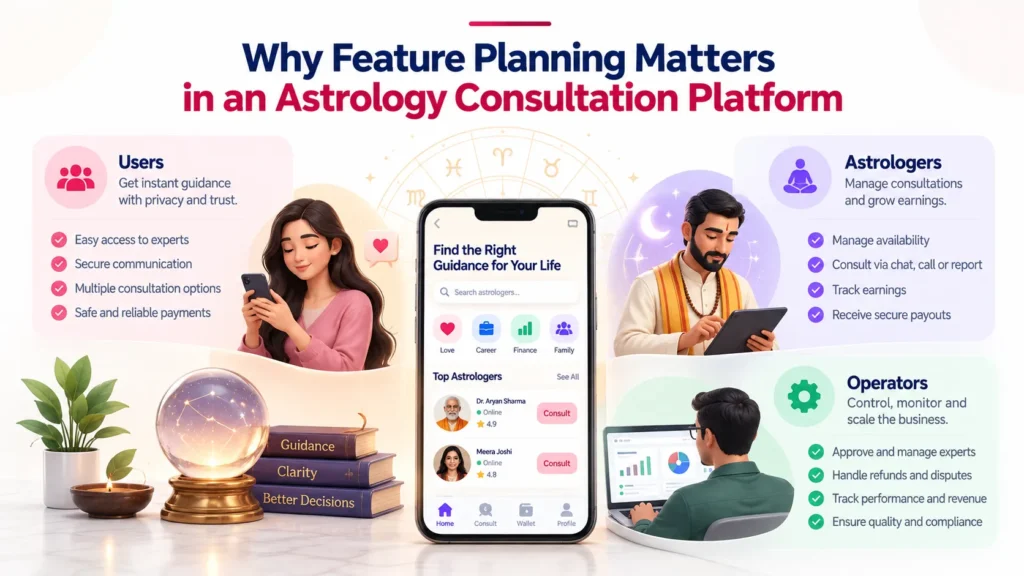
Astrology consultation apps work because they combine emotional intent with instant access. A user may open the app because they want guidance about marriage, career, relationships, finance, family decisions, business uncertainty, or timing. In those moments, speed, privacy, trust, and clarity matter more than visual design alone.
But the platform also needs to work for the astrologer and the business operator. Astrologers must be able to accept requests, manage schedules, deliver reports, track earnings, and receive payouts without confusion. Operators must be able to approve experts, monitor sessions, manage refunds, control commissions, review complaints, and understand which services are generating revenue.
This is where many founders make the wrong decision. They start by listing visible user-facing features such as chat, call, horoscope, and wallet. Those are important, but they are only the surface. The real product foundation includes billing logic, real-time communication, availability rules, reporting, admin permissions, quality control, and operational workflows.
A successful astrology consultation platform should therefore be planned as a complete service marketplace. Every feature should answer one of four business questions: does it help users trust the platform, does it help astrologers serve better, does it help the operator control the business, or does it help revenue flow through the product more cleanly?
The Three Core Roles Every Astrology Platform Must Support
An astrology consultation platform usually has three major user groups. Each group needs a different product experience, but the flows must stay connected behind the scenes.
Feature Planning by Platform Role
| Platform Role | Core Need | Important Feature Areas | Business Impact |
|---|---|---|---|
| User | Fast, trusted access to astrology guidance | Onboarding, astrologer discovery, wallet recharge, chat, voice, video, reports, reviews, support | Improves conversion, repeat usage, trust, and paid consultation activity |
| Astrologer | Simple tools to manage consultations and earnings | Verification, profile management, availability, live consultation dashboard, report delivery, payout requests | Improves supply quality, astrologer retention, service availability, and consultation completion |
| Operator | Control over marketplace operations and revenue | Admin dashboard, user management, commission settings, wallet logs, refunds, disputes, analytics, content control | Improves governance, monetization, support efficiency, and platform scalability |
Essential User Features for an Astrology Consultation Platform
The user app is where demand enters the business. It should feel simple, but it must support a complete journey: signup, birth-detail collection, astrologer discovery, wallet recharge, consultation, report access, reviews, and repeat engagement.
A weak user experience can reduce paid conversions even when the backend is strong. A strong user experience helps people move from curiosity to trust, and from trust to paid consultation.
1. Simple Registration and Birth Detail Collection
Registration should be fast. Users should be able to sign up with a mobile number, email, OTP, or social login, depending on the target market. The app should collect only the details needed to personalize the experience at the right stage.
For astrology platforms, birth details are not ordinary profile fields. Date of birth, time of birth, place of birth, gender, preferred language, and consultation interests can power kundli generation, horoscope personalization, compatibility checks, report suggestions, and astrologer recommendations.
The mistake to avoid is asking too much too early. A first-time user may not want to complete a long form before seeing value. A smarter flow collects the essentials first, then asks for deeper details when the user generates a kundli, books a consultation, or requests a personalized report.
2. Personalized Home Screen
The home screen should not be a random collection of banners and categories. It should guide the user toward the next useful action. For a new user, that may be creating a free birth chart or browsing available astrologers. For a returning user, it may be continuing a previous consultation, checking today’s horoscope, recharging the wallet, or joining a live session.
A strong home screen can include recommended astrologers, daily horoscope cards, kundli shortcuts, live sessions, wallet balance, active offers, recent consultations, pending reports, and support access. The goal is to reduce confusion and make the platform feel alive from the first visit.
3. Astrologer Discovery and Smart Filters
Astrologer discovery is one of the most important conversion points in the app. Users should be able to browse experts based on expertise, language, experience, rating, consultation mode, price per minute, availability, and user reviews.
Discovery should also support intent-based categories. Some users are looking for marriage guidance. Others want career advice, business astrology, tarot reading, numerology, vastu guidance, love consultation, finance guidance, or daily predictions. Category-based browsing helps users reach the right expert faster.
The listing card should show enough information to support a decision without making the screen crowded. Useful fields include astrologer photo, name, skills, languages, years of experience, rating, number of consultations, price, online status, wait time, and available consultation modes.
4. Chat Consultation
Chat is often the first paid consultation mode because it feels private, quick, and lower-pressure than a call. A strong chat feature should include real-time message delivery, typing status, read receipts, session timer, wallet deduction, low-balance alerts, media sharing controls, consultation history, and session end summaries.
The business logic behind chat is more important than the chat screen itself. Before a session begins, the system should check the user’s wallet balance, astrologer availability, price per minute, and session rules. During the session, it should track time accurately and update wallet balance clearly. After the session, it should store the consultation history, transaction record, review option, and support reference.
For deeper technical planning, founders can read Miracuves’ guide on real-time chat, session events, and wallet updates in astrology consultation apps.
5. Voice and Video Consultation
Voice consultation creates a more personal experience for users who want detailed explanations. Video consultation can work as a premium trust-building feature for deeper sessions such as kundli reading, marriage guidance, career planning, or business-related consultation.
Both features need reliable call handling. The app should support call request notifications, accept/reject flow, session timer, wallet deduction, low-balance warning, auto-end rules, missed call handling, call status, consultation notes, call history, and dispute reference data.
For founders, the biggest risk is treating calls as a simple communication feature. In reality, voice and video sessions are paid service events. The call system, billing system, availability system, and admin reporting system must work together. If the call continues but the wallet does not deduct correctly, the business loses money. If the wallet deducts but the call fails, the user loses trust.
6. Wallet Recharge and Per-Minute Billing
The wallet is the financial center of an astrology consultation platform. Instead of charging users after each session, the platform can allow users to recharge first and then spend wallet balance on chat, calls, reports, live sessions, or other paid services.
A strong wallet system should include recharge plans, payment gateway integration, transaction history, bonus balance, promo credits, cashback, refund handling, failed payment status, invoices, low-balance alerts, and session-level deduction logic.
Per-minute billing should be transparent. Users should know the astrologer’s rate before starting the session. They should see whether the session is paid, free, discounted, or using bonus balance. If the wallet is running low, the app should warn them before the consultation ends.
Wallet accuracy directly affects trust. If deductions are unclear, users may raise complaints. If astrologer earnings are not calculated correctly, the supply side may lose confidence. That is why wallet logic should be planned as a core platform feature, not a small payment add-on.
7. Kundli, Horoscope, Panchang, and Matchmaking Tools
Free astrology tools help bring users into the platform before they are ready to pay. Kundli generation, daily horoscope, panchang, muhurat, compatibility matching, numerology, tarot, and personalized prediction features can all increase repeat usage.
Kundli features should collect accurate birth details and present the output in a clear format. Depending on the platform’s scope, this may include birth chart, planetary positions, Lagna, Nakshatra, Dasha, house placement, and simple interpretation. The goal is not just to show data; the goal is to help the user understand enough to continue into a paid report or consultation.
Horoscope content can support daily retention. Users may not consult an astrologer every day, but they may return for daily, weekly, monthly, or yearly horoscope updates. Panchang and muhurat tools can also bring users back during festivals, rituals, travel planning, weddings, business openings, or important dates.
8. Paid Reports and Downloadable Astrology Documents
Paid reports create another monetization layer beyond live consultations. A platform can offer marriage reports, career reports, yearly prediction reports, finance reports, health reports, compatibility reports, detailed kundli reports, and festival-specific reports.
The report system should support order placement, payment, astrologer assignment if needed, automated generation if applicable, delivery status, PDF download, user notifications, revisions, and support requests. Users should be able to find purchased reports easily inside their account.
Reports are useful because they give users a product they can revisit. They also help the platform monetize users who may not want a live consultation immediately but are willing to pay for structured guidance.
9. Ratings, Reviews, and Trust Indicators
Trust signals are essential because users often discuss sensitive personal questions during astrology consultations. The platform should show clear ratings, verified reviews, number of consultations, response quality, profile completeness, language expertise, and availability status.
Reviews should also be moderated. The admin team should be able to detect spam, abusive language, fake feedback, repeated complaint patterns, and unfair ratings. A review system should protect users, astrologers, and the marketplace brand at the same time.
10. Support, Complaints, and Refund Requests
Paid consultation platforms need a clear support flow. Users may face failed payments, call drops, report delays, wrong recharge status, refund requests, or concerns about consultation quality. The app should give users a simple way to raise tickets and track resolution status.
Support should be connected to session history, wallet logs, payment records, astrologer details, and chat or call metadata. This helps the support team resolve issues based on evidence rather than guesswork.
Essential Astrologer Features for a Reliable Supply Side
Astrologers are the supply side of the marketplace. If they cannot manage requests, update availability, understand earnings, or receive payouts smoothly, the platform will struggle even if users are signing up.
A good astrologer panel should reduce friction, support professional service delivery, and help operators maintain quality across the marketplace.
1. Astrologer Registration and Verification
Astrologer onboarding should collect profile details, contact information, skills, languages, years of experience, consultation categories, pricing preferences, documents, profile image, bio, and sample credentials where required.
Verification protects platform trust. Operators should be able to review astrologer applications before publishing profiles. The approval process may include identity checks, document review, experience validation, skill category mapping, profile quality review, and account status control.
This feature matters because users do not only buy minutes. They buy confidence. A verified and well-managed expert network helps users feel safer before starting paid consultations.
2. Profile Management
Astrologers should be able to manage their public profiles without depending on support for every small update. A profile can include name, photo, bio, skills, languages, experience, consultation modes, charges, availability, intro video, ratings, and service categories.
The operator may still require approval for major changes. For example, updates to pricing, credentials, or service categories may need review before they go live. This protects marketplace quality while giving astrologers enough flexibility to keep their profile fresh.
3. Availability and Status Control
Availability is critical in live consultation platforms. Astrologers should be able to mark themselves online, offline, busy, on break, or available later. Users should see accurate status before trying to start a chat or call.
The system should also handle different availability by consultation mode. An astrologer may be available for chat but not for video. Another may accept scheduled calls but not instant requests. These rules help reduce failed connection attempts and user frustration.
Queue management is also important. When a popular astrologer is busy, users should see wait time, queue position, or notification options. This keeps demand inside the platform instead of making users abandon the session.
4. Consultation Workspace
The astrologer dashboard should make active sessions easy to manage. It should show incoming chat requests, call requests, user profile details, birth details, concern category, previous consultation notes where appropriate, session timer, wallet/session status, and communication tools.
For chat sessions, astrologers need fast messaging, canned responses if allowed, typing visibility, attachment controls, and session summary tools. For calls, they need call accept/reject controls, timer visibility, session status, and post-session notes.
A smooth workspace improves consultation quality. It also reduces operational confusion because astrologers can see what they need at the right time instead of switching between multiple screens.
5. Report Creation and Delivery
If the platform sells personalized astrology reports, astrologers may need tools to create, upload, update, or deliver reports. The dashboard should show report orders, user birth details, delivery deadlines, report status, payment status, and user communication options.
This feature helps the platform create revenue beyond live sessions. It also gives astrologers another earning opportunity, especially when users prefer structured written guidance over real-time consultation.
6. Earnings, Commission, and Payout Visibility
Astrologers should always understand how much they have earned, what commission was deducted, what amount is pending, and when they can request withdrawal. Lack of payout clarity can damage supply-side trust quickly.
The astrologer panel should include completed sessions, total earnings, pending balance, payout requests, payout history, commission deductions, refund adjustments, bonuses, penalties if applicable, and settlement status.
The goal is transparency. When astrologers trust the payout system, they are more likely to stay active, accept more consultations, and maintain service quality.
7. Notifications and Schedule Reminders
Astrologers should receive alerts for incoming consultations, scheduled sessions, pending reports, low activity, payout updates, user follow-ups, live session reminders, and admin messages. Notifications help experts respond faster and maintain availability.
However, notifications should be controlled carefully. Too many alerts can become noise. The right notification system gives astrologers the information needed to serve users without overwhelming them.
Essential Operator and Admin Features for Platform Control
The operator dashboard is the control center of the business. It is where the platform owner manages quality, payments, supply, support, revenue, content, campaigns, analytics, and compliance-ready workflows.
A weak admin dashboard creates dependency. The operator must ask developers to change banners, update fees, approve astrologers, check payments, resolve disputes, or pull reports. A strong dashboard gives the business team control over daily operations.
1. User Management
Admins should be able to view and manage user accounts, profile information, consultation history, wallet transactions, support tickets, refund requests, blocked status, reported activity, and app engagement.
User management helps the support team resolve problems faster. It also helps the operator identify patterns such as failed payments, repeated complaints, high-value users, inactive users, or users responding well to specific campaigns.
2. Astrologer Management
The admin panel should allow operators to approve astrologers, review documents, edit categories, manage profile visibility, monitor ratings, review consultation performance, control pricing rules, handle complaints, and suspend accounts when required.
This is not just a moderation feature. It is marketplace quality control. If low-quality profiles remain visible or unavailable astrologers dominate listings, users may lose trust and stop booking sessions.
3. Payment, Wallet, and Transaction Logs
Operators need full visibility into recharge activity, wallet debits, bonus credits, cashback, failed payments, refunds, invoices, payment gateway responses, session deductions, and payout adjustments.
Every paid action should leave a clear transaction trail. This helps the finance team reconcile revenue, helps support teams resolve disputes, and helps founders understand how users are spending inside the platform.
For founders comparing feature scope with budget, Miracuves also provides a dedicated guide on astrology consultation app development cost and pricing factors.
4. Commission and Payout Controls
Commission settings define how the platform earns from paid consultations. The admin should be able to set platform commission, astrologer-specific commission, category-based rules, consultation-mode rules, promotional rules, and payout eligibility.
Payout controls should include withdrawal requests, payout approval, payout rejection, minimum withdrawal threshold, payout method, settlement status, tax-related fields where applicable, and downloadable reports.
This feature is important because astrologer retention depends heavily on payout clarity. A founder may focus on user acquisition, but if supply-side earnings are unclear, the platform can lose its best experts.
5. Refund, Complaint, and Dispute Management
Every paid consultation platform needs dispute workflows. Users may complain about dropped calls, delayed reports, inaccurate billing, poor consultation experience, wrong recharge status, or unresponsive astrologers.
The admin panel should allow support teams to check session details, wallet logs, payment records, user complaints, astrologer responses, chat history where allowed, and refund eligibility. This helps the team make faster and fairer decisions.
Dispute management protects revenue and reputation. Without it, small technical problems can turn into poor reviews, refund pressure, and support overload.
6. Content, Horoscope, and Campaign Management
Astrology platforms rely on content to keep users engaged between paid sessions. Operators should be able to manage horoscope content, banners, festival campaigns, blog posts, push notification campaigns, live session promotions, report offers, and app announcements.
Content management becomes especially useful during festivals, auspicious dates, marriage seasons, new year predictions, monthly horoscope campaigns, or special spiritual events. The operator should be able to run these campaigns without waiting for a code release.
7. Analytics Dashboard
Analytics helps founders understand whether the platform is working as a business. The dashboard should show user signups, active users, wallet recharge volume, consultation volume, chat revenue, call revenue, video revenue, top astrologers, top categories, refund rate, failed payments, repeat users, campaign performance, and retention trends.
The strongest analytics dashboards do not only show totals. They help operators make decisions. For example, if many users recharge but do not start consultations, the issue may be astrologer availability or pricing. If users start sessions but do not return, the issue may be trust, quality, or follow-up engagement. If one category earns more than others, marketing can be adjusted around that demand.
8. Role-Based Access for Internal Teams
As the platform grows, not every team member should access every dashboard area. A support executive may need complaint and session history access. A finance member may need transaction and payout access. A content manager may need horoscope and banner controls. The founder or super admin may need full access.
Role-based access control helps reduce operational risk. It also makes the admin dashboard more practical because each team member sees the tools relevant to their work.
Revenue Features That Should Be Planned Early
Revenue features should not feel forced. The strongest astrology platforms connect monetization naturally with user intent. A user comes for guidance, creates a profile, checks astrology tools, discovers experts, recharges the wallet, consults, downloads reports, joins live sessions, or buys related spiritual products.
Each monetization feature should fit into that journey. If monetization appears too early, users may leave before trusting the platform. If monetization is planned too late, the platform may attract users but fail to convert them into revenue.
Revenue Features and Their Business Purpose
| Revenue Feature | How It Works | Why It Matters |
|---|---|---|
| Per-minute consultation | Users pay from wallet balance for chat, voice, or video sessions. | Creates direct revenue from expert guidance and user engagement. |
| Paid reports | Users purchase detailed kundli, marriage, career, finance, or yearly reports. | Adds a structured digital product beyond live consultations. |
| Live sessions | Astrologers host group sessions, Q&A, festival events, or premium broadcasts. | Allows one expert to reach many users at the same time. |
| Subscriptions | Users pay regularly for premium horoscope, priority access, reports, or exclusive content. | Supports recurring revenue and deeper retention. |
| Spiritual commerce | The platform sells remedies, gemstones, puja kits, books, or related products. | Turns consultation intent into relevant commerce opportunities. |
| Featured listings | Astrologers can receive higher visibility based on operator-approved rules. | Creates supply-side monetization while helping users discover active experts. |
To explore the monetization side in more detail, read Miracuves’ breakdown of revenue streams for astrology consultation marketplaces.
Technical Features Behind a Smooth Consultation Experience
Many founders evaluate astrology apps by looking at screens. But the real difference between a stable platform and a fragile one is usually in the backend. The platform has to manage live communication, wallet deductions, payments, availability, reports, notifications, support, and analytics at the same time.
Real-Time Communication Layer
Live chat, call requests, typing status, availability updates, queue movement, low-balance warnings, and session timers depend on real-time event handling. If these updates are delayed, users may think the app is broken or the astrologer is unresponsive.
Real-time systems should be planned carefully for paid consultations because every second can affect billing, trust, and support outcomes. The backend should know when the session starts, when the user balance changes, when the astrologer accepts, when the session ends, and what should be recorded for future reference.
Payment Gateway and Recharge System
The payment gateway should support the target market’s preferred methods. Depending on geography, that may include UPI, cards, net banking, wallets, or international payment options. The platform should also manage successful transactions, failed transactions, pending status, refunds, invoices, and recharge offers.
A clean recharge flow reduces drop-offs. A transparent payment history reduces support pressure. A reliable refund workflow protects user trust.
Astrology Data and Calculation Logic
Kundli, horoscope, panchang, matchmaking, and prediction features depend on accurate user data and calculation logic. The system should handle date, time, place, timezone, coordinates, planetary positions, astrology rules, and report formatting carefully.
For founders, the practical question is whether the platform should use astrology APIs, custom calculation logic, expert-generated content, AI-assisted summaries, or a hybrid model. Each approach affects cost, quality control, scalability, and user trust.
Notification and Engagement Automation
Notifications can help bring users back, but only when they are useful. Common triggers include daily horoscope updates, astrologer availability, wallet recharge offers, report delivery, live session reminders, abandoned recharge, incomplete profile, and follow-up consultation prompts.
The operator should be able to segment notifications based on user behavior. A new user, a high-value user, an inactive user, and a frequent consultation user should not receive the same message every time.
Security, Moderation, and Privacy Controls
Astrology consultation platforms often process personal details, private questions, chat histories, payment activity, and sensitive emotional conversations. Security should therefore be treated as a foundation, not a marketing badge.
Important security and trust features include secure authentication, encrypted data transfer, encrypted data storage where required, permission-based dashboards, activity logs, payment security, content moderation, abuse reporting, complaint handling, and admin access controls.
Founders planning a safer launch can also review Miracuves’ guide on security considerations for white-label astrology consultation apps.
Which Features Should Be Included at Launch and Which Can Come Later?
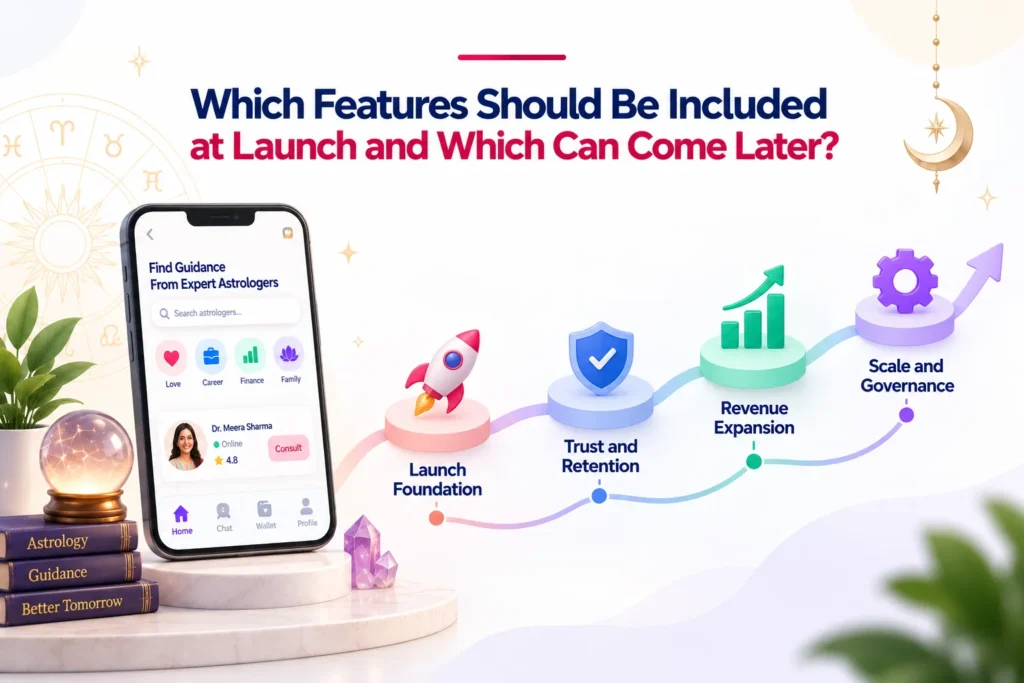
Not every astrology consultation platform needs every advanced feature on day one. The right approach is to launch with a strong foundation, validate real user behavior, and then add deeper engagement and monetization features based on data.
Launching with only a chat screen is risky because it leaves out wallet control, admin operations, astrologer verification, support workflows, and revenue visibility. But overbuilding too early can delay launch and increase complexity before the founder knows which features users actually value.
Feature Roadmap for Astrology Consultation Platforms
| Stage | Features to Prioritize | Business Purpose |
|---|---|---|
| Launch Foundation | User signup, astrologer listing, verification, chat, voice call, wallet recharge, payment gateway, admin dashboard, basic support | Start paid consultations with enough control to manage real users and experts. |
| Trust and Retention | Kundli, horoscope, panchang, matchmaking, reviews, consultation history, push notifications, report delivery | Bring users back and give them reasons to trust the platform beyond one session. |
| Revenue Expansion | Video consultation, live sessions, paid reports, subscriptions, featured listings, spiritual commerce | Add monetization layers without depending only on chat and call revenue. |
| Scale and Governance | Advanced analytics, role-based access, moderation tools, multi-language support, regional pricing, deeper reporting | Prepare the platform for larger teams, more users, more astrologers, and multi-region operations. |
Founder Decision Signals: How to Prioritize the Right Features
Founder Decision Signals
Speed
Start with the features required to complete real paid consultations: onboarding, astrologer discovery, chat or call, wallet recharge, payment gateway, and admin control. Everything else should support the first reliable transaction.
Cost
Feature scope directly affects development cost. Wallet logic, live communication, reports, payouts, and admin workflows should be prioritized before decorative features because they carry business risk.
Scalability
Plan real-time communication, queue handling, transaction logs, role-based access, and analytics early. These areas become harder to fix after users, astrologers, and payments increase.
Market Fit
Use free tools and consultation flows to validate demand. Add live sessions, subscriptions, commerce, and advanced personalization once the platform shows repeat usage and payment behavior.
Common Mistakes Founders Should Avoid
Mistakes Founders Should Avoid
Building only chat and call features
Chat and call are important, but they are not enough. The platform also needs wallet billing, astrologer verification, admin control, payout rules, support workflows, and retention features.
Ignoring wallet accuracy
Wallet errors can create user complaints, astrologer disputes, and revenue leakage. Balance checks, session timers, deductions, refunds, and payout calculations should be planned carefully from the start.
Treating astrologer onboarding as a small feature
Astrologers are the supply side of the marketplace. Weak verification, poor profile tools, unclear earnings, and delayed payouts can reduce expert participation and hurt user experience.
Depending on developers for basic operations
Operators should be able to manage users, experts, commissions, content, refunds, reviews, banners, and reports from the admin dashboard. Otherwise, simple business changes become technical tasks.
How Miracuves Helps Founders Build Astrology Consultation Platforms Faster
Building an astrology consultation platform from scratch can become complex because every visible feature depends on deeper business logic. Chat depends on real-time events. Calls depend on session control. Wallets depend on accurate deduction and refunds. Astrologer panels depend on verification, availability, and payout rules. Admin dashboards depend on permissions, reports, and operational visibility.
Miracuves helps founders reduce this complexity with a ready-made, white-label astrology consultation app foundation that can be configured around user flows, astrologer workflows, admin control, wallet-based billing, and marketplace monetization. For founders who want to move faster, Miracuves’ 6-day solution delivery can help validate the market without waiting months for every core module to be built from zero.
The value is not only faster deployment. The value is starting with the right product foundation: user experience, expert management, payment flow, admin visibility, source-code ownership, and customization flexibility. Founders who want to explore the full solution can review Miracuves’ launch-ready astrology consultation platform.
For a deeper product-level feature view, you can also explore the complete astrology marketplace feature set and compare it with the feature priorities discussed in this guide.
Final Thoughts: Build the Feature System, Not Just the Feature List
The right astrology consultation platform is not built by adding every feature at once. It is built by understanding how users, astrologers, and operators interact inside the same business system.
Users need trusted guidance, smooth payments, useful astrology tools, and simple consultation access. Astrologers need verification, profile control, availability management, consultation tools, and transparent payouts. Operators need admin control, payment visibility, commission rules, content management, security workflows, and analytics.
When these layers work together, the platform becomes more than a digital astrology app. It becomes a monetization-ready consultation marketplace that can attract users, support experts, control operations, and scale with better business clarity.
For founders, the strongest decision is to plan features around outcomes: trust, conversion, retention, monetization, and control. Once that foundation is clear, the platform becomes easier to launch, improve, and grow.
FAQs
What features should an astrology consultation platform include?
An astrology consultation platform should include user registration, birth detail collection, astrologer discovery, chat consultation, voice and video calls, wallet recharge, per-minute billing, kundli generation, horoscope, panchang, paid reports, ratings, reviews, support, astrologer dashboard, payout workflows, and admin control.
What user features are most important in an astrology app?
The most important user features are simple signup, personalized home screen, astrologer search and filters, wallet recharge, chat consultation, voice and video sessions, kundli and horoscope tools, paid reports, consultation history, reviews, notifications, and support access.
What should an astrologer panel include?
An astrologer panel should include onboarding, verification, profile management, availability control, incoming consultation requests, chat and call workspace, report delivery tools, earnings dashboard, commission visibility, payout requests, schedule reminders, and performance insights.
Why is wallet billing important in astrology consultation platforms?
Wallet billing is important because most live astrology consultations are charged by time. A strong wallet system manages recharge, balance checks, per-minute deduction, low-balance alerts, refunds, transaction logs, bonus credits, and payout calculations. This helps reduce disputes and improves payment transparency.
Which features should be launched first in an astrology consultation app?
The first launch should prioritize user signup, astrologer listing, astrologer verification, chat or voice consultation, wallet recharge, payment gateway, per-minute billing, basic admin dashboard, consultation history, and support workflows. Advanced features such as live sessions, subscriptions, commerce, and advanced analytics can be added after validation.
How does an admin dashboard help astrology platform operators?
An admin dashboard helps operators manage users, astrologers, payments, wallet logs, commissions, payouts, refunds, complaints, reviews, content, banners, notifications, analytics, and access permissions. It gives the business team control over daily operations without relying on developers for every small change.
Can an astrology consultation platform include live sessions and paid reports?
Yes. Live sessions and paid reports can add revenue beyond one-to-one consultations. Live sessions allow astrologers to reach many users at once, while paid reports create structured digital products such as career reports, marriage reports, finance reports, yearly predictions, and detailed kundli reports.
How can Miracuves help build an astrology consultation platform faster?
Miracuves can help founders launch a ready-made, white-label astrology consultation platform with user workflows, astrologer panels, wallet-based billing, admin controls, source-code ownership, custom branding, and faster deployment. Its 6-day delivery option can help founders validate the market without building every core module from scratch.
Miracuves is an independent software development company. We are not affiliated with, connected to, sponsored by, or endorsed by any company or product named in this article.
Terms such as “X Clone” are used descriptively. It is how the software industry refers to building a platform with functionality comparable to a known service, and how clients search for it.
The entire design and codebase of our products is built by our own team. Our products contain no code, design, graphics, or content originating from any third-party website or applications.
All third-party names and marks referenced in this article are the property of their respective owners, referenced solely to identify the services discussed.