
Key Takeaways
- A creator membership platform can generate revenue through subscription tiers, locked content, paid messaging, tips, live access, virtual gifts, and platform commissions.
- Tiered memberships create recurring revenue by giving fans different levels of access to exclusive posts, premium media, private communities, and creator benefits.
- Locked content and paid interactions add transaction-based revenue on top of subscriptions, helping creators monetize high-value content and direct fan engagement.
Revenue Model Signals
- Membership tiers can vary by price, content access, posting frequency, private community privileges, early releases, discounts, and subscriber-only experiences.
- Locked photos, videos, posts, bundles, message attachments, and premium releases allow creators to charge separately for individual content purchases.
- Platforms can monetize creator activity through commissions, transaction fees, payout charges, premium creator tools, subscriptions, and other value-added services.
Paid Engagement Insights
- Paid messaging, tips, live sessions, one-to-one interactions, virtual gifts, and personalized requests can turn direct fan communication into additional creator revenue.
- Creators should track membership renewals, tier upgrades, locked-content purchases, paid-message conversions, live participation, tips, and revenue per fan.
- Miracuves develops customizable creator membership platforms with subscription tiers, locked content, paid interactions, messaging, live streaming, tipping, payouts, analytics, and admin controls.
Creator membership platforms generate revenue by turning audience loyalty into repeatable digital transactions. Instead of relying only on ads or sponsorships, creators can earn directly from fans through recurring membership tiers, locked content, paid messages, tips, live sessions, private requests, digital products, and exclusive community access.
For founders, the opportunity is bigger than launching a basic subscription product. Strong creator membership platforms work as monetization engines where creators earn from premium fan access, fans receive exclusive content or personal interaction, and the platform operator manages subscriptions, PPV unlocks, tips, payouts, wallet activity, and admin rules through a clear creator subscription platform development foundation.
This is why modern creator platforms are moving beyond simple paywalls. Patreon allows creators to set membership tiers and offer recurring benefits, YouTube channel memberships give fans access to member-only perks, and X Subscriptions support exclusive subscriber content. For founders planning to launch a creator monetization business, the real question is not only “Can we add subscriptions?” It is “Can we build a platform where tiers, locked content, paid interactions, payment flows, and creator payouts work together without friction?”
Why Creator Membership Platforms Are Different From Simple Subscription Apps
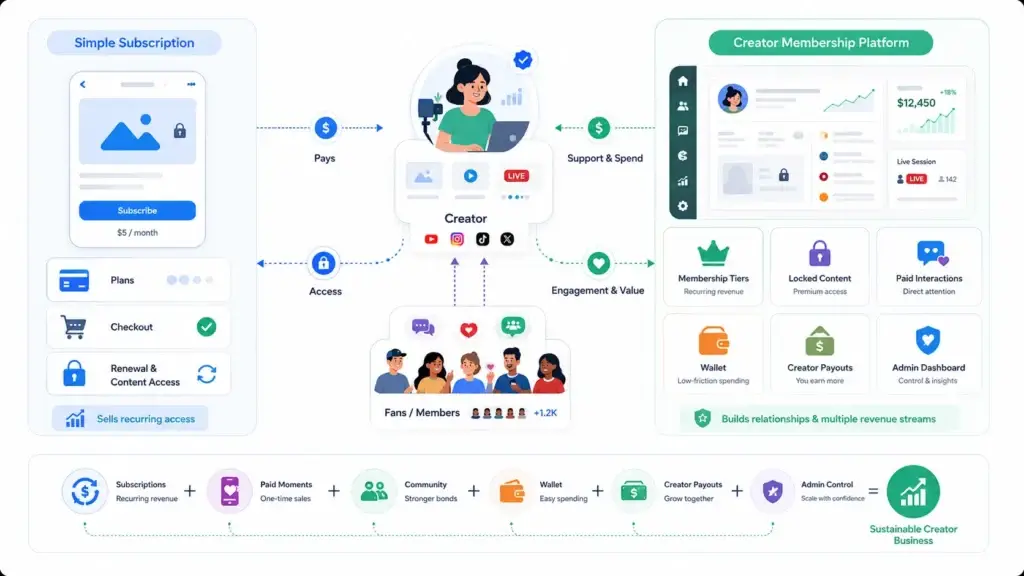
A subscription app usually sells recurring access to content. A creator membership platform sells a relationship.
This is why creator membership products often sit inside the larger digital entertainment platform category, where audience engagement, content monetization, subscriptions, and in-app purchases work together to create repeatable revenue.
That difference matters because creators are not only uploading files. They are building communities, rewarding loyal fans, testing exclusive experiences, and creating paid moments around attention. A fan may subscribe for access, but they may spend more when they feel personally connected to the creator.
A simple subscription product may only need plans, checkout, and renewal logic. A creator membership platform needs more layers:
| Platform Layer | What It Controls | Why It Matters |
|---|---|---|
| Membership tiers | Monthly or annual access levels | Creates predictable recurring revenue |
| Locked content | Paid posts, media, files, or bundles | Adds one-time purchase revenue |
| Paid interactions | DMs, calls, live sessions, requests | Monetizes direct creator attention |
| Wallet system | Stored user balance or credits | Reduces payment friction for repeat spending |
| Creator payouts | Earnings, commissions, withdrawals | Builds creator trust |
| Admin dashboard | Users, content, payments, reports | Gives the platform operator control |
For readers who want a practical example of how discovery, memberships, paid content, creator profiles, and fan access work together, this guide on subscription-based creator platforms gives useful context without taking the focus away from the revenue model.
How Membership Tiers Create Recurring Revenue
Membership tiers are the foundation of predictable revenue. A fan pays a recurring fee to access a creator’s private content, community, benefits, or interaction layer.
The platform can earn from tiers in several ways:
| Revenue Method | How It Works | Founder Benefit |
| Platform commission | The platform keeps a percentage of each creator subscription | Directly aligns platform revenue with creator earnings |
| Creator subscription fee | Creators pay the platform for advanced tools | Useful when creators bring their own audience |
| Premium fan plans | Fans pay the platform for broader access or better features | Helps diversify beyond creator-by-creator subscriptions |
| Annual membership plans | Fans pay upfront for longer access | Improves cash flow and reduces monthly churn |
| Upgrade paths | Fans move from basic to premium tiers | Raises average revenue per paying member |
The mistake founders often make is assuming that three prices automatically create a membership model. They do not.
A good tier system needs meaningful differences. For example:
| Tier Type | Fan Promise | Good Use Case |
| Entry tier | Basic exclusive posts and community access | Converts loyal free followers into paying fans |
| Mid tier | More frequent content, behind-the-scenes access, member-only updates | Builds stronger recurring engagement |
| Premium tier | Direct interaction, priority replies, live sessions, special requests | Monetizes high-intent fans |
| Limited tier | Fixed number of available spots | Creates scarcity for high-touch creator access |
For a founder, the main business value of tiers is not only recurring income. It is revenue predictability. Once the platform understands active subscribers, cancellations, upgrades, downgrades, and renewal rates, it becomes easier to forecast creator earnings and platform revenue.
How Locked Content Generates Pay-Per-View Revenue
Locked content is premium content that fans pay to unlock separately from a membership plan. This can include photos, videos, long-form posts, exclusive audio, digital downloads, archived live sessions, premium documents, or content bundles.
This model works because not every fan wants a recurring subscription. Some users may prefer one-time purchases. Others may already subscribe but still pay extra for higher-value content.
Common locked content formats include:
| Locked Content Type | Revenue Logic | Product Requirement |
| PPV posts | Fan pays once to unlock a post | Paywall, preview, purchase record |
| Locked media messages | Fan pays to view private media inside chat | Secure messaging and attachment control |
| Premium bundles | Fan buys a collection of posts, files, or videos | Bundle access rules and fulfillment |
| Event replays | Fan pays for access after a live session | Time-limited or permanent access settings |
| Digital downloads | Fan buys files, templates, guides, or resources | Secure file delivery and license rules |
Locked content is powerful because it lets creators monetize specific moments of demand. A fitness creator may sell a workout plan. A musician may sell a private demo. A coach may sell a replay. A fan community may pay for behind-the-scenes material.
For the platform, this creates transaction-based revenue. Instead of earning only when renewals happen, the business earns when users unlock premium content. That gives the platform more revenue opportunities across different fan behaviors.
How Paid Interactions Turn Attention Into Revenue
Paid interactions are one of the most important revenue layers in creator membership platforms because they monetize access, not just content.
Fans often pay more for direct connection than for passive viewing. This is why paid messages, tips, live sessions, shoutouts, private calls, custom requests, and priority replies can become meaningful revenue streams.
Examples of paid interaction models include:
| Paid Interaction | How Fans Pay | Why It Works |
| Paid direct messages | Per message, per reply, or locked media unlock | Fans value personal communication |
| Tips and gifts | One-time support or virtual gift purchase | Works well during emotional or live moments |
| Paid audio/video calls | Per minute or fixed session fee | Monetizes high-value direct access |
| Live session access | Paid entry or premium viewer access | Turns real-time engagement into revenue |
| Custom requests | Fan pays for a personalized response or content item | Adds premium creator service revenue |
| Priority replies | Higher-tier fans receive faster responses | Encourages upgrades |
The platform can monetize these interactions through commissions, credit markups, service fees, or creator tool plans. However, founders must also design limits carefully. If creators receive too many requests without workflow controls, response quality drops and churn increases.
A paid interaction system should include pricing controls, availability settings, request approval, refund rules, creator workload management, reporting, and abuse prevention.
Why Wallets and Credits Improve Repeat Spending
Many creator platforms use wallets or credits to reduce checkout friction. Instead of asking a fan to complete a payment every time they tip, unlock content, or send a paid message, the platform lets users preload balance and spend quickly.
This creates several advantages:
| Wallet Benefit | Business Impact |
| Faster transactions | Fans can unlock content or tip without repeated checkout steps |
| Higher repeat spending | Stored balance encourages more platform activity |
| Lower payment friction | Users are less likely to abandon small purchases |
| Cleaner transaction records | Wallet ledgers help track spending and refunds |
| Better interaction monetization | Tips, gifts, DMs, and PPV content become easier to purchase |
Wallets also give platform operators better visibility into user behavior. The admin dashboard can show wallet top-ups, spending patterns, creator earnings, refund requests, and failed payments.
For founders, wallet logic should not be treated as a cosmetic feature. It affects checkout speed, transaction reliability, financial reporting, dispute handling, and user trust.
How Platform Commissions Work Behind the Scenes
A creator membership platform does not always keep the full amount paid by the fan. A cleaner way to think about the money flow is:
Fan payment → payment processing → platform commission → creator balance → creator payout
This distinction matters because gross user spending is not the same as platform revenue. Scrile’s creator platform business model guide explains that user spend may include subscriptions, PPV purchases, tips, paid messages, live sessions, digital products, bookings, and credits, while platform revenue is what remains after creator payout logic and other costs are considered.
A platform may earn through:
| Commission Type | Example |
| Subscription commission | Percentage of monthly membership payments |
| PPV commission | Percentage of locked content unlocks |
| Interaction commission | Percentage of paid DMs, calls, tips, or requests |
| Wallet margin | Margin on credits or stored balance spending |
| Creator tool fee | Monthly fee for advanced analytics, automation, or promotion |
| Featured placement fee | Creators pay to boost visibility |
| Agency account fee | Agencies pay for managing multiple creator profiles |
The right model depends on the target creator category. Education creators, coaches, performers, influencers, entertainers, and niche community leaders may all need different monetization rules.
Revenue From Tiers vs Locked Content vs Paid Interactions
Each revenue stream behaves differently. Founders should not treat them as interchangeable.
| Revenue Stream | Strength | Risk | Best Fit |
| Membership tiers | Predictable recurring revenue | Churn if benefits feel weak | Communities, educators, creators with loyal audiences |
| Locked content | Strong one-time purchase potential | Irregular purchase frequency | Premium media, guides, replays, bundles |
| Paid interactions | High revenue per engaged fan | Creator workload and response delays | Influencers, coaches, performers, experts |
| Tips and gifts | Easy emotional spending | Revenue may depend on a small group of fans | Live sessions, fan communities, social creators |
| Creator SaaS plans | Stable creator-side revenue | Pre-revenue creators may cancel | Professional creators, agencies, creator teams |
| Promotions | Monetizes discovery demand | Can reduce trust if overused | Large platforms with many creators |
A healthy creator membership platform usually combines recurring revenue with transaction-based revenue. Subscriptions create the base. Locked content increases transaction volume. Paid interactions raise fan value. Wallets reduce friction. Admin controls keep the platform manageable.
Read More: For founders comparing how different paid creator platforms structure subscriptions, PPV content, creator payouts, and commissions, read this creator platform business model comparison.
Founder Decision Signals
Speed
If you want to launch quickly, start with membership tiers first. They create a clear recurring revenue base before adding complex monetization layers.
Cost
Locked content and paid interactions can increase revenue, but they also require payment rules, access control, refunds, and creator payout logic.
Scalability
A creator platform becomes easier to scale when subscriptions, PPV unlocks, paid messages, wallets, and payouts are managed from one admin system.
Market Fit
If fans want continuous access, use tiers. If fans pay for specific content, use locked posts. If fans value personal attention, add paid interactions.
Product Features Needed to Support Revenue Properly
Revenue models only work when the product infrastructure supports them. A platform cannot scale paid memberships if access control, billing states, payout rules, and admin reporting are weak. Founders planning the product scope can also review these creator monetization app features to understand how subscription access, locked content, paid messaging, wallet payments, analytics, and admin controls work together.
A creator membership platform should include:
| Feature | Why It Matters |
| Tier management | Lets creators create, edit, limit, or retire plans |
| Access control | Ensures users only see content they paid for |
| PPV paywalls | Enables one-time content unlocks |
| Paid messaging | Turns direct fan communication into revenue |
| Wallet and credits | Supports faster repeat transactions |
| Payout dashboard | Shows creator earnings, fees, refunds, and withdrawals |
| Admin commission settings | Lets the platform control revenue share |
| Analytics | Tracks conversion, churn, upgrades, unlocks, and fan value |
| Moderation workflows | Protects users, creators, and platform reputation |
| Refund and dispute logic | Reduces operational confusion |
| Activity logs | Helps investigate payment, content, and access issues |
This is where a ready-made platform can reduce launch complexity. Miracuves helps founders build a white-label creator membership platform with subscriptions, PPV unlocks, paid messaging, wallet payments, creator tools, live engagement, moderation, admin control, and source-code ownership.
Mistakes Founders Should Avoid
Treating Tiers as Only Pricing Labels
A basic, standard, and premium plan is not enough. Each tier should change the fan experience in a visible way. Better content, earlier access, community privileges, direct interaction, or limited availability can make upgrades feel meaningful.
Adding Locked Content Without Clear Access Rules
Locked content needs clear rules. Does the buyer keep access forever? Does access expire? Can the creator remove the content? What happens after refunds? These details affect support tickets and user trust.
Launching Paid Messages Without Creator Workflow Controls
Paid DMs can generate strong revenue, but they also create operational pressure. Creators need inbox filters, message pricing, templates, notifications, safety controls, and availability limits.
Ignoring Refunds, Chargebacks, and Failed Payments
Revenue does not end at checkout. Failed renewals, chargebacks, refunds, cancellations, and payout delays all affect platform trust. X’s subscription documentation, for example, notes that creator earnings may be adjusted for chargebacks and refunds.
Forgetting Content Security
A paywall is not the same as protection. Premium content platforms need authentication, access control, secure media delivery, abuse reporting, moderation, payment safety, and admin visibility. This premium content platform security guide explains why content protection should be part of the product architecture, not a later patch.
Read More: To go deeper into planning errors, feature overload, weak moderation, and launch risks, explore these creator membership platform launch mistakes.
How Miracuves Helps Build Monetization-Ready Creator Platforms
Miracuves helps founders build creator membership platforms where monetization is not treated as a plugin. The platform foundation can include creator onboarding, fan access, membership tiers, PPV content, paid messaging, wallet transactions, creator payouts, content moderation, analytics, and admin controls.
For founders who want to move faster, Miracuves provides ready-made and white-label app foundations that can be customized for branding, monetization strategy, creator categories, payment workflows, and business rules. The goal is not to copy another platform blindly. The goal is to launch a controlled, monetization-ready creator ecosystem that fits your market.
You can also explore Miracuves’ creator monetization platform guide for broader development context and the TikTok clone app if your creator model includes short-form video, discovery feeds, and social engagement loops.
Final Thoughts
Creator membership platforms generate revenue by combining predictable access with high-intent fan spending.
Membership tiers build recurring revenue. Locked content creates one-time purchase opportunities. Paid interactions turn creator attention into premium value. Wallets make repeat spending easier. Platform commissions connect creator success with business growth. Admin controls keep the system manageable.
For founders, the winning move is not to add every monetization feature at once. It is to choose the revenue layers that match the creator type, fan behavior, and business model. A fitness creator community, premium fan platform, coaching network, short video creator app, and digital learning community may all use membership revenue, but each needs different rules.
The strongest creator membership platforms are built around clear value, smooth payments, trusted payouts, safer content access, and flexible monetization workflows. That is where the business becomes more than a subscription page. It becomes a creator economy platform.
FAQs
How do creator membership platforms make money?
Creator membership platforms make money through recurring subscriptions, platform commissions, locked content unlocks, paid messages, tips, gifts, live sessions, creator tool fees, wallet spending, and promotional placements.
What are membership tiers in creator platforms?
Membership tiers are paid access levels that offer different benefits to fans. A lower tier may include basic exclusive content, while a higher tier may include private community access, early releases, paid interaction privileges, or premium creator experiences.
How does locked content generate revenue?
Locked content generates revenue when fans pay to unlock specific posts, videos, images, files, replays, messages, or content bundles. The platform can earn a commission from each unlock.
Are paid interactions more profitable than subscriptions?
Paid interactions can generate higher revenue from engaged fans, but they are less predictable than subscriptions. The strongest creator platforms often combine recurring memberships with paid messages, calls, tips, and PPV content.
Why do creator platforms need wallet systems?
Wallet systems reduce payment friction by letting fans preload balance or credits. This makes it easier to send tips, unlock content, buy gifts, pay for messages, or join live sessions without repeating checkout each time.
What should founders track in a creator membership platform?
Founders should track paid members, churn, upgrades, downgrades, PPV unlocks, average revenue per paying user, creator earnings, platform commission, refund rate, chargebacks, wallet spending, and payout requests.
Can a creator membership platform work without subscriptions?
Yes, but it depends on the business model. Some platforms may focus more on PPV content, paid interactions, digital products, or live events. However, subscriptions usually provide stronger recurring revenue and better forecasting.
How can Miracuves help launch a creator membership platform?
Miracuves helps founders launch white-label creator membership platforms with subscription tiers, locked content, paid messaging, wallet payments, creator payouts, admin dashboards, branded design, source-code ownership, and faster deployment.
Miracuves is an independent software development company. We are not affiliated with, connected to, sponsored by, or endorsed by any company or product named in this article.
Terms such as “X Clone” are used descriptively. It is how the software industry refers to building a platform with functionality comparable to a known service, and how clients search for it.
The entire design and codebase of our products is built by our own team. Our products contain no code, design, graphics, or content originating from any third-party website or applications.
All third-party names and marks referenced in this article are the property of their respective owners, referenced solely to identify the services discussed.